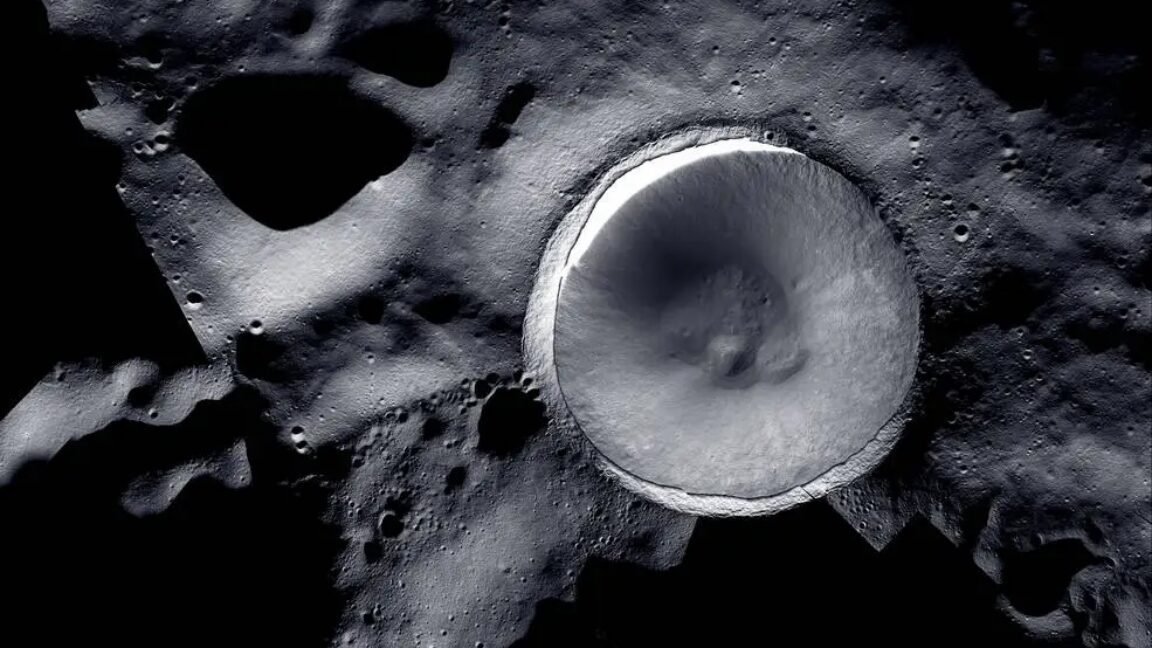
Later this year, two spacecraft are scheduled for launch on missions to land somewhere near the rim of Shackleton Crater, an impact basin near the Moon’s south pole harboring an immense reservoir of water ice.
The two landers will arguably be the most ambitious robotic missions ever sent to the Moon. The Endurance spacecraft, built by Jeff Bezos’ space company Blue Origin, will become the largest lunar lander in history, exceeding the size of NASA’s Apollo lunar module that ferried crews to and from the lunar surface more than 50 years ago. China’s Chang’e 7 mission will feature a smaller lander, but the project also includes an orbiter, rover, and a hopper drone to scout for hidden ice deposits.
Blue Origin’s Endurance lander departed NASA’s Johnson Space Center in Houston on Saturday for a trip by barge back to Cape Canaveral, Florida, for final preparations to launch on the company’s heavy-lift New Glenn rocket. The lander underwent a comprehensive test in Houston to ensure it can survive the extreme temperatures on the airless lunar surface. Two days earlier, Chang’e 7 arrived at a spaceport on Hainan Island in the South China Sea to be integrated with China’s own heavy-lifter: the Long March 5 rocket.
Both launches are scheduled to go off later this year, perhaps in late summer, but it is too soon to know if China’s Chang’e 7 or Blue Origin’s Endurance has a better shot at reaching Shackleton first. What’s more interesting than which mission lands first is the distinct possibility of both vehicles operating in relative close proximity on a piece of prime lunar real estate.
A certain appeal
Shackleton Crater is about 13 miles (21 kilometers) wide, with a surface area roughly the same as the cities of Philadelphia, Las Vegas, or Detroit. The crater measures 14,000 feet (4.2 kilometers) deep. If Endurance and Chang’e 7 land on or near the crater rim, as expected, it would be the first time landers from different nations have operated simultaneously so close to one another on another planetary body.
The plans to send two missions to Shackleton at close to the same time are also emblematic of the brewing competition between the United States and China to land humans on the Moon before the end of this decade. Both nations plan to construct a lunar base near the Moon’s south pole in the 2030s.
The highest crests of Shackleton’s rim offer the advantage of near-continuous sunlight, providing a lander or future Moon base a stable source of solar power right next to a crater floor in eternal shadow, where temperatures are cold enough to preserve ancient ice deposits. The Moon’s polar cold traps, including Shackleton, are attractive targets for future exploration. The ice at these locations could be harvested to supply drinking water, oxygen, and rocket fuel for a lunar outpost.
Shackleton has some pertinence for fans of Apple TV’s sci-fi alternate-history series For All Mankind, in which prospectors from the United States and the Soviet Union compete for water resources inside the crater.
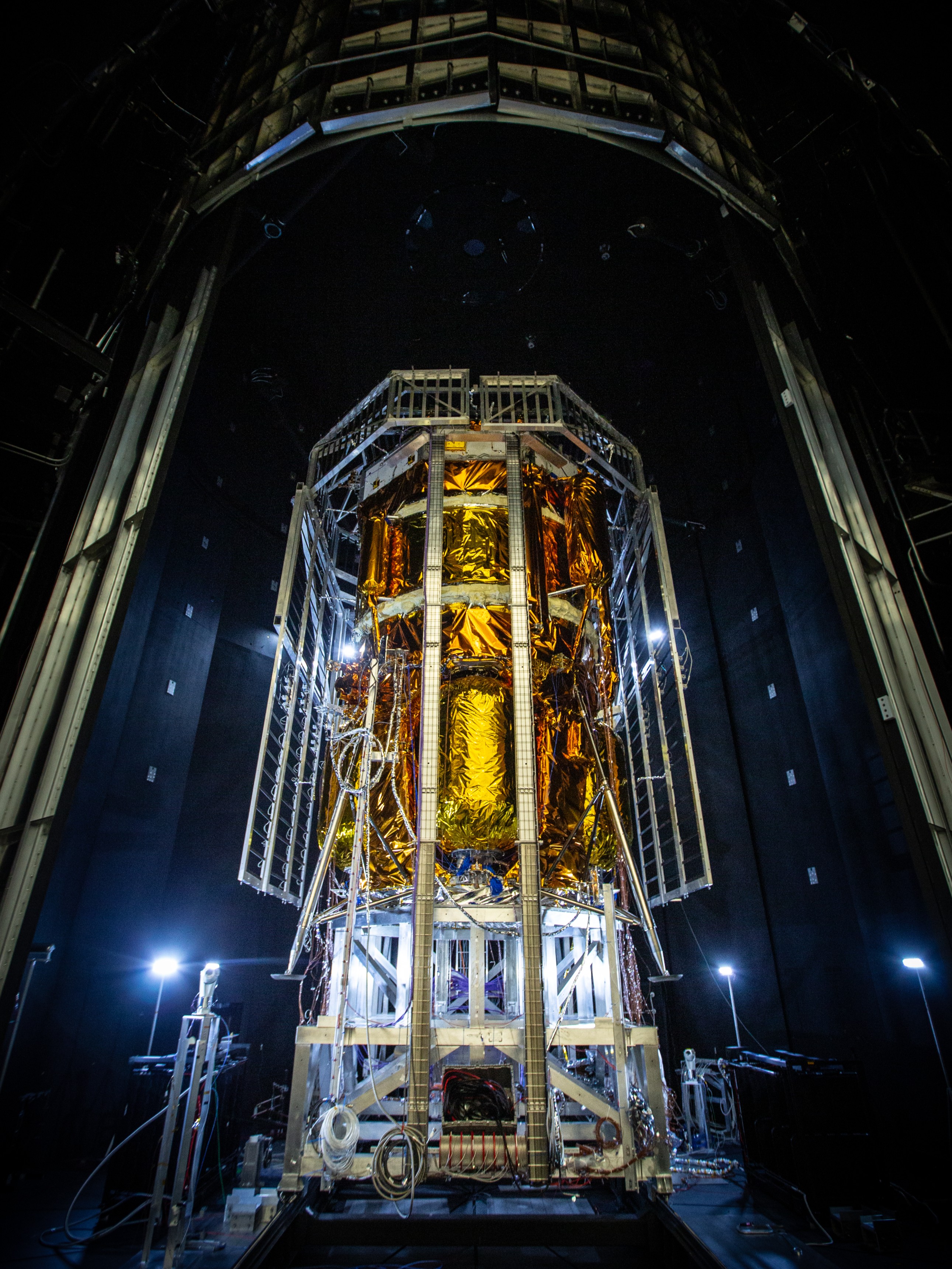
Blue Origin’s Endurance lander is the first test flight of the company’s Blue Moon Mark 1 design, a 26-foot-tall (8-meter) vehicle intended to deliver cargo and experiments to the lunar surface. Blue Moon Mark 1 is a stepping stone to Blue Origin’s human-rated lunar lander for NASA’s Artemis program.
Blue Origin has not publicly identified the exact landing site for the Endurance test flight, other than saying it will target the Moon’s south pole region. In a social media post last year, Bezos said it would land “near Shackleton Crater.” The south pole lies directly on the crater rim. Endurance will carry a suite of NASA-funded stereo cameras to observe interactions between the lander’s engine plume and lunar soil, along with a laser ranging reflector to help scientists pinpoint the craft’s precise location on the Moon. Blue Origin has not yet revealed what else the mission might do after landing, but getting to the surface intact and upright is the primary goal for Endurance.
Similarly, Chinese officials have not announced where on Shackleton’s rim Chang’e 7 will land. But we know more about Chang’e 7’s exploration pursuits after it reaches the south pole. The Chinese mission, which also includes an orbiter, will deploy a rover and a “mini-flying probe” after landing. The rover and drone will carry instruments to analyze and measure the abundance of water ice in lunar soil in and around Shackleton Crater.
One of Chang’e 7’s goals is to “directly confirm the existence and source of water ice” in the south pole region, according to a research paper published about the mission. NASA’s VIPER rover has similar objectives. It is slated to land near the Moon’s south pole aboard Blue Origin’s second Blue Moon Mark 1 lander in 2027.
Defining due regard
So, what happens if one mission encounters another on the Moon? The United States and China are parties to the 1967 Outer Space Treaty, which prohibits claims of territorial sovereignty on the Moon and other celestial bodies. But the treaty allows for bases, and it requires parties to the agreement act with “due regard” to the interests of other nations.
In an article published last year, Michelle Hanlon, a professor of air and space law at the University of Mississippi, outlined the advantages of being first at the Moon. The first country to succeed in placing a nuclear reactor on the Moon, for example, could “shape the norms for expectations, behaviors, and legal interpretations,” she wrote.
These first-mover advantages could extend to future lunar bases, mining, and other resource extraction activities on the Moon. NASA has proposed the concept of “safety zones” to avoid interference between the operations of different nations on the Moon. Signatories to the Artemis Accords drafted by the US government must agree to this idea. Sixty-one nations have signed the accords to date, but China and Russia are not part of the agreement.
Missions like Endurance, VIPER, and Chang’e 7 will be followed by more robotic landers. NASA aims to land astronauts on the Moon again as soon as 2028, and China wants to put its citizens on the lunar surface by 2030. Much of this traffic will be confined to an area within 100 miles of the south pole. It is conceivable that a eureka-like discovery of vast deposits of water ice or another valuable resource could focus future missions and lunar bases into an even smaller area, setting the conditions for an eventual test of the legal definition of “due regard” in the Outer Space Treaty.
“These sought-after regions are scientifically vital and geopolitically sensitive, as multiple countries want to build bases or conduct research there,” Hanlon wrote last year. “Building infrastructure in these areas would cement a country’s ability to access the resources there and potentially exclude others from doing the same.”