Geopolitical crises rarely produce only short-term economic shocks. More often they reshape how governments think about long-term economic security and industrial resilience. A serious disruption in the Persian Gulf could therefore have consequences far beyond temporary oil price spikes.
When such instability coincides with the rapid expansion of artificial intelligence-driven economies, policymakers are forced to reconsider how their industries will be powered in the future. In a world increasingly defined by electricity-intensive technologies, China’s ability to supply large, reliable and affordable power systems will gain a strategic advantage.
Recent developments surrounding the 2026 Iran–Israel–US crisis highlight the scale of potential disruption. Analysts warn that serious interruptions to shipping through the Strait of Hormuz could raise global inflation by roughly 0.6 to 1.2 percentage points as oil prices surge above $100 to $120 per barrel.
Regions heavily dependent on imported energy, particularly Europe and parts of Asia, could see inflation approach 4%. The economic consequences extend beyond fuel markets.
Nearly 30% of global fertilizer trade passes through the strait, and the crisis has already pushed urea prices up by around 30% while maritime insurance premiums and freight costs have surged by as much as 250%.
Such disruptions quickly translate into higher food prices, industrial costs and broader inflation pressures, reminding governments how vulnerable modern economies remain to geopolitical energy shocks.
These shocks matter not only because of the immediate economic damage they cause, but because they reveal structural weaknesses in the global energy system. Dependence on imported fossil fuels exposes economies to sudden price volatility and supply disruptions that can ripple across financial markets and industrial supply chains.
As a result, governments increasingly view energy security as a question of long-term infrastructure rather than short-term fuel supply. This shift in thinking comes at a time when global economic growth itself is increasingly dependent on electricity.
According to the International Energy Agency, global electricity demand is projected to grow by about 3.3% in 2025 and 3.7% in 2026, following a sharp 4.4% increase in 2024. Much of this increase is linked to electrification across transportation, manufacturing and digital industries.
The same projections indicate that nearly all additional demand growth between 2025 and 2027 will come from low-emissions electricity sources. As economies electrify more sectors, reliable electricity generation becomes a core element of economic resilience. Artificial intelligence is now accelerating this transformation.
AI systems require enormous computational capacity, and the infrastructure that supports them consumes large amounts of electricity. Data centers have become critical nodes in the global digital economy, yet they are also among the most energy-intensive facilities ever built.
The International Energy Agency estimates that electricity consumption by data centres could more than double to roughly 945 terawatt hours by 2030, with demand growing at around 15% annually between 2024 and 2030.
Countries hoping to compete seriously in the AI economy therefore require power systems that are not only large but also stable and scalable. When this rapid growth in electricity demand intersects with volatility in oil markets, governments are pushed toward a strategic response that emphasizes electrification.
Electrification offers a way to expand energy supply while reducing exposure to oil market instability. Renewable generation, battery storage, electric mobility and modern power grids form part of an integrated energy ecosystem capable of supporting both industrial growth and digital infrastructure.
Electric vehicles reduce dependence on oil-based transport fuels, batteries stabilize electricity systems and solar generation expands domestic power capacity that can support factories as well as data centers. Global projections reflect the scale of this transition.
The International Energy Agency expects renewables, particularly solar photovoltaic, to account for nearly 80% of global electricity capacity expansion through 2030, while nuclear energy is entering a new growth phase as countries explore advanced reactor technologies.
As electrification accelerates, control over the supply chains behind these technologies becomes increasingly important.
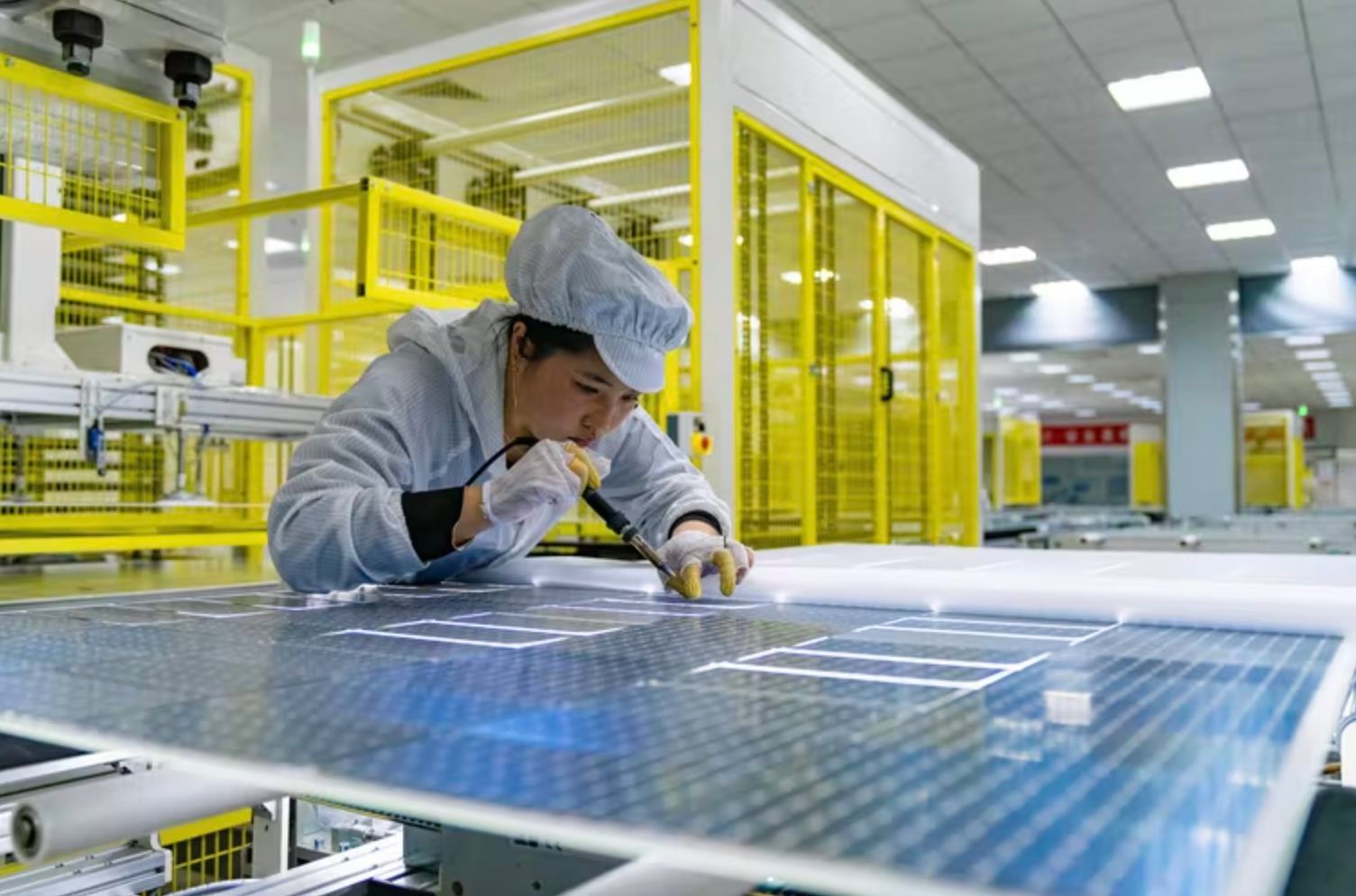
In this emerging industrial landscape, China occupies a uniquely strong position. Chinese companies dominate several stages of the global solar manufacturing supply chain, holding market shares exceeding 80% in segments such as polysilicon processing, wafer production and solar module assembly.
Since 2011, China has invested more than $50 billion in solar manufacturing capacity, enabling it to supply equipment for renewable energy projects worldwide. The country has also become a major exporter of electric vehicles, accounting for roughly 40% of global EV exports in 2024, equivalent to about 1.25 million vehicles.
China’s influence is equally significant in battery production, which is essential for both electric mobility and energy storage systems. The country produces approximately 80% of global battery cells, and battery pack prices in China in 2025 were about 30% lower than in the United States and 35% lower than in Europe.
These cost advantages make Chinese technologies particularly attractive for countries attempting to expand electricity systems rapidly while keeping infrastructure costs manageable. Industrial capacity alone, however, does not fully explain China’s global reach.
China also combines manufacturing strength with large-scale infrastructure financing. Research by AidData estimates that China directed roughly $2.2 trillion in overseas loans and grants between 2000 and 2023 across more than 200 countries and territories, with more than two-thirds of the funding focused on infrastructure projects.
This financial capacity allows Chinese companies to offer integrated packages that combine equipment supply, engineering services and project financing. For governments seeking to expand power generation capacity or modernize electricity networks, this approach offers a practical pathway for rapid development.
None of this suggests that China will escape the economic consequences of the expanding Gulf crisis. As the world’s largest crude oil importer, it will also face higher energy costs if global oil prices continue to surge sharply.
In reality, geopolitical shocks rarely affect all actors equally. They tend to strengthen those best positioned for the structural adjustments that follow.
If governments conclude that future economic resilience depends on electricity systems capable of powering both industry and artificial intelligence, then countries able to deliver renewable energy technologies, batteries, electric vehicles and power infrastructure at scale will gain influence.
By that measure, China appears particularly well positioned for the next phase of the global economic transition.
Zohaib Altaf is associate director at the Center for International Strategic Studies, where he leads research on emerging technologies, strategic warfare and international security. He is an alumnus of the NESA Center at the National Defense University, Washington, DC.