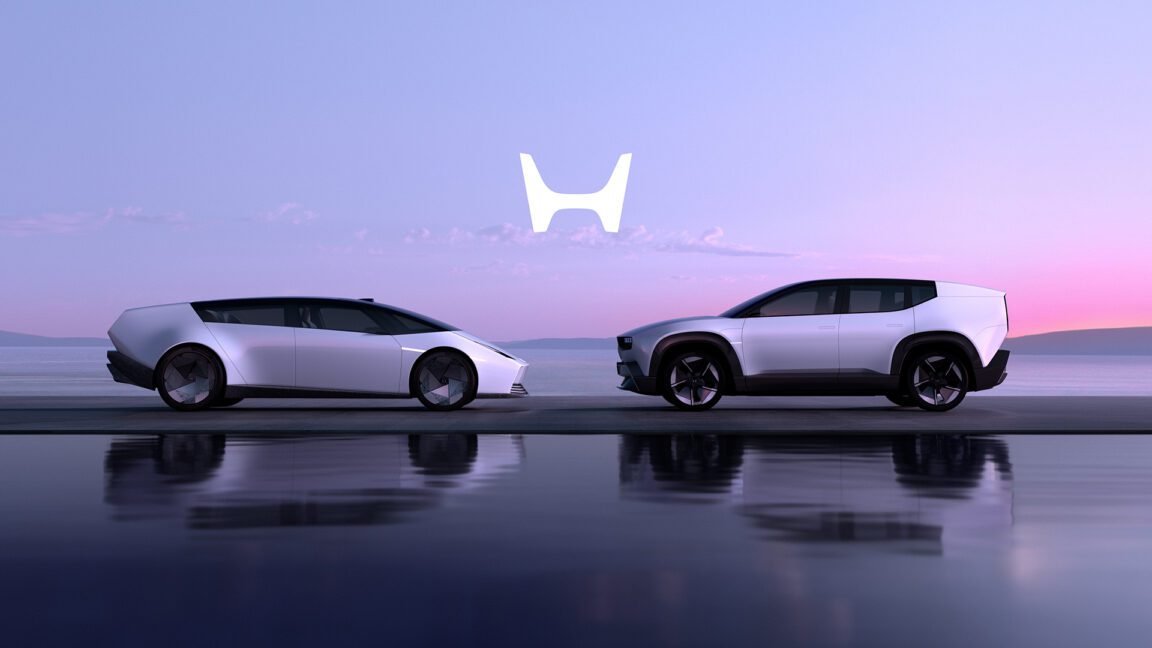
Last year, Honda gave Ars a tour of some of its manufacturing facilities in Ohio. The Anna Engine Plant and Marysville Auto Plant had undergone a transformation that added to their capabilities: a massive die cast operation to make electric vehicle battery packs alongside the lines that make engines at Anna, and a gleaming new section of Marysville filled with robots, ready to incorporate three new Honda and Acura EVs into the production mix alongside Accords and Integras.
Only now, they won’t. Earlier today, Honda announced that it’s facing heavy losses for the financial year: between $5.1 billion and $7 billion (820 billion–1.12 trillion yen). To help stanch the flow, it’s sacrificing the Honda 0 SUV, Honda 0 sedan, and the electric Acura RSX, EVs it revealed at CES last year in “nearly production” state.
Honda says there are several reasons for killing off its new EVs before they even reach the market. The first is extremely predictable: the ongoing chaos of the trade war and its tariffs, which have eaten into the profitability of the cars it imports into the US. A second is the US government’s revanchist decision to cease enforcing emissions and fuel economy standards on the auto industry. Although Honda says that “striving for carbon neutrality” is a “responsibility Honda… must fulfill for the future,” it seems that responsibility only applies when being forced by a government.
But Honda’s problems are bigger than the US government’s anti-environmental heel turn. No, its other problem is in China, where it admits it just can’t compete. Chinese customers don’t care about efficiency or interior space; they want software features, and plenty of them. And they want them regularly updated, too.
“This has intensified the competition due to the rapid emergence of newer EV manufacturers that leverage their short product development cycles and strengths in the area of software-defined vehicle (SDV) technologies, including advanced driver-assistance systems (ADAS),” Honda says. And it just isn’t able to match that rate of development or offer vehicles in China that were better value for the money, “resulting in a decline in competitiveness.”
And if all of that weren’t enough, unlike China and the EU, US demand for EVs is weak and has been undermined by the ending of the federal clean vehicle tax credit incentive, and launching the Honda 0s and the new RDX would simply compound Honda’s losses.
The company says it will beef up its hybrid offerings in the US instead, greenlighting future EVs only if demand and profitability can be met. Oh, and senior executives at the company will undergo voluntary pay cuts of between 20–30 percent for three months. I can’t help wondering if that’s something Detroit might consider as well.