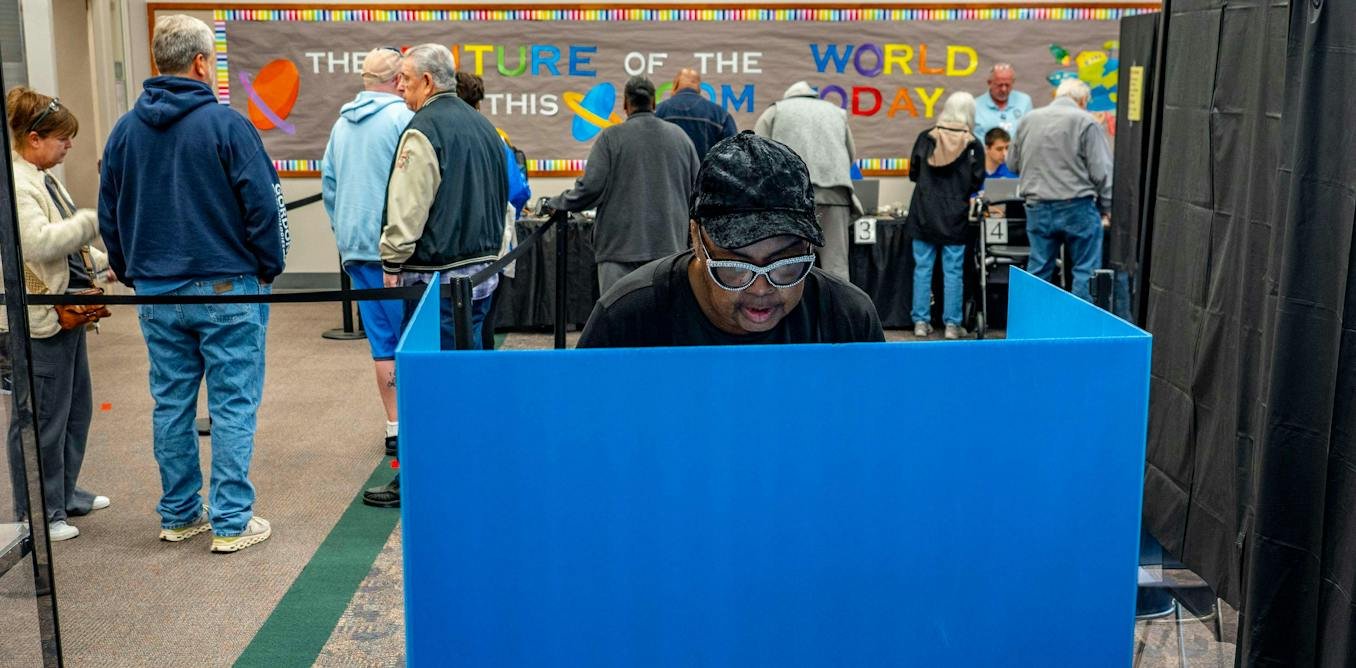
In advance of the midterm elections, US states have been engaged in what US Supreme Court Justice Elena Kagan has called, a “race to bottom” with an exercise known as “gerrymandering”.
What a gerrymander effectively does is move the boundaries of voting districts to concentrate groups of people who are likely to vote to a party’s advantage.
In recent months, in the run up to the US midterm elections, both Democrat and Republican states have been fixing their electoral boundaries according to both traditional political affiliations and racial lines. And it was the US Supreme Court that fired the starting gun.
Every two years in the United States there are Congressional elections. All 435 members of House of Representatives are elected. Representatives are allotted to each state proportionately based on its population. In states with more than one representative, the state is divided up into districts with one representative being elected from each district.
Redistricting used to take place once a decade after the nationwide census. But in 2006, the Supreme Court ruled, in a case involving Texas, that federal law does not prohibit states from redrawing congressional district lines in the middle of a decade.
Before 2025, Georgia was the only other state to engage in partisan, mid-decade redistricting. All other mid-decade redistricts were court ordered.
But in 2019 the Supreme Court ruled five to four in a case called Rucho v. Common Cause that “partisan gerrymandering claims present political questions beyond the reach of the federal courts”. This means that, in legal terms, such complaints are not “justiciable”. They are not suitable for a federal court of law to resolve. While some state courts may hear claims under state law – the district courts and Supreme Court would no longer hear complaints about political gerrymandering.
The Rucho decision set the stage for President Donald Trump’s demand that states with Republican-controlled legislatures redistrict to increase the chance of the party winning more seats. This push began in June 2025 when the president asked Texas Republican governor, Greg Abbott, to redistrict to add five more GOP seats.
The governor agreed to redistrict after the Department of Justice claimed that four districts on the current map were unconstitutional racial gerrymanders.
In a rerun of Democratic tactics from 2003 and 2021, a majority of the state’s Democratic legislators left the state so the legislature could not act because it did not have the required quorum. They returned once California governor Gavin Newsom had proposed a similar redistricting in his state, adding five more Democratic districts.
Republican states North Carolina and Missouri also heeded Trump’s demands to redistrict (although Missouri’s new map is on hold for this election), while Virginia and Maryland tried but failed to do so on behalf of the Democrats.
Race politics?
Meanwhile, in April 2026, a Texas district court upheld a challenge to the new electoral map with the additional Republican seats. It said that the state’s new map was gerrymandered on the basis of race, not just politics. But the Supreme Court summarily reversed this ruling.
Two days later, it issued its ruling in the case Louisiana v Callais which effectively makes it all but impossible to challenge redistricting on racial grounds under the Voting Rights Act (VRA).
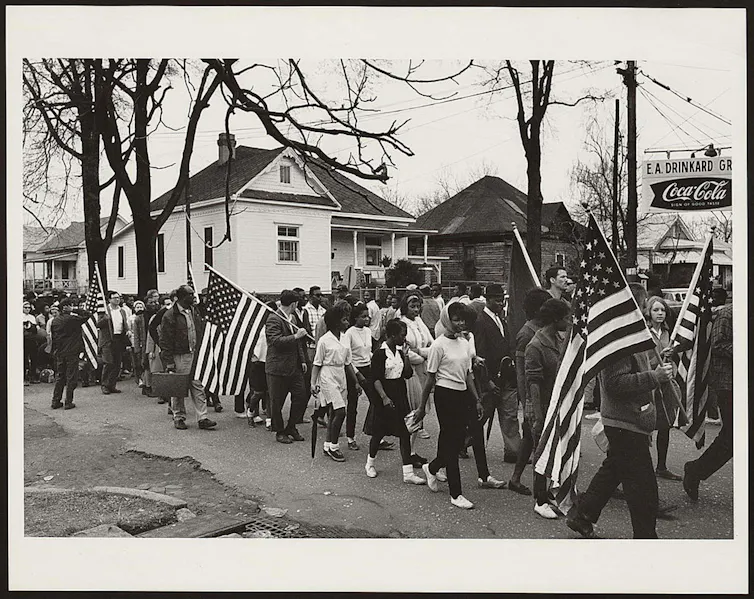
The VRA, a landmark 1965 piece of US civil rights legislation, requires states to create so-called “majority-minority” districts, with boundaries set to ensure that African American voters were in a majority in some areas to ensure they “can elect representatives of their choice”. Where minority voters are spread across white majority districts, their votes are diluted so they can never elect their chosen representative.
This matters because majority and minority voters – especially in America’s south – tend to be politically polarised. The VRA has resulted in the election of a more diverse selection of representatives to Congress.
The conservative majority used Callais to gut Section 2 of the Voting Rights Act, which prohibits voting practices that discriminate on the basis of race, colour, or membership in a minority language group. It ultimately reinterpreted and then upheld the constitutionality of Section 2, but only where the circumstances of redistricting “give rise to a strong inference that intentional discrimination has occurred”.
It is no longer enough for those complaining to show that redistricting “resulted in a dilution of minority voting power; litigants will have to show … that the legislators were motivated by a discriminatory purpose”.
According to Justice Elena Kagan’s dissent, the court’s test makes it “well-nigh impossible” for litigants complaining about redistricting on racial grounds to make a successful claim. State legislators never openly state an intent to racially gerrymander. After Callais, all they need do is claim that the gerrymander was based on politics, not race.
Taking advantage of Callais
In Florida, governor Ron DeSantis held back his redistricting until the decision in Callais. An hour after the decision was announced, the Florida House of Representatives voted on a new map that added four Republican districts. He claimed that redistricting was required in order to make districts “race neutral”.
Within days, Tennessee had repealed the state’s law against mid-decade redistricting and redrawn its map to split up or “crack” the only African American majority district.
Even Alabama’s map, which the lower court said was intentionally racially discriminatory, was approved by the Supreme Court.
Callais can also now potentially be used to challenge districts already set up under the VRA. On October 27 a Louisiana district court agreed to consider whether the Supreme Court’s Callais decision requires the elimination of Louisiana’s last remaining African American majority district in a state where one-third of the population is African American.
States are already lining up to gerrymander districts in advance of the 2028 presidential election – and the 2030 census will provide another opportunity for politicians to redraw electoral maps.
Politicians and elected state court justices can be removed by the voters. But the transformation of the US electoral landscape by the Supreme Court will be far longer lasting and far more difficult to change.