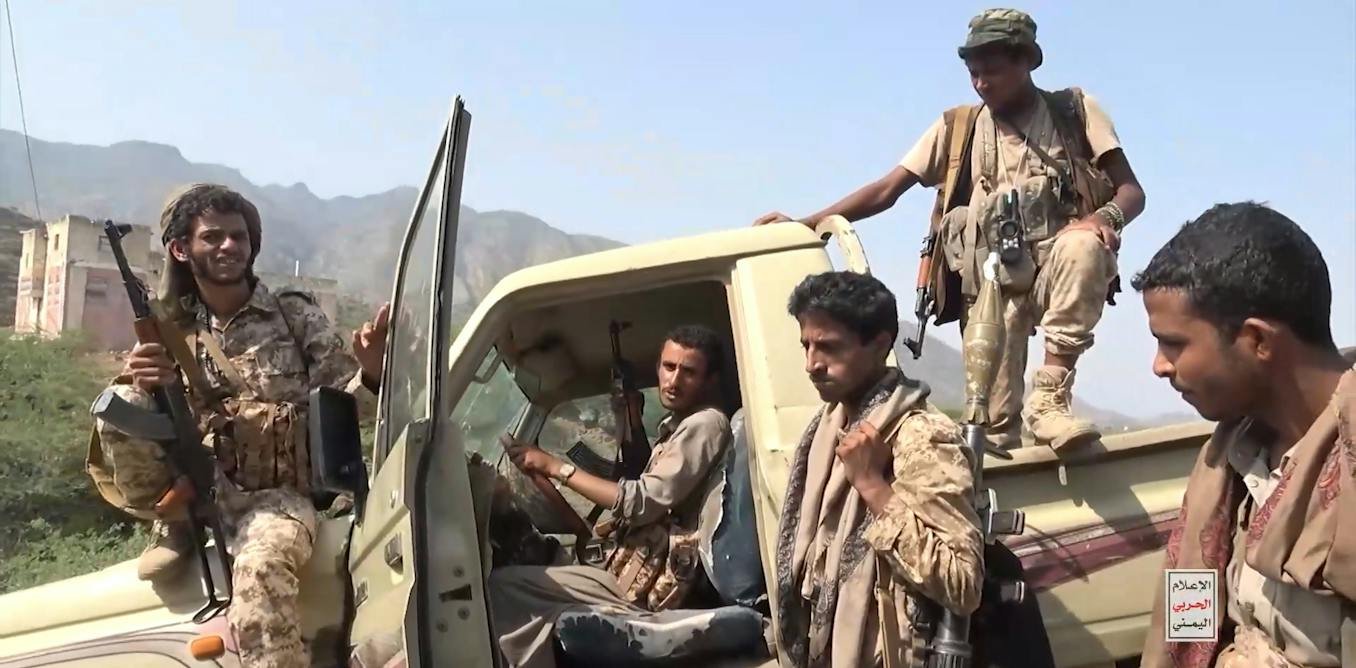
Yemen’s Houthis have launched a major offensive in recent days. They’ve rapidly swept down the Red Sea coast, seizing strategically important positions and giving the Iran-backed rebel group the potential to control traffic through this vital waterway.
This could cut off Saudi Arabia’s ability to export oil – which was already seriously hampered by Iran’s attempts to control the Strait of Hormuz on the other side of the country.
Drone attacks by Iran-backed militias in Iraq on September 11 forced Riyadh to order the closure of its vital east-west oil pipeline, which has been funnelling oil to the port of Yanbu on the Red Sea. Saudi Arabia has since claimed to have shot down a Houthi drone close to the holy city of Mecca, home of Islam’s most sacred shrine – something the Houthis have denied.
These are significant and dangerous developments in the current Middle East crisis – and by extension, in global security. Saudi Arabia recently signed a defence pact with Turkey and Pakistan, having already been raised to the status of a major non-Nato ally by the US.
Whether such ties will draw any of these allies into a major military confrontation is not yet clear. But the situation shows how perilous this conflict has become, six months after the US and Israel launched what they thought would be a relatively short confrontation with Iran.
How this conflict might escalate – and the possible routes for de-escalation – have become urgent questions. There are increasingly clear links between the US-Iran war and the 4½-year conflict between Russia and Ukraine, both of which look like increasingly intractable conflicts.
Iran and Russia have deepened their military ties since Russia’s invasion of Ukraine in 2022. Iran has supplied Russia with munitions, artillery shells and drones, and Russia reciprocated by sending Iran fighter jets and attack helicopters.
In 2025, the two countries signed a Comprehensive Strategic Partnership Treaty, aimed at deepening their strategic ties over the next two decades.
They have both used the Caspian Sea as a route to transfer military supplies. Their “shadow fleets” of tankers transporting oil to avoid sanctions are now considered to be operating virtually interchangeably, so are viewed as legitimate targets by both Washington and Kyiv.
The US recently sank five Iranian oil tankers in the Strait of Hormuz, three of which are believed to have been transporting oil for Russia. This followed an incident in July when Ukrainian drones attacked and sank an Iranian cargo ship in the Caspian Sea.
Ukraine’s foreign minister, Andrii Sybiha, has declared: “The regime in Tehran is a direct accomplice to Russian aggression against Ukraine, fuelling Moscow’s criminal war with weapons that have killed Ukrainians since 2022.” This was followed by a comment from Ukraine’s ambassador to Israel, Yevgen Korniychuk, that both countries were fighting against the same “axis of evil”, albeit on different fronts.
Worryingly, there are also reports that China – which bought 80% of Iran’s shipped oil in 2025 – is providing important intelligence and potentially also military hardware to Iran.
The fear is that, between them, the Ukraine and Iran conflicts already involve three major competing world powers.
Security dilemma
The way conflicts can rapidly escalate has long been a concern for scholars of international security. In reference to the events which spiralled out of control leading to the first world war, American scholar of international relations John Herz referred to what he called “the security dilemma”. This was predicated on a simple idea, where “each state’s quest for security necessarily leads to insecurity for others”.
In the face of growing international insecurity, states seek to increase their own security. This contributes to a spiral whereby rivals respond and the world locks into escalation – something seen in the years leading up to 1914, when a single act such as the assassination of Archduke Franz Ferdinand in Sarajevo was enough to drag Europe’s powers into a global conflagration.
Europe in the early 20th century was dramatically different to the contemporary Middle East. But similar patterns of fear and insecurity are now evident in both Europe and the Middle East, and they appear to be driving the actions of many countries.

Quite apart from being drawn in to the war with Ukraine, Nato’s European members are rapidly rearming in response to US pressure – and openly discussing the idea of conflict with Russia.
Meanwhile, there is a real danger that Gulf States such as Saudi Arabia may be drawn into conflict with Iran. The Saudis have already traded strikes with the Iran-backed Popular Mobilisation Forces in Iraq and have vowed to retaliate against the Houthis in Yemen. This has led to a growing regional spread of the conflict.
We saw evidence of how this can develop when the memorandum of understanding signed by the US and Iran in June called for a ceasefire between Israel and Hezbollah in Lebanon, as a necessary condition for the ceasefire between the US, Israel and Iran. Yet Israeli military operations in southern Lebanon continue.
Clearly, the linking up of these different conflicts has made efforts to find a resolution more challenging. When this takes on a global dimension, the challenge increases dramatically.
Taken together, the picture is bleak. The interconnected nature of different arenas of conflict and the looming spectre of global powers makes the situation increasingly combustible – and recent events in Yemen will only make matters worse.