This year marks four decades since Vietnam launched Doi Moi, the economic renovation program that broke with communist central planning. It also marks one of the most concentrated bursts of institutional change the country has witnessed since launching the market-oriented reforms.
Over those four decades, a social contract has underpinned Vietnam’s transition and growth: the ruling Communist Party of Vietnam (CPV) delivers economic progress and rising living standards, and in return its authoritarian governance goes mainly unchallenged.
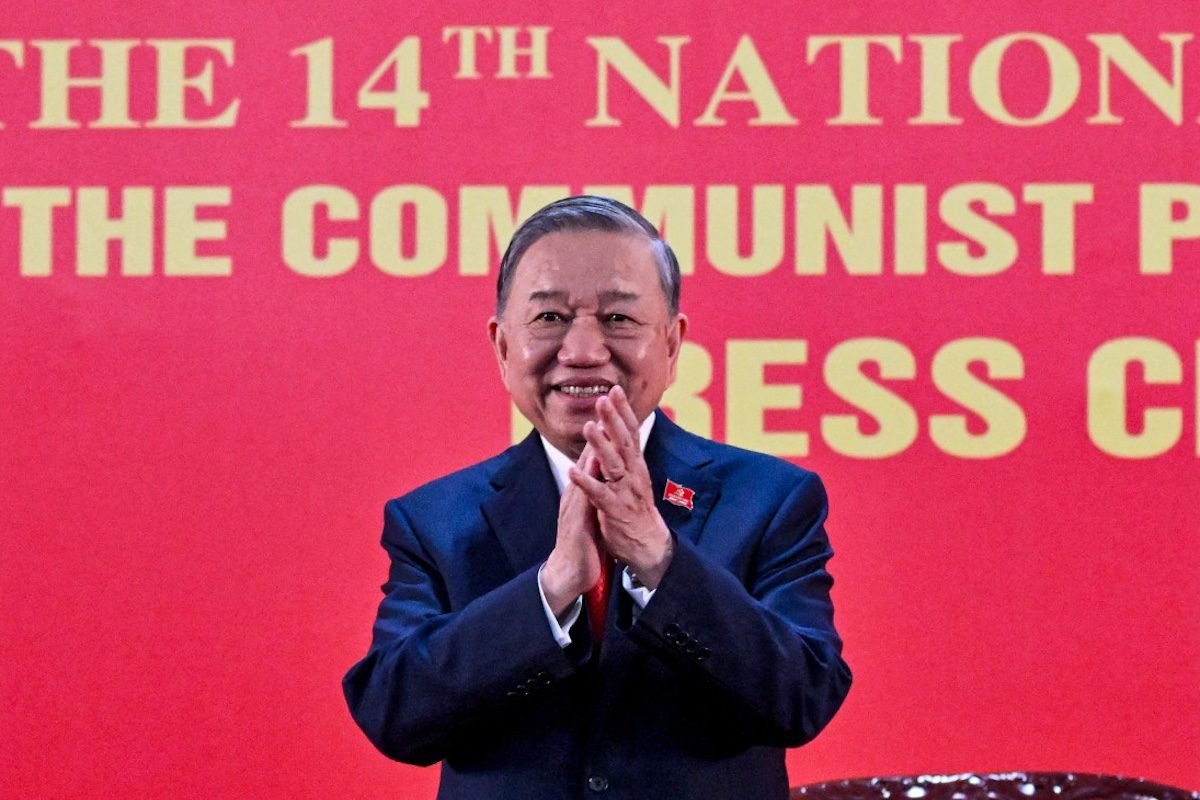
The terms of that compact have been revisited multiple times, and the current reshaping under national leader To Lam, a former minister of public security, is the most far-reaching yet. In January, the CPV held its 14th National Congress and confirmed an extraordinary target first set the previous year: sustained double-digit GDP growth through 2030.
At the congress, To Lam was returned as general secretary for a full five-year term, and within months he was formally installed as state president, consolidating the two most powerful positions in Vietnamese politics for the first time as a planned structure.
In 2025, government ministries were consolidated from 22 to 17, provinces were merged from 63 to 34, and the entire district tier of government was eliminated.
Rewind to December 1986, the Sixth Party Congress broke with central planning because the country faced an existential economic crisis. GDP per capita was at around US$230, Soviet support was contracting and the communist command economy had plainly failed.
Doi Moi was, from the start and at its core, a survival strategy, and the compact it established has been redefined in stages since. In the 1990s, through normalization with former adversaries and regional integration; in the 2000s through World Trade Organization (WTO) accession and opening to foreign investment; and under General Secretary Nguyen Phu Trong, whose intra-party anti-corruption campaign from 2016 onwards became the defining feature of Vietnamese politics during his tenure.
Now under To Lam, the CPV is reshaping the compact again, this time by centralizing power at a pace and scale not seen in decades.
Economic pressures
The economic transformation that has underwritten the social compact has been genuinely remarkable. GDP per capita has risen from around $230 in 1986 to over $5,000 now. Extreme poverty has fallen from 14% to under 4% since 2010 alone. GDP grew 8% in 2025, the highest rate in the region. In July this year, the World Bank reclassified Vietnam as an upper-middle-income economy.
The country has joined the WTO, signed the CPTPP and EVFTA free trade deals, and emerged as one of the world’s most open, trade-oriented economies. Alongside this, Vietnam has undertaken successive waves of legal and regulatory reform to bring the commercial environment closer to the demands of a market economy.
But the compact with Vietnamese citizens depends on continued delivery, and the model’s structural weaknesses have become harder to ignore and forgive.
The economy remains heavily dependent on foreign direct investment (FDI). The domestic private sector now contributes nearly half of GDP, but continues to face structural constraints limiting productivity, innovation and participation in global value chains. The middle-income trap is no longer a theoretical risk and is starting to squeeze in real time.
The property and financial sectors show where the compact’s governance has fallen short. All land remains state-owned under the constitution, and although the 2024 Land Law has moved toward more market-based valuation, a gap persists between the legal framework and economic reality.
Access to land use rights and infrastructure contracts has been one of the most important engines of wealth accumulation, generating disproportionate gains for the politically well-connected and forming the commercial base of several of Vietnam’s largest conglomerates.
The 2024 Van Thinh Phat case, in which property tycoon Truong My Lan was convicted and sentenced to life imprisonment for embezzlement of $12.5 billion, the largest financial scandal in Southeast Asian history, laid bare the rot in the system. The case showed that when property rights are ambiguous and enforcement is uneven, capital flows to those with political access.
Foreign policy as part of the bargain
Vietnam’s foreign policy has been integral to the compact’s success, even if it is often analyzed separately.
Normalizing relations with the United States in 1995, deepening engagement with China even amid persistent South China Sea tensions, and elevating to a comprehensive strategic partnership with Washington in September 2023 all reflect a deliberate strategy of diversifying dependencies and embedding Vietnam in institutional frameworks that constrain larger states.
Vietnam has also built comprehensive strategic partnerships with Australia, India, Japan and South Korea, and anchored itself in multilateral trade frameworks from the WTO to the CPTPP.
This external positioning has directly served the domestic compact: it has opened markets, attracted FDI and helped underwrite the growth on which the CPV’s legitimacy depends.
Through this web of relationships, Vietnam has also reshaped how it is perceived in international society, actively building an identity as a responsible stakeholder and rules-based actor through diplomatic practice and institutional participation, though its human rights record remains a sore point with many in the West and activist groups.
The South China Sea remains the most sensitive test of this balancing act, with the CPV managing nationalist sentiment against China carefully, aware that it cannot always be controlled once stirred and mobilized.
The CPV’s survival through four decades of market transformation is itself central to the compact’s durability.
Where the Soviet Union and its satellites saw economic reform accelerate political disintegration, Vietnam has managed the transition without a systemic political crisis, sustained its internal discipline through factional bargaining and shifted its legitimacy basis from revolutionary credentials to performance-based measures.
Trong’s anti-corruption campaign, known as the “blazing furnace” for the heat it applied to wayward cadres, sought to address one of the compact’s most visible failures. It was at once a governance reform and a tool of elite political management, disciplining cadres while demonstrating the CPV’s capacity for self-correction.
Under To Lam, the 2025-2026 restructuring carries forward Trong’s institutional ambitions but at an unprecedented scale, combining institutional discipline with a concentration of authority that goes well beyond what Trong attempted.
Whether this represents a strengthening of state capacity or an accumulation of personal power remains an open question, but the political terms of the compact are shifting more than at any point since 1986.
Alongside this restructuring, there has been a notable revival of socialist rhetoric, not so much as a return to ideological orthodoxy but as scaffolding to support and legitimate the concentration of authority.
Pressure from below
The compact also faces pressure from a society transformed by the development it delivered. Vietnam urbanized rapidly over the Doi Moi period, from roughly 20% urban in 1986 to over 40% today.
A generation has come of age with no memory of the pre-reform era, and their expectations of the CPV are shaped by what the model has delivered rather than by any connection to its revolutionary origins. Meanwhile, the demographic dividend that has so far powered manufacturing growth is giving way to a fast-aging population.
This generational shift has found expression in the digital sphere. The Doi Moi period gave rise to new forms of civil society, from bloggers and citizen journalists to legal advocacy and environmental organizations, even as the CPV maintained tight limits on organized opposition and often imposed severe controls on independent voices.
Much of this civic energy has focused on governance issues that the public sees as performance failures within the compact, including environmental protection, land rights, official accountability and transparency in public spending.
Quiet dissent and civic disobedience have grown substantially since the mid-2010s, with the 2016 Formosa disaster and the mass protests against the 2018 special economic zones law that promised 99-year land leases to foreign investors marking turning points.
Among younger generations, activism has shifted toward quieter forms of dissent on global platforms. The justice tree campaign of August 2026, a Threads-driven demand for official accountability contained entirely on the foreign-hosted platform, is one example.
Such movements hold the state to its own stated commitments rather than rejecting the system outright. The norms the CPV has claimed to sustain the compact—good governance, accountability, development for all—are now being turned back on it by Vietnamese citizens who internalized them.
The next phase
The CPV’s framing of 2026 as the beginning of a “new era” is itself part of how the compact is being revisited and perhaps renegotiated. Doi Moi was always more than an economic development program.
It has been the CPV’s legitimating raison d’être: the party leads because it consistently renovates itself. Over four decades, successive leaderships have adapted that claim to serve substantially different political purposes while keeping the label intact.
To Lam’s 10% GDP growth target is ambitious — the World Bank, by comparison, forecasts 6.8% this year – but also bids to set the terms of a renewed compact in which transformation is accompanied by and accomplished through concentrated power and authority in his hands.
Earlier iterations of the Doi Moi settlement generally worked by expanding participation via more actors in the economy, more partners in foreign policy and more stakeholders with a reason to support the CPV-led system.
The latest is moving in a decidedly different direction, concentrating decision-making while asking the compact to deliver more economically than it ever has. Whether fewer centers of authority can deliver faster growth for a more demanding society is the wager on which To Lam’s legacy and Vietnam’s next decade now rest.
Lam Duc Vu is a Southeast Asia-based risk analyst writing on Indo-Pacific security and regional affairs.