As is standard procedure for major NASA missions, the US space agency held a post-launch news conference on Sunday morning at Kennedy Space Center in Florida to provide information about how the Nancy Grace Roman Space Telescope was faring during its initial maneuvers.
What was not standard, however, is what happened in the middle of the news conference. A little less than half an hour in, NASA Administrator Jared Isaacman looked down at his mobile phone, and then stood up and walked away from the dais where he had been seated behind a table along with other NASA officials. He briefly left the room.
Isaacman returned about a minute later, phone in hand, apologizing for interrupting NASA’s chief of science, Nicky Fox, as she was speaking about the mission. “The President of the United States of America would like to address and congratulate everyone on this mission,” Isaacman said, returning to his seat.
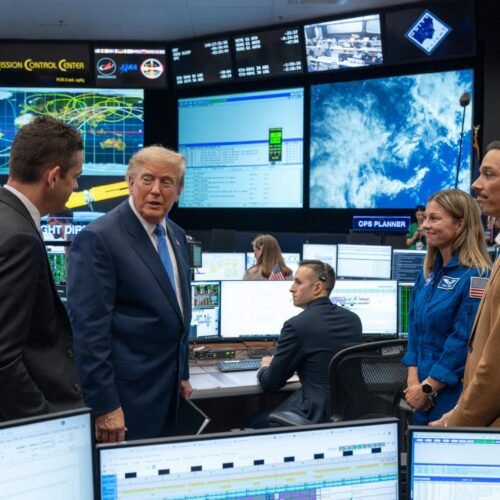
In an unusual moment, Trump then spoke through Isaacman’s phone to the assembled reporters and NASA officials. “I just want to thank everybody, and congratulate you. Boy, it looked beautiful on television,” Trump said of the Roman space telescope launch. “Jared is doing a fantastic job, you are doing a fantastic job, and I’m supplying you all that money.”
What is going on here?
So what to make of this? Presidents, historically, do not call into a NASA news conference. In truth, presidents do not spend much time thinking about space in general, or NASA in particular. This is changing with the increasing importance of space from a military standpoint, but for most presidents civil space lies fairly low on the priority list. Presidents call astronauts when they’re orbiting the Moon; they don’t dial into post-launch news conferences.
But Trump is clearly having a NASA moment. On Friday he spent several hours at Johnson Space Center in Houston, where he awarded the crew of Artemis II the Congressional Space Medal of Honor and then announced plans for a United States Space Academy. Then, over the weekend, he became enraptured by the prospect of launching the Nancy Grace Roman Space Telescope, NASA’s next great space-based observatory.
At every turn Trump has offered praise for Isaacman, a businessman and private astronaut who has been seeking to reform NASA for the modern era of spaceflight. The warm relationship is all the more surprising because it was only a little more than a year ago that Trump pulled Isaacman’s nomination to lead NASA, citing the lack of “complete alignment” with the America First agenda. Isaacman, a political moderate who leans Republican, had donated to some Democratic candidates in the past.
But late last year Trump had a change of heart and reinstated his nomination.
“With Jared, I have to tell you, everybody wanted him,” Trump said Friday, in Houston. “I got a lot of calls from Republicans and Democrats, something that doesn’t happen very often, and the people just said, “He’s just the best.’ There was no competition. And he’s turned out to be better than we even thought possible, right? Even better. So we’re lucky to have Jared.”
Isaacman has spent a lot of the last 12 months developing political relationships with people in the White House and Congress, on both sides of the aisle. In public statements he has broadly supported the Trump White House. But perhaps most importantly he has delivered wins for an Administration that has been swamped by a series of self-owns, including a deeply unpopular war in Iran, inflation, multiple scandals, and other setbacks. With NASA, Trump has been able to bask in the glow of the wildly successful Artemis II mission and now the launch of the Roman space telescope.
Striking while the iron is hot
Isaacman is clearly seeking to seize the moment and parley the President’s interest in NASA into future success for the space agency.
Scientists may scratch their heads as they watch Trump take credit for providing “all that money” for NASA when his first budget for the space agency sought to slash science funding by 50 percent, and cut it overall by 25 percent. The fiscal year 2026 budget proposal even sought to cancel the Roman space telescope. Now, Trump is trying to take credit for its success?
The reality is a little more nuanced. Trump likely does not comb through his budget requests line-by-line, especially for a civil space agency. Rather the cuts sought in fiscal year 2026 and 2027 (which have been, or will be largely repudiated by Congress) in the administration’s budget were driven by Trump’s head of the White House Office of Management and Budget leader Russ Vought, who has been waging a war on US government funding of science—with Trump’s backing.
Although he was certainly responsible for the cuts, it’s unclear how much Trump was interested in their details when they were proposed. But now, at least on a temporary basis, NASA has caught Trump’s interest. Sources said Isaacman has spent a lot of time with the President over the last three days, making the case for future science missions as well as the Artemis Program.
The question is whether this interest will be reflected in the budget request for fiscal year 2028, which is now in the initial stages of preparation. Will Trump, who frequently changes his mind on issues, stay invested in NASA?
NASA’s science programs could use some help. The agency has one more major science mission coming up, the launch of Dragonfly to Titan in 2028. After that the science cupboard looks more threadbare, and NASA could use some major new mission starts. And of course the race back to the Moon continues to heat up with China. If the United States is serious about landing humans there before the end of this decade the space agency could use more resources to make that a reality.