A thousand years ago, feasts in what’s now northern Georgia (in the US) included cacao from Central America.
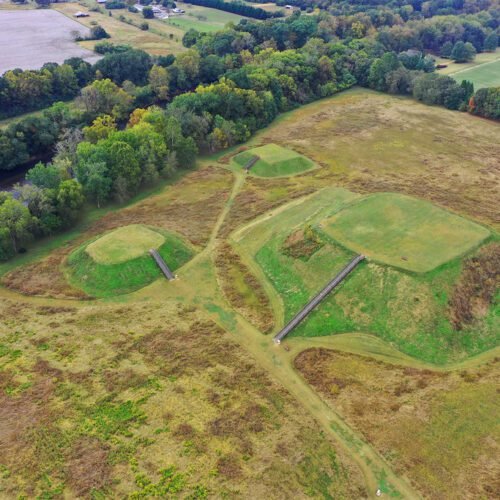
Potsherds discarded after an 11th-century feast at Etowah—an Indigenous city just north of what’s now Atlanta, Georgia—contained traces of cacao, a raw ingredient of chocolate. The chemical residue and ancient DNA reveal that not only did the Mississippian people who built the city have excellent taste, they also had trade connections that reached at least 3,000 kilometers to Central America. And in a sense, chocolate may have helped build the Mississippian mounds.
Ancient dirty dishes
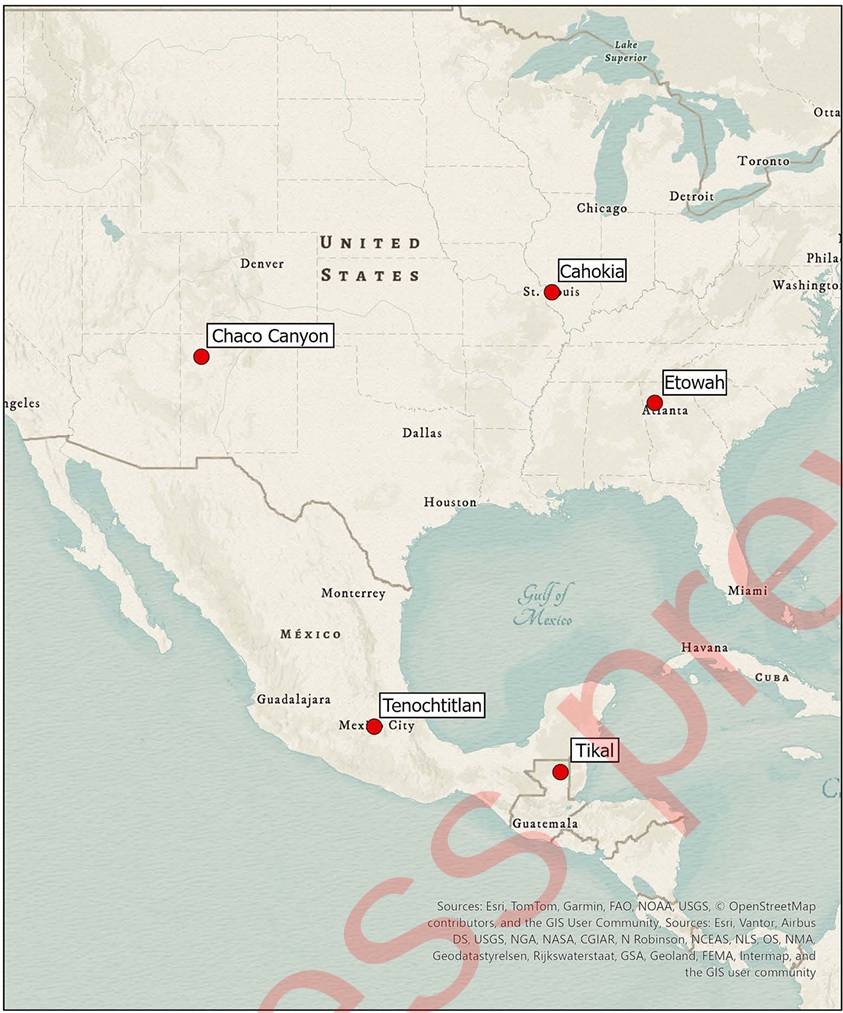
University of South Carolina archaeologist Adam King and his colleagues found fragments of ancient DNA from Theobroma cacao in the inner surfaces of potsherds from long-ago feasts at Etowah. Fruit from the cacao tree contains beans that, when dried and roasted, produce chocolate in all its glorious forms. Cacao only grows in the tropics, which means the nearest actual cacao trees would have been at least a 3,000-kilometer trek away from the woodlands of the eastern US. And that means the Mississippian people who lived in Etowah must have had continent-spanning trade connections.
Etowah was a major center of the Mississippian culture, which flourished in the southeastern U.S. in the centuries before colonization. By 1350 CE, wooden palisades and guard towers ringed a trio of giant earthen mounds (and three smaller ones), the largest of which stood six stories high and covered three acres. Log temples atop the mounds overlooked wide plazas for ball games, ceremonies, and open-air markets. The feast that King and his colleagues studied dates to two centuries before Etowah’s heyday, during the building of the first big platform mound.
After digging up a huge quantity of dirt for that mound (a 19 meter-high mound with a base area of 3 acres has a volume of… math), people filled in a pit with refuse from community feasts, including a lot of broken pottery, much to the delight of future archaeologists, who categorically love broken pottery. And because nobody washed the dishes before tossing them into the feasting pit, King and his colleagues (in a 2017 study) could analyze the microscopic residue of ancient drinks that had soaked into the ceramic.
Mass spectrometry revealed that the broken containers had once held something containing the chemical compounds theobromine, theophylline, caffeine, and paraxanthine. Those compounds are hallmarks of cacao, but they’re also found in yaupon holly, which grows all over the eastern US. Indigenous people in the region have used yaupon holly in tea since well before the rise of Etowah (and someone is probably drinking some right this very minute). Based on the biomarkers, there was no real reason to look for imported cacao instead of local yaupon tea. But King and his colleagues decided to anyway, and they found cacao DNA.
It’s the first evidence that Etowah, and the Mississippian culture of which it was the heart, had trade connections stretching all the way to the Maya world. That’s revelatory enough, but since the potsherds date to the construction of Etowah’s first platform mound, the results mean that Etowah had long-range trade networks even in its early days.
Chaco Canyon connection?
At around the same time people at Etowah were feasting on cacao, so were people at Chaco Canyon in what’s now New Mexico. Chaco Canyon was the beating cultural and economic heart of a roughly 60,000-square-kilometer area of what was, up until the mid-1100s CE, a much greener American Southwest. The area around Chaco Canyon may have been home to around 100,000 people at its height, and the site itself is home to multi-story stone buildings with hundreds of rooms each. And the Ancestral Pueblo people who lived there from 900 to 1150 CE used their trade connections with Mexico and Central America to import everything from scarlet macaws to cacao.
That’s a crucial difference between Chaco Canyon and Etowah: at Chaco Canyon, there’s lots of evidence of trade with Central America, but at Etowah, so far there’s only the cacao residue in the potsherds. So it’s not clear whether Etowah got other exotic trade goods from Central America or from the Southwest, or what goods the woodland mound city offered its trading partners in return. It’s also hard to say whether cacao and other trade goods reached Chaco Canyon and Etowah after long trading expeditions, or by passing through a series of hand-to-hand exchanges along the way.
So far, we know that Chaco Canyon had its own trading network reaching through Mexico and south into Central America. What we don’t know is whether Etowah got its cacao through a network traveling north through Mexico, or if its Central American connection actually ran through Chaco Canyon—or both.
“These results ask us to look more closely for evidence of links connecting the Mississippian world to the Hohokam and Ancestral Pueblo of the Southwest,” wrote King and his colleagues.
Meanwhile, between 800 and 1600 CE, southwestern cultures like the Ancestral Pueblo had connections with the Caddoan cultures who lived west of Etowah, in what’s now Arkansas, Louisiana, Oklahoma, and Texas. Their archaeological sites contain turquoise, southwestern-style pottery, and obsidian from hundreds of kilometers to the west. All of these networks connecting far-flung Indigenous civilizations would have “moved things, people, and ideas,” as King and his colleagues put it. It’s very tempting—and very plausible—to envision a complex web of tradition relationships spanning much of the continent in the millennium before European colonial powers arrived to wreck it all.
But mapping out who was trading with whom is another, and much more complicated, puzzle entirely, one that is going to require a lot more archaeological evidence.
“Early in the history of Mississippian studies, it was common to attribute the complexity of Mississippian lifeways to connections with Central America,” wrote King and his colleagues. “This line of explanation was eventually abandoned for lack of supporting evidence and because of the implication that Indigenous people of the Eastern Woodlands were not capable of creating a complex civilization. As new evidence comes to light, it will become time to explore those connections, but this time without denying the achievements of Mississippian people.”
PLOS ONE, 2026 DOI: 10.1371/journal.pone.0353607. (About DOIs).