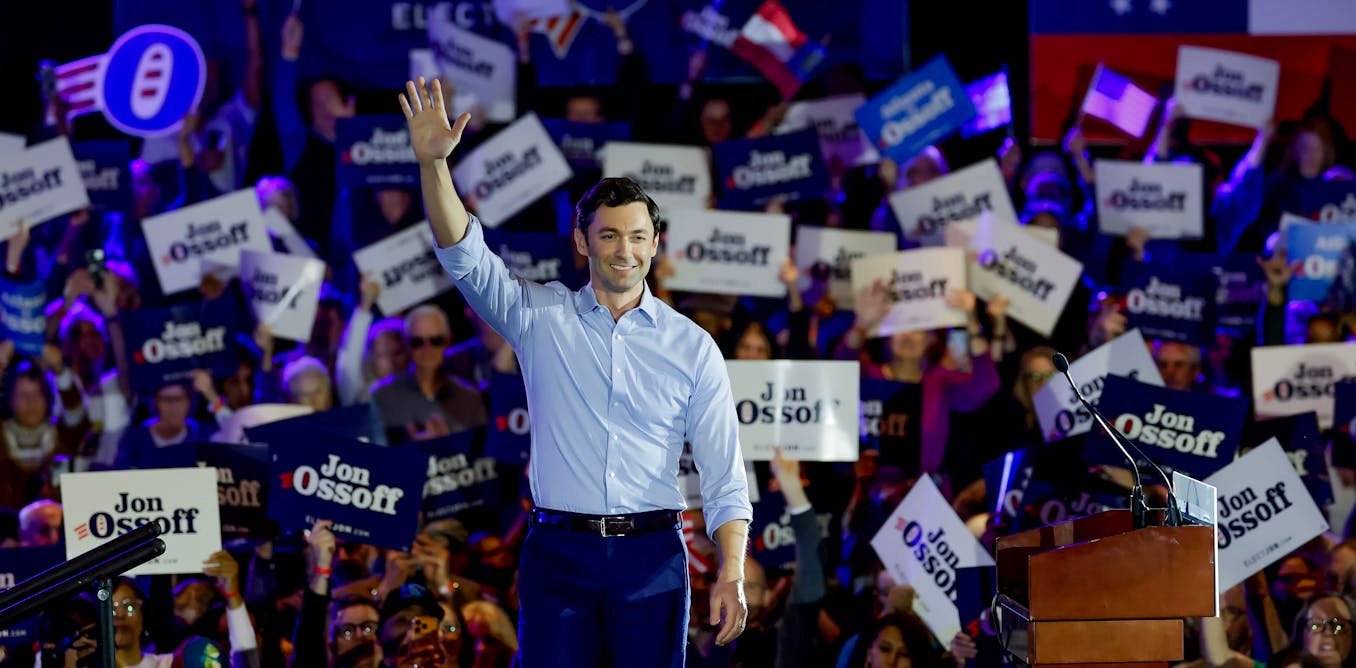
The official campaign for the US midterm elections usually begins after America celebrates Labor Day on September 7. But over the summer, the battle for votes has intensified between Donald Trump’s Republican party and a freshly emboldened Democratic party.
In November’s elections, all the seats in the House of Representatives will be contested, as will one-third of the Senate. Throughout the year, Republican and Democratic hopefuls have been engaged in the primary election process.
These are now nearing a conclusion. Primaries have now been held across the country for gubernatorial, Senate and House contests. Following the August 18 primaries, polling showed the Democrats with a six-point lead.
The Democratic party has also been buoyed by data from earlier in the month from a Reuters/Ipsos poll that revealed for the first time in nearly a decade that voters prefer the party’s approach to the economy. This could be a decisive factor come election day on November 3.
Elaine Kamarck, a senior fellow at the Brookings Institution, a thinktank, has asserted that in America’s current bitterly divided political climate “where more congressional districts than ever before are considered ‘safe’ for one party or the other, real change plays out in congressional primaries”.
Results from the August 18 primaries in Florida, Alaska and Wyoming have underlined the current shifts in voting preferences among both Republican and Democratic supporters.
On the Democrat side, there appears to be a developing trend of candidates on the party’s left defeating centrist hopefuls. In Florida, democratic socialist Angie Nixon defeated her moderate Democrat opponent, Alex Vindman.
The result was striking for two reasons. First, the contrast in campaign spending by both candidates. Nixon raised US$975,000 (£716,000) compared to Vindman’s war chest of over US$16.3 million.
The other noteworthy point was Nixon’s robust position on Israel. She advocated stripping the country of US aid, something that is politically risky in a state that contains America’s third-largest Jewish population.
This was by no means uniform – other candidates backed by the Democratic Socialists of America (DSA) lost out to more established Democratic candidates. But Nixon’s victory represented another progressive outsider advancing to November’s elections – something already witnessed in states like Wisconsin, Minnesota and Michigan.
DSA figures have been able to tap into significant frustration among the Democratic voter base that has become increasingly vexed by cost-of-living issues as well as growing discontent towards their party establishment.
Trump ticket no longer golden
Democrats are now beginning to feel increasingly optimistic about their chances to take back control of the US Senate after November. This would require a net gain of four seats.
An emerging trend from recent Republican results suggests that the once hugely sought-after Trump endorsement is no longer the guarantee of victory it once was. The president’s first choice in Florida’s 19th congressional district, Catalina Lauf, lost out to Jim Schwartzel. Similarly, in Wyoming’s Republican primary for governor the sitting state senator Eric Barlow defeated the Trump-backed candidate Megan Degenfelder.
In South Carolina, Darline Graham – who replaced her brother Lindsay Graham as senator when he died in July – won a run-off primary with the strong backing of the president. But given the late Senator Graham’s prominent profile, she is perhaps best seen as a continuity candidate, winning on name recognition as much as on the Trump endorsement.
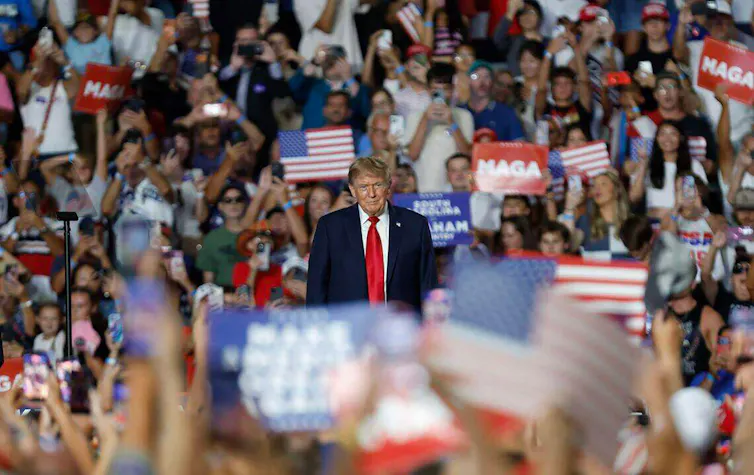
This apparent defiance against the 47th president among registered Republican voters seems to be increasingly common, with the president’s preferences in Iowa, Georgia and South Carolina’s gubernatorial races all losing.
Trump’s job approval ratings remain in negative territory. A recent RealClearPolitics polling average had the president’s approval rating at 39.2% with 58.4% of respondents saying they disapprove of his performance.
The war in Iran is having a daily impact on the lives of ordinary Americans through rising fuel prices. The survey also revealed that just three out of ten voters approved of Trump’s management of the conflict. This may explain why some Republican voters are prepared to reject the president’s endorsement.
Rural voters
Rural voters are emerging as a key demographic that appears to be turning away from Trump. Sharp rises in fuel and fertiliser costs are hitting grain producers particularly hard, while Trump’s tariff regime is hurting agricultural exports.
A recent Fox News analysis found that among rural voters, Trump’s net job approval fell from +20 in early 2025 to -14 in May 2026. A recent article by Brookings senior fellow, William A. Galston, pointed to the fact that Trump carried 64% of the rural vote to Kamala Harris’s 34% in 2024. He believes that in November, while Republican voters may not choose to cast their ballot for Democratic candidates, there’s a strong possibility more will choose not to vote at all.
There was further bad news for the Republicans in a Pew Research study from July which found that, despite Trump himself not being on the ballot, nearly twice as many voters – 42% – will use their ballot to vote against him as those who will use it to vote for him.
But all might not be lost just yet for the GOP. It may look as if the Democrats are on course to retake the House of Representatives – and potentially also the Senate – in November. But we have yet to discover the impact of significant redistricting by various states under the administration of both parties.
Redistricting is when a state redraws the boundaries of its electoral seats to better reflect the state’s demographics. This happens automatically every ten years. But a number of states have redrawn their boundaries since July 2025 outside this automatic process. Analysis shows that out of the ten states to have engaged in a voluntary redistricting process, the new electoral maps of eight favour Republicans.
So while Democrats have a clear polling edge and obvious momentum, the results of the midterms are still far from certain.