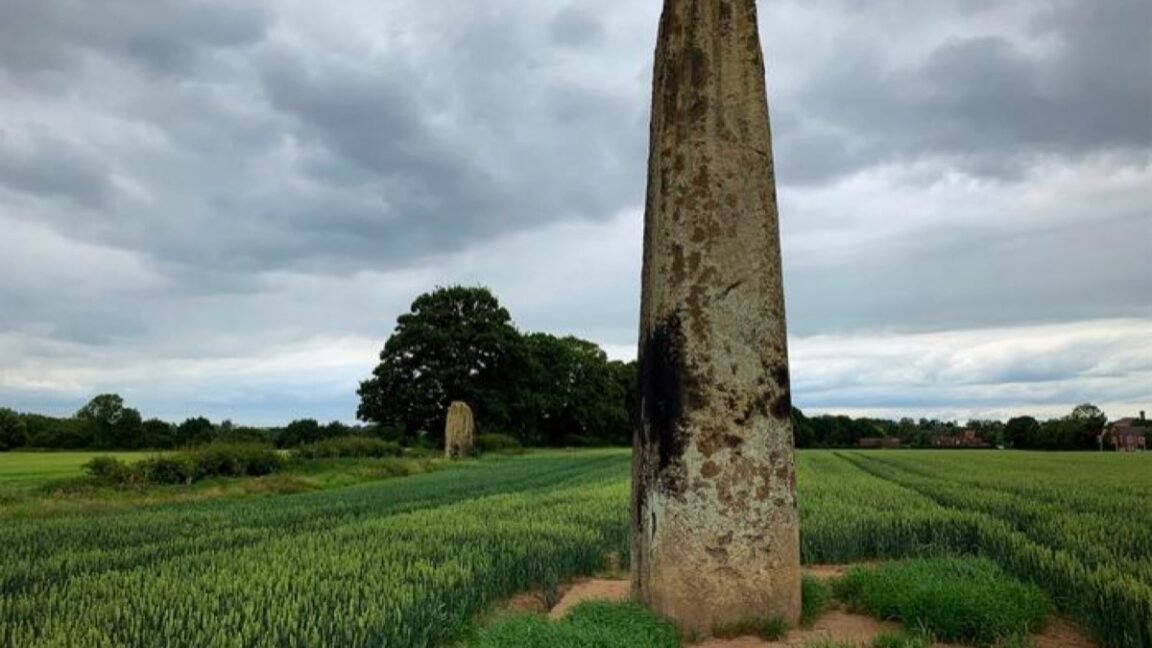
Stonehenge is the most famous example of megalithic architecture across Britain and Ireland, but there are plenty of others, including Calanais, Newgrange, and Avebury, as well as the Devil’s Arrows. The latter is Britain’s tallest standing stone alignment, yet little is known about the provenance of its stones. Scientists have confirmed that the stones came from a site 18 kilometers (11 miles) away, transported by humans rather than glacial movement, according to a paper published in the Proceedings of the Royal Society A: Mathematical, Physical and Engineering Sciences.
“Sites in southern England and Scotland receive considerable attention but monuments like the Devil’s Arrows have remained comparatively understudied despite their significance,” said co-author Jim Leary of the University of York. “We have now proved that Neolithic communities moved several 25-ton stones across Yorkshire, transforming a familiar site into an epic quest to create a sacred landscape.”
Stonehenge has been the focus of recent chemical analyses identifying where all the stones that make up the structure came from, revealing that many originated in quarries a significant distance away. For instance, a 2019 study concluded that the 42 bluestones that make up the inner ring came all the way from western Wales. The outer layer of sarsen stones hails from much closer to home: Marlborough Downs, an area of round, grassy hills 25 to 30 km (17 miles) north of Stonehenge, which has the largest concentration of sarsen in the UK.
In 2024, Anthony Clarke, who co-authored this latest study, and his team discovered that the Stonehenge Altar Stone originated from the Orkney region in the very northeast corner of Scotland, rather than Wales. Next, they tackled the long-standing debate over how the stones got to that location in the first place. One theory holds that glaciers moved the bluestones at least part of the way from Wales to Salisbury Plain in southern England, while others contend that humans moved them—although precisely how that was done has yet to be conclusively determined.
Earlier this year, Curtin’s team produced the strongest scientific evidence to date that it was humans, not glaciers, that transported the stones. They analyzed hundreds of zircon crystals collected from rivers close to the historic monument, looking for evidence of Pleistocene-era sediment. If the stones had “sailed” to the plain from farther north, there would be a distinct mineral signature in that sediment as the transported rocks eroded over time. They didn’t find that signature, making it far more likely that humans transported the stone.
The devil went down to Boroughbridge
Now Curtin et al. have turned their attention to the Devil’s Arrows, three aligned stones located in the lowlands, just outside Boroughbridge in North Yorkshire. Local legend holds that the Devil formed the arrangement by standing on How Hill and hurling giant stone arrows while shouting “Borobrigg keep out o’ way, for Aldborough town I will ding down!” But the arrows didn’t quite reach their target and landed where the stones stand today. The tallest of the stones stands 6.85 meters (22.5 feet). The stones are part of a broader Neolithic complex, and it’s believed their arrangement is meant to align with the southernmost summer moonrise.
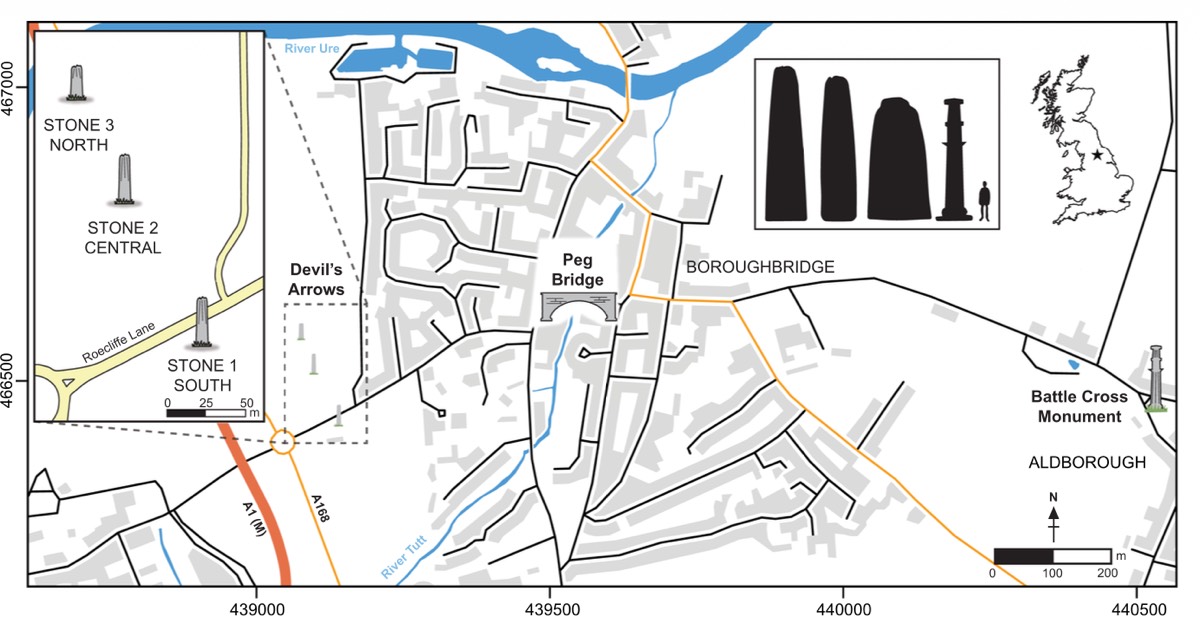
A 2025 geophysical survey found two distinct patches of magnetic disturbance thought to be an indication of former positions of stones that have been removed. There is also evidence, in the form of possible stone sockets, that the line of stones had once continued north and may have served as way markers along the Great North Route.
Among historical records, there is a 16th century account of a fourth standing stone to the north-northwest of the surviving Devil’s Arrows that had toppled over by the dawn of the 17th century. There is a 1687 report of locals breaking up a stone and using the remnants to build the nearby Peg Bridge, transporting the upper segment to nearby Aldborough Manor. And 19th century antiquarian J.R. Walbran suggested that a repurposed monolith had become the Battle Cross Monument that once stood in Boroughbridge’s market square before being relocated to Aldborough in 1852.
Clarke et al. took samples from all three Devil’s Arrows stones, as well as from the Battle Cross monument and Peg Bridge, using small sections of adhesive tape applied to inconspicuous areas of the stones free of lichens or mosses. Grain samples stuck to the tape and were later removed by dissolving the tape glue with mineral turpentine. They removed coarse magnetic materials and light minerals like quartz and feldspars, and imaged what remained in the samples using field emission scanning electron microscopy. They also performed an isotopic analysis of zircon and apatite minerals to get an age “fingerprint” in order to match the stones to their likely source.
The Devil’s Arrows are made of a coarse-grained sandstone. Plumpton Rocks, which is closer to the Devil’s Arrows, had previously been identified as the probable source of the stones. Based on their analysis, Clarke and his team concluded that the most likely source is actually Brimham Rocks, meaning the stones were transported by prehistoric builders significantly farther than originally thought. Regional ice-flow reconstructions ruled out a possible glacial transport mechanism for the stones.
“Our research shows these stones weren’t simply taken from the nearest available source—they were deliberately chosen from a challenging landscape 18 kilometers away,” said Clarke. “Moving them would have required incredible planning, coordination, and engineering skill. This tells us prehistoric people placed real importance on the landscape itself. It wasn’t just about convenience—the location the stones came from likely held meaning for them.”
Their results also confirmed that the Battle Cross monument is composed of one of the missing Devil’s Arrows stones.
“Reuse does not erase meaning,” the authors concluded. “Rather, it adds further episodes to the stone’s biography. A monolith may begin as bedrock, become a selected and transported prehistoric object, acquire significance within a megalithic setting, and later be reimagined as building stone, bridge fabric, a crossing marker, or part of a Christianized or civic landscape. Each phase modifies the interpretive frame. The object is not a static remnant of a single past, but a material witness to repeated acts of human engagement.”
Proceedings of the Royal Society A Mathematical, Physical and Engineering Sciences, 2026. DOI: 10.1098/rspa.2026.0504 (About DOIs).