The unclaimed attacks have not been linked, but they come as rival power centers compete for influence and the US seeks to reunify Libya’s divided institutions
Drone attacks on energy facilities in western Libya and the assassination of a senior intelligence official in the east have renewed fears of instability as Libyan factions maneuver ahead of possible political negotiations.
No evidence has emerged connecting the two sets of events, and no group has claimed responsibility for either. Their timing has nonetheless raised questions about whether Libya faces another brief outbreak of violence or a broader contest for influence.
Maj. Gen. Fawzi al-Mansouri, head of military intelligence for Khalifa Haftar’s eastern-based forces, was killed in Benghazi on Monday night, August 10, when an explosive device detonated at his vehicle in the Hawari district, according to security officials and the eastern General Command.
Al-Mansouri was buried the following day at a funeral attended by senior military figures, including Saddam Haftar, one of Khalifa Haftar’s sons. A security committee has opened an investigation, but authorities have not publicly identified a suspect or motive.
The assassination eliminated one of the most senior officials in an eastern security establishment that has portrayed Benghazi and much of eastern Libya as having left behind the instability of earlier years.
Hundreds of kilometers to the west, attacks were hitting some of the country’s most important energy facilities.
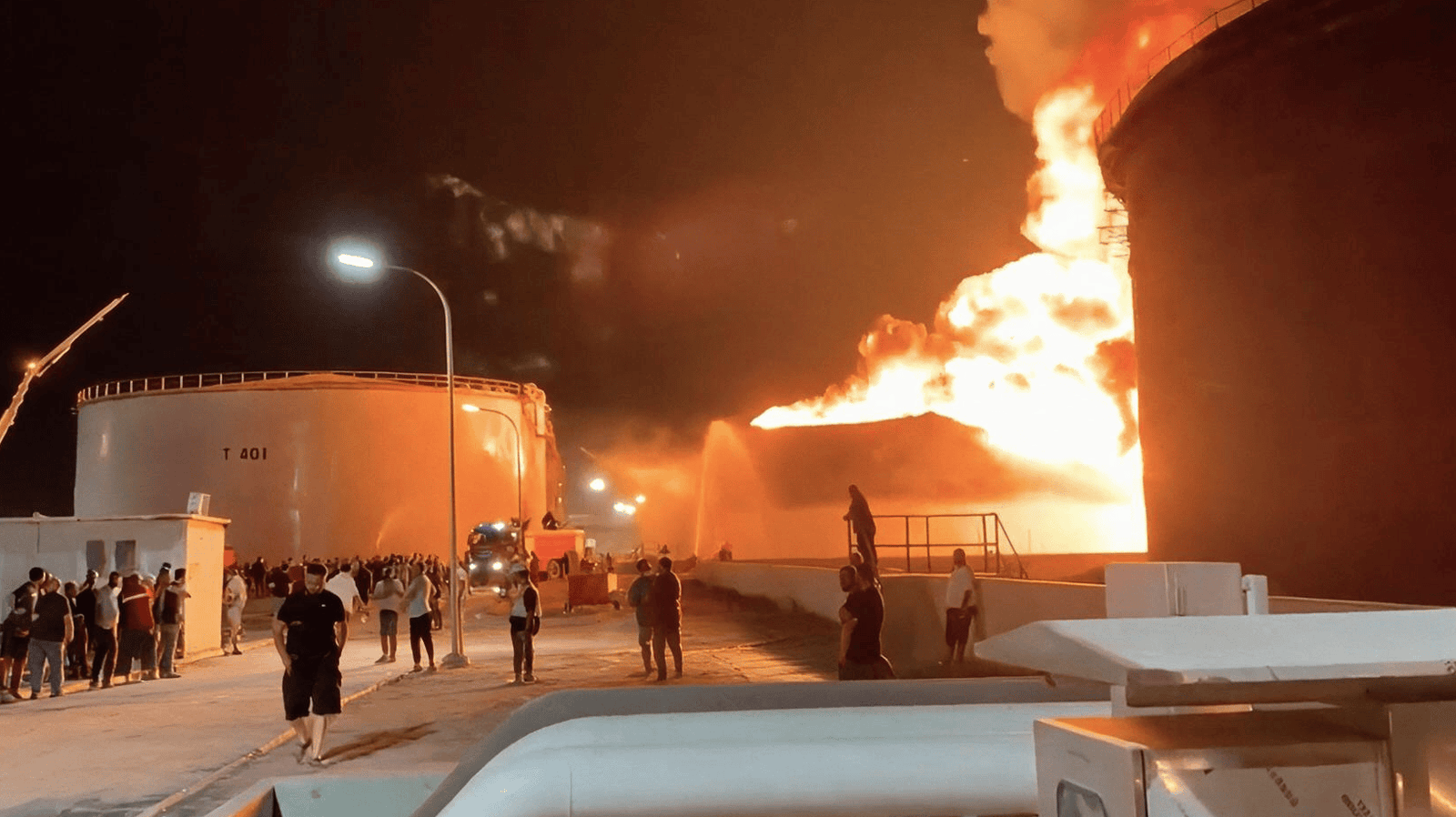
Drone strikes began targeting facilities in Zawiya on August 9. The following night, a drone hit a gasoline-storage tank at the Zawiya oil complex, west of Tripoli, causing a major fire and the tank’s collapse. The tank held approximately 4.5 million liters of gasoline when it was struck, according to Libya’s National Oil Corporation.
Another drone landed near a second tank without causing reported casualties or damage. Further attacks continued into August 11.
The National Oil Corporation said firefighters had contained the blazes and that the refinery itself was not damaged, although production was briefly disrupted. It warned that more attacks could force it to suspend operations.
The complex includes Libya’s largest operating refinery, which can process approximately 120,000 barrels per day. It is connected to the Sharara oil field and plays a central role in the country’s energy production and fuel-distribution network.
Prime Minister Abdul Hamid Dbeibah, who heads the internationally recognized Government of National Unity in Tripoli, condemned the strikes as organized crime and promised to hold those responsible accountable.
Another drone struck the South Zawiya electricity substation on August 12, setting it ablaze and causing widespread outages. Libya’s state-run General Electricity Company said more than 700 megawatts of the nearby power plant’s 1,300-megawatt capacity remained unavailable.
US energy company GE suspended work at the power station and withdrew its technical teams because of the security situation.
The attackers and their objectives remain unknown. Zawiya is divided among armed groups with shifting alliances, and tensions have grown between Dbeibah’s government and forces associated with Mohamed Bahroun, a powerful commander in the city.
Libya has been divided between rival centers of authority for more than a decade. Dbeibah’s government operates from Tripoli, while authorities backed by Haftar’s forces control the east. A 2020 ceasefire ended the last major nationwide war but failed to produce unified political, military, or security institutions.
The latest violence comes as Libyan leaders and foreign governments seek arrangements that could narrow the east-west divide.
Misbah Omar, a Libya-based analyst at the Institute for Integrated Transitions and a member of the Mediterranean Platform, said the attacks could be part of a larger contest, although no wider pattern has yet been established.
What we are witnessing may represent an initial phase in the restructuring of Libya’s political and security landscape
“If this assessment is correct, what we are witnessing may represent an initial phase in the restructuring of Libya’s political and security landscape—one aimed at allowing the main actors to consolidate or redefine their respective spheres of influence before moving toward a clearer political process,” Omar told The Media Line.
Zawiya is particularly important in any contest over western Libya. The city sits west of Tripoli at the junction of armed influence, energy infrastructure, migration routes, and economic networks.
The attacks raise the possibility that armed factions or their opponents are shifting their focus from direct clashes to the resources and supply systems that sustain military power.
“Such actions would represent a significant shift in the nature of the confrontation,” Omar said. “Rather than focusing exclusively on the armed formations themselves, pressure could increasingly be directed toward the economic and logistical networks that sustain their influence and operational capacity.”
Potential targets could include infrastructure, revenue sources, supply routes, and other assets that help armed groups maintain their position, he added.
Ibrahim Mousa Said Grada, a former Libyan ambassador to Sweden and former UN adviser, also described Zawiya as central to the struggle over political power and economic resources.
“This happened in Zawiya, a city that deserves to be described as afflicted and targeted because it has become a meeting point for the contradictions of politics, conflicts of interest, and disputes over the division of power and resources in Libya,” Grada told The Media Line.
This happened in Zawiya, a city that… has become a meeting point for the contradictions of politics, conflicts of interest, and disputes over the division of power and resources in Libya
The violence coincides with renewed US efforts to encourage cooperation between Libya’s rival authorities.
Massad Boulos, senior adviser to President Donald Trump for Arab and African affairs, has promoted an initiative focused on institutional reunification and economic cooperation. He has met Haftar, Dbeibah, and other political and military figures across Libya.
Published accounts describe the initiative as an effort to reach agreements between Haftar’s eastern authorities and Dbeibah’s Tripoli-based government, with energy investment and economic development offered as incentives.
The plan remains controversial, and many of its details have not been made public. Critics warn that a power-sharing agreement could preserve the authority of Libya’s current leaders and armed factions rather than build representative national institutions.
Omar said the US approach seemed to favor a series of limited agreements rather than a comprehensive settlement.
“If this trajectory continues, the initiative could enter a more practical phase during the final quarter of this year and the beginning of next year, operating along two parallel tracks: economic and political, supported by corresponding security arrangements on the ground,” he said.
Grada was less optimistic about its immediate prospects.
“The Boulos initiative ‘appears’ to have been placed in a freezer during this scorching summer, so that it does not die or become buried altogether,” he said.
The recent attacks do not show that Libya’s factions have agreed on a new division of power. They could instead represent attempts by competing groups to improve their positions before negotiations, whose timing and structure remain unclear.
Al-Mansouri’s assassination creates another problem for the east. Grada said the loss of its military intelligence chief came at a sensitive time for Libya’s divided security services.
“At the same time, the absence of the head of military intelligence for the eastern Libyan forces coincides with the continuing dispute over the leadership of the General Intelligence Service, or external security apparatus,” Grada said. “This means an intelligence vacuum and state of confusion at a particularly dark and sensitive moment domestically and during a highly unstable and critical international environment.”
Foreign involvement adds to the uncertainty. Russia, Turkey, the US, European powers, and regional governments retain varying degrees of political, economic, and security influence in Libya.
“There is an increasing possibility that Libya could be transformed into an arena for proxy warfare between intelligence services and their military and media arms, as international and regional conflicts and rivalries expand and deepen,” Grada said.
The latest violence does not necessarily mean that Libya is heading back to nationwide war. Omar said a series of limited moves intended to change the balance of power was more likely than an immediate, large-scale confrontation.
These developments should not necessarily be interpreted as evidence of an imminent comprehensive military confrontation
“However, these developments should not necessarily be interpreted as evidence of an imminent comprehensive military confrontation,” he said. “A more plausible scenario may be a series of calibrated and limited moves designed to alter the balance of power gradually, while leaving room for negotiations and political accommodation.”
The next political agreement may depend as much on events outside formal negotiations as on what happens at the table. Control of territory, energy assets, and security institutions will help determine what Libya’s competing factions are willing—and able—to accept.
The Zawiya strikes and al-Mansouri’s assassination do not prove that anyone is carrying out a coordinated plan to redraw Libya’s balance of power. They do show how quickly an attack on an oil tank, power station, or security chief can unsettle a country whose rival authorities have never fully resolved the conflict between them.