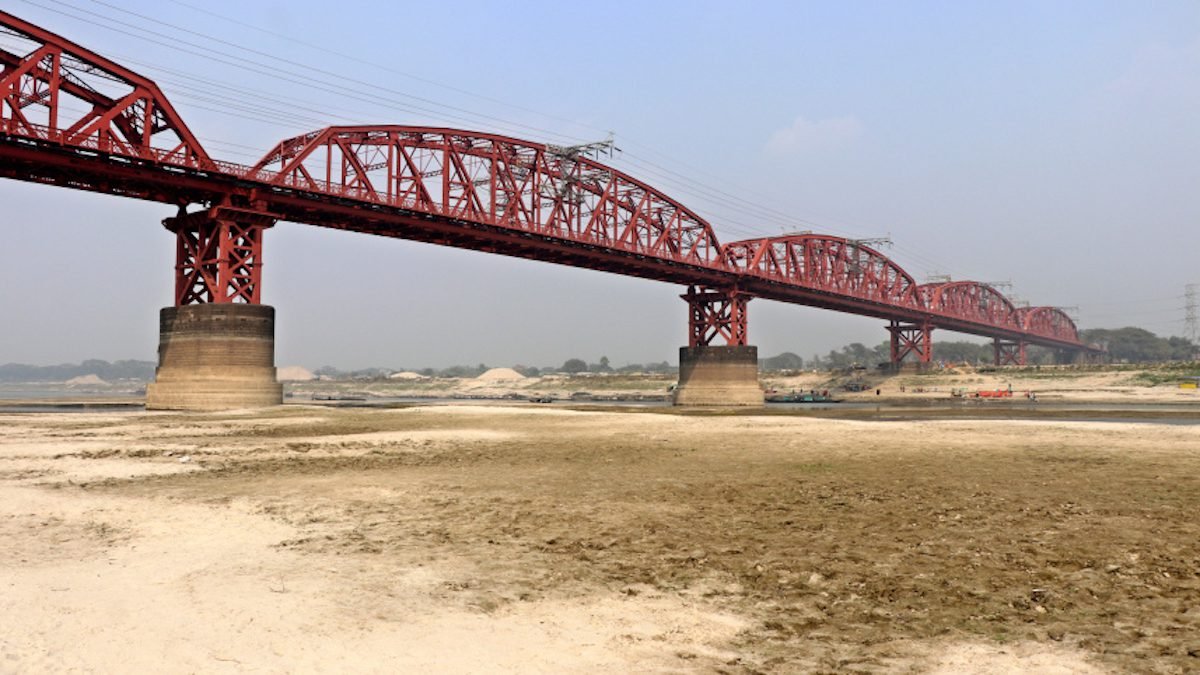
May 15 occupies a charged place in Bangladesh’s political memory. The date is observed as “Farakka Day”, commemorating the 1976 long march led by Maulana Abdul Hamid Khan Bhashani protesting India’s diversion of Ganges water through the Farakka Barrage. Nearly half a century later, the symbolism remains painfully current.
Bangladesh’s latest mega project — the US$2.8 billion Padma Barrage approved this week by the Executive Committee of the National Economic Council — is in many ways a delayed answer to the same unresolved question that animated Bhashani’s march: how can a downstream country survive when the tap upstream is controlled elsewhere?
The government has framed the barrage as an engineering solution to an ecological problem. Built at Pangsha in Rajbari district of Bangladesh, the structure is intended to retain monsoon water from the Padma River and redistribute it during the dry season, when vast parts of southwestern Bangladesh turn increasingly saline and water-starved.
Officials say the barrage will hold nearly 2,900 million cubic meters of water, revive at least five major river systems, improve irrigation across 28.8 lakh hectares of farmland, support fisheries and navigation, recharge groundwater and strengthen freshwater flows into the Sundarbans.
The project is colossal even by Bangladesh’s infrastructure standards. At more than $2.8 billion for its first phase alone — with eventual costs potentially crossing $4 billion — it instantly joins the ranks of the country’s most ambitious public works.
Yet the deeper significance of the barrage lies in geopolitics. It is a tacit admission that Dhaka no longer believes diplomacy alone can guarantee sufficient water from India.
That anxiety is sharpened by the calendar. The 1996 Ganges Water Sharing Treaty between Bangladesh and India expires in December 2026, only months away. Signed after years of acrimony, the treaty regulates dry-season water sharing at Farakka between January and May — precisely when Bangladesh suffers its harshest shortages.
The agreement was once hailed as a breakthrough in regional water diplomacy. Yet in Bangladesh, dissatisfaction with its outcomes has steadily grown.
Dhaka has long argued that actual flows reaching the Padma during lean months remain inadequate for agriculture, river transport and ecological balance. Bangladeshi hydrologists blame the Farakka Barrage, commissioned by India in the 1970s to divert water toward the Hooghly River and Kolkata port, for fundamentally reshaping the hydrology of southwest Bangladesh.
Rivers such as the Gorai, Madhumati and Ichamati have progressively silted up. Salinity intrusion has crept deeper inland. Navigability has deteriorated. Fisheries have weakened. The effects are not merely environmental but civilizational: riverine Bangladesh increasingly finds itself without rivers.
The Padma Barrage represents an attempt at strategic adaptation. If Bangladesh cannot fully secure guaranteed upstream water politically, it must maximize storage of whatever water does arrive during the monsoon. In effect, the state is trying to compensate domestically for uncertainty internationally.
But that logic collides with another hydrological reality…that barrages do not manufacture water. They only regulate what exists. That is why the debate surrounding the project has quickly become inseparable from the future of the Ganges treaty itself.
Water experts have warned that without predictable upstream flow after 2026, the barrage could struggle to meet its lofty promises. During severe dry seasons, Ganges flow entering Bangladesh has already dropped sharply because of upstream diversion and changing rainfall patterns linked to climate change.
Analysts have pointed to a basic engineering dilemma: retaining water in the Padma, one of the world’s most sediment-heavy rivers, will be extraordinarily difficult. Himalayan sediment loads constantly reshape the riverbed. Without sophisticated sediment management, critics fear silt accumulation could rapidly undermine both navigability and storage capacity.
Environmental groups such as Bangladesh Poribesh Andolon have questioned whether sufficient feasibility studies and consultations were conducted before approval. Bangladesh’s history with mega projects has made such skepticism politically potent.
Over the past decade, infrastructure spending under the previous Bangladesh Nationalist Party rival government and the Awami League alike has often been dogged by allegations of inflated costs, procurement irregularities and weak accountability.
That creates an awkward political contradiction for the current government led by Prime Minister Tarique Rahman. Before returning to power, BNP leaders repeatedly criticized mega projects associated with the Sheik Hasina era, arguing that Bangladesh should prioritize education and human development rather than prestige infrastructure financed through debt.
The Padma Barrage, therefore, marks a striking reversal. Officials insist the difference is existential necessity: this is not a vanity bridge or symbolic expressway but a survival project tied to food security, climate resilience and freshwater availability.
Still, even supporters privately acknowledge that the barrage’s ultimate viability depends less on engineering than diplomacy. A former diplomat who preferred to remain unnamed told this correspondent that the decision to proceed with the project is likely evidence of “declining confidence” that negotiations alone can secure Bangladesh’s water future.
The remark captures a growing unease in Dhaka about the broader trajectory of India-Bangladesh river relations. That unease extends beyond the Ganges.
The unresolved Teesta dispute looms heavily in the background. Bangladesh and India appeared close to a Teesta water-sharing agreement more than a decade ago, only for opposition from West Bengal’s state government to derail the deal. The issue became an enduring symbol in Bangladesh of how Indian domestic politics can obstruct bilateral diplomacy.
Now, political developments in West Bengal may once again reshape calculations. The recent electoral rise of the Bharatiya Janata Party in the state has revived speculation that New Delhi could eventually gain greater room to pursue a Teesta settlement without resistance from regional actors. Yet that prospect cuts both ways for Bangladesh.
While some policymakers see an opportunity for renewed negotiations, others fear that a stronger BJP footprint in eastern India may harden New Delhi’s strategic approach to transboundary rivers at a moment when climate pressures are intensifying across the basin.
Indeed, the entire regional context is becoming more volatile. Climate change is altering Himalayan snowmelt, disrupting monsoon patterns and increasing the unpredictability of river flows throughout South Asia. Water is no longer merely an environmental issue but a strategic one.
Bangladesh’s barrage project therefore reflects a broader geopolitical trend: downstream states increasingly seeking infrastructural self-protection against uncertain transboundary arrangements.
Yet the central paradox remains unresolved. Bangladesh can build barrages, dredge rivers and expand irrigation networks, but none of these measures can fully substitute for reliable upstream cooperation. The Ganges is an international river system, and no domestic engineering project can escape that fact.
That is why the approaching expiry of the 1996 treaty is so profoundly important. If Dhaka and New Delhi fail to negotiate a credible successor framework, the Padma Barrage risks becoming a monument to strategic anxiety rather than hydrological success.
Even if renewed, any future agreement will need to address realities that the original treaty only partially confronted: climate variability, ecological sustainability and sediment management, not simply volumetric sharing formulas.
For Bangladesh, Farakka Day thus has become a reminder that the country’s river crisis remains fundamentally unfinished. The Padma Barrage may prove an impressive feat of engineering. It may revive distributaries, reduce salinity and support agriculture.
But unless Bangladesh secures dependable transboundary water flows, the project will remain constrained by the same geopolitical vulnerability that Bhashani warned about back in 1976.
Faisal Mahmud is a Dhaka-based journalist