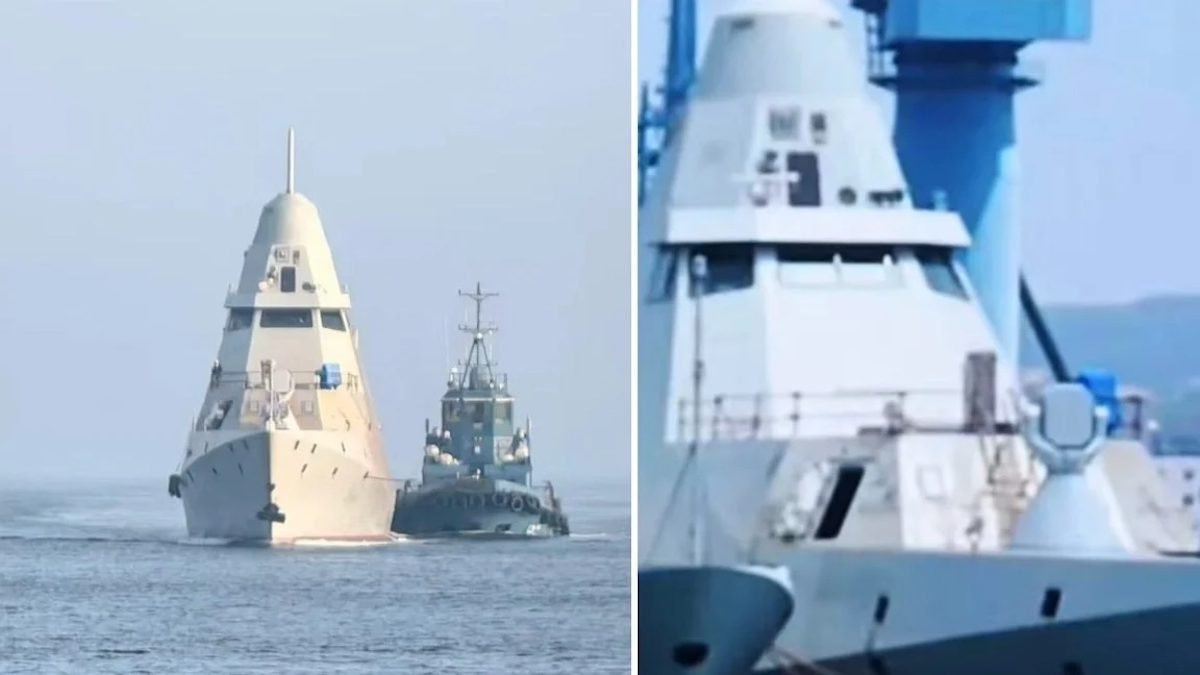
China’s mystery weapon aboard its experimental stealth corvette points to a wider naval race to harness directed energy for everything from deniable gray-zone coercion to defeating the drone swarms that threaten to overwhelm conventional ship defenses.
This month, Defense Blog reported that China has modified its experimental stealth corvette by replacing a previously fitted missile launcher with an unidentified boxy deck-mounted system.
Naval open-source analysts watching the vessel – first spotted at Liaonan Shipyard in 2023 – are divided on whether the hardware is a shipborne sonic weapon designed to disorient enemy personnel or a high-power microwave (HPM) system built to neutralize incoming drone swarms.
The sonic theory is based on China’s documented use of acoustic devices for non-lethal maritime harassment and riot control. Conversely, the HPM theory points to the system’s placement and boxy profile, which mirrors recent Chinese land-based directed-energy weapons designed to fry small unmanned aerial vehicles’ electronics beyond three kilometers.
Naval warfare researchers note that adapting directed energy technology onto stealth warships offers a practical countermeasure against cheap, massed drone attacks capable of exhausting standard missile defenses.
While no official confirmation exists regarding the module’s exact purpose, the modification highlights the low-observable test ship’s primary mission as a flexible trials platform designed to evaluate emerging weapons, sensors and low-signature naval technologies at sea.
Looking at China’s test stealth corvette, The War Zone (TWZ) noted in August 2024 that the ship, first observed in November 2023, features smooth, planar and faceted low-observable surfaces designed to minimize radar signature.
TWZ notes that it includes a main gun concealed within a stealth cupola, lid hinges suggesting a potential vertical launch system (VLS), and a modified mount resembling an HQ-10 missile launcher, though possessing a single aperture likely for electro-optics, laser testing, or mockup evaluation. It adds that its streamlined mast and potential hybrid all-electric propulsion demonstrate concepts aimed at advancing future littoral combatants.
China has already employed non-kinetic weapons and directed-energy systems in its gray-zone operations in the South China Sea, where hostilities are kept below the threshold of armed conflict through ambiguity and deniability, incrementalism and hybrid methods combining non-military tools with low-level force.
China has also used sonic weapons at sea. In January 2025, the China Coast Guard (CCG) reportedly used a long-range acoustic device (LRAD) to harass the Philippine Coast Guard (PCG) ship BRP Cabra.
In late 2023, China may have also deployed the same weapon against ships operated by the Philippine Bureau of Fisheries and Aquatic Resources (BFAR), following a previous incident early that year in which it used a military laser against the PCG ship BRP Malapascua, temporarily blinding the crew.
Unlike traditional loudspeakers that project sound in a spreading cone, an LRAD projects powerful sound in a focused beam, similar to a flashlight. While intended for ship-to-ship hailing and crowd control, the weapon can cause serious injuries.
Yue Li and other writers note in an April 2025 article in the peer-reviewed Chinese Journal of Traumatology that intense sound inflicts acoustic trauma, eardrum rupture, ossicle fractures, and hearing loss.
Depending on frequency, they mention that infrasound induces organ resonance, dizziness, and organ damage, while ultrasound generates thermal energy, causing tissue burns, visual blurring, internal pain and bone fractures.
China has been at the forefront of developing HPM weapons, making it plausible that the mystery device on its stealth test corvette is one such system.
Microwave weapons have also figured in speculation surrounding the unexplained medical symptoms known as “Havana Syndrome,” despite disputed foreign attribution – highlighting how an invisible and difficult-to-attribute means of attack could theoretically lend itself to gray-zone coercion.
A Chinese HPM attack against a law enforcement vessel from a rival claimant state could temporarily incapacitate the crew, destroy the target’s on-board electronics and force a mission abort, while maintaining plausible deniability and avoiding high-profile media exposure or attribution.
For ship defense purposes, HPMs are designed to defeat drone swarms over a wide area by delivering electromagnetic pulses, which cause voltage spikes, overheating and arcing, destroying sensitive electronic components.
Stealth warships may be particularly vulnerable to drone swarms, as heterogeneous drones carrying optical, radar, infrared, magnetic and acoustic sensors could detect targets across multiple signatures. Large numbers of strike drones and unmanned boats could bypass a warship’s layered defenses. While shipboard defenses might defeat most of the attackers, those that slip through could cause major damage.
Defeating a drone swarm may require prodigious amounts of ammunition and expend limited interceptor stocks. A June 2026 South Korean military exercise showed that even eight 20-millimeter Vulcan guns firing simultaneously at 1,000–3,000 rounds per minute at close range struggled against a 50-drone quadcopter swarm flying slowly in formation: successive bursts destroyed 44 drones, while infantry using shotguns and hand lasers eliminated the remainder.
In a real drone attack, the swarm would not fly in a slow, coordinated fashion; it would attack from multiple directions and possibly combine with anti-ship missiles and unmanned surface vehicles (USVs) to maximize the chances of a hit.
Underscoring the threat USVs pose to large surface warships, private US drone firm Seasats released footage in July 2026 of its US$240,000 Lightfish USV closing in on a Chinese Type 052D destroyer in the South China Sea, demonstrating how a small USV can approach a major combatant at close range.
The ongoing Iran War and the campaign against the Houthi rebels in the Red Sea further underscore the problem of magazine depth and cost-exchange ratios for shipboard missile interceptors. Both campaigns highlight the risk of ships expending limited stocks of hard-to-replace, multimillion-dollar interceptors against vastly cheaper expendable drones.
Directed-energy weapons such as lasers and HPMs have been advanced as a potential solution to magazine-depth and cost-exchange problems, promising negligible cost per shot, scalable effects against different targets and near-instantaneous engagement.
Whether the stealth corvette’s mystery system proves to be a sonic weapon, an HPM emitter or something else, its appearance on a Chinese stealth testbed points to a broader naval future in which directed-energy systems could serve both gray-zone missions and high-end defense against massed drones, even as power, cooling, range and countermeasure challenges still stand between experimentation and reliable combat use.