While recycling is a mathematically obvious response to the finite, non-renewable nature of many resources, the economic math is often challenging. For many materials, it can be hard to compete with virgin materials on a cost basis. Fast-moving technologies like electric vehicles throw in an added complication: By the time a car is scrapped, the industry may have moved on to a different battery chemistry. That reduces the value of recycling the car’s battery back into the production chain.
Still, a study led by Xin Xiong at Nanjing University finds that in China, recycling could become the dominant source of many key materials needed to manufacture EV components over the coming decades.
Modeling manufacturing needs
The researchers set out to model how the supply of recycled materials compares to manufacturing demand in China between 2010 and 2050. It covers materials relevant to batteries across hybrid, battery-electric, and even fuel-cell vehicles (lithium, cobalt, nickel, manganese, phosphorus, sodium, sulfur, and graphite), as well as several critical elements used in electric motors (copper, neodymium, dysprosium, samarium, and cerium).
The researchers considered four scenarios for technological progression. Some see battery and motor chemistry slowly transition to technologies like solid-state lithium, sodium batteries, or motors with reduced rare-earth content. Other scenarios transition more quickly. The model calculates the “circularity potential” of each element over time—how much of manufacturing demand can be supplied by the flow of recycled material in that same year.
It also factors in recent Chinese policies, which aim to increase recycling rates of certain battery elements from the current 40 percent to a new standard of at least 98 percent, and to increase the share of EVs in new sales from 45 percent to 60 percent by 2030.
Though hybrid and plug-in hybrid vehicles eventually fade out, the sales of battery electric vehicles continued to increase all the way to 2050 in their model. This leaves the number of vehicles hitting recyclers lagging behind but also steadily increasing. (The model assumes that battery replacement will be common, since batteries can lose capacity long before a vehicle hits end-of-life, primarily in commercial settings with heavy use. Between that and China’s battery-swapping stations, this means extra batteries being manufactured and recycled.)
Nevertheless, the amount of manufacturing demand that can be met by recycling generally rises to pretty high levels across all scenarios, though the patterns look a little different. Early on, the supply of recycled materials rises as the growth of EVs eventually drives a corresponding growth in dead EVs.
Details matter
But for some elements like cobalt, demand can drop as the industry pivots to low-cobalt battery chemistries—and the recycled supply quickly exceeds demand. Conversely, the amount of nickel and manganese needed for batteries could increase drastically over time, keeping the share that recycling can supply pretty flat.
The story for elements in motors is similar, but it’s also quite sensitive to the nature of the technological change—like if cerium is used to displace more expensive rare-earth elements, for example.
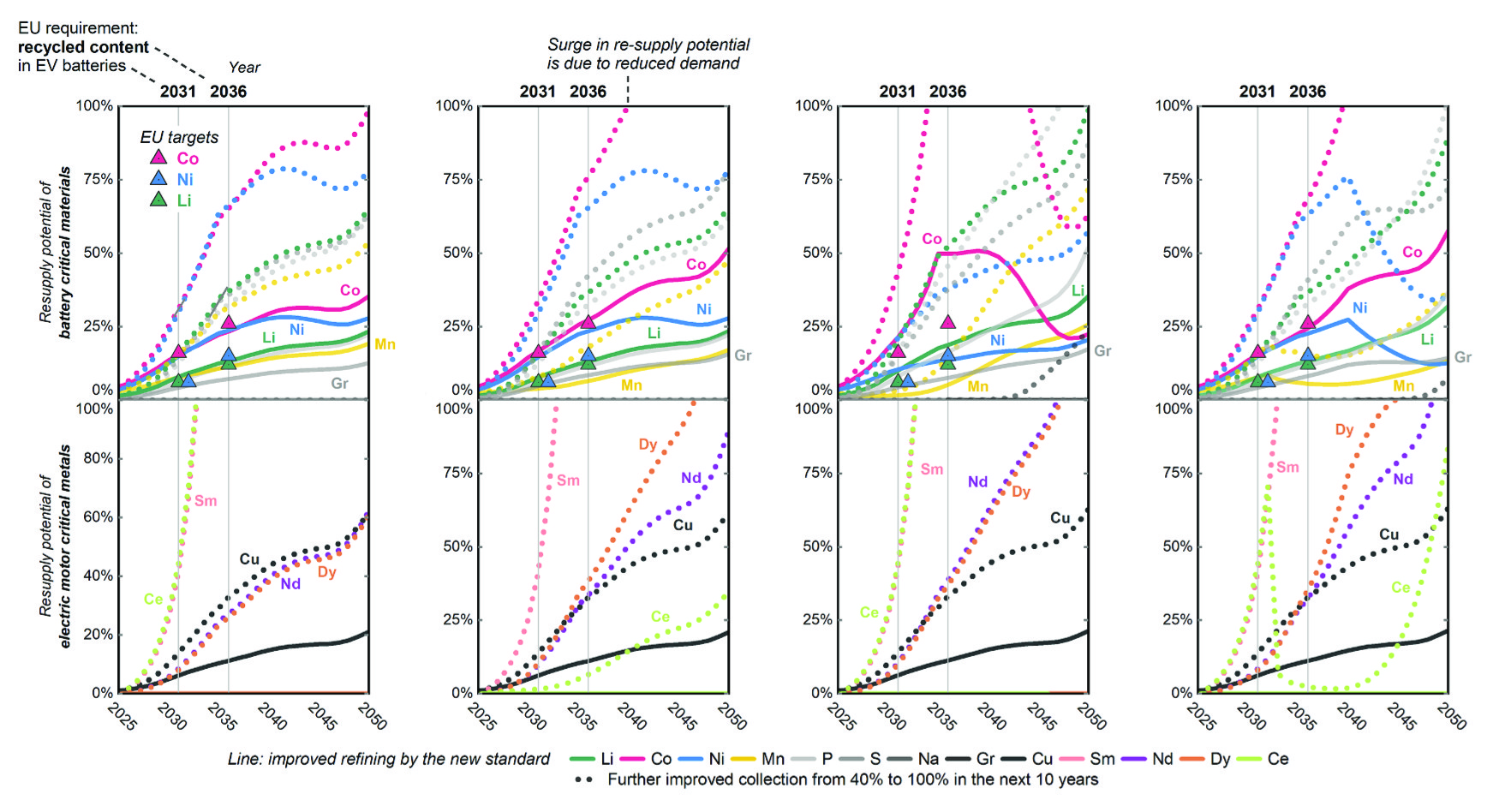
Depending on which scenario you find most plausible and which promising technologies you think will take over, this model can show you which demands can be met by effective recycling and which we’ll remain dependent on mining to supply.
This all hinges on the word “effective” in “effective recycling.” The researchers highlight a number of links in the recycling chain that will need to be strengthened to reach the high end of their numbers.
China is using regulations to address a couple of issues, mandating “battery passports” that identify each battery and its chemical makeup and working to force more scrapped batteries to be sent to officially licensed recyclers. But the researchers also note that China has yet to mandate some level of recycled content in new battery production. And they say the complex recycling chain will be vulnerable to bottlenecks as it rapidly scales up to handle more electric vehicles over time.
Just as the graphite in batteries is often not recycled now because its value is low, the rise of technologies like sodium batteries could be a bit of a double-edged sword, too. Using a less expensive material makes batteries cheaper, but it also means their contents are less valuable to recyclers.
But although technological change complicates the goal of recycling EVs to build new ones, this model shows that the math could work out pretty well for many materials.
Joule, 2026. DOI: 10.1016/j.joule.2026.102602 (About DOIs).