
Climate change is being driven largely by the greenhouse gases we’ve pumped into the atmosphere, which trap more of the Sun’s energy there. That added energy increases the odds of extreme events: longer, more intense heat waves and droughts, interspersed with excessive precipitation. But these sorts of events have happened in the past—how can we tell if any given weather disaster has been made more likely by the climate?
It’s a question with implications for everything from building codes to disaster preparedness. And there’s some good news: According to a report released by the US National Academies of Science on Thursday, the field of climate attribution is growing increasingly mature and can answer some questions for us with far greater confidence than it could just a decade ago. The report also notes that there are still important limits and suggests steps to address them.
Overall, this makes it clear that climate attribution is normal, mainstream science. And the fossil fuel industry views that as a problem, as it could make it easier to hold companies liable for damages. This has triggered a backlash that has Republicans in Congress and state governments threatening the National Academies’ funding.
A decade of progress
Heat waves, excessive precipitation, and other extreme weather events have been happening throughout Earth’s history. The relatively stable climate humanity has enjoyed since the end of the last glacial period has meant that historic extremes typically fall within a relatively narrow range. But we’ve been exiting the stable climate humanity has been familiar with, so we should expect events that fall outside the normal range of variability we’re accustomed to. Can we recognize them when they happen?
That question is linked to a query that has accompanied many weather disasters—the public wants to know if it was the outcome of the global warming we’ve been warned about.
Attribution science has been developed to try to answer these questions. At its simplest, it identifies the major atmospheric features associated with a weather event and then asks how often they occur in climate models under two scenarios: one with our present conditions and one without humanity’s greenhouse gas emissions. The difference in frequency within these two scenarios provides a measure of the influence of climate change.
This approach has been through peer review and has since been used to examine a wide variety of weather events, many of which show the fingerprint (or, in some cases, the fist print) of climate change. There have also been some instances where the methods don’t provide a clear picture.
Understanding the role of climate change in these events can be useful for more than satisfying public curiosity. A lot of our infrastructure and regulations are based on the patterns of events we’ve observed in the past. If those patterns no longer apply, then a lot of things need updating. Obvious examples include the drainage needed to handle typical precipitation or the temperatures a road material will need to tolerate without melting.
Given the importance of these policy implications, it’s no surprise that the National Academies of Science (NAS) have been called on to weigh in on the state of the field; one of its roles has traditionally been to evaluate complex areas of science and provide a summary that policymakers can use. In fact, the NAS was asked to weigh in back in 2016, when the field was developing rapidly. A decade later, it was asked to take a look at where those developments have led.
Degrees of difficulty
The report provides a great overview of how attribution analysis works, where it succeeds, and what challenges keep it from being effective in some circumstances. But one of the first things it makes clear is that the field has gotten better since the NAS last checked in. “Over the past decade, advances in physical understanding—through accumulating observational and modeling evidence supporting long-standing theoretical expectations—together with improved and more sophisticated numerical models, expanded observational datasets, and advanced statistical and machine-learning techniques, have strengthened the foundation for extreme event attribution,” the report’s authors write. “This progress has led to more robust assessments and an increased ability to examine a broader range of extreme event types.”
While there have been (and continue to be) new approaches developed for answering questions, the report says that most of the work is being done within one of two frameworks. The first is called “probabilistic,” which focuses on how climate change has altered the odds of a similar event occurring. The second is termed “storyline,” and is more focused on the specifics of the weather event (to give one example, the frequency of large hailstones) as well as the atmospheric conditions that make them possible. Storylining is especially useful for events like tropical cyclones, where the frequency is rare but some of the atmospheric conditions that contribute to their trajectory or rainfall might show up far more often.
Both of these have benefitted from the same advances in climate science: better models, a greater theoretical understanding of how atmospheric conditions influence weather events, datasets that cover more years and new parts of the globe, and more.
That said, there are some clear limits to what we can do. The biggest of these is simply a lack of historical data. Weather monitoring in the pre-satellite era was not very consistent, and there are areas of the Earth, especially in the Global South, where we simply don’t have good enough records to assess the long-term probabilities of some events. Obviously, things get better with each year’s data, but there are some areas where we can’t say as much about the probability of many events.
The other data limitation is that many extreme weather phenomena take place on small scales—think thunderstorm dynamics or tornado formation. Contrast that with climate models, where even the most advanced ones presently break the world up into grid cells that are 50 to 100 km on a side. This makes it extremely difficult to evaluate many important weather events under different greenhouse gas concentrations.
The result is what the report presents as a confidence gap. We’ve got a strong sense of how climate change influences temperature and rainfall extremes, and so our confidence in attribution in these areas is far stronger. For things like wildfires and severe storms, by contrast, our confidence is much lower. We can also struggle to interpret what the report’s authors call “compound events”—for example, wildfires that occur during extreme dry periods.
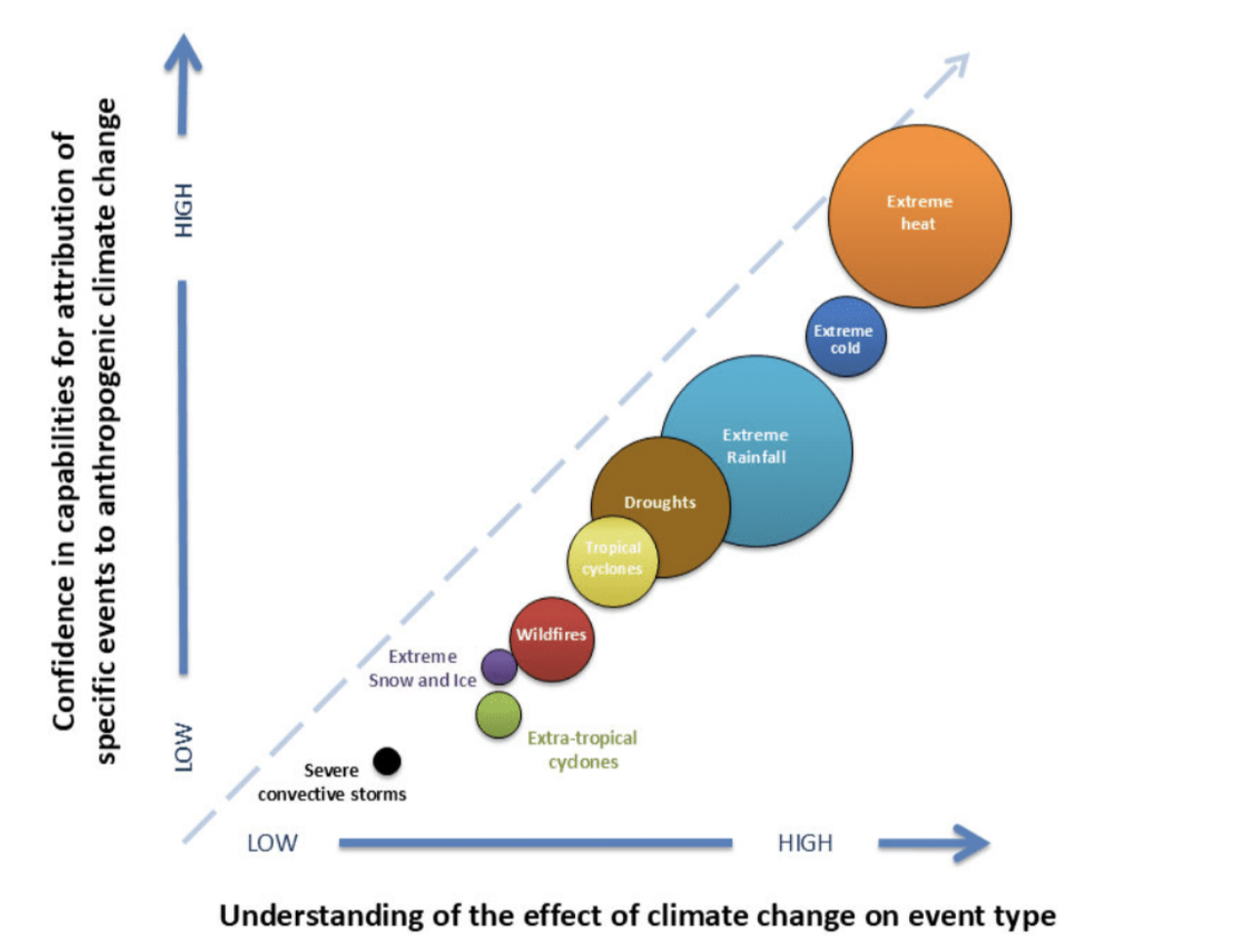
A separate but related challenge comes from analyzing things like heavy rainfall during an El Niño event. Since El Niños (Los Niños?) are stochastic events, it can be difficult to find climate model runs in which the relevant atmospheric conditions appear while an El Niño happens to be occurring.
And then there’s the issue that, by the very nature of the field, it’s looking at rare and extreme events. “The increasing likelihood of interactions between hazards across space and time is leading to more compounding, cascading, and record-breaking events,” the report states. “Attribution of such events poses unique methodological challenges. Calculating the historical likelihood of extreme events with characteristics far outside the tails of the historical distribution poses a statistical challenge.”
What’s needed
The report makes a number of recommendations that, given the above, seem pretty obvious. We need longer and higher-quality records from the global south so that we can have a more global picture of event probabilities. Since we can’t create records where none exist, we should consider using non-instrument records to get them (think of looking for sand deposited inland by extreme storms). Running a climate model with grid squares on a 1-kilometer scale is a massive computational challenge, but the field would really benefit from doing so. The report also recommends greater consideration of human influences beyond greenhouse gases, specifically listing aerosols, irrigation, and land-use changes.
It also notes that, once an attribution method is described in the peer-reviewed literature, most actual uses of that method get published informally. The report’s authors urge their colleagues to periodically revisit what they’re doing in the peer-reviewed literature, although they acknowledge that the journals may not be very interested in publishing papers that don’t seem very novel. The other thing they would like to see is more papers analyzing a single event using both probabilistic and storyline methods, so we can get a better understanding of the relative strengths of the different methods.
The report also looks at a subfield that has been having a moment over the last couple of years: extreme event impact attribution (EEIA). It’s easy to think that there’s a nice linear relationship between the degree of extremity and the severity of the impacts: flooding damage proportional to the amount of precipitation, or deaths proportional to the number of degrees above normal temperatures. But there’s no actual reason to think that’s the case, and plenty of reasons not to.
Flooding damage, for example, tends to have major step changes once water levels exceed specific marks set by riverbanks. How quickly the rain comes down and how long it has been since the last major rain will also influence the damage levels.
Given our developing ability to determine the difference in severity caused by climate change, researchers have attempted to quantify how that translates into damages. These approaches can involve developing what are called impact-response functions, which track the non-linear relationship between the severity of an event and its impact. An alternative is what is called process-based impact modeling, which can involve things like building a complete model of an affected river basin and exploring how it responds to different levels of rain. This latter approach tends to be considerably more involved.
Both of these suffer from a problem that should be familiar by now: “The maturity of impact-response functions and process-based impact modeling varies by hazard, impact type, and region.” They’re most effective in North America and Europe because we’ve got the best records of past events here. Epidemiologists are already providing comprehensive estimates of how many people died in this summer’s European heat wave; a similar event in, say, Papua New Guinea is unlikely to get such comprehensive attention.
These approaches are still the subject of ongoing development, so the report has two recommendations: researchers should be very transparent about the uncertainties in what they’re doing, and they should develop tools to make these analyses useful for disaster preparedness. Knowing that a new weather extreme is possible is far less useful than knowing what aspects of the extreme pose the highest risks.
Normal science
Beyond the specifics of the report, the biggest takeaway is that this is normal science. Researchers have done a lot of work to explore one scientific question, and other researchers are taking the resulting knowledge and tools and applying them to new questions. There are some cases where that has been immediately effective, but there are plenty of others where there’s still considerable work to do.
At that level, it’s difficult to see why anybody would even find this report notable beyond its top-line conclusions about where we’re most confident. It’s even more difficult to see why preparing the report would cause political operatives to launch a FOIA campaign against those authors who happen to work at public universities, as described in the Politico report mentioned above.
The reason the report has stirred up controversy ahead of its release is that the fossil fuel industry views it as a threat. The industry has faced a large number of lawsuits accusing it of everything from fraudulently misleading the public to being responsible for financial damages from weather events. It’s those latter suits that make this report a threat. By presenting attribution as normal science that we’re increasingly confident in, it raises the prospect that courts will allow the scientific evidence developed by the field to be used as evidence in the courtroom.
The situation has been made worse by the fact that the National Academies were already involved in a political fight over the use of climate science in the courtroom. State officials had demanded that the report it prepared on the use of science by judges have a chapter on climate change deleted. The academies have refused, leading to the threats against their funding mentioned above.
Regardless of those threats, the report has now been released. It may take a few years to see whether the fossil fuel industry’s fears are realized in courtrooms, but it’s safe to expect that we’ll see attacks on the science detailed here in the meantime.