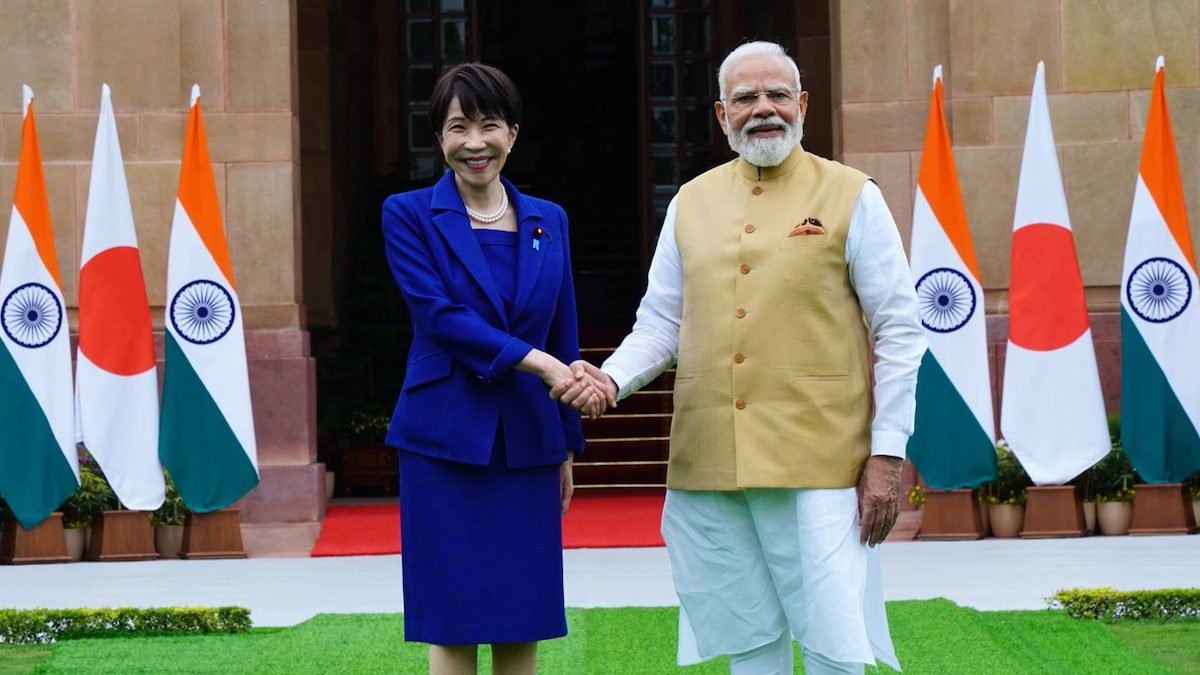
Japanese Prime Minister Sanae Takaichi’s meeting with Indian Prime Minister Narendra Modi in New Delhi on July 2 produced a long list of agreements spanning artificial intelligence, batteries, critical minerals, defense manufacturing, energy resilience and financial cooperation.
While the agreements made headlines, the larger message was the Indo-Pacific’s shifting geostrategic framework. Set against the backdrop of evolving China-Japan dynamics since Takaichi took office, her meeting with Modi underscored that the India-Japan convergence is both structural and strategic.
The meeting signaled a quest for a new economic security architecture in the Indo-Pacific — one that seeks to both manage influence and hedge against vulnerability.
China’s growing willingness to use export controls, investment restrictions and other forms of economic coercion has reinforced concerns about concentrated production networks and technological dependence.
At the same time, the Trump administration’s transactional approach to alliances and burden-sharing — along with the symbolic shift toward “Pacific,” rather than “Indo-Pacific,” in US strategic nomenclature — has reminded regional partners that they can no longer assume continuity in Washington’s strategic priorities.
The central question confronting large Indo-Pacific nations is no longer who they align with, but how they configure the technologies, industries and production systems on which economic security ultimately depends.
Frontier technologies and digital-industrial architectures are emerging as instruments of geopolitical leverage because these platforms and networks are becoming inseparable from national security, economic systems, surveillance and intelligence collection, trade governance and political influence.
The geography of these ecosystems and the interconnections between them determine whether states possess the technological, industrial and resource base necessary to sustain influence. Together, they form the architecture that defines economic security and strategic vulnerability.
The defense-industrial dimension of the India-Japan agreement is particularly revealing. The joint production of the UNICORN integrated naval antenna and communications mast is significant because it demonstrates how industrial policy and defense policy are becoming increasingly intertwined. The distinction between civilian and military industrial ecosystems is steadily narrowing as technological competitiveness itself becomes an element of deterrence.
The Indo-Pacific’s future balance of power will increasingly depend not only on military capability or diplomatic alignment, but on who can configure and anchor resilient industrial ecosystems linking technology, resources, manufacturing and defense production across trusted partners.
Semiconductors, artificial intelligence, critical minerals, batteries, trusted digital infrastructure and defense manufacturing are becoming instruments of influence.
Tokyo is not simply looking for an alternative investment destination in Asia. It is seeking partners capable of anchoring a geographically distributed, resilient industrial ecosystem — one that can absorb geopolitical shocks without the dependencies and vulnerabilities that have emerged in existing supply chains and markets.
Therein lies the significance of the Modi-Takaichi summit as a framework for economic security and influence across the Indo-Pacific. It is about building complementary capabilities that provide a long-term hedge against rival US-China axes as trade weaponization and strategic vulnerabilities pose growing threats.
India and Japan occupy vital nodes in Asia’s industrial landscape outside China. Their capabilities are, in some ways, complementary: Japan contributes capital, advanced manufacturing, precision engineering and frontier technologies, while India offers manufacturing scale, software capability, engineering talent, a large domestic market and a strategic location connecting the Western Pacific with the Indian Ocean.
These attributes make India less an alternative to China than a vital component of a more distributed Indo-Pacific production network — one that hedges against economic and national security vulnerabilities. New Delhi’s pursuit of hedging, balance and strategic autonomy amid the rival U.S. and China-dominated axes, combined with its economic capabilities, gives it a singular position in Asia.
The Takaichi-Modi meeting could thus mark the start of a wider shift toward technology-defense-industrial systems integration across the larger Indo-Pacific economies seeking a hedge against the rival US-China axes. Takaichi’s interpretation of Japan’s Free and Open Indo-Pacific (FOIP) strategy reflects this shift. Under Takaichi, economic security has become FOIP’s defining characteristic.
Strategic industries now occupy a central place in Japan’s strategic thinking, alongside maritime security. FOIP has consequently evolved from a framework for preserving regional order into one for managing strategic vulnerability at a time when economic interdependence itself has become a source of geopolitical risk.
India fits well with Japan’s need to anchor a wider industrial ecosystem that does not replicate the concentration risks associated with China-dominated production networks. The agreements signed in New Delhi, therefore, represent more than an expansion of bilateral cooperation. They show how India and Japan are seeking to reconfigure strategic influence through technology-defense-industrial capabilities rather than diplomacy alone.
Neither India nor Japan seeks to diminish the US’s central role in the region. Both recognize that they cannot address global vulnerabilities arising from critical-mineral dependencies, semiconductor supply chains or technological concentration without American participation in the global technology-industry architecture. Japan and India also understand the need for alliances that can endure regardless of shifts in American politics.
The Quad will remain a key Indo-Pacific strategic coordination framework, central to the China context. But its significance increasingly lies in facilitating cooperation among Asia’s largest industrial, technological and defense manufacturing systems and networks.
The agreements announced in New Delhi, therefore, are not simply discrete bilateral initiatives. They point to an emerging Indo-Pacific strategic and economic security architecture.
Vivek Y Kelkar is a researcher and analyst focused on the intersection of geoeconomics, geopolitics and corporate strategy.