TOKYO — South Korea has long been one of the world’s best early-warning systems. Its US$1.9 trillion economy is open, large, and sits at the intersection of every major shift in trade, finance and technology. Right now, Seoul, true to form, is flashing red about the risks of betting it all on artificial intelligence.
No major economy has pivoted its core growth engine faster or more abruptly than the one President Lee Jae Myung has led since June 2025. Ask the average Korean on New Year’s Day what defined their economy, and they’d likely have said cars, ships, smartphones, or K-pop. Six months later, the answer is unanimous: AI.
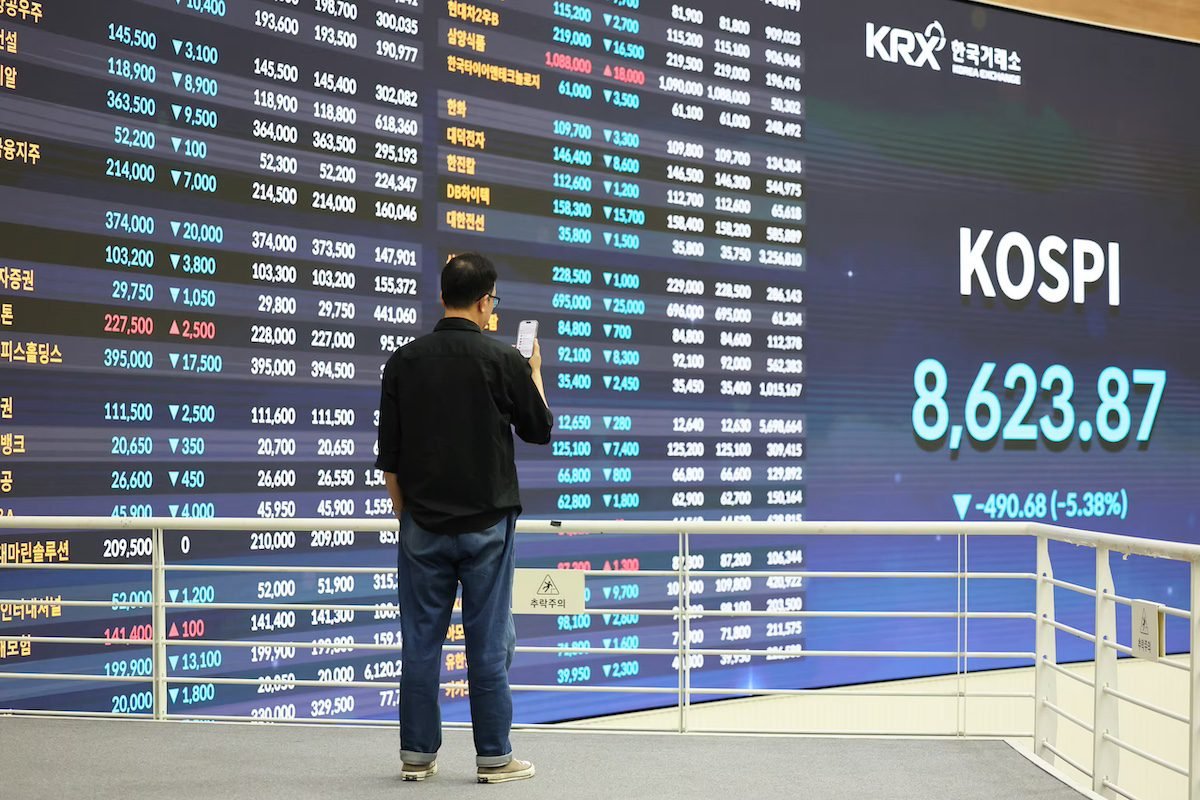
Investors are less sure the bet is paying off. The nearly $5 trillion Kospi index has been swinging like a meme stock — erratic behavior for a top-10 global bourse by market cap. It’s a case of the tail wagging the dog: a rally powered by two or three companies and an unproven technology now dwarfs the country’s GDP by more than 2.5 times. That concentration has become the Lee administration’s problem to manage.
Monday’s 5% Kospi drop barely raised eyebrows by recent standards. The index has hit 12 circuit-breaker halts in its history — six of them this year alone.
The sell-off came despite Samsung Electronics posting a record 1,800% jump in year-on-year profit on nearly double the sales. If anything, the scale of that number unnerved investors further, stoking fears that AI infrastructure spending is running ahead of actual demand for machine-learning tools.
Markets “need confident guidance, durable pricing power and proof that AI demand is still accelerating,” says Charu Chanana, chief investment strategist at Saxo Markets. The real question, she notes, is whether today’s memory-chip shortage becomes tomorrow’s glut.
Tickmill Group analyst Patrick Munnelly frames it similarly: investors haven’t given up on the AI story, but they’re testing whether a sector priced for perfection can keep delivering through earnings season.
That’s an uncomfortable backdrop for SK Hynix, which debuts Friday in a $28 billion US IPO — the largest ever by a foreign company, and many times oversubscribed. The turbulence heading into the listing likely isn’t helping anyone sleep in Seoul’s boardrooms, especially with SK Hynix up 639% year-to-date — a run that has some investors wondering if the easy gains are already behind it.
Regulators are on edge too. Korea’s Ministry of Finance warned this week that concentration in the semiconductor sector is amplifying market-wide volatility, since swings in chip stocks now ripple through the entire index.
On Tuesday, the Financial Supervisory Service said it’s watching the fallout from newly launched single-stock leveraged exchange-traded funds (ETFs) tied to chipmakers — SK Hynix chief among them — and scrutinizing how asset managers are marketing them. The Bank of Korea said Sunday it’s coordinating with other agencies on the same concentration risk.
Taiwan is living a version of the same story. Betting on Taiwan increasingly means betting on one company: Taiwan Semiconductor Manufacturing Co. AI chip demand pushed Taiwan’s GDP up 13% year-on-year in the first quarter — its $976 billion economy is just as leveraged to the AI cycle as Korea’s.
Japan is heading that way, too. SoftBank has overtaken Toyota as Tokyo’s most valuable company. The 588% ytd rally in Kioxia shares saw the memory maker leapfrog Toyota, too. Components supplier Taiyo Yuden is gaining on Toyota, too.
The Nikkei 225 just surged recently through 72,000, up from 50,000 on January 1. Never mind stagflation, falling real wages, stagnating and the Bank of Japan hikes rising to a 31‑year high. AI is lifting all financial boats.
What’s striking is how completely AI has taken over Korea’s growth model in the space of months. Autos have gone flat and nobody seems to mind — because the 61% jump in exports in the first 20 days of June is an AI story, not a car story.
Semiconductors now account for 41.2% of total exports, up 18.3 percentage points from a year earlier, with chip exports alone up 188.4%.
The deeper worry: this isn’t confined to one company or one stock. Korea is the world’s 15th-largest economy, Taiwan the 22nd-largest, and both are tying their futures to a technology that hasn’t yet proven it can generate returns to match the hype. It’s a reversal of the diversification drive both pursued after the 1997 Asian financial crisis.
Seoul isn’t hedging that bet — it’s doubling down. Korea is backing AI with more than $102 billion in incentives and blurring the line between the sector and the economy itself.
Late last month, Lee stood with the heads of Samsung and SK Hynix to announce corporate investment pledges of at least US$880 billion, including $500 billion in new chipmaking plants far from the capital.
It’s part of an effort to fix Korea’s long-standing overconcentration in Seoul. As Lee frames it: “Balanced national development is no longer merely a policy objective — it has become a national survival strategy.”
But if global investors ever decide that titanic bets on monetizing AI — and the sprawling data centers underwriting it — are too risky, Korea won’t be a bystander to the reckoning. It and the rest of Asia will be ground zero for the financial fallout should AI experience a dot-com-style reckoning.
The US faces its own risks. As Ben Snider, a top equity strategist at Goldman Sachs, puts it: “Sharp momentum factor rallies with the equity market near highs have historically boded poorly for subsequent S&P 500 returns, with comparable previous examples including late 1999 and late 2021.”
That’s true globally, too. Looking through the lens of valuations, positioning, and sentiment, “all measures of asymmetry and risk are flashing amber,” Oliver Shale, investment specialist at Ruffer LLP, tells Reuters. “None of this is to say that the end is nigh, but that is a fragile setup for any market.”
JJ Kinahan, head of alternative investment products at Cboe Global Markets, adds that “the folks selling the picks and shovels are in incredibly good stead. Those buying them still have to prove that the billions and billions of dollars they’re spending is worth it.”
Peter Perkins, strategist at advisory firm MacroResearchBoard, notes that his team sees “greater odds of investor disappointment than positive surprises in the year ahead.” He adds that “gauges of investor sentiment underscore that current capital market pricing already reflects significant economic optimism and further upside for stocks versus bonds. The test for technology stocks, and semiconductors in particular, looms.”
With the Kospi down 20% from June highs — putting the market in technical bear-market territory — that test may be arriving in Seoul earlier than for its peers. The benchmark had climbed as much as 116% year-to-date at its high; it’s now up roughly 72%.
This would be as much a blow to investors as to Lee’s Democratic Party. Over the past 13 months, Team Lee has delivered few of the upgrades needed to raise productivity, level the corporate playing field, empower women, and clear space for startups to disrupt the old order.
To be fair, Lee has been busy restoring calm and credibility to Korea’s government. Seoul had descended into chaos after Lee’s predecessor, Yoon Suk-yeol, declared martial law in December 2024. The stunt got Yoon impeached and imprisoned, and put Asia’s fourth-largest economy in the same company as fellow martial-law-declarers Indonesia, Myanmar, the Philippines and Thailand. Rebuilding credibility — at home and abroad — fell to Lee.
Unfortunately, his team has proceeded as if AI were an economic elixir, one that might spare Korea the harder work of structural reform. That’s especially true when it comes to reining in the family-owned conglomerates, or chaebols, that have towered over the economy for decades — soaking up the space and capital that startups and mid-size firms need to grow.
Instead, AI may be making the historically opaque chaebols stronger than ever. Two of the biggest — Samsung and SK Hynix — are growing more dominant by the day. One consequence: Korea’s multi-year push for an upgrade to developed-market status from index giant MSCI has just gotten harder. Such a reclassification would pull powerful waves of international capital into won-denominated assets — and pull Korea out of the orbit of China and India.
In recent years, Seoul has pledged to accelerate corporate reform. In 2024, policymakers launched a “Corporate Value-Up” program modeled on Japan’s decade-long push to boost returns on equity, promising sweeping capital-markets upgrades: greater transparency, the removal of outdated regulations, longer currency-trading hours, and looser limits on corporate ownership.
This week, Seoul followed through on one piece of that, launching a 24-hour onshore spot dollar-won trading system — a “starting point for the won’s global leap,” says Finance Minister Koo Yun-cheol.
But the AI-driven volatility now roiling Korea’s markets is a challenge Lee’s economic team probably didn’t see coming. And it’s peaking just as renewed fighting in Iran threatens to reignite global inflation — perhaps raising pressure on the Bank of Korea to hike interest rates.
Amid deep uncertainty over the second half of 2026, one thing seems clear: Korea’s “old economy” and “new economy” are on a collision course — one that will send shockwaves well beyond its borders. And set the stage for what other beneficiaries of the AI trade may soon experience.
Follow William Pesek on X at @WilliamPesek