As India’s stealth fighter gap widens, Russia is pitching the Su-57 as a solution — but production realities may tell a different story.
This month, Defense News reported that Russian President Vladimir Putin renewed his offer of unrestricted joint production and technology transfer for Russia’s Su-57 fifth-generation stealth fighter during the St. Petersburg International Economic Forum.
This strategic proposal directly addresses India’s critical capability gap: the Indian Air Force currently lacks fifth-generation stealth platforms while neighboring China rapidly scales up its fleet and Pakistan reportedly plans to acquire Chinese J-35 stealth jets.
Though India previously withdrew from a similar co-development project with Russia in 2018 over cost and technology disputes, Hindustan Aeronautics Ltd. confirmed that they are now awaiting Russia’s financial quotation to present to air force officials.
Indian defense planners confront a significant dilemma: procuring two to three interim Su-57 squadrons could quickly address regional threats.
However, the multi-billion-dollar deal might divert crucial resources and reduce motivation to develop India’s indigenous fifth-generation fighter, which is unlikely to become operational before 2035.
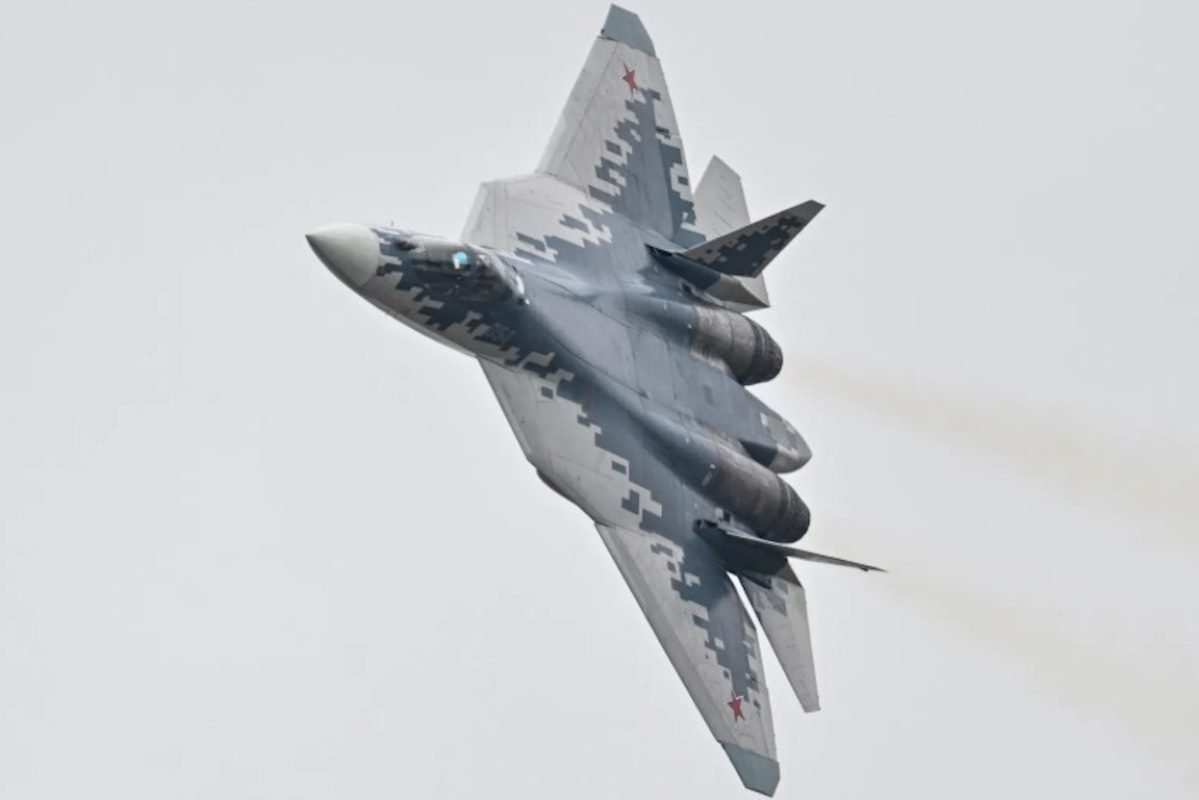
The US Army’s ODIN database describes the Su-57 as an air-superiority and strike fighter that combines low-observable features, internal weapons bays, advanced sensor fusion and an active phased-array (AESA) radar with exceptional maneuverability.
According to the database, the Su-57 can supercruise at speeds up to Mach 2, sustain supersonic flight without afterburners, and has a combat range exceeding 1,500 kilometers. Its extensive use of composite materials enhances stealth and reduces weight, while its aerodynamic design supports extreme high-angle-of-attack maneuvers.
Furthermore, Russia has produced a two-seat version of the Su-57. The extra crew could enable long-range air defense and strike missions and possibly serve as a “mission commander” for loyal wingman drones such as the Okhotnik.
The Su-57 has already been exported, with two units delivered to Algeria in November 2025, as part of an order for 12 aircraft.
As for the Su-57’s combat record, Army Recognition reports this month that Russia has used the aircraft in Ukraine, launching standoff strikes with Kh-59/69 cruise missiles up to 400 kilometers behind the front lines rather than penetrating defended airspace.
The report adds that launch distance, altitude management, controlled flight corridors, electronic protection, and precision-guided weapons enhance the aircraft’s survivability.
Such employment mirrors the doctrine used by both sides during the May 2025 aerial skirmishes over Kashmir, in which no aircraft from either side crossed national borders, reflecting the seriousness with which both sides view each other’s air defense capabilities.
Beyond exercising caution, this doctrine may have been intended to prevent escalation, as the conflict became a war of drone and missile exchanges, precluding border crossings by either aircraft or land forces and mass mobilization.
In view of that, the Su-57 may offer a qualitative solution to the Indian Air Force’s modernization challenges exposed during the May 2025 aerial skirmishes over Kashmir.
Peter Layton mentioned in a November 2025 Airspace brief that India lost two, or maybe three fighters – a French-made Rafale, a Russian-made MiG-29, and perhaps a Russian-made Su-30.
Most tellingly, a Chinese-made Pakistani J-10C using a long-range PL-15 missile was credited with downing one of India’s Rafale jets, suggesting that Chinese weapons may now be capable of competing with leading Western systems.
Furthermore, Pakistan’s Chinese-origin “ABC” aerial kill chain – locked on by ground systems such as the HQ-9P air defense system, PL-15 missiles launched by J-10C fighter jets, and guided by ZDK-03 airborne warning and control (AWACS) to their targets – stands in stark contrast to India’s mixed ecosystem combining Western, Russian, and domestically made systems, which may pose integration problems.
Moreover, the Pakistan Air Force may be on the verge of a major ecosystem upgrade, with Defense Security Asia reporting this month that, along with the J-35, Pakistan may acquire the KJ-500 AWACS and HQ-19 air defense systems, improving its Chinese-made kill chain but at the same time deepening its dependence on Chinese military hardware.
China has positioned J-20 stealth fighters at Shigatse Air Base in Tibet, close to the disputed Himalayan border with India. These aircraft are less than 160 kilometers from India’s Sikkim border and the Siliguri Corridor.
Taken together, these developments may be eroding India’s traditional qualitative edge in the air domain.
In addition, India may not have enough fighter aircraft for its needs, with the International Institute for Strategic Studies (IISS) noting in February 2026 that the Indian Air Force has about 29 fighter and ground-attack squadrons, well below the minimum target of 42 fighter squadrons.
Still, the question remains whether Russia can produce enough Su-57s to meet India’s needs. Peter Suciu points out in a January 2026 article for The National Interest (TNI) that as of that date, Russia appears to have only 32 Su-57 units, including prototypes and non-combat models – way short of its stated goal of having 76 units by 2027-2028.
Suciu says that deliveries have fallen short due to supply chain and funding constraints. He mentions that, with a price tag of US$100 million per aircraft, Russia has sought foreign buyers to subsidize the aircraft’s costs.
However, Ukrainian deep strikes in Russia have destroyed two Su-57s on the ground in April 2026, and a fire the same month at the Komsomolsk-on-Amur plant producing critical composite materials for the aircraft may further slow already low production rates by disrupting key supply-chain nodes.
Furthermore, India’s longstanding preference for Russian arms appears to be undergoing a significant structural shift. Multiple data sets from the Stockholm International Peace Research Institute (SIPRI) show that while Russia remained India’s top supplier from 2017 through 2025 — accounting for 46% of Indian imports in 2017-21, 45% in 2018–22, 36% in 2019–23 and 40% in 2021–25 — overall import volumes have steadily declined.
This drop stems from India’s expanding domestic defense manufacturing and a deliberate strategy to diversify its supplier base.
Driven by persistent geopolitical tensions with China and Pakistan, India is shifting toward Western suppliers, placing substantial new and planned orders with France, Israel, and the US rather than Russia.
Furthermore, Russia’s export capacity faces long-term constraints due to trade sanctions, international pressure, and a mandate to prioritize its domestic military needs following the 2022 invasion of Ukraine. Consequently, two-thirds of Russia’s shrinking global arms exports are now concentrated in just three states: India, China and Kazakhstan.
The Su-57 may offer India a faster path to fifth-generation capability, yet it remains unclear whether Russia can reliably supply the aircraft in the numbers India requires — or whether doing so would come at the expense of India’s long-term quest for defense self-reliance.