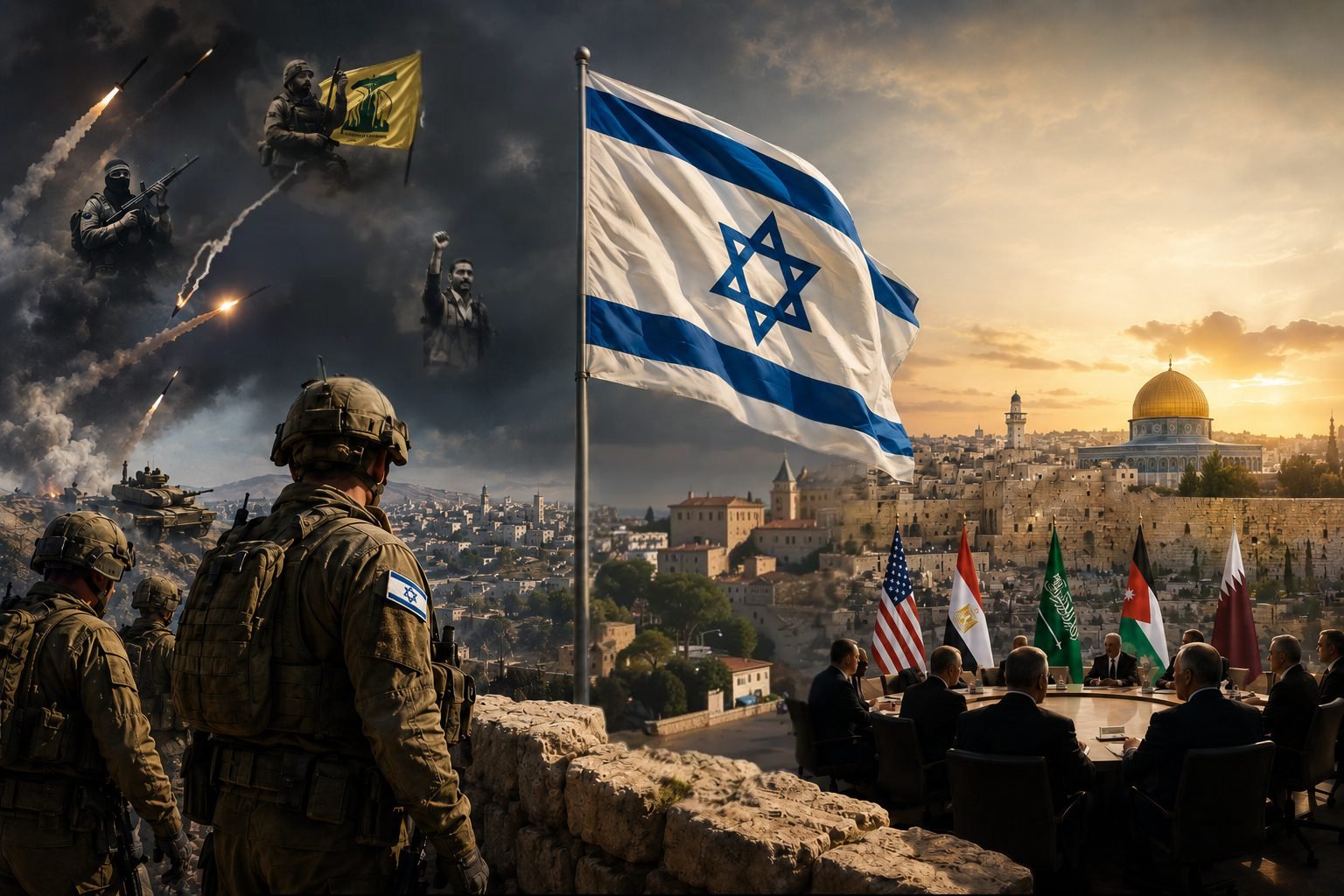
Israel must defend itself against Hamas, Hezbollah, and Iran, but military strength alone cannot secure the future without a clear diplomatic and strategic plan for the day after
For nearly two years, Israel has been fighting on multiple fronts. Our soldiers continue to risk their lives. Families continue to mourn loved ones. Entire communities have lived under the constant threat of rockets, missiles, drones, and terrorism.
The State of Israel has demonstrated extraordinary resilience and military strength. Our soldiers, reservists, security services, and civilians have faced unprecedented challenges with courage and determination.
But courage cannot substitute for strategy.
Israel cannot afford to remain trapped in endless war. The people of Israel cannot. The Iranian people, who themselves suffer under a regime that prioritizes regional aggression over the well-being of its citizens, cannot.
The Middle East needs a future beyond permanent conflict. Yet any serious discussion about peace must begin with a simple and undeniable truth: Israel cannot be expected to accept insecurity as the price of stability.
For radical Muslims, there is no concept of permanent peace with non-Muslims. Instead, there is the concept of hudna, which refers to a temporary truce or suspension of hostilities rather than a lasting peace agreement.
Today, Israel faces threats on several fronts.
On the southern border, Hamas remains committed to Israel’s destruction. The atrocities of October 7 were not an isolated event. They were the result of an extremist ideology that openly celebrates terrorism and targets innocent civilians. No country in the world would agree to live alongside an armed organization that openly promises future massacres. Israel cannot be expected to do so either.
On the northern border, Hezbollah continues to pose a major threat. Backed, funded, and armed by Iran, Hezbollah has accumulated a massive arsenal of rockets and missiles aimed at Israeli cities and communities. For years, the residents of northern Israel have known no normalcy—living under the persistent threat of attack, with entire communities bearing a heavy and painful price.
Beyond these physical borders stands the central source of instability in the region: Iran.
Iran has deliberately constructed a network of armed proxies across the region—from Gaza to Lebanon, from Syria to Yemen. Rather than investing in the welfare of its own citizens, the regime channels billions into terrorism and military expansion. As long as Tehran believes it can achieve its ambitions through armed proxies and escalation, lasting stability in the region will remain out of reach.
But Israel is fighting another battle as well.
There is a growing international campaign that seeks to portray Israel as the aggressor while ignoring the realities it faces. Too often, international media outlets present images without context, repeat unverified claims, or create a false moral equivalence between a democratic state defending its citizens and terrorist organizations whose stated goal is its destruction.
This battle over truth matters.
When misinformation spreads, it fuels hostility toward Israel, strengthens extremist narratives, and contributes to rising antisemitism around the world. It undermines genuine diplomacy and makes it more difficult for the international community to understand the complex realities on the ground.
Israel faces a double burden: defending its citizens from rockets and missiles, while defending its very legitimacy from systematic distortion and disinformation. That is the reality—and it must be named.
The massacre of October 7 shattered many assumptions. It reminded Israelis that porous borders, weak deterrence, and wishful thinking can carry a devastating cost.
No responsible Israeli government, whether from the right, the center, or the left, can agree to a future in which Hamas remains in power, terrorist armies continue to threaten our borders, and Iran retains the ability to dictate events through its proxies.
These are not partisan positions.
These are not matters of political preference.
They are matters of national survival.
Whether one supports Prime Minister Benjamin Netanyahu or opposes him is a legitimate democratic debate. Israelis hold deeply different views regarding his leadership, his decisions, and his responsibility for the failures that preceded October 7. Ultimately, those questions will be decided by the Israeli public through democratic elections.
But while political arguments continue, strategic realities do not wait.
Major discussions about the future of the Middle East are taking place right now. Regional arrangements, diplomatic initiatives, security understandings, and negotiations involving key regional actors are often conducted in capitals far from Jerusalem.
This is not a criticism of the United States.
America, like every sovereign nation, acts first and foremost in accordance with its own national interests. That is natural, legitimate, and expected. Every American administration, Republican or Democrat, is accountable to the American people before anyone else.
President Donald Trump entered office promising to end wars and reduce instability in the Middle East. Many people welcomed that aspiration. After decades of conflict, the desire to create a more stable region is understandable.
Yet a deal that leaves Israel vulnerable is not a path to stability. It is a path to the next war, but with an experienced and more powerful enemy.
The question is not whether America will pursue its own interests. The question is whether Israel is doing enough to ensure that its own vital interests are fully represented in the discussions that will shape the future of the region.
Too often, Israel appears to be reacting to developments rather than helping shape them.
A strong Israeli leadership must ensure that decisions affecting Israel’s future are not made without a significant Israeli voice at the table. The future of Gaza, the threat from Iran, security arrangements along our borders, and the broader regional architecture will directly affect the lives of Israeli citizens for generations.
At the same time, military success must eventually be translated into political and strategic achievements.
No nation can thrive in a state of permanent war.
The people of Israel deserve security and a future free from constant threat. The Iranian people deserve a government that invests in their prosperity instead of spending their future on regional aggression.
The Middle East does not need another generation raised amid fear, hatred, and violence.
Israel must remain strong. It must maintain its military superiority. It must never compromise on the security of its citizens.
But strength alone is not enough.
Israel needs security, but it also needs a strategy for the day after.
Because endless war is not a strategy.
Security, stability, and hope are.