A manual put out by Palestine Action, a group banned in the UK, which lists companies and private addresses, has drawn criticism that the material lowers the barrier between protest, vandalism, and operational targeting
A public map of companies linked, directly or indirectly, to Israel’s defense industry has turned Palestine Action’s campaign into something more difficult to classify than a protest drive. The map lists companies, suppliers, facilities, and, in some cases, private addresses connected to individuals linked to targeted firms. A linked guide tells supporters how to organize.
The organization has been banned in Britain since February, but continues to operate freely in other countries. Now, B’nai Brith Canada is calling on Ottawa to examine whether Palestine Action should be listed as a terrorist entity, saying the material is being shared by an active Canadian chapter and is available for anyone to access.
Palestine Action was launched in the United Kingdom in July 2020. It operates by targeting companies it identifies as “corporate enablers” of the Israeli military, with a primary focus on dismantling the operations of Israeli arms firm Elbit Systems. The organization has since expanded to target other Israel-linked companies and individuals in several countries.
“You know where it starts. You never know where it ends,” Matias Rott, head of intelligence at Taurus and a certified expert in cyber investigation, told The Media Line after reviewing the map and manual. “The manual is so lax that you can say, ‘I can do whatever I want with this manual because it’s just teaching me the ABC on how to do any protest.’”
The manual is so lax that you can say, ‘I can do whatever I want with this manual because it’s just teaching me the ABC on how to do any protest’
Following an attack on RAF Brize Norton in June 2025, the UK Government formally proscribed the group on July 5, 2025, under anti-terrorism legislation. Palestine Action remains banned in the United Kingdom pending the government’s appeal, even after London’s High Court ruled the ban unlawful, saying it disproportionately interfered with rights to free expression and assembly.
The same judgment did not describe Palestine Action as an ordinary protest group. It noted that the organization promoted its political cause through criminality and its encouragement, but found that proscription had not been justified at the required scale and level of persistence.
That legal tension sits at the center of the debate surrounding the group’s “Target Map” campaign. Supporters frame it as pressure against companies tied to Israeli defense contractors. Critics say the combination of mapped targets, private addresses, operational guidance, and decentralized action turns political campaigning into a threat environment.
Richard Robertson, director of research and advocacy at B’nai Brith Canada, told The Media Line that his organization is “deeply concerned by Palestine Action globally,” and specifically by what he described as an active Canadian chapter sharing the group’s underground manual and target map.
“What is concerning about this is that they’re identifying targets in Canada and around the world openly on the web for anyone to access and encouraging individuals to engage in criminal activity against those targets,” Robertson said. “This is something that we don’t typically see. Usually, those who are engaging in sabotage or who are promoting violence or anarchy don’t do so in the public forum. But what separates Palestine Action, and in fact, what we believe makes them so dangerous, is that they’re doing this in plain sight.”
Robertson said the issue should not be treated as a conventional free speech dispute.
“This isn’t even hate speech,” he said. “This is counseling criminal activity, suggesting that individuals form cells, conduct reconnaissance, engage in acts of sabotage, engage in acts of criminal violence. This isn’t protected speech, certainly not in Canada or in any country for that matter. This is counseling terrorism.”
This isn’t protected speech. … This is counseling terrorism.
He continued, “We have formally asked for the Canadian government to review Palestine Action Canada and to consider whether or not they meet the threshold for listing as a terrorist entity here in Canada.”
“Doing so, listing Palestine Action Canada or listing Palestine Action as a global organization would enable our government to take preemptive actions to protect Canadians against the threat that they pose,” he continued.
Robertson said B’nai Brith Canada is also calling for an investigation into Palestine Action, its manual, its target map, and any foreign links that could meet the threshold for criminal charges.
“We need to get ahead of this group,” he said. “We can’t wait for them to actuate on their threats here in Canada.
Rott said the danger lies in the way open-source information can be turned into operational material. Companies, suppliers, contractors, and corporate officers can often be traced through open sources, especially when campaigners spend time building databases. What changes the picture, he said, is the use made of that information.
Every big attack starts in open-source intelligence. You are going to try to gather as much information as you can in order to profile your victim.
“Open-source intelligence is one of the keystones to becoming operational,” Rott said. “Every big attack starts in open-source intelligence. You are going to try to gather as much information as you can in order to profile your victim.”
The Palestine Action manual, available through the target map, does not simply present slogans or protest messaging. It discusses small groups, secrecy, preparation, and action. Rott said that is why the material should be analyzed differently from standard activist content.
“Technically, they are operating as any intelligence cell and as any terrorist cell,” he said. “We are going through not only how to create a cell, but also how to perpetrate an attack.”
He stopped short of making a formal legal classification, saying different countries would handle the case under different laws. But as an intelligence matter, he said, the structure is clear enough. “They seem to have some degree of intelligence on how to create a dormant cell, how to perpetrate an attack, and even more, how to secure lines of communications in order to organize everything,” he said. “What we are seeing right now is dormant cells that can act as lone wolves. They have to choose their own objectives.”
Lt. Col. (Res.) Dr. Uri Ben Yaakov, a former senior officer in the Israeli security establishment and a researcher at the International Institute for Counter-Terrorism at Reichman University, said the model is not new. What is striking, he said, is how openly it is now available.
“I don’t think it’s a new phenomenon,” Ben Yaakov told The Media Line. “We found in the past what they called killing lists with names and addresses of army people, and we saw it in different places.”
He said groups under pressure have often moved from centralized command structures to calls for autonomous action. “We learned it once Al-Qaida faced, I would say after September 11, when all the intelligence entities were after them,” he said. “They had to go below the radar, and they started the call for lone wolves and independent operations. The same with ISIS [Islamic State] in 2017, after they started facing losses in Syria and Iraq.”
Ben Yaakov said Palestine Action’s methods should be viewed within the broader pattern of proxy-style activity, even if the ideology and target set differ. “The call for proxy operations is very acceptable nowadays,” he said.
For him, the key issue is not only the damage done at a specific site, but also the pressure placed on the people and companies being named. “The damage, the real damage, is not the important issue,” he said. “The real damage is to the reputation. The real damage is to threaten the different organizations or people behind these organizations.”
The real damage is to the reputation. The real damage is to threaten the different organizations or people behind these organizations
That matters because many of the listed targets are not Israeli state institutions. Some are local companies, suppliers, business partners, landlords, or entities accused of indirect links to Israel’s defense sector. Security experts say that broadening the target pool can expose people who are not decision-makers in Israeli policy and may have no direct role in any military activity.
Robertson said the danger to Canadian targets should not be treated as hypothetical. He pointed to the record of Palestine Action in Britain, where the group has targeted institutions it had previously identified.
“It’s our opinion that the risk is real and that it must be taken seriously,” he said. “We’ve already seen the willingness of other Palestine Action chapters, specifically the chapter in the UK, to actuate on their desires. They have targeted the institutions that they’ve highlighted in the United Kingdom.”
“We can’t wait for similar things to happen here in Canada,” Robertson continued. “We know that this group is willing and able to actuate when they target something, when they identify something. We have to take that seriously.”A similar concern has emerged in the United States, where the Anti-Defamation League (ADL) says Palestine Action US later appeared under a new name, Unity of Fields. The ADL described Unity of Fields as a direct-action network that supports groups such as Hamas, Hezbollah, the Houthis, and the Popular Front for the Liberation of Palestine, and said the new formation called itself “a new front against the US Empire.”
The group has also appeared before Congress for security testimony. In June 2025, Kerry Sleeper, deputy director of intelligence and information sharing at the Secure Community Network (SCN), told the US House Committee on Homeland Security that anti-Israel networks operating in the United States and online were helping create a more dangerous domestic threat environment. SCN, the official safety and security organization of the Jewish community in North America, works with Jewish federations, law enforcement agencies, and Jewish communal security partners across the continent.
Sleeper named Unity of Fields alongside Students for Justice in Palestine, Within Our Lifetime, and online propaganda hubs such as the emerging ISNAD Network, saying such networks “help blur the lines between protest and incitement” by justifying, glorifying, and promoting violence against the Jewish community in the name of Gaza.
SCN’s testimony also placed that concern in a broader threat context. Sleeper said SCN analysts identified approximately 500 online “Threats to Life” targeting the Jewish and Israeli community in the previous year and were on pace to surpass 700 in 2025. After the May 21 shooting outside the Capital Jewish Museum in Washington, SCN analysts identified approximately 6,000 violent threats against the Jewish community on social media in one week.
The US rebranding matters because it points to a broader problem raised by both experts interviewed by The Media Line: once a map, manual, and propaganda channel exist online, the model can be copied, renamed, and adapted by actors who are not formally controlled by the original organization. The name may change, but the operational logic can remain.
Rott said the campaign should be understood as a full process, not only as a website. The map identifies potential locations. The manual describes how supporters can organize. The group encourages activists to document actions and feed them back into the campaign. “After communicating the target and perpetrating the attack, they can even send pictures or videos of the attack that they may use in order to recruit other people,” he said.
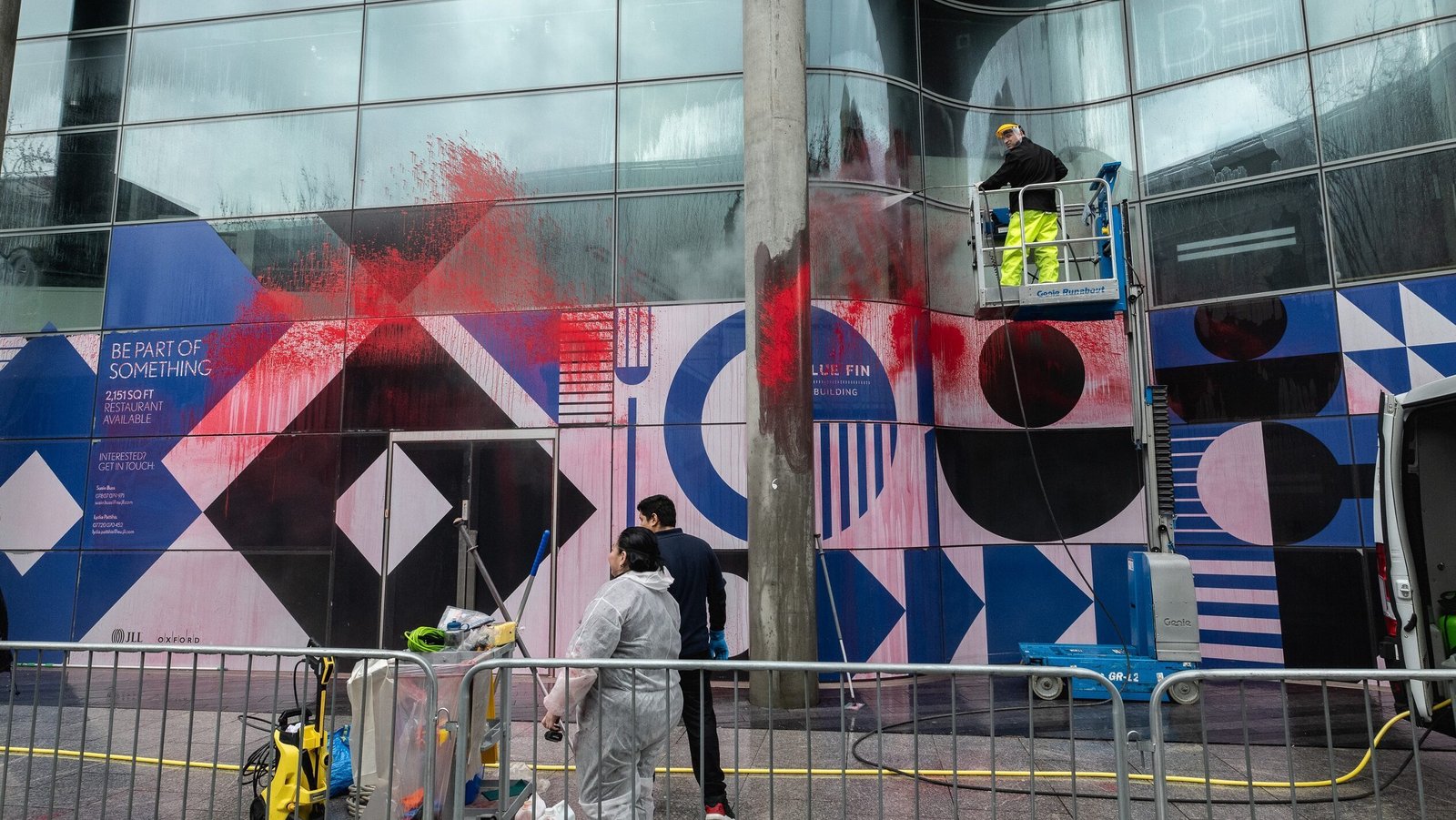
In his view, that creates a cycle: information, action, propaganda, recruitment, and then more action. “It’s a really complex situation that should be taken into account,” he said. “Sometimes you say it can start as something not as important, once again, a painting. But if you follow the procedures and you are a little bit more shady, you can get into a proper terrorist attack with this kind of manual.”
Ben Yaakov focused less on radicalization as an abstract process and more on execution. The danger, he said, is that online material can simplify the move from belief to action.
I think that the problem is the execution, or how easy it is to execute such an operation, more than radicalization
“I think that the problem is the execution, or how easy it is to execute such an operation, more than radicalization,” he said. “Because radicalization, you know, it’s something that is out there.”
For democratic governments, that creates an uncomfortable security challenge. Traditional intelligence methods are more effective when people communicate within an organization, receive orders, transfer money, or coordinate logistics. But decentralized action moves some of the most important decisions into private spaces, sometimes into the mind of a single person or a tiny group.
“When you have an organization of a group of people that are on the way to commit an attack or preparing something, they are talking among themselves,” Ben Yaakov said. “So the traditional, the classic intelligence is good. You have communication intelligence. You have human intelligence.”
But the model changes when the idea comes from a public campaign and the execution happens elsewhere. “The preparation is everything, and everything is always between the two ears of a sick man, or between him and his brother or wife or good friend,” he said. “That’s already a challenge to the law enforcement agencies, the intelligence agencies.”
The legal question is just as complicated. Rott said that in his view, the material crosses a line when it encourages illegal action. “As soon as you are inciting to violate the law, free speech is not legal,” he said.
Ben Yaakov drew a three-part distinction: legal protest, ordinary crime, and terrorism. Protest, he said, must remain protected. Illegal conduct must then be judged according to its target and purpose. “There is no clear line,” he said. “We have hundreds of definitions for terrorism.”
Still, he said, the agenda behind an act matters. “The difference between the two is the background, the agenda behind, the aim,” he said. “If the attack will be made against civilians, this is pure terrorism.”
Asked specifically where he would place attacks on civilian companies, Ben Yaakov said he would classify them as terrorism because they target private actors for an ideological purpose. “At the end of the game, I will call it terrorism because of the aim,” he said.
That is not the only view in the British debate. Civil liberties groups and lawyers challenging the proscription have argued that the government stretched terrorism law into the realm of disruptive protest and property damage. The High Court ruling reflected part of that concern, finding the ban disproportionate even while rejecting the idea that Palestine Action was simply a nonviolent civil disobedience group.
That distinction may matter for governments beyond Britain. If authorities move too broadly, they risk turning a security response into a free speech controversy. If they move too slowly, they may allow targeting material to spread until individuals outside the original network act on it.
Rott said enforcement is difficult because the internet does not respect national borders. A server can sit in one country, activists can operate in another, and an attack can take place in a third. “The Internet has no boundaries,” he said. “The Internet doesn’t recognize borders.”
He said removing one website is not enough. Material can remain in internet archives, circulate through mirrors, or be reached through tools that mask a user’s location. “It requires a lot of work in order to erase this kind of content,” he said.
The bottom line is that nowadays, a terrorist can penetrate into your bedroom with no gates, no doors
Ben Yaakov said that states have not yet properly adjusted to the way online platforms now operate in security terms. “The bottom line is that nowadays, a terrorist can penetrate into your bedroom with no gates, no doors, no nothing between him sitting in, I don’t know, in Tehran and your home in the UK,” he said.
In his view, governments already use the private sector in counterterrorism financing, requiring banks, accountants, lawyers, and others to report suspicious activity. He said a similar concept may eventually be needed for online platforms and service providers.
“This is part of the security, like states are taking care of our borders,” he said. “In a way, we should see it as one of the borders and states need to control it.”
For now, the Palestine Action map remains part of a wider fight over where protest ends, and operational targeting begins. The answer varies by country, court, and security agency. But the concern raised by experts and Jewish organizations is no longer limited to one country.
“The material needs to be out,” Ben Yaakov said. “It cannot be online.”