Alligator Sneaks into Shop Terrifying Workers (Video)
A North Carolina bagel shop got the surprise of a lifetime when an unexpected visitor with sharp teeth and four legs wandered through the back door, turning an ordinary afternoon into a scene straight out of a movie.
The uninvited guest was a 3-foot alligator that casually strolled into Bagel Dock Express in Southport on Thursday, October 29, apparently determined to explore the restaurant despite having no business being anywhere near the kitchen.
Surveillance footage captured the bizarre encounter as the young reptile slipped through an open back door, wandered through a storage area and crossed the kitchen before making its way toward the front counter.
Shop owner Jesse Driscoll was busy overseeing the installation of a new oven when he suddenly spotted the scaly intruder. His reaction was priceless. Startled by the sight, Driscoll jumped back and hurried outside before returning with another man to show him the unexpected visitor.
“It’s just so far out of the ordinary for a bagel shop,” Driscoll told local station WWAY. “You can see lots of things. People coming in. Friends coming in to say hi. But, never in a million years did I think I’d see an alligator.”
Fortunately, the restaurant was closed to customers at the time, preventing what could have been an even more chaotic encounter.
Driscoll called 911, prompting Southport police and Animal Protective Services to respond. The reptile was safely captured and removed without anyone being injured.
The Southport Police Department couldn’t resist having a little fun with the unusual call, joking on social media, “Alligator- Isle 1.”
Bagel Dock Express also embraced its unexpected moment in the spotlight, sharing the surveillance footage with a hilarious explanation.
“Apparently, word of our fresh bagels has made its way into the swamp!” the business joked. “No injuries, no drama … just one very unusual customer! Fresh bagels. Wild experiences.”
While an alligator wandering into a bagel shop might sound unbelievable, encounters with the reptiles are not entirely unusual along North Carolina’s southeastern coast.
Earlier this year, Southport authorities dealt with a massive 12-foot alligator that appeared on a woman’s doorstep, while another measuring approximately 8 feet was discovered at a bank drive-thru.
Still, Driscoll probably never imagined that running a neighborhood bagel shop would involve calling the police to remove a reptile from his kitchen.
And although this particular customer left without ordering anything, it certainly gave the restaurant a story its employees won’t soon forget.
India’s military modernization drive has a core problem. While officials keep approving billions of dollars in new weapons, the country’s aerospace industry is struggling to deliver aircraft ordered years ago
The gap raises questions about the country’s industrial capacity, its dependence on foreign technology and its military readiness at a time of regional security pressure.
On October 26, India’s Defence Acquisition Council, chaired by Defense Minister Rajnath Singh, granted “acceptance of necessity” to proposals worth about 2.12 trillion rupees (US$22 billion) across the armed forces.
The package includes outlays for helicopters, air-defense systems, weapons and surveillance equipment. About 82% of the proposed procurement is intended to come from Indian industry.
These are in-principle approvals, not signed contracts or expenditure already incurred. Nor does the domestic procurement target lay out the final indigenous content of individual systems.
The announcement signals India’s determination to modernize its forces, but its rupee value says little about when the military equipment will actually become operational. Two existing aerospace programs show why.
The C295 transport: manufacturing ambitions meet production reality
The Tata Advanced Systems-Airbus C295 program was meant to mark India’s shift from importing military aircraft to building them.
The contract, signed in September 2021 for 21,935 crore rupees ($2.3 billion), covers 56 transport planes. Sixteen were delivered from Spain, while the remaining 40 were to be built and assembled in India. The final assembly line in Vadodara, inaugurated on October 28, 2024, became a centerpiece of the government’s “Make in India” initiative.
The first Indian-assembled aircraft rolled out in May this year and made its maiden flight on June 10. However, its expected September delivery slipped after technical problems emerged during production testing. Air Chief Marshal A.P. Singh said in October that fixing them could take another one to two months.
Despite the setback, the C295 program has real achievements, including creation of a domestic assembly line and a growing supplier network. But finishing an aircraft, conducting its maiden flight, winning formal military acceptance and putting it into operational service are all separate milestones.
Five years after the contract was signed, the first Indian-assembled C295 had still not been delivered to the Indian Air Force as of late October 2026.
Tejas fighter shows integration limitations
Hindustan Aeronautics’ Tejas Mk-1A program’s shortcomings are more consequential. In February 2021, India ordered 83 of the jets, specifically 73 single-seat fighters and 10 trainers, for about 46,898 crore rupees ($4.94 billion), with deliveries due to begin in March 2024. By October this year, the Indian Air Force had not received a single one.
The delays have exposed problems beyond manufacturing. GE Aerospace’s F404 engine deliveries have fallen behind schedule, while radar integration, software validation and weapons certification have also stalled.
By October 7, GE had shipped 14 engines. Hindustan Aeronautics reported 27 airframes ready in September, but unresolved integration and testing issues continued to hold up handovers. An earlier order for 40 Tejas Mk-1 aircraft was completed only in September, nearly a decade after its contractual deadline.
The contrast with the C295 program is revealing. The C295 primarily tests whether India can run licensed manufacturing, coordinate suppliers and complete certification.
The Tejas adds the integration of engines, sensors, weapons and software in a sophisticated combat aircraft. Domestic assembly capability, therefore, does not automatically establish technological independence or operational readiness.
The delays come at a costly moment. India’s fighter fleet has shrunk to about 29 squadrons, against an authorized strength of 42.5. China’s expanding aerospace capabilities and Pakistan’s ongoing fighter modernization put pressure on India’s air-power planners, especially as older aircraft approach retirement.
Delivery, not announcements
Both programs point to weaknesses in manufacturing execution, overreliance on foreign suppliers and predictable delivery timelines.
India’s Kaveri engine program shows how deep the problem runs. Decades of research have produced prototype engines, flight-testing experience and technical advances, but not yet an engine capable of powering the operational Tejas fleet.
Fixing all this will take more than new procurement announcements. Contracts will need to set measurable milestones for component supply, systems integration, certification and military acceptance. Agreements with foreign engine suppliers, meanwhile, need enforceable delivery commitments, realistic schedules and backup plans for disruptions.
Regular public reports should separate aircraft assembled, aircraft in testing, aircraft accepted by the air force and aircraft in operational service, so policymakers can identify bottlenecks rather than treat production announcements as proof of readiness.
Manufacturers, foreign suppliers, certification authorities and military users also need to coordinate more closely; penalties alone cannot fix engineering or integration failures.
India’s growing supplier base and aerospace infrastructure give it a foundation for greater self-reliance, but their strategic value depends on consistently delivering certified aircraft and critical components.
The October 26 approvals address genuine military needs. Whether they produce dependable capability will depend on whether India’s procurement institutions can turn industrial ambition into dependable operational capability.
For New Delhi, the test of self-reliance won’t be measured in billions of approved contracts or inaugurated new factories but in how many operational aircraft are delivered on time.
Saima Afzalis a researcher specializing in South Asian security, counterterrorism, and broader geopolitical dynamics across the Middle East, Afghanistan and the Indo-Pacific. She is currently a research scholar at Justus Liebig University, Germany.
Israel, Kazakhstan Agree to Joint Space Research and Technology Projects
Israel and Kazakhstan agreed to pursue joint space technology projects Monday, signing a declaration in Jerusalem covering satellite applications, scientific research and cooperation between government agencies and private companies.
The agreement was signed by Israeli Minister of Innovation, Science and Technology Gila Gamliel and Baubek Oralmagambetov, who heads the Aerospace Committee at Kazakhstan’s Ministry of Artificial Intelligence and Digital Development.
Under the declaration, the two countries will examine opportunities for collaborative projects involving Earth observation, satellite information, space education and technology demonstrations. The initiative also calls for closer contact between Israeli and Kazakh space companies, including sharing information about potential partnerships.
Gamliel described space as an increasingly important component of national security and economic development, citing its applications in agriculture, navigation, communications, intelligence and early warning systems.
“Relations between Israel and Kazakhstan have developed in recent years on the basis of trust, mutual respect, and a desire to expand cooperation in strategic fields. In the space sector, both countries have an opportunity to bring together knowledge, infrastructure, technology, and professional capabilities, and turn diplomatic ties into practical cooperation among government bodies, scientists, educational systems, and companies in the industry.”
The signing was held Nov. 2 at the Waldorf Astoria Hotel during the 10th session of the Israel-Kazakhstan Intergovernmental Commission on Trade and Economic Cooperation.
The conference was led by the Ministry of Foreign Affairs and Minister Zeev Elkin, with Kazakhstan represented by a delegation headed by Deputy Prime Minister and Minister of Artificial Intelligence and Development Zhaslan Madiyev.
Dr. Shlomit Maman, chair of the Israel Space Agency, participated in separate professional meetings with Kazakh representatives.
Israel’s Ministry of Innovation, Science and Technology said relations between the countries had strengthened over the previous year through diplomatic visits and expanded discussions among government and professional institutions.
Shani Edri, head of the ministry’s Senior Department for Foreign Relations, coordinated the initiative alongside Israel Space Agency teams.
The declaration provides a basis for further discussions between the countries’ space organizations on possible projects and longer-term cooperation.
Big Tech claims voters’ AI backlash is “anti-Trump” not “anti-tech”
Donald Trump’s big, rapid American AI buildout now faces a major slowdown as voters in yesterday’s elections overwhelmingly supported candidates and measures that favored increasing restrictions on AI and data centers nationwide.
One resource from a polling firm, called Redbud Consulting, tracked data center initiatives on the ballot and reported that out of 44 measures across 10 states seeking to restrict data centers, 38 passed so far. Those measures included dozens of moratoriums and bans. Analysts suggested those won’t impact data centers already under construction or approved through 2027, instead largely impacting future projects planned for 2028. Only one measure passed allowing a data center to proceed. But even that small win represented pushback on the AI industry—requiring data center developers in a North Dakota city to pay for independent reviews and hold public hearings when expanding or proposing projects.
In addition to increasing regulations on data centers, voters also backed anti-AI candidates, electing officials vowing crackdowns in key states building out the most data center capacity in the US.
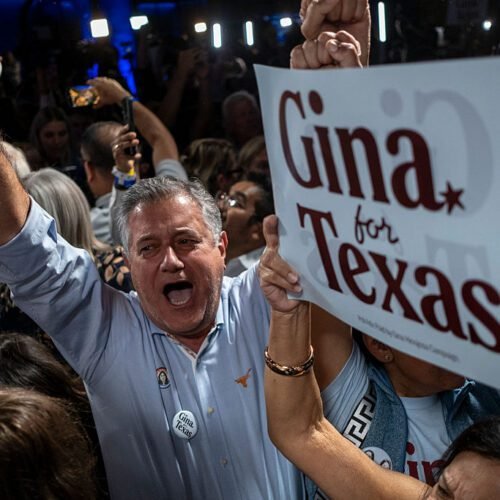
Most notably, Democratic challenger Gina Hinojosa won the Texas governor race that Axios reported would fundamentally scramble the math on Trump’s AI buildout. According to Bloomberg, Hinojosa’s election has developers facing down the “worst-case scenario.” Texas is the epicenter of the AI boom, Axios noted, and was expected to account for more than 41 percent of added data center capacity in 2028.
Now, Hinojosa plans to delay projects as long as it takes to pass laws “tackling impacts on water, electricity, air, and property rights.” Approximately “13 gigawatts of data center capacity” is now exposed, Bloomberg reported. Gordon Johnson of GLJ Research warned in a note that Texas projects with “power, permits and steel keep going,” but “those with power but no state environmental permits slip 12 to 18 months,” Bloomberg reported. Some projects may leave the state entirely, perhaps moving to Louisiana or Georgia—or perhaps going nowhere.
“She would impose a moratorium until legislation is passed that gives communities a voice, protects household utility bills, and ends the tax incentives for data centers,” Johnson’s note said. “The question now is how long the pause lasts.” As PIMCO head of public policy Libby Cantrill similarly warned, “even if statewide moratoria do not result, we expect to see a lot more sand in the gears of the AI buildout regardless—with more time required to secure permits and other approvals, as well as more concessions that data center developers will have to make.”
Big Tech downplays AI election results
Texas wasn’t the only big shake-up. Democrats won governor races in the next three biggest states previously wooing data center developers—Arizona, Georgia, and Ohio. Overall, Axios projected that “nearly two-thirds of 2028 data center capacity” could face similar delays as Hinojosa threatens in Texas. Bloomberg estimated that half the data centers in the US are now more vulnerable to scrutiny.
For AI firms, that’s a nightmare, since any delays will set back revenue, and IT consulting firm Gartner recently estimated “the AI boom is nearly $5 trillion short of paying for itself.”
Likely soon, developers nationwide will face tighter rules limiting tax incentives and requiring stronger protections for residents around who pays for grid infrastructure and water use. Those kinds of regulations will most likely increase developers’ costs at an inconvenient time, Bloomberg’s report said.
While many reports suggested that the first so-called “AI election” proved the power of the people to rein in Big Tech, some AI industry insiders downplayed the election results on Wednesday. In a statement, Adam Kovacevich—a former Google executive and the CEO of a tech industry trade group and policy coalition called Chamber of Progress—suggested “the results offer little evidence of a voter mandate to crack down on AI or data centers.” He emphasized that “Democratic gubernatorial candidates who opposed data center bans won at a higher rate than those who supported them,” and admonished, “Let’s not confuse an anti-Trump wave with an anti-tech mandate.”
“Voters wanted change on the economy, not a crackdown on innovation,” Kovacevich said, while sharing a resource for those in the tech industry seeking an alternative spin on the results.
Poll: 3 out of 4 voters opposed data centers
NBC News exit polls suggest it’s true that issues like cost of living or government corruption were ranked as more significant by voters than AI and data centers. However, like many analysts who point to AI opposition as a make-or-break issue for many voters, Alejandra Montoya-Boyer, vice president of The Leadership Conference’s Center for Civil Rights and Technology, disagreed with Kovacevich’s lens.
“The 2026 midterms have been the first true AI election in the US,” Montoya-Boyer said. “We saw voters turn up at the polls in record midterm numbers and vote for leaders who are willing to protect them and their rights from unchecked AI.”
Montoya-Boyer cited NBC’s polls showing that 3 in 4 voters are opposed to data centers. Additionally, more than half of voters said that “AI and data centers were a crucial or major factor in their vote for Congress.” The mass backlash is not just about utility costs or other data center fears, Montoya-Boyer suggested, but instead stemmed from a call from voters to regulate AI. Election day came “as the biggest AI companies raced to go public, AI systems broke out of the test ‘sandboxes’ meant to contain them, and biased and discriminatory AI kept making life-altering decisions about us,” Montoya-Boyer said.
“These results confirm numerous polls and what we civil rights leaders have been hearing from the communities we represent: Innovation is only real when it includes all of us and actually improves our lives,” Montoya-Boyer said.
Other analysts told Axios that voters appeared to be “more concerned about efforts to block state AI regulation than they are about data center controversies,” with one noting that across four swing districts, “voters trust Democrats over Republicans to hold AI executives accountable by a margin of 7 to 10 points.” Brad Carson, co-founder of Americans for Responsible Innovation, told Axios that “voters just sent a clear message that they want rules for AI and data centers.”
“What we just witnessed was an AI earthquake,” Carson said.
Expert: China benefits from US slowdown
Slowing down America’s AI infrastructure buildout could hamper frontier AI and set the US back in the so-called “AI race.” That’s Trump’s main rationale for refusing to regulate the AI industry.
Gary Ng Cheuk-yan, a senior economist at a global financial institute called the Natixis Corporate and Investment Bank, told the South China Morning Post that “a slowdown in the US could be a win for China.”
Like analysts who projected that Democrats won’t try to block all data center development, Ng suggested that the AI buildout won’t come to a complete halt following the “blue wave” unseating many Republicans. However, a Democrat-controlled Congress will likely “introduce new constraints on US computing capacity,” and that could give China a leg up, Ng suggested.
“This would keep [US] AI token prices high, giving China an opportunity to export cost-effective inference services, supported by abundant electricity supplies,” Ng said.
At the furthest extreme, US data center opposition could push giants like Amazon or Google to build hyperscalers outside the US, Ng suggested. That outcome represents the opposite of Trump’s vision for 100 percent US-made tech, which experts have warned is an impossible dream.
Michael Strobaek, global chief investment officer at Swiss private bank Lombard Odier, noted that Trump still has the power to veto any federal laws that Congress may advance. Democrats will likely need “substantial Republican support” to pass laws over a potential veto, Time reported. However, with a majority, Democrats could threaten to block Trump’s efforts to roll back Environmental Protection Agency protections to aid data centers, according to some analysts.
Musk among election day’s biggest losers
On Wednesday, Trump did not directly mention AI in a batch of Truth Social posts reacting to election results. Instead, he seemed to blame Fox News for hosting Democrats, while arguing that outcomes would somehow have been different if he was on the ballot.
But Trump’s silence suggests that he has no talking points to gloss over the fact that polling from Blue Rose Research showed that “Americans would rather live near a prison, methadone clinic, or a nuclear power plant than an AI data center.” And while existential fears that AI firms like Anthropic have recently warned about are a concern for many Americans, “concrete local impacts” like higher energy bills or pollution “were far more salient” for voters, Blue Rose’s director of research, Ali Mortell, told Time. And even when developers promise to cover costs, “trust in institutions is low,” to the point where even “when tech companies and politicians offer reassurance,” Mortell said, “voters are not positioned to believe that’s true.”
“There’s not a clear divide between Democratic voters and Republican voters on how they’re thinking about [data centers],” Mortell said. “Opinion has soured with everyone.”
Counting among the biggest losers on Election Day was Elon Musk, who is currently facing a lawsuit over allegations that the gas turbines at his Colossus data center in Memphis, Tennessee, are emitting pollution. Musk dumped “almost half a billion dollars” into Republican candidates as of October, “a sum no other individual donor in the 2026 midterms approaches,” Quartz reported.
The SpaceXAI founder had joined other tech CEOs and AI SuperPACs in donating “hundreds of millions in campaign contributions to guard against any meaningful federal regulation,” Montoya-Boyer said. But “voters proved unswayable,” and instead elected members to Congress who vowed to probe AI firms.
As the votes came in, SpaceX and Tesla shares dropped, as investors perhaps questioned if a potential merger between those firms may now be in doubt, with Musk’s political foes back in power and in a position to add friction.
With opposition possibly mounting, Musk appears to be immune to the pressure and determined to plow ahead with expanding his controversial data center on a much faster timeline. According to SemiAnalysis, an independent research newsletter covering the AI industry, SpaceX recently revised its estimate for the data center capacity it’s building out for 2027. Instead of aiming to reach 10 gigawatts of capacity, SpaceX notched its goal up to approximately 13GW in 2027.
“This would be the largest amount of data center capacity ever built by any one company in that timeframe, roughly equivalent to all of Google’s data center capacity from 1999-2026 in just 1.5 years,” SemiAnalysis reported. “We think it’s possible and have already identified more than 9GW of capacity.”
The Democrats not only made significant gains in Tuesday’s midterm elections but also took control of both chambers of Congress. Here are five insights that can be drawn from this moment.
1. US democracy is alive and well
The storming of the Capitol, attempts to change the rules of the electoral process, a spate of presidential executive orders to bypass Congress and many more examples sparked concerns that the US’ vaunted democracy was being transformed into an authoritarian system under Donald Trump. But the country’s democratic institutions have proven more resilient than many had feared.
Many voters were driven by their opposition to Trump‘s desire to rule with unfettered power. Instead they want to see country’s institutional safeguards strengthened.
This midterm result sends a clear signal that voters want stronger parliamentary oversight. President Trump could of course continue trying to govern through executive orders, bypassing Congress. But Congress sets the budget.
This means the Democrats, who now control Congress, can deny the president the funds he needs for his political initiatives. They can also set up investigative committees, which puts the Trump government under considerable pressure to justify its actions.
2. The Democrats can still win elections
For a long time, the Democratic Party lacked compelling leadership, a unified approach and a clear answer as to how it intends to win votes. Tuesday’s election proves the party is still a political force to be reckoned with.
Its gains in many Republican strongholds are nothing short of sensational. The party was even able to score victories in Texas and South Carolina. In Kansas, the Democrats won a Senate seat for the first time since 1932.
The midterms have also put the spotlight on a new generation of Democrats: Younger politicians, some of them noticeably more progressive, who could chart a fresh course for the party.
Take, for instance, the Democratic Socialists of America, or DSA, an organization which is considerably more left-wing than the Democratic Party itself. At least five candidates endorsed by the DSA have been elected to the House of Representatives.
The DSA advocate for strong welfare policies that focus on affordable housing, health care and workers’ rights. They also want to see greater checks on the power of large corporations.
“The argument was always that these folks can’t win on a national stage,” Brandon Bohrn, an expert on trans-Atlantic relations at the Bertelsmann Foundation, told DW. Now some of them have defied the odds and actually won, potentially sparking an internal debate about what the Democrats stand for and how they plan to win voters in the 2028 presidential election, Bohrn said.
3. The Republicans face a fierce internal battle over the party’s future
Donald Trump has already made it clear that he does not hold himself responsible for this midterms defeat, taking to Truth Social to deflect any blame.
Yet not everyone in the Republican party is likely to agree. Critics of Trump who had been sidelined may feel emboldened to speak up again. The question as to whether the Republicans should abandon Trumpism will be almost impossible to ignore.
By law, Donald Trump cannot run for a third term in the 2028 presidential race so Republicans will have to think about who can. But who will take the lead? And more importantly: On what policy platform?
Tuesday’s election defeat will likely accelerate this debate, making a power struggle over the Republicans’ political future inevitable.
4. For Iran’s leadership, Trump’s defeat is good news
The war against Iran and resulting economic hardships have cost the Republicans many votes. The cost of living, in particular, was a key issue for many American voters.
The consequences of the Iran war have primarily driven up energy prices. This is likely to significantly increase domestic pressure on Trump to reach a lasting agreement with Iran.
Trump does seem keen to cut foreign policy costs, especially in areas where it has been politically controversial for his party. Shortly before the midterms, he announced that he no longer intends to provide billions in military aid to Israel. This was in relation to a deal that was meant to expire in two years anyway.
5. What the election outcome could mean for Europe
Ian Lesser, an expert on US foreign and security policy at the German Marshall Fund, believes that the midterm elections could also impact trans-Atlantic relations. “This actually makes a big difference for Europe in a number of different important ways,” Lesser told DW.
The Democrats could try to reinvigorate dialogue between Europe and the US, Lesser suggests. After all, with control of Congress, the Democrats have more say on Trump’s NATO policy, can influence budget decisions and military funding, and can complicate planned cuts to US support. Europe and the US may even cooperate on climate and environmental issues.
“Simply restoring a degree of trust and predictability, however we get to that, makes a big difference,” Lesser said.
Not all differences will be resolved overnight though.
“Tariffs are a little tricky because there are clearly vested interests in the US in keeping some of this in place,” Lesser concluded. “But in terms of new and very aggressive tariff measures, I think Congress would absolutely push back against that, on both sides of the aisle, actually.”
How the Democrats will try to stop Trump’s Iran war
<
article id=”post-952357″>
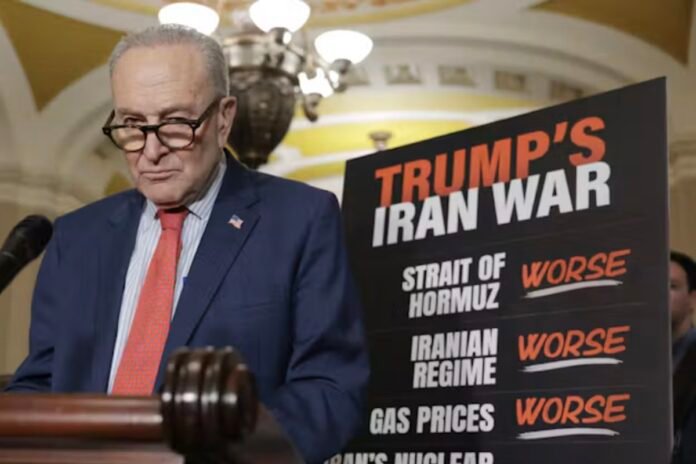
The Democrats’ sweeping victory in the US midterm elections puts them in a stronger position to interfere with President Donald Trump’s agenda. This includes his deeply unpopular and costly war against Iran, which could be among their first priorities.
As president, Trump will be able to veto any legislation aimed at ending the war. But the Democrats still have another powerful card up their sleeves: cutting off funding for the war.
There are caveats, however. History suggests exercising this power could trigger a political confrontation that may backfire. And even if the Democrats succeed in ending the war, they may not be able to reverse the damage it has done to the US’ global standing.
The limits of legislation
Democrats will have three main options to try to force the war against Iran to a close. Two of these, however, face significant limitations.
The first – and perhaps most obvious – option is through legislation. There are a few different ways to do this. One approach is to pass a resolution calling for an end to the war.
Congress already attempted this in June, passing a concurrent resolution (with the support of some Republicans) that directed the president to either withdraw US forces from hostilities against Iran or seek the approval of Congress before continuing. This was done under the War Powers Resolution of 1973.
These so-called concurrent resolutions are, however, widely seen as non-binding. Intended to express the opinion or will of Congress, they are generally used to deal with internal matters within Congress.
For such a resolution to be binding, it would need the force of a law passed by Congress, which the president would likely veto. To overcome that veto, the Democrats would need the support of a two-thirds majority in both the House and the Senate.
This would require a significant number of Republicans to cross the aisle.
A second option for the Democrats is to launch a series of congressional investigations into the way the war has been conducted. This would likely include public hearings, subpoenas and demands for documents from the Trump administration.
The Democrats may also attempt to impeach senior officials in the Trump administration.
If Hakeem Jeffries, the Democrat tipped to become the next speaker of the House, wants to appease some of the more progressive voices in his party – or the hardline voices on the Iran war or against Trump – Defense Secretary Pete Hegseth could be targeted for impeachment.
But the grounds for such proceedings are unclear at this stage, and even with the Democrats’ new Senate majority, he would be unlikely to be convicted unless a significant number of Republicans crossed the aisle.
More pertinently, congressional investigations are a protracted process, and unlikely to bring the war to a swift end.
The ‘power of the purse’
The more immediate power that Congress has to end the war swiftly is in Article I, Section 9 of the US Constitution, which states:
No Money shall be drawn from the Treasury, but in Consequence of Appropriations made by Law […]
This is known as the “power of the purse.” Once the new Congress is sworn in in January, every new dollar that Trump’s Department of War wants to spend needs to be approved by the House and the Senate.
A Democrat-controlled Congress could put a clause into the defense budget, prohibiting funds from being used for hostilities against Iran. Trump could veto this, but this would mean blocking the paycheck for everyone in the military, as well.
The Democrats tried this very approach in 2007, attempting to force a timetable for a US withdrawal from Iraq. Then-President George W. Bush vetoed it, but it became a political football, with both sides accusing the other of leaving US troops unfunded.
The Democrats ultimately backed down due to the growing risk of backlash from voters.
Today, this approach would carry a similar risk. Are the Democrats willing to put their political credibility on the line if the president accuses them of letting American soldiers down? Who blinks first?
Republicans face a reckoning
As the dust settled on Wednesday, Trump himself acknowledged the Iran war had played a role in the Republican Party’s crushing defeat. But he doubled down on the decision, saying he would do it all over again if necessary to prevent Iran from acquiring a nuclear weapon.
Vice President JD Vance was less defensive. In a detailed statement posted to X, Vance bluntly declared the war was the reason the Republicans lost. He added, “any honest conversation about where we go from here must start there.”
Vance has long criticized US military involvement in overseas conflicts, but in his role as vice president, he has publicly backed Trump’s actions against Iran. This week’s overwhelming Democratic victory has made it much easier for Vance – and other Republicans – to now break ranks with the president.
In the wake of a rout at the midterms, US Vice President JD Vance has distanced himself from the president’s stance on Iran. Photo: White House Handout
The balance of power has shifted
For Trump, bringing the war to an end now would mean humiliation. The US has so far poured almost US$50 billion into a military campaign with few tangible achievements.
On top of that, Iran has learned that the Strait of Hormuz is a chokepoint it can control. The same is true for the Bab al-Mandeb Strait off the coast of Yemen, where the Iran-aligned Houthis have attacked commercial ships.
These costs will outlast the Trump presidency. The war might definitively bring to an end the unipolar global order Washington built after the end of the Cold War. The biggest winner may not be Tehran, but Beijing.
Markus Wagner is professor of law at the University of Wollongong School of Law.
AMD’s record quarter: Data center business doubles, while gaming craters
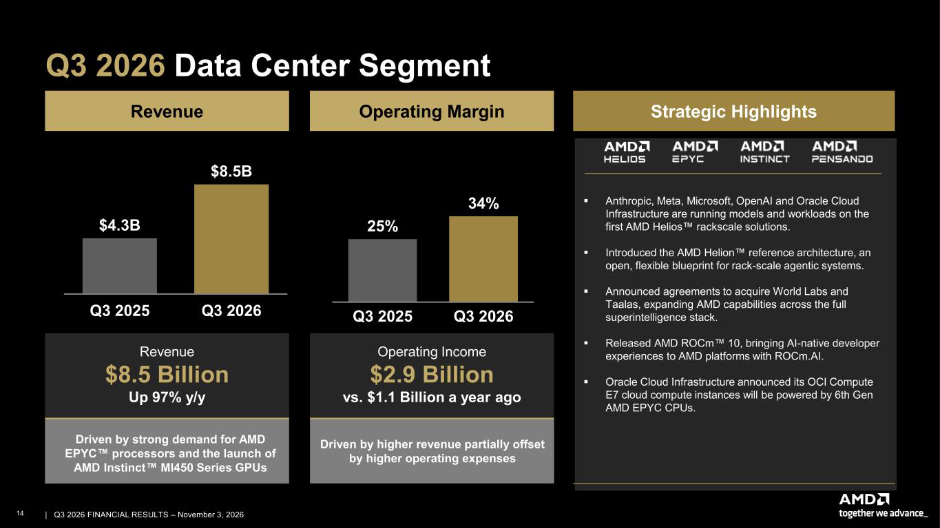
AMD reported third-quarter revenues on Tuesday with a record $13.4 billion, an increase of 45 percent year over year, as data center business nearly doubled and the company’s gaming segment cratered.
AMD CFO Jean Hu said, “We expect revenue to be approximately $17 billion, plus or minus 3%. The middle point of our guidance represents approximately 66% year-over-year revenue growth, primarily driven by the acceleration of our Data Center segment.” AMD says its Q4 revenue projections are up another 27 percent from this quarter’s results. As reported by Tom’s Hardware, Intel’s Q4 guidance places revenue estimates between $15 billion and $16 billion. That means that if both companies land where they expect to at the end of the fourth quarter, AMD would exceed Intel’s revenue for the first time in history.
The data center segment of AMD’s business was up 97 percent year over year, with a record $8.5 billion. AMD attributes the growth to demand for its EPYC line of enterprise server CPUs, along with the launch of the Instinct MI450 series GPUs. Sales of AMD Ryzen mobile chips led growth in the Client business, which includes desktop Ryzen processors and posted $2.95 billion in revenue, up 7 percent year over year.
Gaming revenue fell sharply for the company, posting a 40 percent drop in revenue at $773 million, which AMD attributes to “lower semi-custom and graphics revenue.” Operating margins in AMD’s data center business expanded from 25 percent to 34 percent, with operating income surging 168 percent to $2.88 billion.
Embedded segment revenue, or all the SoCs, FPGAs, and boards under AMD’s umbrella that go into other hardware, was $1.1 billion, up 29 percent. AMD attributed this growth to gains made in the “aerospace and defense, automotive, communications, and industrial end markets.”
The gaming segment of AMD’s business is composed of two main sources. There are semi-custom processors that AMD supplies to other manufacturers’ consoles, as well as its own Radeon graphics business. Where things can get confusing is that Ryzen processors, like those commonly installed in gaming PCs, are counted under the company’s client business, not gaming. According to AMD Chair and CEO Lisa Su, “In Gaming, revenue declined 40% year over year to $773 million, primarily due to lower semi-custom sales as expected at this stage of the console cycle.” The financial results do not break down the split between console chip sales and PC graphics cards.
AMD also announced that Windows-based systems running on its Ryzen AI Halo platform will be “coming soon.” Known as Project Zenith, the effort will support a developer-focused Windows experience on the current PRO 400 Series platform. Built on the Ryzen AI Max+ PRO 495 processor, the chip supports up to 192GB of unified system memory, with up to 160GB of that available to be allocated for graphics, and is capable of running 300 billion-parameter models at 4-bit quantization. On the call, Su stated that AMD “started shipping MI455X in volume in the quarter, and lead customers, including Anthropic, Meta, Microsoft, OpenAI, and Oracle, brought their first Helios racks online quickly.”
The size of the Democrats’ victory Tuesday night shattered records and even the most optimistic expectations, handing the party a governing mandate with a clear demand for change.
But what do voters want that change to look like? This week on The Intercept Briefing, politics reporter Jessica Washington and managing editor Maia Hibbett break down Tuesday night’s election and hear from voters in Maine, Michigan, and Texas about what drove them to the polls in the midterms that saw a so-called “blue tsunami.”
“The rich get richer, the poor get poorer,” said one voter in Maine. In Michigan, a voter told The Intercept that politics “feels like a game that the rich play sometimes.” A Texas voter expressed anger that President Donald Trump was “spending taxpayer money to renovate the White House and turn it into this gold sanctuary.”
Frustration with wealth inequality and money in politics came up again and again in The Intercept’s conversations with voters. So did a desire for more social welfare spending, Medicare for All, freedom for Palestinians — and responses to transphobic and Islamophobic fearmongering on the campaign trail.
“When Democrats win so far across the board, you can make an argument that any faction of the Democratic Party has the mandate,” said Hibbett, “because Democrats of all stripes won Tuesday night.”
In any case, the results indicated a clear disapproval of the way the Trump administration is governing and the use of fearmongering as a tactic of distraction.
“One lesson maybe for Democrats is there’s no point in attempting to placate people when it comes to bigotry,” said Washington. “The thing that’ll motivate voters is if you can convince them that you’re going to make their lives better, not if you can convince them that you’re playing the middle on an issue of civil rights.”
For more, listen to the full conversation of The Intercept Briefing on Apple Podcasts, Spotify, YouTube, or wherever you listen to podcasts.
Transcript
Bruce Bryan: We’re just hoping that people step up and tell Washington to go fuck itself.
Jessica Washington: Welcome to the Intercept Briefing. I’m Jessica Washington, politics reporter at The Intercept.
Maia Hibbett: And I’m Maia Hibbett, managing editor here.
JW: Over the past few days, Intercept reporters hit the ground in key states to speak to voters about the issues driving them to the polls. We went to Texas.
Jermiah Robinson: The food prices, for one, and the gas prices.
Darryl Moore: Gotta work two jobs just to make it.
Tiffany Williams: I never really understood, like, how important it is for the minority to vote.
Lenna Tasby: This election is important because this election is going to make or break whether we have a vote or not. There’s a reason why they’re shutting down these polling places.
Intercept reporter Akela Lacy: What are the issues that motivated you this cycle?
Charles Senter: Well, I love Trump.
Helen Dexter: Red ticket all the way. The stop of the Muslim influx.
Lenna Tasby: If you’re spending taxpayer money to renovate the White House and turn it into this gold sanctuary, that’s money that can be used for our military veterans. That’s money that can be used to help with this homeless population. The government needs to be held accountable.
MH: We heard from voters in Michigan.
Erin Horne: The election this year is very critical because Trump’s got two more years.
Zouheir Alawieh: Our democracy is in danger.
Noora Iskander: I believe in Medicare for All. People have a right to self-determination, especially in Palestine.
Wendy: There’s a lot of concern about, of course, the economy, but the data centers, our children’s education.
JW: And we spoke to voters in Maine.
Intercept reporter Noah Hurowitz: What mattered to you as a voter this election?
Tyler Echard: Cost for the most part. Everything keeps going up.
Bryan Golay: The rich get richer, the poor get poorer. At least 30 years ago, there was like a veneer of caring, and now there’s just blatant corruption and greed.
JW: So Maia, what a night.
MH: Yeah, it’s honestly embarrassing if you’re a Democrat and you did not win. They swept the House and the Senate by just about the biggest margins that the pollsters could have predicted. So luckily, the audience I’m concerned about, the pollsters, can rest easy. As of 11:00 a.m. [ET] on Wednesday morning, they had 228 seats in the House, Democrats did. They only needed 218 for a majority, so obviously that is more, and they’re expected to pick up some more seats as some more races get called. They had 54 seats in the Senate, which means that they have a big enough margin that they can’t be stopped from legislating by one lone senator, if one senator wanted to gum things up.
JW: And not at all surprising. The White House tried to spin Republican losses on Trump not being on the ballot and the quality of candidates, despite the fact that Trump repeatedly said at rallies across the country, “Pretend I’m on the ballot.”
Donald Trump: We’re going to ask you to pretend I’m on the ballot, because when I’m on the ballot, this has nothing to do with ego, I just get 49.2 percent more vote. And if we get even a good percentage of that, we’ll have the biggest victory that you’ve ever seen.
MH: He’s saying, “We’ll have the biggest victory ever” — and it was a very historic night. I think people will hear the word “historic” a lot in the coverage in the coming days because of this huge blue wave, not the kind of history Trump wanted, but also because there are some really surprising major firsts.
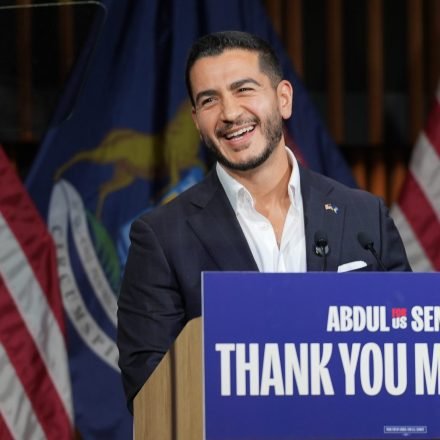
One of them was that last night, very early, like at 2:30 a.m. [ET], Abdul El-Sayed became the winner of the Senate race in Michigan, which means he will be the first ever Muslim U.S. senator.
Abdul El-Sayed (acceptance speech): To all the kids who watched this last month, to all the parents who struggled to explain why the president openly mocked someone for their name or how they pray, let them know tomorrow that the bad guys lost.
JW: That race was filled with Islamophobia, both in the primary and in the general election. His Republican opponent, Mike Rogers, just peddled in a million different Islamophobic tropes. Voters told our colleague, Matt Sledge, who was out in Michigan speaking with them, that they really didn’t like hearing all of this hate speech.
Zouheir Alawieh: They don’t have any programs for our economy, for our health, for our future. So that’s why they are attacking us as Muslims and as human beings.
Tea Edwards: Just, like, all of the Islamophobic hate campaigns that have been going around will probably sway a few people. The people who are actually researching what will be good for communities I think will see right through it.
MH: This was a campaign that was defined by so much panic about El-Sayed being Muslim. The race ended 25 years after 9/11, and there were all of these really kind of vitriolic Islamophobic tropes. It reminded me a lot of the campaign against [Mayor] Zohran Mamdani here in New York last year. There’s all this fear of the left and this fearmongering suggesting that there’s no way a Muslim candidate could represent American interests.
And of course, one of the big differences between El-Sayed and Mamdani is that El-Sayed is not a socialist.
JW: Say that again for the people in the back, because they are not going to believe you. El-Sayed has described himself as a capitalist who understands how capitalism works, so definitely not a socialist.
I’ve heard him described as much more of a [Sen. Elizabeth] Warren than someone in the Bernie Sanders mold.
MH: But he still faced millions of dollars in outside spending in this race, mostly because of his stance on the United States relationship to one other country.
We’ve heard in some of these deep-blue districts in the House races where socialists were elevated in the primaries, there was a lot of rhetoric on opposing Israel’s genocide in Gaza and fighting U.S. weapons flows to Israel. But it’s pretty rare to hear that from a U.S. Senate candidate, and now from a senator-elect.
JW: It also caused some really ugly drama with his former primary opponent, Haley Stevens.
MH: Do you want to try to recap that as fast as we can, or should I?
JW: I’ll get started and see if you can add in anything that I miss.
So essentially, on the Friday right before [Election Day], Haley Stevens released a statement condemning an ad that was not even created by the El-Sayed campaign, calling on him to condemn the ad, which he did disavow. She also asked him to take back his statements on Israel.
Now, things seemed fine for a second. Haley Stevens had all of these Democratic surrogates going on air saying that she promised to support him. While Haley Stevens’s staffers were at an event for El-Sayed, Haley Stevens popped up at an event supporting the Republican candidate, Mike Rogers, giving him her endorsement.
Maia, is there anything that I missed in that?
MH: Jessie, I think the only thing you missed was just how baffling and strange this episode was. So you mentioned this ad that kicked it off. It was produced by this outside group Rebellion PAC, which is the group headed by Cenk Uygur, who some listeners might know from The Young Turks. He is also famously Hasan Piker’s uncle.
Haley Stevens, as she was struggling to explain why she switched from El-Sayed to the Rogers camp, kept citing Hasan Piker and the “uncle.” It was this kind of almost incomprehensible move where Anderson Cooper, the CNN host, was pressing her at one point, saying, well, you cite his affiliation with Hasan Piker and this part of the Democratic Party you don’t like, but you knew about this before — so what changed?
It really seemed strange. So we sent Matt Sledge out in Michigan to ask some voters what they thought of it, and if they thought that this was a politically savvy move that would have any resonance. And here’s what they said.
Kathleen Britton: I’m so disappointed in Haley Stevens. I gave her serious consideration during the primary.
Jesse Craft: She fought against Mike Rogers, then said somehow he earned her vote. I don’t really understand it. I kinda think it’s career-ending for her.
Wendy: How embarrassing to use an African American church. How embarrassing for you to use our votes and then disregard them because of your own personal issues.
Intercept reporter Matt Sledge: So you don’t think it’s gonna help Mike Rogers?
Kathleen Britton: I do not.
Erin Horne: No, I think she actually helped Abdul.
[Break]
JW: Maia, before the break, you started talking about money and politics, and I want to get into how that shaped the midterms. Last week, we talked about how this election cycle became the most expensive on record. Midterms ad spending is expected to reach north of $11.6 billion. Mega-donors overwhelmingly gave to Republican candidates, including Elon Musk, who spent nearly $450 million, with large sums of that directed at boosting Ken Paxton in Texas, who, by the way, lost to James Talarico. Now, for context, the next highest donors under Musk are a Republican couple [Richard and Elizabeth Uihlein] who spent $150 million, mostly in Wisconsin and Illinois.
Jesse Craft: We all see where money is coming from. It’s coming from very, very wealthy billionaires. I don’t think we should be able to buy elections.
Tea Edwards: Politics, it just feels like a game that the rich play sometimes. Kind of feels hopeless when you’re just looking at all of these people and corporations giving money to each other.
MH: You hate to see Elon Musk throw away almost half a billion dollars. It only leaves him so many billions to go.
JW: Heartbreaking.
MH: But, I mean, in Texas, as you mentioned, that money really did not pan out. It didn’t seem to sway voters. It seemed like if anything from the voters who talked to our reporters in Texas, in Michigan, and in Maine, which we’ll get to later, people were really mad about outside election spending and don’t like the idea that billionaires or corporations can buy their elections.
And in Texas, a lot of that money went to propping up this anti-trans panic campaign that Paxton was running. But all that money was not enough to save Paxton from James Talarico. Paxton was a pretty bad candidate: He was mired in too many scandals to keep track of, including a 2015 grand jury indictment on felony securities fraud charges.
In 2020, eight of his top deputies reported to the FBI that he was potentially abusing his office to do favors for a donor and friend. And just earlier this year, he offered a plea deal in a child sex abuse case that seemed to anger Texans and voters.
JW: As it turns out, there is not enough money in the world to buy Ken Paxton out of being Ken Paxton and voters recognizing that. But Republicans tried this cycle to spend big on transphobia and to blanket the airwaves with these anti-trans advertisements.
Elon Musk’s Texas PAC spent $78 million on anti-transgender ads in Texas, which actually accounted for nearly half of all ad spending in support of Paxton. Republicans’ big play in Texas was transphobia — and that play failed.
While clearly it didn’t sway the election, some of those messages did appear to trickle down to voters. Our colleague, Akela Lacy, talked to voters in Dallas and the surrounding areas, and she did come across some voters who said they wanted to support Talarico or even some voters who did support Talarico but were concerned about his stance on trans rights, an issue that Republicans really fearmongered on this cycle yet again after doing it in 2024.
Akela Lacy: When you said you saw some stuff about James Talarico that made you unsure about voting for him, can you say more about that? What did you see, and what’s your impression of him?
Jermiah Robinson: I think I seen something about the LGBTQ+ community? I mean, I don’t really care about it, but I don’t know. People were saying a lot of bad stuff. I think they said something about him —
Canvasser: Encouraging sex change.
Jermiah Robinson: Yeah, on the children. I don’t really stand for that.
Danielle Buck: He wants to trans our kids. He believes that there are six genders.
Andrew Kolvet: They wanna indoctrinate your kids. They wanna trans your kids.
Adam Sosnick: They’re gonna trans your kids. They’re gonna Talarico your kids.
Donald Trump Jr.: Trans kids back in school, trans agendas back in school, in your classrooms, with your children.
JW: Clearly, some of that rhetoric did trickle down to voters based on Akela’s conversations, and some people even believed the misinformation being spread in those ads.
But fearmongering was just clearly not persuasive enough to distract people from their lived reality, and that lived reality is that gas prices are up, rent is unaffordable, and grocery prices are up.
I think one lesson maybe for Democrats is, there’s no point in attempting to placate people when it comes to bigotry. The right can and will distort your messages, and so you can stand in your values or not, but the thing that’ll motivate voters is if you can convince them that you’re going to make their lives better, not if you can convince them that you’re playing the middle on an issue of civil rights.
MH: We saw a parallel to this in some ways in Michigan as well, where a lot of the Republican argument was based on this perception of Islamophobia and fearmongering. Ultimately, that was not enough to elevate Mike Rogers over Abdul El-Sayed. In Texas, there’s also, of course, the strong anti-immigrant sentiment that Republicans frequently run on, and I think the statewide results showed us that that narrative really fell apart this cycle.
JW: To your point, clearly, attacks on trans people, attacks on immigrants didn’t work in Texas. Democrats had an amazing night. Gina Hinojosa toppled three-term incumbent Gov. Greg Abbott. The state has not had a Democratic governor since 1990.
“Attacks on trans people, attacks on immigrants didn’t work in Texas.”
MH: And speaking of toppling long-term incumbents that have been hard to get out of office, our colleague Noah Hurowitz was in Maine, where Troy Jackson defeated Susan Collins last night after many Democratic attempts to get her out of office.
This issue of disillusionment with money and politics came up quite a bit when he was talking to Maine voters.
Sharon McDonnell: It’s immoral. It is immoral to have people worried about their fuel and have that much money coming into this. It’s just wrong.
“The amount of money is more than I will probably make in my lifetime, spent in this election.”
Tyler Echard: The amount they spent on just mailers, not handed at the door but in the mail, is especially, it seems, on the Republican side of things, has been absolutely insane. The amount of money is more than I will probably make in my lifetime, spent in this election.
Charlie Dingman: It’s been extraordinary in Maine, the amount of spending in this race, particularly in the Senate race. I think there’s a lot of fatigue. I think people are tired of it. I have had some conversations with voters at the doors that lead me to think that the extremely negative and extremely untruthful ads may be backfiring.
JW: It seems like those ads backfired. The last voice you heard was Charlie Dingman, Maine Democratic Party chair.
Collins campaigned on her record of securing federal investments for state infrastructure, such as rural hospitals, and she really prided herself on being a moderate Republican who apparently breaks rank with President Donald Trump. But the reality of the situation is quite different.
The Congressional Quarterly Roll Call found that her votes aligned with Trump 90 percent of the time in both of the president’s first and second terms, and voters really noticed that. They understood the difference between what she said she was, a political moderate, and her voting record, which aligned with the really far-right Donald Trump. And that’s something that Noah heard from voters as well.
Sharon McDonnell: She has had this persona of moderate cross-party stuff that’s just really eroded. If you read every article about her, it’s like, “Moderate Susan Collins.” Like, wait a minute, she’s voted with Trump. She hasn’t used her power.
Susan Collins “has had this persona of moderate cross-party stuff that’s just really eroded.”
MH: Collins really used that line about her being a moderate and being an independent voice in Washington as a go-to for her campaign.
In past cycles, it has worked. As we alluded to a little bit earlier, the Democrats have mounted challenges against her before. In 2020, they ran a candidate named Sara Gideon, who looked somewhat likely to oust Collins. And I think this cycle, there were a lot of reasons for Democrats to be nervous about this race.
Troy Jackson, the nominee, is a former state senator, and he ran on lowering costs, really centering working-class interests. But he had jumped into the race kind of hastily. If you remember Graham Platner, Jessie, he was the former nominee for Senate in Maine for the Democratic Party, and he was really considered a rising star, but had to drop out because of a series of scandals, and Jackson had to jump in last minute and fill his place.
But ultimately, Jackson pulled it off.
Troy Jackson (acceptance speech): We did it. Working people did it.
JW: Clearly, Jackson had a disadvantage going into this race. There were people who complained and said that he wasn’t as charming as Platner, he wasn’t as polished. But in this election, the ideas and running on affordability seems to have won the day in Maine and really throughout the country.
Collins had a reputation of delivering for the state, but clearly that wasn’t enough to overcome this blue wave across the country and some frustrations with Collins as well.
But Maia, taking a step back to look at the full scope of Democratic wins, what do you make of their gains on Tuesday? Are there other races that stood out to you? What stood out to you overall?
MH: Well, there’s the spin about the spin, which is that everybody is going to be framing this election and these results in their own interests. When Democrats win so far across the board, you can make an argument that any faction of the Democratic Party has the mandate, because Democrats of all stripes won Tuesday night.
But to my view, it’s hard to see how this is a world where there isn’t a clear demand for some kind of transformational change. So I’m wondering what Democrats do with their mandate now, especially as we think ahead to 2028.
If you recall 2020 and the last time the U.S. elected a Democratic president, you might remember that the Biden campaign was the sort of centrist, moderate return to normalcy choice, but they got there after a lot of left momentum in the primary and a really serious showing of support for Bernie Sanders, who remains one of the most popular politicians in the country.
Once Biden got into office, he arguably tried to give some of that kind of left, dare we say, populist economic message some service. There was the Build Back Better plan that had a lot of social safety net spending and Covid relief. There were climate infrastructure projects. There was the elevation of Lina Khan [to Federal Trade Commission chair].
So I’m curious what Democrats have learned from the Biden years and how that will convert into the next congressional term and the next presidential election.
JW: It really feels like I’ve lived a million lives in between now and that debate that really tanked Joe Biden’s entire political career at the end there.
I will say to your point, we’re already seeing Hakeem Jeffries, who’s likely to be the House Speaker, calling for unity and saying that people don’t want to fight. But you don’t really get a blue wave like this or a political wave like this when people don’t want to fight.
Clearly, there’s anger at Republicans. There’s anger at the cost of living. There’s anger at the war. If Democrats don’t deliver, they’re likely to see a red wave come the next cycle.
But I did want to take just a little bit of a step back and talk about Black voters and what’s happened in the aftermath of the Supreme Court voting rights decision. Black voters in this election really delivered historic victories in southern states for Democrats, but Black representation in Congress thus far appears to have been slightly reduced in this election. Now, for those who remember our discussion earlier this year about the Supreme Court decision to gut the Voting Rights Act, there were a lot of deep concerns that the decision would crater Black political representation, and so far that hasn’t come to bear, but it’s worth paying attention to in cycles that are less blue, where we’ve seen really massive redistricting.
I will shout out, there was one historic victory for Black Americans: Keisha Lance Bottoms, the former Atlanta mayor, won her race for governor, becoming the first Black female governor in the country.
MH: We’ve talked a lot about these historic wins, but we would be remiss to not mention a close call in Florida, where Angie Nixon narrowly lost.
Nixon is a Black woman who’s a member of the Democratic Socialists of America and had a really shocking primary upset when she defeated the establishment favorite to get the Democratic nomination. The Democrats didn’t invest very much in her Senate race in Florida. The conventional wisdom says Florida’s not flippable, but conventional wisdom also says that South Carolina’s not flippable — and they did that.
“The conventional wisdom says Florida’s not flippable, but conventional wisdom also says that South Carolina’s not flippable — and they did that.”
Nixon ended up coming within about 2 [percentage] points to Ashley Moody, the Republican incumbent, who just won a full term after being appointed to hold the seat that used to belong to [Secretary of State] Marco Rubio. A lot of people on the left side of the Democratic Party are wondering what would have happened if Democrats had invested in a DSA candidate running statewide in Florida, which is kind of a crazy statement to make if you think of just two years ago.
JW: I mean, I listened to her [concession] speech, she is an incredible speaker, but obviously, that’s not enough to win elections. You need money, clearly, and investment from the party.
We’re going to leave it there, but there is so much more election coverage you can follow at theintercept.com.
That does it for this episode.
We want to hear from you. Tell us what you’re following or want to see more coverage of. Email us at podcasts@theintercept.com, or leave us a voice mail at 530-POD-CAST, that’s 530-763-2278.
This episode was produced by Laura Flynn. Chelsey B. Coombs is our social media producer. Ben Muessig is our editor-in-chief. Maia Hibbett is our managing editor. Thank you to all of our reporters who worked late on election night: Matt Sledge, Akela Lacy, Noah Hurowitz, Jonah Valdez, and Austin Campbell, and the rest of our team.
Nara Shin is our copy editor. William Stanton mixed our show. Legal review by David Bralow.
Slip Stream provided our theme music.
This show and our reporting at The Intercept do not exist without you. Your donation, no matter the amount, makes a real difference. Keep our investigations free and fearless at theintercept.com/join.
And if you haven’t already, please subscribe to The Intercept Briefing wherever you listen to podcasts. Do leave us a rating or a review; it helps other listeners find our reporting.
Israel’s ‘Preferential Democracy’: Accept Inequality or Lose Your Seat | Palestine This Week
Israel’s election has left neither camp with a majority, and unseating Benjamin Netanyahu is impossible without the 19 seats held by Palestinian parties, yet no Zionist party will govern with them. This week we ask what that deadlock reveals about a state that offers Palestinian citizens the vote but not equality, from Gadi Eisenkot’s demand that Arab parties recognise Israel as a Jewish state to liberal Zionists rebranding inequality as “preferential democracy”. We also look at a new report tracing an Islamophobic influence campaign in Europe to Israel, and at the anti-Muslim smears dominating the US election campaign.
WATCH: Israel Can’t Vote Its Way Out of Apartheid | Palestine This Week
Despite being an iconic part of Vermont’s landscape and a large source of the state’s drinking water, Lake Champlain has been polluted for decades. Phosphorus runoff from farm fields, rural roads, parking lots, stormwater drains and wastewater treatment plants flows into the lake, fueling algae blooms that frequently choke its bays and shorelines.
Vermont is halfway through a 20-year effort to clean up the lake. In 2016, the U.S. Environmental Protection Agency established new, stricter requirements for reducing phosphorus runoff that the state must meet by 2036. But more than a decade in, after spending nearly a billion dollars, the state is lagging behind. Water quality has not improved dramatically, and in some parts of the lake, it is getting worse. This past summer algae blooms shut down swimming at public beaches in St. Albans Bay in the northeast part of the lake.
Seven Days and ProPublica have teamed up to understand the reasons behind this lack of progress. We want to know how pollution in the lake is affecting Vermont’s economy and the lifestyles and livelihoods of Vermonters and visitors alike. We’re also interested in learning more about how persistently poor water quality in Lake Champlain affects Vermonters’ health, well-being and finances.
Do you live, play or depend on Lake Champlain? We want to hear from you. Your perspective will help us understand how longstanding pollution affects a wide range of issues, from drinking water quality to tax revenue from tourism around the lake.
We’re gathering these stories for our reporting, which can take several weeks or months. We may not be able to follow up with everyone, but we will read everything you submit and it will help guide our project.