Establishment Dems Want to Renew Trump’s Domestic Spy Powers Before New Congress
With huge changes looming in Congress, the fate of a controversial warrantless surveillance law underlying many of former National Security Agency contractor Edward Snowden’s disclosures is up for debate.
And, instead of waiting for an influx of progressives in the next Congress to shake up the conversation, establishment Democrats are pushing to renew the law before the Republican-dominated Senate and House flip over.
The might, however, run into the same foes who have held up the renewal of Section 702 of the Foreign Intelligence Surveillance Act — chief among them Sen. Ron Wyden, D-Ore.
Wyden and other privacy advocates said they are opposed to passing the law during the lame-duck period without major reforms. One long-sought-after goal is a warrant requirement.
Wyden told The Intercept this week that he has never felt so close to achieving real reform.
“I would very much like to see a FISA program that would ensure both liberty and security,” Wyden said. “I have been through this for quite some time. I think we’ve now got a huge following on both sides of the aisle.”
The surveillance law has long sparked complicated maneuvering in Congress, where the warrant question scrambles traditional partisan divides. The law, which allows the NSA to collect communications of Americans made from or to recipients abroad, expired in June. Existing court orders, however, meant that the NSA and other agencies can continue to collect reams of intelligence from foreign communications until March 17, 2027.
President Donald Trump inflamed the debate over renewal this spring by tapping a loyalist mortgage official, Bill Pulte, to briefly lead the Office of the Director of National Intelligence.
The result was a collapse in Democratic support for the law — but not a permanent one.
Top Democratic members on the House and Senate intelligence committees, Rep. Jim Himes of Connecticut and Sen. Mark Warner of Virginia, want a renewal this year.
Warner acknowledged in comments to reporters this week that the only way the controversial law can pass is if it’s tacked on to a larger piece of “must-pass” legislation.
“We need FISA,” he said. “I think the only way to get it done is if it gets attached to something, at this point. But none of this gets easier in a new Congress.”
“Take It or Leave It”
The few pieces legislation considered by broad swaths of Congress to be “must-pass” bills this year include the National Defense Authorization Act and a bill to replace the current government funding law, which expires December 11.
Both bills will already involve fraught negotiations over funding for the Iran war. The ranking Democrat on the House Armed Services Committee told Punchbowl News that he opposes adding FISA to the defense law.
“It’s time to sit down and make some meaningful changes to FISA.”
Senate Judiciary Committee ranking member Dick Durbin, D-Ill., told The Intercept that he is doubtful a renewal can pass this year.
“I don’t think that’s realistic,” said Durbin, whose committee has dual jurisdiction over the law. “I think it’s time to sit down and make some meaningful changes to FISA.”
The Democrats joining Trump loyalists in favor of renewal before a new Congress is sworn in were bolstered by testimony from Director of National Intelligence Jay Clayton at a Tuesday hearing. Clayton, who said the lapse of the authorization hadn’t caused a substantial decline in the number of foreign communications collected, argued that the law needs to be renewed soon to prevent internet communication companies from refusing to comply with the law.
The push from Democrats such as Himes and Warner has outraged progressive groups who favor adding a warrant requirement. They argue that voting on the law now before the next Congress would represent a betrayal of the voters.
“Even with the rejection of the status quo that we saw at the ballot box earlier this month, the leadership, possibly of both parties, seem to be pulling the same tactics, possibly leaving members with a ‘take it or leave it’ proposition,” said Hajar Hammado, a senior policy adviser at the group Demand Progress.
Senate Minority Leader Chuck Schumer, D-N.Y., and House Minority Leader Hakeem Jeffries, D-N.Y., have not said whether they support passing a renewal of the law this year.
Jeffries said Tuesday that there were open discussions between Himes and House Judiciary Committee ranking member Jamie Raskin, who favors stricter limits on the spying program.
One representative-elect who campaigned on reform, Brad Lander, told The Intercept last week that he is agnostic on the timing of FISA renewal — as long as a warrant requirement is included.
“We should add a warrant requirement,” Lander said. “If that can happen now, great, but if it’s not going to happen now, we should wait and do it in the new Congress.”
10 port workers injured in attack on Russian ship in Libya’s Benghazi
Ten Libyan port workers were injured in an attack on a Russian ship docked in Benghazi early Sunday, while a second attack in the evening targeted a Maltese cargo ship off the port, Anadolu reports.
An official with the Health Ministry of Libya’s eastern-based government, speaking on condition of anonymity, said all 10 injured were Libyan port workers and were in moderate condition.
A Libyan military source said the second vessel targeted by drone boats “was Maltese and its entire crew was evacuated.” The source added that Libyan air and naval forces destroyed several of the explosive-laden boats.
Al-Masar and Libya Al-Hadath, two broadcasters affiliated with Libyan forces in the country’s east, reported that remotely operated explosive boats targeted the port, the city’s coastline and a commercial ship offshore. The broadcasters described the boats as Ukrainian.
There was no immediate comment from Russia or Ukraine.
Earlier Sunday, Libya’s eastern-based government said preliminary findings indicated that a drone attack likely caused the explosion aboard the Russian ship at the Benghazi naval base.
READ: Explosion hits ammunition depot at Libya’s Benghazi naval base
Pumpkin Pecan Cobbler combines warmly spiced pumpkin cake, buttery pecans, and a rich maple-brown sugar sauce for a comforting dessert.
Pumpkin Pecan Cobbler combines soft, warmly spiced pumpkin cake, buttery pecans, and a rich maple-brown sugar sauce that forms right in the baking dish. The top turns golden with slightly crisp edges, while underneath, a warm caramel-like sauce makes every spoonful extra inviting.
Browned butter adds a lovely toasted flavor that pairs beautifully with pumpkin and cinnamon. Meanwhile, a generous layer of pecans brings just the right crunch. A touch of maple syrup rounds out the sweetness without overpowering the pumpkin.
What makes this dessert especially appealing is how easily it comes together. There’s no pastry to roll, no caramel to prepare separately, and no complicated layering. Just a simple pumpkin batter, a sweet pecan topping, and a clever baking method that creates its own sauce.
Serve it warm with vanilla ice cream for a cozy, comforting dessert that feels special enough for company.
Pumpkin Pecan Cobbler combines warmly spiced pumpkin cake, buttery pecans, and a rich maple-brown sugar sauce for a comforting dessert.
Recipe Yield: 8 servings
INGREDIENTS
Pumpkin Cobbler: 1 1/4 cups all-purpose flour 3/4 cup pure pumpkin puree (not pumpkin pie filling) 1/3 cup whole milk 5 tbsp unsalted butter 2 tsp baking powder 1/2 tsp fine sea salt 1 1/2 tsp ground cinnamon 1/2 tsp ground ginger 1/4 tsp ground nutmeg 1/2 cup packed light brown sugar 1 1/2 tsp vanilla extract
Maple Pecan Topping: 3/4 cup packed light brown sugar 1/4 cup granulated sugar 1/4 tsp ground cinnamon 3/4 cup roughly chopped pecans 1/4 cup pecan halves 1 1/3 cups very hot water 2 tbsp pure maple syrup
Optional for Serving: vanilla ice cream or lightly sweetened whipped cream
INSTRUCTIONS
1. Prepare the Oven: Preheat the oven to 350°F. Lightly grease a deep 8-inch square baking dish or a similarly sized oval baking dish, at least 2 1/2 inches deep. Place it on a rimmed baking sheet.
2. Brown the Butter: Melt the butter in a small, light-colored saucepan over medium heat. Swirl frequently until golden-brown flecks appear and the butter smells nutty, about 4–7 minutes. Immediately transfer to a bowl, including the browned bits. Cool for 5 minutes.
3. Mix the Dry Ingredients: In a large bowl, whisk together the flour, baking powder, salt, cinnamon, ginger, nutmeg, and brown sugar. Break up any sugar lumps.
4. Make the Pumpkin Batter: In another bowl, whisk together the pumpkin puree, milk, browned butter, and vanilla. Add to the dry ingredients and stir gently until just combined. The batter will be thick.
5. Spread the Batter: Spoon the pumpkin batter into the prepared baking dish. Spread evenly with a spatula, reaching into the corners.
6. Add the Pecan Topping: Mix the brown sugar, granulated sugar, cinnamon, and chopped pecans in a bowl. Sprinkle evenly over the pumpkin batter.
7. Create the Maple Sauce: Stir the maple syrup into the very hot water. Slowly pour over the entire cobbler, using the back of a spoon to soften the flow. Do not stir. Gently scatter the pecan halves over the surface.
8. Bake Until Golden: Bake for 45–60 minutes, until the top is golden, the center looks set rather than wet, and the edges bubble with sauce. The cake should spring back lightly when touched. The sauce underneath will remain fluid.
9. Rest and Serve: Let the cobbler rest for 15–20 minutes so the sauce thickens slightly. Spoon into bowls, reaching to the bottom for the warm maple-brown sugar sauce. Serve with vanilla ice cream, if desired.
Helpful Tips to Perfect This Recipe
Use a deep baking dish: A deep 8-inch square dish gives the pumpkin cake room to rise while keeping plenty of sauce underneath. Avoid shallow pans, and place the dish on a rimmed baking sheet to catch any bubbling sauce.
Measure flour carefully: Spoon the flour into your measuring cup and level it off. Too much flour can make the pumpkin cake heavy. Also, use fresh baking powder for a light, tender texture.
Don’t stir after adding water: The liquid may look unusual sitting over the topping, but that’s exactly how it should be. As the cobbler bakes, the cake rises and the sugar mixture forms a warm sauce underneath.
Check the center before removing: The surface should look set, not wet or shiny with uncooked batter. The edges may finish first, so allow extra baking time if needed. A toothpick pushed into the sauce underneath won’t give an accurate result.
Serve warm for the best texture: The sauce thickens as the cobbler rests. Refrigerate cooled leftovers in a covered container for up to 4 days, then gently reheat individual portions until warm.
Rate This Recipe
Enjoyed this recipe? Your rating helps other home cooks!
An Air Force Major Is Being Held in Solitary Confinement for Criticizing Trump on CNN
Seth Stern is the director of advocacy for Freedom of the Press Foundation.
Government lawyers on Tuesday played a video in court of a CNN interview where an American citizen called for President Donald Trump’s impeachment, arguing that the video alone proves the interviewee must remain in solitary confinement until his February trial.
“Not only is [Trump] a failure as president, he is flagrantly violating the Constitution, breaking the law, engaged in rampant corruption, and is killing Americans,” the now-defendant told CNN host Erin Burnett in August. “I believe we can defeat this government if we just take a stand.”
This view of the current presidential administration is hardly controversial, as this month’s midterm elections proved, let alone criminal.
The catch is that the interviewee is an Air Force officer, Maj. Jason Watson. In July, he was arrested during a protest on the steps of the U.S. Capitol where he wore his military uniform and held a sign calling for Trump to be impeached and removed from office.
He was subsequently charged under the Uniform Code of Military Justice over the protest and the CNN and other media interviews, including for “contemptuous words” against the president, failing to obey orders or regulations, and conduct unbecoming of an officer.
The military, unfortunately, has been afforded significantly greater leeway by the judiciary to punish speech than civilian courts.
But not that much leeway. As we’ve seen before, when the law gives the Trump administration an inch, it takes a mile. Watson’s case is the latest example of the administration plucking low-hanging fruit to suppress — and harshly punish — dissent.
The administration took advantage of purported ambiguities in immigration law to try to deport noncitizens for protesting and writing op-eds and posting on social media. It believes its broad authority to fight terrorism empowers it to make up a domestic terror organization, antifa, and prosecute and convict protesters — or people who merely read radical literature — as conspirators. It has used the archaic Espionage Act to harass journalists and their sources for exposing its incompetence.
Now, it’s weaponizing military law to retaliate against soldiers who talk to journalists.
The Trump administration is far from the first to try to justify punishing whistleblowers, and like its predecessors, it claims, based on flimsy or no evidence, that leaks of newsworthy classified documents threaten national security. But like the noncitizens the administration targets for their political speech, Watson leaked nothing. He simply spoke his mind, and for that he’s being held in extreme isolation for 24 hours a day, as if his freedom poses a danger to Americans.
The conditions of Watson’s confinement are further proof of the government’s vengeful motives. The charges against him cite the July 1 protest and his anti-Trump comments to a Substack blog in June in addition to the CNN interview, but he was placed in pretrial solitary confinement after the cable news appearance, where he’s been ever since. That interview was also used to justify his conditions at the recent hearing.
The Air Force says the CNN interview establishes probable cause of “continued misconduct.” But “continued misconduct” implies an initial misconduct, and according to military defense attorney Cody Harnish, who has followed the case closely, the order that Watson reportedly violated by talking to Burnett had expired weeks earlier.
But what kind of “continued misconduct” does the military fear enough that warrants keeping a decorated officer in conditions the United Nations considers torture? Is the prospect that he might give further interviews (despite his attorneys offering assurances he won’t pending trial) so terrifying that Watson must be caged for months?
Even those who agree that the military should be able to punish political expression in ways that civilian courts cannot should be alarmed by this escalation.
Watson simply spoke his mind, and for that he’s being held in extreme isolation for 24 hours a day, as if his freedom poses a danger to Americans.
Watson has been convicted of no crime. Military law says a service member awaiting trial cannot be punished, and confinement may not be any more rigorous than the circumstances require.
According to Watson’s legal team, the government’s own witnesses testified Watson is not a flight risk. The military has not argued he is dangerous to anyone. Watson offered to resign in lieu of being court-martialed, an offer his attorney said in court that the government declined within a day.
Watson’s attorney, Christopher Mutimer, says Watson is the first major in the history of the military to be charged for “contemptuous words.” Harnish counts only three modern “contemptuous words” cases against service members of any rank. He has noted the offense is aimed at personal attacks, not advocating for legal processes like impeachment.
Yet the government is so committed to keeping Watson in solitary confinement that it’s willing to spend additional taxpayer funds to do so. Watson sits in a Maryland civilian jail because Joint Base Anacostia–Bolling, where he is stationed, has no confinement facility of its own. That means the government is contracting to hold Watson in jail, at your expense, for speaking his mind about the current presidential administration.
The government has claimed Watson is allowed to leave his cell for recreation and library visits. But the defining characteristic of solitary confinement, under the U.N. Nelson Mandela Rules, is solitude rather than space constraints.
His lawyers say he spends 20 to 22 hours a day alone in a small cell, where the lights are on around the clock. But as Mutimer told CNN, “Even if he gets an hour to eat or to exercise, he’s alone.”
Conditions are only getting worse. With the weather getting colder, he reportedly has to wear thermal underwear in his cell to keep warm. Guards have suggested jumping jacks to keep his body temperature up. That will, presumably, be less effective come January.
Mutimer told NPR that even soldiers who have been arrested for sexual assault and other violent crimes are not held in solitary confinement.
Watson’s case is selective enforcement at best and lawless retaliation at worst. Americans — whether they’re military or civilian, immigrant or citizen — should not be held in torturous conditions for months at a time, without having even been convicted of a crime, merely because they criticized the president or his policies.
A ruling in Watson’s case should come down soon, but even if he succeeds in being freed from solitary confinement, the administration will have succeeded in making an example of him.
Richard Simmons’ Estate Battle Explodes Over Millions in Missing Jewelry
More than two years after Richard Simmons’ death, a bitter battle over his estimated $20 million fortune has taken another dramatic turn, with his own brother accusing the fitness legend’s longtime housekeeper of taking valuable jewelry and deeply personal belongings.
At the center of the escalating courtroom showdown are more than $1 million in disputed jewelry, handwritten song lyrics, treasured family keepsakes and even the colorful striped shorts that helped make Simmons a household name.
Now, newly reported court filings reveal that the late star’s longtime accountant could become a key witness in a trial scheduled for 2027, potentially challenging the housekeeper’s claims that Simmons personally gave her the expensive possessions.
Simmons’ brother, Leonard “Lenny” Simmons, has been locked in a contentious legal dispute with Teresa Reveles Muro, who worked for the beloved entertainer for approximately 36 years and lived in his Los Angeles home.
Both were named to help oversee Simmons’ trust, but their relationship deteriorated following his death in July 2024.
According to court documents obtained by RadarOnline, Lenny believes Muro improperly removed valuable belongings from Simmons’ home after his death. Muro has strongly denied wrongdoing, insisting that much of the disputed jewelry was given to her by Simmons himself years earlier.
The latest development involves Joel Levy, Simmons’ longtime accountant, who is expected to testify about the star’s valuable possessions and insurance records.
Court filings indicate that Levy regularly met with Simmons over approximately a decade to review his insurance coverage and determine whether expensive items had been sold, lost, gifted or otherwise needed to be removed from the policy.
According to Lenny’s legal team, Simmons never informed Levy that he had given away the disputed jewelry. Attorneys also point to an insurance-related note Simmons reportedly wrote just five months before his death, bearing the words “All the Same.”
Lenny’s side argues that the records raise serious questions about Muro’s account of how she obtained the jewelry.
Muro, however, has offered a strikingly different explanation.
In previous court filings, she claimed Simmons surprised her around Thanksgiving 2014 by placing several expensive pieces of jewelry on a kitchen table. She said he slipped a pink diamond ring onto her finger before telling her she could keep the remaining pieces because he no longer intended to wear them.
She maintains that the jewelry was a personal gift from a man she had spent decades caring for, rather than property taken after his death.
The disagreement extends far beyond diamonds and expensive watches.
Lenny has also raised questions about missing artwork, personal photographs, handwritten musical compositions and some of Simmons’ most recognizable workout clothing.
Muro acknowledged taking three pairs of his striped shorts but explained that she believed they were headed for charity donations. She said she wanted to preserve them as sentimental reminders of their nearly four decades together.
The increasingly personal dispute has also exposed painful disagreements about Simmons’ family relationships.
Muro previously claimed Lenny had not visited his brother in person for more than six years before his death. Lenny, meanwhile, has accused her of being upset that Simmons named him, rather than her, as the beneficiary of his life insurance policy.
Those competing claims have become part of a wider fight over control of the entertainer’s estate, with both sides accusing the other of interfering with his wishes.
Simmons’ longtime personal assistant is also expected to testify. According to the latest filings, her testimony may challenge the significance of the insurance records while describing Simmons’ reputation for generosity and giving expensive gifts to people close to him.
The anticipated trial could last approximately six days, with roughly 10 witnesses and more than 300 exhibits potentially presented.
For now, the allegations remain disputed, and the court has not determined that Muro stole the jewelry or other possessions.
The feud is an especially heartbreaking chapter in the legacy of Simmons, whose infectious enthusiasm, flamboyant outfits and enormously successful Sweatin’ to the Oldies workouts made him one of America’s most recognizable fitness personalities.
Simmons died on July 13, 2024, one day after his 76th birthday. The Los Angeles County Medical Examiner ruled his death accidental, attributing it to complications from injuries sustained in a fall, with cardiovascular disease contributing.
While millions of Americans remember Simmons for spreading encouragement, laughter and positivity, the people closest to him now face a courtroom battle over what he left behind.
And with a trial approaching, the question of who rightfully owns some of the late entertainer’s most prized possessions remains unanswered.
As the Kerch Bridge goes down, the Ukraine War clock is ticking
<
article id=”post-953331″>
The dictators/dictator-wannabe summit – which, believe me, was nothing close to the Yalta Summit in 1945 – helped set the stage for the geopolitical developments in the war this past week. It was a needy, pathetic attempt by Trump to convince himself that Xi and Putin value him. I should also note that just a few hours ago, Trump went bananas and tweeted obsessively about his new buddies. It was like watching some love-struck high schooler get all warm and gooey about his new girlfriend(s).
The attempt was also desperate, and this matters for the war. Trump and his administration, in their efforts to help Putin and Russia, understand that when the new Congress sits on January 3, 2027, their freedom of maneuver will be constrained. They will be confronted by large majorities in both houses that want tougher sanctions on Russia, that want to aid Ukraine and that will hold his accomplices (that means you, Elon Musk) responsible for aiding the Russian dictatorship in its war against Ukrainian democracy. That will be the first story in this weekend update.
Next, the destruction of the road part of the Kerch Bridge is important in and of itself, but its real importance seems to be as part of a larger plan to degrade Russia’s logistical operations. So, there will be a section on the attack and what it means.
Finally, Ukraine continues to show superiority in conducting ground operations that cause heavy Russian casualties and which are keeping Ukrainian casualties low. Here are some stories you might have missed.
The clock is ticking
The clock is ticking on the unchecked power of the Trump administration – and they know it. Of course, being strategically incompetent, they are communicating this reality to the very people, the Ukrainians and Europeans, that they are trying to bully/entice into making catastrophic concessions to reward Vladimir Putin. It was a sign that, this week at least, stupidity triumphed over evil.
It is fascinating to see how quickly bad narratives can die if needs be and people start pretending that they never existed in the first place. The narrative that died this week was the one that Trump could continue with his foreign policy of overtly helping Russia without regard to the US mid-term elections. This was, interestingly, a boast that the administration was making as the vote approached.
“Congress plays a role – there’s no doubt about it – but the central role belongs to the executive branch,” Rubio told reporters Saturday after being asked if he feared his job would become harder if Democrats took control of one or both houses of Congress next year. “It won’t influence or change the president’s directives in terms of what he was elected to do,” said Rubio, who was in Atlanta to host the two-day G20 foreign ministers’ meeting.
The exact opposite is actually the case, and it is the Trump administration itself which is making this clear. The administration is now in close to panic mode and is trying to force Ukraine and Europe as a whole to take a Putin-friendly deal before the new US Congress sits.
The number of stories on this became a veritable flood in just the last few days, in outlets ranging from the Financial Times to the Kyiv Independent. The KI’s article is free to all, so here is a section from that.
US envoys Steve Witkoff and Jared Kushner have warned their Russian and Ukrainian counterparts that the current round of peace talks could be the last realistic opportunity to secure a deal before political dynamics in Washington shift, the Kyiv Independent has learned.
The warning reflects concerns that Russia’s leverage at the negotiating table could diminish as Democrats move closer to taking control of Congress. A shift in power could trigger renewed bipartisan pressure to increase military and financial assistance to Ukraine, while intensifying scrutiny of the Trump administration’s dealings with the Kremlin, one person familiar with the talks told the Kyiv Independent.
And during the week it was notable how Trump, et al., started talking up the prospects of a deal and, most notably, talking about how reliable and trustworthy Vladimir Putin is as a negotiating partner. After Trump’s lovefest with Putin in Shenzhen, the US president proclaimed this directly, saying of Putin:
He clearly expressed his desire to see the war between Russia and Ukraine end by diplomatic means.
Later in the White House, Trump exclaimed this about the Russian dictator:
President Putin would like to get this settled and that’s with surety.
Kushner, if anything, outdid Trump in presenting Putin as a honest partner for peace, saying that the Russian dictator, who has spent the last five years killing and maiming to try and destroy Ukraine as a country, now wants peace and is done with war. In Berlin, Kushner spoke as follows (pay attention to what is bolded):
“I think we’ve gotten the Russians comfortable with that concept where any security guarantee for Ukraine would be based on Article 5,” Kushner said. “And I think that that comes with at least what the Russians are saying, which is their intention is when this war is over to not have another war in the future.”
This is, as I am sure you understand, complete BS. First, it is important to see that Kushner is now including an important qualifier about security guarantees not coming directly from NATO Article 5, but being “based on” something like Article 5. As for Putin’s sincere desire not to have another war in the future – I leave that up to you to decide if that is legitimate.
It is also worth acknowledging that the Russians have come out and rejected the idea of such security guarantees for Ukraine.
So, what we have is the Trump administration desperately pushing for any kind of deal that can persuade Ukraine to surrender the Donbas to Putin and which will be endorsed by Europe as a whole. That is what this is – a desperate throw of the dice to get Putin a win before the new Congress sits.
So far, the Ukrainians seem to get this, and Europe is mostly holding firm.
The other issue that the administration faces is that they cannot guarantee that Putin would take a deal in the first place.
Now, if Putin were actually offered all the Donbas (and we do not know if the Trump administration includes the unoccupied parts of Zaporizhzhia to the land it wants Ukraine to hand to Russia), he might agree to a ceasefire. It would split Ukraine terribly, basically wipe out the present Ukrainian defensive line, which the Ukrainian army is using to devastate the Russian army (more on that below) and would give Russia a chance to rebuild and come again.
However, Putin also knows that this is his opportunity to conduct the war with the US president on his side, and because of that he knows he can bombard Ukraine and kill Ukrainian civilians with impunity.
With US backing in this way, he might indeed want to press through all winter in his massive campaign of war crimes. In the last few days, the Russians have, if anything, stepped up their campaign of slaughter against Ukrainian civilians.
So this is the Trump administration acting frantically to pretend it can make a deal work, lying to the Ukrainians and Europeans, and feeling the time pressure of the new Congress. It does look like they will fail. However, their efforts indicate the upcoming change is going to hit them hard, and they know it.
Remember, this is also about getting paid. And they need Ukraine to surrender more land and people as part of their deal with Putin.
The clock is ticking …
The Kerch Bridge goes down – What is the bigger picture?
The most notable military story of the week was that the Ukrainians took down a crucial section of the Kerch Bridge – the section that not only carried a road bridge but also spanned the opening for shipping from the Sea of Azov to the Black Sea. As the week went on, there were more and more pictures of the damage, including this rather striking one I saw in The Times.
I wrote this piece almost immediately after the news came out, and the part about the Kerch Bridge being hit was free.
Since then, more has come out about the attack and what the Ukrainian plan might be from this point. First, what do we know about the attack itself? Well, President Zelensky has provided some of the details. Here is a short clip of him speaking to NBC News. He provided even more detail in this tweet, which was released within a day of the successful attack being reported. It is worth reading closely.
A few things stand out. First, is the “several weeks” of attacks that had to be undertaken to prepare the ground. In other words, this plan was put into operation sometime in early October (my guess is that it was when Trump finally made it undeniable that he is in Putin’s camp). The second thing is that this was an entirely Ukrainian homegrown attack, using just Ukrainian systems. Moreover, they used an impressive variety of them, from the workhorse “Palianytsia” strike drones to the heavy Flamingos.
Thirdly, they were trying to bring the whole bridge down, including the rail line. They devoted the heaviest ordnance to that section of the bridge (the rail section is even more robust than the road section because it has to carry heavy freight). However, in this case, the attacks did not fully succeed. That being said, Zelensky repeated elsewhere that the Kerch Bridge will go, and that strongly implies that attacks on the rail section will continue.
These forces are very vulnerable and were suffering shortages already from the Ukrainian mid-range strike campaign (which is almost certainly one of the reasons Trump/Musk have cut Ukrainian access to Starlink/Starshield). They are arguably the most vulnerable forces in the Russian army. It looks like Ukraine is trying to make the entire force combat ineffective. That might be the end product of all of this.
Ukraine keeps showing greater resilience and adaptability in the land war
If you watch closely, more and more stories are emerging about Ukraine maintaining an adaptability and flexibility edge in the land war. This was seen earlier in the year in Operation Vivaldi, which saw the Ukrainians clear Russian forces out of positions threatening the city of Kramatorsk. Here, btw, is a useful, short overview ofVivaldiboth operationally and strategically.
In the last few weeks, there have been some interesting stories of Ukrainian operations away from the Donbas, specifically in the Sumy oblast of Ukraine and even in the Kursk Oblast of Russia.
In Sumy, in earlier November, reports started emerging about an operation that I do not think I have seen reported much at all in the West, and that was Operation Cheburechna. The Russians had infiltrated soldiers across the border into Sumy and seemed to have established a pretty firm position and were poised to launch further attacks into Ukraine.
However, over a number of weeks this autumn, the Ukrainians cleared the whole area, liberating 600+ acres and eliminating all Russian forces. The reason it was interesting is that there is also a video of some of the operation (note that the dialogue and narration is all in Ukrainian), but it gives an idea of the small unit operations that are increasingly vital in the land war.
The Ukrainians are now superior in these small unit operations, which are keeping their casualties down and with which the Russians are struggling to contend.
Add it up, and the heartening thing is that the Ukrainians are continuing to show their superiority in adaptation and flexibility. This is all happening while Russian casualties are continuing to rise (discussed last week).
Note: I published an article in The Atlantic Friday night, which discussed the Trump-Putin-Xi summit in Shenzhen, China, this week. It focused on Trump’s belief that Putin and Xi are his “friends” – even though both Russia and China have been helping Iran kill US soldiers under Trump’s command. Here is how the piece ended.
This week’s photo ops are a true perversion of the U.S. presidency. Instead of using the highest office in the land to protect Americans – and especially the service members who are fighting his discretionary war and serving under his command – Trump is celebrating in the company of leaders whose countries have almost certainly helped Iran kill many of them. Despite Trump’s claims that the summit was “a big win” for the United States, the only American who seems to be benefiting from this week’s glad-handing is Trump. In effect, he is dismissing the sacrifice of devoted patriots in exchange for the flattery of tyrants on a red carpet.
Also, I am excited to announce that my next Substack Live with the amazing people from Come Back Alive is scheduled for this coming Wednesday, November 25, at 5 pm UK time, noon US Eastern time. I will be chatting with Oleksii Moskalenko. We will discuss Ukraine’s crucial efforts to defend itself against the growing Russian attacks by jet-powered UAVs. CBA is a major player in this and you will hear about some of the most important developments directly from the source. Please do come and listen if you are interested.
Phillips O’Brien is a professor of strategic studies at the University of St. Andrew.
This article was originally published by Phillips’s Newsletter, a reader-supported publication. To receive new posts and support his work, consider becoming a free or paid subscriber. Upgrade to paid.
The ICJ’s genocide judgment against Myanmar offers a vital way to examine Gaza: not by isolating individual incidents, but by confronting the cumulative evidence. As Israel’s military campaign has devastated the territory, the world must stop treating the absence of a final verdict as permission to delay action.
Gaza has become a landscape the world recognises but has somehow failed to confront. Apartment blocks reduced to concrete dust. Hospitals are struggling to function. Streets erased. Families searching through rubble for relatives. Children carrying the remains of childhood in plastic bags. Entire neighbourhoods transformed beyond recognition.
These are not scenes from a dystopian film. They are documented images from a real place, recorded by journalists, medical workers, humanitarian organisations and Palestinians who have kept filming while living through the destruction. The camera has become an unwilling witness to a catastrophe that diplomatic language too often makes sound abstract.
More than 70,000 Palestinians have reportedly been killed. But the scale of Gaza’s devastation cannot be understood through a death toll alone. The destruction of homes, healthcare, water systems, schools and the basic infrastructure of survival raises a deeper question: what happens to a people when the foundations of collective life are systematically dismantled?
That question now sits at the heart of South Africa’s genocide case against Israel before the International Court of Justice (ICJ). The Court has not yet delivered a final judgment finding Israel responsible for genocide. But its provisional-measures orders are binding, and the duty to prevent genocide does not begin only when judges deliver their final words.
The world should pay particular attention to what the ICJ said in its 19th November 2026 judgment in The Gambia v. Myanmar. Not because Myanmar and Gaza are identical. They are not. The importance lies in how the Court approached the evidence—and what that approach demands of anyone examining Gaza.
The ICJ found Myanmar responsible for genocide against the Rohingya. Crucially, it did not formally lower the legal standard for proving genocide. It retained the demanding requirement that, where genocidal intent is inferred from circumstantial evidence, that intent must be the only reasonable inference from the evidence.
What mattered was the Court’s examination of the totality of the record. It did not treat killings, serious bodily and mental harm, sexual violence, discriminatory policies, attacks affecting children and measures intended to prevent births as disconnected events. It examined how the evidence related to the broader treatment of the Rohingya.
The significance of individual acts became clearer when considered alongside the institutional and historical conditions in which they occurred. This is the central lesson for Gaza: the evidence cannot be understood by looking at each destroyed building, each displaced family or each military operation in isolation. The pattern matters.
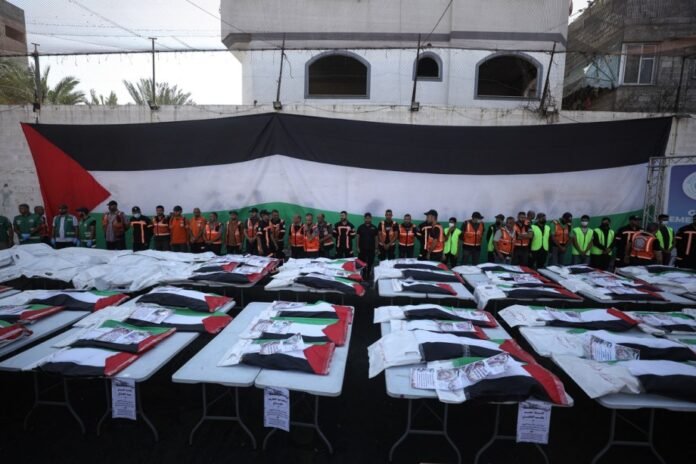
READ: Remains of 129 more Palestinians recovered from rubble in central Gaza
A government’s stated security rationale cannot automatically settle the legal inquiry. The Court must examine what was done, how it was done, the consequences for the protected population and what the cumulative evidence reveals about intent.
For Gaza, that means confronting the destruction of civilian infrastructure, the collapse of essential services, repeated displacement, the devastation of medical facilities and the conditions in which Palestinians have been expected to survive. None of these facts, considered individually, automatically proves genocide. But none should be removed from the larger evidentiary picture.
The question is whether the complete pattern, assessed against the Convention’s demanding legal test, supports the conclusion that prohibited acts were committed with the specific intent to destroy Palestinians in Gaza, in whole or in substantial part, as a protected group.
Myanmar does not predetermine that answer. It makes clear why the question must be asked without looking away. The destruction of a place is also the destruction of the conditions for living
There is something profoundly misleading about describing Gaza’s devastation only in terms of buildings destroyed. A hospital is not merely concrete and medical equipment. It is the possibility of survival. A water system is not simply infrastructure. It is the difference between health and disease. A home is not just a structure. It is memory, privacy, family and belonging.
When these foundations are destroyed on a vast scale, the consequences reach beyond the immediate moment of an attack. They shape whether people can remain in their communities, whether children can grow up safely, whether patients can receive treatment and whether families have any realistic prospect of rebuilding their lives.
Article II(c) of the Genocide Convention addresses the deliberate infliction of conditions of life calculated to bring about the physical destruction of a protected group, in whole or in part. The legal test is exacting: deprivation and displacement alone do not automatically establish this offence. The Court must assess the nature of the conditions, their capacity to cause physical destruction and the specific intent required by the Convention.
The Myanmar judgment is instructive precisely because the Court did not stretch the law to accommodate every allegation. It examined conditions of life but was not satisfied that the evidence established the particular offence under Article II(c). Its genocide finding rested on other prohibited acts.
That distinction should strengthen the Gaza inquiry. It shows that the Court can recognise genocide without turning every form of suffering into the same legal category. It also reminds governments that the destruction of civilian life must be investigated through evidence, not dismissed through political explanations.
The camera has recorded what diplomatic language cannot soften. The documentary record of Gaza matters. Images and footage from journalists, humanitarian workers, medical personnel and residents have made it harder for the world to pretend that the destruction is distant or unknowable.
A filmed hospital ward, a family returning to a flattened neighbourhood, a child searching for water, or a rescue worker digging through rubble is not, by itself, proof of genocidal intent. Legal findings require verification, context and a rigorous assessment of evidence. But such documentation can help establish what happened, when it happened, who was affected and how the conditions of civilian life changed.
The preservation of that record is essential. Governments should support independent investigations, protect witnesses, preserve digital evidence and ensure that journalists and humanitarian personnel can work safely. The destruction of evidence must not become another route to impunity.
The world should also resist the temptation to turn Palestinian suffering into a spectacle consumed briefly and then forgotten. These images are not content. They are records of human lives and potential evidence in the pursuit of accountability.
READ: Hamas seeks emergency talks after Israeli strike killed 3 Gaza aid workers
The ICJ has not yet decided the merits of South Africa v. Israel. Its provisional measures orders are not a final finding of genocide, but they are binding. The case may take years to complete. That timetable cannot become an excuse for governments to postpone their own responsibilities.
Under the Genocide Convention, the duty to prevent arises when a state knows, or should normally have known, of a serious risk that genocide will be committed. The ICJ explained this principle in Bosnia v. Serbia. The obligation requires due diligence: states must use the means reasonably available to them, taking account of their influence and capacity to affect the situation.
For the United States, the United Kingdom, Germany, France, Canada and other governments with significant relationships with Israel, the implications are immediate. They must review arms transfers, military cooperation and other forms of assistance against the risks identified by the Convention and their own domestic laws. Where a serious risk cannot be adequately mitigated, transfers must be reconsidered or suspended as required by law.
They must also use diplomatic leverage to press for compliance with the ICJ’s orders, protect humanitarian access, support the restoration of essential civilian services and preserve evidence for accountability.
This does not mean that every state supplying Israel is automatically complicit in genocide. Complicity and the independent duty to prevent are separate legal questions. But governments cannot claim that their obligations begin only after a final judgment. Prevention would be meaningless if it required the world to wait until the harm was complete.
The global community has repeatedly portrayed itself as the guardian of a rules-based international order. It has demanded accountability for atrocities in Sudan and Myanmar. Yet its response to Gaza has exposed a deep credibility problem: international law appears less universal when enforcing it could threaten an ally’s interests.
The Myanmar judgment makes that inconsistency harder to defend. If governments accept the ICJ’s reasoning when the accused state is politically isolated but hesitate when the accused is strategically important, they are not defending universal law. They are defending a hierarchy of political convenience.
The Court must remain independent. Governments should not dictate their verdict or announce in advance what their judges must conclude. They must, however, respect its binding orders, support its proceedings and fulfil their own preventive responsibilities. The final judgment may take years. The images are already here. The evidence is being recorded. The human consequences are unfolding in real time.
Myanmar taught the world that the evidence of destruction must be read as a whole, not fragmented into convenient explanations. Gaza now asks whether the world has learned that lesson. The ICJ must decide the law. But the Global North must decide whether it will act before the opportunity to prevent further destruction disappears.
OPINION: Macron was right, and the scapegoats were chosen
The views expressed in this article belong to the author and do not necessarily reflect the editorial policy of Middle East Monitor.
GLP-1 drugs could have a surprisingly large environmental payoff
GLP-1 weight-loss medicines such as Ozempic and Wegovy could affect much more than the waistlines of the people who take them. If widely used, our new research suggests these appetite-suppressing medicines could transform the global food system and free up vast areas of agricultural land.
The global food system is ultimately driven by demand. If people eat less, producers respond, affecting production, prices, trade, and how much land is needed. We used a powerful computer simulation to explore scenarios ranging from GLP-1 use concentrated in high-income countries to widespread global access.
With widespread use of these medicines among adults living with obesity, we estimate that reduced calorie intake could prevent up to 6.6 million deaths each year by 2050, while freeing up as much as 32 million hectares of agricultural land—an area slightly larger than Italy—for other uses.
The biggest effects, however, occurred when reduced calorie intake was combined with a shift toward healthier diets. In this scenario, up to 7 million deaths could be avoided each year by 2050, while around 46 million hectares of agricultural land would have become available for other uses. This suggests that alongside weight-loss medicines, we need to make healthier options more widely available, affordable, and more appealing.
The food system could respond in unexpected ways
Food systems are interconnected across countries. If demand falls in one part of the world, this can affect farming, trade, and food prices elsewhere, with consequences for people who are not taking the medications at all.
Lower demand from GLP-1 users, for instance, could make food cheaper. That sounds positive, but cheaper food could also encourage greater consumption among non-users, offsetting some of the intended benefit. The effects of widespread GLP-1 use, in other words, cannot be understood just by looking at individual patients’ weight loss. They ripple through the global food system.
It’s tempting to read these findings as an argument for putting more people on weight-loss medication. That would miss the bigger picture.
Obesity has often been framed as a “lifestyle disease,” blaming individual people for not having enough willpower. But diets are shaped by what food is available, what it costs, how it’s marketed, where shops are located, and what’s most convenient. In many high-income countries, it is remarkably easy to consume large amounts of cheap, energy-dense food. Society tells people to make healthier choices while surrounding them with an environment that often encourages the opposite.
The UK government-commissioned national food strategy, finalized in 2021, made this point clearly: improving diets can’t simply be about asking individuals to choose better. The wider food environment needs to change to make the better choice the easy one.
Our findings shouldn’t be taken to mean that people living with obesity have a responsibility to lose weight to reduce the environmental impacts of food production. Rather, our research examines the wider consequences that changes in food demand could have across the food system.
Changing the food system alongside medicine
A healthier diet is not necessarily just a diet with fewer calories. It could mean more fruit, vegetables, and other nutritious foods, alongside less excessive consumption of foods linked to poor health. These changes affect not only human health but also agriculture, land use, and the environment.
Rather than asking whether GLP-1 medications or healthier diets are the answer, let’s ask how they can work together. Imagine a food system where healthier foods are affordable and accessible, unhealthy options aren’t relentlessly promoted, agricultural policy supports nutritious and sustainable production, and people who need medical treatment can access it. That combination could be far more powerful than any single intervention.
GLP-1 medicines can play an important role in tackling obesity, but they shouldn’t become a technological fix that allows the wider food system to escape scrutiny. They can help people eat less in an unhealthy food environment, but the long-term goal should be to make it easier and more affordable to have a healthier, more sustainable diet.
The remarkable thing about GLP-1 medications may not be that they change how much food people eat. It may be that they show us, with new clarity, just how closely human health, food production, and environmental health are connected, and how much could be gained if we tackled all three together.
Woman Makes Terrifying Discovery in Shower, Then U.S. Marshals Arrive (Video)
What began as an ordinary shower turned into a bizarre late-night ordeal for a woman who discovered a mysterious hole in her bathroom ceiling, called 911 and soon found herself surrounded by police activity outside her apartment building.
The woman, identified only as Katrina, captured the unsettling experience in a TikTok video that has since attracted more than 20 million views. What made the situation even stranger was the unexpected appearance of officers wearing U.S. Marshals Fugitive Task Force gear, followed by someone Katrina described as a crime scene investigator.
Katrina, who posts under the username @oofthegoof, shared the footage on October 4, explaining that she had been showering when she noticed something unusual above her head.
“On the phone with 911 bc a mysterious hole came through the ceiling while I was in the shower,” she wrote.
The video showed a small opening in the textured ceiling, with what appeared to be an unidentified object lodged in the damaged drywall. Alarmed by the discovery, Katrina contacted emergency services. A screenshot of her phone records showed a seven-minute 911 call beginning around 11:40 p.m.
But the mysterious damage was only the beginning of an increasingly strange night.
As Katrina documented what was happening, her camera captured officers gathering outside the brick apartment building. One man wore a tactical vest identifying him as a member of the U.S. Marshals Fugitive Task Force, while other law enforcement personnel could be seen nearby.
Katrina appeared stunned by the growing police presence, claiming that snipers were positioned outside the building. Despite the potentially serious situation, she couldn’t help pointing out one particularly inconvenient detail.
“They got snipers here and s**t bro,” she wrote, before adding, “I have conditioner in my hair.”
Her disbelief continued as the night dragged on. Rather than relaxing after her shower, Katrina found herself outside with family members while additional officers reportedly arrived.
At one point, she posed for a photograph with two male relatives, jokingly describing the unexpected gathering as a “Family bonding experience.”
By approximately 12:22 a.m., Katrina was still waiting outside and appeared increasingly amused by the absurdity of her predicament.
“We’re still outside, more cops keep coming, I have sugar scrub on my legs lmao,” she wrote.
Eventually, Katrina managed to return inside and finish her interrupted shower. However, according to her account, the night still had one final surprise.
“Finished my shower and now a lady from the crime scene unit is here taking pictures,” she told viewers.
The unusual sequence of events quickly captured attention online, with viewers wondering whether the mysterious ceiling damage was connected to the law enforcement operation.
Some commenters speculated that the hole could have been caused by a bullet traveling through the floor of an upstairs apartment. One viewer even described a frightening experience involving a bullet that allegedly passed through their ceiling and landed in their couch.
However, no evidence has established that a firearm caused the damage in Katrina’s bathroom.
The Daily Dot, which reported on the viral video November 18, said it could not independently verify the circumstances surrounding the incident.
The location of the apartment building, the reason federal officers were present and whether any arrests occurred have not been publicly established. It also remains unclear whether the reported crime scene investigation was directly related to the hole in Katrina’s ceiling.
For now, the biggest mystery remains unanswered: What caused the hole above Katrina’s shower, and why were so many law enforcement officers outside her home that same night?
Iran says reopening Hormuz ‘not difficult’ if US accepts Tehran’s conditions
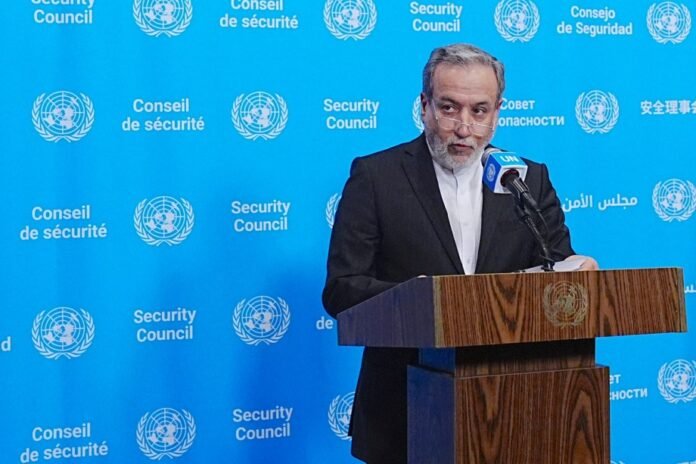
Seyed Abbas Araghchi, Minister for Foreign Affairs, Islamic Republic of Iran, holds a press conference at the Security Council Stakeout at the UN Headquarters, New York City, U.S., September 25, 2026. [Selçuk Acar – Anadolu Agency]
Iranian Foreign Minister Abbas Araghchi said Saturday that reopening the Strait of Hormuz was “not difficult” if the United States accepted Tehran’s conditions, but the waterway would remain closed until they were met.
“Reopening the Strait of Hormuz is not difficult. The United States only needs to accept Iran’s reasonable conditions, which are in line with international law,” Araghchi said at a ceremony marking Oman’s National Day, the semi-official Tasnim news agency reported.
He said the current situation could be resolved only if Washington “acknowledged its mistakes and fulfilled its previous commitments.” He added that past wars had shown regional security must come from within the region and that talks on the issue had begun.
Responding to a Tasnim question about a Qatari delegation’s visit to Tehran, Araghchi said such visits were routine and that mediators between Iran and the US regularly traveled to relay ideas and proposals.
“Our position is clear. As long as Iran’s demands are not met, reopening the Strait of Hormuz is not on the agenda,” he said. “We have always said we are ready for talks, just as we are ready to defend ourselves.”
Araghchi called the US blockade of Iran “completely illegal” and said there was considerable speculation about it. He urged giving regional talks and mediation efforts time and said he hoped for “a rational way to lift the blockade.”
READ: Iran rejects Trump’s bioweapons claims, warns against repeat of disproved allegations that Iraq had WMD
He praised Oman’s efforts to ease regional tensions and said the countries’ close ties were based on mutual respect. Araghchi said the latest round of consultations took place four days earlier, when he met Oman’s sultan and foreign minister. He said close consultations would continue given the sensitive situation in the region.
Iran moved to close the strait again on July 12, four days after the US resumed attacks on the country.
Araghchi also said he had requested an emergency meeting of foreign ministers from the Organization of Islamic Cooperation (OIC) to discuss the situation in Gaza.
He described what was happening there as “a kind of silent genocide” and accused Israel of continuing to kill Palestinians “without pause.”
Separately, Iranian Deputy Foreign Minister Kazem Gharibabadi said a Qatari delegation arrived in Tehran on Friday evening and held two hours of talks.
He said talks with Qatar were continuing online and in person to explore an opening for diplomacy. Qatar did not immediately comment.
READ: Iran urges world to remember scores of children killed in US airstrikes on school






 Seth Stern is the director of advocacy for Freedom of the Press Foundation.