Home Blog

Indonesia primed to lead a Global South forest protection bloc

0
indonesia-primed-to-lead-a-global-south-forest-protection-bloc
Indonesia primed to lead a Global South forest protection bloc

Indonesia is well placed to lead in tropical rainforest conservation. Image: X Screengrab

Indonesia, Brazil and the Democratic Republic of Congo together hold more than half of the world’s tropical rainforests.

In 2022, when Indonesia hosted the G20 summit in Bali, the three countries pledged to cooperate on how to pay to protect those forests. The promise was one of South-South cooperation: developing countries working together rather than waiting for aid from the wealthy North.

Four years on, that pledge has yet to become a real negotiating bloc in which countries agree on a single position and speak with one voice. Then as now, Indonesia is well placed to make it actually happen.

The forest countries of the South share a common problem. They are asked to keep vast forests standing for the good of the planet, yet they have little money of their own to do it.

In April, Indonesia’s finance minister warned that high oil prices could push this year’s budget deficit to 2.9% of the economy. The Republic of Congo, which owes about US$5 billion abroad, is exploring a deal to cancel part of its debt in return for forest protection.

Help from the North is meager and uneven. Researchers at the Center for International Forestry Research have shown that the Congo Basin received just 11% of international tropical forest financing between 2008 and 2017, compared with 55% for Southeast Asia and 34% for the Amazon.

The price paid for results is low. A 2022 study found that Norway paid Indonesia about $1 per tonne of carbon emissions its forests helped avoid, far below Norway’s stated rate of $5.

A new global fund will test whether that changes. The Tropical Forest Forever Facility, launched in Brazil last year, plans to pay countries every year for each hectare of forest they preserve. It has secured $7.3 billion from governments, but payments are unlikely before 2028.

Strikingly, Brazil and Indonesia have each pledged $1 billion, while some wealthy donors committed only a few million dollars each. The South is already paying into the fund meant to pay it, which gives it a claim to shape the rules.

Why should Indonesia lead? It has put real money into the fund and sits on its board alongside Brazil and the Democratic Republic of Congo. It has a long record of working with Norway on forest payments, so it knows where such deals can go wrong.

And it has lessons to share with other forest countries, from granting villages legal rights to manage state forests to fighting peat fires. Indonesia can bring Southeast Asia into the conversation and act as a bridge between the Amazon and the Congo Basin.

Today, each forest country mostly negotiates alone. That lets donors set the terms and pits countries of the South against one another for the same small pot. A joint South-South position would change the balance and should address three issues.

The first is finance. Payments should be large enough to offset what a country gives up by not clearing its forest; they should arrive on time, and they should come as grants rather than loans that add to debt.

The second is safeguards that make sure forest money does not harm local people. The bloc should adopt a common set of rules, written by forest countries with their own communities and incorporating the fund’s promise to send 20% of payments to indigenous peoples and local communities. Standards written in the South would be harder for buyers in the North to ignore.

The third is fair pricing. The bloc should push for a minimum price for forest-protection results, so a tonne of pollution avoided in Borneo or the Congo isn’t valued at a fraction of a tonne cut in Europe.

South-South cooperation should also mean learning from each other, not only bargaining together. Brazil can share how it tracks forest loss by satellite, Congo Basin countries how they work with forest communities, and Indonesia what it learned about fires and land rights.

A bloc must also be honest at home. Its members must continue to reduce forest loss, respect land rights and publish their data.

COP31, the United Nations climate summit in Antalya, opens next month. Indonesia should use it to bring the forest countries of the South to a single table and a single position.

Together they hold the forests the world needs to fight climate change. They should also hold the pen when the rules for paying to protect them are written.

Bhima Yudhistira Adhinegara is the executive director of the Center of Economic and Law Studies (CELIOS), a Jakarta-based think tank. Muhammad Zulfikar Rakhmat is the director of the China-Indonesia and MENA-Indonesia desks at CELIOS.

Egypt Moves Closer To Joining Fight Against Houthis; Saudi Apache Helicopter Downed 

0
egypt-moves-closer-to-joining-fight-against-houthis;-saudi-apache-helicopter-downed 
Egypt Moves Closer To Joining Fight Against Houthis; Saudi Apache Helicopter Downed 


Egypt moved closer Sunday to potentially joining the fighting between Saudi Arabia and Yemen, with parliament convening an emergency session after President Abdel Fattah el-Sisi said Cairo was prepared to provide military support requested by Riyadh to defend the kingdom. 

The development came as the Houthis said they shot down a Saudi Apache attack helicopter near the border region of Najran on Saturday.  

Egypt’s House of Representatives scheduled its emergency session for 1 p.m. local time Sunday at el-Sisi’s request. Speaking at a military academy graduation ceremony Saturday, el-Sisi said Egypt was prepared to take any measures requested by Saudi Arabia to protect its security and sovereignty but stressed that such action “requires parliamentary approval.” 

El-Sisi said any potential Egyptian military involvement would be strictly defensive rather than intended to wage war. 

Yahya Ali al-Raee, speaker of Yemen’s House of Representatives, appealed to Egypt on Saturday not to enter the conflict militarily, Houthi-run al-Masirah TV reported. 

In a letter to Egyptian House of Representatives Speaker Hisham Badawi, al-Raee urged Cairo to support efforts toward a political settlement in Yemen instead. He accused Saudi Arabia of abandoning previous deescalation efforts and escalating military operations in Houthi-controlled areas and called for an end to hostilities and respect for “Yemen’s sovereignty.” 

Al-Raee warned that Egyptian military involvement could further complicate the conflict and affect regional stability. He also cited what he described as Egypt’s longstanding support for Yemen’s unity and stability. 

Two crew members were killed when a Saudi AH-6i reconnaissance helicopter crashed in the southwestern Najran region because of a technical malfunction, according to the Saudi-led coalition fighting in Yemen. 

Coalition spokesperson Maj. Gen. Turki Al-Maliki said the helicopter, operated by Saudi Arabia’s Ministry of National Guard, went down inside Saudi territory. 

Yemen has been embroiled in conflict since late 2014, when the Houthis seized the capital, Sanaa, and much of northern Yemen. A Saudi Arabia-led coalition intervened in 2015 in support of the internationally recognized government. 

Saudi Arabia and the Houthis have exchanged attacks and military warnings in recent days as hostilities between the two sides have intensified. 

Reality TV Star Quits Show After Suffering Serious Injury

0
reality-tv-star-quits-show-after-suffering-serious-injury
Reality TV Star Quits Show After Suffering Serious Injury


Reality TV star Mauricio Umansky has made an emotional exit from Special Forces: World’s Toughest Test after suffering a painful injury that left him struggling to breathe and fearing he could seriously hurt himself if he continued.

The 56-year-old real estate mogul, best known for his appearances on The Real Housewives of Beverly Hills alongside estranged wife Kyle Richards, became the fifth celebrity to leave the grueling FOX competition during its fifth season.

His departure came during the October 15 episode, as contestants prepared to enter a simulated chemical warfare environment in the jungles of Malaysia.

Umansky had already been battling severe rib pain after an earlier boxing challenge against former NBA player Matt Barnes.

He initially attempted to push through the discomfort, completing two additional challenges despite the injury.

But when instructors announced that the next exercise would involve exposure to tear gas, Umansky realized continuing could make his condition significantly worse.

“My rib is just hurting and if I’m going to be coughing and not able to breathe, I feel like it’s gonna break further,” he explained during the episode.

Rather than risk further injury, Umansky made the difficult decision to voluntarily withdraw.

He later told PEOPLE that he wanted to leave on his own terms rather than wait for medical staff to remove him from the competition.

The decision was especially heartbreaking because he had joined the show alongside his daughter, Alexia Umansky, 30.

The father-daughter duo previously appeared together on Netflix’s Buying Beverly Hills, which followed the family’s luxury real estate company, The Agency.

But their latest television adventure was far different from selling multimillion-dollar homes.

The FOX series places celebrities in an intense military-style training program designed to test their physical endurance, mental strength and ability to handle extreme pressure.

Contestants face exhausting exercises, harsh outdoor conditions and demanding challenges modeled after special forces selection training.

For Mauricio, however, the most difficult part wasn’t the physical punishment. It was knowing he would have to leave his daughter behind.

“I wish I would’ve still been there with my daughter,” he told PEOPLE.

He explained that watching Alexia challenge herself and grow more confident had become one of the most rewarding parts of the experience.

Although disappointed that he couldn’t remain longer, Umansky said their four days together were priceless.

Alexia was visibly upset by her father’s departure but remained determined to continue competing.

She explained that participating in the show was an opportunity to discover just how strong she could be, both physically and emotionally.

The experience also brought the family closer in unexpected ways.

During an earlier episode, Alexia publicly discussed a painful experience from her past that she had never previously shared with her parents.

Mauricio later said he was proud of his daughter’s courage and determination, describing their time together as an opportunity to strengthen their relationship.

As for his injury, Umansky revealed that the damage was more serious than he initially realized.

He suffered a cracked rib, which made breathing, coughing and even traveling home extremely uncomfortable.

The reality star said the injury took approximately 10 weeks to heal completely, although he has since recovered and returned to his normal fitness routine.

Despite the painful experience, he insists he has no regrets about participating.

And he certainly isn’t the only celebrity whose time on the show ended unexpectedly.

Former Real Housewives of Beverly Hills star Brandi Glanville was the first contestant to leave after suffering injuries during a helicopter challenge.

The 53-year-old reportedly sustained a cracked rib, bruising and a concussion after hitting the water during the demanding exercise.

Actress Ruby Rose also withdrew after struggling with injuries, while former New York Congressman George Santos left because of severe back and sciatic nerve pain.

Former NFL running back LeSean “Shady” McCoy also walked away from the competition, citing difficulties with the harsh living conditions, including the bathroom facilities.

Those departures have made the season particularly unpredictable, with five celebrities leaving within the first four episodes.

For Umansky, the experience may have ended earlier than he hoped, but it gave him something he considers more valuable than finishing the competition.

He got to spend several unforgettable days alongside his daughter while watching her prove to herself just how much she could accomplish.

And although he couldn’t complete the challenge, he said he was proud to have pushed himself beyond his comfort zone and grateful for the experience.

US racing to field drone wingmen to close fighter gap with China

0
us-racing-to-field-drone-wingmen-to-close-fighter-gap-with-china
US racing to field drone wingmen to close fighter gap with China

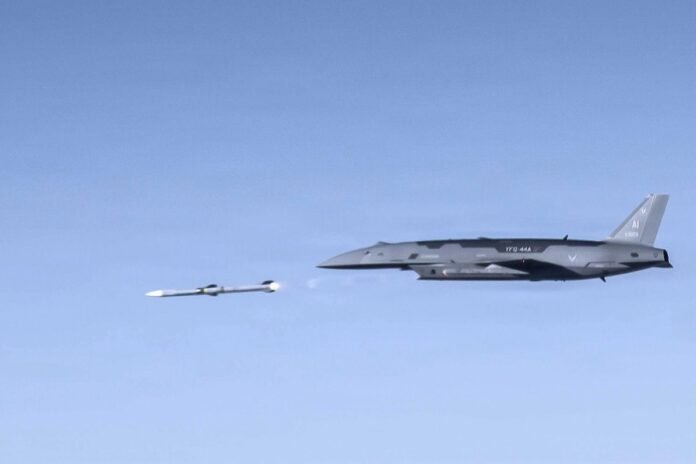
A recent breakthrough in airborne drone control has offered a tangible glimpse into the future of US air combat, signaling the US Air Force’s accelerating push to integrate autonomous wingmen alongside frontline fighters.

This month, The War Zone (TWZ) reported that a US Air Force F-22 Raptor pilot successfully controlled an uncrewed YFQ-44A Fury fighter drone from the cockpit for the first time, according to the military branch and contractor Anduril.

After both aircraft launched from Edwards Air Force Base and met midair, the Raptor pilot, acting as an airborne “quarterback,” transmitted updated mission plans and high-level tactical directives via data link, which the drone’s onboard autonomy software translated into dynamic flight maneuvers and simulated combat tasks in real time.

The landmark test — coordinated with the 412th Test Wing and the Nellis-based Experimental Operations Unit — marks a major step in the service’s Collaborative Combat Aircraft (CCA) program, which designates F-22s as the initial tactical coordinators for semi-autonomous wingmen ahead of large-force integration trials at Exercise Emerald Flag in December.

By pairing human pilots with autonomous aircraft, the Air Force aims to field an initial operational fleet of at least 500 Increment 1 CCAs by 2032, expanding combat mass and survivability while advancing digital cockpit architectures to reduce single-pilot workload.

Although the landmark in-flight control of a YFQ-44A Fury drone from an F-22 cockpit demonstrates tangible progress in manned-unmanned teaming (MUM-T), the CCA program faces deep tensions between its operational promises and severe technical realities.

At its core, the program is designed to affordably rebuild counterair mass, lethality, and operational capacity to offset mounting US fighter deficits against China’s expansive anti-access/area-denial (A2/AD) umbrella in the Western Pacific.

According to a September 2026 US Congressional Research Service (CRS) report, the US Air Force fighter fleet dropped to 1,098 combat-coded aircraft in 2026, breaching Congress’s statutory 1,145-jet minimum.

The CRS report notes that the shortfall stems from decades of post-Cold War drawdowns, lagging procurement, and an aging fleet averaging 27.4 years with falling mission availability; defense industrial bottlenecks, spare parts shortages and a 1,900-pilot deficit compound the crisis. Consequently, the report notes that the service aims to field 1,558 crewed fighters by 2035 to meet operational demands.

Furthermore, Olli Suorsa says in a February 2025 Pacific Forum report that China’s dense, layered anti-aircraft network in the South China Sea combines ground-, sea-, and air-based interceptors under an integrated sensor umbrella.

According to Suorsa, the People’s Liberation Army (PLA) fields advanced Russian S-300 and S-400 batteries alongside indigenous HQ-9 air-defense missiles extending hundreds of kilometers seaward.

He notes that this ground umbrella is reinforced by naval surface combatants packing 1,900 vertical launch cells and modern J-16 and stealth J-20 fighters carrying long-range PL-15 missiles cued by KJ-500 radar planes.

In response to US fighter shortages and China’s extensive A2/AD capabilities, Mark Gunzinger and other authors note in a February 2024 Mitchell Institute report that CCAs deploy mission-tailorable payloads—including radar, infrared sensors, electronic warfare jammers, decoys, and air-to-air missiles—at a fraction of the cost of procuring crewed aircraft.

Gunzinger and others describe CCAs as expendable, attritable lead forces that disrupt enemy air defenses, absorb missile salvos, and launch distributed sorties from runway-independent forward bases across the Pacific.

They note that teaming CCAs with fifth-generation fighters like the F-22 creates an advanced outer screen of distributed sensors and shooters, transforming combat tactics.

In this collaborative construct, Gunzinger and others note that CCAs project forward to generate intercept-quality tracks and launch weapons via secure datalinks, enabling trailing F-22 pilots to coordinate long-range strikes from standoff ranges, preserve their critical low observability, and drastically reduce costly attrition of crewed combat aircraft.

However, recent wargames may cast doubt on the actual effectiveness of CCAs in a US-China conflict over Taiwan. In an August 2026 interview, Hudson Institute senior fellow Bryan Clark said recent war games with senior US Navy leaders at the Naval War College revealed severe operational flaws in MUM-T with CCAs.

Clark warned that uncrewed drones are more detectable than stealth fighters like the F-35, drawing hostile fire and endangering human pilots. He noted that speed and range mismatches hinder joint flight, while fielding CCAs with equivalent stealth and sensors inflates costs to near-crewed fighter levels, neutralizing their intended affordability and combat mass advantage.

In an August 2025 Aether journal article, S. Tucker Browne and co-authors note that integrating tactical AI into CCAs is undermined by perception failures, data scarcity, and adversarial brittleness.

Browne and his co-authors point out that autonomous systems struggle to build battlespace situational awareness in chaotic environments and routinely fail at sense-making. Furthermore, they emphasize that AI models cannot generalize beyond flawed peacetime or synthetic training datasets, leaving them unable to handle unexpected combat tactics.

Compounding those limitations, they warn that combat AI remains dangerously brittle against rudimentary adversarial deception while falsely projecting high confidence.

Consequently, Browne and others argue that tethering to crewed fighters merely overburdens pilots and exposes critical command nodes to hostile jamming and attacks.

US airbases across the Indo-Pacific face acute vulnerability to pre-emptive Chinese missile salvos, as the PLA exploits inadequate regional air and missile defenses to target centralized facilities and destroy combat aircraft on the ground.

In a separate February 2025 Mitchell Institute report, Gunzinger contends that the US Air Force can counter that vulnerability by pairing crewed fighters with CCAs that require minimal logistical footprints.

According to Gunzinger, CCAs can launch from roads, shortened airstrips or rocket-assisted ramps without traditional runways; units can disperse across austere sites in southern Japan and the northern Philippines, diluting enemy strikes and complicating Chinese missile targeting.

Concurrently, he says that standoff bombers and fourth-generation fighters operating from distant sanctuaries can air-launch weaponized CCAs directly into contested airspace.

In flight, he notes that these uncrewed systems screen for fifth-generation F-22s and F-35s, absorbing hostile fire, jamming enemy radars, and sustaining continuous counterair pressure between crewed strike pulses.

Still, dispersion assumes that the US can generate aircraft sorties faster than China can close its kill chains to target US bases and destroy US aircraft on the ground.

Ultimately, the future of US air dominance will depend on whether military planners can resolve foundational algorithmic frailties, soaring platform costs, and austere logistics before an Indo-Pacific crisis forces unproven robotic doctrines into real-world combat.

Cosmic Breath: Global calls to prayer answer rising Islamophobia in London

0
cosmic-breath:-global-calls-to-prayer-answer-rising-islamophobia-in-london
Cosmic Breath: Global calls to prayer answer rising Islamophobia in London

Tucked away just a stone’s throw from the relentless hum of Oxford Street, a new sonic sanctuary has taken root in central London. Joe Namy, an American-born Lebanese artist and composer whose practice encompasses sound, its history, and its physical impact on the built environment, has brought his multi-channel sound installation, Cosmic Breath, to the UK capital, Anadolu reports.

The work is reimagined for Ibraaz’s Musalla, a space dedicated to spiritual practice as both lived experience and creative expression.

Composed of recordings of the adhan—the Islamic call to prayer—the installation brings together historical and contemporary calls from different geographies, amplified through horn speakers like those mounted on mosque minarets.

Played simultaneously, each speaker softly emits a different adhan recording, inviting the audience to lean in and listen closely. At prayer times, the volume increases, making the calls clearly audible throughout the room, creating a congregation of calls to prayer.

‘Interested in collective sound experiences’

The work forms part of Namy’s wider exploration of sound systems, community, and spirituality.

First commissioned for the Islamic Arts Biennale in Jeddah in 2023 by its artistic director and architect, Sumayya Vally, the installation explores collective auditory experiences and public sound landmarks.

“A lot of my work deals with the politics of sound, and deals with the spirituality of sound as well, how it affects us in different ways,” Namy explains. “So, I’m interested in sound system cultures (and) collective sound experiences as well, and how they impact our lives.”

Developed in close collaboration with Vally, who designed the installation’s spatial scenography, the artwork grew out of a poetic reflection on time and geography.

Namy was moved by the idea that “at any moment in time on Earth, there is an adhan happening somewhere on this planet, which I think is such a really powerful and beautiful gesture.”

Approaching the adhan through a sociological lens, Namy examines how an ancient oral tradition has transformed alongside modern technology, amplification, and recordings.

Bringing the piece from Saudi Arabia to London reshapes its meaning dramatically, particularly given the current social atmosphere in the UK.

READ: UK security adviser’s wife faces scrutiny over Palestine Action post

From Jeddah to London: A different political soundscape

“Showing it for the first time in Jeddah was a very different experience than showing it here in London, which … situates the work very differently than how it was situated there,” Namy underlined.

He pointed directly to the heightened hostility surrounding the current political landscape: “Especially now today in the current kind of political climate here in London… there’s just a more heightened kind of Islamophobia, xenophobia, prejudice… all these things that we’ve been experiencing and has been increasing.”

For Namy, installing the piece in the heart of London serves as a sanctuary and an antidote to that hostility.

“I feel like it’s a more powerful gesture to be able to show it here in the center of London, you know, just off of Oxford Street, and to be able to have this space for people to be able to come, relax,” he said.

He notes how rare it is in contemporary art spaces to engage with faith so openly: “I think, what I really enjoy is the fact that it’s thinking about the spirituality in relation to art, which you don’t always get a chance to explore, but also providing a kind of third space for people to explore more.”

A London memory born during lockdown

To ground the exhibition in its current environment, this iteration at Ibraaz features a local recording. “So, this recording is from London,” Namy notes.

“Actually, it was important to bring in something that was local as well, and so this was actually one of the first recordings of a public adhan in London that happened in Walthamstow during COVID. It was again a time (when) everyone was social distancing, and so it was a way for the community to be able to kind of — although they were distant — to feel closer together, so it was important to bring in a local element into the setting as well, so that we have some a more closer connection to where we are here in London.”

The recording captures the historic call performed by the Waltham Forest Islamic Association in 2020, offering a sonic expression of shared experience when physical gathering was impossible.

Adhans from Mecca to Singapore, Tbilisi to Khartoum

The audio selections in Cosmic Breath span more than a century and cross vast physical and acoustic terrains, revealing how each call carries a unique character shaped by local traditions, acoustic environments, and regional histories.

“The selections that we included within this installation each represent a certain aspect, or have a unique aspect for the adhan,” Namy says. “Part of it is thinking about spaces (where) you normally wouldn’t encounter the adhan, spaces in which recordings of the adhan are kind of historically significant as well.”

Among the archival highlights is what is considered the first recording of the adhan at the Haram Mosque in Mecca, dating back to the late 19th century. “I think this one is the first recording that was ever done of the adhan from the late 1800s in Mecca. You can kind of hear the grain of the recording. It’s not a really great recording, but it’s interesting to hear it in context of all the other ones,” Namy reflects.

From Asia, the piece gathers landmark history and geography.

“From the Philippines, (there is) an archival recording from the 1950s. It was one of the first recordings of the adhan in the Philippines,” Namy points out.

Contemporary and historical selections also feature the Al-Aqsa Mosque in Jerusalem and Singapore’s Sultan Mosque, thought to be the first mosque to adopt loudspeakers in the 1930s.

READ: Protest outside Azerbaijan’s embassy in London against hijab ban in schools

“This one is from Singapore, and this was recorded at the first mosque that actually used speakers to amplify the call to prayer. The mosque is still there, and that was important,” he adds.

Other field recordings offer stark contrasts in style and setting—from the ornate to the stripped-back.

“This one is Georgia Tbilisi, and this one is probably the most flowery, I think. You really hear the improvisation and the embellishments and how the voice gets extended in the recitation,” Namy says.

In contrast, “one is from the Sahrawi refugee camp in Algeria, and it’s one of the only ones that’s not recorded, that’s not amplified,” Namy explains saying, “It’s somebody who is old school-style, kind of just reciting it without any speakers or anything like that, just their voice.”

The installation captures deeply intimate acts of faith as well as distinct colloquial traditions.

“I think this one is from Japan,” Namy shares, explaining that similar to the recording mentioned before, it was “somebody just kind of reciting it into the forest for themselves, basically, which I thought was a really beautiful gesture. So, it’s a very personal personal recording reflection.”

A call to prayer from Khartoum highlights regional identity: “This one is Khartoum. It’s recorded in Sudan, and again, you hear the colloquial differences and how the adhan is recited. It’s very different in the recitation. It’s very Sudani in its style, which I really love.”

Not every place could be captured on audio.

Namy recalls attempting to record the first mosque built in South America, located in Brazil. Because the building is reserved for special occasions, “you don’t hear the adhan there, so we recorded just kind of like the empty space from that room, just to have that kind of gesture,” though it ultimately remained unreleased alongside seaside field recordings from Egypt.

From South Africa, a protest becomes the seed of Cosmic Breath

The initial impulse for Cosmic Breath traces back to a pivotal moment of civic resistance in South Africa. During the COVID-19 lockdowns in 2020, rising social tension, Islamophobia, and xenophobia in Durban led to a local ban on publicly broadcasting the adhan.

In response, an act of interfaith solidarity emerged. “This protest was actually organized by a Hindu community member. He wasn’t Muslim, but he organized this protest in solidarity with the Muslim community there,” Namy recalls.

Sumayya Vally shared the link to the event with him, sparking the broader concept.

Restricted by social distancing rules, residents adapted: “How do you protest at a time when you can’t congregate and gather together? And so they asked everybody to bring their cars and made this huge parade. Everybody tuned their car stereo systems to one of the channels that was broadcasting the adhan.”

The resulting soundscape of hundreds of car speakers reverberating through the streets of Durban provided the foundation for the entire project. “This is the recording from that experience as well,” Namy reflects.

“And that was kind of the first recordings that really made me think about the piece… and bring everything together.”

WATCH: 9/11 at 25 — Why Israel Fuels Islamophobia | Palestine This Week

IDF Condemns West Bank Attack on European Diplomats; Netanyahu Questions Reports 

0
idf-condemns-west-bank-attack-on-european-diplomats;-netanyahu-questions-reports 
IDF Condemns West Bank Attack on European Diplomats; Netanyahu Questions Reports 


A group of European diplomats was attacked by masked Israeli rioters in the West Bank village of Taybeh on Saturday, according to the Israel Defense Forces (IDF), while Prime Minister Benjamin Netanyahu’s office said the available evidence did not establish the full circumstances of the incident and warned against drawing conclusions before an investigation is completed.

“We urge caution before drawing conclusions from today’s reports that European diplomats were attacked by masked Israelis in Judea and Samaria. Any violence against diplomats is unacceptable. The more serious the accusation, the greater the demand for compelling evidence,” the Prime Minister’s Office (PMO) said.

Army Radio reported that vehicles used by diplomats from France, Belgium and Poland came under attack during an olive harvest in Taybeh, northeast of Ramallah. Footage published by the station showed stones being thrown at one diplomatic vehicle, a smashed window and a diplomat on the ground.

According to testimony cited by Army Radio, seven masked settlers arrived on ATVs, surrounded a diplomatic vehicle, demanded identification documents and broke a window of a Belgian Consulate vehicle.

The IDF said its preliminary investigation found that no soldiers were at the scene when the incident occurred and that security forces arrived after the rioters had fled.

“The IDF strongly condemns the severe act of violence that took place in the area of Taybeh, during which diplomatic representatives were attacked by Israeli rioters,” the military said.

Police opened an investigation after receiving footage and said investigators were working with the Foreign Ministry to locate those involved, collect testimony and identify suspects. Officers entered the area under IDF protection to gather evidence.

Netanyahu’s office said the delegation had entered “a sensitive area with a history of confrontations” without coordinating with the IDF beforehand, arguing that such coordination was essential to protecting visiting diplomats and preventing violence.

The PMO also said the delegation included Bernard Baudoux, a French Communist Party mayor who previously raised the Palestinian flag over his municipal building, prompting French authorities to order its removal.

Baudoux blamed the incident on what he described as government tolerance of settler violence.

“I think that if settlers are behaving like this, there is a tolerance on the part of the Israeli government,” he told AFP.

Foreign Minister Gideon Sa’ar also condemned the attack while criticizing the lack of advance coordination.

“A police investigation has been opened, and forensic investigators from the Judea and Samaria District are already at the scene collecting evidence. The Foreign Ministry is in contact with the ambassadors of the countries concerned in order to assist the law enforcement authorities, who are working to identify the attackers and bring them to justice,” Sa’ar wrote on X.

“Without detracting from the severity of the incident, it is unfortunate that the visit was not coordinated with the IDF in advance. Such coordination could have helped safeguard the visitors’ security,” he added.

Belgian Foreign Minister Maxime Prevot condemned the incident “in the strongest terms,” saying a French mayor had been assaulted and a Belgian vehicle damaged. He pledged to continue pressing the European Union for sanctions against those responsible for settler violence.

“Palestinians face this violence every day. Settlers also target journalists reporting on it and diplomats. Harvesting olives, reporting the news or carrying out diplomatic duties should never put anyone at risk of attack,” Prevot said.

Netanyahu’s office maintained that footage showing masked individuals confronting a diplomatic vehicle, along with images of the damaged window and a person on the ground, did not establish the complete sequence of events or individual responsibility.

The PMO also raised concerns about what it described as a “coordinated campaign to smear Israel and the Jewish residents of Judea and Samaria during the annual olive harvest,” saying allegations could cause reputational damage before the evidence was fully examined.

President Isaac Herzog also referred to the Taybeh incident Saturday evening while speaking with Washington Post photographer Heidi Levine, who was seriously injured in an attack near the Palestinian village of Abu Falah a day earlier.

“I strongly condemn this outrageous and shocking phenomenon of violence — both in the terrible attack you endured and in other serious incidents, such as what happened today in Taybeh,” Herzog said.


Europe Shifts AI Strategy From Building Models to Driving Adoption

0
europe-shifts-ai-strategy-from-building-models-to-driving-adoption
Europe Shifts AI Strategy From Building Models to Driving Adoption


Europe is shifting its artificial intelligence strategy towards deploying AI across industries, as it struggles to compete with leading American and Chinese developers of advanced models.

European Commission President Ursula von der Leyen and other policymakers argue that boosting AI adoption among businesses could improve productivity and strengthen the bloc’s economy. The priority is increasingly helping companies, particularly small and medium-sized enterprises, integrate existing technology into sectors such as healthcare, manufacturing, transport and defence.

However, reliance on foreign AI models, chips and cloud infrastructure raises concerns about technological sovereignty and national security. European developer Mistral argues that abandoning frontier AI development would leave the continent dependent on overseas providers, despite its efforts to narrow the performance gap.

EU officials maintain that developing European models remains important, but acknowledge that limited computing capacity presents a major obstacle. As European leaders prepare to discuss AI adoption at an international summit in Dublin, the debate centres on whether prioritising practical applications offers a realistic competitive advantage or risks deepening Europe’s technological dependence.

via Politico

Nurse Dies After Hospital Sent Her Home with ‘Acid Reflux’

0
nurse-dies-after-hospital-sent-her-home-with-‘acid-reflux’
Nurse Dies After Hospital Sent Her Home with ‘Acid Reflux’


A 47-year-old nurse who dedicated nearly 25 years of her life to caring for others died just three days after doctors sent her home from a hospital with an acid reflux diagnosis, missing a life-threatening tear in her body’s main artery.

Paula Ivers, a mother of one from Denton, England, sought emergency treatment at Tameside General Hospital on March 5, 2024, after experiencing severe chest pain that spread into her back.

Despite the intensity of her symptoms and a family history of early heart-related death, doctors diagnosed her with gastroesophageal reflux disease, commonly known as acid reflux, and prescribed medication.

Three days later, her young daughter discovered her collapsed on her bedroom floor. Ivers was pronounced dead on March 8.

Now, more than two years after her death, an official investigation has concluded that serious failures in her medical care contributed to the tragedy.

British coroner Christopher Morris determined that Ivers died from an undiagnosed aortic dissection, a dangerous condition in which a tear develops in the inner wall of the aorta, the major artery carrying blood from the heart to the rest of the body.

The condition can quickly become fatal if it is not identified and treated.

According to the coroner’s findings, Ivers had been experiencing worsening chest pain since the evening before she visited the hospital.

Doctors performed an electrocardiogram, commonly called an EKG in the United States, along with a chest X-ray and blood tests.

Most results were normal, although her heart rate was elevated and blood tests showed a slightly increased level of C-reactive protein, a marker associated with inflammation.

She was transferred to a same-day emergency care unit before being discharged with a prescription for omeprazole, a medication used to reduce stomach acid.

But investigators later determined that doctors had failed to consider aortic dissection as a possible explanation for her symptoms.

They also failed to adequately account for the severity of her pain and her family’s medical history.

Ivers’ father had died from a heart-related condition in his 40s, a detail the coroner said should have been considered during her assessment.

Crucially, doctors did not order a CT angiogram, a specialized imaging scan that can reveal problems in major blood vessels.

The coroner concluded that such a scan likely would have identified the tear and allowed Ivers to be transferred to a specialist hospital for emergency surgery.

He found that she probably would have survived if the condition had been diagnosed and treated.

An autopsy revealed that Ivers died after blood accumulated around her heart, a complication of the aortic dissection that prevented her heart from functioning properly.

The underlying tear was associated with cystic medial degeneration, a weakening of tissue within the aortic wall.

At the conclusion of the inquest on June 17, 2026, Morris formally determined that neglect contributed to her death.

The findings have devastated Ivers’ family, particularly because she had spent most of her adult life working for Britain’s National Health Service.

Her sister, Lesley Ivers, described Paula as a loving, generous and compassionate woman who devoted herself to helping patients.

“For almost 25 years Paula devoted her life to the NHS,” Lesley said.

She explained that one of the family’s greatest struggles has been accepting that Paula died after seeking help from the same health system she had served for decades.

The tragedy has also prompted action beyond the family’s individual case.

In a formal report issued August 26 and published in October, the coroner warned that additional deaths could occur unless hospitals improve how they evaluate patients experiencing chest pain.

He raised concerns about the failure to consistently document important family medical history, the absence of routine blood pressure measurements in both arms and the way patients are directed into urgent care services.

The report also questioned whether patients should receive an early, in-person assessment by an experienced physician before decisions are made about which emergency service should treat them.

The Tameside and Glossop Integrated Care NHS Foundation Trust has since acknowledged serious shortcomings in Ivers’ treatment.

In civil proceedings brought by the family, the hospital operator admitted that it failed to consider an aortic dissection, did not carry out appropriate investigations and discharged Ivers without adequately explaining her symptoms.

The trust also acknowledged that appropriate testing would likely have led to emergency surgery and that Ivers probably would have survived.

The family’s attorneys are now working toward a financial settlement.

NHS England has also responded to the broader concerns, pointing to existing emergency care guidance and measures intended to improve timely access to medical assessments.

For Americans, the case highlights an important distinction between ordinary acid reflux and potentially life-threatening cardiovascular emergencies.

Acid reflux can cause burning discomfort in the chest, but aortic dissection may cause sudden, severe chest or back pain and can sometimes resemble other medical conditions.

Not every patient experiences the same symptoms, and some may have pain without the classic warning signs.

Sudden, severe or unexplained chest or upper-back pain should be treated as a medical emergency, particularly when accompanied by fainting, weakness, trouble breathing or other concerning symptoms.

For Ivers’ family, the tragedy has become a mission to prevent others from experiencing a similar loss.

Her sister said the family does not want Paula’s death to discourage people from seeking medical help. Instead, they hope it will encourage hospitals to recognize dangerous symptoms earlier and provide appropriate treatment.

The family is also determined to make sure Paula’s daughter grows up knowing how deeply her mother loved her.

Thousands rally in Tunis against President Saied

0
thousands-rally-in-tunis-against-president-saied
Thousands rally in Tunis against President Saied

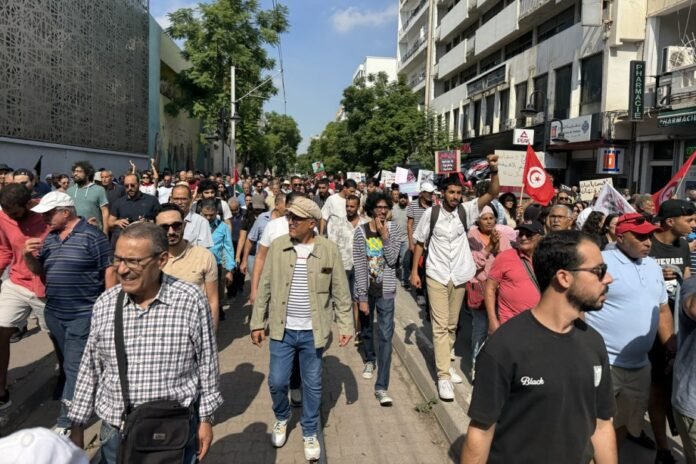
Thousands of people protested against Tunisian President Kais Saied’s policies in Tunis on Saturday, calling for freedom of expression and the protection of civil liberties, Anadolu reports.

The demonstration began outside the headquarters of the Tunisian General Labour Union (UGTT) and was organized by the union, civil society organizations and political parties.

Protesters marched through the capital, chanting slogans opposing the government and demanding greater freedoms. They also called for Saied’s resignation.

Representatives and supporters of various political groups, including the People’s Movement, the Ennahda Movement and the National Salvation Front, joined the march.

At a rally outside the municipal theater at the end of the march, UGTT Secretary-General Salah Eddine Salmi said that if the authorities sidelined dialogue, the streets and public squares would become forums for it.

READ: Tunisia: Ennahda condemns restrictions on prisoners’ access to media

Salmi urged Tunisians to unite and speak out in defense of the country and people’s rights and freedoms. He said people’s rights were being violated and that Tunisia could not be reduced to the rule of a single person or left to the decisions of a government that listened only to itself.

Mounir Jellassi, a secondary-school teacher who attended the demonstration, said he had two main reasons for joining the protest.

Jellassi said his first reason for joining the protest was the shrinking space for freedom of expression and increasing restrictions on fundamental freedoms.

He also pointed to economic difficulties, saying the rising cost of living was making it difficult for people to lead a normal life in their own country.

READ: US provides Tunisia with $1m in security equipment to support counter-terrorism efforts

Ukrainian drones hit Russia’s biggest data centre

0
ukrainian-drones-hit-russia’s-biggest-data-centre
Ukrainian drones hit Russia’s biggest data centre


Ukrainian drones hit Russia’s biggest data ​centre, owned by the country’s largest bank and technology ‌company, Sberbank, but did not disrupt its operations, a senior company executive said on Wednesday.

The strike in the Saratov region on the Volga River ​followed three attacks in the past week on data ​centres owned by Russian tech group Yandex. Ukraine says ⁠it is responding to Russian attacks on its own data ​sites.

“We confirm that the data processing centre was attacked. At the ​same time, all of Sberbank’s systems and services are operating normally and without disruption,” Sberbank First Deputy CEO Alexander Vedyakhin told reporters.

Along with Yandex, its ​main domestic rival, Sberbank is Russia’s leading developer of artificial ​intelligence. The domestic market is shared between Sberbank’s GigaChat model and YandexGPT.

Both ‌companies ⁠have invested heavily in the development of their models but lag global leaders in the United States and China by up to nine months, partly due to Western sanctions which complicate Russia’s ​access to the ​most advanced ⁠hardware.

Russia’s state RIA Novosti news agency reported in 2024 that the Sberbank centre that was hit ​in Balakovo, covering an area of 55,000 square ​metres, will ⁠host Russia’s biggest supercomputer, which is scheduled to go into operation in 2027.

The site is located next to the Balakovo nuclear power ⁠plant ​and the Saratov hydroelectric power plant.

Neither ​Yandex nor Sberbank have said whether supercomputers were damaged in the Ukrainian attacks.

Source:  Reuters

0FansLike
0FollowersFollow
0FollowersFollow
0SubscribersSubscribe
- Advertisement -
Google search engine

Recent Posts