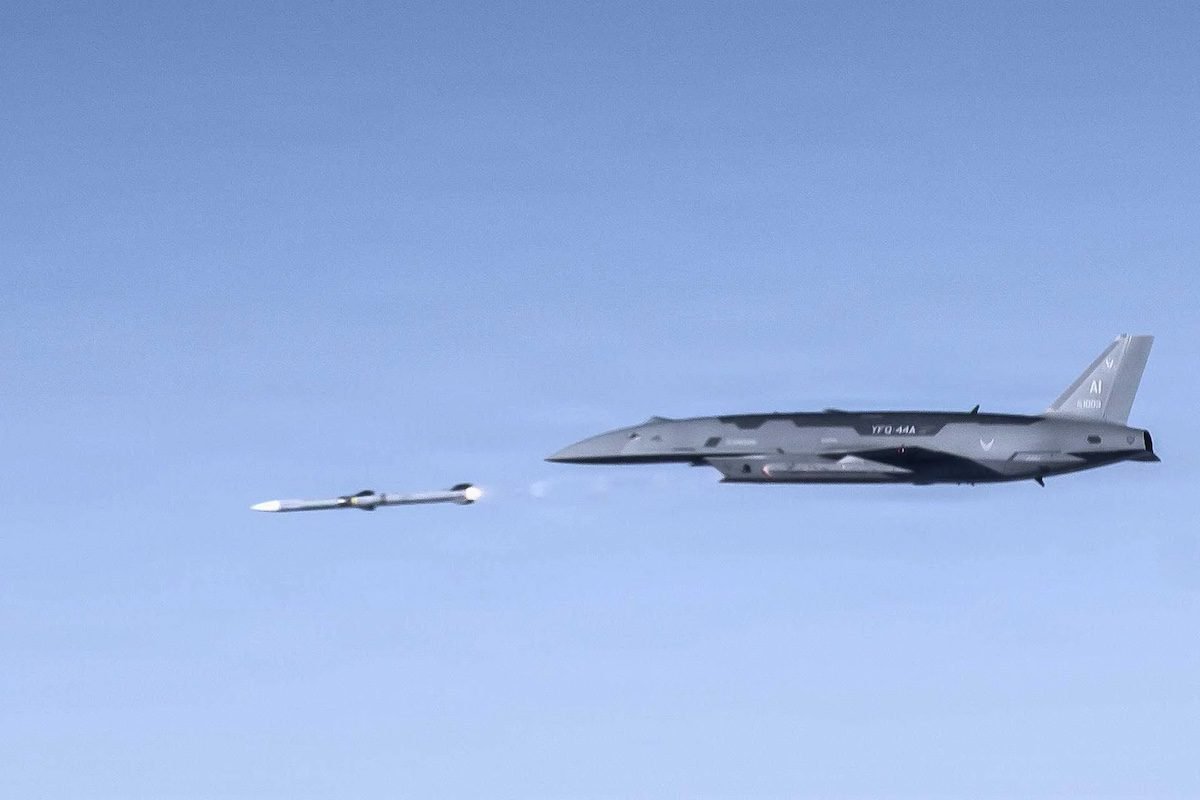
A recent breakthrough in airborne drone control has offered a tangible glimpse into the future of US air combat, signaling the US Air Force’s accelerating push to integrate autonomous wingmen alongside frontline fighters.
This month, The War Zone (TWZ) reported that a US Air Force F-22 Raptor pilot successfully controlled an uncrewed YFQ-44A Fury fighter drone from the cockpit for the first time, according to the military branch and contractor Anduril.
After both aircraft launched from Edwards Air Force Base and met midair, the Raptor pilot, acting as an airborne “quarterback,” transmitted updated mission plans and high-level tactical directives via data link, which the drone’s onboard autonomy software translated into dynamic flight maneuvers and simulated combat tasks in real time.
The landmark test — coordinated with the 412th Test Wing and the Nellis-based Experimental Operations Unit — marks a major step in the service’s Collaborative Combat Aircraft (CCA) program, which designates F-22s as the initial tactical coordinators for semi-autonomous wingmen ahead of large-force integration trials at Exercise Emerald Flag in December.
By pairing human pilots with autonomous aircraft, the Air Force aims to field an initial operational fleet of at least 500 Increment 1 CCAs by 2032, expanding combat mass and survivability while advancing digital cockpit architectures to reduce single-pilot workload.
Although the landmark in-flight control of a YFQ-44A Fury drone from an F-22 cockpit demonstrates tangible progress in manned-unmanned teaming (MUM-T), the CCA program faces deep tensions between its operational promises and severe technical realities.
At its core, the program is designed to affordably rebuild counterair mass, lethality, and operational capacity to offset mounting US fighter deficits against China’s expansive anti-access/area-denial (A2/AD) umbrella in the Western Pacific.
According to a September 2026 US Congressional Research Service (CRS) report, the US Air Force fighter fleet dropped to 1,098 combat-coded aircraft in 2026, breaching Congress’s statutory 1,145-jet minimum.
The CRS report notes that the shortfall stems from decades of post-Cold War drawdowns, lagging procurement, and an aging fleet averaging 27.4 years with falling mission availability; defense industrial bottlenecks, spare parts shortages and a 1,900-pilot deficit compound the crisis. Consequently, the report notes that the service aims to field 1,558 crewed fighters by 2035 to meet operational demands.
Furthermore, Olli Suorsa says in a February 2025 Pacific Forum report that China’s dense, layered anti-aircraft network in the South China Sea combines ground-, sea-, and air-based interceptors under an integrated sensor umbrella.
According to Suorsa, the People’s Liberation Army (PLA) fields advanced Russian S-300 and S-400 batteries alongside indigenous HQ-9 air-defense missiles extending hundreds of kilometers seaward.
He notes that this ground umbrella is reinforced by naval surface combatants packing 1,900 vertical launch cells and modern J-16 and stealth J-20 fighters carrying long-range PL-15 missiles cued by KJ-500 radar planes.
In response to US fighter shortages and China’s extensive A2/AD capabilities, Mark Gunzinger and other authors note in a February 2024 Mitchell Institute report that CCAs deploy mission-tailorable payloads—including radar, infrared sensors, electronic warfare jammers, decoys, and air-to-air missiles—at a fraction of the cost of procuring crewed aircraft.
Gunzinger and others describe CCAs as expendable, attritable lead forces that disrupt enemy air defenses, absorb missile salvos, and launch distributed sorties from runway-independent forward bases across the Pacific.
They note that teaming CCAs with fifth-generation fighters like the F-22 creates an advanced outer screen of distributed sensors and shooters, transforming combat tactics.
In this collaborative construct, Gunzinger and others note that CCAs project forward to generate intercept-quality tracks and launch weapons via secure datalinks, enabling trailing F-22 pilots to coordinate long-range strikes from standoff ranges, preserve their critical low observability, and drastically reduce costly attrition of crewed combat aircraft.
However, recent wargames may cast doubt on the actual effectiveness of CCAs in a US-China conflict over Taiwan. In an August 2026 interview, Hudson Institute senior fellow Bryan Clark said recent war games with senior US Navy leaders at the Naval War College revealed severe operational flaws in MUM-T with CCAs.
Clark warned that uncrewed drones are more detectable than stealth fighters like the F-35, drawing hostile fire and endangering human pilots. He noted that speed and range mismatches hinder joint flight, while fielding CCAs with equivalent stealth and sensors inflates costs to near-crewed fighter levels, neutralizing their intended affordability and combat mass advantage.
In an August 2025 Aether journal article, S. Tucker Browne and co-authors note that integrating tactical AI into CCAs is undermined by perception failures, data scarcity, and adversarial brittleness.
Browne and his co-authors point out that autonomous systems struggle to build battlespace situational awareness in chaotic environments and routinely fail at sense-making. Furthermore, they emphasize that AI models cannot generalize beyond flawed peacetime or synthetic training datasets, leaving them unable to handle unexpected combat tactics.
Compounding those limitations, they warn that combat AI remains dangerously brittle against rudimentary adversarial deception while falsely projecting high confidence.
Consequently, Browne and others argue that tethering to crewed fighters merely overburdens pilots and exposes critical command nodes to hostile jamming and attacks.
US airbases across the Indo-Pacific face acute vulnerability to pre-emptive Chinese missile salvos, as the PLA exploits inadequate regional air and missile defenses to target centralized facilities and destroy combat aircraft on the ground.
In a separate February 2025 Mitchell Institute report, Gunzinger contends that the US Air Force can counter that vulnerability by pairing crewed fighters with CCAs that require minimal logistical footprints.
According to Gunzinger, CCAs can launch from roads, shortened airstrips or rocket-assisted ramps without traditional runways; units can disperse across austere sites in southern Japan and the northern Philippines, diluting enemy strikes and complicating Chinese missile targeting.
Concurrently, he says that standoff bombers and fourth-generation fighters operating from distant sanctuaries can air-launch weaponized CCAs directly into contested airspace.
In flight, he notes that these uncrewed systems screen for fifth-generation F-22s and F-35s, absorbing hostile fire, jamming enemy radars, and sustaining continuous counterair pressure between crewed strike pulses.
Still, dispersion assumes that the US can generate aircraft sorties faster than China can close its kill chains to target US bases and destroy US aircraft on the ground.
Ultimately, the future of US air dominance will depend on whether military planners can resolve foundational algorithmic frailties, soaring platform costs, and austere logistics before an Indo-Pacific crisis forces unproven robotic doctrines into real-world combat.