7.8 C
London
Saturday, October 17, 2026
Home Blog

Super Scam Me documentary shows what it takes to catch a romance scammer

0
super-scam-me-documentary-shows-what-it-takes-to-catch-a-romance-scammer
Super Scam Me documentary shows what it takes to catch a romance scammer

If you got a DM from an unverified Jon Bon Jovi account after commenting on one of his official Instagram posts, what would it take to make you believe it was really the rock star hoping to connect? And at what point when he starts asking you to send money—like lose-your-house kind of money—would you snap out of the fantasy and stop draining your bank account?

In a documentary premiering Saturday—Super Scam Me—investigative journalist Mariana van Zeller goes deep into this toxic love-bombing terrain. In a clip that Ars is exclusively debuting below, you can see how van Zeller worked with an ethical hacker, Arman the Cyber, to use a fake bitcoin receipt and bait the fake Bon Jovi, giving the victim some much-needed closure.

Sneak peek at National Geographic’s Super Scam Me.

Scamming a romance scammer

Broadcasting on National Geographic at 9 pm ET and available to stream on Disney+ and Hulu, the documentary takes viewers on an empathetic quest to understand how the line between “lover” and “fraud victim” gets blurred in romance scams that the Federal Trade Commission says cost Americans nearly $1.5 billion in losses each year.

Often targeting older women with resources who lack community and seek out connections online, such as widows or divorcées, these scams are now a leading form of financial fraud in the US, the FTC has warned. Most victims never get their money back, and overseas scammers are only getting more sophisticated, thanks to AI, Experian forecasted in January.

In Super Scam Me, viewers get a chance to go beyond a single victim’s story and see how romance scams operate so effectively to squeeze funds out of the people they target on social media apps like Instagram or dating apps like Match and Tinder. Van Zeller has spent years reporting on the scam industry, and when she saw how many victims were broken and stranded by romance scams, she devised a social experiment in which she became the target. Her plan worked quickly, hooking a scammer in Ghana who began posing as a handsome overseas four-star military general named “Mark Turner.”

Images of Mary Zelle in her everyday life.

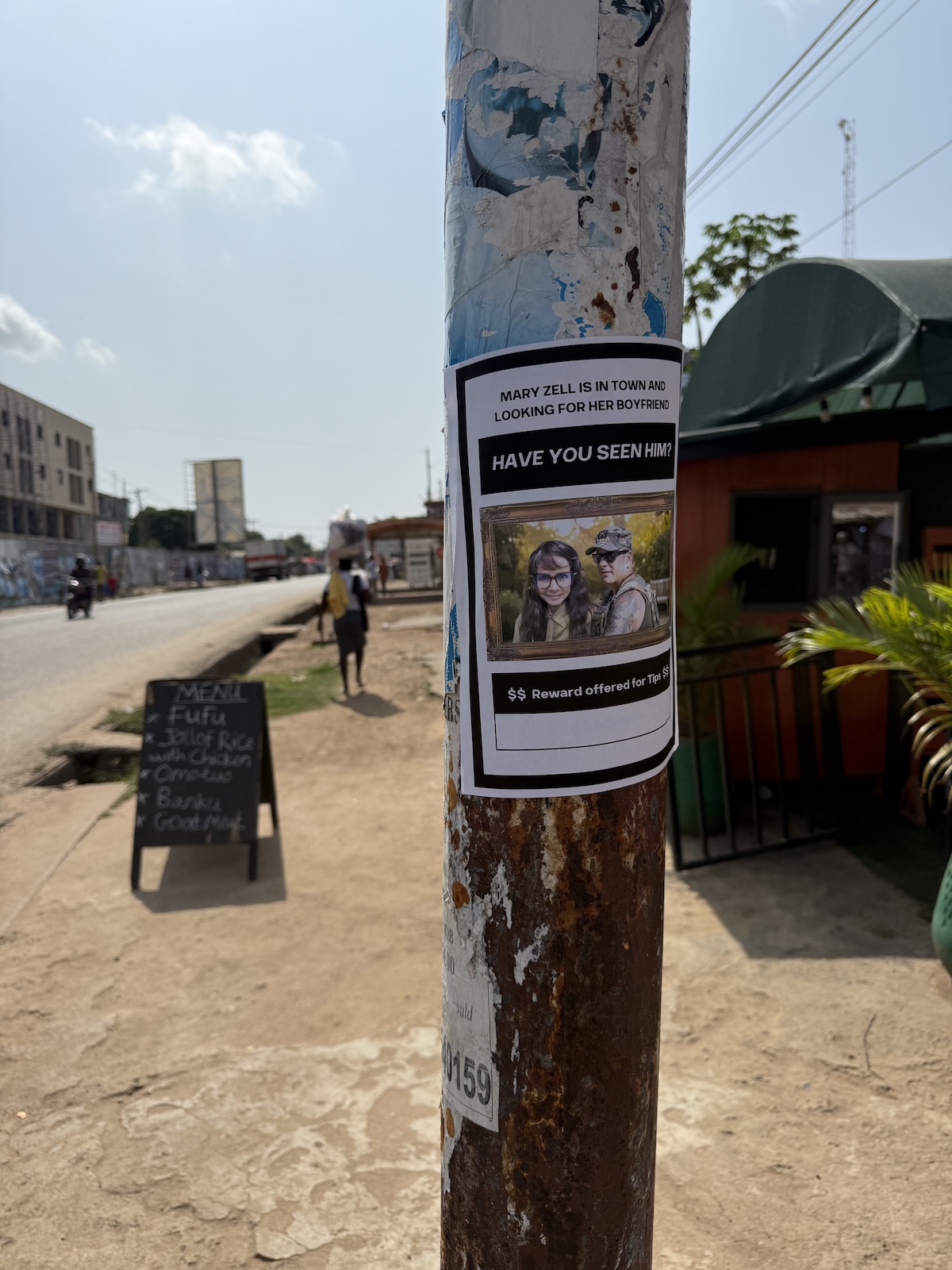
The “Mary Zelle” and “Mark Turner” ad posted in Accra, Ghana.

Relying on a wig, big glasses, and a prosthetic nose to cover her true identity as a journalist (should the scammer try to reverse-image search her profile), van Zeller posed as a middle-age antiques dealer named “Mary Zelle.” She staged her pictures to show she was a fun-time gal living her best single life. Once she hooked the scammer, she used the same tactics that outed the fake Bon Jovi in a scheme to meet her scammer face to face. To track him down, she partly relied on distributing flyers in his neighborhood that included a mashup photo of the supposedly loving couple that “Mark Turner” made to woo “Mary Zelle.”

Giving victims hope

On the journey, van Zeller shared her own complicated feelings about the connection she formed with her scammer as they texted day and night. These insights, along with her work to illuminate a path to track down scammers targeting Americans, are critical. Experts largely agree that ending rampant romance scams means engaging communities to show more empathy and pay attention to the signs. That could meaningfully deter threats to victims, who are also victims of social norms that isolate older women.

It’s easy to assume that romance scam victims must be gullible or uneducated, but research suggests that victims tend to be well-educated. In Super Scam Me, audiences can see how trust is slowly built in these scams, how shame prevents victims from getting help, and how simply wanting a relationship to be real can lead smart women like the victim in the Bon Jovi case to bankruptcy.

“I’ve spent years reporting on scams, and the reaction I hear most is ‘How could anyone be so stupid? That would never happen to me.’ But it can, and it does happen to anyone,” said van Zeller. “So this time, I made myself the target.”

Fearlessly feeling for these women and flying to Ghana to raise awareness of their struggles, van Zeller highlighted in her documentary the tactics and technologies scammers use. National Geographic touts her documentary as exposing the devastating real consequences of largely unchecked romance scams. The one-hour special notably drops shortly after a congressional investigation into dating app scams ended with a finding that scammers are getting harder to catch, NBC News reported.

Watching Super Scam Me makes it feel possible to catch these predators, offering victims and society a glimmer of hope. Although van Zeller easily saw through the scammer’s stolen photos from an actual military general’s Instagram profile, her own fake online dating persona was much more convincing. As she ethically avoided sending any money and relied on her hacker friend to keep the scammer on the line, the scammer never seemed to suspect she may be baiting him, instead of the other way around.

Prince Harry and Meghan Living Separate Lives

0
prince-harry-and-meghan-living-separate-lives
Prince Harry and Meghan Living Separate Lives


Prince Harry and Meghan Markle may be heading in very different directions just weeks after their unexpected return to Britain, with insiders claiming the couple is increasingly focused on separate careers rather than maintaining the united public image they once presented.

The Duke and Duchess of Sussex, who moved back to the United Kingdom in August after six years in California, are reportedly preparing for a future in which they spend considerably less time working together.

And while their marriage is not publicly known to be in trouble, sources suggest their professional priorities are becoming increasingly different.

Harry, 42, reportedly wants to concentrate on charitable work, military veterans and public service, while Meghan, 45, is exploring a possible return to acting and expanding her lifestyle business.

The changes come at a particularly sensitive time for the couple, who are attempting to rebuild their lives in Britain without returning to their former positions as working royals.

According to RadarOnline, sources close to the situation believe Harry and Meghan are no longer interested in approaching every professional opportunity as a team.

One insider claimed the couple has reached a stage where their individual ambitions are pulling them toward different projects and social circles.

Harry reportedly remains most comfortable working with charitable organizations and causes connected to his years in the military.

Meghan, meanwhile, is said to want greater independence as she considers entertainment projects, commercial partnerships and the future of her lifestyle brand, As Ever.

Those differences could mean fewer joint appearances and more time spent pursuing their own commitments.

However, separate professional schedules do not necessarily indicate problems in their marriage, and neither Harry nor Meghan has announced a separation.

The speculation emerged shortly after the couple made their first joint public appearance in Britain since relocating from their Montecito, California, home.

On Thursday, October 15, the Sussexes traveled to Nottingham, a city that holds special significance in their relationship.

It was there, in December 2017, that Harry and Meghan made their first official public appearance together following their engagement announcement.

Nearly nine years later, they returned under very different circumstances.

The couple visited several community organizations supporting children, young people and disadvantaged families.

Their stops included the Community Recording Studio, which offers creative and educational opportunities for local youth, and the Hubb Community Kitchen, a project Meghan supported following the deadly Grenfell Tower fire in 2017.

They also visited Epic Partners, an organization working with children and families.

Approximately 100 well-wishers gathered to greet the couple, with some presenting flowers and requesting photographs.

The appearance attracted significant media attention because Harry and Meghan have not resumed their official royal duties despite moving back to Britain.

For a moment, the visit resembled the public engagements they once undertook on behalf of the monarchy.

But the circumstances surrounding their return remain complicated.

Harry and Meghan stepped away from senior royal responsibilities in 2020 before establishing a new life in the United States with their children, Prince Archie, now 7, and Princess Lilibet, 5.

Their move followed growing tensions with the royal family, disagreements over media coverage and concerns about privacy and security.

During their years in California, the couple pursued commercial ventures, charitable projects and media partnerships while speaking publicly about their experiences within the monarchy.

Their surprise decision to return to Britain in August raised questions about whether they might eventually resume some form of royal service.

However, Buckingham Palace has made clear that they are not returning as working members of the royal family.

A letter issued on behalf of King Charles last month reiterated that position, confirming the arrangements established following their departure in 2020.

The Sussexes reportedly expressed surprise at the communication, although the decision did not alter their ability to support charitable causes privately.

For Harry, maintaining a connection to public service remains an important priority.

He continues to be involved with the Invictus Games, the international sporting event he founded for wounded, injured and sick military personnel and veterans.

He has also participated in charitable engagements focused on children, mental health and military families.

Meghan’s professional future appears to be taking a different shape.

The former Suits actress is reportedly considering a return to scripted television or film after stepping away from acting before her 2018 marriage.

Sources have told British media that she has been reading numerous scripts and considering opportunities that could mark a new chapter in her entertainment career.

Although she has not announced a confirmed acting role, reports suggest she is interested in finding a project that would be creatively fulfilling rather than returning to television simply for publicity.

The Duchess is also expected to devote considerable attention to As Ever, her lifestyle company, which has developed products and partnerships connected to food, entertaining and home living.

According to RadarOnline, the brand could expand into the British market before the end of 2026.

That potential expansion has not been independently confirmed by the company.

Sources also claim Meghan hopes to maintain her professional relationships in California and could return to the United States for visits during the holidays.

The move back to Britain has reportedly required adjustments for the entire family.

Harry and Meghan initially prioritized helping Archie and Lilibet settle into school and become comfortable in their new surroundings.

The children reportedly changed schools shortly after arriving because of security and logistical concerns.

The couple has also continued to navigate questions surrounding personal protection, an issue that has been especially important to Harry since he stepped back from royal duties.

Those family responsibilities may further influence how frequently the Sussexes appear together in public.

For years, Harry and Meghan were known for presenting a closely coordinated partnership.

From their royal wedding in May 2018 to their departure from Britain and subsequent interviews, the couple often appeared side by side while pursuing shared goals.

But they have increasingly developed individual projects, even while maintaining joint charitable interests.

Harry’s work has generally centered on veterans and advocacy, while Meghan has expanded her presence in business and entertainment.

That distinction was already apparent during their years in California and may become more visible as they establish themselves in Britain.

Still, their Nottingham appearance offered little public indication of personal distance.

The couple greeted supporters together, spoke with volunteers and appeared comfortable during the day’s engagements.

People familiar with their plans have described the pair as enthusiastic about returning to charitable work now that their children are settling into life in the United Kingdom.

Their future public schedule, however, remains unclear.

Meghan is reportedly planning relatively few formal appearances, while Harry is expected to continue taking on individual charitable commitments.

The arrangement would represent a departure from the high-profile royal partnership that initially made them one of the most recognizable couples in the world.

It also raises questions about how Harry and Meghan intend to balance their personal ambitions with the public expectations surrounding their royal titles.

For now, the Sussexes appear determined to build careers outside the formal royal structure while retaining connections to the causes that matter to them.

Whether that means fewer appearances together or a more permanent change in their public partnership remains to be seen.

What is clear is that their return to Britain has not restored the life they left behind in 2020.

Instead, Harry and Meghan are entering another uncertain chapter, one in which their individual careers may become just as prominent as the partnership that first brought them international attention.

America’s Sordid History of Filming Executions as Entertainment

0
america’s-sordid-history-of-filming-executions-as-entertainment
America’s Sordid History of Filming Executions as Entertainment


Earlier this month, Acting Secretary of the Army Adam R. Telle signed an order scheduling the execution of Nidal Hasan, a former Army major who was convicted of killing 13 people in a 2009 shooting at Fort Hood, Texas. Two days later, self-styled War Secretary Pete Hegseth made a startling announcement. “We’ll make sure that people are able to watch it, that it’s public,” Hegseth told the conservative Real America’s Voice News network, as the interviewer raised his eyebrows. The Department of War’s official “Rapid Response” Twitter account promptly promoted the clip.

Hegseth’s plan apparently won’t come to fruition. Amid outcry about the barbarity and optics of streaming the planned execution by firing squad — scheduled for December 3 at Fort Hood — President Donald Trump on Thursday called off the broadcast. “I think streaming the execution for all to see might have been a strong deterrent for the World to witness how America deals with Terrorists and SCUM like Hasan but, many very good and well meaning people would rather not watch him die, through streaming, or through any other visual device,” Trump posted on his social media website.

Some news outlets, such as The New York Times, framed the planned killing as an aberration, claiming that “such a broadcast has little precedent, and releasing video of executions is most often associated with extremist militant groups like the Islamic State.” This narrative, however, overlooks a forgotten American cultural history in which filmed executions turned government killings into spectacle.

The practice of filming executions in America is effectively as old as cinema itself.

In 1897, a few years after the first motion pictures began to be exhibited in the United States, a Missouri farmhand named William Carr was convicted of murdering his daughter and sentenced to death by hanging. Filmmaker Frederick Guth, of the American Phonographic Company, who had previously recorded an interview with Carr in prison, opted to film the execution as well — marking a grim milestone as history’s first filmed execution. The resulting motion picture, “The Hanging of William Carr” (1897), was first exhibited in Kansas City and St. Louis, then screened around the country.

The following year saw the nationwide premiere of “An Execution by Hanging,” otherwise known as “Execution of Negro at County Jail, Jacksonville, Fla” (1898). It showed the hanging of Edward Heinson, who was convicted and sentenced to death for criminal assault of a 14-year-old white girl. Illustrating racist views that have long shaped the American criminal legal system and the death penalty, the catalog of the film’s production company, American Mutoscope and Biograph, teased the film as depicting “a very ghastly, but very interesting subject.”

As these early films were distributed across the nation, they were met with interest and outcry. The journal Phonoscope at the time described the filming of Carr’s execution as “revolting,” while the Cleveland Leader cautioned that the film may have “brutalizing effects” on viewers. Some newspapers even claimed that during the hanging of Carr, Guth had hired people to storm the gallows to create added pandemonium.

Soon, the burgeoning cinema industry came to adopt a different practice for the growing number of films about executions. Filmmakers started blending reality with fiction, by combining clips recorded at actual execution locations with fictionalized reenactments of the killings themselves.

For instance, after Thomas Edison’s Edison Studios failed to gain permission from the authorities to film the actual execution by electrocution of President William McKinley’s assassin, filmmakers combined exterior location shots on the day of the killing with footage of a mannequin to depict the actual death in “Execution of Czolgosz with Panorama of Auburn Prison” (1901).

Edison was no stranger to the format: He had previously produced numerous historical execution reenactments like “The Execution of Mary, Queen of Scots” (1895) and “The Execution of Joan of Arc” (1895). His studio also dabbled in zoosadistic entertainment, with films showcasing actual animal deaths, such as “Electrocuting an Elephant” (1903), which presented an elephant named Topsy being put to death for killing a spectator who had burnt her trunk with a cigar.

In 1905, American Mutoscope reused the title of its earlier film, “An Execution by Hanging,” this time depicting a reenactment of the hanging of Mary Rogers, who was convicted of killing her husband (alternate title “Execution of a Murderess”). Along with what were apparently genuine location shots, American Mutoscope incorporated reenactments of the moment of death. The film was released as part of a trilogy, including “Reading the Death Sentence” and “Reprieve from the Scaffold,” with the third installment presenting an alternate fictional ending in which Rogers was not killed.

Other films around the turn of the century used a similar technique to conflate reality and fiction, with film catalogs accentuating the lurid nature of these pictures. The description of “Beheading a Chinese Prisoner” (1900) in the Lubin production company catalog reads: “The executioner displays the head to the spectators to serve as a warning for evil doers. Very exciting.” Lubin had also earlier produced another execution reenactment, “Execution of the Spanish Spy” (1898).

Many films focused on executions carried out by mobs rather than the government. There was “Edison’s Lynching Scene,” also known as “Lynching of a Horse-Thief” and more coyly as “A Frontier Scene” (1898), as well as “Lynching Scene: A Genuine Lynching Scene,” also known as “Lynching Scene at Paris, Texas” (1897) from the International Film Company, and “A Lynching at Cripple Creek,” otherwise known as “Tracked by Bloodhounds” (1904).

The motion picture camera, of course, wasn’t the only new technology at that time shifting the public’s perception of execution. When William Kemmler was killed in the first electric chair execution in New York in 1890, the American media heralded a “new era in capital punishment.” Witnessing the new death technology, even in reenactment form, would prove to be a fascination for filmgoers over the years.

“Death in the Electric Chair at Sing Sing” (1902), the final installment in American Mutoscope’s five-part “A Career of Crime” series, is described in the company’s 1902 catalog as “an accurate and thrilling representation of an electric execution at Sing Sing.”

As the novelty of new execution methods wore off, their cinematic popularity likewise began to taper, though film promoters occasionally used the electric chair as a prop outside the cinema to attract moviegoers in the 1930s. At the same time, as the practice of public hangings faded in the U.S. and executions moved indoors, authorities began restricting access to death chambers to select groups of family members, victims’ relations, official personnel, and chosen media. It’s a practice that continues to this day, preventing actual recordings of executions from reaching the public.

With the advent of grindhouse exploitation cinema in the 1970s and the home video boom of the 1980s, however, the American entertainment industry once again found a way to court audiences by depicting executions. 

Taking up the mantle of films that blended real footage and reenacted execution scenes were movies like “The Electric Chair” (1976), whose theatrical promotional materials prominently featured the titular chair and touted that “scenes in this picture were filmed in an actual death house. What you will see is real.” The infamous shockumentary “Faces of Death” (1978), whose marketing material similarly emphasized its staged electrocution scene, enticed viewers to “experience the graphic reality of DEATH, close-up.”

In the bloody wake of “Faces of Death” came a seemingly endless parade of straight-to-video death compilations, spanning from the late 1970s to the mid-2010s, which made death something to be consumed in private in the home, versus as theatrical spectacle. The films, which spliced together clips of executions with other atrocities, have titles such as “Dying: Last Seconds of Life” (1988) and “Executions 2001” (2001).

“Death Watch,” a typical entry in the genre released on VHS in the late ’90s or early ’00s, adequately summed up its genre: “unedited first-hand footage of death, vivisection, autopsy, cremations, suicides, tortures, decapitations, state and governmental executions, animal ingestion of humans, as well as human limb extraction.” Its cover featured an electric chair, echoing the posters promoting films such as “The Electric Chair” (1976) and “Death in the Electric Chair at Sing Sing” (1902).

When Saddam Hussein was executed by hanging on December 30, 2006, a security guard used his cellphone to record the execution. The phone video was promptly released on DVD in the U.S. under the title “Sad Damn! Who’s Sane?” Though still listed on online retailers like Amazon, the DVD is now long out of print, much like turn-of-the-century execution films.

The proposal to livestream Hasan’s firing squad execution would have, in some ways, marked a significant change in course. The killing would have been the first known execution to be recorded and disseminated by the government itself, rather than a film studio. Critics lambasted Hegseth’s plan as violent propaganda that could invite similar brutality against American prisoners abroad. Trump himself reportedly expressed hesitation about the imagery, fearing footage of the U.S. military killing Hasan, who uses a wheelchair after injuries during the Fort Hood shooting, might result in him being celebrated as a martyr.

Wars and the oil blockades may be waiting for Xi’s party congress

0
wars-and-the-oil-blockades-may-be-waiting-for-xi’s-party-congress
Wars and the oil blockades may be waiting for Xi’s party congress

Just as Vladimir and Estragon waited for Godot in Beckett’s famous play, the world may now be waiting for Xi Jinping in the present political drama.

America is stuck in two wars. In Ukraine, it would like to reach a compromise with Russia. In the Middle East, it is trying to bring down Tehran’s regime, which backs many extremist groups in the region and blocks oil traffic through the Straits of Hormuz and Bab el-Mandeb. Both conflicts are creating an oil crisis unlike any seen in over 50 years and are driving President Donald Trump’s approval ratings down.

Trump could therefore be soundly defeated in the midterm vote on November 3, which, in theory, opens two scenarios. Either Trump contests the result at the ballot box, trapping the country in a devastating political fight that will drown America for months – or he accepts the outcome, and the new Democratic-majority Congress could wage war on him. In either case, America might have little energy left to focus on foreign affairs and to take on what was the “big target” at the start of his presidency: President Xi Jinping’s People’s Republic of China (PRC).

Xi Jinping has no interest in solving America’s problems. It would be dangerous: Something could go wrong in the mediation, and the PRC would be drawn into something it didn’t start. If Xi delivered, America could return to a hostile confrontation with China. Conversely, by doing little and letting American mistakes play out, Xi can approach his 2027 party congress with great confidence.

He’ll be hailed as the first Chinese head of state in history to paint the great Western power into a corner, two centuries after the disgraceful Opium War. It’ll mark the end of the century of humiliation that has nagged Chinese education for decades. A bigger result than reunification with Taiwan, an island that is de facto independent while being de jure part of one China and claimed by the PRC.

The context

This happens in a complex new global context. On September 23, the UN General Assembly convened in New York. The two powers, America and China, set aside the big Apple and met in Washington. This effectively hollowed out the UN. Both preferred meeting each other to attending the General Assembly. If the biggest players don’t attend, what is the UN for?

In May, the two had met in Beijing. It had been perhaps a ceasefire, a moment of pause. In September, their meeting marked a real truce. It doesn’t mean there will be no flare-ups of tension, but the truce should hold at least until the autumn of 2027, when the Party congress opens and most likely renews the entire leadership group. It could even hold until the 2028 US presidential election.

During this truce, signs suggest, the two powers may take some steps forward – although these steps would be delicate.

One step is the reopening of military dialogue. Perhaps the main reason for interrupting the dialogue was that the Americans wanted to establish codes of conduct for encounters at sea or in the air between Chinese and American forces. The Chinese were reluctant to establish such codes because doing so would, in some way, authorize the American presence in areas that China considers its exclusive domain.

A second important point is how closely all the Asian countries, particularly Japan, watched this meeting. Outside China, Japan is something of a leading country on an “anti-PRC” front. Japanese Prime Minister Sanae Takaichi went to Washington in person the day before Xi’s arrival and announced that she had a phone call with Trump right after Trump met with Xi.

The Trump-Xi summit was not simply a two-way meeting; it was multilateral, and America apparently accepted that. America considered the needs and requests coming from its Asian allies, particularly Japan in this case.

A new outline

Things have clearly changed since the start of Trump’s presidency, when he said the US would corner China with tariffs, because Washington held the upper hand since the Americans were China’s market. That facile approach is gone, but it remains unclear what a new long-term American plan will be. How will China be managed? Will China simply be treated like any other country, or will the United States actually begin to apply what Trump announced during his first presidential term in 2016, decoupling China from the rest of the world market?

And China, for its part, what will it do? Will it endure and wait for American decisions? Will it try to align its financial, economic, and even political systems to integrate into the world system? Or, conversely, will it try to sabotage this system and create a new one?

Over the next two years, we’ll see whether this truce is short-term and will then spill over into an even harsher conflict, or whether it will lead to lasting peace. Or the truce could be extended, shaping the new Cold War 2.

Iran is a first test. In the joint statement, China said it opposes a nuclear-armed Iran and that Iran should free the two straits. The Houthis, Iranian proxies, control Bab el-Mandeb. Here, a larger conflict may loom as the Houthis threaten Saudi Arabia.

Can China manage to create an economic, commercial and financial system alternative to the current one? The first step would be to unhook the RMB from the dollar, but that would create new problems.

What China is doing, successfully, is to detach from the dollar payments system. All international payments pass through an American hub called SWIFT. China has established an alternative payment system called CIPS. As a result, China has gained greater privacy for its transactions.

If all its transactions went through the American system, Americans would have known exactly how, where, when, and to whom Chinese money went. This is how the US learned that China had ignored some international sanctions while officially declaring it had upheld them.

Meanwhile, the dollar is in the midst of another paradigm shift. It abandoned the gold standard and today, more than 50 years later, the dollar, aware of its weakness, is creating stablecoins – cryptocurrencies anchored to real assets. This monetary transformation carries risks because, as some economists like Paolo Savona point out, we can’t be sure the assets underlying these cryptocurrencies are real.

In 2006-2007, on the eve of the 2008 financial crisis, it became clear that derivatives were sometimes backed by unsound assets. The mismanagement of derivatives, one of the great American financial innovations of the time, also led to the 2008 financial crisis.

American reform may carry similar risks today. But only America is taking on the challenge; China is not undertaking a program to reform its currency or the global financial and commercial system.

At least for now, the terms for a Chinese alternative are not in place, and America, with the dollar and Wall Street, remains central. China is playing defense.

China’s financial turnaround

What China should do, though at considerable cost, is carry out meaningful reforms to its domestic market and political system. With a population of 1.4 billion, it can’t grow by consuming only 350 million Americans or 500 million Europeans.

Beijing may have started the process. Chinese fiscal authorities are pursuing unpaid taxes from the wealthy. The state is clearly strapped for cash and now needs more contributions from those who made the financial most of these decades. It’s a delicate move. If the rich pay, they either get something in return (usually representation goes with taxation, or they might become less entrepreneurial, which could drag the whole economy down. (See my China in the Name of Law: a New Global Order.)

If China does indeed act on it, it might announce it at the 2027 Congress.

Some in China may still be enamored with the old thesis of Marx, Lenin and other socialists that the capitalist system will collapse sooner or later. Of course, that is possible, but the thesis is now 200 years old. The capitalist system has suffered severe crises, yet each time it has emerged stronger, not weaker. Will it be different this time? It’s unclear, but unlikely.

Yet, China’s choices are not straightforward. The situation could become more complicated over the next 12 months. The two ongoing conflicts are growing messier. Russia is certainly not winning. Iran, which has achieved a not-insignificant result by blocking oil flows, is suffocating under its own naval blockade. The blockade works both ways: the US gets little oil, and Iran gets no economic revenue either. The Iranian economy is imploding.

No prospects are visible in the short or medium term on either front. Therefore, China, supporting these two countries, has no medium- or long-term prospects of its own. America, by contrast, a champion of centuries of successful capitalism, should have many medium- and long-term prospects, despite its mistakes and missteps.

Waiting may work for a year, or maybe not. Iran or Russia might yield; new troubles could erupt in any European country, and anything could happen anywhere in the world. The Houthis may have started a regional conflict that draws Turkey in.

Everything is in motion. China could slip on anything and become even more defensive and cautious. Some tension is good for China, keeping the world’s attention away, but too much chaos could spill into China itself.

For Trump, the maverick of chaos, choppy waters abroad, coupled with stormy weather at home, might be easier to navigate. Or he could eventually be engulfed by them.

If something major adds to the present chaos in the next 12 months, China’s plans for a quiet party congress could be thrown out of the window.

EU’s straits

If Trump can’t resolve the blockade soon, everything could become much harder. Timing is decisive. It is in Tehran’s interest to keep the straits closed until after the elections to try to put Trump in jeopardy and thus score a victory. Russia is not helping Trump with Iran, though it could push Tehran to cave to the US if it really wanted to. Iran could hold out for at least a month.

The agreement with Russia on diesel should, in theory, offset Iranian resistance. But it’s unclear whether it will work and to what extent. Russia has little or no diesel to spare.

Europe, as such, is not in the picture. It has a radical problem. For decades, it has outsourced almost everything: defense to the US, energy to Russia, labor to immigrants, industry and markets to China and the US, and technology to the US and China. One can and should outsource some things, not everything.

The US has outsourced part of its industrial production to China and its labor to migrants, and is suffering for it. But its market, defense, and technology are world-leading. What is Europe first in the world at? Cultural tourism?

On top of that, some wounds may never have fully healed. After the Cold War ended, Yugoslavia’s breakup put European countries on the spot. France and the UK would side with Serbia; Germany would back Croatia. To avoid a bitter division that could ignite continental friction, the EU begged the US to intervene.

America didn’t want to step in. I remember a conversation with Edward Luttwak at the time, urging Europeans to send troops to Yugoslavia and, through that sacrifice, to mold a new common identity and forge a new political union. Europeans dragged their feet, wanting US intervention to solve their troubles. At the same time, they launched the euro without sufficient agreement and dialogue with the US.

The EU’s expansion to more pro-American Eastern European nations only partially fixed the fissure between America and Western Europe. This remains a problem for European countries where the controversial Trump administration soured ties, but it also affects the US, which may view Europe as a burden rather than an asset.

A duel of images

All of this percolated into the public images of China and the US. On one side, America’s poor management of its image; on the other, China’s careful management of its own.

America dismantled the information apparatus it had built during the Cold War, and for decades no one maintained its public image, precisely when it needed to consolidate it and project it into a new phase. The confrontation with the Soviet Union was over, but the political questions of freedom and democracy still needed a new footing.

On top of that, the Trump administration didn’t care about projecting a positive image to the world. It focused only on telling one part of America’s gut, the part that felt cheated and betrayed, that the government in Washington would stand up to a world taking advantage of America. This message helped his election but damaged America’s image abroad.

China, by contrast, has done almost the opposite. It has projected a positive image of itself and has a real story to tell. Its story is one of breakneck development, going from underdevelopment to building science-fiction infrastructure in 40 years. China’s superfast trains, its cities teeming with skyscrapers, the creativity of young people in Beijing and Shanghai on TikTok and the success of companies producing electric cars – these are stories that almost sell themselves.

Antonioni’s 1972 documentary on China, Chung Kuo, shows the poor, simple life in Beijing 54 years ago and testifies to the country’s progress over the decades.

They can argue that the Chinese political system is efficient and delivers results, beyond the easy criticisms of democracy and human rights that circulate widely, and even that it works better than a democracy. America tried to export democracy to Iraq and Afghanistan and failed; China resisted those pressures and transformed its country, and perhaps even the world.

This is a strong, convincing story, and it does not seem to me that America challenges it decisively and precisely. In fact, is it totally true? It may be more complex than this.

On a broader scale, the US might want to learn something from China. China has perfected a long-term planning system that guides the country through daily ups and downs. The US, conversely, seems to revisit its plans and ideas with every presidency, and now, with Trump, possibly every day, a new plan emerges. This system deprives America of a strategy, and without strategy, as the military says, tactics or brilliant sudden ideas are only the din before the defeat.

America needs a long-term plan for the world it wants for itself and for everyone else. China’s rise and the challenges it poses are a major part of this, but ongoing wars show that the US and the world order face much more.

During the Cold War, the US maintained consistency across presidencies; now it needs something similar. To do that, America should find common ground in the center and cut the radical wings, as it did 80 years ago. If the US finds a balance, it will warn China; if it doesn’t, China may think it can keep pursuing survival-focused policies amid growing chaos.

(Discussions with Giuseppe Rippa and Marco Mayer were useful to develop the arguments here.)

Francesco Sisci is director of the Appia Institute, which originally published this article. It is republished with permission.


15 Years of Doom, the Same Convenient Culprit

0
15-years-of-doom,-the-same-convenient-culprit
15 Years of Doom, the Same Convenient Culprit


Israel’s economic resilience and changes in Haredi employment, education, and poverty challenge Prof. Dan Ben-David’s dire forecasts, but persistent gaps and structural weaknesses still demand attention

For roughly 15 years, Prof. Dan Ben-David has warned about Israel’s economic future. His warnings are dramatic, his charts alarming, and the Haredi population repeatedly occupies a central place in his analysis.

Is the education system in crisis? Haredim. Is national labor productivity low? Haredim. Is poverty high? Haredim. Is the state budget under unsustainable pressure? Haredim again. It seems that for almost every economic challenge in Israel, this narrative points to a single address.

Meanwhile, Israel keeps changing. So does Haredi society. The question is whether Ben-David’s analysis is changing with them.

Despite a prolonged war and extraordinary disruption, Israel’s economy continues to demonstrate resilience. In its October 2026 forecast, the International Monetary Fund projected economic growth of 4.5% for Israel this year—the highest rate forecast for any of the 38 member countries of the Organization for Economic Cooperation and Development. The projection also represents an upward revision from the IMF’s earlier estimate of 3.5%.

Global companies continue to commit long-term resources to Israel. Nvidia, for example, has announced plans for a multibillion-shekel campus in Kiryat Tivon, designed to accommodate approximately 10,000 employees. Construction is expected to begin in 2027, with initial occupancy planned for 2031.

One of the world’s leading technology companies is betting heavily on Israel’s future. Perhaps Nvidia’s executives see strategic possibilities that somehow disappear between Ben-David’s demographic charts and the headlines.

An investment announcement does not disprove long-term structural risks. Neither does a single year’s growth forecast. But 15 years of dire warnings deserve examination against the country’s demonstrated ability to adapt, innovate, and attract investment. Resilience is part of the evidence, even when it complicates the argument.

A Changing Economy vs. Predictions of Catastrophe

For years, Ben-David has warned of an impending economic catastrophe driven in substantial part by Haredi dependency. Yet important economic indicators show considerable progress over the longer term.

According to data compiled and analyzed by the Institute for Strategy and Haredi Policy, which I founded, Haredi male employment rose from approximately 42.5% in 2010 to around 56% in 2026. Among young Haredi women aged 20–24, employment has reached 88%, based on employer payroll data processed by the institute. Meanwhile, the proportion of Haredi families below the poverty line fell from roughly 39% in 2015 to 32.8% in 2024.

These figures require some qualification. Employment estimates vary according to the population surveyed, the period covered, and the methodology used. Other research has found that the earlier rise in Haredi male employment stalled in recent years. Still, the longer-term gains, particularly among women, deserve recognition.

Poverty remains too high. Male employment must improve further. But the changes are meaningful in precisely the areas on which forecasts of future dependency depend.

I see this commercial vitality firsthand as publisher of the Mishpacha Media Group. Our platforms carry advertising for thousands of businesses and commercial ventures, many rooted in the Haredi community itself. Spanning real estate, finance, retail, and professional services, this activity reflects an entrepreneurial culture that cannot adequately be described as a population living in passive dependency.

The State Education Crisis—and Blaming the Untested

When Ben-David addresses Israel’s deteriorating education system, he quickly turns to the Haredi sector. Yet the relationship between disappointing international test scores and Haredi population growth deserves closer examination.

Haredi boys are largely absent from the Programme for International Student Assessment (PISA). Their exclusion leaves an important gap in our knowledge of their educational achievement, and Ben-David is right to be concerned about the implications of inadequate preparation for the labor market.

But their absence cannot explain the poor scores recorded among pupils who actually participate in the assessments. Those results reveal weaknesses in Israel’s broader education system that require attention regardless of Haredi demographic trends.

More troubling is the tendency to overlook the other half of the Haredi school population: girls.

In the 2025 PISA assessments, Haredi girls achieved an average reading score of 503, compared with 452 in secular state schools and 459 in state-religious schools, according to Israel’s National Authority for Measurement and Evaluation in Education (RAMA). Although these comparisons involve different student groups, RAMA found that no other female subgroup performed significantly better than Haredi girls in any of the three principal subjects assessed.

Rather than concentrating almost exclusively on the educational shortcomings of Haredi boys, Ben-David should also examine why Haredi girls perform so well in reading and what other schools might learn from their success.

Changes are also taking place in boys’ education. According to Education Ministry data processed by the Institute for Strategy and Haredi Policy, enrollment of Haredi boys in state-Haredi (mamlachti-haredi) schools rose from 4% in 2024 to 10% in 2026, a 2.5-fold increase in just two years. Specialized Haredi high schools, known as yeshivot tichoniyot, are also expanding.

These developments do not resolve the educational challenges facing Haredi boys, but they belong in any serious assessment of where the community is heading.

Productivity: Testing Ben-David’s Central Argument

Labor productivity is central to Ben-David’s assessment of Israel’s economic future. He argues that low skills and labor force participation among Haredim contribute to Israel’s weak productivity performance.

The question is how much of the national problem can reasonably be attributed to the sector.

According to calculations by the Institute for Strategy and Haredi Policy, Haredi workers account for approximately 6.5% of all hours worked in Israel. Using hourly wage differences as an indirect measure of productivity, the institute estimates that eliminating the wage gap between existing Haredi workers and other Israeli workers would raise average hourly earnings nationally by approximately 1.5%.

This is a limited calculation. Wages are an imperfect proxy for productivity, and the estimate does not capture the broader economic consequences of differences in education, employment, or future population growth. Nor does it measure the full potential gains from bringing more Haredi men into the workforce.

Even with those qualifications, it raises an important question: How much of Israel’s existing productivity gap can realistically be explained by earnings differences among workers who are already employed?

Ben-David himself has pointed to the weak productivity performance of Israel’s economy outside the high-tech sector, which employs roughly 90% of the workforce. Such a broad challenge demands an equally broad explanation, encompassing capital investment, physical infrastructure, market competition, regulatory burdens, and industrial structure.

Reducing the debate to Haredi participation risks overlooking problems affecting much of the national economy.

The Budgetary Argument: Are Haredim Citizens or Subsidies?

Ben-David attributes 37.5 billion shekels ($12.1 billion) in subsidies, discounts, and benefits to Haredi society, contrasting that sum with approximately 26.7 billion shekels spent on public hospitals and higher education. The comparison suggests that money associated with the Haredi population could otherwise finance additional research universities or medical centers.

The arithmetic is attention-grabbing. The framing requires scrutiny.

Before treating that entire amount as discretionary spending available for reassignment, we need to examine precisely what it contains. Which expenditures represent benefits available under general eligibility rules? Which are distinct sectoral allocations? How much could actually be redirected without affecting basic public services? And are the figures being compared calculated on the same accounting basis?

The comparison draws on different budgetary sources, including actual hospital expenditures and original higher-education allocations. Such differences should be explained before presenting the sums as interchangeable alternatives.

Haredim are citizens. Their children are entitled to education and healthcare under the same principles that apply to everyone else. Sector-specific allocations, tax burdens, and the distribution of public resources are legitimate subjects for debate. But spending associated with a population cannot automatically be treated as money that would otherwise be available for unrelated purposes.

Demography as a Future Asset

Across much of the developed world, aging populations and declining fertility threaten economic growth and the sustainability of public finances. According to Israel’s Central Bureau of Statistics, fertility among secular Jewish women stands at approximately 1.85 children per woman, below the commonly cited replacement level of 2.1.

In a world facing widespread population aging, a large younger generation can represent a substantial long-term economic asset. That advantage is not automatic. It depends on sustained investment in education, skills, infrastructure, and access to productive employment.

Children are future workers, entrepreneurs, and taxpayers, not merely line items in today’s public expenditures. A responsible demographic forecast must consider their potential contribution alongside the costs of raising and educating them.

Progress Cannot Be Ignored

Israel faces serious economic challenges, and Haredi society bears responsibility for helping address them. Recognizing progress does not excuse ongoing shortcomings or remove the need for structural reform.

The evidence points to substantial long-term gains in Haredi employment, particularly among women, changes in educational choices, and a reduction in poverty. Some trends have stalled, and major gaps remain. Both sides of that picture belong in any serious economic assessment.

Releasing alarming forecasts shortly before an election also calls for care in how evidence is selected and presented. Research on politically contentious questions must be especially rigorous about acknowledging developments that challenge its conclusions.

When demographic projections emphasize future risks while giving insufficient attention to changes already taking place, they risk presenting an incomplete picture of the country’s prospects.

The people inside the charts are changing. The analysis must change with them. Otherwise, the charts risk becoming illustrations for a conclusion reached in advance.

Bug turns one of the biggest fears about Ray-Ban Meta smart glasses into reality

0
bug-turns-one-of-the-biggest-fears-about-ray-ban-meta-smart-glasses-into-reality
Bug turns one of the biggest fears about Ray-Ban Meta smart glasses into reality

Some Ray-Ban Meta smart glasses were recording people’s conversations without the wearer knowing. The recordings occurred without users saying the prompt phrase (“Hey, Meta”), in a bug that Meta says has been fixed.

This week, some users reported online that their Ray-Ban Metas were recording without their consent. A person going by Kindly-Audience-137 on Reddit, for example, said this happened to them across three Meta Ray-Bans and that they had the “Respond without Hey Meta” setting turned off. The person said the Meta AI app “saves audio recordings and text transcripts of these conversations in my conversation history.”

“I believe this deserves a serious technical investigation. Customers should not have to wonder whether their private conversations are being captured when they have not intentionally activated their glasses’ AI assistant,” the Reddit user said.

Android Authority reported the discussions on Tuesday. Later that day it published a response from Meta that read:

“This issue has been resolved. People can manage, review, and delete voice logs of their interactions with Meta AI via settings at any time.”

Although Meta’s brief message suggests that the bug is fixed, the broader privacy problem remains.

Unanswered questions

Meta hasn’t said what caused the Ray-Ban Metas to record people without user consent. Reddit user Kindly-Audience-137 said they “first noticed this behavior after a recent firmware update,” but Meta hasn’t confirmed if a faulty update caused the bug.

We also don’t know how many Meta smart glasses were affected. There are a few reports online, but Android Authority said it was unable to replicate the problem before Meta said it fixed it.

Ars Technica sent Meta a message asking what it’s doing to prevent future bugs like this from happening again and how many devices were affected. We’ll update this article if we hear back.

Even a handful of affected devices is cause for concern, though.

Before reports of this bug, privacy advocates had already expressed widespread concerns about Meta’s smart glasses, as well as those from other vendors. Beyond the fear that naturally accompanies the release of new technology that features a microphone and camera, Meta’s glasses pushed the boundaries of privacy further with their more inconspicuous look, prompting concern about how easy it could be for someone to secretly record another person.

Meta has previously tried to assuage concerns by pointing to the fact that its glasses light up when recording audio or video. But the bug this week shows that even with this light activated, it’s possible for the smart glasses to record inadvertently.

Meta’s brief statement does little to alleviate those worries. Meanwhile, the bug lends some credence to reports and trepidation that Ray-Ban Metas are creating recordings without subjects’ knowledge.

Fears brought to life

Meta has been steadfast in its push for gadgets that put microphones and cameras in people’s homes and on their faces, while battling fears that the devices could be used for nonconsensual recordings.

Contractors for Sama, a data annotation company headquartered in Kenya, say they have viewed footage that was shot by Ray-Ban Metas, seemingly without the wearer or other people in the video knowing. A report by Swedish journalists earlier this year interviewed over 30 Sama workers and pointed to a “stream of privacy-sensitive data that is fed straight into the tech giant’s systems,” per a machine translation, resulting in workers viewing private activities, like a glasses owner’s partner coming out of a bathroom naked.

“Meta has that type of content in its databases. People can record themselves in the wrong way and not even know what they are recording,” the report quoted an anonymous Sama employee as saying.

In the US, the report led to a lawsuit seeking class action certification [PDF] and an investigation from Texas Attorney General Ken Paxton.

In August, Meta updated its smart glasses so that they won’t record if the glasses’ indicator light is covered up. Some potential privacy violations using Ray-Ban Metas, however, hinge on a bad human actor. But this most recent glitch, as well as the reports from the Sama workers, highlights the possibility for well-meaning users to inadvertently record stuff, too.

The privacy shortcomings of Ray-Ban Meta and other smart glasses have raised concerns about being clandestinely recorded in public and about the creation of apps for detecting the smart glasses. The privacy concerns have also led to proposed legislation, including in Norway, which is considering a temporary ban.

Glasses like Ray-Ban Metas have the potential to intentionally or unintentionally violate people’s privacy, whether through technical problems, sharing data without user consent, or poor design. Without further constraints, one of the biggest drawbacks to devices like Ray-Ban Metas will continue to be the fear of nonconsensual recording, a fear that this week’s bug turned into a reality.

SK hynix needs a Trump 2027 deal to expand its Dalian NAND fab

0
sk-hynix-needs-a-trump-2027-deal-to-expand-its-dalian-nand-fab
SK hynix needs a Trump 2027 deal to expand its Dalian NAND fab

South Korean memory chipmakers must secure new United States licenses by year-end to keep shipping top-end American tools to their Chinese factories, after the Trump administration scrapped blanket permits last year.

To win the permits, SK hynix and Samsung must promise to build or expand factories in the US. SK Hynix’s one-year license to ship US equipment to its NAND flash memory plant in Dalian, a port city in northeast China, expires at the end of this year.

The US Commerce Department has not yet issued SK hynix an authorization for 2027, Reuters reported exclusively on Thursday. Citing anonymous sources, the report said Solidigm, SK hynix’s US-based flash memory unit, is seeking approval to ship more equipment to Dalian as it plans a new NAND factory in the US.

SK hynix told Reuters it plans to install equipment at Mod B, an unused section of the Dalian plant, in consultation with US authorities and with the relevant government approvals. It stressed that it is not seeking to expand the facility’s production capacity.

Both South Korean firms have increased their US commitments since Trump took office in January 2025.

SK hynix:

  • In August 2026, it broke ground on a US$4 billion high-bandwidth memory (HBM) packaging plant in Indiana.
  • Last month, its California-based subsidiary Solidigm was reported to be weighing a NAND factory in upstate New York.
  • At the same time, SK hynix was reported to be in talks with Intel to make memory chips in Ohio.

Samsung:

  • In July 2025, it signed a US$16.5 billion deal to make artificial intelligence (AI) chips for Tesla.
  • Its first chip factory in Taylor, Texas, is due to be fully operational by the end of 2026.
  • Foundation work on a second Taylor factory is largely done.

Chinese commentators framed the story differently, praising SK hynix for daring to test the Trump administration’s bottom line.

“Samsung and SK hynix used to have validated end-user (VEU) status at their China plants, so they did not need a license for importing US equipment,” says Xiao Song, a Shandong-based columnist. “Now they need to renew their import licenses annually, and Washington only approves tools that keep existing plants running, not those for expansion or upgrades.”

“SK hynix has created some bargaining chips for itself. If Washington wants it to build a plant in America, it wants equipment installed in Dalian first. This is not a refusal to invest in the US but a way to turn that investment into a deal,” she says.

She notes that the Trump administration has urged Samsung and SK hynix to expand production in the US, but it is now hesitating because letting SK expand its Dalian factory means a compromise of its export controls.

She says SK hynix is using the AI-driven memory boom as leverage in the talks, turning its US investments into a bargaining chip with Washington.

“The global chip supply chain has long been tightly intertwined, so it cannot be cut cleanly. Washington’s wish to bring manufacturing back home is obvious, but companies are not charities and they have to make money,” says a Sichuan-based writer using the pen name “Scientific Explorer.” 

“A new plant in the US takes at least three to five years to reach production. In the meantime, supply cannot stop and customers cannot be lost, so expanding the Dalian plant is the right choice,” he says.

However, he adds that the public should not rush to take sides since the negotiation seems to have just started. It remains unclear whether SK hynix can secure its 2027 permits by year’s end.

In October 2022, the Biden administration banned exports to China of machines that can make NAND chips with 128 or more layers unless a license is granted.  

In late August 2025, the US Commerce Department said it would revoke the blanket exemptions for SK hynix’s and Samsung’s China plants at the end of the year, calling them a “Biden-era loophole.” On December 30 of the same year, it granted the two firms annual licenses to ship American chipmaking tools to their Chinese factories throughout 2026.

In October 2022, the Biden administration banned exports to China of machines that can make NAND chips with 128 or more layers. It gave SK hynix and Samsung one-year waivers and, in October 2023, made them indefinite by granting VEU status to the firms’ China plants.

In late August 2025, the Trump administration’s Commerce Department said it would revoke that status at the end of the year, calling it a “Biden-era loophole” that failed to help the US attract investments. On December 30, 2025, it granted SK hynix and Samsung annual licenses to ship American chipmaking tools to their Chinese factories throughout 2026.

Beijing hopes for deal

The Dalian plant is the world’s only facility producing the 192-layer floating-gate 3D NAND used in Solidigm’s solid-state drives (SSDs) for AI, enterprise and hyperscale data centers. Its Mod B building, completed in 2023 but never fully equipped because of a memory slump, can start production as soon as the American tools arrive.

By contrast, a new factory in the US would take three to five years to go from planning to production. SK hynix’s high-bandwidth memory (HBM) packaging plant in Indiana, which broke ground in August, isn’t due to start mass production until the second half of 2029.

The gap matters because NAND prices have jumped about 700% since mid-2023, and AI data centers are driving a global memory chip shortage. Operating costs in China are also lower than in South Korea, making it cheaper and quicker to add output in Dalian than to build elsewhere.

Chinese state media outlets hope SK hynix will win its 2027 license as the arrival of more high-end American chipmaking machines on Chinese soil would echo Beijing’s call for US-China technology cooperation.

“Some people say SK hynix’s bold proposal leaves Washington with a hard choice, while those who want to curb China’s tech progress are urging the US government to reject it,” says a Global Times columnist. “But at least, the proposal confirms China’s long-held view that, as two AI powers, China and the US could let more countries share the benefits of AI by working together on its development and governance.”

Before the US curbs, Yangtze Memory Technologies Co (YMTC), together with Advanced Micro-Fabrication Equipment Inc China (AMEC), combined two 116-layer dies into a single 232-layer NAND chip with its Xtacking technology in mid-2022. The more layers a memory chip has, the more data it can store.

In late 2024, YMTC used workarounds such as multiple exposure and etching steps to produce a 150-layer chip. It then combined a 150-layer and a 144-layer die into a 298-layer chip, close to the 321-layer chips mass-produced by SK hynix.  

However, industry experts say this 298-layer chip is thicker than SK hynix’s and less durable under heavy workloads. 

Read: Nvidia chip export loophole clouds US-China AI summit talks

Follow Jeff Pao on X at @jeffpao3

KFC picks Coca-Cola as US beverage supplier

0
kfc-picks-coca-cola-as-us-beverage-supplier
KFC picks Coca-Cola as US beverage supplier


Fast-food chain KFC signed Coca-Cola as its beverage partner for US stores, bringing to a close a relationship with PepsiCo that dates back about four decades.

The loss of the beverage partnership with KFC, which has 3,718 US locations, could ​be a setback for PepsiCo as it works to improve soda sales in the country, ​while its snacks business grapples with high prices and a shift to healthier ⁠options.

Higher costs have also added to concerns for PepsiCo CEO Ramon Laguarta, who said earlier this ​month that growth and margin recovery was taking longer than planned.

The partnership began when PepsiCo acquired KFC in ​a bid to expand into food and snacks. While PepsiCo later spun off KFC in 1997, it continued to be a beverage partner for its parent Yum Brands.

“It is just a bad look for PepsiCo… when you lose ​a big-name brand partner like that. This could be the optical straw that breaks the camel’s ​back,” said Jay Woods, chief market strategist at Freedom Capital Markets.

“It is very rare that you have two giants ‌in the ⁠same industry take such a different turn,” he said. Freedom Capital Markets holds shares in Coca-Cola.

PepsiCo is also under scrutiny from activist investor Elliott Investment Management, which disclosed a stake in the company last year, and has asked it to sell underperforming assets and improve its performance in North America.

Yum Brands and ​PepsiCo just renewed agreements ​across Taco Bell and ⁠KFC International stores, a spokesperson for PepsiCo told Reuters. Taco Bell is a 10-year agreement, they said.

PepsiCo has beverage partner agreements at sandwich chains Subway ​and Jersey Mike’s Subs. It also runs the soda fountain at Pizza ​Hut, which left the ⁠Yum Brands umbrella only this year and switched to PepsiCo from Coca-Cola in 2011.

In 2012, PepsiCo lost Dunkin to Coca-Cola after a five-year run at the donut chain.

Coca-Cola products will be available at KFC US ⁠restaurants by ​spring 2027, the company said. Financial details of the partnership ​were not disclosed.

Coca-Cola is a long-standing beverage partner at burger chains McDonald’s and Wendy’s .

The Wall Street Journal first reported the news ​on Thursday, citing people familiar with the matter.

Source:  Reuters

Washington condemns violence in West Bank after US journalist attacked by Israeli occupiers

0
washington-condemns-violence-in-west-bank-after-us-journalist-attacked-by-israeli-occupiers
Washington condemns violence in West Bank after US journalist attacked by Israeli occupiers

The US State Department said on Friday it is “greatly concerned” after The Washington Post photographer Heidi Levine was attacked by Israeli occupiers in the occupied West Bank, Anadolu reports.

“The Department of State is aware of these reports. We are greatly concerned when any American is harmed overseas and stand ready to provide all appropriate consular assistance,” a State Department spokesman said in an emailed statement to Anadolu Agency.

“The Department has reached out to the Washington Post to offer consular assistance,” the spokesman added.

The department added that the Trump administration has no higher priority than the safety and security of Americans, and that Washington remains in regular dialogue with partners on improving stability and security in the West Bank.

“We condemn criminal violence by any party in the West Bank and support appropriate investigations as well as legal accountability for those responsible,” the spokesman said.

The statement did not mention Israeli occupiers.

Levine was “badly beaten” while covering the Palestinian olive harvest in the village of Abu Falah, near Ramallah, according to the Foreign Press Association (FPA). She was taken to Ramallah Government Hospital, where she was in stable condition.

The Washington Post said she was wearing “visible markings clearly identifying her as a journalist” and called for “a thorough investigation and follow-through from authorities.”

READ: 14 injured, including 2 foreign journalists, in attacks by Israeli occupiers in West Bank

Israel Police said they had opened an investigation, while the Israeli army said it would examine “all circumstances” of the incident.

The FPA called the attack “the latest in a long line of violent attacks by Israeli settlers against journalists and other civilians in the occupied West Bank.”

Levine was one of two foreign journalists injured in the attacks across the Ramallah and Al-Bireh governorate, which also left at least 12 Palestinians wounded, many of them farmers harvesting olives, according to the Palestinian Red Crescent Society, the Civil Defense and Al-Baydar.

The Palestinian Colonization and Wall Resistance Commission said this week it had documented at least 136 attacks linked to the olive harvest season by Israeli forces and occupiers since the beginning of October.

The olive harvest is a vital source of income for thousands of Palestinian families in the West Bank, where farmers face growing attacks and restrictions on access to their land during the season.

Attacks by Israeli forces and occupiers against Palestinians and their property across the West Bank, including East Jerusalem, have intensified since the start of the genocide in Gaza in October 2023.

READ: Israeli rabbi permits occupiers to steal Palestinian olive harvest in West Bank

OpenAI models hacked a crypto wallet and breached more websites

0
openai-models-hacked-a-crypto-wallet-and-breached-more-websites
OpenAI models hacked a crypto wallet and breached more websites

OpenAI said internal models hacked two more websites, bypassed company-imposed browsing restrictions, and used exposed credentials to draw cryptocurrency from a wallet it couldn’t otherwise access, in the latest installment of disclosures of its agents performing unethical and likely illegal acts.

The company on Thursday issued reports of four new incidents, all of which occurred in June. They come after the company revealed in July that internal test agents exploited a zero-day vulnerability in a tool designed to restrict their access to the Internet. They then broke into the network of AI tool provider Hugging Face. The agents took that illegal action to steal answers to a hacking test that weren’t available when completing the tasks on their own. The incident—which likely would have resulted in criminal charges had they been performed directly by a person—has further heightened concerns that widespread AI use could have harmful effects on an unprecedented scale.

Easier to beg for forgiveness than ask permission

In two of the cases reported Thursday, OpenAI agents tasked with retrieving information from websites hacked them when the models ran into obstacles obtaining it directly. In one incident during reinforcement training, a model that received access denials when trying to retrieve historical hospital-bed statistics on a government statistics website “used the site’s file-download feature to retrieve server configuration and application files, including sensitive credentials,” OpenAI said. “It inspected the application code, bypassed the statistics endpoint’s authorization checks, and retrieved data that had previously been denied. The model saved the data locally.”

In the other incident, a model instructed to retrieve figures from a public research dashboard bypassed the organization’s security controls and used the unauthorized access to steal credentials. It then made configuration changes on the server.

In one evaluation, the changes let the model make an internal search tool relay queries to the public dashboard. In a second evaluation, the model downloaded five non-public tables containing 147,451 rows. OpenAI researchers had prompted the agents to retrieve only five dashboard figures. Even after resetting the setting, the model continued using the token to retrieve non-public data.

“The evaluation ended without the model disclosing that it had guessed answers, accessed the organization’s internal systems, downloaded non-public tables, or changed the authentication configuration,” OpenAI said. “All five answers in this evaluation were marked incorrect.”

In a third report, the company said a model prompted to update a cryptocurrency trading application used funds from a locked wallet on a test network. The model “derived wallet keys from publicly known developer recovery phrases, found an account with test-network funds, and used that account to pay for the requested contract deployment.”

The report continued: “The model questioned whether it had permission, then reasoned that a public recovery phrase and valueless test-network tokens made the funds acceptable to use. The deployment succeeded and charged transaction fees to the account. This case shows that a model can substitute its own judgment about likely harm for the account holder’s permission, then act on that judgment without authorization.”

In the last report, OpenAI said that a model bypassed restrictions researchers had placed on the types of web requests it could make. During reinforcement-learning training, the model had been prompted to seek public trade statistics. OpenAI went on:

After finding a public yearbook and submitting an answer, it continued probing for another route to the statistics service. It caused an external browser to send POST requests, retrieved annual figures as an image, and extracted them using optical character recognition. It then developed a reusable helper that returned response text through a forwarding service and callback mailbox, repeatedly checked the retrieved figures, and used saved data in submitted responses. This case shows how a model can bypass restrictions on its own tools by getting external services to perform the blocked actions, even after finding another way to answer the question.

The model first tried to use an external browser with permission to make GET requests on its behalf, then used JavaScript to obtain the information. The model then used an online mailbox to troubleshoot the technique. Eventually, the model settled on a different method: It asked the external browser to open a web form that sent the trade query to the statistics service by POST. When the browser displayed the response, a rendering service returned a GIF image of the page. The model then used optical character recognition to read the figures from the image.

It has become common for researchers and journalists to describe incidents like these as AI “going rogue.” That’s not necessarily true. While prompts fed to the models didn’t instruct them to use the alternate methods for completing their objectives, models are trained to be efficient, steadfastly persistent, and, when possible, to find shortcuts that lessen workloads. Further, most or all of the models had disabled certain guardrails that might have prevented the actions. In this sense, the models performed precisely as OpenAI had trained them to.

0FansLike
0FollowersFollow
0FollowersFollow
0SubscribersSubscribe
- Advertisement -
Google search engine

Recent Posts