60 countries participate in historic Global Day of Action for Palestine
The Global Day of Action for Palestine called for today, 10th October, has received massive support worldwide. Convened by the Global Alliance for Palestine with the support of the Anti-Apartheid Movement (AAM) and SANED, this historic international mobilisation unites over 200 organisations through 325 mapped events across 60 countries and six continents. From London to capitals and cities worldwide, people of conscience are rising together to declare that the genocide and suffering of the Palestinian people will never be swept aside, and Israel’s illegal occupation will never be normalised.
A press statement from the organisers said the scale of today’s mobilisation demonstrates that solidarity with Palestine has blossomed into a thriving, borderless movement, with communities everywhere finding their voice:
Europe (176 actions across 24 countries): Anchored by massive turnouts, including 64 actions in Italy and 38 in Spain, alongside major demonstrations at Rome’s Colosseum, Berlin’s Brandenburg Gate, and Brussels’ Israeli Embassy.
Oceania (45 actions): Kicking off from the earliest hours in Australia and New Zealand, featuring the powerful Hīkoi for Palestine marching from the New Zealand Parliament to Civic Square in
Latin America & the Caribbean (36 actions across 8 countries): Highlighted by major marches in Santiago, Chile (organised by FECh, Coordinadora Feminista 8M, and CIP), alongside active mobilisations spanning Mexico City, Colombia, Peru, and Uruguay.
Africa (32 actions across 10 countries): Centred around a Global Mass March in Cape Town, moving from Muir Street Masjid in historic District Six to the Western Cape Provincial Parliament.
North America & Asia: Featuring a demonstration outside the Israeli Consulate in Los Angeles organised by CODEPINK, a gathering outside the Israeli Embassy in Bangkok, and extensive nationwide mobilisations across Malaysia — including a mass rally and memorandum handover at the US Embassy in Kuala Lumpur, strategic forums, and community advocacy training by MyCARE and PACE.
Diversity of Action
Beyond the traditional marches and demonstrations, this international mobilisation breathes through a remarkable mosaic of cultural, educational, and creative community defiance, proving that resistance takes many forms across the globe. Communities are channeling their solidarity with Palestine into powerful artistic and educational expressions: in Alessandria and Cape Town, solemn memorial processions carry staggering 25-metre and 20-metre shrouds bearing the names of Palestinian children killed by Israel’s genocide in Gaza.
This creative resistance spans continents through events such as ‘Birdwatching for Palestine’ hosted by Colectivo Cardenales and ComPalestina Yucatán in Mexico, the staging of the powerful theatre performance ‘Mashahidi wa Gaza (The Martyrs of Gaza)’ by Friends of Palestine Tanzania in Dar es Salaam, a funeral-themed public commemoration and reading of names at Place Kléber in Strasbourg, a two-day Palestine Solidarity Festival at the Lycabettus Theatre in Athens, and a children’s kite-flying event organised alongside the international conference ‘Ecocide: The Silent War Crime’ in Tehran.
Pushing for tangible accountability
Brought together by established anti-war coalitions, trade unions, student federations, and grassroots networks, participants worldwide stand shoulder-to-shoulder under uncompromising and fierce demands directed squarely at ending Israeli state impunity:
Governments can no longer hide behind empty statements of concern or complicit silence. Tangible measures must be enforced immediately to hold Israel accountable, impose military embargoes, halt arms supplies, and prosecute those responsible for war crimes and state atrocities.
Today’s mobilisation is not a passing wave, but a defining turning point in a sustained international struggle. Palestine is not alone, and this global movement will not falter until Israeli impunity is shattered and true justice, freedom, and liberation for the Palestinian people are achieved.
READ: Over 200 organisations across more than 60 countries unite in Global Mobilisation for Palestine on 10 October
Fifty billion seedlings: Can Ethiopia replant its ravaged forests?
This story was originally published by Yale E360and is reproduced here as part of the Climate Desk collaboration.
Niku Argane’s farm sits on a steep hillside in central Ethiopia’s semi-mountainous Gurage Zone, where years of flooding have carved deep gullies through the land. Soil that once produced enough barley and potatoes to feed his wife and four children — and left a surplus to sell in the market — has eroded, while drought has made what land remains harder to cultivate.
“We have never stopped farming, but our production declined because of land degradation,” the 32-year-old said from his farm in Ambele Kebele.
Over the last century, Ethiopia nearly eradicated its forests as trees were cleared for farming, grazing, and fuel. The loss of tree cover and tree roots allowed wind and rain to wash away fertile topsoil and contributed to declining crop yields. That vulnerability is now being compounded by climate change. Ethiopia is among the countries most vulnerable to its effects: Heavier downpours are sluicing away depleted soils and triggering landslides, while more intense droughts, combined with the loss of shade that trees once provided, rapidly dry out the land.
Land degradation costs the country an estimated $4.3 billion a year through smaller harvests and lost income to farmers, which also means there is less food to eat. With more than 100 million Ethiopians dependent on agriculture for their livelihoods, the consequences reach far beyond the environment. Climate shocks and crop losses are among the biggest drivers of acute hunger; in 2024, 15.8 million Ethiopians were estimated to need food assistance, roughly 12 percent of the population.
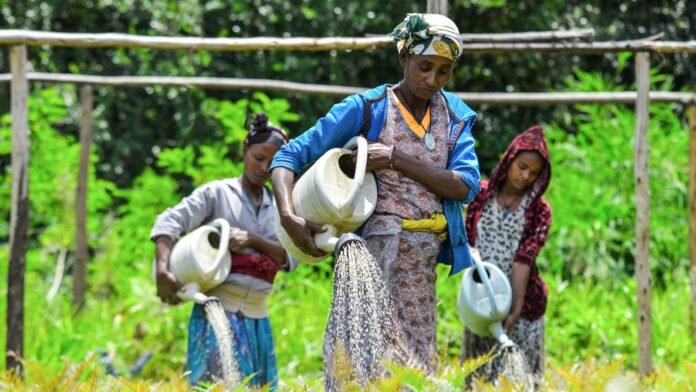
Volunteers plant seedlings on the outskirts of Addis Ababa as part of a nationwide tree-planting drive in early August. Freddie Clayton
Now the country is trying to reverse this trajectory. Argane planted 80 tree seedlings on his farmland and another 50 in a communal area — a small contribution to a vastly larger effort. In just the last seven years, tens of millions of Ethiopians have planted more than 47 billion seedlings across the country in one of the world’s largest environmental restoration campaigns. Volunteers for the program, which aims to plant 50 billion seedlings by 2030, are planting trees to rebuild native forests and integrating them into farmland. In the process, they are sequestering carbon to help protect future generations from ever more extreme weather.
Such programs often fall short, but Ethiopians are finding hope in the scale of their ambitions. “Reforestation is one of the most difficult things you can imagine,” said Aad Kessler, a researcher at the Netherlands’ Wageningen University. “It almost always fails, but this is so big that even if 30 percent of the trees survive, it’s still huge.”
In the early 20th century, forests covered an estimated 35 to 40 percent of Ethiopia. Its highlands were greener, with forests spanning much of the country’s cool, fertile uplands. But as populations grew and settlements spread, trees were cleared for agriculture, pasture, fuel, and construction. As soils lost their fertility, cultivation moved onto increasingly marginal land, including steep slopes, where tillage and the loss of protective vegetation led to the erosion of fertile topsoil, which washed into rivers and reservoirs. By 1989, forest cover was estimated at less than 3 percent, while Ethiopia’s highlands were losing around 1 billion metric tons of topsoil every year.
After the devastating droughts and famines of the 1970s and 1980s, Ethiopia’s government and international donor organizations began investing heavily in soil and water conservation, excluding livestock from worn-out land, planting trees across the country, and building terraces and check dams — small, low barriers of rocks and logs placed across gullies — to slow the flow of rainwater. By the 2000s, restoration programs were being implemented at increasing scale.
Local women load seedlings from the Mekalu nursery in Adua, Ethiopia. Brent Stirton/Getty Images
The government supercharged that effort in 2019 by turning tree-planting into a nationwide campaign with a scheme known as the Green Legacy Initiative, which mobilized millions of individuals and groups, including farmers, public servants, schools, and religious organizations, and distributed free seedlings across the country. In 2024, the government established the Green Legacy and Landscape Restoration Special Fund, committing 0.5 percent to 1 percent of the annual federal budget — roughly $73 million to $145 million — to restoring landscapes. It was an unusually large commitment for a low-income country, and the program’s success and ambition, according to development experts, contributed to the selection of Ethiopia as the host of next year’s U.N. climate conference — a prestigious honor that will help the nation showcase its greening efforts.
In August, 26.6 million Ethiopians planted 800 million tree seedlings in a single day, according to government figures, beating the previous year’s tally of 714.7 million. One of the volunteers, Yeshihareg Teferi, traveled at sunrise from her home in Addis Ababa to Tulu Dimtu so she could hunch in the rain to dig holes in the mud. It was Teferi’s fifth year participating in the annual event. Previously she’d planted indigenous species, including African wild olive and African fern pine. This time, she chose juniper. “We have a responsibility to ensure future generations inherit a green and fertile environment, rather than barren land,” she said.
There are already signs the work is having an impact.
The government reports that national forest cover rose from 17.2 percent in 2019 to 23.6 percent in 2023, while studies of restored areas have found substantial reductions in soil erosion. Between 2013 and 2023, the annual deforestation rate fell from more than 350 square miles to around 100 square miles.
Such efforts can also benefit wildlife. In Abijata-Shalla National Park, in the Ethiopian highlands, workers replanted degraded areas and built terraces and contour bunds (small earthen ridges that run across hillsides to slow runoff and allow water to soak into the soil). As trees and native grasses returned, more water infiltrated into the ground, and water levels on lakes in the park began to rise, said Kumera Wakjira, director-general of the Ethiopian Wildlife Conservation Authority. More water spurred the return of fish and fish-eating birds like cormorants and African darters. Grant’s gazelles and wild dogs are also expanding into areas where they were previously scarce, Wakjira said.
Read Next
But planted trees are not guaranteed to survive. A 2022 study of 176 reforestation projects in Asia found that around half of planted trees did not live five years. And trees alone do not make a forest, said Endalkachew Wolde-Meskel, a soil scientist and senior researcher at the Center for International Forestry Research: That process usually requires the regeneration of grasses and other vegetation, in addition to soil- and water-conservation measures and management by local communities. “The objective is not really ‘plant trees,’” he said. “It is to restore the functioning of the entire landscape.”
Emiru Birhane Hizikias, an Ethiopian restoration ecologist at Norway’s Nord University, said it was a “blessing, politically speaking,” to have the prime minister lead on tree planting but that the scale of the Green Legacy Initiative had outpaced the systems needed to make it work effectively on the ground. Too often, he said, the focus is on getting huge numbers of seedlings into the earth rather than ensuring their survival. You can’t expect a baby to grow if you don’t care for it, he said, but “that’s how plantation in Ethiopia is being done.”
Abreham Berta Aneseyee, an environmental scientist at Ethiopia’s Wolkite University and an adviser to the Ministry of Agriculture, disputes that characterization, saying the planting campaign is accompanied by practical advice from government experts in forestry and farming. The experts go from farm to farm, advising smallholders on how to plant and care for different types of seedlings, he said, including how deeply to place them in soil and how to conserve soil with structures like bunds. They also advise farmers on managing forests and protecting trees rather than cutting them down.
A 2026 study of more than 44,500 seedlings planted in southern Ethiopia under the Green Legacy Initiative in 2023 found that about 80 percent had survived, with rates significantly higher among older seedlings, wet-season plantings, and seedlings whose planters had received training in best “plantation practices.” In Humbo and Boloso Sore districts in Ethiopia’s southwestern Wolaita Zone, the Green Legacy Initiative has been layered onto longer-running efforts to sustainably manage land, with communities building check dams to stabilize gullies, digging half-moon ditches to trap water and let it soak into the soil, and planting trees alongside grasses and other vegetation.
Ethiopia’s approach has few direct parallels in Africa for its combination of political leadership, funding, public mobilization, and scale, said Kessler of Wageningen University. He compared the effort with China’s restoration of the Loess Plateau, one of the world’s most highly eroded regions. In the 1990s, China launched major restoration efforts on the plateau, including a World Bank-backed watershed rehabilitation project and, starting in 1999, the Grain for Green program, which paid farmers to restrict cultivation and plant trees, shrubs, and grasses. By 2016, more than 11,500 square miles of rain-fed cropland had been converted to more dense forest or grassland, contributing to a 25 percent increase in vegetative cover in a decade.
Read Next
The comparison has limits, though. China paid farmers to take degraded slopes out of cultivation, while millions of Ethiopian smallholders still depend on the land for food and livelihoods. But Kessler said the two efforts shared a fundamental approach: “Do it massively, and then see where you end up.”
Kessler’s work, which includes a government-backed field project in Ethiopia, takes a more participatory approach, involving farmers and communities in decisions about what to restore and how. “Of course it is better [than top-down action],” he said, “but it takes more time.”
Even as Ethiopia invests in rebuilding forests and soils, climate change is altering the conditions landscapes must withstand. In the arid pastoral regions of Afar and Somali, the Green Legacy Initiative focuses on drought-tolerant species, but it is unclear whether the trees planted today will be able to withstand the conditions they face decades from now.
The Intergovernmental Panel on Climate Change projects more frequent and intense rainfall in East Africa as global temperatures rise. In July 2024, exceptionally heavy rainfall in Ethiopia’s Geze Gofa district, in the southern highlands, triggered two landslides that killed at least 257 people. Recent studies also suggest that climate change is making El Niños more frequent and severe, with consequences for East Africa. This summer, the Famine Early Warning Systems Network linked El Niño to “historically poor” summer rains in parts of Ethiopia, leaving some areas with their driest June and July on record.
For some farmers, the changing climate has already complicated the most basic requirement of restoration: getting seedlings to survive their first season. Belayneh Mamo, 65, a farmer from Ethiopia’s northern and drought-prone Amhara region, relies on July rainfall for his teff, sorghum, maize, and wheat for bulgur. He also receives government-provided coffee, neem, and gesho seeds, but was unable to plant any crop until August, when the season’s first rains arrived.
“In previous years, September was a period when crops were already developing and food such as bulgur and maize were becoming available for consumption,” he said. “The delays affected the seedlings we plant, our crops, and the availability of animal feed.”
On Argane’s hillside in the Gurage Zone, however, signs of restoration are already visible. Since 2019, he has planted grass, fodder, fenugreek, and fruit trees along the edges of his fields, helping to hold soil in place while providing feed for the four cows, six goats, and three sheep that he keeps for milk and meat. His barley harvest has risen from about 1,800 pounds per acre to roughly 3,200, while the trees and grasses have reduced erosion and slowed the flow of water across his land during heavy rains.
“Restoring degraded land isn’t just about protecting the environment,” Argane said. “It’s also about making life better for my family and community.”
Starlink spectrum deal boosts Musk plan to beat AT&T, T-Mobile, and Verizon
SpaceX has a deal to purchase nationwide low-band spectrum licenses for a planned terrestrial mobile network that would complement the space-based Starlink cellular service.
SpaceX will buy up to 14 megahertz of spectrum in the 800 MHz band from investment firm Grain Management, which bought the spectrum rights from T-Mobile earlier this year. T-Mobile had obtained the spectrum when it bought Sprint in 2020 and was required to sell the licenses under a merger condition imposed by the US government.
“This prime low-band spectrum addresses one of the key remaining technical gaps that will pave the way for Starlink Mobile to become a major mobile carrier in the US,” SpaceX said yesterday. SpaceX this week also received US approval to launch 15,000 satellites for an upgraded version of its mobile service that it says will be far more powerful than the current offering.
The 800 MHz spectrum licenses cover “approximately 100 percent of the US population,” the Federal Communications Commission said in a July 2026 order approving Grain’s purchase of the T-Mobile licenses. While the licenses are nationwide, it’s not a huge amount of spectrum. It ranges from 4.85 megahertz to 14 megahertz depending on the county. The FCC said the 800 MHz spectrum can be used for terrestrial service, satellite-to-mobile service, or both.
SpaceX’s low-band purchase is in addition to 65 MHz of nationwide mid-band spectrum licenses it is buying from EchoStar. The FCC approved that $17 billion purchase in May 2026.
“While Starlink Mobile’s global 2 GHz mid-band spectrum will provide high-bandwidth capacity in the United States, this new low-band spectrum will provide a coverage layer that ensures Starlink Mobile’s signal penetrates through obstacles, such as walls, and can provide service to customers’ devices even when they are in buildings. Critically, most existing mobile devices already support this underused band,” SpaceX said.
SpaceX’s big mobile plans
SpaceX’s spectrum deal is likely to be approved by the FCC, but it could face opposition from small carriers. The Rural Wireless Association opposed EchoStar’s spectrum sales to AT&T and SpaceX, saying the deals “continue the troubling pattern of spectrum aggregation that disadvantages rural wireless providers.” Across all carriers in the US, there is about 1.1 GHz of licensed spectrum allocated to mobile operators, with the big three holding dominant spectrum portfolios.
SpaceX has been claiming for months that Starlink Mobile will eventually offer better service than AT&T, T-Mobile, and Verizon. SpaceX previously focused on partnering with carriers and providing them with satellite coverage for dead spots in their terrestrial networks. Stock prices for AT&T, T-Mobile, Verizon, and satellite company AST SpaceMobile fell sharply today in response to SpaceX’s spectrum deal.
SpaceX’s partner for mobile service in the US is T-Mobile, and the space company leased 10 MHz of nationwide mid-band spectrum from T-Mobile as part of that deal. With this week’s Grain deal, SpaceX is buying former T-Mobile spectrum in order to compete against the giant wireless carrier.
CEO Elon Musk said in August that Starlink would deploy many small base stations instead of “expensive and difficult-to-locate large cellular base stations.” He said the Starlink broadband antennas on the roofs of houses and businesses can help provide connectivity to cellphones.
SpaceX yesterday submitted a filing that asks the FCC to approve the low-band purchase. It said the deployment “will rely on radios feeding sectorized antennas on towers, rooftops, and other structures, configured to provide reliable signal coverage and meaningful broadband service. The propagation characteristics of 800 MHz (long-range coverage, strong performance against terrain and clutter, and superior building penetration) make this paired low-band spectrum an efficient coverage layer for markets of all sizes and densities, including areas where higher-frequency networks cannot serve.”
“The V2 Starlink Mobile satellites will deliver more than 100 times the bandwidth of our current generation, bringing high-speed service directly to unmodified devices anywhere in the world,” SpaceX said yesterday. “Additionally, the FCC authorized the full range of backhaul bands (in Ka/V/E/W) used by Starlink’s V3 broadband satellites, enabling them to operate with the existing Starlink gateway network.”
SpaceX said that once it deploys all its spectrum and launches next-generation satellites, it will be able to offer US residents “a reliable service indoors, outdoors, in cellular dead zones, and everywhere in between.” SpaceX previously told the Canadian government in a filing that it “will begin launching its next-generation Starlink direct-to-device satellites with service beginning by late 2027,” and launch “thousands more satellites” by the end of 2028.
Terms of the SpaceX/Grain spectrum deal were not disclosed. Grain originally obtained the spectrum from T-Mobile in a swap that included cash and other spectrum licenses. Specifically, T-Mobile sold its 800 MHz spectrum licenses to Grain for $2.9 billion and Grain’s 600 MHz spectrum licenses that consist of 10 MHz in 212 counties covering approximately 15 percent of the US population.
“The 800 MHz licenses that Grain is acquiring (817–824 MHz paired with 862–869 MHz)—a valuable source of paired, broadband-ready, low-band spectrum—have been underutilized in recent years,” the FCC said in its approval of the cash-and-spectrum swap.
Big carriers pool spectrum to counter SpaceX
Dish was previously given the first option to buy the 800 MHz spectrum under a merger condition imposed by the US Department of Justice on T-Mobile’s purchase of Sprint. Dish declined the option to buy it for $3.59 billion, and the offer expired in 2024, forcing T-Mobile to find a new buyer.
AT&T, T-Mobile, and Verizon are trying to counter SpaceX’s moves into mobile by pooling spectrum for a new joint venture focused on using satellite to cover dead zones in terrestrial networks. The big three carriers finalized the joint venture agreement last week, saying it will give other satellite operators a better chance to compete.
The venture will “improve the application and utilization of valuable and scarce nationally licensed spectrum resources,” the carriers said. They said they plan industry-wide device compatibility through a “standards-based approach to development involving operating system providers, mobile app developers and original equipment manufacturers.”
Existing carrier-satellite agreements will remain in place, and the three big carriers “can continue connectivity efforts independently,” the press release said. Meanwhile, an FCC plan announced this week could auction 25 MHz of mid-band spectrum for use in terrestrial and satellite networks.
The FCC also proposed rule changes that would allow 482 MHz of spectrum to be used for satellite-to-mobile service. This would be an expansion of the Supplemental Coverage from Space (SCS) framework in which terrestrial wireless spectrum is made available for satellite use.
MasterChef Star Dies Only Months After Shocking Diagnosis
MasterChef Poland star Mariusz Komenda has died at just 44 years old, only months after revealing that doctors had diagnosed him with a malignant brain tumor.
Komenda, a chef and restaurateur who reached the semifinals of the eighth season of MasterChef Poland in 2019, died on October 7 following months of intensive treatment and rehabilitation.
TVN, the Polish network behind MasterChef, confirmed the heartbreaking news and remembered Komenda as an important member of the show’s extended family.
“It is with great sadness that we received the news of Mariusz Komenda’s death,” the program said in a tribute translated from Polish.
The MasterChef team remembered him as a man filled with passion, energy and a deep love of cooking, adding that he had continued returning to the program after his original season to share his experience with other contestants.
Komenda’s health crisis began suddenly in January 2026.
He later revealed that he had been hospitalized after doctors initially suspected he may have suffered a stroke. Medical testing instead uncovered a tumor in the right thalamus, a region located deep within the brain.
Doctors determined that the tumor had characteristics consistent with a malignant glioma.
The diagnosis transformed Komenda’s life almost overnight.
Writing about his condition months later, he said he initially believed he was dealing with a temporary medical crisis. Instead, the discovery marked the beginning of what he described as the hardest fight of his life.
Komenda underwent two major brain operations in a short period of time.
During the first procedure, doctors were able to surgically remove the tumor. His fundraising page said the area was then treated with radiation.
A second operation later became necessary, during which surgeons removed part of his skull in an effort to reduce the risk of further complications and allow his treatment to continue.
Komenda subsequently began intensive rehabilitation while remaining under the care of specialists in Warsaw. He was also undergoing additional medical testing and consultations after other health problems were discovered during his cancer treatment.
The chef launched a public fundraising campaign in March to help cover the rapidly growing costs of his treatment, rehabilitation, medications and repeated travel to hospitals.
He explained that the expenses were consuming much of his family’s savings and said he wanted to concentrate on recovering rather than worrying about how to pay for the next stage of care.
Even while facing the disease, Komenda repeatedly told supporters that he was determined to keep fighting.
His death came only about 18 months after he fulfilled another major dream with his son.
In April 2025, Komenda and his son Mateusz opened Father & Son in their hometown of Środa Śląska in southwestern Poland. The restaurant specialized largely in Mexican-inspired food while also offering some Polish dishes.
The family venture followed Komenda’s rise to national attention on MasterChef Poland.
During the 2019 competition, he advanced all the way to the semifinals and was among the contestants who traveled to Mexico for one stage of the show.
Although he did not win the competition, MasterChef helped turn his passion for cooking into a wider career. He remained connected to the program in later years and continued working in the restaurant industry.
Following his death, the MasterChef team said it was difficult to find words capable of expressing their grief.
Their tribute concluded with a simple message to the chef who had remained part of their television family long after his season ended.
President Trump Weighs Joining US Saudi Strikes on Houthis After Riyadh Airport Attack
President Donald Trump said the United States is considering joining Saudi strikes against Iran-backed Houthi rebels in Yemen after the group claimed attacks on Saudi airports, military facilities and oil infrastructure, including King Khalid International Airport in Riyadh.
“We may. We’re going to look at it,” Trump told reporters. “We just found out about the recent attack. So we’ll make a decision. We move very quickly.”
Asked about the attacks at the White House, President Trump said: “Not good. It’s not a good thing. I’m not happy about it.”
Saudi Arabia’s General Authority of Civil Aviation said a passenger terminal at King Khalid International Airport was hit Saturday, injuring several people and forcing authorities to suspend airport operations while the damage was assessed.
“This incident occurs against the backdrop of ongoing attacks targeting civil aviation facilities in the Kingdom. As a result of the attack, several people were injured and the full extent is under investigation,” the authority said.
“Airport operations have been temporarily suspended until completion of damage assessment and verification of facility safety, in coordination with the relevant authorities.”
Reports said many people were injured in Saturday’s attack, while embassies around the world warned their citizens against traveling through the airport. The site was evacuated and flights were halted following the strike.
Saudi Arabia’s Foreign Ministry instructed travelers abroad who had been unable to reach their destinations in the Kingdom because of the disruption to contact Saudi missions in the countries where they were located for assistance.
Saturday’s attack followed another Houthi strike on King Khalid International Airport last Thursday that killed three people, according to Saudi Arabia’s Civil Aviation Authority.
The Houthis have also claimed attacks against other Saudi airports, military installations and oil infrastructure.
Your artwork could be featured in the next Debian release
The Debian Linux project has opened a call for community artwork submissions ahead of the release of the upcoming Forky (Debian 14). If you think you’ve got the artistic chops, your art could appear on the boot screens, login prompts, and desktop wallpapers of millions of users. The submission deadline is November 26.
Continuing Debian’s community-driven ethos, the artwork submission process mirrors that of previous releases. The artwork must feel distinctively “Debian,” integrate cleanly without the need for core software patching, and remain visually appealing for the long term.
Elise Couper’s “Ceratopsian” theme was chosen as the winning default for Debian 13 Trixie. For anyone who might not be up on the latest from the Toy Story franchise, the release names echo character names from the animated films. Trixie was a triceratops introduced in Toy Story 3, hence the “Ceratopsian” wink in the winning submission. It makes sense that the next version of Debian continues this trend with Forky, a character introduced in the franchise’s fourth entry. The Debian team cautions against overly busy designs that may cause user fatigue, but if anyone can successfully incorporate Forky’s googly eyes into the design somehow, know that you’d at least win the contest for my Debian desktop wallpaper.
The Ceratopsian theme for Debian 13 Trixie. Credit: Elise Couper / Debian Project
The Ceratopsian theme for Debian 13 Trixie. Credit: Elise Couper / Debian Project
Debian celebrated its 33rd anniversary in August 2026 and continues to position itself as the “universal operating system,” with support and compatibility stretching across different hardware architectures. Debian’s latest point release, Trixie 13.7, arrived on September 12, 2026. Forky (Debian 14) is now in the later stages of its development cycle, with the artwork selection process marking one of the final boxes to be checked before the release is made available. Interested artists can review the submission requirements on the Debian Wiki.
Earlier this year, we heard that reporter Jake Pearson planned to ask our editors at ProPublica for more than $20,000 so he could spend the NBA playoffs betting like a problem gambler.
We told him we wanted in on the action.
For 10 weeks, our documentary team at ProPublica filmed Jake as he dove ball-cap-first into DraftKings and FanDuel, the country’s largest online sportsbooks. Jake bet early, late and often, ramping up the amounts and frequency of his wagers, chasing his losses with even bigger bets. He wanted to flagrantly wave the red flags of a gambler descending into addiction. Would the apps serve up speed bumps as he careened into the red, or would they push him to keep betting?
Since 2018, the year the Supreme Court opened the door for states to legalize sports betting, the number of people staking money on games has exploded. It’s now legal in 39 states and Washington, D.C. The apps don’t just offer straight action on the outcome of a “Sunday Night Football” game — you can put money on myriad sports events and outcomes, including who will score the next point in a tense contest of Czech table tennis. Every month, millions do.
More than $600 billion has sloshed through the legal sportsbooks in wagers — and brought billions in state tax revenue — in the last eight years. But between the ever-present ads featuring celebrities from LeBron James and Charles Barkley to Kevin Hart and Kendall Jenner, cracks in the system have started to show.
About a quarter of active sportsbook account holders surveyed by the Siena Research Institute this year said that they’d lost enough on a bet that they’d have trouble meeting their financial obligations. Other studies and public health experts warn of rising cases of bankruptcy, addiction and self-harm.
ProPublica reporter Jake Pearson at a Manhattan bar this spring, testing DraftKings’ and FanDuel’s guardrails. More than a quarter of people in the U.S. say they have an active account with an online sportsbook, according to a poll by the Siena Research Institute.Gerardo del Valle/ProPublica
DraftKings and FanDuel say that they don’t want to profit off bettors who can’t control themselves, and they provide a range of what the industry calls “responsible gaming” tools to help users stay in check.
Jake received pop-up notices, reminders and emails noting his time on the app and nudging him to “take a beat” after a loss. He opted into some of the tools DraftKings makes available. But he was struck by user design choices and promotions that encouraged him to keep betting, some of which he was served right after setting limits on his play.
In a statement, DraftKings told ProPublica that it trains its more than 5,000 employees on responsible gaming and has more than 50 full-time staff dedicated to its “responsible engagement” program. A FanDuel spokesperson wrote that the company’s program is “designed to identify potential risk early and empower customers with real-time information about their play.”
Even so, regulators and lawmakers from Colorado to Massachusetts have begun to question whether sportsbooks have sufficient protections in place. Those concerns have risen with the popularization of prediction markets, which are even less regulated than sports betting apps like DraftKings.
We were behind the camera back in April when Jake opened his DraftKings account to place his first bet, a $100 Hail Mary wager for the New York Knicks to win the chip. We had no idea what a ride it would be.
Watch our new documentary that follows Jake as he intentionally descends into problem gambling — and see how the apps react.
Have you used apps like DraftKings or FanDuel to place sports bets? ProPublica is looking for at least 250 people who use these apps to share their data with us. Your transaction history will help us better understand how the apps respond to user behavior. You can also reach Jake Pearson and the reporting team at 917-512-0276 or [email protected].
Support Independent Journalism:
As a nonprofit newsroom, we rely on donations from individuals like you to fuel our work. Your support today will directly fund investigations that shine a light on urgent issues: corporations prioritizing profits over public safety, health insurers denying coverage to patients, unintended consequences of new laws and more.
Rights group files ICC complaint against Israeli medical officials over torture of Palestinian detainees
The Hind Rajab Foundation filed a complaint with the International Criminal Court (ICC) against Israeli medical officials over torture and mistreatment of Palestinian detainees, Israeli media reported Saturday, Anadolu reports.
The complaint targets the Israeli Medical Association, Health Ministry officials and medical personnel over abuses at the Sde Teiman military detention facility in southern Israel.
According to the Israeli newspaper Yedioth Ahronoth, the Brussels-based rights group submitted the complaint to the ICC prosecutor under Article 15 of the Rome Statute.
The foundation said that Israeli medical personnel and officials were involved in practices amounting to war crimes and crimes against humanity.
– Allegations of systematic mistreatment
Since October 2023, the Sde Teiman military base in Israel’s southern Negev desert has been used to hold thousands of Palestinians from the Gaza Strip, most of them civilians, including men, women, children, older people, journalists and health and humanitarian workers.
The foundation said that detainees were classified as “unlawful combatants,” a designation it described as a means of denying them basic legal protections and holding them without charge or trial.
The complaint said Israel’s Health Ministry established a medical facility at Sde Teiman shortly after Oct. 7, 2023.
According to the foundation, medical personnel were required to sign documents placing them under military police authority rather than the army’s Medical Corps.
The complaint seeks investigations into officials from Israel’s health and defense ministries, medical personnel, hospital administrators and the Israeli Medical Association.
Those named include former health ministers Moshe Arbel and Uriel Buso, association chairman Zion Hagay, director general Leah Wapner and ethics board chairman Yosef Walfisch.
– Detainees restrained during medical treatment
The foundation said a Health Ministry directive issued on Dec. 19, 2023, required medical personnel to treat detainees while they were handcuffed and blindfolded.
According to the complaint, the directive also permitted forced medical treatment without adequate safeguards.
Medical staff were allegedly instructed not to disclose their names and to sign medical records using only their professional titles.
The foundation argued that these practices obscured individual responsibility and hindered documentation of injuries.
– Amputations, surgeries without adequate pain relief
The foundation cited accounts from Israeli medical workers and former Palestinian detainees describing abuses at Sde Teiman.
According to the complaint, a doctor wrote to Israeli authorities in April 2024 that two detainees had undergone leg amputations within one week because of injuries caused by shackling.
The doctor reportedly described shackling as routine at the facility.
The foundation also cited medical workers who told the Associated Press they had witnessed surgeries performed without adequate pain relief.
One account described an elderly detainee screaming and shaking during leg surgery.
Other workers reported detainees being blindfolded, forced to wear diapers and restrained by all four limbs to hospital beds.
The foundation said at least 29 detainees had died at Sde Teiman by November 2025 because of physical violence, medical neglect or both.
– Medical association accused of complicity
The complaint accused the Israeli Medical Association of helping legitimize torture and mistreatment at the facility.
The foundation said the association responded to allegations of medical complicity with general reminders about professional ethics rather than sufficient investigative action.
It also said findings from an internal Health Ministry ethical assessment following a visit to Sde Teiman were not publicly released.
“Instead of investigating the allegations, leaders of the association publicly defended the medical care provided at Sde Teiman,” the foundation said.
Established in February 2024 and based in Brussels, the Hind Rajab Foundation has pursued legal cases in several countries against Israeli officials and military personnel over alleged violations in Gaza.
Since October 2023, Israel’s war in Gaza has killed more than 74,000 Palestinians and injured over 175,000 others, according to Palestinian figures.
AI disqualification yields new Nikon Small World in Motion winner
Credit: Nguyen Nam Nhat.
Last month we covered the winner of Nikon’s Small World in Motion video: Ning Xu of Tsinghua University in China, whose video captured tiny cilia beating in the airways of a child with a rare respiratory disorder. But allegations surfaced about Xu’s use of AI while making the video. Nikon launched an investigation and concluded that Xu’s entry did not comply with competition rules. The new winner is Nguyen Nam Nhat of Vietnam with a video of a tiny roundworm and a single-celled organism (above).
According to a BBC report, some researchers expressed concern that Xu’s video had structural abnormalities and that cell features appeared and disappeared in a way one would not see in actual cellular biology. Others spotted what looked like AI watermarks embedded within the source files. Xu said he used AI “to distinguish and visualize features in the reconstructed grayscale images”; however, he denied that AI was used “to generate the experimental movie, the cilia, or their motion.”
Founded in 2011, the Nikon Small World in Motion competition is a spinoff of the company’s Small World Photomicrography Competition, which has been around since 1974. Both are meant “to showcase the beauty and complexity of things seen through the light microscope”—one through still photographs, the other through photovideography, taking advantage of all the technological advances that now allow users to make movies or time-lapse images through the microscope.
The other winners also moved up a notch with Xu’s disqualification. Benedikt Pleyer of Bavaria, Germany, placed second with a video of jellyfish larvae suspended in water droplets; Andrew Moore of Howard Hughes Medical Institute in the US placed third with a video of synchronized cell division in neighboring cells; Patrick Hickey of Hypha Research Ltd. in Edinburgh, Scotland, placed fourth with a video of the dynamics of mitochondria and chloroplasts in Turtle Vine leaf cells; and Igor Adameyko placed fifth with a video of a tiny, colorful sea slug (Cyerce kikutarobabai) on the move.
Here is Nikon’s full statement:
After thoroughly re-evaluating the video and supporting materials and consulting with members of our judging panel, Nikon has determined that the winning video did not comply with the competition rules regarding generative AI. Nikon has adjusted the competition rankings on our website to reflect this decision.
This decision is based solely on the submitted video’s eligibility under the rules outlined for this competition. It should not be interpreted as a judgment of the entrant’s professional reputation, scientific contributions, or intent.
Advances in imaging and artificial intelligence continue to evolve rapidly, creating new challenges for organizations across many fields. This event has shown the need for Nikon Small World and Nikon Small World in Motion to revisit rules and evaluation procedures for future competition entries.
The Nikon Small World and Nikon Small World in Motion competitions celebrate excellence in imaging, both scientific and artistic in nature. We value the integrity of each image and video selected to appear in our winning galleries, and remain committed to upholding the standards of excellence that have defined this competition.
65% of Publicly Listed Company Directors Now Regard AI as a Key Issue Facing Their Boards
Artificial intelligence is rapidly moving up the boardroom agenda, raising an important question for non-executive directors: are boards equipped to oversee the transformation AI is bringing to businesses?
This and other issues will be explored at Zampa Partners’ forthcoming NED Forum, a half-day event taking place on 15 October at the Verdala Wellness Hotel in Rabat.
The forum will bring together non-executive directors, board and committee members, chairs and company secretaries for a practical programme focused on some of the key challenges facing today’s boardrooms.
AI is just one of the issues placing new demands on directors.
A survey published last April by the National Association of Corporate Directors found that 65% of directors at publicly listed companies now regard AI as one of the key issues facing their boards, up sharply from 27% just over a year earlier. Cybersecurity threats have also climbed the agenda, cited by 43% of directors.
At the same time, corporate governance expectations around AI are still developing. More than six in 10 large-cap European companies had no formal AI policy disclosed in 2025, according to Glass Lewis, a leading provider of global governance and proxy advisory services to institutional investors.
Against this backdrop, the NED Forum will examine a range of issues increasingly central to effective corporate governance. These will include directors’ responsibilities in listed companies, oversight of tax returns, the use of artificial intelligence in the boardroom, regulatory investigations, anti-money laundering obligations, cyberattacks, and the role of non-executive directors in mergers and acquisitions.
The programme will combine panel discussions with focused keynote presentations from professionals across the legal, financial, regulatory and business sectors.
“The role of the non-executive director continues to evolve, and with it comes a broader range of responsibilities and challenges,” explains Michael Agius Vadala, Partner at Zampa Partners, who will also address how directors can ensure their companies are prepared to reduce the risk of a cyberattack.
“From cyber risk and AI to regulatory scrutiny and transactions, directors are increasingly expected to understand issues that extend well beyond traditional governance. We chose these themes for our forthcoming NED Forum because they reflect the realities boards are dealing with today, and we wanted to create a practical forum where directors can exchange perspectives and gain insights that are directly relevant to their role.”
The programme reflects the changing role of the non-executive director. As boards face increasingly complex regulatory and technological risks, directors are expected not only to provide effective oversight, but also to contribute meaningfully to strategic decision-making.