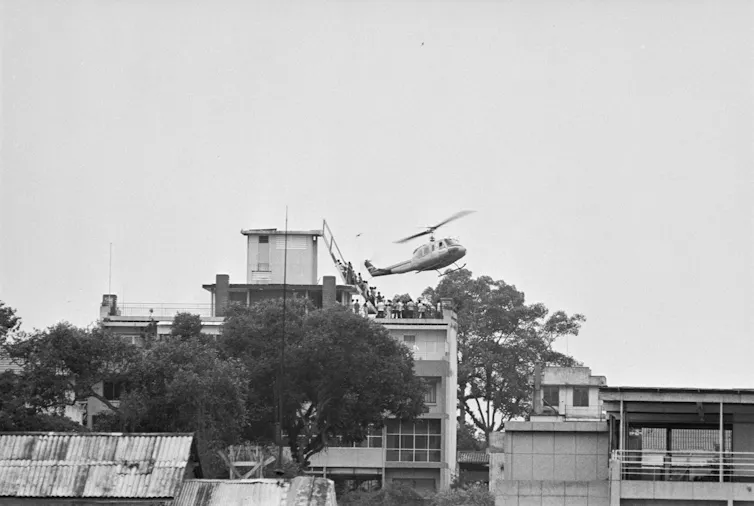
Iraqi Kurds sees opportunities – and risks – in the withdrawal of US troops
When the last U.S. forces left Erbil Air Base in Iraqi Kurdistan on Sept. 30, 2026, it marked more than the removal of soldiers and military equipment. It also changed the security calculus in the region.
For years, the American troop presence had two effects at once. It provided the region – home to 6.5 million people, mainly ethnically Kurdish – with broader military support and protection against drones and missiles launched by Iran and its allied groups in Iraq. The American presence also helped make the region part of a wider confrontation between the United States, Iran and those same Iranian-allied groups.
The withdrawal, therefore, creates a paradox. Iraqi Kurdistan may become less attractive as a target for militant groups seeking to pressure the United States. Yet the region loses some of the capabilities that helped manage threats that have little to do with the American presence.
The important question, then, for me as a regional expert is not simply whether Iraqi Kurdistan is safer after the U.S. departure, but which disappears faster: the threats that existed as a response to American forces or the protection their presence provided.
Removing a target, not all threats
Iraqi Kurdistan, officially called the Kurdistan Region of Iraq, is a semi-autonomous federal region of the country and shares borders with Iran, Turkey and Syria.
After decades of repression under Saddam Hussein, the Kurds were able to maintain self-rule with the support of the U.S. after the 1991 Gulf War. The relationship later grew into a close security partnership, especially in the fight against the Islamic State group.
Those tensions increased after the 2017 Kurdistan independence referendum, in which nearly 92.73% of Kurds supported independence after years of unresolved disputes with Baghdad over territory, oil revenues and the budget.
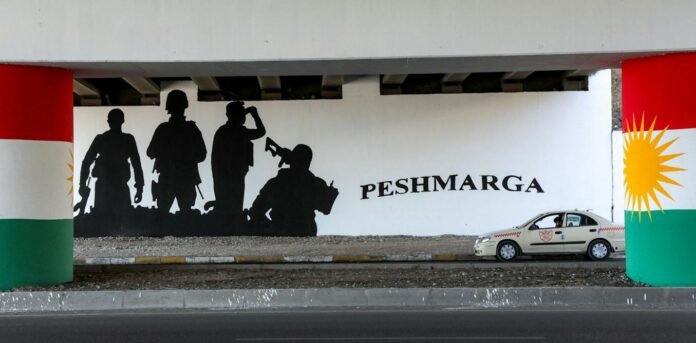
The failed bid for independence led to the loss of disputed territories previously held by the Peshmerga, the Kurdish security forces. This brought Iran-aligned militia groups closer to the Kurdistan region, and some of these areas later became launching points for attacks on Kurdish targets.
Those targets have included various oil fields, refineries, gas facilities and other energy infrastructure. Kurdish officials have in turn criticized the federal government in Baghdad for failing to take effective action.
The withdrawal of U.S. military forces will remove one clear source of exposure for Iraqi Kurds as it relates to that ongoing war. But what remains are the preexisting security and political issues that have long divided Iraq.
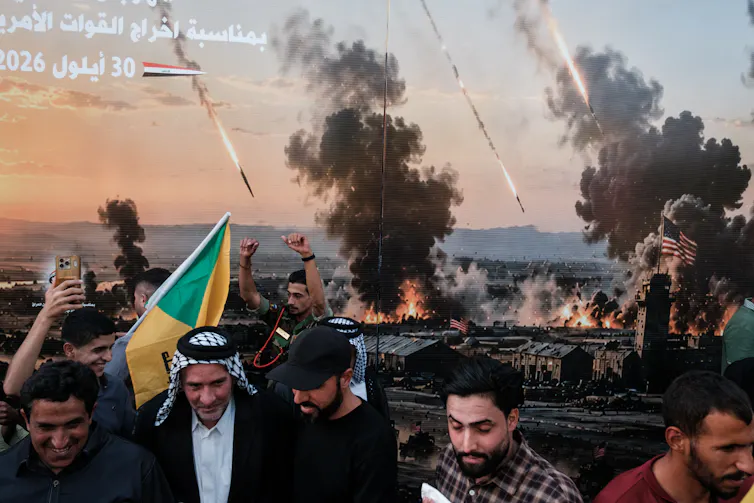
People pose for photos on a stage during a rally for the Iran-allied Popular Mobilization Forces, celebrating the end of the U.S. military presence in Iraq in Baghdad.Guy Peterson/Getty Images
A unified Peshmerga – but without air defense
The timing of the U.S. withdrawal creates another important contrast.
Days before U.S. forces left, the Kurdistan region formally completed the unification of the Peshmerga under one government command structure. Those forces had long been divided between the two main Kurdish parties in Iraq, the KDP and the PUK. Completing this long-standing U.S. demand was a historical milestone for the security of the region and Iraq.
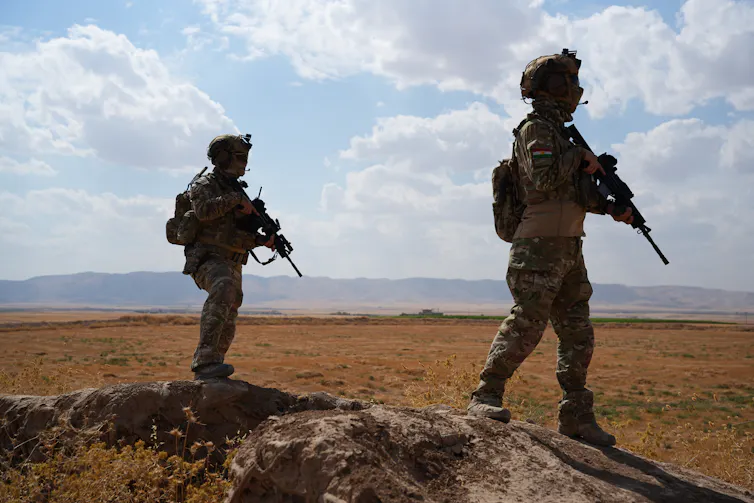
Yet the unification addresses a far different concern than the one the region now faces. The Peshmerga have decades of experience in ground warfare and played an important role in the fight against the Islamic State group. But missile and drone defense require a different set of capabilities that the Kurdistan region lacks on its own.
Echoing a common refrain among fellow Kurdish leaders, Kurdistan Region Prime Minister Masrour Barzani said the next stage of the development of his territory’s armed forces should include stronger military capabilities, advanced weapons and air-defense systems.
That makes the problem partly federal. The Ministry of Peshmerga has called the timing of the U.S. withdrawal sensitive, given instability that threatens security in both the region and for the Iraqi central government. It has also stressed that safeguarding Kurdistan’s airspace against future aerial threats is ultimately Iraq’s responsibility.
But the transition is incomplete. Kurdistan is now more dependent on Baghdad for air defense, while Iraq’s national air-defense system is still being built and is not yet fully operational.
Sovereignty does not equal security
Iraq marked the end of the U.S.-led coalition mission as sovereignty day. Foreign troops had left, and responsibility for Iraq’s security had returned more fully to Iraqi institutions.
But withdrawal changes sovereignty in Iraq from a long-standing political claim into a practical test.
Kurdistan Region President Nechirvan Barzani noted that sovereignty does not mean only the departure of the foreign forces, but also the capability of the state to have authority and agency.
Yet the central government still doesn’t have full control over armed groups operating in the country. Baghdad extended its deadline for bringing under government authority the weapons of armed groups outside state control from Sept. 30, 2026, to June 30, 2027, amid resistance from powerful armed groups.
The extension does not prove that Baghdad will fail. But it exposes a gap between formal sovereignty and effective control over armed forces.
For Kurdistan, this turns into a question of whether Baghdad can increase its defense of all Iraqi territory and airspace, including from Iranian drones in the region.
A new phase of US-Kurdish relationship
The U.S. withdrawal also changes how the U.S.-Kurdish relationship should be judged.
Historically, security support and mutual regional goals have defined the U.S.–Kurdistan region relationship. That included the 1991 no-fly zone during the first Gulf War, American support during the 2003 U.S. invasion of Iraq and the war against the Islamic State group, in which Kurdish groups in Iraq and in Syria were indispensable allies on the ground.
Each phase produced a clear security rationale. With American troops no longer based in Irbil, that rationale has expired. The question is whether the relationship can survive without the military logic that created it.
There is evidence it can.
The U.S. completed a new consulate complex in Irbil in 2025, as a long-term platform for diplomacy, economic ties, education and support for American companies interested in the region.
This diversification matters because a partnership built mainly around military needs becomes vulnerable when U.S. security priorities change. Economic ties, investment and permanent diplomatic institutions create other reasons for the relationship to continue. And the U.S. remains an important economic partner, ranking sixth among countries with the largest number of companies operating in the Kurdistan Region.
This will matter to both sides going forward. For Kurdistan, it would reduce the tendency to read every change in U.S. military posture as a measure of political commitment. For Washington, it would offer a way to maintain influence and partnership without making a permanent troop presence the foundation of the relationship.
The region going forward
The U.S. withdrawal does not create a simple security vacuum.
It changes who is responsible for managing the threats that remain. What happens next in terms of security will be especially instructive.
If attacks decline after U.S. facilities disappear, the American presence was clearly a primary source of instability and potentially an inhibiting factor on improving security. That would then be a welcome change for Kurdish sovereignty and the goal of Iraqi nation-building.
If, however, things largely continue on as before, then security of the Kurdistan region, and the implications for politics and energy, will continue to be a major source of worry – and confirm the worst fears of many Kurdish leaders concerning the American withdrawal.
US imposes sanctions on International Criminal Court, threatens to ‘dismantle’ it
The US on Friday imposed sanctions on the International Criminal Court (ICC), Secretary of State Marco Rubio announced, hours after former court judge Navi Pillay won the 2026 Nobel Peace Prize, Anadolu reports.
“President Trump will never allow the International Criminal Court to prosecute Americans. That is why, today, the United States is sanctioning the International Criminal Court,” Rubio said in a statement.
Rubio said Washington had deferred the designation “in hopes that the ICC would change course or would otherwise be restrained by States Parties,” but neither had “taken meaningful steps to address our concerns.”
“Either the ICC will end its threats, or we will end the ICC,” Rubio said, calling on US allies that are members of the court “to rein in the court.”
“If they do not, the United States will continue its campaign to dismantle the ICC, brick by brick, until Americans are threatened no longer,” he added.
The ICC strongly rejected the sanctions, describing them as an assault on the rule of law.
The court also urged its member states to ensure its continued operation.
The announcement came hours after Pillay, a South African jurist who served on the ICC’s Appeals Chamber from 2003 to 2008, won the Nobel Peace Prize for her work in international criminal justice.
The sanctions also followed intensified US pressure on the court after it issued arrest warrants in November 2024 for Israeli Prime Minister Benjamin Netanyahu and former Israeli Defense Minister Yoav Gallant over alleged war crimes in Gaza.
Washington previously sanctioned ICC judges and prosecutors, including court President Tomoko Akane in August.
At a Cabinet meeting at Camp David on July 31, US President Donald Trump said Rubio’s campaign against the court was not intended to protect him.
“He’s trying to defend Bibi and various other people,” Trump said, referring to Netanyahu.
The ICC has 125 member states. Neither the US nor Israel is a party to the court.
Volkswagen’s replacement for the ID.4 crossover is here
Volkswagen’s ID.4 is no more. The midsize crossover debuted in 2021, one of VW’s first new electric vehicles designed in the wake of dieselgate. A year later, the company began local production in Chattanooga, Tennessee, and a couple of years ago facelifted the model, adding a much-improved rear drive unit in the process. But Chattanooga turned its attention away from the ID.4 earlier this year. And, having sold almost a million ID.4s (and near-identical ID.5s) globally, the German automaker has decided it’s time for its replacement. Meet the ID. Tiguan.
Dropping the numerical and adopting the moniker of VW’s big seller is a statement. “The Tiguan is our best-selling model worldwide, and the ID.4 and ID.5 are among our most successful electric cars. The ID. Tiguan brings these two success stories together,” said Thomas Schäfer, CEO of the VW brand.
VW was an early pioneer of using flexible vehicle architectures to create a multitude of bodystyles and sizes with common parts, and its transition into building EVs hasn’t changed that. The ID. Tiguan uses an updated version of the company’s mass-market EV platform, now called MEB+, with either 58 kWh or 77 kWh battery packs. The smaller pack is only available with a 187 hp (140 kW) rear electric motor, but the 77 kWh battery can be had with either a 281 hp (210 kW) rear-wheel drive powertrain or as a 295 hp (220 kW) all-wheel drive version. Range is up to 373 miles (600 km), at least according to the European WLTP test.
It debuts a new design language for the automaker.
Volkswagen
It debuts a new design language for the automaker. Volkswagen
Note there are even real switches for the windows—huzzah!
Volkswagen
Note there are even real switches for the windows—huzzah! Volkswagen
It debuts a new design language for the automaker. Volkswagen
Note there are even real switches for the windows—huzzah! Volkswagen
Backlighting and Audi-like switches.
Volkswagen
Backlighting and Audi-like switches. Volkswagen
The rear seats.
Volkswagen
The rear seats. Volkswagen
Backlighting and Audi-like switches. Volkswagen
The rear seats. Volkswagen
Alongside the mainstream name, it has a more mainstream look, though it’s part of VW’s new design language. For those keeping track of the various interesting names car companies give their design languages—it can’t just be me—this one is called Pure Positive. The automaker says it wants the ID. Tiguan to feel like it belongs to the premium rather than mainstream segment, both inside and out.
Based on the images VW supplied to Ars, I think they’ve mostly met that brief; the R-Line interior in particular looks rather good to me. More importantly though, VW has been listening to feedback.
The return to normal door handles will be welcome, even if it might have been driven by Chinese vehicle regulators. Even more welcome are the plethora of physical controls: real buttons on the steering wheel, real switches for the climate control and windows, and real physical air vents, not computer-controlled ones. There’s a new 15-inch infotainment screen that looks nice but will need to be responsive, plus the option of a 12-inch passenger display, a trend I continue to bemoan like Grandpa Simpson shouting at the clouds.
One of six retro dial designs. Instead of a tachometer, it shows you percentage power deployed (or regenerated).
Volkswagen
One of six retro dial designs. Instead of a tachometer, it shows you percentage power deployed (or regenerated). Volkswagen
The interior looks less utilitarian than the ID.4, particularly in R-Line trim.
Volkswagen
The interior looks less utilitarian than the ID.4, particularly in R-Line trim. Volkswagen
One of six retro dial designs. Instead of a tachometer, it shows you percentage power deployed (or regenerated). Volkswagen
The interior looks less utilitarian than the ID.4, particularly in R-Line trim. Volkswagen
The R-Line seats look more supportive than a generation of helicopter parents.
Volkswagen
The R-Line seats look more supportive than a generation of helicopter parents. Volkswagen
The electric Tiguan should be practical.
Volkswagen
The electric Tiguan should be practical. Volkswagen
The R-Line seats look more supportive than a generation of helicopter parents. Volkswagen
The electric Tiguan should be practical. Volkswagen
One feature that really got my attention is one of the options for the new 10-inch digital main instrument display: the retro dials. Instead of something presumably 21st-century looking—I don’t know since we didn’t get any press shots of the default theme—you can opt to replicate the dials and warning lights from an Mk1 Golf, an Mk2 Golf Country, an Mk 4 Golf, a first-gen Tiguan, a racing Toureg, or the Beetle. (I’m not sure if it’s the original rear-engined Beetle or the retro one designed by J Mays in the late 1990s.)
Pre-sales for the electric Tiguan start in Europe next week, with a starting price in Germany of 42,695 euros ($44,716). Although the ID. Tiguan is coming to the US, VW told us it “has not announced North American timing for the vehicle. Following the European ID. Tiguan launch in early 2027, the company will share North American timing, offer structure, pricing, and other market-specific details in due course.”
Operation CANTABRIA:Fruit-export front used to hide cocaine shipments from Ecuador
Police in Ecuador arrested 20 suspects Thursday in an operation targeting a network that moved large amounts of cocaine from Latin America to Europe, Europol said.
Ecuador’s Federal Police carried out the arrests and searched 23 properties on Oct. 8, working with Spain’s Guardia Civil and National Police. Europol supported the operation, code-named CANTABRIA.
Investigators say the network used Ecuador as an export hub because of its proximity to Colombia, the world’s leading cocaine producer. It also has a strong export sector, particularly tropical fruit shipments to Europe, and major commercial ports with heavy container traffic.
The group hid drugs in commercial freight, taking advantage of the sheer volume of maritime trade to avoid detection, authorities said. To get past police and customs inspections, it operated as tropical fruit import-export companies.
Suspects also kept bases in Peru and at major European logistics hubs, including ports in Belgium, Spain and the Netherlands, and established operational links in the United Arab Emirates, according to the investigation.
“International cooperation is our greatest strength against drug trafficking,” said Magnus Brunner, the European Union commissioner for internal affairs and migration. He said the operation showed that 43 tonnes of cocaine had been seized and a major trafficking route into Europe disrupted.
Two Ecuadorian officers were posted to Europol’s headquarters in The Hague during the investigation. They worked with European Union member states and Europol to gather intelligence, share information, analyze data and support investigators in the field.
After years of joint investigation, authorities seized more than 43 tonnes of cocaine in 13 major operations between 2022 and 2026, including Operation CANTABRIA. Some of the seizures were detected through Sky ECC data.
In December 2020, Dutch authorities intercepted two banana container shipments from Ecuador holding nearly 4 tonnes of cocaine. A few months later, Ecuadorian law enforcement stopped a shipment of more than 2 tonnes bound for Belgian ports. In 2023 and 2024 alone, authorities seized more than 35 tonnes, including a record 13-tonne seizure in Spain.
The operation received support from EL PACCTO 2.0, the EU’s cooperation program with Latin America and the Caribbean against transnational organized crime.
As so-called prediction markets like Kalshi and Polymarket embed themselves in every aspect of our daily lives, from elections to sports and entertainment, concerns have grown about what the explosion of these poorly understood, loosely regulated platforms could mean for regular people and democracy writ large.
Celebrities from LeBron James to Sydney Sweeney have inked lucrative deals with prediction platforms. Legacy news outlets have even begun including prediction market data in their coverage. And the Trump family is deeply embedded in these platforms’ success; Donald Trump Jr.’s VC firm just became a lead investor in Polymarket, and he is a paid adviser to both Polymarket and Kalshi.
But what actually is a prediction market, and what separates it from online sports betting platforms like DraftKings or FanDuel?
This week on The Intercept Briefing, Kate Knibbs — a senior writer at Wired who covers prediction markets, the future of media, and how AI is changing the internet — breaks down the battles to define prediction markets; what they’re getting away with in the meantime, while existing in this “weird” regulatory gray zone; and their potential to be a “disruptive force” in next month’s midterm elections.
States have been looking to regulate these platforms like they do sports gambling. But the companies are pushing back: The founders of Kalshi donated $200,000 to a new Texas-focused political action committee, a week after state lawmakers held hearings to investigate whether prediction markets constitute sports betting, which is illegal in Texas.
“Both Kalshi and Polymarket are tech unicorns at this point. They have a lot of money to spend, and they realize that this is an existential fight,” says Knibbs. “Donald Trump Jr. is very involved in this industry, and stands to gain a lot from prediction markets being able to operate as they desire and not be beholden to various state regulations that they’re currently not beholden to. … I am very interested in what is going to happen in this space when we have a different administration. Kalshi is seeming to hedge its bets by aggressively hiring former Biden administration stars.”
In addition to spending heavily on lobbying, their survival strategy includes inking deals with mainstream media companies like CNN, CNBC, and even Substack to establish credibility.
“I have been following the enmeshment between prediction markets and the media very closely because I think it’s flown under the radar a little bit, while all of these regulatory fights have been going on, just how quickly the prediction markets managed to establish themselves as another source of truth about what’s potentially happening in the world,” says Knibbs. “They are still so new, and the way that they are operating is still in this murky regulatory gray area. It just boggles my mind that they’ve managed to just become part of the financial news establishment in the way that they have.”
For more, listen to the full conversation of The Intercept Briefing on Apple Podcasts, Spotify, YouTube, or wherever you listen.
Transcript
Jessica Washington: Welcome to the Intercept Briefing. I’m Jessica Washington, politics reporter at The Intercept.
Akela Lacy: And I’m Akela Lacy, senior politics reporter at The Intercept.
JW: So Akela, we completely missed a major milestone for the Intercept Briefing.
JW: I actually can’t believe how fast the time has flown. Thank you all so much for sticking with us every week. We genuinely and literally could not do this without you. Akela, what are you watching this week?
AL: The story that was all over my feed on Thursday morning was this bombshell report from the New York Times about how a senior adviser to U.S. ambassador to Israel, Mike Huckabee, suppressed and distorted internal reports that were critical of Israel, including a report describing the dozens of Palestinians who were killed near food distribution sites run by the Gaza Humanitarian Foundation last summer. This reporting comes after the anniversary this week of the October 7 attacks in 2023.
There was also a lot of news in New York City where protesters met Mayor Zohran Mamdani at an October 7 vigil and were shouting him down, basically criticizing him over his administration’s inaction on different policies that are within his purview in terms of sticking to some of his campaign promises on Israel policy, including the sale of occupied land in the West Bank that occurs across New York City.
JW: Online, what I had really seen was a lot of misconstruing of what the protesters were actually doing there. A lot of people saying they were just upset about Mamdani’s October 7 post, where he both spoke about the loss of life in Israel and the people who were killed on October 7, but then also talked about the ongoing genocide in Gaza and about the long history that led to the point of October 7. So there were some who were saying that the protesters felt that he wasn’t deferential enough to Gaza protesters in that post. But obviously the reality, as you’ve pointed out, is that while there are, I’m sure, a myriad of reasons that people showed up that day, a lot of it had to do with actual policy disagreements.
Speaking of protest movements, in France, hundreds of thousands of protesters — including students, teachers, and union leaders — have taken to the streets to protest widespread education inequality. The protests began in the suburbs outside of Paris, which are plagued by deep racial and socioeconomic inequality.
Students say they’ve suffered significant neglect, from teacher shortages to crumbling infrastructure. As the protests continued, they’ve really been bolstered by union leaders and left-leaning politicians. Now, there have been accounts of violence from the police towards protesters, and thousands have been arrested. Another mass demonstration was held on Thursday as well.
It really made me think back to that Nikole Hannah-Jones essay in The New York Times from a few weeks ago, where she wrote about her own experience navigating our unequal education system in the U.S. as a parent. It’s been really interesting to read about the parallels in France to our domestic system, where we’re also currently seeing massive cuts to the education system, particularly for vulnerable communities in programs like Head Start, but also in college programs throughout the country that are seeing cuts in high schools.
So it’s interesting to see both those parallels and the anger we’re witnessing in France toward not just cuts, but the long-standing inequality that’s been present.
AL: That’s one of many issues that will be top of mind for voters as we get closer and closer to the midterm elections next month.
JW: We’re less than a month away from the midterms, and among this long, long, and growing list of concerns around election integrity, prediction markets have somehow made their way into the conversation. So while these markets are best known for users betting on sports, Kalshi and Polymarket users — and by the way, these are prediction market platforms — are also betting on election outcomes.
So a number of controversies have come up in the primaries related to these platforms. Both of these platforms have had to ask their paid influencers to remove misleading information on social media. I get into all of that and much, much more with Kate Knibbs, senior writer at WIRED. She covers prediction markets, the future of media, and how AI is changing the internet.
Kate, welcome to The Intercept Briefing.
Kate Knibbs: Thanks so much for having me.
JW: Kate, we wanted to speak to you today because prediction and betting markets appear to be everywhere these days. You can’t walk down a busy street without seeing an ad for one, or on TV, watching your favorite sport’s team. Celebrities are cashing in. NBA player, LeBron James has a major deal with Polymarket, the prediction platform. Actress Sydney Sweeney made waves with her ad promoting Novig, a sports prediction site. Prediction markets have become ubiquitous.
So to start, how are prediction markets being defined? How do they differ or not from sports betting and gambling, and how are they similar?
KK: OK, you’re starting off with a very hard question because—
JW: It’s a big question. [Laughter.]
KK: There’s this huge, ongoing, multifaceted legal battle happening in the United States right now to define prediction markets. So what the federal government and the prediction markets think is these are regulated financial instruments that are traded on regulated financial exchanges. This view of prediction markets perceives them as a cousin to traditional commodities exchanges — except instead of trading corn futures, you’re trading futures on who’s going to win the Super Bowl, who’s going to win the presidential election, whether Iran is going to nuke anyone.
“They want to commodify absolutely everything in the world.”
It’s just this idea that these are financial markets for anything. Kalshi actually means, I believe, “everything” in Arabic. And the idea behind the platform is that they want to commodify absolutely everything in the world.
Now, a lot of states have seen this and gone, “OK, wait, but you’re also allowing people to trade futures on the outcome of sports events. That’s just sports gambling, and we want the tax money. And we don’t think that the federal government should be able to just give you carte blanche to operate in our states without our permission, without you having to abide by state gambling laws.”
There’s honestly dozens and dozens of lawsuits to the point where I don’t have the exact figure. It’s upwards of 50. So at the moment, the status quo is that they’re “financial exchanges.” Whether that will change and they’ll be reclassified as gambling platforms remains to be seen and will likely go to the Supreme Court.
To make matters even more confusing — there are two main prediction markets right now, Kalshi and Polymarket. Kalshi is a federally regulated exchange in the United States. Polymarket has Polymarket U.S., which is a federally regulated exchange with the United States.
But Polymarket’s flagship product, like what you’re probably thinking of — the website polymarket.com — that people go on and trade about the Iran war? That is an offshore, unregulated exchange that Americans are actually banned from using, even though it’s headquartered in America and heavily promoted in America.
So it’s actually in its own weird regulatory gray zone right now, and I think there are intentions to bring the entire exchange back into the U.S., but right now, the main Polymarket is not supposed to be accessed by people in the U.S. It doesn’t have the “Know Your Customer” regulations that something like Kalshi does, so people can trade anonymously, and it’s just sort of a different beast. So there’s that layer that makes things even more confusing.
JW: From your perspective, what is the difference between placing a bet on who wins the Super Bowl on something like DraftKings, and making a prediction on something like the Super Bowl? Understanding that, yeah, this is complicated, but what is the difference between those two things?
KK: It’s complicated on a technical level in that when you’re placing a bet on something like DraftKings — DraftKings has a house, so you are giving money to the platform.
And with prediction markets, you’re supposed to be trading with another person. It’s supposed to be peer to peer, and that’s why it’s allegedly more like a financial exchange.
In practice, though, if I’m betting that the Bears win, and they win, I make money either way. Functionally, for most regular people who are using these platforms, there’s not much of a difference at all.
JW: I want to get into some of the impacts and some of the potential harm, but first, you alluded to some of these state fights, and so I wanted to get into one of them in Texas and how these prediction markets are responding.
On Monday, the New York Times reported that the founders of Kalshi, the prediction market platform, dropped $200,000 into a new Texas-focused PAC.
The state has some of the strictest gambling laws in the country, where it’s pretty much illegal outside of the state lottery and some animal races. Kalshi’s founders’ contributions come one week after Texas lawmakers held a hearing to investigate whether prediction platforms like Kalshi are actually just gambling sites.
What is known about how these companies are trying to influence lawmakers and shape policies that are going to affect their bottom line?
KK: Kalshi in particular is making an extremely concentrated push into political lobbying. It has a murderers’ row of lawyers — many of whom come from the Biden administration — fighting to ensure that it stays a federally regulated financial exchange and doesn’t get reclassified as gambling. It is basically continually hiring different comms people and lobbyists who come from D.C. and know how to get things done.
There are a few different organizations that it’s associated with, in addition to the PACs that it’s giving money to. One is called the Coalition for Prediction Markets, and that does a lot of advocacy work on behalf of regulated exchanges, really trying to ensure there’s a bipartisan coalition that approves of these markets being regulated like financial exchanges.
It’s also worth mentioning, right now, the company has pretty deep pockets. Both Kalshi and Polymarket are tech unicorns at this point. They have a lot of money to spend, and they realize that this is an existential fight. They are willing to put everything on the line and as much money as necessary on the line to ensure that they have the right people in Washington advocating on their behalf.
JW: I want to get into who they have in Washington a little bit more and what’s going on with the federal government in this regard. But I also want to talk about their potential impact on the midterms.
You reported in August that “election officials are preparing for prediction markets to sow chaos in the midterms.” You spoke to election officials across the country for that story. What did you hear from them? What are their major concerns?
KK: There’s a lot of concern about this. One of the main concerns is actually not directly tied to how the markets are resolved. So it wouldn’t be tied to how, for example, Kalshi or Polymarket called an election — but it’s tied to how these platforms currently use social media.
Both of the prediction markets have very popular X accounts and social media accounts, and they really use them like they are more traditional media companies. There’s a lot of breaking, scoop. There’s all of these news summaries blasted out to millions of followers. There have already been some cases where the way that these prediction markets have been updating their followers has been confusing or misleading for voters. They’ve made social media posts that implied that a race was over when it wasn’t.
“A lot of people are more distrustful about election integrity than ever.”
There’s concern that their social media presences will be a disruptive force. Right now, when we’re in a moment where a lot of people are more distrustful about election integrity than ever. If a candidate that someone has put money on them winning ends up losing, but then one of these prediction markets sent out a tweet two hours before the polls closed, implied that it was a sure thing — that that could anger the electorate to the point where poll workers would be in jeopardy, or there would just be even more rancor and discord and distrust of the election process. That’s one of their concerns.
Another major concern is that there could be market manipulation in some of the markets that are directly tied to elections. We’ve already seen — Kalshi has caught politicians trading on their races. None of them were really successful in moving the odds for a long period of time or anything. But there’s still a risk, especially on Polymarket offshore where people can trade semi-anonymously, that there could be bad actors coming in deliberately trying to manipulate the markets in a way that, again, would make the wagering electorate very angry when they ended up losing money on races that they thought they would win, in part because the markets were manipulated to make them think they would win.
There are a few different reasons why people are really concerned. Then there’s the overarching concern that encouraging people to gamble on the elections is going to change their relationship with the electoral process in a very detrimental way to society. It’s not tied to any one specific race, but more of a general, “This is degrading our democracy just by commodifying electoral races in this way.” I honestly think that that’s the one that I’m the most on board with as a real threat.
“There’s the overarching concern that … ‘This is degrading our democracy just by commodifying electoral races in this way.’”
JW: These platforms are partnering with traditional media as well. Your reporting has shown, and other reporting as well, that we’re seeing these partnerships between Polymarket and Dow Jones and Substack; Kalshi has deals with CNN, CNBC, and Fox.
What is known about how these partnerships and how the data from Polymarket and Kalshi are being integrated into news coverage? Does this give them an air of legitimacy that maybe is unearned?
KK: I think that striking these deals was such a huge coup for these companies, and it really did a lot to establish credibility that they might otherwise not have at all with the general population.
“Striking these [media] deals was such a huge coup for these companies, and it really did a lot to establish credibility.”
If you flip around, I’ve been waking up super early with my baby and turning on [CNBC’s] “Squawk Box” — because I hate myself, I guess [laughs]. And I’m always amazed: They are constantly bringing up Kalshi. The Kalshi odds are another part of the program in the same way that like the stock market ticker is. It’s really just considered another signal to tell people about what’s going on with the world, what’s going on with different markets — and they’re not being treated as experimental things at all at this point by very mainstream organizations like CNBC, CNN, Dow Jones.
I’m sure there’s going to be more partnerships inked by the time the year is up, too. I have been following the enmeshment between prediction markets and the media very closely because I think it’s flown under the radar a little bit while all of these regulatory fights have been going on, just how quickly the prediction markets managed to establish themselves as another source of truth about what’s potentially happening in the world.
They’re not inaccurate; they’re not more inaccurate than polling in many cases. I think there are many reasonable arguments to be made that these can be sources of information that have use cases. That’s one of the reasons I’m interested in writing about them, to be honest, is because I do think that they’re fascinating signals about public sentiment.
That said, they are still so new, and the way that they are operating is still in this murky regulatory gray area. It just boggles my mind that they’ve managed to just become part of the financial news establishment in the way that they have.
“They’re not being treated as experimental things at all at this point by very mainstream organizations like CNBC, CNN.”
JW: In that vein, I wanted to talk about a really interesting story you published on Monday, about a new prediction market — Verifact Markets — which allows users to essentially place predictions on facts, like where the Covid-19 virus originated from, and whether the moon landing was staged.
You spoke to tech investor, Peter Wokwicz, whose family office Positron Capital Management, is funding and incubating the start-up, writing that Wokwicz, “envisions the startup as a way to settle debates over hot-button issues like the amount of energy consumed by AI data centers.”
How does predicting on a fact even work, and should prediction markets be in the business of adjudicating reality?
KK: Such an interesting question, and it’s just such a bonkers startup. I get a lot of pitches from startups in the prediction market space in my inbox at this point, and most of them I just ignore for my own sanity. This one was so off-the-wall that I had to speak to them, and I had to know more about how this would actually play out, because it’s such a zany concept.
I still have a lot of questions because, as I laid out in the piece, they’re pretty unwilling to give potential users or the media any specifics about how they’ll ultimately resolve the markets.
My first question was, “OK, well, if somebody wanted to prove a point, they could just put a bunch of money on whatever their desired outcome would be, and then point to that and say, ‘See, I was right.’”
And the Verifacts team was quick to assure me that they weren’t actually going to resolve the markets based on the outcome of the markets alone. It was going to be how people were trading on them and the odds. Then they were going to use some sort of proprietary, AI-flavored system to adjudicate the truth.
JW: Of course.
KK: There was a lot of hand-waving going on. The market just opened, so we’ll see, first of all, if anyone’s going to use it, and second of all, whether they’re actually going to be able to clear up any of the long-standing mysteries or debates about conspiracy theories that are ongoing, because it seems like an extremely tall order.
A friend of mine texted me after I published that article and was like, “I think we just had our Pets.com moment for the prediction market space.” This specific startup is really indicative of how frothy the bubble is right now. You’re just rolling out a prediction market for the past, and people are seemingly OK with it.
We’ll see if they actually manage to do that. I definitely don’t think that a world in which Verifact markets will be able to adjudicate contentious specifics about reality would be good, but I also am very skeptical that that will actually happen.
JW: That’s a fair point. Reading the article, which is really well-written and interesting by the way, I thought it was a very good catch when you pointed out that it would be a very big deal if they could figure out what actually caused the Covid-19 virus, if they could give a definitive answer, and you’re like, “Well, major news outlets are really interested in some of these questions.”
I did want to get into some of the possible harms here though. Prediction markets obviously want to distinguish themselves from sports betting, but people suffering from gambling addictions and the clinicians who treat them have said both produce the same results. That’s according to reporting from The Associated Press earlier this year.
“There may be real differences in how these products are defined or regulated, but in the therapy room, we are often seeing the same cycle of anticipation, action and reaction play out again and again.” That’s what Dr. Cynthia Grant told the AP. She’s the vice president of clinical for Birches Health, which operates a national network of providers for treating gambling addiction.
Kate, what have you found in your reporting? Do they really differ in terms of promoting addictive tendencies?
KK: No, I don’t think so. I’ve talked to some people who are working in the addiction space to try to get some clarification about whether there’s a big difference, for example, in demographics of people who are coming in with problematic behaviors in prediction markets versus traditional sportsbooks.
I haven’t actually written anything about it yet because I’ve been still gathering thread, but what I’ve found so far is that there’s a ton of overlap. One therapist I spoke to noted that they anecdotally have seen more women who have been coming in with problematic behaviors tied to prediction markets versus traditional sportsbooks.
It’s still really something that predominantly affects young men. The prediction markets, even while they’re having these battles and insisting that they’re financial instruments, have at least nodded towards the reality that the way that people use their products has a lot in common with gambling and wagering.
They’ve come up with different guardrails. Both sportsbooks and prediction markets now offer people an opportunity to self-exclude. So if you basically want to ban yourself from something like DraftKings, you can, and now from something like Kalshi, you can. Which obviously is a good start, but it doesn’t resolve the baseline fact that what they’re offering is something that is speculative, and you’re putting money on the line.
For many people, it can be fun and entertaining in the same way that people wagering small sums of money on football games in traditional sportsbooks can be fun and entertaining. But there’s inevitably always going to be a portion of the population that struggles with addictive behaviors, and the way that these platforms incentivize risky financial choices.
As they grow even more and more mainstream, inevitably that’s going to mean that there’s going to be more and more people who struggle with that kind of behavior. I don’t know if there’s any version of these products that’s going to exist that can do away with that kind of harm altogether.
I really perceive these platforms, both sportsbooks and prediction markets, they’re vice platforms at heart — in the same way that alcohol can be fun for a lot of people, but then drinking is deeply addictive behavior for others, and there’s no inventing a healthy alcohol. There’s no inventing a type of prediction market or sportsbook or stock exchange that doesn’t have some portion of the people using it displaying really problematic behaviors.
“Alcohol can be fun for a lot of people, but then drinking is deeply addictive behavior for others, and there’s no inventing a healthy alcohol.”
JW: It sounds like what you’re saying is that these are almost like the flavored vapes of the online world, in some way, where it’s like, “Oh, it’s so safe,” and now all of the kids are smoking these vapes.
KK: Yes.
JW: There’s something similar about it. And there’s a ubiquitousness about it that feels really different, too. What you just said about women being more pulled in, potentially — obviously, we don’t know that research yet — that makes sense to me, only because I see the ads in a way that I never would get ads for sports betting.
Do you want to place a bet on “Dancing With the Stars”? Do you want to place a bet on whether or not Donald Trump’s tie is going to be this color that day? Things that are outside of the sports world that kind of appeal to a larger audience. That clearly seems to be the goal, like you said earlier.
KK: “Love Island” was a big one for a while, and “Survivor.” There are certain reality shows that have really robust markets, and I think that the people on them skew more female than they would versus a football market or basically anything happening on the sportsbook. So yeah, the ubiquity is crazy.
It’ll be interesting to see how long these platforms are able to cater to the 18-to-24[-year-old] crowd. There are some, Novig, for example, like the prediction market startup that Sydney Sweeney’s involved with, they are only 21+ and are positioning themselves as a more virtuous option because of that.
I could see regulators really pushing to raise the participation floor to 21. I don’t think that the other major players are going to do it voluntarily. But, yeah, just how rampant this seems on college campuses doesn’t seem great.
JW: It’s hard to argue that. And when we’re also talking about the harm of these platforms, I think it’s important to also talk about who is propping them up.
I know earlier we got a little bit into who was behind these real attempts to limit regulation. Of course, the elephant in the room here is that these industries have exploded in an environment where a 2018 Supreme Court decision opened the floodgate to legalized sports betting, and you also have a president and his family fully invested in the prediction market industry succeeding.
When it comes to the legal battles to regulate companies like Polymarket and Kalshi, the Trump administration is backing the prediction market operators, fighting the states who are at minimum trying to enforce some regulations or outright ban them where sports betting and gambling is illegal.
Can you talk more about this tension and the stakeholders who in particular have a lot to gain by limiting regulations on these industries?
“Any conversation about what’s going on with prediction markets in the U.S. right now needs to have a big disclaimer: Donald Trump Jr. is a huge investor in Polymarket.”
KK: I think that any conversation about what’s going on with prediction markets in the U.S. right now needs to have a big disclaimer: Donald Trump Jr. is a huge investor in Polymarket. His VC firm, 1789 Capital, just became the lead investor for Polymarket’s latest fundraising round. He’s, in addition to that, also a paid adviser to Kalshi.
In addition to that, Trump Media was planning on launching its own prediction market. It walked that back a little, and now it just has this weird partnership with crypto.com. But Donald Trump Jr. is very involved in this industry, and stands to gain a lot from prediction markets being able to operate as they desire and not be beholden to various state regulations that they’re currently not beholden to. It’s the fact that it’s coloring everything that’s going on here.
I am very interested in what is going to happen in this space when we have a different administration. Kalshi is seeming to hedge its bets by aggressively hiring former Biden administration stars, or people affiliated with the Biden administration, or Democratic politicians.
Will that be enough? I don’t know. But yeah, at the moment, the very explicit financial ties that the Trump family has to the leading players in this world seem to be directing how easily it’s been for them to explode in popularity.
JW: With all of that said, with the Trump family’s interest, with the fact that these companies know that they need to get in good with Democrats as things go forward, where is this going to go?
Where do these platforms go from here? Do you see them massively expanding? Do you really see any kind of effort at regulation? I frankly, five years ago, could not have predicted that I would be interviewing people about prediction markets and sports betting as this kind of major force. Where do we go from here?
KK: Right now, almost everyone I talk to who is a legal expert paying attention to the regulatory battles is expecting the Supreme Court to end up taking one of these cases — and most of the cases are specifically about whether the sports markets are gambling or not.
“Prediction markets are here to stay as part of the fabric of the speculative economy. They are the inheritors to the commodities trade.”
It’s really unclear how they will land on that, so there is a world in which the sports markets end up getting reclassified as gambling. I definitely don’t think that these markets are going away, by any means. Prediction markets are here to stay as part of the fabric of the speculative economy. They are the inheritors to the commodities trade.
Kalshi and Polymarket are often described as arch-rivals, and they are, but they’re also gunning for CME Group and more traditional financial institutions. So, we’ll see. I do think that we will probably get more guardrails at some point, I hope, but not until a new administration comes in.
If the Supreme Court ends up siding with state regulators and reclassifying the sports markets, that will have a pretty big impact on the bottom lines of these companies, because right now the war markets and some of the more controversial geopolitical markets get a lot of attention, but most retail traders are using these to bet on sports. So yeah, I think they’re not going away. They might be reined in, but not in the near term.
JW: Sounds like we have a lot to watch out for. We’re going to leave it there. Kate, thank you so much for joining me on The Intercept Briefing. You can find more of Kate Knibbs’s reporting at Wired.
KK: Thanks so much for having me.
JW: That does it for this episode.
We want to hear from you. Tell us what you’re following or want to see more coverage of. Email us at podcasts@theintercept.com, or leave us a voicemail at 530-POD-CAST, that’s 530-763-2278.
This episode was produced by Laura Flynn. Jordan Uhl is our social media producer. Ben Muessig is our editor-in-chief. Maia Hibbett is our managing editor. Nara Shin is our copy editor. William Stanton mixed our show. Legal review by David Bralow. Slip Stream provided our theme music.
This show and our reporting at The Intercept do not exist without you. Your donation, no matter the amount, makes a real difference. Keep our investigations free and fearless at theintercept.com/join.
And if you haven’t already, please subscribe to The Intercept Briefing wherever you listen to podcasts. Do leave us a rating or a review, it helps other listeners find our reporting.
Mecca pact: Pakistan and Turkey have answered Saudi Arabia’s call for help – but don’t expect them to fight the Houthis
Within two months of it being signed, Saudi Arabia, Turkey and Pakistan invoked the Mecca mutual defence pact in response to attacks by Yemen’s Houthi rebel forces.
The three countries agreed on October 5 to activate what Saudi defence minister Khalid bin Salman called collective deterrence measures against the Houthis. Islamabad and Ankara have undertaken to provide “agreed military forces and capabilities” and ensure their rapid deployment to the kingdom.
The same day this agreement was struck, Saudi-backed Yemeni government forces opened a counteroffensive, supported by 100 Saudi-led coalition jets from Arab and regional states, to push the Houthis back from the Bab al-Mandab, the strait they seized in September.
For a month it had looked as if the pact may turn out to be a hollow promise. Islamabad and Ankara issued messages of condemnation after a string of Houthi rebel attacks on the kingdom, but did little else. Analysts were talking of the alliance as a stress test for the alliance. And the question was whether Pakistan and Turkey would fail the test. So the two countries’ decision to deploy troops means that pact has now passed that stress test – but in the narrowest sense. Its members have turned up. But what they brought a shield, rather than a sword.
Pakistan’s defence minister, Khawaja Asif, announced that Pakistani and Turkish forces would play a supporting role, involved in reconnaissance, while Saudi forces do the fighting.
Pakistan was already in the kingdom in strength, with around 8,000 troops, a squadron of JF-17 fighters, drones and an HQ-9 air defence system operated by Pakistani crews. Its contribution can quickly assert itself.
Turkey’s cannot. Under Article 92 of Turkey’s constitution, sending troops abroad needs parliamentary approval and, despite two months having passed, the parliament has yet to ratify the pact. The alliance has, however, begun to build institutions, appointing a retired Pakistani general, Numan Mahmud, as its first secretary general.
This matches the line Pakistan drew over Yemen once before. In April 2015, its parliament voted unanimously to stay neutral in the Saudi war against the Houthis. But it pledged to stand shoulder-to-shoulder with the kingdom if its territory or the holy cities were threatened. The statement on October 4 used almost the same terms.
The wording is deliberate. It ties Pakistan’s commitment to the one cause no Pakistani government can refuse, the defence of Islam’s holiest sites. But to nothing beyond that.
How it measures up against Nato
The comparison with Nato looks unflattering. Nato’s Article 5 mutual defence clause rests on 75 years of integrated command, common equipment and an American nuclear guarantee. The Mecca pact has a text, a secretariat and two months of history.
But Article 5 itself is less automatic than its reputation might suggest. It obliges each ally to take such action as it deems necessary, leaving each ally to decide what that means. It has been invoked only once, after the attacks of September 11 2001.
When Turkey asked its Nato allies for help as the Syrian war spilled over its border, the answer was to reinforce Turkish air defences, not to send armies into Syria. The Mecca pact is following the same template.
The real difference lies elsewhere. Nato’s guarantee is credible enough that it has rarely been tested. The Mecca pact has been tested within weeks.
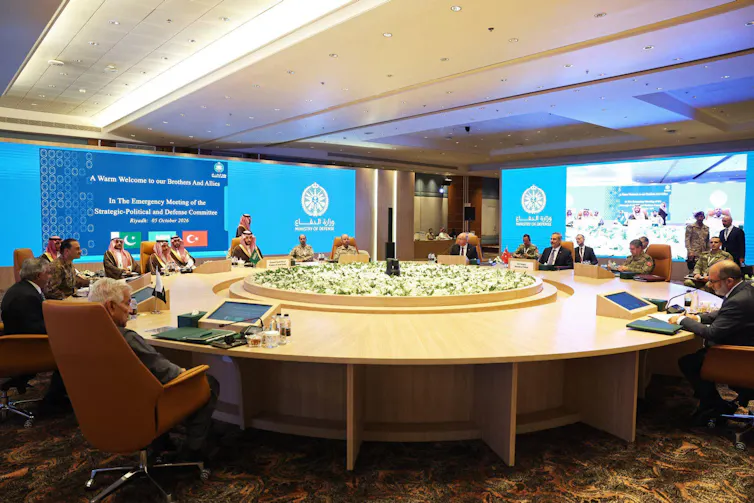
The Strategic Political and Defense Committee of the Mecca alliance met in Riyadh to discuss mutual defence against attacks on Saudi Arabia by Houthi rebels, October 5 2026.Xinhua/Alamy Live News
Turkey’s Nato membership is also worth examining: the alliance’s Article 6 confines the collective defence guarantee to the North Atlantic area. This means a Turkish soldier hit by a Houthi missile in Riyadh would fall under the Mecca pact, not Nato. Ankara now sits inside two collective defence treaties that do not overlap.
The al-Mandab Strait and the Red Sea
The Mecca pact will not, by itself, guarantee the reopening of the Bab al-Mandab, through which about 12% of global trade passes in normal times. This will depend on Yemeni ground forces and Saudi air power.
What the pact does is subtler. By putting Pakistani and Turkish air defenders around Saudi cities and oil installations, it frees Saudi aircraft and crews to fight over Yemen. Riyadh is assembling a ring of defensive partners so it can concentrate on the offensive.
But the danger is mission creep. Yemeni government forces now speak of marching on the capital, Sanaa – under Houthi occupation since 2014 – rather than simply recovering the coast. If so, a short campaign to restore the strait could become another open-ended war. Pakistan has signalled where its line falls – and foreign minister, Ishaq Dar, has stressed that the pact is defensive in nature. Reports that Pakistan flew four planeloads of weapons to Aden show how thin that line can become, and it is the one Islamabad must hold most firmly.
The bigger picture
For Washington, the Mecca pact has become a convenience. US president, Donald Trump, refused the crown prince’s requests for strikes on the Houthis in September after the group promised to spare American shipping. His secretary of state, Marco Rubio, now says the US will live by its defence agreement with Riyadh – which former Pentagon officials expect to mean assistance with intelligence and surveillance rather than combat.
Pakistan will also be sounding out where Iran sits. One Tehran analyst put the distinction plainly: a deployment limited to protecting Saudi installations can be tolerated – offensive operations against the Houthis cannot. That is exactly where Islamabad has placed itself, which keeps alive its role as a channel between Washington and Tehran. The pact is also defending a sea lane that matters more to Asian and Chinese trade than it does to American trade; a point not lost on Beijing, Pakistan’s closest strategic partner.
One more signal deserves notice. When the US stood aside in September, Israel reportedly offered to intervene on Saudi Arabia’s behalf. Riyadh’s public answer was to invoke a pact with its Muslim partners in the name of the holy cities, which says something about where it now believes its security must come from.
The real test is whether the pact can keep its forces on the right side of the Yemeni border if the war drags on, or if a Pakistani or Turkish soldier is killed on Saudi soil.
Body of Russian Plague Scientist in ‘Metal Coffin Drowned in Bleach’
The unexplained death of a 28-year-old Russian researcher who worked at an anti-plague laboratory has taken another mysterious turn as questions grow over when — and under what conditions — her funeral will be held.
Daria Shipilova, an employee of the Irkutsk Anti-Plague Research Institute in Siberia, died on October 2 after developing a severe respiratory illness.
Russian authorities have not confirmed that plague killed her, instead describing her illness as pneumonia of unknown origin. But the unusually aggressive public-health response surrounding her death has fueled questions about whether officials suspected pneumonic plague even if laboratory confirmation has not been announced.
Shipilova’s body has also become a focus of attention because special precautions may be required if authorities are treating her as a suspected plague victim.
Reports citing Russian sanitary rules say the remains of a person suspected of dying from plague can be subject to stringent handling procedures designed to prevent exposure to bodily fluids. Those precautions may include disinfectant-treated material, protective equipment for workers and placement of the body in a tightly secured coffin.
Some Russian protocols reportedly allow for a metal coffin or a sealed wooden coffin lined with impermeable material in certain circumstances.
There is no confirmed evidence, however, that Shipilova’s body has undergone those specific procedures.
International guidance also recommends substantial precautions when handling the remains of a person infected with plague because the bacteria that cause the disease, Yersinia pestis, may remain present after death.
The unanswered questions surrounding Shipilova’s funeral have only added to the uncertainty.
Her mother, Dr. Svetlana Shipilova, said in an interview that the family had not been given a funeral date while relatives remained under quarantine.
“Who is going to bury her if we are sitting here imprisoned?” she said.
Russian officials have not publicly announced detailed funeral arrangements or explained whether the continuing investigation into Shipilova’s death has affected the burial.
The case has attracted international attention because Shipilova worked at an institute specifically tasked with studying plague and other dangerous infectious diseases.
Rumors initially circulated that she may have been exposed to plague bacteria during a laboratory accident. Russian health authorities have disputed claims of a workplace accident and maintain that no confirmed plague cases have been recorded in Irkutsk.
Russia told the World Health Organization that Shipilova’s illness initially resembled an ordinary acute respiratory viral infection before becoming more serious.
Authorities also said people who came into contact with her had been identified, monitored and tested, with no dangerous infectious pathogens detected among those contacts.
But the precise cause of Shipilova’s death remains unresolved publicly.
WHO officials have said they continue to seek information from Russia as laboratory testing and the investigation continue.
The uncertainty has been magnified by the scale of the precautions taken after Shipilova became ill.
People who had been in contact with her were placed under medical observation, parts of medical facilities were subjected to quarantine restrictions and Russia’s top public-health official, Anna Popova, traveled to the region.
The response immediately caught the attention of Russian-born epidemiologist Mikhail Favorov, who has publicly argued that the circumstances strongly suggest authorities were dealing with a suspected plague case.
Favorov pointed in particular to Popova’s trip to Irkutsk and the quarantine measures imposed around the case.
His conclusion, however, remains an expert interpretation rather than an officially confirmed diagnosis.
Conflicting statements from regional officials have further fueled speculation.
Officials in Irkutsk and neighboring Buryatia publicly disputed reports about whether Shipilova had recently traveled to Buryatia and could have been exposed there.
Favorov argued that the disagreement itself was revealing because it suggested officials were urgently trying to determine where a potentially dangerous infection might have originated.
Russian authorities have pushed back strongly against speculation about a plague outbreak.
The Kremlin has accused some media outlets of circulating false information and urged the public to rely on statements from the country’s health watchdog, Rospotrebnadzor.
Moscow has repeatedly insisted that there is no confirmed plague outbreak in Irkutsk.
That distinction is important.
Pneumonic plague is one of the most dangerous forms of infection caused by Yersinia pestis because it affects the lungs and can spread between people through close exposure to respiratory droplets.
Yet plague is no longer the virtually untreatable disease associated with the medieval Black Death. Modern antibiotics can successfully treat infections when they are recognized and treated quickly.
The disease also still exists naturally in animal populations in several parts of the world, including areas of Asia and the western United States.
The World Health Organization has said the broader public-health risk from the situation in Russia appears low based on the information currently available.
What remains unanswered is exactly what killed Shipilova.
Favorov has argued that an inability to isolate Yersinia pestis in laboratory testing would not necessarily prove that plague was absent, particularly in an extremely severe case or after treatment had already begun.
Russian officials, meanwhile, have offered no confirmation that the young researcher contracted the bacterium she worked around professionally.
Health authorities in neighboring Mongolia have also sought information about the case and increased surveillance precautions despite being told that no suspected plague case had been confirmed.
For now, the extraordinary precautions, quarantine measures and continuing uncertainty surrounding Shipilova’s funeral are likely to keep questions alive.
Until investigators disclose a definitive cause of death, however, claims that she died from plague — or that her body was subjected to any particular plague-burial procedure — remain unconfirmed.
Ken Paxton’s Security for Travel Cost Taxpayers Millions. Just 1 in 6 of His Trips Had a Stated Business Purpose.
In the summer of 2023, after he was impeached on charges of abusing his office for personal gain, Texas Attorney General Ken Paxton was suspended and barred from conducting any official business for more than three months while awaiting trial in the state Senate.
So, he traveled.
Paxton, a Republican who is now running for U.S. Senate, took at least 17 trips over three months, including to resort destinations Park City, Utah, and Vail, Colorado. He visited the Oklahoma town where he owns a vacation lodge and a Utah community with a golf resort, where he later bought four condominiums.
State police joined him each time, costing taxpayers tens of thousands of dollars for trips unrelated to his job as attorney general. The Texas Senate ultimately acquitted him on the impeachment charges.
But Paxton’s use of the taxpayer-funded detail did not begin or end there. In fact, it stands out compared with his predecessor, fellow elected officials in Texas and other state attorneys general, ProPublica and The Texas Tribune found.
Paxton has traveled frequently out of state while listing little on his official calendar, The Associated Press reported last week. ProPublica and the Tribune’s analysis, which included reviewing every publicly available document Paxton’s office says it possesses about his travel, discloses for the first time how few of his trips had a listed business purpose: just 1 in 6.
It also found Paxton’s security has cost taxpayers far more than has previously been reported.
Since assuming office in 2015, Paxton has taken nearly 1,000 trips with a state-funded security detail, costing $3.3 million. The newsrooms’ review of Paxton’s travel records, obtained through the state’s Public Information Act, could only connect 138 of those trips and $553,000 in security costs to state business.
Records detailing the purpose of Paxton’s visits to 36 states and 19 countries do not appear to exist in most cases. These include a trip to a small town in Hawaii months before his family’s blind trust bought land there; 24 trips to Utah, where the trust owns five properties; and 53 trips to Florida, where Paxton and the trust have two houses and a townhome.
“If you’ve got all these extra trips, it becomes ethically and morally problematic,” said Chris Toth, former executive director of the National Association of Attorneys General, who has also criticized Paxton’s conduct on other issues. “The ethical question is whether a legitimate security function has effectively become a taxpayer-funded subsidy.”
Texas law allows the Department of Public Safety to provide security for key state leaders, including the attorney general, but does not require officials to use it. In fact, Paxton himself hasn’t used it in at least two dozen cases while traveling on official business.
Paxton has dismissed opponents’ attacks that he has used the perks of office to benefit himself and has not answered questions about how he vastly increased his wealth as a public servant.
He also did not answer detailed questions for this story. ProPublica and the Tribune sent Paxton a spreadsheet detailing travel for which there was no record that he was on state business and asked him to provide additional information if the trips were not personal. Neither Paxton nor his office provided such records. Instead, his office provided a general statement.
“Throughout his career, Ken Paxton has faced numerous security threats stemming from his courageous work as Attorney General fighting on behalf of the people of Texas,” his office said in the statement. “Those threats are a direct result of him taking on the cartels terrorizing Texans and some of the nation’s most dangerous violent criminals.”
Paxton’s office directed additional questions to DPS.
A DPS spokesperson declined to answer the newsrooms’ questions, saying the agency does not comment on its security arrangements.
Logs from the Texas Department of Public Safety security detail assigned to Attorney General Ken Paxton show multiple out-of-state trips while he was suspended from office in 2023.Obtained and highlighted by ProPublica and The Texas Tribune
An Outlier Among Peers
To analyze Paxton’s travel, ProPublica and the Tribune reviewed DPS logs for his security detail and records from the attorney general’s office, including airfare and lodging receipts, per diems and his daily calendars.
The records available for his predecessor, Greg Abbott, show a stark difference: Abbott traveled mostly within the state as attorney general, and his security cost $203,000 during his last three years in the office. Adjusted for inflation, Abbott’s security detail cost $7,400 per month. Paxton’s has averaged $24,300.
Because the state keeps records only for a limited time, Abbott’s travel expenses and his daily calendars as attorney general no longer exist, so the news organizations could not determine how many of his trips were for business.
Records are available, however, for Abbott’s security costs as governor and for Lt. Gov. Dan Patrick. Both are also offered state police security and have been in their current roles as long as Paxton.
When compared, the records show Paxton has taken 82 more out-of-state trips with a security detail than Abbott and nearly as many as the governor and lieutenant governor combined.
Though DPS security detail records are available for state leaders’ full tenure, Abbott’s office only provided calendars that document business-related activity for his first six years in office. More than two-thirds of the governor’s international trips during those years had a listed business purpose, compared with just two of 25 for Paxton during his full tenure. The governor’s office said it planned to release the remaining five years on Tuesday but only provided five months, saying it needed more time.
The attorney general’s records do not show a business purpose for travel to Albania, Aruba, Australia, Costa Rica, the Czech Republic, the Dominican Republic, England, Estonia, Finland, Greece, Hungary, Italy, Malta, Mexico, Poland, South Africa or Taiwan.
The share of Paxton’s travel with a documented business purpose peaked early in his tenure, in 2018 and 2019, at 30%, the newsrooms’ analysis found. That aligns with the governor’s share of business travel during that period.
Since then, Paxton has taken fewer trips that are documented as state business while increasingly traveling out of state. Last year, just five of Paxton’s 91 trips with the security detail had a listed business purpose. Forty-one were outside Texas.
In some cases, Paxton has taken business trips without a DPS detail, an analysis of records from the department and the attorney general’s office shows. They include a 2019 meeting in Nashville, Tennessee, with that state’s attorney general to discuss opioid litigation and a 2021 visit with unnamed U.S. senators in North Carolina. There is also no record of Paxton taking the detail on political fundraising trips to Florida and the Bahamas.
But Paxton has traveled with security to other campaign-related activities, including one that came just two days after he was acquitted in the impeachment trial. Paxton boarded a Maine-bound private plane owned by a North Texas businessman to tape an episode of Tucker Carlson’s show, according to campaign finance records. During the interview, he hinted that he’d challenge U.S. Sen. John Cornyn in the 2026 Republican primary.
“Everything is on the table for me,” Paxton said when Carlson suggested he should run.
In his interview with Carlson, Paxton said it was unfair that he was automatically suspended before he could clear his name. He said he was eager to get back to work and that he was “reenergized to do the things the voters sent me to do.”
Paxton should pay for his own security on trips where there is no benefit for Texans, like vacations and campaign events, said Richard Briffault, a professor at Columbia Law School who has written about government ethics.
“There’s no reason for the taxpayers to be paying for things that they would not be paying for if he had stayed home,” Briffault said. “That’s a misuse of public funds.”
State officials said there are no records of Paxton or his campaign reimbursing Texas for security costs.
Of the 10 most populous states, Texas and New York confirmed that they provide security for their attorneys general, while Florida law allows its top lawyer to receive a detail upon request. North Carolina does not. Attorneys general offices for the remaining six states did not respond to requests for comment.
Former Oregon Attorney General Ellen Rosenblum said she never used a security detail during her 12 years in office, which ended in 2024. The Democrat said that Paxton’s higher profile might create a greater need for protection, but his extensive out-of-state travel without a documented business purpose raises questions about his workload.
“Was he minding the store? There’s a lot of work to be done at the office,” Rosenblum said.
Travel and Real Estate
Some of Paxton’s travel to four states with a security detail has overlapped with locations where he or his family’s trust has purchased 10 properties since 2021. A recent ProPublica and Tribune analysis found he owns or co-owns 15 properties with a market value of about $11 million.
In June 2021, Paxton attended an attorneys general conference in Maui. The security detail listed the destination as Lahaina, a small community on the Hawaiian island’s west coast. Four months later, Paxton’s family trust purchased an oceanview lot in a residential neighborhood there for $410,000, land records show.
The 7,000-square-foot lot remains vacant but has proved to be a savvy investment, now assessed at $1.2 million by Maui County.
Paxton set up the trust with his estranged wife, State Sen. Angela Paxton, who declined to be interviewed but said through a spokesperson that she has not been involved in her husband’s business dealings since 2024, when she filed for divorce. The Paxtons’ friend, Chip Loper, runs the trust. He did not respond to requests for comment.
Paxton has also gone to the Salt Lake City area 19 times, twice for listed business purposes. He visited three times — once on business — in the months leading up to his family trust’s July 2021 purchase of a plot in the ski town of Eden. The trust bought a mountainside lot on about two-thirds of an acre for $315,000 in cash, the seller told the newsrooms. It also remains undeveloped.
During his suspension in August 2023, Paxton visited St. George, Utah, a small city in the state’s southwest corner. Nearby is the Black Desert Resort, which hosts an annual PGA Tour golf tournament. Paxton purchased one condo at the resort in 2025 and three more in February. Paxton took out mortgages totaling $1.9 million for them, according to legal documents filed with the local county.
Paxton has visited Florida more than any other state, 53 times. Two of those trips have a documented business purpose. Between 2021 and 2022, Paxton purchased two homes in Ocala, known for its horse breeding industry, and a townhome in Dunedin, on the Gulf of Mexico near Tampa.
Paxton also traveled with the detail twice to Broken Bow, Oklahoma, where he purchased a $1.5 million vacation lodge in 2022. He visited in June 2023, during his suspension. Then again the following December. He traveled to the neighboring town of Idabel in 2023 and 2024. None of the trips had a listed business purpose.
Records that show travel with a security detail do not list the attorney general’s name but rather the position. State officials familiar with the travel records said the two temporary attorneys general appointed during Paxton’s suspension did not take the trips listed on the state police travel logs.
The attorney general’s office has said that Paxton’s work to secure large legal settlements with drugmakers and tech companies requires routine travel. Such travel is noted in calendars reviewed by ProPublica and the Tribune. Even so, more than 800 trips lack a documented business purpose.
Paul Nolette, a Marquette University political science professor who studies attorneys general, said that the role has become more expansive in recent years as states increasingly collaborate on big lawsuits. That could lead to more travel, he said. Nolette added these officials deserve occasional vacations like everyday Americans.
But given repeated accusations from Democrats and Republicans alike about Paxton’s ethics, Nolette said it is difficult to give him the benefit of the doubt that he’s constantly working while leaving the state so frequently.
“It just raises more red flags about how he’s using the office to do things that may not give the best bang for the buck for Texans,” Nolette said.
Paxton has not commented publicly about his use of the taxpayer-funded detail. During a podcast interview in November, Houston lawyer Tony Buzbee, who led his impeachment defense, asked the attorney general where he liked to travel.
“I love Jackson Hole. I like Park City. I like the mountains. I also like beaches,” Paxton responded. “I like places in Florida, places in California, even though I don’t like to admit I go to California. But it’s beautiful to see them.”
Some commentators have argued that the bombings and multiple ceasefires actually strengthen American credibility by demonstrating American deterrence capabilities and resolve toward adversaries.
Others cite the lack of a persuasive justification for conflict, the strikes themselves and subsequent fits and starts of peacemaking as evidence that America’s global image has been undermined, as has the persuasiveness of its public claims. And this, in turn, has undercut the credibility of future pronouncements by the U.S. administration.
Either way, most observers insist that for the United States, “credibility is on the line in Iran.” But that has long been a central concern of U.S. foreign policy. As political scientist Stephen Walt observed in 2022, one of the most predictable aspects of virtually any debate over Washington’s involvement overseas is the “ritual invoking of ‘credibility.’”
But what, exactly, is “American credibility”? And why is there apparently so much groupthink about the concept and practice?
Vietnam and the credibility discourse
For policymakers, diplomats and scholars the technical definition is straightforward: Credibility refers to the perceived likelihood that a country will reliably keeps its promises, carry out its threats and deliver on its pledges. In this manner, a country is credible if allies and adversaries alike will believe it the next time. But as suggested by contemporary debates and usage, credibility, in practice, often means something more than simply keeping up with commitments.
People in downtown Tehran, Iran, walk past a mural depicting a U.S. aircraft carrier under missile attack.AP Photo/Vahid Salemi
Credibility is not only about whether nations successfully signal resolve, but also whether relevant audiences perceive their commitments as credible. In other words, contemplating a nation’s credibility is about assumptions over the “strategic culture” that undergird it – and this can include everything from a country’s military resources to abstract notions about its values.
Historical examples are useful here, in particular the Vietnam War, during which American credibility was at stake in unprecedented ways.
On the surface, Vietnam posed little intrinsic value to the United States – it was not a primary theater of the Cold War by most measures. Yet policymakers repeatedly insisted that Vietnam was the place where American credibility had to be demonstrated and established. Why?
Secretary of State John Foster Dulles warned in 1954 that communist expansion in Asia posed “a grave threat to the whole free community” and insisted that demonstrating resolve would prevent greater dangers later. National security adviser McGeorge Bundy similarly argued that the “international prestige of the United States” was deeply invested in Vietnam.
Credibility, to them, meant more than simply honoring commitments. Rather, it was bound up with broader questions of power, honor and America’s place in the world between competing powers.
Prestige, or the lack thereof
As diplomatic historian Robert McMahon observed decades ago, credibility has often been treated as if it were a concrete and measurable concept. Yet in practice it has always carried an important symbolic dimension – credibility has come to be a shorthand for American prestige itself.
And that variant of American credibility has in particular rested on anxieties about the continued dominance and superiority of the U.S.-led world order.
During one congressional discussion in 1965, U.S. policymakers warned that withdrawing from Vietnam would mean surrendering “all Asia to Communists,” prompting the reflection: “If a nation with 14 million can make Uncle Sam run, what will China think?”
An exchange between President Lyndon Johnson and Undersecretary of State George Ball in 1965 is even more illustrative. President Johnson worried that abandoning Vietnam would make “all these countries say that Uncle Sam was a paper tiger” and wondered whether America would lose the credibility built by three presidents. Ball’s response was, “No sir. The worst blow would be that the mightiest power on earth is unable to defeat a handful of guerrillas.”
The anxiety was not that America might fail to keep up with its word, but that the leader of the “free world” might fail to defeat a non-Western, technologically inferior opponent.
The credibility at stake was both America’s sense of national self and the perceived superiority of a Western-led world order.
Counterintuitively, while the Vietnam War was fought in the eyes of many policymakers to defend U.S. credibility, its conclusion shattered conventional notions of credibility. It called into question the U.S.’s place in the world in an era historians have termed an “Age of Fracture,” characterized by economic challenges such as stagflation, oil shocks and rising distrust in politics, government and institutions.
For many observers within and outside the U.S., images of the helicopters lifting off and fleeing from Saigon – and thereby deserting allies and a purportedly essential cause in the process – signaled a moment of American and Western decline. The phenomenon even led to a widely used term – “Vietnam Syndrome” – referring to the public’s unwillingness thereafter to commit to large-scale foreign interventions and nation-building exercises.
A U.S. helicopter escorts Americans and foreign nationals from the top of a Saigon building in 1975.Bettmann/Getty Images
Credibility up to the present
That image of U.S. decline and impotence is one that has resonated ever since in foreign policy debates.
The perception of the loss of credibility in Vietnam has served as a yardstick for planning, assessing and implementing interventions in other regions. It has been both a way of warning about the dangers of rash interventionism and the consequences of hubris, as well as a rallying cry to avoid repeating past errors. yet maintain credibility through actions in places from the Middle East to Latin America.
The credibility issues central to the U.S. administration’s actions today in Iran – and Ukraine, Venezuela and elsewhere – are thus about the U.S.’s living up to pledges and following through to achieve objectives. As with Vietnam, they also concern clustering around nebulous concepts. of and aims about not looking weak militarily or diplomatically.
But the Iran example – and particularly the ongoing episodic closures of the Strait of Hormuz – is one of the best illustrations today of how merely invoking credibility to act is not the same as having an overall endgame strategy.
While some commentators view this currently as a sign of a lack of resolve, or credibility, if we turn to Iranian actions and to the words of Iran’s acting Defense Minister Majid Ebn-e-Reza we find something else. Namely, Tehran views all threats from the United States as “real and credible” and “as a reason to bolster its defense.”
The U.S. and Iran agree on one thing in terms of credibility: America can credibly be relied on to carry out overwhelming violence.
But the problem, as it was in the Vietnam War, is that credibly engaging in war and violence is not a substitute for strategy. Credibility is affected deeply by strategic cultural assessments about superiority and inferiority, and notions about when, where, how and for whom the credibility matters.
Moreover, merely establishing credibility to act cannot necessarily overwhelm a resolute adversary, as has been borne out in Iran. In fact, it can also perpetuate never-ending conflict that serves to undermine the very prestige and world power that it was supposed to enhance.
‘Grotesque’ Journalism: Accuracy of NYT Report on Huckabee Top Aide Challenged
US Ambassador Mike Huckabee and Middle East analyst Eitan Fischberger challenged a New York Times investigation into Huckabee’s top aide, David Milstein, accusing the newspaper of relying on anonymous sources and misrepresenting legitimate oversight of embassy reporting as misconduct.
The investigation by Natan Odenheimer and Adam Rasgon, published on Thursday, alleged that Milstein suppressed, delayed or extensively rewrote internal US Embassy reports concerning Israeli actions to portray the Netanyahu government more favorably and shield it from criticism in Washington.
Among its allegations, the Times said Milstein restricted reporting that suggested Israel had failed to address settler violence and blocked a detailed report sought by members of Congress concerning the killings of Palestinian Americans. It also reported that Milstein required approval of communications from the embassy section responsible for Palestinian affairs, after which the number of cables sent to Washington fell sharply.
The newspaper said its reporting included interviews with 15 US officials who had worked with Milstein and nine former diplomats, all of whom spoke anonymously for fear of reprisal. It also said it obtained or reviewed dozens of documents, cables, memos and other internal communications.
Huckabee rejected the allegations on X, accusing the Times of using “ANONYMOUS!” sources who don’t even exist.” He added, “Milstein fights for @realDonaldTrump agenda & USA. Sleazy reporters at the Slimes should dream of having the integrity Milstein does!”
Huckabee also thanked Fischberger and reposted his rebuttal. Fischberger called the article against Milstein “one of the most grotesque things I’ve witnessed in journalism,” arguing that it portrayed ordinary diplomatic oversight as wrongdoing.
Fischberger noted that the Times itself described Milstein’s responsibilities as “reviewing and amending information sent to Washington” and acknowledged that previous US ambassadors to Israel had political advisers who influenced diplomatic reporting.
“Reviewing diplomatic cables is a completely normal, standard function,” Fischberger wrote. He also cited the newspaper’s acknowledgment that “it is not clear whether Mr. Milstein’s interventions have affected White House policy.”
“Disagreeing with career diplomats isn’t corruption. Exercising authority delegated by an ambassador isn’t misconduct,” Fischberger wrote, adding that any evidence of wrongdoing should be presented publicly so readers can judge it.