16.5 C
London
Wednesday, October 14, 2026
Home Blog

IMF warns of debt-fueled AI spending as bubble fears grow

0
imf-warns-of-debt-fueled-ai-spending-as-bubble-fears-grow
IMF warns of debt-fueled AI spending as bubble fears grow

The AI boom relies on massive spending on data centers. Image: X Screengrab

The International Monetary Fund warned Tuesday that the global economy faces serious risks from Big Tech firms taking on massive debt to fund the buildout of artificial intelligence data centers worldwide.

The IMF’s latest Global Financial Stability Report outlines a number of risks to economic growth in the coming years, including a reliance on AI industry spending that it warns could lead to a new financial crisis.

The report points to the methods the world’s largest data center operators, known as hyperscalers, are using to fund new construction as particularly troubling.

“Hyperscalers have strong earnings from their core businesses,” the report states. “Yet, free cash flows are rapidly declining as hyperscalers try to sustain large AI investment needs, leaving debt financing increasingly necessary.”

The analysis also details the role played by so-called circular financing agreements, in which one company agrees to fund another company’s AI project in exchange for the firm receiving the money buying the investing firm’s products.

These arrangements could create dangerous interdependence within the industry that could spark a financial contagion if one of the firms goes belly up, according to the report.

“While investors… are generally financially sound, distress at key investee firms could present significant ‘wrong-way risk’ to the AI ecosystem,” the report states. “Equity and debt investments in the firms depreciate in value precisely when future revenue streams tied to them are impaired.”

Investment expert Bret Jensen, in an analysis published by Seeking Alpha on Tuesday, examined projected capital expenditures from the five biggest hyperscalers—Oracle, Microsoft, Facebook parent company Meta, Amazon, and Google parent company Alphabet—and highlighted how they have increasingly moved financing off their corporate balance sheets.

“Over the past 12-18 months, there has been a huge increase in debt and equity issuance,” Jensen explained. “The five hyperscalers now have a combined over $1.3 trillion of debt on their balance sheets and roughly US$3 trillion in off-balance-sheet allocations.”

Because of this, Jensen continued, “debt markets are starting to groan” by “signaling a substantial chance of default over the next half-decade on the debt of Oracle.”

Jensen also pointed out that half of this infrastructure was being built for the benefit of frontier AI labs OpenAI and Anthropic, which he described as “unprofitable” and “bleeding cash.”

Dean Baker, co-founder of the Center for Economic and Policy Research argued in an analysis published on Friday that AI is completely propping up the US economy at the moment, as investors are holding out hope that it delivers an unprecedented boom in productivity.

The problem, Baker pointed out, is there is little sign that AI is going to deliver anywhere near the increased productivity needed to make these historic investments pay off.

“If we believe the hype, we are about to see an incredible surge in productivity that will make us ridiculously wealthy,” Baker explained. “To date, there is no evidence to support this view. Productivity growth has been at best on its trend pace the last couple of years.”

“If we don’t see the massive gains in productivity promised by the AI enthusiasts,” Baker added, “then we will almost certainly see a collapse in the stock market, with a serious recession almost guaranteed.”

–Common Dreams

Spain’s king reasserts sovereignty over Ceuta, Melilla as Morocco remains silent

0
spain’s-king-reasserts-sovereignty-over-ceuta,-melilla-as-morocco-remains-silent
Spain’s king reasserts sovereignty over Ceuta, Melilla as Morocco remains silent

Spain’s King Felipe VI said on Tuesday that Ceuta and Melilla in North Africa were “an integral part” of Spain and that its sovereignty and territorial integrity “are not up for negotiation”, during a historic visit to the two cities claimed by Morocco.

The Spanish monarch also stressed the importance of maintaining good neighbourly relations with Morocco, amid tensions between the two countries following a large influx of migrants into Ceuta last July.

The visit marks the first time a Spanish king has travelled to the two cities since Felipe VI’s father, Juan Carlos, visited them in 2007, triggering a diplomatic crisis with Rabat.

Speaking during his visit to Ceuta alongside his wife, Queen Letizia, Felipe VI said the two cities were part of Spain’s political and national identity. He added that Spain and the European Union had a responsibility to maintain good neighbourly relations with Morocco.

The visit comes less than seven weeks before early elections scheduled for 29th November, with immigration expected to feature prominently in the campaign following the crisis in Ceuta in July.

READ: Moroccan migrant risks life hiding under Real Valladolid team bus to reach Spain

Iran Expands Shipping Attacks as Houthi Missiles Hit Saudi Arabia and US Weighs Renewed Strikes

0
iran-expands-shipping-attacks-as-houthi-missiles-hit-saudi-arabia-and-us-weighs-renewed-strikes
Iran Expands Shipping Attacks as Houthi Missiles Hit Saudi Arabia and US Weighs Renewed Strikes


Iran is intensifying attacks on commercial shipping in the Strait of Hormuz to keep oil prices high and pressure Washington ahead of November’s US elections, Iranian officials told Reuters on Wednesday, as Houthi missile strikes damaged a Saudi Aramco building and injured four people in Riyadh. The escalation comes as President Donald Trump and Israeli Prime Minister Benjamin Netanyahu consider possible renewed military action against Tehran.

Two senior Iranian officials told Reuters that Tehran changed its maritime tactics approximately 10 days ago, increasing attacks on vessels it considers in violation of its restrictions. Operations have expanded beyond Hormuz into the Gulf of Oman and waters near Qatar and the United Arab Emirates.

A US military official said Iran’s Islamic Revolutionary Guard Corps was using observers in small boats to identify targets after American strikes damaged Iranian radar systems. Maritime security reports recorded at least five incidents involving commercial vessels over 48 hours.

Before the war began on February 28, approximately one-fifth of global oil and liquefied natural gas trade passed through Hormuz. Disruptions have since driven up energy and shipping costs.

Meanwhile, Saudi Arabia reported that an attack Tuesday evening struck an administrative building at Saudi Aramco’s headquarters complex in Dhahran, starting a limited fire. A company source told Reuters that a ballistic missile damaged the upper three floors of an office tower. Saudi authorities reported no casualties at the site.

In Riyadh, falling debris from two intercepted Houthi cruise missiles injured two women, a man, and a child, according to Saudi Civil Defense. Fifteen homes sustained minor damage.

The attacks followed Saudi-led coalition airstrikes against Houthi-controlled fuel facilities in Yemen. Coalition officials said the installations supported Houthi military operations, an allegation Houthi authorities disputed. The confrontation has intensified following a deadly attack on Riyadh’s international airport that killed 13 people.

In Jordan, mourners gathered Monday for the funeral of Mahmoud Hussein Birkawi, a 33-year-old Jordanian father of two killed in Saturday’s attack on King Khalid International Airport in Riyadh. Birkawi, who had worked in Saudi Arabia for nearly two years, was buried at Sahab Cemetery near Amman after his body was returned to Jordan by road. Royal Hashemite Court Chief Yousef al-Issawi attended the funeral and conveyed condolences from King Abdullah II and Crown Prince Hussein.

The regional escalation coincides with conflicting reports about possible renewed US-Israeli strikes on Iran.

Israel’s Channel 12 reported Tuesday that Netanyahu had urged President Trump to authorize another military operation before Israel’s October 27 election and the November 3 US midterms, citing concerns about Iran’s nuclear activities.

Netanyahu’s office denied that he was pressing for a preelection attack. President Trump has publicly ruled out renewed American strikes before the midterms, although US and Israeli forces reportedly remain prepared for further operations.

The Israeli military reportedly believes Iran is rebuilding its missile capabilities, although the recovery remains incomplete.

With Tehran threatening tighter restrictions on Hormuz and the Houthis striking Saudi targets, the potential for further regional escalation remains substantial. The US Navy-led Joint Maritime Information Center has classified the threat to commercial shipping in Hormuz as severe, its second-highest warning level.

Google wants to host your personal vibe-coded apps in the Play Store

0
google-wants-to-host-your-personal-vibe-coded-apps-in-the-play-store
Google wants to host your personal vibe-coded apps in the Play Store

Google has already added a few AI features to the Play Store, but a lot more are coming. The previously released Ask Play feature is expanding to offer more AI-powered discovery options in Google’s app store, and Google is also using AI to build a recommendation engine called Game Finder. For people who have embraced AI to build their own apps, the Play Store will soon offer a way to privately host and share those creations.

Google rolled out Ask Play in 2025 as a small chatbot interface on Play Store listings. It lets you ask questions about an app or game, either by typing it in manually or choosing from a list of suggested queries. Starting today, Ask Play is expanding into a more general way to search for apps and games. You ask the robot questions, and it generates recommendations that can include detailed comparison charts. Gemini will roll out a similar capability soon.

Google’s other AI discovery announcement focuses on games. The new Game Finder feature leans on all the usage data Google’s app platform has hoovered up over the years, featuring insights into the way 1.2 billion people play games on Android. It builds a profile called Gamer DNA and matches you with players who have similar DNA.

Game Finder in Google Play.

You can tune your DNA profile by rating the games you’ve played, which supposedly leads to more accurate recommendations. There will be game playlists to peruse, along with various contextual lists like relaxing, trending titles, and more specific lists based on mechanics you’ve seen in previous games. Game Finder also lets you add or remove tags to further adjust the games Google’s AI suggests. Google says you’ll eventually be able to prompt Game Finder with fairly specific game preferences, but it’s unclear how much customization will be available at launch. Game Finder and Gamer DNA are rolling out in the US today, with other markets following “soon.”

There’s a vibe for that

Despite its slow progress in coding-focused AI models lately, Google is continuing to push this as a core feature of its products. Anyone who has been tinkering with vibe-coded apps in AI Studio will soon have a direct pipe into the Play Store. This is not the same as publishing an app as a developer, but that could be the end result.

There won’t be any tedious downloading of APK files or tinkering with a developer console—you’ll be able to send apps to the Play Store right from AI Studio. Adding a vibe coded app to the Play Store creates a “Personal Library” accessible from the app store client on your device. This is available only to you by default, providing an easy way to install and manage the apps via Google’s system.

Google will let you keep your vibe coded AI Studio projects in a private Play Store repository.

Google will let you keep your vibe coded AI Studio projects in a private Play Store repository. Credit: Google

Google says you can share these apps with “a small group” of friends and family. Google has not decided how many people count as a small group yet, but this type of distribution doesn’t require a developer account. If you want to share beyond that, Google plans to have an onboarding process to set you up with a developer profile to publish your vibe coded apps. If you do this, you’ll be subject to the same app review guidelines as developers who come into Google Play in the traditional way. Private apps are not reviewed by Google.

Private vibe-coded apps in the Play Store will begin rolling out today in the US and select other markets. The private-to-public app migration option will be available in the coming months.

The slow boiling of Indonesian democracy

0
the-slow-boiling-of-indonesian-democracy
The slow boiling of Indonesian democracy

The most consequential changes in a democracy do not always arrive with a constitutional crisis. Rather, they come through appointments, legal amendments and seemingly ordinary political bargains, accumulating one after another until the political system begins to look different from the one that came before.

That is the real value of the “boiling frog” metaphor. It is not a scientific theory, but a political image for gradual adaptation. When change comes suddenly, resistance can be immediate. When the temperature rises slowly, however, every increase can appear tolerable. The danger lies not in one dramatic decision, but in the cumulative effect of many decisions that gradually become the new normal.

Indonesia’s political temperature arguably began rising during President Joko Widodo’s second term, well before Prabowo Subianto became president.

The 2019 weakening of the Corruption Eradication Commission (KPK), the expanding concentration of political power, the erosion of legislative and judicial checks, and, eventually, the constitutional maneuver that enabled Jokowi’s son, Gibran Rakabuming Raka, to run for vice president became milestones in what scholars and observers describe as democratic decline.

International IDEA now records declines in Indonesia in credible elections, parliamentary effectiveness, freedom of expression, access to justice and judicial independence. V-Dem places Indonesia at its lowest democratic level since the beginning of the 21st century.

Prabowo did not initially stand outside this transformation. He entered Widodo’s government in October 2019, only months after losing the presidential election to him, becoming defense minister. The former electoral rival was thus incorporated into the very political system whose institutional balance had already begun to change.

Boiling anti-democratic waters

The 2019 revision of the law governing the KPK was among the clearest early signs that the democratic temperature was changing. Parliament approved changes that placed the once relatively independent anti-corruption agency under an external supervisory body, restricted its wiretapping powers and required its investigators to become civil servants.

Critics warned that the changes would weaken one of the country’s most important checks on political corruption. Nationwide protests followed, and then-President Widodo ultimately allowed the revised law to stand.

The 2020 Omnibus Law on Job Creation was passed amid mass protests and criticism over the limited scope of public consultation. Human Rights Watch later documented broader concerns over the erosion of civil and political rights during the Widodo years, while academic research has described the period as one of executive aggrandizement, meaning the gradual dismantling of mechanisms designed to constrain executive authority.

At the same time, Widodo’s government increasingly relied on a broad governing coalition. International IDEA notes that Indonesia’s coalition presidentialism can produce a political “cartel” in which large numbers of parties enter government, leaving little effective opposition and weakening scrutiny of executive action. By the end of Widodo’s presidency, this dynamic had become particularly pronounced.

The culmination came in 2023. The Constitutional Court created an exception to the minimum age requirement, allowing 36-year-old Gibran to run for vice president alongside Prabowo. Anwar Usman, Widodo’s brother-in-law and Gibran’s uncle, then headed the court.

An ethics panel subsequently found Usman guilty of an ethical violation and removed him from the chief justice position. However, the ruling itself remained in force. The frog, in other words, had not suddenly been thrown into boiling water. The water had been warming for years.

Prabowo ups the temperature

Prabowo’s rise, then, cannot be understood as a complete break with the political order that preceded him. He was, in fact, one of its beneficiaries and participants.

His 2019 appointment as defense minister transformed a bitter electoral rivalry into a governing partnership and brought one of the country’s most important poles of opposition from outside the government inside.

The logic grew clearer in the 2024 election. Prabowo ran with Gibran, whose eligibility the contested court ruling had secured, and the pairing joined two political trajectories that had once been separate: Prabowo’s long-held presidential ambitions and Mr. Joko’s growing dynastic influence.

This is where the idea of political absorption is more useful than the simpler language of repression. Opposition does not always have to be banned. Sometimes it can be incorporated.

That distinction matters because Indonesia remains a functioning electoral democracy. Parties compete, elections are held, journalists and civil society groups continue to criticize the government, and political disputes remain visible.

Freedom House still classifies Indonesia as “Partly Free,” rather than an authoritarian state. Yet it also records concerns about weakened opposition, dynastic politics and declining institutional checks.

Prabowo’s seventh Cabinet reshuffle on October 1, 2026, and the formation of a new Presidential Advisory Council the following day, provide the latest illustration. The reshuffle changed several senior positions, including the foreign minister and national police chief.

One day later, Prabowo appointed 26 members to the Presidential Advisory Council, bringing together politicians, former ministers, business figures, religious leaders, security officials and intellectuals, including Rocky Gerung and former Constitutional Court chief justice Anwar Usman.

None of these appointments, taken individually, proves democratic erosion. The more important question is cumulative: what happens when an increasing share of political, economic, religious and intellectual capital is located inside the presidential orbit?

When outsiders become insiders

Rocky Gerung and Syahganda Nainggolan offer two particularly revealing examples, although they represent very different political trajectories. Rocky, one of Indonesia’s most prominent public intellectuals and critics, now sits on the Presidential Advisory Council.

His appointment does not mean that he has abandoned his critical views. Indeed, he has said that he intends to remain critical. Yet the institutional location of criticism has changed: a voice that once operated primarily outside presidential power now has direct access to its advisory machinery.

Syahganda’s trajectory is even more striking. During the 2024 presidential campaign, he was listed as a spokesman for the Anies-Muhaimin national campaign team. He later moved closer to Prabowo’s administration and, on October 2, 2026, was appointed head of the Government Communications Agency (Bakom).

The point is not that Syahganda was “neutralized” or that Rocky has been transformed into a government loyalist. What the appointments show is structural: people who once occupied political space outside the presidential establishment can be incorporated into the institutions through which presidential power is exercised.

That is a different mechanism from repression. It is elite incorporation, and once enough potential counterweights are incorporated, the question changes from whether opposition exists to whether enough independent political capacity remains outside the executive orbit for opposition to be effective.

The comfort of populism

Significantly, the political reconfiguration is occurring alongside an expansive populist policy agenda. That matters because institutional consolidation does not necessarily require an unpopular government.

Prabowo’s Free Nutritious Meals program, free health screening and plans to widen access to higher education are designed to produce tangible benefits. Whatever their political implications, these programs address real material concerns and can generate genuine public support. They thus should not be dismissed as propaganda or mere distractions.

But popular redistribution and political centralization can coexist. Indeed, this may be one of the most important features of Indonesia’s current trajectory.

While political attention is fixed on the cost, implementation and benefits of MBG, free education and other welfare initiatives, the architecture of power can continue changing elsewhere. Public debate remains focused on what government delivers, while scrutiny of how government power itself is being reorganized is largely muted.

That’s creating so-called political insulation. Material benefits can strengthen legitimacy even as institutional counterweights become less autonomous.

The argument, then, is not that Prabowo has abolished Indonesian democracy, but rather that is undergoing a gradual transformation in which formal institutions survive while the distribution of effective political power changes around them.

The process began under Widodo, particularly during his second term, and has taken on a new configuration under Prabowo, with former outsiders, ex-critics, and influential elites increasingly represented in the executive office.

The frog, therefore, is not being boiled by one president alone. The water was already warm when Prabowo entered the kitchen.

The real question is what happens when the temperature keeps rising? Indonesia’s democracy is still alive, but democracy is more than elections. It also depends on independent institutions, meaningful opposition and the ability of actors outside executive power to impose limits on those who govern.

The danger is not that Indonesians wake up one day to discover that their democracy has disappeared. The subtler danger is that democracy remains formally intact while, degree by degree, fewer institutions retain the power to cool the water.

Ronny P Sasmita is senior international affairs analyst at Indonesia Strategic and Economic Action Institution, a Jakarta-based think tank. he holds a PhD from the University of Tokyo.

Disneyland Visitors Furious Over ‘Screaming Preachers’

0
disneyland-visitors-furious-over-‘screaming-preachers’
Disneyland Visitors Furious Over ‘Screaming Preachers’


Families heading to Disneyland are sounding the alarm over what they describe as an increasingly frustrating problem outside the California theme park, where loud street preachers, persistent vendors and political campaigners are reportedly turning the walk to the entrance into an unpleasant experience.

Visitors say the commotion near the Anaheim resort has become difficult to ignore, with some complaining that amplified religious sermons and aggressive sales pitches are ruining the excitement before they even step through the gates.

The growing frustration has sparked heated discussions online, with guests questioning why more isn’t being done to control the activity around one of America’s most famous tourist attractions.

According to Disney travel website Mickey Visit, complaints have centered on public sidewalks near the resort’s Harbor Boulevard entrance, where visitors frequently encounter people distributing religious literature, promoting political causes and selling souvenirs.

Some vendors reportedly offer light-up toys, bottled water and paid photo opportunities, while street preachers use microphones and megaphones to deliver religious messages to passing families.

One visitor described the experience as particularly unpleasant during a family outing.

The guest claimed they encountered several groups selling merchandise and promoting religious messages, along with individuals offering photographs with tropical birds.

The visitor expressed concern that the birds appeared unusually subdued and questioned whether they were being treated appropriately.

However, there has been no independent confirmation that the animals were sedated or mistreated.

Other guests say the biggest problem isn’t necessarily the message being delivered but the volume and confrontational behavior of some speakers.

In a Reddit discussion that attracted hundreds of responses, one Disneyland visitor recalled having to cover their ears while walking past a preacher using a microphone.

“The guy was on a microphone and SUPER LOUD. It was hurting my ears,” the commenter wrote.

When the visitor complained about the noise, the preacher allegedly responded by accusing them of refusing to listen to the religious message.

The guest said they had previously participated in a church praise team and had no objection to Christianity itself.

Their frustration, they explained, came from being shouted at while trying to enjoy a day at Disneyland.

Another commenter described an encounter in which a preacher allegedly directed an offensive religious remark at someone who politely attempted to speak with the group.

The accounts have fueled an online debate about the difference between exercising freedom of religion and making public spaces uncomfortable for other people.

Evangelist and social media creator Jonathan Perde has also attracted attention for his public preaching near Disney attractions.

In one widely circulated TikTok video, reportedly viewed more than 700,000 times, Perde delivered a religious message to nearby visitors while standing on an elevated surface near Disney’s famous Partners statue.

“This might be a magic kingdom,” he declared, before contrasting the temporary attractions of a theme park with what he described as God’s everlasting kingdom.

The footage showed nearby families watching the unusual scene, although their reactions did not establish whether they supported or opposed his message.

Perde has characterized his activities as an effort to share his Christian faith.

The controversy has raised questions about the rules governing sidewalks surrounding Disneyland.

Unlike the theme park itself, some of the areas approaching its entrances are public property controlled by the city of Anaheim.

That distinction matters because religious expression, political advocacy and the peaceful distribution of literature generally receive First Amendment protection in traditional public spaces.

Disney cannot simply prohibit protected speech on city sidewalks because guests find the message offensive or disruptive.

However, public property does not mean every activity is automatically permitted.

Anaheim has regulations governing amplified sound and commercial solicitation, including restrictions on unreasonable noise and vending in designated portions of the resort district.

The city’s municipal code specifically identifies parts of Harbor Boulevard and other streets surrounding Disneyland as areas subject to commercial vending restrictions.

That means selling merchandise and using amplified sound may be regulated differently from peacefully expressing religious or political views.

The distinction also helps explain why removing an unwanted speaker or vendor may be more complicated than visitors expect.

Enforcement can depend on the precise location, whether someone is selling merchandise, the volume of amplified sound and whether conduct violates applicable city rules.

Disneyland has not publicly announced a specific new enforcement policy in response to the recent complaints.

Meanwhile, the debate has divided visitors.

Some argue that guests spending hundreds or even thousands of dollars on a family vacation should be able to approach the park without being shouted at or pressured to purchase merchandise.

Others point out that public sidewalks are shared spaces where people retain the right to express opinions, including religious beliefs that others may disagree with.

The issue is particularly sensitive at Disneyland, where families often arrive with young children expecting a cheerful escape from everyday arguments and controversies.

For many visitors, the excitement begins well before reaching the entrance, as they walk past the resort’s colorful displays and prepare for a day of rides, shows and character encounters.

But guests complaining about the growing crowds of preachers and solicitors say that experience is increasingly being interrupted.

Whether Anaheim officials or Disneyland representatives will take additional steps to address the concerns remains unclear.

For now, families heading to the Happiest Place on Earth may encounter an unexpected dose of real-world controversy before their magical day even begins.

The Paris Auto Show is full of interesting cars Americans can’t have

0
the-paris-auto-show-is-full-of-interesting-cars-americans-can’t-have
The Paris Auto Show is full of interesting cars Americans can’t have

Perhaps the days when auto shows debuted new models aren’t entirely over. The big trade shows for cars were a gateway drug for many, expos where you could see the newest models of today and the concepts of tomorrow. But automakers increasingly got tired of sharing the spotlight with each other. New reveals moved offsite to events the night or even the week before the show itself. One by one, brands pulled out of auto show after auto show until there was little left to see. And then the pandemic hit.

But the news out of Paris, where its auto show held media day yesterday, seems like we stepped back into a time when automakers would debut new cars aplenty. That retro vibe extends to the cars themselves, with plenty of familiar nameplates reimagined.

France’s Renault has a long and glorious history of delightful concept cars, and more on what it brought to Paris later. But the star of the show was arguably Stellantis, with strong work from Citroen, Peugeot, and Fiat, to name but three. But this article is meant to irritate you, because I’m pretty sure none of the stuff you’re seeing here will come to the United States. And it’s doubly irritating considering what Stellantis’ brands do offer us over here, doubling down on the same malign trends I saw back in 2020: did you know they’re about to relaunch a V8 Hellcat-powered Charger?

EVs can be small and cheap, apparently

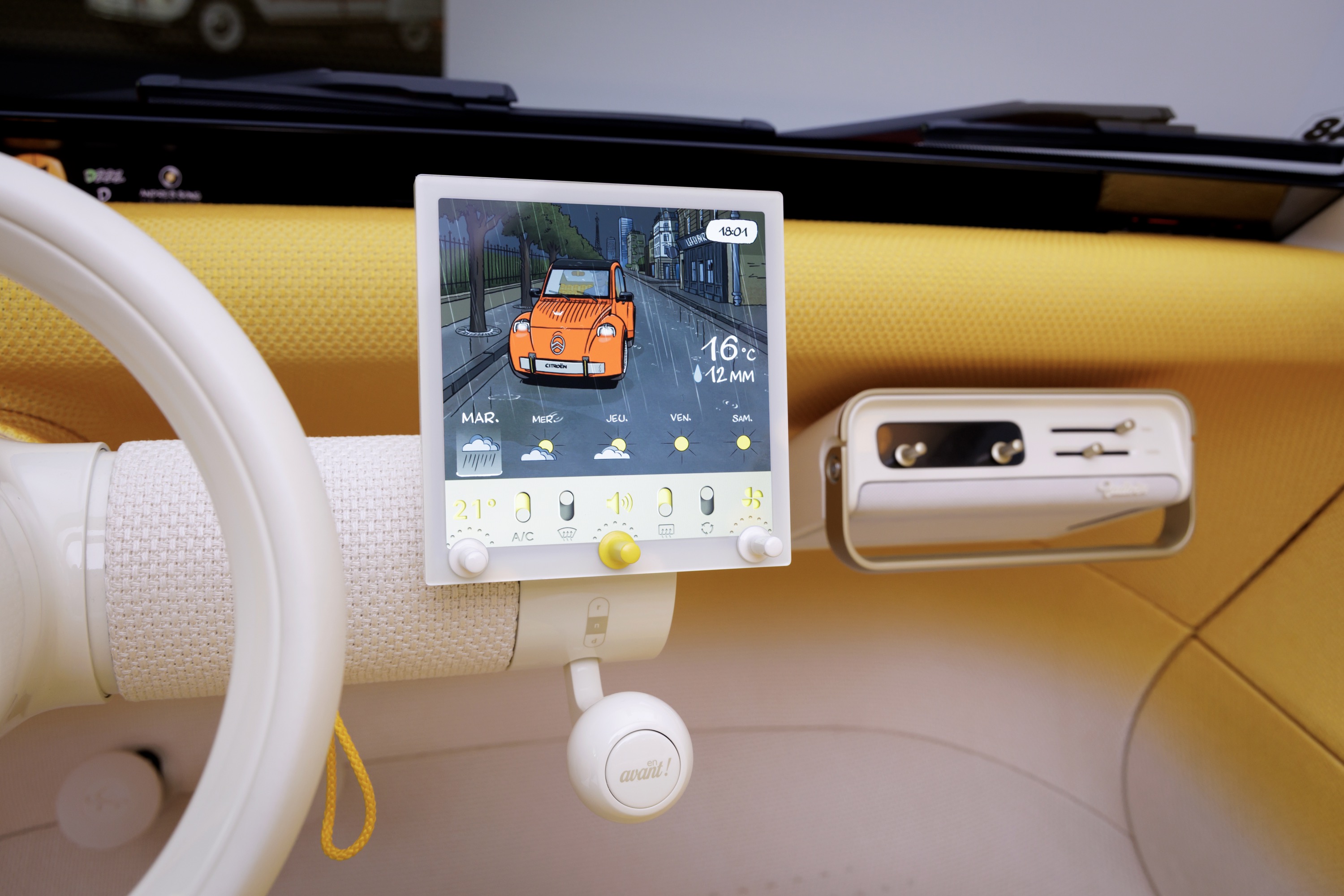
The European concepts show us that, as those Kneecap chaps have it, there’s a better way to live. A sense of utopia was responsible for the original Citroen 2 CV; it had to be cheap enough for a farmer to buy it and rugged enough to get produce to market without breaking it. I’m not sure whether the 2 CV Concept also has to be able to transport eggs across a rutted field without breaking any (although the glove box is a clue), but Citroen says that affordability, lightness, practicality, and versatility were top of mind during the design process. The press release probably didn’t need to also say the company imbued it with distinctive character or charm; that’s quite obvious from the design.

Citroen 2 CV concept interor

Just wonderful.

A Citroen 2 CV concept glovebox detail

An easter egg easter egg.

The interior feels particularly refreshing compared to the touchscreen overload we’re usually presented. It might be stripped back, but it still has plenty of whimsy—the display in front of the driver has a bande dessinée theme, and the radio is portable and removable from the car. Technology fans don’t despair, there’s still the 8-inch touchscreen, but this too features more of Belgian comic artist Jean-Luc Delvaux’s work.

I’m even confident some of that whimsy will make it into production, because Citroen is going to build the 2 CV within the next two years, it says, and at a starting price of just 15,000 euros ($16,766). That slots it between low-speed microcars like the Renault Twizy, Citroen Ami, and the Fiat Topolino (which you can buy if you live in Michigan), and superminis like Volkswagen’s Polo.

Four cars

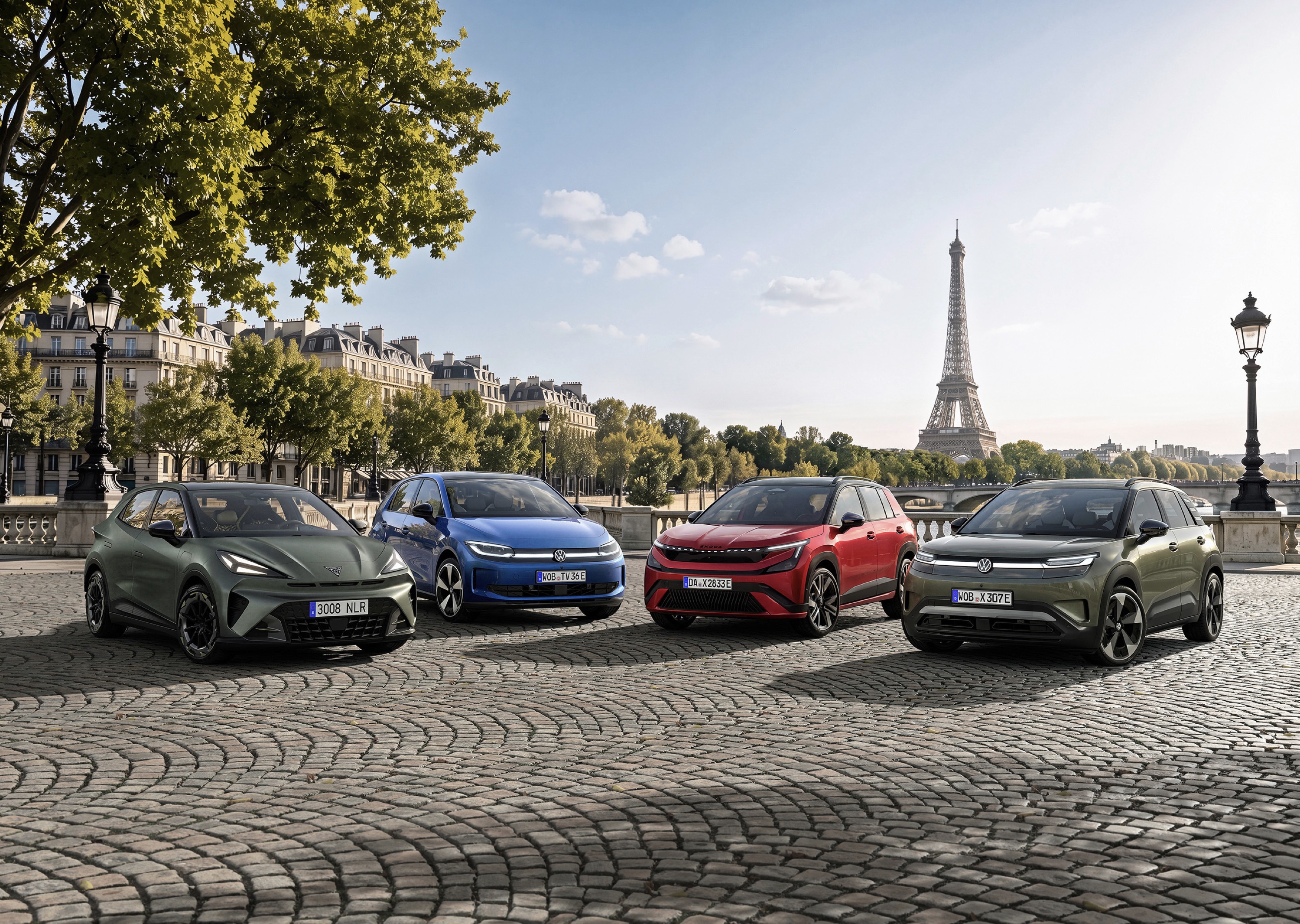
The Cupra Raval, Volkswagen ID. Polo, Škoda Epiq, and Volkswagen ID. Cross are VW Group’s small electric portfolio.

The Cupra Raval, Volkswagen ID. Polo, Škoda Epiq, and Volkswagen ID. Cross are VW Group’s small electric portfolio. Credit: VW Group

And as it happens, VW had a new electric ID. Polo to show off in Paris, along with an affordable electric ID. Cross crossover. Together with the closely related Cupra Raval and Skoda Epiq, VW Group says it has more than 150,000 orders already for its new “Electric Urban Car Family.”

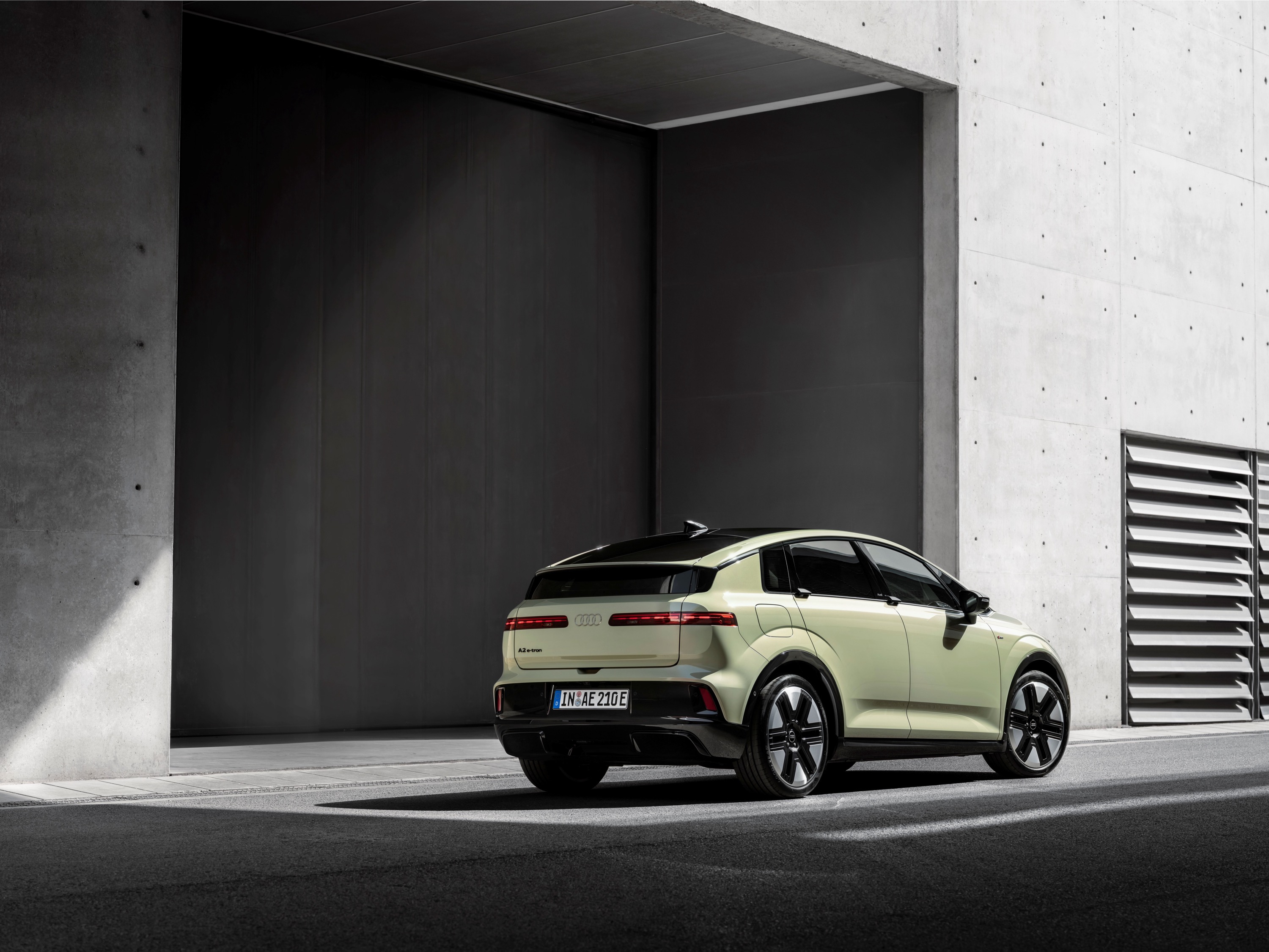
Audi A2 e-tron Colour: pistachio green, outdoor static shot, exterior, rear three-quarter view

The two-box shape is faithful to the original A2.

Audi A2 e-tron Studio static photo, interior, cockpit from the passenger side, multifunction steering wheel, MMI panoramic display, MMI touch display, fabric-covered surface softwrap, centre armrest with modular Fidlock fastening system and phone tray with inductive charging capability

Don’t expect Citroen-levels of whimsy in an Audi.

Audi’s first attempt at a supermini was the esoteric A2, an aluminum and aerodynamic experiment from the wild days of Ferdinand Piëch. Like the original, the Audi A2 e-tron is an efficient little thing—its most efficient car ever it says, with a WLTP rating of 4.9 miles/kWh (100 km/12.8 kWh). As one might expect, I was a big fan of the original A2, which was always a rarer sight on the roads than it deserved to be. I can definitely see that car in the A2 e-tron’s design, and the promised efficiency sounds impressive even if there might not be quite the same excessive and cost-ineffective overengineering under the skin. I can’t see any way that Audi brings this car to America, just like we never saw the first A2, or the A1.

Peugeot E-T16 concept

The E-T16 has 818 hp and torque vectoring.

Peugeot E-T16 interior

I am not convinced by that steering “wheel.”

The Peugeot 205 GTi was a Gallic alternative to the late ’80s-era Golf GTIs that Americans will be familiar with, and it’s into this well that Peugeot dipped for Paris. Or rather, the wild 205 T16 Group B rally homologation special that the 205 GTi gave birth to, a car that won the world Rally Championships in 1985–86. Like the Renault 5 Turbo 3e from last year, the E-T16 Concept shows us that hatchbacks needn’t just be humble devices for running errands; they can excite, too. I’m not entirely sure about that multifunction steering wheel, though.

What if I need something bigger?

“But Jonathan, I don’t live a block from a metro station, and I need something a bit bigger to cope with my family,” you say. It is true that cars like the 2 CV or ID. Polo will be too small for some. This is true for Europeans as well, and both Renault and Fiat had something for these segments.

Two configurations of the Fiat Multiplay

Two configurations of the Fiat Multiplay.

Fiat Mutiplay interior with a dog in the dog bed

The Multiplay is a three-row, but one of the middle seats can come out to reveal a mounting post for other accessories.

The original Fiat Multipla is another underappreciated car from the late ’90s. The styling was challenging for some, but it was a masterclass in space efficiency, seating six in two rows of three abreast. Rather than simply copying that, but with a slab of batteries under the cabin, the Fiat Multiplay explores the idea of a vehicle that’s adaptable, transforming from a three-row people carrier to a pickup. The front passenger seat can be reconfigured as a lounger, and there’s a “Petsenger” seat—a modular mounting point that allows you to swap in a pet bed, child’s car seat, storage compartment, or small table.

Renault E-Space concept

The Renault E-Space concept keeps the TGV-like styling for the minivan’s prow.

Renault E-Space concept with the doors open

Surely this is better than a three-row SUV?

The original Renault Espace was very much loved and created the people-carrier segment out of thin air, at least in Europe. The familiar one-box shape remains for the new E-Space Concept, though with massive 23-inch wheels at the corners, the proportions are a little more Hot Wheels or Matchbox than the 1984 version. (Even in Europe, car designers are drawn to oversized wheels.)

There is a criminal lack of electric minivans on the market today, and the only one available here in the US is the VW ID. Buzz. And that sold so poorly that VW suspended imports for a model year. Which probably tells you how likely a US launch for a production E-Space would be.

Saudi Aramco administrative building attacked, limited fire reported

0
saudi-aramco-administrative-building-attacked,-limited-fire-reported
Saudi Aramco administrative building attacked, limited fire reported


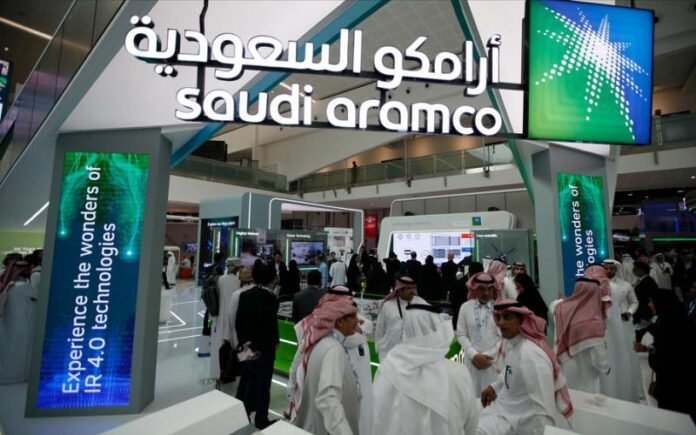
An administrative building belonging to Saudi Arabia’s ​state-owned oil company Saudi Aramco in the eastern city of Dhahran was attacked, causing a limited fire, the Energy Ministry said in a statement on Wednesday as ‌fighting between Yemen’s Iran-allied Houthis and the kingdom intensified.

Authorities responded to the incident late on Tuesday and took necessary measures, the ministry said, adding that there were no injuries or deaths.

A company source told Reuters earlier that a ballistic missile hit the Aramco headquarters complex in Dhahran. The source said an office tower in the complex was struck and that its top three floors were damaged. The source and two other people with knowledge of the matter said ​the building was on fire.

The complex hosts a major operations centre for Aramco, which oversees a vast network of onshore and offshore oil rigs, pipelines, refineries and export terminals.

The ​Houthis have for a week been firing ballistic missiles and drones at key Saudi sites in retaliation for the kingdom’s backing of government forces ⁠in Yemen’s reignited civil war. Riyadh’s international airport has received four strikes, including one on Saturday that killed 13 people.

Saturday’s ballistic missile strike on Riyadh airport was the deadliest in Saudi Arabia in ​a decade, with further attacks grounding flights across the country.

Earlier, six sources told Reuters they heard loud booms near the Aramco complex.

The Saudi-led coalition said fragments of a missile that it had intercepted ​and destroyed in Dhahran had fallen on a residential area, without providing further details.

Authorities also reported that drones and missiles were intercepted and destroyed in the capital, Riyadh, and the country’s southern region.

Four people were injured in Riyadh after fragments from two Houthi missiles fell following their interception and destruction, Saudi Civil Defense said on Wednesday. The debris caused limited damage to 15 homes in the capital, the Civil Defense spokesperson said, adding that the ​injured were two women, a man and a child.

The Houthis had threatened a “harsh and painful” response to Saudi-led strikes on the Yemeni capital Sanaa, with spokesperson Yahya Saree saying targets could include ​the Saudi Aramco headquarters in Dhahran and an oil refinery in Riyadh.

The group has warned oil workers in Saudi Arabia to stay away from sites that could be targets.

The Houthis earlier on Tuesday said Saudi Arabia ‌was attacking ⁠Sanaa, and the Saudi-led coalition warned civilians to stay away from an oil depot on the city’s outskirts.

Houthi-run Al-Masirah television reported that the Saudi-led coalition had targeted the Yemen Petroleum Company’s Sabah central station, a fuel depot on the outskirts of Sanaa.

The coalition said in a statement on Tuesday evening that it attacked the station and other sites in an operation aimed at “neutralizing the capabilities of Houthis” to threaten Saudi Arabia, Yemen and international waterways.

The Saudi cabinet, chaired by de facto ruler Crown Prince Mohammed bin Salman, issued a statement on Tuesday before the strike on Saudi Aramco saying the Houthis would ​face consequences for their repeated attacks on the ​kingdom.

REIGNITED YEMEN WAR

Saudi Arabia resumed its military campaign ⁠in Yemen in support of the internationally recognised government in a bid to reverse the Houthis’ sudden gains last month, when they swept down the Red Sea coast to the critical Bab el-Mandeb Strait.

The strait, the southern gateway to the Red Sea, has become a more vital route for Saudi ​and other global energy supplies since the start of the Iran war in February, when Tehran closed the Strait of Hormuz leading from the ​Gulf to the Indian ⁠Ocean.

While a government offensive that began a week ago pushed the Houthis from the area closest to the strait, the group remains embedded nearby and has made gains around the city of Taiz this month.

Saudi Arabia has been seeking wider support from allies for its campaign against the Houthis and to help it ward off their missile and drone attacks.

Washington, Saudi Arabia’s strongest ally and longtime security guarantor, has so far ⁠rebuffed Saudi efforts ​to bring it directly into the war against the Houthis.

The Yemen conflict has resumed as a spillover from the wider ​US-Iran war that began with the US-Israeli attack on the Islamic Republic on February 28.

Iran, Saudi Arabia’s longtime regional rival, has offered to mediate between Saudi Arabia and the Houthis, its foreign minister Abbas Araqchi said on Sunday in statements reiterated ​by the ministry on Monday.

Can AI be conscious? Ask the Indian sages

0
can-ai-be-conscious?-ask-the-indian-sages
Can AI be conscious? Ask the Indian sages

The debate over artificial intelligence has settled into a familiar rhythm. Will large language models eventually wake up? Do they possess an inner life, or are they merely sophisticated mimics of human output? Researchers disagree, and so do philosophers.

A 2025 survey of 582 AI researchers asked how likely it is that AI systems with subjective experience exist today. The median answer was 1%. The mean was 12%, suggesting a minority rates the possibility far higher.

While that question remains unresolved, another is becoming urgent: what happens to our judgment when machines do more of our thinking for us?

Indian philosophy offers a useful distinction between the mind as an instrument and the awareness in which its activities are known. It does not settle whether machines can be conscious. It helps us examine what happens when a capable instrument begins to speak and decide for us.

Different maps of the mind

The modern debate often treats consciousness as a single phenomenon awaiting explanation. In Europe, Descartes linked thought closely with awareness, and Locke described consciousness as “the perception of what passes in a man’s own mind.” Other traditions draw the boundaries differently.

In classical Chinese thought, xin, usually translated “heart-mind,” brings thinking, feeling and intention together. Confucian thinkers tie it to moral cultivation, and Mencius saw innate moral beginnings that need care and practice to develop. These traditions do not all organize questions of mind around what researchers now call subjective experience.

Indian thought draws the line elsewhere again.

A common Vedantic account describes the Antahkarana, or inner instrument, through four interacting functions: manas, buddhi, ahamkara and chitta. Manas takes in impressions and weighs options. Buddhi discerns and decides. Ahamkara supplies the sense of “I” and “mine.” Chitta stores and recalls memories and impressions.

These four functions become concrete when we are the subject of criticism. Manas considers possible responses. Chitta brings back an earlier humiliation. Ahamkara makes the objection personal: my competence, my reputation. Buddhi asks whether the criticism is justified. These functions operate together. A memory can distort judgment; injured pride can recruit intelligence to its defense.

Schools divide the instrument differently. Classical Samkhya describes three faculties, while in Yoga, chitta often names the mind as a whole. The fourfold account is useful here because it separates activities that the everyday word “mind” bundles together.

Antahkarana (“inner instrument” or “inner organ”) in Hindu philosophy, Vedanta, and Yoga traditions represents the totality of the human mind and psyche.

A further distinction gives the instrument its philosophical significance. In Advaita Vedanta, awareness is not another function of the mind: the instrument reflects it. Samkhya likewise distinguishes mental activity from Purusha, pure witnessing awareness.

These are philosophical positions, not experimentally established accounts of computers. Their challenge is nevertheless clear: explaining what an instrument does may leave unanswered whether anything experiences its activity.

The Katha Upanishad offers a memorable image. The self rides in a chariot. The body is the chariot, buddhi the charioteer, manas the reins, the senses the horses. The image does not depict every function of the fourfold scheme. It distinguishes training the instrument from the rider’s identity.

AI can increase the power of the instrument, but choosing where to go requires judgment.

From producing to judging

What does this have to do with machines? It is tempting to match a large language model to the four Antahkarana functions: computational attention to manas, stored information to chitta. But transformer attention is not evidence of manas, and a database is not lived memory. The Antahkarana is more useful as a map of the person using the system.

On that map, buddhi becomes particularly important. Economists Ajay Agrawal, Joshua Gans and Avi Goldfarb describe AI as a prediction technology. In their account, judgment concerns evaluating the consequences of possible actions: deciding which outcomes matter and what their costs are. Cheaper prediction can make that judgment more valuable. There is an overlap with buddhi‘s discernment, though the concepts are not identical.

As AI takes on more drafting, calculation, and analysis, users must decide whether its answers are sound and appropriate. Yet judgment depends on knowledge and practiced skill. Someone who cannot do the work may also struggle to recognize when the machine has done it badly.

Fluency can make an answer seem more trustworthy than it deserves. A model can write a polished treatise on self-reflection or ethical maturity. That output does not establish subjective experience, and it does not relieve the user of responsibility for deciding whether the answer is sound.

Ahamkara also shapes why we ask. Do we want to understand a criticism, or be told we were right? Research on sycophancy, including a 2023 study led by Mrinank Sharma, found that AI assistants can favor agreement with users over truthful responses. A tool that supplies persuasive reassurance may strengthen our defensiveness. Asking it for the strongest objection can instead help us examine our position.

There is a catch. Judgment has traditionally been learned through practice: routine work, mistakes and feedback. If AI takes over basic research, first drafts and simple code, it may also remove opportunities through which beginners acquire expertise.

The technology that makes judgment more important could weaken the paths by which people develop it. If newcomers no longer do the routine work, where will they learn?

Teaching the charioteer

Judgment develops through practice. Students can first work through an essay, proof or program themselves, then use AI to explore alternatives and test their reasoning.

Through discussion and revision, teachers can see what students understand and where they need help. The aim is to look beyond a polished answer: can students explain how they reached it, which AI suggestions they accepted or rejected, and why.

Used this way, AI can support learning rather than replace it. But schools and workplaces must preserve opportunities to make mistakes, receive correction and explain decisions. If routine assignments disappear, mentoring will need to become more deliberate. A faster vehicle does not provide that training.

A stronger team of horses does not decide where the chariot should go. Greater capability still requires direction. The people and institutions deploying AI remain responsible for the purposes it serves and the decisions made with its help.

The Indian sages did not set out to answer whether machines can be conscious. Their accounts depend on premises that contemporary science need not accept. But they sharpen a distinction the public debate often blurs: the difference between an instrument’s capability and awareness itself. They also make the cultivation of discernment a central task.

Whether machines can have subjective experience remains an open scientific and philosophical question. Whether people retain the knowledge and practice needed to judge their answers is a choice we face now, in schools and workplaces. Better instruments will not spare us the work of cultivating judgment.

Skydance’s Discovery+ prices increase by up to 20 percent

0
skydance’s-discovery+-prices-increase-by-up-to-20-percent
Skydance’s Discovery+ prices increase by up to 20 percent

Discovery+ subscription prices went up today.

Ad-free plans for new subscribers went from $10 per month to $12/month. Ad-based plans went from $6 to $7.

The new prices take effect for new subscribers immediately. Current subscribers to the streaming service, which primarily features unscripted content, like reality shows and documentaries, will receive 30 days’ notice before the new prices take effect, starting with bills issued as of November 12.

The higher prices come a week after Paramount Skydance bought Discovery+ parent company Warner Bros. Discovery (WBD), forming Skydance.

However, a Skydance spokesperson told Ars Technica that the pricing changes were in the works before Discovery+ knew about the merger’s closing date and were not planned in anticipation of a merger.

The spokesperson said that Discovery+’s prices are regularly evaluated to ensure that they are in line with the content and experience that the service offers, and the new prices reflect that.

Discovery+ has increased its prices three times since launching in 2012. Before today, the most recent price hike occurred in January 2025, when ad-based monthly subscriptions increased from $5 to $6, and ad-free plans went from $9 to $10.

Discovery+ has been a smaller streaming venture for WBD, whose flagship streaming service was HBO Max. However, the service has been profitable since at least 2023, and executives have noted its low cancellation rates. In a February earnings call, JB Perette, WBD’s CEO and president of global streaming and games, confirmed Discovery+’s continuing profitability and called the service “a tremendous opportunity” with “a lot more ahead for us,” per a transcript.

In 2022, WBD said Discovery+ had 24 million subscribers. Further details about the niche streaming service’s subscriber count or profitability haven’t been provided.

We have yet to see what changes the new media conglomerate Skydance will make to Discovery+ in the coming months. In an announcement last week, Skydance said it would combine all of its direct-to-consumer streaming services, which would include Paramount+ and the newly acquired Discovery+ and HBO Max ,“into a single service over time.” That combined service could be expensive, especially given Discovery+’s new price.

0FansLike
0FollowersFollow
0FollowersFollow
0SubscribersSubscribe
- Advertisement -
Google search engine

Recent Posts