14.3 C
London
Thursday, October 1, 2026
Home Blog

‘It Will Change the Way We Do Things’: Former Israeli Pilots Association Chief on Flydubai Cockpit Attack

0
‘it-will-change-the-way-we-do-things’:-former-israeli-pilots-association-chief-on-flydubai-cockpit-attack
‘It Will Change the Way We Do Things’: Former Israeli Pilots Association Chief on Flydubai Cockpit Attack


Images circulated after the landing appeared to show damage to the aircraft’s rudder, but no aviation authority had publicly established the cause of the apparent damage

Twenty-five years after the September 11 attacks, an Israel-bound passenger jet plunged more than 14,000 feet as a violent struggle unfolded inside its cockpit. Israeli officials say the co-pilot stabbed the captain and tried to crash Flydubai Flight FZ1073 before passengers subdued him and a reserve Flydubai crew traveling aboard took control of the aircraft and landed it safely in Saudi Arabia.

Saudi authorities are investigating the incident and have not publicly established a motive. Flydubai has confirmed an altercation on the flight deck but has cautioned against speculation while the investigation continues.

If the Israeli account is borne out, the episode would pose a different aviation-security problem from the September 11, 2001, attacks. The alleged attacker did not need to bypass cockpit security to access the controls. He was authorized to be there.

Flight FZ1073, a Boeing 737 MAX 8, was traveling Wednesday from Dubai to Tel Aviv with 172 passengers, 169 of them Israeli, according to Israel’s ambassador at its permanent mission in Geneva, Daniel Meron, who spoke to Reuters.

The flight diverted to Prince Sultan bin Abdulaziz International Airport in Tabuk, northwestern Saudi Arabia. The airport said air traffic control received the aircraft’s request for an emergency landing at 8:44 a.m. local time. It landed at 9:45 a.m.

Both the captain and co-pilot were injured and taken to a hospital. Prime Minister Benjamin Netanyahu said Saudi authorities arrested and interrogated the co-pilot.

Israeli officials have identified the alleged attacker as an Omani national and say they are treating the incident as a suspected terrorist attack. Defense Minister Israel Katz characterized it as an attempted jihadist attack. Saudi investigators have not publicly adopted that conclusion, and Flydubai says the reasons and motives remain unknown.

Flight-tracking data show how quickly the situation became dangerous. Flightradar24 data cited by Reuters showed the aircraft cruising at about 34,000 feet over Saudi Arabia before losing more than 14,000 feet in roughly 30 seconds. It briefly crossed into Jordanian airspace before returning to Saudi Arabia and heading toward Tabuk.

The aircraft transmitted squawk code 7700, the international signal for a general emergency, and several minutes later switched to 7500, which indicates unlawful interference. It subsequently returned to the general emergency code.

The flight data can establish what the aircraft did, but not why. Investigators will need cockpit voice and flight-data recordings, air traffic control communications and testimony from passengers and crew to reconstruct the order of the stabbing, rapid descent, emergency signals and intervention.

Netanyahu said the injured captain managed to release the cockpit door, allowing passengers to enter as the aircraft was descending. Doron Spielman, a spokesman for the Prime Minister’s Office, told Reuters that passengers found the wounded captain on the floor and the other pilot at the controls.

One passenger subdued the alleged attacker, according to Spielman. A reserve Flydubai crew traveling aboard then took control of the aircraft.

Flydubai has confirmed that account in part, saying an on-duty crew traveling on the flight secured the aircraft, diverted it and landed safely in Tabuk.

Video from the flight verified by Reuters showed two injured, bloodied men lying on the floor after the confrontation. Other images showed blood on passengers who had apparently been involved in the intervention.

The comparison with September 11 rests on the alleged objective, not on any established connection to those attacks or to al-Qaida.

On September 11, 2001, hijackers seized four US passenger aircraft. Three were deliberately flown into the World Trade Center towers and the Pentagon. Passengers and crew on United Airlines Flight 93 fought back after learning what had happened to the other aircraft; the plane crashed in Pennsylvania before reaching its suspected target in Washington.

The Flydubai case differs fundamentally: the person accused of trying to bring down the aircraft was himself a member of the flight crew.

That gives the incident another historical parallel. In 2015, Germanwings Flight 9525 crashed in the French Alps after co-pilot Andreas Lubitz locked the captain out of the cockpit and deliberately put the Airbus A320 into a descent, killing all 150 people aboard. Investigators did not conclude that the Germanwings crash was terrorism.

“It will change the way we do things,” Capt. Meidan Barr, former chairman of the Israeli Pilots Association, told The Media Line.

Barr, who had flown a Boeing 737 earlier Wednesday, said the safe landing should give investigators access to flight data and cockpit recordings that can be checked against accounts from passengers and crew. He urged investigators to complete that work before drawing conclusions about how a reported knife reached the cockpit or which safeguard may have failed.

Barr said a descent as rapid as the one recorded Wednesday can put substantial stress on an aircraft and make a subsequent landing more difficult. It can also make movement and communication aboard the aircraft harder as forces act on those inside.

Pilots train to carry out rapid emergency descents in circumstances such as a loss of cabin pressure, he said, but that does not explain what caused Wednesday’s descent.

Images circulated after the landing appeared to show damage to the aircraft’s rudder, but no aviation authority had publicly established the cause of the apparent damage.

The presence of reserve pilots aboard was crucial, Barr said, but did not make the situation routine. Airlines have procedures for dealing with an incapacitated pilot, and ground personnel can assist crews by radio. Taking control of an aircraft in the middle of an emergency without having prepared to operate that particular flight remains demanding even for a qualified pilot.

“It’s feasible, but it’s very difficult,” Barr said.

The incident is also turning attention toward what happens before a pilot ever enters a cockpit.

Barr expects investigators and aviation authorities to examine how crew members are recruited, trained, assessed and monitored. He would not prescribe a particular change while the facts remain unsettled.

Pilot vetting has already become part of the official response. Aviation-security specialists told Reuters that commercial pilots undergo background checks as well as continuing medical and psychological assessments. International Civil Aviation Organization standards provide the framework, but individual countries and airlines are responsible for implementing them.

The European Union Aviation Safety Agency told Reuters that Flydubai’s certification and safety oversight are the responsibility of the United Arab Emirates’ General Civil Aviation Authority, including requirements governing flight crews and their fitness to fly.

Dr. Uri Ben Yaakov, chief operating officer and senior researcher at the International Institute for Counter-Terrorism at Reichman University, also raised September 11 during his interview with The Media Line.

He said the comparison would depend on whether investigators establish that the co-pilot deliberately intended to use the passenger aircraft to kill those aboard. An attempted crash by itself does not establish terrorism, he said. Investigators will have to examine the co-pilot’s background, communications and recent behavior and determine whether he acted alone or had contact with an organization.

That inquiry may explain what happened more readily than it reveals how it could have been prevented.

Ben Yaakov said a person acting alone may exchange no instructions for an intelligence service to intercept. Investigators are likely to question people close to the suspect about changes in his behavior and examine his contacts and electronic material for indications of outside involvement.

He was cautious about predicting copycat attempts. Knife and vehicle attacks can be repeated by people with ordinary access to public spaces, he said. Very few people have authorized access to the controls of a commercial airliner.

Aviation security has also been repeatedly strengthened since the wave of airline hijackings in the late 1960s and 1970s and again after September 11.

We never have 100% security

Still, Ben Yaakov said, “we never have 100% security.”

Much of the physical evidence is now in Saudi Arabia, a country that does not have formal diplomatic relations with Israel. Saudi authorities received the aircraft, treated the injured pilots and detained the co-pilot. Israeli officials are seeking information about his background, possible contacts and whether anyone else was involved.

Ben Yaakov said law enforcement agencies can cooperate on investigations despite political differences between their governments, although sharing information about an airline employee may be more complicated than coordinating the physical security of an airport or aircraft.

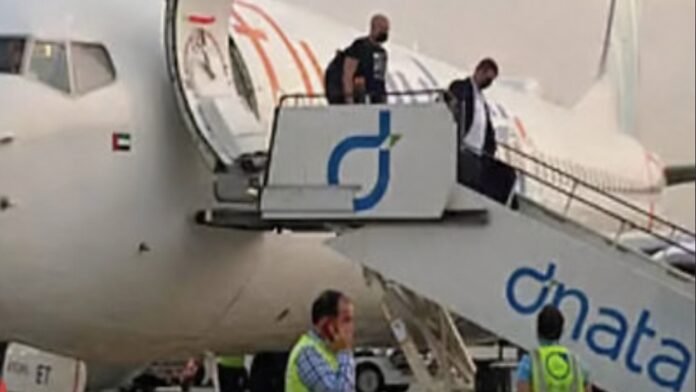
The passengers, meanwhile, left Saudi Arabia aboard a replacement Flydubai aircraft at 5:40 p.m., according to Tabuk airport authorities. The flight landed at Ben Gurion Airport Wednesday evening.

Magen David Adom teams and airport medical personnel were waiting when they arrived. Most passengers required no medical treatment. A 51-year-old man with a minor upper-body injury was taken to a hospital in good condition.

The incident has already produced competing political responses in Israel.

Transportation Minister Miri Regev called for Flydubai flights to Israel to be suspended while the case is investigated and asked the Civil Aviation Authority to examine whether the United Arab Emirates complied with its aviation agreement with Israel.

Amir Hayek, Israel’s former ambassador to the UAE, urged officials not to rush to blame Flydubai. He pointed out that Flydubai and Etihad continued serving Israel during periods when many foreign airlines suspended operations.

Flydubai said the incident had not affected its wider scheduled operations, and no general suspension of its Israel service had been announced Wednesday evening.

Netanyahu, meanwhile, has ordered tighter security measures for pilots flying into Israel on both Israeli and foreign airlines.

Spielman told Reuters that authorities intend to know the identity of every pilot operating flights into Israel and subject them to security screening.

Who is flying my plane?

For Barr, that is where Wednesday’s incident is likely to leave its longest mark. Passengers have long been trained to think about who might try to get into a cockpit. The next set of questions may concern the people already inside it.

“Who is flying my plane?” Barr asked.

Attackers have been exploiting critical Zimbra flaw to steal emails

0
attackers-have-been-exploiting-critical-zimbra-flaw-to-steal-emails
Attackers have been exploiting critical Zimbra flaw to steal emails

Hackers have been exploiting a critical vulnerability in the Zimbra Collaboration Suite in an attempt to obtain email backups and authentication credentials of vulnerable organzations, Microsoft has warned.

The vulnerability, tracked as CVE-2026-73570, lets attackers remotely issue operating system commands without authentication. Zimbra maintainer Synacor issued a patch on July 20, but didn’t disclose the vulnerability for more than three weeks after that. The security-focused Shadowserver Foundation said last week that its scans found that 274 separate instances of the Zimbra Collaboration Suite had been compromised. The number of servers running the software has fluctuated from 19,000 in the week following the patch to about 12,000 in the weeks following that. Currently, Shadowserver is tracking about 10,000 instances.

Look, ma, no authorization

From July 28 to August 7, Microsoft said Wednesday, the company detected two distinct scanning tools probing the Internet for vulnerable endpoints. The attackers first validated their exploit worked by sending HTTP, requests and DNS, ICMP, and out-of-band identity checks to domains hosted on public services. The probes allowed the attackers to confirm the exploit successfully executed commands on vulnerable servers without actually compromising them. Eventually, the attackers began using their command injection capability to install malicious payloads. Microsoft wrote:

Following successful exploitation, observed activity included deployment of JSP web shells and reverse shells, privilege escalation, persistent remote-access tooling, and memory-backed execution. Threat actors also accessed email and collected authentication and mailbox data, with archive creation and subsequent transfer activity observed. The activity included both automated payload delivery and hands-on-keyboard operations on compromised mail servers. Microsoft observed affected organizations in more than one region and industry. Based on the environments investigated, exploitation was not limited to a single sector or geographic area.

CVE-2026-73570 allows remote attackers with no credentials to run operating system commands through a crafted email that targets the ZCS SNMP notification path but only when an optional zimbra-snmp package is in place and SNMP notifications are enabled.

“An attacker can send a specially crafted SMTP request that introduces untrusted input into SNMP notification processing,” Microsoft explained. “If the input is not sufficiently sanitized, embedded shell commands can execute with the privileges of the zimbra service account.”

Microsoft said the attackers it observed went on to install the webshells and use them to issue commands to create email backups and collect credentials. The company said it had no means to verify that the attackers successfully exfiltrated that data. Microsoft provided no details about who the attackers were or whether they were nation-state actors or financially motivated criminals.

Anyone responsible for maintaining ZCS software should ensure they’re running version 10.1.20 or later. The company provides other guidance for locking down systems.

Exclusive: Feds Denied Ballistics Expert Access to Prairieland Defendant Who Got 100 Years in Prison

0
exclusive:-feds-denied-ballistics-expert-access-to-prairieland-defendant-who-got-100-years-in-prison
Exclusive: Feds Denied Ballistics Expert Access to Prairieland Defendant Who Got 100 Years in Prison


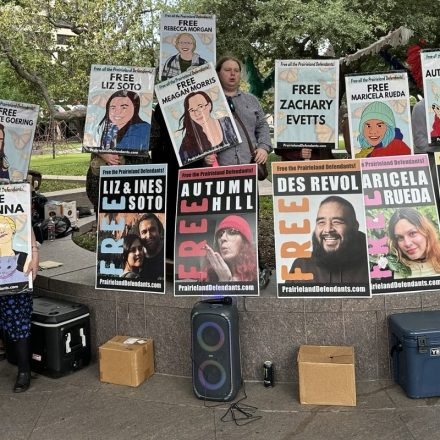
On the last day of the Prairieland trial, in which nine Texas protesters were accused of crimes including providing material support to terrorists, the attorney for activist Benjamin Song presented a novel argument that, if true, would have upended the federal government’s case.

Song had been charged with attempted murder for allegedly firing a gun at the first police officer who arrived on the scene after a noise demonstration outside U.S. Immigration and Customs Enforcement’s Prairieland Detention Center in Alvarado on July 4, 2025.

The defense — more than a dozen attorneys representing clients with varying degrees of involvement in the protest — had rested their argument without calling a single expert witness, owing to what they thought was the weakness of the government’s case.

“Attempted murder requires that you intend to kill. And if the government can’t prove that intent, that’s a not guilty — period.”

During closing arguments, however, Phillip Hayes, Song’s attorney, raised what he said was a major flaw in the government’s depiction of what happened: Song never aimed his weapon at the police officer. Relying on evidence introduced by the prosecution — a photograph of the bullet, witness testimony, and CCTV footage of the incident — Hayes said his client never intended to shoot Alvarado Police Department Lt. Thomas Gross.

Rather, Hayes said, Song fired his weapon at the ground and the bullet ricocheted off a hard surface before striking the officer just below the neck. That would explain the plumes of dust that were visible in the video. According to Hayes, the only photo of the bullet, which appears severely bent and with several missing fragments, backs up the theory.

“Attempted murder requires that you intend to kill,” Hayes, a lanky, soft-spoken criminal defense attorney, told the jury on March 11. “And if the government can’t prove that intent, that’s a not guilty — period.”

The jury didn’t bite. Instead of being acquitted, Song was convicted and sentenced to 100 years in prison.

One reason the ricochet theory didn’t play a bigger role in the trial was that the federal government prevented it from being fully aired. Key details about the shooting, and the officer’s actions, were only revealed during the trial itself. Prosecution motions and favorable rulings by the judge, a Trump appointee, made it difficult for Song’s lawyers to fully vet the idea or argue that he had acted in self-defense.

And an independent ballistics expert hired by Song’s defense team before the trial was denied access to the defendant in federal prison. As a routine part of any case about a murder or a shooting involving a police officer, said Daryl Parker, the former Marine Corps officer and criminal defense investigator hired by Song’s team, a ballistics expert will meet with an alleged shooter to collect information. Nothing about the Prairieland case, however, was turning out to be routine.

It was the first time in his 25-year career that the forensics expert had been denied access to a client in a federal facility.

In emails reviewed by The Intercept, Parker and Hayes repeatedly wrote to Federal Medical Center Fort Worth, the federal detention center where Song was held before and during the trial, asking to visit the defendant. All the requests went unanswered. (FMC Fort Worth declined to respond to a request for comment.)

Parker never got a response from the jail official in charge of Song’s detention, let alone visitation rights.

“We sent him everything he asked for,” Parker, speaking publicly for the first time about the case, told The Intercept. “But approval never came.”

It was the first time in his 25-year career that the forensics expert had been denied access to a client in a federal facility.

In the end, members of the jury never received a full airing of the argument nor the multiple pieces of evidence that support it.

The ricochet theory, though, may yet be part of Song’s appeal and the basis of a new trial, according to two lawyers on Song’s defense team in his state-level case. New evidence, including material revealed for the first time in this Intercept investigation, shows that Song, a former Marine reservist and expert marksman, may have never intended to shoot the police officer.

New Evidence

The Prairieland case was touted by the Trump administration as the government’s first prosecution of an “antifa cell,” moving from indictment to trial in the Northern District of Texas in just a few months. For such a complex high-profile case, there wasn’t much time to prepare. And key pieces of information were hidden within or even omitted from discovery.

Buried within the tens of thousands of pages of evidence provided to the defense team was a grainy photograph: the government’s only image of the bullet that struck the police officer. According to two ballistics experts interviewed for this story, the photo is of such poor quality that it is difficult to conclude anything from the image alone.

Shaun Jaikissoon, a former firearms examiner with the New York City Police Department for 10 years who now has his own consulting firm, said the photo of the fragment provided by the prosecution tells us almost nothing and may even be deemed “unsuitable,” meaning it lacks value for a forensic analysis.

Parker, the independent ballistics expert hired by the defense team, said he agreed the photo was of little value.

“It is sparse,” he said. “You should have images of the end of the bullet — 360 degrees — so you can properly evaluate it.”

Despite the photograph’s limitations, it does reveal that the bullet was severely deformed, indicating a possible ricochet.

“It’s a copper banana,” said Parker. “It obviously struck something.”

The opinion is shared by one of the government’s own witnesses. During the trial, Philip Stout, a forensic scientist for the Texas Department of Public Safety, described the extreme curvature of the bullet as characteristic of a projectile fired into a water tank.

“When you’re dealing with higher velocity bullets, they slow down very quickly, so it gets that curved — I refer to it as a banana shape, but it’s more of a semicircle shape,” said Stout. “What that tells me is that bullet struck something and slowed down very quickly.”

Other questions arose from the shooting and investigation, Parker said. Perhaps most important is the fact that Gross’s bulletproof vest — level IIIA soft body armor — would not have been able to withstand the force of a bullet fired from an AR-15-style rifle at such close range. Even the label on the vest, introduced into evidence by the government, says: “This is NOT intended to protect against rifle fire.”

According to Parker, if the bullet had struck Gross directly — without first hitting another surface or object — it would have ripped through him “like Swiss cheese” and almost certainly killed him. Instead, the bullet came to rest inside Gross’s vest, with Gross sustaining minor injuries. He was released from the hospital a few hours later.

“The standard body armor that police officers wear is not rated for rifles,” Parker said. “It’s only rated for handguns. It’s not even rated for knives.”

“The fact that the officer is not dead, to me, is a big red flag that Song wasn’t aiming at him.”

Another clue that points to a ricochet, according to Parker, is Song’s skill as a marksman, especially given the short distance between the two shooters and Song’s previous training as a Marine.

“The fact that the officer is not dead, to me, is a big red flag that Song wasn’t aiming at him,” Parker told The Intercept.

Together, this new evidence of a ricochet matches the information that became apparent only during the trial when Gross testified that he drew his weapon first and aimed at a fleeing protester. Drawing on this testimony, along with video evidence, Song recounted the same version of events in a statement he read during sentencing.

“When I saw Lieutenant Thomas Gross stop pursuing and point his gun at the back of a running, unarmed protester, like he testified, I was terrified,” Song said. “As a firearms instructor and a United States Marine Corps veteran, I understood what I was seeing. As the evidence shows, I did not want to hurt anyone.”

ALVARADO, TEXAS - JANUARY 30: The Prarieland Detention Center is seen, on Friday, Jan. 30, 2026, in Alvarado. (Shafkat Anowar/The Dallas Morning News via Getty Images)
U.S. Immigration and Customs Enforcement’s Prarieland Detention Center is seen on Jan. 30, 2026, in Alvarado, Texas. Photo: Shafkat Anowar/The Dallas Morning News via Getty Images

Shots Fired

That Gross drew first and aimed at a protester’s back were among the facts that, according to Song’s lawyers, were not revealed to the defense until the trial itself. Also missing from the pre-trial discovery was evidence indicating that bullets fired at the scene struck the ground. The marks in the pavement were not documented as part of the investigation.

Given these late-breaking revelations, Song’s lawyers had to scramble in the middle of the trial to put together their argument. Song’s defense team, in a motion for a new trial filed in April, said that the failure to disclose evidence of the bullet strikes sooner deprived them of the ability to make their case that Song never intended to shoot officer Gross.  

The existence of bullet strikes was only revealed during the second week of the trial, when evidence from the investigation, headed up by the Texas Rangers, an elite unit within the state’s Department of Public Safety, was divulged in court. Texas Ranger Billy James Hill Jr., responsible for photographing the scene, admitted during cross-examination to finding “recent looking defects in the concrete surface.”

Tailim Song, Benjamin Song’s father and a civil attorney who was part of his son’s defense team, said the ricochet theory only began to take shape when they learned about the deformations in the road.

“It really didn’t come home until the Rangers said there were fresh bullet strikes in the concrete.”

“In my mind,” Tailim Song said, “it really didn’t come home until the Rangers said there were fresh bullet strikes in the concrete.”

The photographs from the scene, however, didn’t include shots of the ground. When asked during the trial whether he had taken any photos of what he believed to be bullet strikes, Hill, the Texas Ranger, responded that it “wasn’t part of my responsibility.”

Hill had taken photographs using a high-tech camera system called a Leica RTC360 Digital Crime Scene Scanner, which creates reconstructions of the alleged events. The reconstruction, however, omitted photographs and chemical swabs of where the bullets had struck the pavement as well as the crucial trajectory analysis and shooter-position determinations. (The Texas Department of Public Safety and the Department of Justice did not respond to questions about the investigation or crime scene reconstruction.)

Ryan Rider, a former Texas police officer who teaches crime scene reconstruction at Tarleton State University, said the technology, if used properly, can provide precise measurements — down to the millimeter — that can be used with other evidence like testimony and physical evidence to track the bullet’s pathway in relation to the shooter.

“It does tell you a story,” said Rider, who is slated to train law enforcement agencies on the Leica system.

Rider — who spoke to The Intercept generally about investigations, since he has not examined the Prairieland evidence — also said shootings involving officers are potentially chaotic environments with multiple agencies involved in collecting evidence, interviewing witnesses, and securing the crime scene.

In the Prairieland case, Alvarado Police Department; the Johnson County, Texas, Sheriff’s Office; the Department of Homeland Security; the Bureau of Alcohol, Tobacco, Firearms, and Explosives; and the FBI; in addition to the Texas Rangers; were all present. Not documenting the bullet strikes — especially if the Rangers knew they were there, as Hill acknowledged in court — is hard to explain, Rider added.

“A trooper shouldn’t be up on the stand saying, ‘That wasn’t my responsibility,’” Rider said. “If they’re on the scene, people are going to expect them to be the ones to say, ‘Hey, get pictures of this.’”

“A trooper shouldn’t be up on the stand saying, ‘That wasn’t my responsibility.’”

With the gaps in the forensic evidence and crucial facts withheld until the middle of the three-week trial, defense attorneys couldn’t pull together a coherent, countervailing version of events quickly enough. Even when they tried, as evidence undermining the government’s claims trickled out, the lawyers faced new hurdles.

Gross gave his testimony early in the trial about drawing his gun first, information that was left off a police report and not included in discovery. Then the judge granted a prosecutors’ motion barring Song’s lawyers from using a self-defense argument, which became a frequent point of contention.

At one point, during his closing argument, Hayes, Song’s defense attorney, suggested that Gross may not have been justified in pulling his weapon so quickly. The judge, a member of the conservative Federalist Society, admonished Hayes for treading too close to a rationale for self-defense.

Appealing for His Life

The Prairieland trial unfolded as Trump escalated his crackdown on anti-ICE protests across the country. The verdicts were celebrated by the Trump administration as its first successful prosecution of a violent “antifa cell,” and the first eight defendants were sentenced to more than 450 years in prison altogether.

“These guilty verdicts and convictions rightly reflect the vicious, armed attack that these Antifa cell members planned and executed against law enforcement and detention center officers on the night of July 4 last year,” a top Department of Justice official said after the convictions were handed down.

The government’s narrative rested on the premise that the noise demonstration was an organized ambush of law enforcement officers and that Song’s intent from the outset was to kill a police officer. But this version of events relies on an incomplete picture of what transpired that night.

Whether information that came to light during the trial is adjudicated as part of the appeals process will be decided by the 5th U.S. Circuit Court of Appeals, one of the most conservative courts in the country and one that Trump’s Justice Department has used to secure favorable rulings.

Patrick McLain, an attorney representing another Prairieland defendant, said it would likely be several months before any appeals are filed; it is still unclear what the focus will be and if the defendants will mount a coordinated effort. 

“My hope is that we’re going to have nine solid briefs that are mutually supporting and not contradictory,” McLain said. 

The 5th Circuit has not issued a briefing notice. Once it does, defense teams will have 40 days to submit their documents, according to John Kuchera, Song’s court-appointed appellate lawyer. Kuchera, reached by phone, said he has not yet had time to review the record and has not met with Song. He declined to comment on whether the theory about the bullet would be included in the appeal.

“What my opinions are about anything will show up in my brief,” he said. “Whatever issues that I think need to be addressed will be in that.”

Ultimately, the 5th Circuit will decide if evidence in the Prairieland case, including the bullet that struck Gross, can be reexamined and if Song, who now faces the prospect of spending the rest of his life in prison, will be granted a new trial.

Correction: September 28, 2026
This story has been corrected to note that Ryan Rider, the crime scene reconstruction expert, has not yet begun training law enforcement agencies on the Leica crime scene scanner.

A rickety Europe tries to stand up to China

0
a-rickety-europe-tries-to-stand-up-to-china
A rickety Europe tries to stand up to China

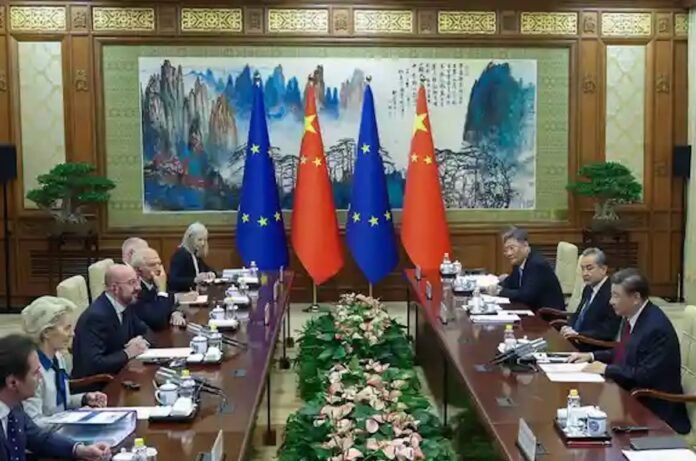
The European Union is embarking on diplomatic hand-to-hand combat with China in an effort to rework its trade with Beijing and show it is not a geopolitical weakling.

Using unusually direct terms, the EU has given China a mid-October deadline to provide ways it will reduce its massive trade advantage over Europe. If not, the EU Commission will make unilateral moves to limit imports of Chinese goods, imposing specific limits on electric vehicle imports and putting tariffs on other industrial goods.

In an early September speech, EU Commission President Ursula van der Leyen laid out the stakes as she sees them. “Our companies do not compete on a level playing field,” she said.” “It leads to deindustrialisation in the industrial heartlands of Europe. This is unsustainable.”

China countered this expression of exasperation with its own harsh language. “Voluntary export restraint is one of the egregious misnomers of modern trade policy, wrote China Daily, an English-language government newspaper. “There is nothing voluntary about a choice made under the threat of punitive tariffs.”

Jion Gong, a professor at Beijing’s University of International Business and Economics, suggested Europe is suffering a kind of nervous breakdown. “It’s a refection of their anxiety. They have to wake up. The best strategy is to embrace competition and investment from China,” he said on CGTN, the state-operated news network.

Certainly, there is deep worry in Europe about its trade relations not only with China but also with the United States. A past EU trade deal with the the US Admiinistration mainly benefited American industries, continental critics argued. Another such accord with China wold sideline the EU as an influential player in the global economy.

Meanwhile, China has already flexed its ability to punish an assertive Europe: In 2025, it withheld exports of rare earth minerals to the EU as part of its retaliation against US limits on high-tech exports to China. In Beijing’s mind’s eyes, the EU is easy to bully. “Beijing judges Europe’s leaders as politically weak, divided on China, and lacking a mandate to launch a trade war against China amidst an actual war in Ukraine and a widening transatlantic rift with US,” wrote Ryan Hass, an East Asia Scholar at the Brookings in Washington.

Valbona Zeneli, a senior fellow at the Atlantic Council’s Scowcroft Center for Strategy and Security, added that, “Washington holds technological leverage; Beijing controls minerals and key manufacturing supply chains. Europe remains exposed to both.”

The question, he added, “Is whether the EU can turn its own economic weight into strategic agency rather than simply absorb the consequences of decisions taken elsewhere.”

Economic statistics suggest an urgent european need for action. The EU’s trade deficit with China leapt from €306 billion (US$347 billion) in 2024 to €360 billion in 2025. This year, the deficit is expected to €400 billion ($408 billion); the gap was €103 billion ($117 billion) in the second quarter.

To reduce this growing deficit, Brussels wants ‌to limit Chinese hybrid vehicle sales to the EU market at 15 percent of total vehicle sales, persuade China to limit exports of an array of chemicals and increase imports of milk and cheese, pork and brandy. EU Trade Commissioner Maros Sefcovic, a diplomat from Slovakia, is in charge of negotiations with China.

He will visit Beijing in advance of an EU meeting in mid-October that will decide whether China has produced satisfactory trade concessions. He will also demand that China end its curbs on critical rare earth minerals to in Europe.

“We are engaged in a dialogue with China to rebalance our trade. But this dialogue must now lead to results. We will use all the tools to rebalance our relationship,” von der Leyen warned.

But critics fear what they call “Panda diplomacy” that fails to resolve fundamental problems and sticks to symbolic gestures – like sending gift pandas to Western zoos.

“To be meaningful for the EU side, a deal cannot consist of a one-off measure involving only one sector, just for China to demonstrate goodwill,” cautioned Gunnar Wiegand, a fellow at the German Marshall Fund, an independent organization dedicated to strengthening transatlantic cooperation.

Despite its perceived weaknesses, the EU “has cards to play” to help bend China to its will, advised the Brookings Institute, a Washington think tank:

  • Intensify formal investigations into unfair subsidies of Chinese companies.
  • Block Chinese investments in the EU.
  • Expand sanctioning on Chinese companies whose sales aid Russia’s war on Ukraine.

China has its own economic problems that the EU can exploit. Consumption is sluggish, while investment in construction and infrastructure along with investments in real estate fell sharply last year.

Urban unemployment also reached 5.3 percent. Subsidies on uneconomical industries were estimated at some 5% of gross domestic product.

And China has its own hidden anxieties: Communist party leadership harbors fear of a kind of economic domino effect should China accedes to EU demands. Other countries might move to ask for trade concessions. “Chinese negotiators are anxious not to agree to a deal which would set a precedent for many other partners,” said Wiegand, a former EU diplomat

He predicted that compromise is unlikely. China is committed to a zero-sum contest in which there can only be one winner, and it won’t be Europe. “Once China has realized all its ambitions, it will have contributed to the impoverishment of its main export markets,” he said.

US has ‘virtually total control’ of Strait of Hormuz: Trump

0
us-has-‘virtually-total-control’-of-strait-of-hormuz:-trump
US has ‘virtually total control’ of Strait of Hormuz: Trump

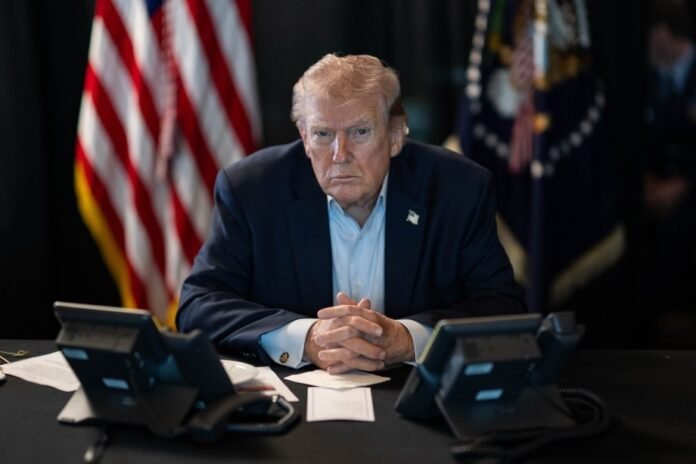
President Donald Trump said Wednesday that the US has “virtually total control” of the Strait of Hormuz, while claiming that oil shipments through the strategically important waterway have surged to historic levels in recent days, Anadolu reports.

“We have virtually total control of the Hormuz Strait,” Trump said during a Hispanic heritage month celebration. “In fact, in the last three days, more oil has come out of the Hormuz Strait than at any time in the history of the Hormuz.”

The president reiterated that Iran’s military had been “totally wiped out,” and said the war would soon be won.

“We’re going to have that war won very quickly, one way or the other,” he said.

In February, the US and Israel launched a war against Iran. Tehran responded with attacks on Israel and US targets in the region before a ceasefire agreement was reached in April.

Washington and Tehran signed a memorandum of understanding in June concerning freedom of navigation in the Strait of Hormuz, but implementation stalled because of disagreements related to security in the strategic waterway.

READ: Iran receives US response to Qatari-mediated proposal: Spokesperson

A local network of implants uses your body as the wiring

0
a-local-network-of-implants-uses-your-body-as-the-wiring
A local network of implants uses your body as the wiring

Most implants like pacemakers and insulin pumps work in isolation. To help them coordinate with each other, a team of Georgia Tech researchers built a networking system that sends signals through body tissue instead of antennas and radio waves.

Radio problems

Implants that communicate today mostly rely on radio protocols like Bluetooth Low Energy or near-field communication (NFC). Both are a poor fit for in-body data transfer, says Alex Abramson, a Georgia Tech engineer and co-author of the new study.

The first problem is power. “If you want an implant to remain in an active state such that it can respond within milliseconds, it’s very difficult to do that with the Bluetooth system,” Abramson said. According to the paper, Bluetooth components, when they’re activated, can cut an implant’s battery life by up to 90 percent.

The second problem is that radio waves don’t travel well through the body. “Bluetooth and near-field communication are attenuated quite a lot in the tissue,” Abramson said. He said that implant-to-implant radio communication systems run into attenuation issues if the signal has to travel more than one centimeter through the tissue. Then there’s size. Radio needs antennas, and commercial Bluetooth components require a device at least five millimeters wide. Implants thinner than three millimeters can be injected with a syringe at an outpatient clinic; bigger ones usually need surgery.

The fix Abramson’s team came up is called SWANS (Smart Wireless Autonomous Networking System) and was inspired by the way body’s own internal communication networks. “The nervous system can take a lot of inputs from all over the body, harvest all that data, and make a specific decision. And our system mimics that,” Abramson said. SWANS relies on ionic conduction just like neurons, which communicate by shuttling sodium and potassium ions through their membranes, creating voltage differences. “But instead of using nerves, we use normal body tissue to send those signals,” Abramson said.

Name calling

The idea isn’t entirely new. A Food and Drug Administration-cleared pill called Abilify MyCite uses ionic conduction to tell a skin patch it was swallowed. But such systems typically link just two devices, while Abramson’s team wanted SWANS to connect many.

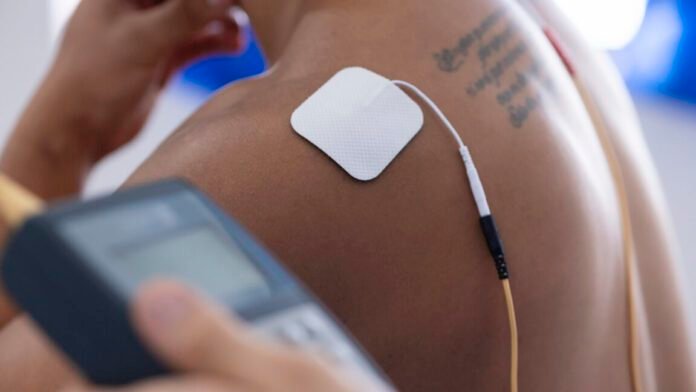
The first SWANS component is a wearable hub. It’s a flexible circuit board that reads sensor data, runs decision-making algorithms, and emits voltage pulses of up to 12 volts. The second is a patch of stainless-steel microneedles that delivers those pulses into the body, bypassing the skin’s outermost, poorly conductive layer. The third is a network of syringe-injectable implants, each packing two receiving pads, a transistor switch, a battery, and either a sensor or an actuator such as a nerve stimulator.

“We created all of the smarts in the wearable hub,” Abramson said. The wearable has more room and more battery power, so the implants could be kept small and simple. When the hub fires a pulse, it creates a brief electric field that spreads through the tissue in all directions. Every implant within range picks it up, but only the right one(s) react, a bit like people in a crowded room who turn around only when they hear their own name.

The team achieved that by making each implant’s transistor switch on only when the incoming pulse crosses a specific threshold. Adding a resistor in front of the transistor raises the voltage needed to flip the switch. Adding a capacitor means the pulse must last long enough to charge it first. By mixing and matching these components, the team made implants that respond only to specific combinations of pulse strength and length. This, the authors admit in the paper, means that voltage thresholds need to be tuned for each body and implant placement.

Because SWANS implants are built from passive components, they draw almost no power while listening, extending battery life more than 15 times compared to Bluetooth and NFC. A complete implant with a battery measures 3 by 1.1 by 17 millimeters and fits through a 6-gauge needle.

To test the system, Abramson and his colleagues installed it in chicken breasts, skin-on, bone-in pork bellies, and living rats.

Twitching legs

“Pork belly is a very thick and heterogeneous tissue,” Abramson said. The signal had to get through fat, muscle, bone, and skin. A single 10-volt pulse produced a detectable voltage gradient more than 30 centimeters across the tissue and up to 14 centimeters deep—more than 10 times the coverage of Bluetooth or NFC.

In live rats, the signals reached implants under the skin, in the abdominal cavity, and even in the stomach. Placement didn’t matter much either. “We put our wearable on the stomach of the rat, and then we were able to get actuation in the back of the rat,” Abramson said.

The most advanced experiment used strain sensors placed on the rats’ front legs. When a sensor detected the left or right forelimb moving, the hub sent a limb-specific pulse through the body that reached an implant on the corresponding hind leg, which stimulated the sciatic nerve and made that leg twitch. The team also built an implant-to-implant relay where a device with a temperature sensor passed a signal to a second implant only when it registered a fever above 40° C (104° F).

Abramson notes that pacemakers and neurostimulators already use similar voltages and pulse lengths, so the team did not expect any major safety issues. In a two-month study in rats, scar tissue up to a millimeter thick grew around the implants, but by raising the voltage within safe limits, the team kept communication going throughout. The pulses didn’t stimulate nerves other than the targeted one, didn’t change the heart’s electrical activity, and caused no more cell death or oxidative stress than needles and implants that weren’t electrified.

But SWANS is not a do-it-all in-body communication system, and it likely never will be.

Implant multiplexing

The first limitation of SWANS is that it can’t send much data. “We don’t want to send large amounts of data using our devices because we want to create ultra-small, ultra-low-power systems,” Abramson said. SWANS, he argues, is meant to pass key information (like a temperature reading) between body parts, but not much else. The system also hasn’t been tested in large animals or humans yet, though Abramson says preliminary large-animal studies have looked promising. And he already thinks about potential applications.

“Right now, neurostimulation and drug delivery are completely separate,” Abramson said. Today, he argues, a person cannot have a drug delivery pump connected with their neurostimulator to allow for combined therapies, even though there are benefits to taking a drug at a specific time in conditions like epilepsy.

The strength of SWANS, Abramson argues, lies in how easily it can be integrated with existing implants. “This new communication protocol can be plugged into any of those previous systems,” he said. “Because it’s completely agnostic to the sensor or the actuator that we’re using, we’d be able to create this full network of in-body therapeutics.”

Science, 2026. DOI: 10.1126/science.adz5300

EU’s EPP seeks emergency powers to restrict asylum claims during migration crises

0
eu’s-epp-seeks-emergency-powers-to-restrict-asylum-claims-during-migration-crises
EU’s EPP seeks emergency powers to restrict asylum claims during migration crises


The European People’s Party (EPP) will call for the suspension of the right to apply for asylum in the EU in cases of “hybrid attacks”, where third countries facilitate large-scale migration with the aim of destabilising a European border.

The controversial measure would allow migrant people to be sent back without an individual assessment of their circumstances, effectively resulting in “collective pushbacks” that are prohibited under current EU law.

The measure could form part of the new “European Emergency Response Framework”, announced by European Commission President Ursula von der Leyen in her State of the Union speech, to tackle irregular arrivals.

Some EU countries have already temporarily suspended the right to seek asylum and support the measure. However, the proposal has drawn criticism from left-wing politicians and migration experts.

The EPP’s call is part of a resolution due to be adopted on Tuesday at the EPP’s political assembly in Toulouse, according to several party sources.

“There are some delegations against it, but the majority of the party is on board,” a senior EPP member told Euronews.

In the text seen by Euronews, the EPP calls on member states to “adopt an additional protocol on asylum and migration authorising the refusal of entry or return without an individual asylum procedure for illegal migrants used in hybrid attacks.”

The text cites the situation in Ceuta, where around 80,000 migrants irregularly entered at the end of July, with several thousand still on the streets of the Spanish exclave. The episode was described as a “hybrid attack and instrumentalisation of migrants” in a recent European Parliament resolution.

“Similar cases require a response that goes beyond the current instruments designed to address migratory flows,” the resolution says.

The EPP is the EU’s largest political family, and its proposals often shape legislation adopted by the European Commission and endorsed by the European Parliament.

In the current legislature, the party has taken a tougher stance on migration, backing legislation to deport asylum seekers and irregular migrants to third countries with no connection to them.

Last June, the EPP adopted another resolution urging the European Commission to limit the right to asylum “in cases of instrumentalisation” and when irregular migrants attempt to enter the EU from a third country deemed “safe”.

Via Euronews

FlyDubai incident: Airline safety expert explains how cockpits have become more secure – but only from outside threats

0
flydubai-incident:-airline-safety-expert-explains-how-cockpits-have-become-more-secure-–-but-only-from-outside-threats
FlyDubai incident: Airline safety expert explains how cockpits have become more secure – but only from outside threats

An incident in which a FlyDubai pilot is said to have stabbed the captain with the intention of crashing a plane of mainly Israeli passengers has shone a light on flight security.

Reports suggest that passengers on the plane were able to enter the cockpit, subduing the alleged attacker before the plane was safely diverted to a Saudi runway. Israeli fighter jets were scrambled in response to the incident.

What do airlines do to prevent incidents like this one?

I’m an aviation security expert with 40 years’ experience in the industry. My expertise is in how the U.S. system works. But much of what has been put in place in the U.S. after the terrorist attacks of 9/11 have been implemented in some form as best practice across the world.

The 2001 attacks – in which terrorists stormed the cockpits of four passenger jets, crashing three into targets, with the fourth being brought down after passengers fought with the hijackers – saw the U.S. and global airline industry change its protocols and safety measures to protect the cockpit from outside threats. Insider threats, however, remain a problem.

Here is how airlines and authorities mitigate the risks:

Preemployment and continuing vetting

All pilots and flight attendants in the U.S. must undergo criminal history record checks and security threat assessments to determine if they’ve been convicted of a major crime or are otherwise a potential threat to aviation.

These checks are more vigorous than before 9/11, when pilots and cabin staff were only subjected to employment history checks.

Passengers pushing luggage walk under a sign that says 'Domestic Arrivals'

Passengers from an earlier diverted FlyDubai flight land at Israel’s Ben Gurion Airport on Sept. 30, 2026. Jack Guez/AFP via Getty Images

Identity verification and controlled access

All U.S. flight crew members must also undergo an identity verification process when hired. They access airports through a designated crew member access point. Although this means they technically bypass the passenger screening process, crew members are subject to random physical screening by the Transportation Security Administration.

The reality is that if a flight crew member wanted to commit a criminal act, they may already have the access they need, but at some point the final layer of security is trusting the people in charge of the plane.

While the potential for random checks may prevent a crew member from having a weapon, it still doesn’t prevent all efforts should a determined crew member want to commit an act of terrorism. In 2015, for example, the pilot of a Germanwings flight locked the captain out of the cockpit when he went to the lavatory, then crashed the plane into the French Alps.

Arming flight crew

There are also some pilots who fly with firearms under the Federal Flight Deck Officer program, created through the Homeland Security Act of 2002. Under the terms of the program, the Federal Aviation Administration certified that pilots can “use firearms to defend against an act of criminal violence and air piracy while attempting to gain control of an aircraft.” To be eligible, flight crew members must pass biannual firearms requalifications, undergo training and have a medical certificate.

Prior to 9/11, pilots and flight attendants were not subjected to passenger-style screening and the Federal Flight Deck Officer program did not exist.

Security training

Current TSA regulations require recurrent security training for flight crew and cabin crew members, which includes self-defense training and exercises on how to handle a hijacking.

This is different from the training pre 9/11, when crew members were taught how to comply with hijackers. Now, the focus is on active resistance and defending the flight deck.

Hardened cockpit

Flight deck doors pre-9/11 were often just as flimsy as the lavatory doors. After the attack, flight deck doors were hardened to provide a significant barrier against anyone outside the cockpit trying to get in. In the case of FlyDubai Flight FZ1073, it has been reported that the wounded captain was able to release the door lock, allowing passengers in.

A large metal door is shown

An armored door on an Airbus installed to stop outside attackers from getting into the cockpit. Eric Cabanis/AFP via Getty Images

New airplanes in the U.S. are also required to have a secondary physical barrier protecting the cockpit when the flight deck door is opened.

But this does nothing if a criminal or terrorist is already inside the cockpit. The fact is, most security measures are to prevent passengers from accessing the cockpit, and very little is done to prevent pilots from taking over the plane.

Historically it has happened, but not very often and not often enough that someone has figured out how to prevent it from happening.

You can put an air marshal in the cockpit, but what if they are compromised, too? At some point you have to trust people, and the U.S. system is largely based on that.

Oil and gas industry expected surplus – but war brought shortage

0
oil-and-gas-industry-expected-surplus-–-but-war-brought-shortage
Oil and gas industry expected surplus – but war brought shortage

In 2023, the International Energy Agency predicted that by 2028 the world’s oil companies would produce more oil than people wanted to buy. Prices responded to that and similar projections of slowing oil demand, dropping too low to attract investment for new wells and refineries.

No forecast anticipated that the Strait of Hormuz, the main route for Middle Eastern oil to reach global markets, would be almost completely blocked.

So in March 2026, when the strait closed in the wake of US and Israeli attacks on Iran, there was little anyone could do to quickly restore the flow of oil and gas that the world’s economy depends on. Some countries did have strategic reserves, but a massive coordinated release from those supplies didn’t make a difference for long – and those reserves may need to be replenished, paradoxically increasing demand for oil in the future.

Just before that conflict broke out, my fellow researcher, Hiroyasu Sakaguchi at the Institute of Energy Economics, Japan, and I wrote a report on oil and gas demand forecasts warning that even in the midst of oversupply, the global buffer for disruption is quite fragile. It was published by the Trilateral Energy Security Committee, which promotes energy-security cooperation among the US, Japan and South Korea.

As the fighting has continued, oil prices have climbed, causing fuel shortages and raising prices of not only gasoline and diesel, but also fertilizer, food, consumer goods and just about everything else.

What an oil forecast is

The reasons today’s demand and supply are so mismatched took shape years earlier, in spreadsheets that most people don’t know about or ignore.

It can take about 20 years to go from exploring a new oil or gas field to shipping petroleum from it. When companies, banks and governments are deciding what projects to invest in, they look for indicators of how much oil and gas the world will want a decade or more from now.

Government research agencies, oil-producing countries and big oil and gas companies all produce long-range projections of demand and supply. These projections are really sets of “what if” stories. Forecasters start with how much energy the world uses today, then make assumptions on topics such as how fast economies will grow, how quickly new technologies like electric cars will be adopted and how policies like those on pollution and greenhouse gas emissions will change.

Each set of assumptions produces a different answer. When my colleagues and I compared major projections from 2025 for 2035, the highest projections expected 116.6 million barrels a day would be used; the lowest expected 89.4 million barrels a day. That’s an enormous difference of 27.2 million barrels a day just 10 years out, equal to about one-quarter of all the oil the world uses today.

Forecasts don’t always pan out

Oil forecasts a year or two out tend to be reasonably close to reality and to each other, because most of the expected production is already in motion. But, much like weather forecasts, the farther into the future an oil market forecast looks, the more errors are possible, both with small errors in assumptions and big surprises nobody saw coming.

In the early 2000s, many experts worried the world was running out of oil that was cheap and easy to produce. Then, new drilling and hydraulic fracturing methods unlocked oil stored in layers of shale. From 2008 to 2025, US production rose from 5 million barrels a day to 13.6 million.

In 2022, the International Energy Agency’s main scenario had world oil demand peaking in the mid-2030s. A year later, largely because sales of electric cars were increasing so quickly, the agency moved that peak to before 2030.

Then in 2025, the IEA revived a scenario it had shelved – one counting only policies already in force – in which oil demand keeps rising until at least 2050. That move was a response to pressure from the US government and others asserting that none of the IEA published forecasts accounted for rising demand from artificial intelligence data centers and anticipated accelerating adoption of green technology.

Assumptions rest on hard-to-predict human behavior and frequently don’t work out. The popularity of electric vehicles provides a good example. In Norway, about nine in 10 new cars sold in 2024 were fully electric. Yet fuel use on the roads fell only about 10%, because Norwegian buses and trucks still mostly burn diesel. In China, more than half of new cars sold in 2024 were electric, but the country still uses more gasoline than it did before 2020.

In the United States, sales of fully electric vehicles appear to have peaked, at least temporarily, following the expiration of a federal tax credit in 2025. The share of registered electric vehicles, including hybrid, plug-in and fully electric, remains in the single digits. Interest, though, has climbed with pump prices: A majority of US drivers now say high gas prices have made them more open to an electric car, even as the cost of buying one keeps sales down.

Preparing for the wrong problem

Forecasts matter because money follows them. If demand is expected to rise, companies drill new wells, expand refineries, build tankers and construct pipelines. If demand is expected to fall, they hold back so they don’t end up with more oil than anyone will buy at a profitable price.

For much of the past decade, the most influential forecasts pointed toward slowing demand. Banks grew wary of funding oil and gas projects, especially considering growing commitments to expand the use of renewable energy sources and reduce emissions to tackle climate change. Banks now have become more willing to support petroleum projects, but funding is just the first step in the multiyear process of bringing more oil to market.

In addition, oil and gas fields produce less as they age. About 90% of recent spending on production went to making up for those declines, not to adding new supply beyond current production levels. The result was a system built to let supply slide gently down, not to quickly ramp up.

Understandably, no forecast predicted a war, and with so little supply to spare, big disruptions translated into big price jumps.

Why lowering prices takes years

Investments do not provide fast relief. When oil prices crashed in 2014, companies nearly stopped approving new liquefied natural gas plants to chill natural gas into liquid for shipping.

Demand kept growing anyway, especially in China, and in 2019 new investment for liquefaction capacity surged – a record year, with about US$65 billion of investment commitments for new projects.

But expansion projects take years to build, so the ones skipped in the lean years simply were not there in the early 2020s. When Russia cut gas to Europe in 2022, there was no slack in the system, and prices hit record highs.

The same delay between investment and production applies now. Money committed in 2026 won’t produce much oil and gas until the 2030s. And investors face a fresh round of guesses about how quickly renewable energy use could grow – especially as oil prices stay high. They also have to guess when the conflict might end, and when wells, refineries and shipping locations will be repaired and able to resume shipping oil out of the Persian Gulf region.

For people filling their gas tanks and paying their heating bills, these forecasting uncertainties mean prices are likely to stay high and volatile for some time, even when the fighting stops. The energy the world has today was shaped by guesses made years ago – and the energy it will have years from now depends on the guesses being made today.

John Patrick Schoeneman Jr. is an assistant professor of international political economics, Oklahoma State University.

This article is republished from The Conversation under a Creative Commons license. Read the original article.

Sylvester Stallone Reveals Heartbreaking Story

0
sylvester-stallone-reveals-heartbreaking-story
Sylvester Stallone Reveals Heartbreaking Story


Sylvester Stallone is opening up about one of the most painful chapters of his life, revealing that he did not attend his mother Jackie Stallone’s funeral after their already difficult relationship had deteriorated into silence.

The 80-year-old Rocky legend discussed his troubled childhood and complicated relationship with both of his parents while promoting his new memoir, The Steps.

Stallone said he learned of his mother’s death in an unexpectedly blunt way in September 2020.

“I was playing golf and someone called, ‘Your mother’s dead,’” Stallone recalled in an interview published Sept. 29.

When asked whether he went to Jackie’s funeral, Stallone answered simply, “No,” before joking that the admission was a scoop.

Jackie Stallone died in September 2020 at age 98. Her son Frank Stallone said at the time that she died in her sleep.

But Sylvester now says his relationship with his mother had become deeply fractured by the final years of her life.

According to the actor, Jackie had always been fiercely independent and was far more interested in her unusual collection of careers and hobbies than in traditional family life.

Jackie became known publicly as an astrologer and television personality, but her colorful résumé went well beyond that. Over the years, she worked as an aerialist, operated a women’s gym, became involved with the original Gorgeous Ladies of Wrestling organization and developed a following for astrology and other forms of fortune-telling.

She later gained a new generation of attention when she appeared on Britain’s Celebrity Big Brother in 2005.

Stallone, however, painted a much less glamorous picture of what growing up with her was like.

“She tried to be this palmist, this astrologist, this rumpologist,” Stallone recalled, before listing some of her other pursuits.

What he said was missing was a close connection with her children and grandchildren.

“Some people just shouldn’t have children,” Stallone said, describing his mother as emotionally immature and intensely interested in becoming a star herself.

His description offers a stark contrast to Jackie’s larger-than-life public persona.

Stallone also recalled an incident surrounding the 1977 Academy Awards, where Rocky had become one of the biggest movies in Hollywood.

The film received 10 Oscar nominations and ultimately won Best Picture, transforming Stallone from a struggling actor and writer into one of Hollywood’s biggest names.

According to Stallone, Jackie wanted to attend the ceremony and bring her hairdresser. When Stallone told her he could not get an additional ticket, he said she decided not to attend.

The disagreement became another example, in Stallone’s telling, of the distance that existed between them.

By the end of Jackie’s life, Stallone said communication between mother and son had almost completely disappeared.

“It got to the point where she just didn’t want to talk to me,” he said.

He added that she ultimately “died in isolation.”

That description represents Stallone’s view of their relationship during Jackie’s final years. His brother Frank offered a somewhat different glimpse into the family after her death, writing in 2020 that Sylvester had taken care of their mother throughout her life.

Together, the accounts suggest a relationship that was complicated rather than easily summarized — one in which financial or practical support could coexist with significant emotional distance.

Stallone has also spoken candidly about his difficult relationship with his father, Frank Stallone Sr.

The actor has described his father as intimidating and emotionally distant during his childhood. In another recent discussion about his memoir, Stallone recalled later caring for his father as the older man battled cancer and realizing that their roles had effectively reversed.

Stallone said his father waited until close to the end of his life to offer him meaningful advice about love and kindness.

The timing left the actor wondering why those lessons had taken so many decades to arrive.

His disclosures are part of a much broader reassessment of his childhood as Stallone looks back at his life at 80.

Despite becoming synonymous with characters who refuse to stay down, Stallone has increasingly acknowledged that some of the drive behind Rocky Balboa and his other underdog characters came from a turbulent upbringing.

Asked about positive memories from those years, Stallone gave an especially bleak answer.

“There are no good memories,” he said.

Still, he believes the instability that surrounded him helped fuel the imagination and determination that eventually changed his life.

“It’s the ones that have all the issues that usually end up being the most creative,” Stallone said.

That creativity eventually produced Rocky, the 1976 film Stallone wrote and starred in after years of struggling to break into Hollywood.

Rocky became a cultural phenomenon, launching a franchise that has lasted for decades and turning Stallone into an international star.

Now, half a century later, Stallone appears increasingly willing to discuss the painful family history behind that famous underdog story — including a relationship with his mother that apparently remained unresolved when she died.

0FansLike
0FollowersFollow
0FollowersFollow
0SubscribersSubscribe
- Advertisement -
Google search engine

Recent Posts