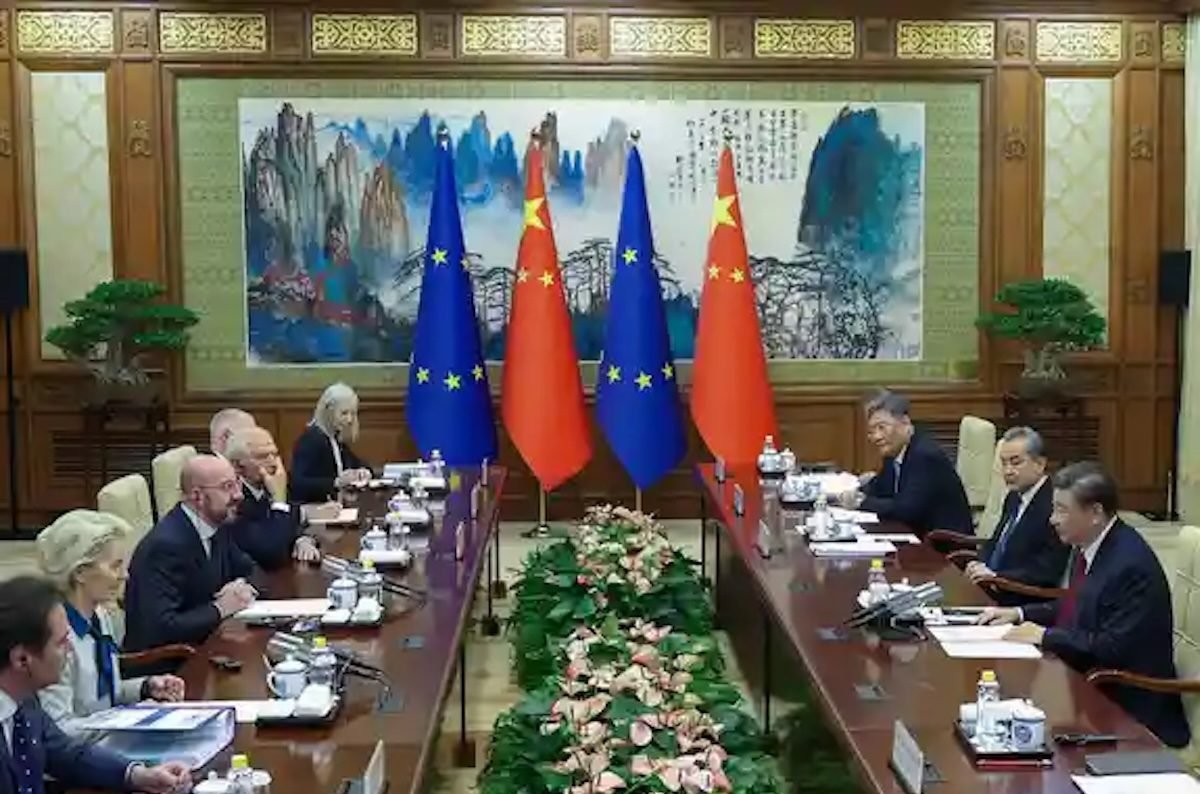
The European Union is embarking on diplomatic hand-to-hand combat with China in an effort to rework its trade with Beijing and show it is not a geopolitical weakling.
Using unusually direct terms, the EU has given China a mid-October deadline to provide ways it will reduce its massive trade advantage over Europe. If not, the EU Commission will make unilateral moves to limit imports of Chinese goods, imposing specific limits on electric vehicle imports and putting tariffs on other industrial goods.
In an early September speech, EU Commission President Ursula van der Leyen laid out the stakes as she sees them. “Our companies do not compete on a level playing field,” she said.” “It leads to deindustrialisation in the industrial heartlands of Europe. This is unsustainable.”
China countered this expression of exasperation with its own harsh language. “Voluntary export restraint is one of the egregious misnomers of modern trade policy, wrote China Daily, an English-language government newspaper. “There is nothing voluntary about a choice made under the threat of punitive tariffs.”
Jion Gong, a professor at Beijing’s University of International Business and Economics, suggested Europe is suffering a kind of nervous breakdown. “It’s a refection of their anxiety. They have to wake up. The best strategy is to embrace competition and investment from China,” he said on CGTN, the state-operated news network.
Certainly, there is deep worry in Europe about its trade relations not only with China but also with the United States. A past EU trade deal with the the US Admiinistration mainly benefited American industries, continental critics argued. Another such accord with China wold sideline the EU as an influential player in the global economy.
Meanwhile, China has already flexed its ability to punish an assertive Europe: In 2025, it withheld exports of rare earth minerals to the EU as part of its retaliation against US limits on high-tech exports to China. In Beijing’s mind’s eyes, the EU is easy to bully. “Beijing judges Europe’s leaders as politically weak, divided on China, and lacking a mandate to launch a trade war against China amidst an actual war in Ukraine and a widening transatlantic rift with US,” wrote Ryan Hass, an East Asia Scholar at the Brookings in Washington.
Valbona Zeneli, a senior fellow at the Atlantic Council’s Scowcroft Center for Strategy and Security, added that, “Washington holds technological leverage; Beijing controls minerals and key manufacturing supply chains. Europe remains exposed to both.”
The question, he added, “Is whether the EU can turn its own economic weight into strategic agency rather than simply absorb the consequences of decisions taken elsewhere.”
Economic statistics suggest an urgent european need for action. The EU’s trade deficit with China leapt from €306 billion (US$347 billion) in 2024 to €360 billion in 2025. This year, the deficit is expected to €400 billion ($408 billion); the gap was €103 billion ($117 billion) in the second quarter.
To reduce this growing deficit, Brussels wants to limit Chinese hybrid vehicle sales to the EU market at 15 percent of total vehicle sales, persuade China to limit exports of an array of chemicals and increase imports of milk and cheese, pork and brandy. EU Trade Commissioner Maros Sefcovic, a diplomat from Slovakia, is in charge of negotiations with China.
He will visit Beijing in advance of an EU meeting in mid-October that will decide whether China has produced satisfactory trade concessions. He will also demand that China end its curbs on critical rare earth minerals to in Europe.
“We are engaged in a dialogue with China to rebalance our trade. But this dialogue must now lead to results. We will use all the tools to rebalance our relationship,” von der Leyen warned.
But critics fear what they call “Panda diplomacy” that fails to resolve fundamental problems and sticks to symbolic gestures – like sending gift pandas to Western zoos.
“To be meaningful for the EU side, a deal cannot consist of a one-off measure involving only one sector, just for China to demonstrate goodwill,” cautioned Gunnar Wiegand, a fellow at the German Marshall Fund, an independent organization dedicated to strengthening transatlantic cooperation.
Despite its perceived weaknesses, the EU “has cards to play” to help bend China to its will, advised the Brookings Institute, a Washington think tank:
- Intensify formal investigations into unfair subsidies of Chinese companies.
- Block Chinese investments in the EU.
- Expand sanctioning on Chinese companies whose sales aid Russia’s war on Ukraine.
China has its own economic problems that the EU can exploit. Consumption is sluggish, while investment in construction and infrastructure along with investments in real estate fell sharply last year.
Urban unemployment also reached 5.3 percent. Subsidies on uneconomical industries were estimated at some 5% of gross domestic product.
And China has its own hidden anxieties: Communist party leadership harbors fear of a kind of economic domino effect should China accedes to EU demands. Other countries might move to ask for trade concessions. “Chinese negotiators are anxious not to agree to a deal which would set a precedent for many other partners,” said Wiegand, a former EU diplomat
He predicted that compromise is unlikely. China is committed to a zero-sum contest in which there can only be one winner, and it won’t be Europe. “Once China has realized all its ambitions, it will have contributed to the impoverishment of its main export markets,” he said.