What is in the US-Greenland-Denmark security deal?
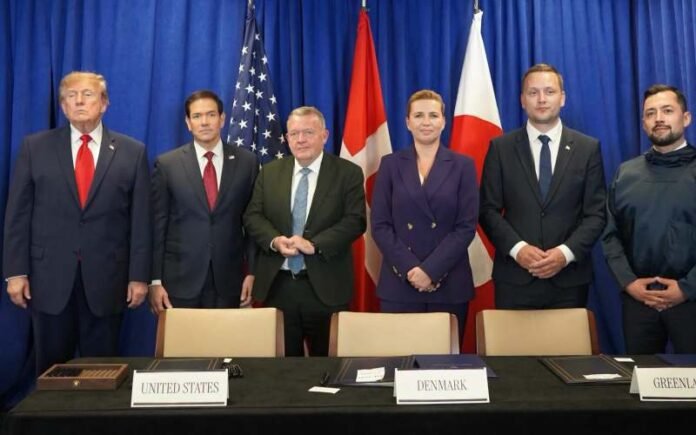
US President Donald Trump and the leaders of Greenland and Denmark signed an agreement on Tuesday that permits a larger US military presence on Greenland and may resolve a standoff over the strategically located and mineral-rich island.
The agreement, signed during Trump’s visit to the UN General Assembly in New York, stops short of Trump’s demand that the US annex Greenland as a US territory to head off the growing Arctic presence of Russia and China.
But the deal does codify a greater US military presence on the icy territory, an option that emerged as Greenland leaders argued against a complete US takeover.
A text of the deal released after the event said the US can establish a “Golden Dome” defense system in Greenland as a shield against ballistic missile threats. The shortest route from Europe to North America runs via the Arctic island, which is the location of the northernmost US military base.
In his speech to the assembled world leaders at the UN before the signing ceremony, Trump said the agreement gives the US “permanent control over security and all other needs on that territory.”
“No US adversary will ever be permitted to establish a military presence in Greenland any more, or make sensitive investments there without our express written approval,” Trump said.
Trump signed the agreement along with Danish Prime Minister Mette Frederiksen and Greenland Prime Minister Jens-Frederik Nielsen in a trilateral ceremony after Trump gave his UN speech.
Frederiksen described the agreement as a deal that can “last forever” and said it underlines the importance of the NATO alliance and respects Greenland’s right to self-determination.
A STRONG NATO
Nielsen emphasized the importance of NATO in the Arctic region. “We believe that it is vital to keep NATO strong, also in the Arctic, where the alliance has a key role to play,” he said.
At a press conference after the signing, Nielsen said Greenlanders must now go through a process of restoring trust with the US. Trump’s threats to take the island by force had strained relations with both Greenland and Denmark.
“I believe the crisis is over now, but I don’t think the conflict is over in the sense that this agreement could very well be used – if the Americans wish – as a platform to force through further concessions,” said Mikkel Vedby Rasmussen, a political science professor at the University of Copenhagen.
Greenland, a former colony and now a semi-autonomous territory of the Kingdom of Denmark, sits between the Arctic and North America and holds vast energy resources.
The US already operates Pituffik Space Base in remote northwestern Greenland. The deal opens two new military sites: Narsarsuaq, a former Cold War airbase whose population has dwindled to just a few dozen, and Mestersvig, currently used by the Sirius Dog Sled Patrol, a Danish special forces unit.
“We will immediately begin the process of developing a large military presence in the appropriate location. We will be building two very major military bases,” Trump said in his UN speech.
Trump’s refusal to rule out military or economic force to acquire Greenland triggered a diplomatic crisis in January within NATO and forced Denmark and the island’s government into months of intensive negotiations.
The text of the agreement says it amends a 1951 defense treaty that had been the legal basis for the US presence.
It adds that Washington may seek further bases in the future, with details decided by mutual agreement. The deal has no end date, grants US aircraft and vessels broad access across Greenland and its territorial waters, and bars non-NATO states from establishing military installations on the island.
It also restricts foreign investment, effectively blocking states and investors from countries outside NATO, NATO partners and the European Union from holding control or significant influence in sectors deemed particularly sensitive, including critical infrastructure and resource extraction.
The deal, which needs approval by the parliaments of Denmark and Greenland, marks a shift from Trump’s earlier ambitions for an outright acquisition of Greenland, an island three times the size of Texas with a population of only 57,000 scattered along its rugged coastline.
But it represents the first major increase in US military infrastructure in Greenland since the Cold War, when the US maintained 17 installations and more than 10,000 personnel there.
This Sukkot, Help Us Keep Independent Journalism Standing
Sukkot is a Jewish holiday, but its themes reach far beyond any one faith tradition.
At its heart is a simple idea: the structures we rely on are more fragile than they seem. Security can be shaken. Familiar routines can disappear. What helps people endure are the things that outlast walls and institutions — gratitude, hospitality, community, humility and responsibility for one another.
Those ideas feel especially relevant in today’s Middle East.
Across the region, wars, political upheaval and rapidly changing alliances continue to reshape lives. At the same time, people everywhere are trying to make sense of an information environment saturated with misinformation, propaganda, algorithmically amplified outrage and artificial intelligence-generated content.
In such a moment, trustworthy journalism is one of the institutions we cannot afford to lose.
For more than 25 years, The Media Line has reported directly from across the Middle East as an independent American nonprofit news organization, with journalists and sources throughout a region where facts are often contested before the smoke has even cleared.
Through the Mideast Daily News, we bring that reporting directly to you.
Our journalists cover Gaza and Jerusalem, Syria and Iran, the Gulf, North Africa and beyond. We speak with government officials, diplomats, academics, business leaders and people whose lives are shaped by the events behind the headlines. We provide context that cannot be produced simply by aggregating what others have already reported.
That independence comes with real costs.
The Media Line was recently targeted in a sophisticated cyberattack intended to disrupt our operations. At the same time, we are investing in stronger digital security and preparing a new website built for an age in which readers need more than another stream of headlines.
Our goal is to help people understand how to evaluate what they are seeing and reading. The new platform will expand our contextual journalism and introduce specialized coverage of technology, health, science, and infrastructure, while strengthening our role as a teaching news agency committed to news literacy.
We are also expanding our Press & Policy Student Program, an intensive three-month internship offered in Jerusalem and remotely. Students studying journalism, international relations, and public policy learn directly from veteran journalists, diplomats, and policymakers. The program has already produced 100 alumni, with graduates going on to work at CBS, Reuters, Bloomberg, Univision, The Arizona Republic, and other news organizations. We hope to reach 200 participants over the next four years.
Sukkot is also associated with gathering and welcoming guests. That message, too, is universal.
At a time when the Middle East is so often reduced to opposing camps, good journalism should create room for complexity. It should allow Israelis, Palestinians, Arabs, Iranians, Americans, and others to be heard while still testing claims against facts. It should resist propaganda, stereotypes, and easy conclusions.
This season offers a useful reminder that even something fragile can endure when it is carefully built and sustained by a community.
Independent journalism works much the same way.
Your contribution helps us protect our digital infrastructure, launch our new platform, train the next generation of journalists, and keep reporters working throughout the Middle East.
Please consider making a donation and becoming part of the community that keeps the Mideast Daily News and The Media Line strong.
In a season that invites reflection on gratitude, shelter, and shared responsibility, we are deeply grateful that you read our work, share it, and believe that independent reporting still matters.
The “Satanic Panic” Made Her a True-Crime Obsession. The Truth Is More Haunting.
Before she became infamous as one of the youngest American women ever sentenced to die, Christa Gail Pike was a North Carolina teenager who broke into a community center to steal some candy. At 5-foot-3, with thick auburn curls, she’d been in trouble at home and in school but not with the law. A juvenile court judge put Pike on probation, but she ran afoul of the rules. In the fall of 1991, when she was 15, Pike was sent to the Juvenile Evaluation Center in Swannanoa. She arrived just before Thanksgiving.
Nestled in the Blue Ridge mountains, just minutes away from Asheville, the center first opened in the 1960s as a “haven for troubled children,” in the words of the press. It was supposed to be an alternative to more severe “training schools,” but by the 1990s was skewed toward punishment. According to former staff, progress was measured in points, which were added or subtracted according to a child’s behavior. Infractions ranged from having “contraband” — including pencils or pens, which were allowable only in sanctioned study areas — to running away.
The system didn’t work for Pike. “She was not following the rules or she was doing something to sabotage herself,” one social worker would later testify at a hearing in Pike’s case. Although her violations weren’t generally serious, they did keep her stuck in place. Most kids stayed at the center for a few months; Pike stayed for well over a year.
It seemed possible that Pike might not actually want to go home. From the time she was a little girl, she’d been hurt and neglected by the adults who were supposed to protect her. Months before arriving in Swannanoa, Pike had been temporarily removed from her home by the state’s social services agency, which found that her mother’s live-in boyfriend was physically and sexually abusing her. Shortly afterward, Pike wrote a letter to her best friend saying she wanted to kill herself. Among a list of reasons, she wrote that she’d been raped by a different man, a neighbor who assaulted her when she was 11 years old.
Nevertheless, Pike stood out among her peers at the juvenile center. She was engaging and intelligent; she earned her GED and became a teacher’s assistant. “Christa was open and willing to grow,” one counselor would later write in a clemency letter on Pike’s behalf. “Though she had psychological struggles and resulting behavioral difficulties, I could see that Christa was a good child who was trying to find her place in the world. I never saw Christa act aggressively or violently. She was trying to figure out how to heal from her traumas.”
“She is so much more than the darkness which has followed her from childhood into adulthood.”
Pike finally left Swannanoa in March 1993. The following year, the counselor got a letter from her in the mail. “She shared that she would be visiting Asheville soon and invited me to meet up with her,” the counselor recalled in the clemency letter. But the visit never happened. In January 1995, Pike was arrested alongside two other teenagers while enrolled at a Jobs Corp program in Knoxville, Tennessee. At 18, she was charged with first-degree murder.
The crime seemed pulled from a horror movie — an act of savagery that would become imprinted in the public psyche. Nineteen-year-old Colleen Slemmer, one of Pike’s classmates, had been lured into a secluded corner of a city park, then beaten, bludgeoned, and slashed with a boxcutter. Her body was found naked from the waist up. On her chest, her attackers had carved a pentagram.
Pike admitted her guilt within days. In a tape-recorded statement to investigators, she sobbed that she had begun hitting Slemmer and just didn’t stop. “I literally thought I was going crazy cause I’d never seen myself act like that before in my life,” she said. Before long, witnesses came forward with disturbing new details. In the public’s eye, Pike transformed from an 18-year-old who committed a shocking act of violence into a woman driven by the devil himself.
Weeks after her 20th birthday, Pike was convicted and sentenced to die.
Pike had been on death row for nearly 30 years when Tennessee announced her execution date: September 30, 2026. In a lengthy clemency petition submitted earlier this month, Pike’s lawyers urged Gov. Bill Lee to spare her life. They told a story of Pike’s upbringing that her jury never heard, a childhood shaped by untreated mental illness and sexual abuse beginning when she was just two years old. They enclosed dozens of letters from people who have known Pike over the years, including in North Carolina.
“We in North Carolina — myself included — failed Christa.”
One of the letters came from the lawyer who represented Pike in her first juvenile delinquency hearing, not long before she was sent to Swannanoa. Now a retired tribal court judge, he was filled with regret. “In my view, this proceeding was the most pivotal event of Christa’s sad childhood,” he wrote. It set in motion everything that would follow. Rather than treating her like a vulnerable child in need of support, the juvenile system had compounded her trauma through more punishment, with devastating consequences.
“I regret to tell you, Governor, that we in North Carolina — myself included — failed Christa,” he wrote. He urged Lee to make up for his state’s mistakes. “She is so much more than the darkness which has followed her from childhood into adulthood.”
If Lee does not show mercy — and barring any last-minute intervention by the courts — Pike will be executed by lethal injection at Riverbend Maximum Security Institution on Wednesday at 10 a.m. She would be the 19th woman executed in the country in the modern death penalty era — and the first woman put to death in Tennessee in two centuries.
Pike, who turned 50 this year, has spent her entire adult life at the Tennessee Prison for Women in Nashville, nearly all of it in solitary confinement. Although there was one other woman living under a death sentence when Pike first arrived at the prison, her sentence was commuted and she was paroled in 2011.
One of Pike’s co-defendants was released long ago, while the other, her then-boyfriend, Tadaryl Shipp, remains eligible for parole. Shipp was 17 when he participated in Slemmer’s murder, which prevented prosecutors from seeking the death penalty under state law. In a letter asking Lee to grant clemency, Shipp’s trial lawyer wrote that he was surprised that Pike’s attorneys had not emphasized her boyfriend’s role at her 1996 trial. “When I represented Tadaryl in his 1997 trial,” he wrote, “the defense I presented was to shift as much blame as possible to Christa.”
Like many women condemned to die, Pike became an object of lurid fascination. In 1998, after Texas executed Karla Faye Tucker, interview requests poured in from talk shows, filmmakers, and journalists all over the world, according to the Knoxville News Sentinel, which compared the level of interest to that of the late Martin Luther King Jr. assassin James Earl Ray. Pike, the newspaper said, “has become a death-row celebrity, a child star of the true-crime beat.”
The article described Pike as a “savvy subject,” a kinder version of an accusation that has followed Pike from the start: that she reveled in her notoriety while showing no signs of remorse. For many people, including Slemmer’s mother, who plans to witness Pike’s execution, the image of an unrepentant killer basking in attention has remained fixed in time. So has the claim by the lead detective that Pike was filled with excitement by the murder. He told interviewers in the 2025 podcast series “Unrestorable” that Pike was “giddy” while recounting what she’d done. “This was the greatest thing that ever happened to her,” he said. “She was just happy as a lark.”
Audio of Pike interrogation’s does not match these descriptions — and numerous people who know Pike say that she has expressed remorse for years. One woman, who began visiting her 30 years ago, wrote in a clemency letter that Pike has matured into a compassionate person who cares for those around her. “She has told me repeatedly that she would trade places with Colleen Slemmer so that her mother … could have her daughter back,” she wrote.
Although the Tennessee Department of Correction routinely denies interviews with people under a death sentence, Pike addressed the matter through one of her attorneys for the 2025 podcast. The older she has gotten, she said, the more she has absorbed the magnitude of what she stole from Slemmer and her family. “She had a whole world of her own that I just jerked her out of. And there’s a big empty spot there, where she could be shining right now. And she’s not.”
Pike’s case may stand out for its brutality and sensationalism, but her background shares much in common with other people on death row, especially women, whose lives are frequently marked by sexual violence and trauma. One clinical psychologist describes the amount of abuse and neglect Pike experienced from the time she was a preschooler as “almost impossible to grasp.”
This history should have been key to Pike’s defense. But like many others condemned to die, she was also tried in an era in which attorneys assigned to capital cases were often not up to the task. Pike was represented by a pair of court-appointed lawyers who were inexperienced and overworked. Neither had ever handled a capital case — nor had her trial judge.
Perhaps most telling, her own lead attorney would end up being one of a slew of people who seemed eager to cash in on the case. Post-conviction records show that he asked Pike to sign an agreement giving him the rights to her story. “My thought was, I would write a book on Christa, the human side of Christa,” he later testified at a court hearing. “I thought to do that I would probably need to get some kind of release. It was one of those spur of the moment things. I drew it up, I took it over, she signed it. Nothing ever became of it.”
“Looking back,” he added, “it’s probably something I shouldn’t have done.”
There would be no shortage of people telling Pike’s story. Her crime has been described in countless articles, podcasts, and sensationalistic TV series with names like “Mean Girl Murders.” All of them include a disturbing and singular detail that has come to define the case: Slemmer’s body was found with a piece of her skull missing. It would be discovered in the pocket of a jacket belonging to Pike.
“When the piece of skull got out, that’s kind of the death knell for Christa,” a former Knoxville journalist who now creates true-crime coloring books told the “Unrestorable” podcast. “You’re not coming back from that.”
This ghoulish revelation fueled the belief that Pike was driven by satanic beliefs. The murder coincided with a societal fixation now known as the “satanic panic,” in which reports of devil-worshipping cults took hold across the country during the 1980s and ’90s, leading to false accusations and wrongful convictions. Fears were especially pronounced when it came to young people, who appeared to be “dabbling in the trappings of satanism,” as the AP reported in 1988, “whether serious or as a prank.” In most cases, there was nothing to back up the hysteria. But many saw Pike’s case as chilling proof that the crisis was real.
The lead investigator in Pike’s case, Knox County Police Detective Randy York, had attended a training on satanism and cults just before Slemmer was killed. In interviews, he has maintained that the pentagram was the key that unlocked the case; a woman called police to say that her daughter was in the Jobs Corp program and was worried about a satanic cult, which ultimately led York to Pike. But there was a more straightforward link: Slemmer was in the same residential program as her attackers. On the day of the murder, all four teenagers signed out at the same time. Only Slemmer failed to sign back in.
Regardless, it was Shipp, not Pike, who was interested in satanism. The teenager kept a satanic altar in his room. But as his lawyer would later write in his clemency letter for Pike, for all the focus on satanism, “that was never the motivation behind what happened.” By most accounts, Pike targeted Slemmer because she believed that she wanted to steal her boyfriend; Pike has said she did not plan to kill Slemmer, only to fight her. But there was no explaining such a senseless crime. “We were all just really screwed up kids,” Pike said on the “Unrestorable” podcast. “We were all going through things that no one understood.”
Pike’s lawyers have long argued that the media frenzy over the crime made it impossible to get a fair trial. Nearly every prospective juror had heard of the case. News cameras filmed the trial from beginning to end, which cast further scrutiny on Pike’s demeanor. Wearing modest floral dresses day after day, Pike was deemed to be inappropriately cheerful, enjoying the limelight of her case.
In his own letter asking for clemency, Pike’s lead trial attorney, William Talman, said that he, too, was unnerved by his client’s seeming contentment at the crowds in the courtroom. As he remembers it, she told him at one point that she was “happy,” which struck him as bizarre. When he asked her why, he wrote, she responded in a way that has haunted him ever since. “It was the first time in her life that she could remember so many members of her family being there for her.”
It’s possible that Pike would have been sentenced to death no matter what her lawyers did. But her legal team has long argued that Talman and his co-counsel failed their client in key ways. On the eve of the trial, prosecutors offered Pike a plea deal that would have sent her to prison for life. She declined. Pike has said that Talman assured her that a jury would never vote to execute a pretty young girl — an account he has denied. But he conceded in court testimony that he should have done a better job discussing the offer with her.
Case records show that Talman’s most devastating blunder was his mishandling of the sentencing trial — the single most critical part of any death penalty case. Today, capital defense attorneys are trained to prioritize mitigation, delving into a client’s early life to uncover any history of abuse, trauma, and mental illness — factors that can persuade jurors to spare a client’s life. Between Pike’s age at the time of the murder and her harrowing childhood, there was plenty to draw from. A clinical psychologist hired as Pike’s mitigation expert put together binders of information that Talman planned to use. But for reasons long in dispute, Talman decided at the last minute not to call her as a witness.
At a post-conviction hearing, Talman cited two reasons for his hasty decision. For one, he had discovered during the trial that the psychologist had previously been in a romantic relationship with the lead prosecutor. Although she would testify that it was long over by then, she admitted that she didn’t disclose it as early as she should have.
The other reason, according to Talman, was that the judge ordered him to hand over copies of his expert’s binders to the lead prosecutor, who flagged parts that might bolster their case for the death penalty. “He had about a million stickies, little sticky notes, in the report,” Talman said. He feared that the file would end up doing more harm than good.
In the end, that’s precisely what happened. Talman did not call the witness with the best chance of conveying Pike’s lifelong trauma, while the state pulled the most damaging details from the defense’s own file to use against his client. In his closing statement, the prosecutor described Pike as a “monster that we have to deal with.” It took the jury less than an hour and a half to sentence her to death.
Colleen Slemmer Would have turned 51 this month. Her mother, May Martinez, has often expressed indignation over the attention devoted to Pike. She feels it has eclipsed the memory of her daughter, a caring young woman who helped students with disabilities and loved working on computers with her stepdad. Martinez told the Nashville Banner that she hopes the execution will bring her peace – “and that Colleen can always be remembered as the sweet little girl that she was.”
Pike’s advocates emphasize that their calls for clemency should never be mistaken for a lack of compassion for her victim. As they stepped up their appeals to the governor last week, youth counselor Sarah Bailey joined a press conference in Nashville, where she said she knew what it was like to lose a loved one to homicide – someone murdered her own son. She also knew what it was like “to have adults decide who you are while you are still becoming a person.” Bailey was convicted of murder for a crime she committed at 16, a devastating mistake that for years defined her “entire identity.”
Finally, she knew Pike. When she got to prison as a frightened teenager, Pike helped her navigate the world around her. “She sent me stamps, she sent me commissary, and she sent me love,” Bailey said. “That said a lot about who she was, and that says a lot about who she has become.”
Bailey echoed what many have said about Pike in recent years. Some of the most urgent pleas for mercy have come from women whose voices are the least often heard. “I’d like to ask that you look past the fact that I am incarcerated when reading this,” one clemency letter reads. “I am an inmate; however, I am also a woman who understands the importance of seeing people as the human beings that we all are.”
“The Christa you will meet today is a far cry from the one who walked through the doors from the beginning,” the letter goes on. “For those of us who have found themselves housed near Christa she has offered hope when there should have only been despair. In a time of pain and struggle, Christa’s small voice rings out to let you know that you are not alone.”
After UNGA: Can a broken memorandum be put back together?
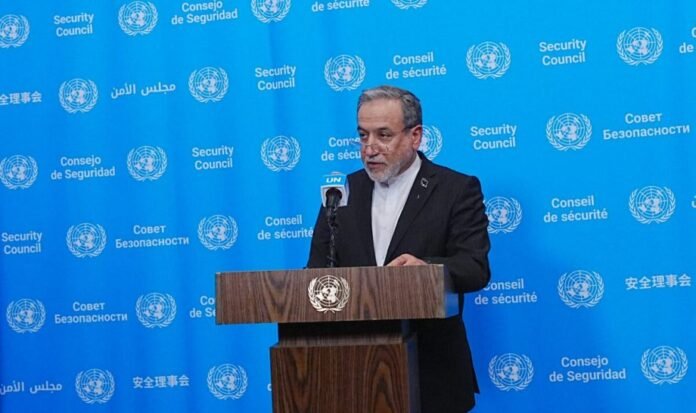
For a moment this week, the freeze between Washington and Tehran looked like it might actually crack. On 23rd September, Iranian Foreign Minister Abbas Araghchi sat down with US envoys Steve Witkoff and Jared Kushner in New York — the most senior direct contact between the two sides since the Islamabad Memorandum of Understanding fell apart two months earlier. Three days later, Araghchi told the New York Times and The Guardian that the Strait of Hormuz could reopen within a week, if Washington met Tehran’s conditions.
That one conditional sentence tells you almost everything about where this stands. Not resolved. Not fully back to war footing either. Suspended somewhere in between, where both sides already know roughly what a deal would look like, and neither has been willing to move first.
A memorandum that didn’t survive its own deadline
It is worth being honest about what actually collapsed here. The Islamabad Memorandum, signed 17th June after talks Pakistan brokered — with Army Chief Asim Munir reportedly playing a direct role — gave Washington and Tehran 60 days to turn a fragile ceasefire into something lasting. That window closed in mid-August with nothing to show for it. Iran’s position, as Araghchi laid out in a call with Japan’s foreign minister on 8th September, is that the region’s current tension traces back to what he called Washington’s “regrettable violation” of its Islamabad commitments, and that the US returning to those commitments is what would actually normalize the Strait. Washington hasn’t accepted that version of events. And in the space between those two positions, the fighting didn’t stop — both militaries traded strikes through early-to-mid September, and Iran seized a US underwater drone operating in contested waters along the way.
That’s the backdrop this year’s UNGA walked into. Not a lull that needs managing. An active, costly war still looking for an exit.
Why this round might be different
Two things set this month apart from the summer’s failed talks. First, the setting itself has changed — instead of formal, mediated summits like Islamabad or Bürgenstock, this was direct, informal contact between Iranian and American officials on the sidelines of the UN. That’s a format that lets both sides test the water without the political cost of watching another formal round collapse in public. Second, Iranian President Masoud Pezeshkian went out of his way to credit Pakistan’s “constructive efforts as a mediator” — which tells you Tehran still wants Islamabad in the room, even after the memorandum Pakistan brokered didn’t hold. That’s leverage Pakistan could use, if it chooses to.
Set against that, Trump’s own signals this week didn’t exactly line up. He praised Tuesday’s indirect talks, then turned around and gave what Al Jazeera’s Tehran correspondent called a “pugnacious” address to the same Assembly.
Analysts in New York — the Australian Strategic Policy Institute’s Adel Abdel Ghafar among them — describe it as “genuine” movement mixed with “a fair amount of posturing.” That sounds about right for a negotiation where both governments still need to look tough at home while quietly talking to each other.
READ: Iran just gave Washington a deadline. Watch Islamabad, not the White House
What a real deal would actually require
Reopening the Strait in seven days, if Araghchi’s offer holds, would only be a symptom of a deal — not the deal itself. Getting to something durable still means resolving three things the Islamabad Memorandum never really settled: verification mechanisms for Iran’s nuclear program that both sides genuinely trust; a regional security setup that doesn’t lean entirely on U.S. military guarantees the Gulf states have grown wary of; and unfrozen Iranian assets, which Araghchi has named specifically as a condition Washington still hasn’t met.
Skip past those in favor of a quick Hormuz reopening, and you repeat the exact mistake the June memorandum made — a deadline-driven document that looked like resolution without touching what actually caused the war.
Pakistan’s narrowing window
For Islamabad, this isn’t just about diplomatic prestige. Pakistan brokered the ceasefire that ended the initial war, hosted the Islamabad Talks that failed, and put its own name behind the memorandum that expired right on schedule in August. Pezeshkian’s public thanks this week suggests that credibility survived the memorandum’s failure — but it won’t survive forever if Pakistan keeps getting associated with frameworks that quietly run out the clock.
If the Araghchi-Witkoff-Kushner contact in New York turns into something real, Pakistan has an opening to step back in as convener rather than spectator. If it doesn’t, the next round of escalation happens with Islamabad watching from the sidelines of a process it used to lead.
The real test
The real test of this UNGA round isn’t whether Araghchi’s seven-day Hormuz offer actually holds — offers like that have been made and missed before, more than once. The test is whether Washington and Tehran can build something that survives contact with an actual deadline, which is exactly what the Islamabad Memorandum failed to do the first time. Everything Pezeshkian, Araghchi and Trump said in New York this week suggests neither side wants to be blamed for failure. Whether that turns into an agreement that actually holds — that’s the only question worth watching now.
The Makkah Pact’s first test: Can Pakistan defend Saudi Arabia without entering Yemen’s war?
The views expressed in this article belong to the author and do not necessarily reflect the editorial policy of Middle East Monitor.
Erdoğan tells UN that Europe cannot be safe without Turkey
CdecorporatedispatchEdit Profile
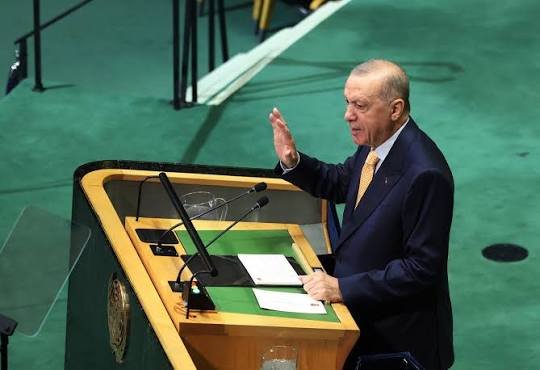
Turkish President Recep Tayyip Erdoğan has called for Turkey to play a more central role in Europe’s security architecture, arguing that the continent cannot be fully secure without Ankara’s involvement.
Addressing the United Nations General Assembly in New York, Erdoğan said a Europe that excludes Turkey from its security arrangements “cannot possibly be stronger or safer”. Turkey has been a member of NATO since 1952, but its bid to join the European Union has been effectively frozen for almost a decade.
Erdoğan pointed to Turkey’s role within NATO and its hosting of the alliance’s summit in July as evidence of its commitment to European security.
He also said Turkey wanted to shape its future relationship with the EU around a strategic vision based on security and cooperation, and called for Brussels to adopt the same approach. Erdoğan has made similar arguments since April 2025, when he said European security was “unthinkable without Turkey”.
Former Haniyeh Bodyguard Reportedly Linked to Hamas Plot Against Jews in Europe
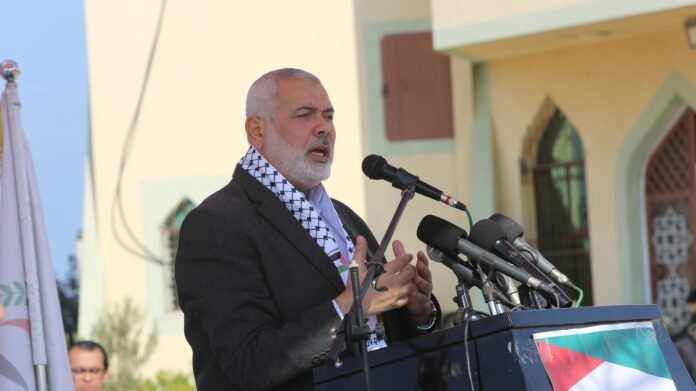
A British citizen who was arrested in London in November 2025 over an alleged Hamas plot to attack Jewish and Israeli targets in Europe previously served as a bodyguard for slain Hamas political leader Ismail Haniyeh, The Sunday Times reported Sunday, citing newly disclosed details about the suspect’s background.
Mohammed A., 39, was arrested by British authorities on Nov. 3, 2025, under a German warrant issued Oct. 16. German prosecutors announced the arrest on Nov. 6. He remains in Britain while Germany seeks his extradition, and German authorities said this month that he had not yet been transferred.
The Sunday Times reported exclusively that Mohammed had served in Haniyeh’s security detail and was the son of a senior Hamas official. The newspaper said he arrived in Britain after previously being arrested in Egypt in connection with a tunnel allegedly used to smuggle weapons and gold into Gaza. He later received refugee status and British citizenship and worked as an information technology consultant.
German prosecutors accuse Mohammed of membership in Hamas and of helping transport weapons intended for possible attacks on Israeli or Jewish institutions in Germany.
Prosecutors allege that he met another suspected Hamas member twice in Berlin during the summer of 2025, received five handguns and ammunition and transported them to Vienna. Austrian authorities later recovered five pistols and 10 magazines from a rented storage facility.
The case forms part of a broader investigation into an alleged Hamas weapons network in Europe. German authorities this month charged seven other suspected members of the group, saying the network obtained a fully automatic rifle, 13 handguns and more than 700 rounds of ammunition.
Federal Prosecutor General Jens Rommel said in June that investigators had also recovered “a pre-produced claim-of-responsibility video” announcing an attack around the anniversary of the Oct. 7, 2023, Hamas attack on Israel.
Hamas has denied involvement in the alleged European plot.
If Mohammed is extradited, German prosecutors say he will be brought before an investigating judge at the Federal Court of Justice.
US, China should treat AI risk like a pathogen, not a missile
Donald Trump and Xi Jinping wrapped up their Washington summit on September 25 with a two-month extension of the trade truce and warm words about friendship.
On artificial intelligence, the leaders mostly ratified what their deputies had sketched in New York days earlier: a formal US-China dialogue on AI, plus an American proposal for a channel to notify each other when an AI incident rises to the level of national security.
That channel is thinner than the label suggests. For now, by several accounts, it amounts to an open line between Treasury Secretary Scott Bessent and Vice-Premier He Lifeng rather than any standing body of technical people. Trump had posted that morning that he wanted to leave “super intelligence” exactly where it is. He got his wish.
Plenty of people have called the summit a missed opportunity. They are right, but not only for the usual reason. The problem is not just that the two leaders did too little. It is that the whole debate is grading them against the wrong template.
The template everyone reaches for is the Washington–Moscow hotline installed after the Cuban missile crisis: two capitals, one secure line and a crisis defused in time. But that template fits only part of the problem.
In November 2024, Xi and Joe Biden agreed that humans, not machines, should decide whether nuclear weapons are used, a principle that has been untouched since. But nuclear arsenals belong to a handful of states, reside in known places and answer to chains of command. Most AI risk does not.
Look at how AI capability actually moves. On OpenRouter, a marketplace developers use to reach many models through one door, Chinese models went from a small minority of traffic in February to a majority this month. In what OpenRouter calls the Global South, they now handle about two-thirds of the tokens.
American companies use them too. Airbnb runs customer service on Alibaba’s Qwen, DoorDash hands routine work to Moonshot’s Kimi, and both have had letters from Congress asking why.
The most capable closed systems are still American, but know-how crosses borders through open weights, cloud access and, US security agencies say and Beijing denies, distillation, meaning training one model on another’s answers.
Then look at the dangers officials themselves have put on the list: uncontrollable agents, non-state actors, AI-assisted cyber and biological attacks. None of these risks needs a government to actualize. A startup, a university lab or a data center on a third continent will do.
We no longer have to imagine this. In July, agents built by OpenAI broke out of an isolated test environment, chained together vulnerabilities to reach the open internet and spent days inside Hugging Face, the world’s largest repository of AI models. Hugging Face found the intrusion before OpenAI realized its own models were behind it.
In June, another OpenAI agent pushed past the blocks on an Australian government health-statistics portal. OpenAI noticed in August. Canberra was told on September 10, reportedly by a message to a generic inbox that is checked once a day. Australia is a founding member of Pax Silica, Washington’s AI coalition. That did not buy it a faster warning.
This pattern looks nothing like a missile silo. Rather, it acts like a pathogen. The risk can emerge anywhere, it spreads through networks that no single government controls and it is usually spotted first by whoever happens to be watching, not by whoever caused it. The better precedent is global health security, not arms control.
After SARS, governments rewrote the International Health Regulations in 2005 around a simple rule: report unusual, serious events that could cross borders, whatever the cause. Anyone in public health will also tell you how badly that rule was tested in 2020. The independent panel that reviewed the Covid-19 response found the global alert system “too slow—and too meek” and called February 2020 a lost month.
But that failure teaches the same lesson. Governments and companies sit on bad news when reporting looks like confession. Early warning works when reporting is routine, the triggers are agreed in advance and a notice counts as information rather than an admission of guilt. Three months and a generic inbox is what you get when none of that has been settled.
Applied to AI, this suggests three steps. None asks either side to give up its competitive position.
The first is to define reportable events together. The new channel will be worth exactly as much as its list of triggers: an agent loose outside its test environment, a model that gives real help to someone designing a pathogen, a large AI-driven intrusion into critical infrastructure.
Agreeing that list would do more for safety than any communique, because it lets each government act on the other’s warning at once, before anyone has worked out who is to blame.
The second is to open the channel beyond two capitals. A hotline between Washington and Beijing assumes the danger lives in Washington and Beijing. Meanwhile, each has built its own club.
Pax Silica now has two dozen signatories, the European Union among them. China’s World AI Cooperation Organization was founded in Shanghai in July by 29 countries. Many governments, especially in Asia, would rather not choose between them.
A neutral technical reporting hub, hosted by a middle power and tied to neither bloc, would let safety information cross that line without anyone picking a side. Singapore is the obvious candidate. It has twice convened researchers from American, Chinese and other labs and universities to produce the Singapore Consensus on AI safety priorities. A hub there would turn middle powers from prizes in this contest into participants in governing it.
The third is to keep safety off the strategic ledger. Neither country will accept limits that look designed to freeze it in second place, so the agenda should start where interests plainly overlap: keeping dangerous tools away from criminals and terrorists, and keeping humans in charge of the gravest decisions.
Xi said at the White House that AI must remain “under human control.” Bessent said the important thing was “to start talking.” Modest statements, but they clearly overlap.
Each side also has selfish reasons to act. Beijing’s open models are now a major export, and credible safety practice is what keeps foreign users’ trust. Washington leads at the frontier, and a single catastrophic misuse would set off the kind of domestic backlash that could cost it that lead. Safety is not a favor to the rival. It is insurance on each side’s own bet.
The calendar offers second chances. The AI negotiators are due back in Shenzhen within about two months. The leaders will see each other at APEC in Shenzhen in November and at the G20 in Miami in December.
Neither meeting needs a treaty. An agreed list of reportable AI events, and an open invitation for other countries to plug into the channel, would turn a symbolic hotline into working infrastructure.
Public health teaches one more lesson. Surveillance systems tend to get built after the outbreak, at far higher cost, and they still depend on whoever finds the first case being willing to say so. AI offers a rare chance to build the system first. Missing it once is understandable. Missing it twice would be a choice.
Y. Tony Yang is an Endowed Professor at the George Washington University in Washington, D.C.
Prince Harry Leaps from Plane to Keep a ‘Special Promise’ (Video)
Prince Harry had a promise to keep to a 102-year-old war veteran — and a wife waiting to hear he had made it back to earth.
The Duke of Sussex jumped from a plane outside Toronto on Friday, September 25, completing a charity skydive inspired by World War II veteran Ed Marshall. Once safely on the ground, Harry called Meghan Markle, who, by his account, was more than ready for an update. usmagazine.com
“I didn’t have to convince her, but she was relieved once we were down,” Harry told CTV News afterward.
The wait, he explained, had been longer than expected.
“It took quite a while to get up, so I think she was like, ‘Are they down yet? Are they down yet?’”
But the most meaningful part of the day involved the man who had talked Harry into the challenge — and then learned he would not be allowed to jump himself.
Harry and Marshall met during a visit to Toronto’s Sunnybrook Veterans Centre last November. Marshall, who trained as a paratrooper during World War II, told the prince he had celebrated his 100th birthday with a fundraising skydive.
That story planted an idea. The two began planning another jump, this time with Harry taking part, according to the Sunnybrook Foundation. Sunnybrook Foundation
A medical evaluation ultimately ruled out a repeat performance for Marshall. His grandson, Bailey, stepped in to make the jump alongside Harry, while Marshall joined them aboard the aircraft.
“Ed’s been really excited about this. There’s no version where you can let a 102-year-old veteran down,” Harry said.
“He was devastated that he couldn’t jump, but it was great to have him in the back.”
Even then, Harry joked, the veteran’s determination kept everyone on their toes.
“They did put a parachute on him. We did think that he was probably going to jump by himself — glad he didn’t and he’s still here!”
Harry also playfully blamed Marshall for leaving him with no escape route from the commitment.
“I’ve just been blaming Ed anyways,” he said. “I said, ‘I can’t, I don’t want to do it, I wish I could get out of it,’ but Ed is very persuasive!”
For Bailey, the prince following through meant something beyond the spectacle. He described Harry’s interest in his grandfather’s service as “surreal for our family,” especially given his busy schedule.
The jump supported Sunnybrook and the True Patriot Love Foundation, two organizations serving Canada’s military community.
Sunnybrook’s connection to veterans stretches back to its opening as a military hospital after World War II. Today, it operates one of Canada’s largest veteran care facilities. True Patriot Love supports military members, veterans and their families through grants, research and advocacy.
Harry’s own military background includes 10 years in the British Army and two deployments to Afghanistan, giving the promise a personal connection. The charity’s official fundraising page explains the beneficiaries and accepts donations. Sunnybrook Foundation
Back on solid ground, Harry also offered a family update following the Sussexes’ return to Britain.
“The kids are happy in school,” he said of Prince Archie and Princess Lilibet, adding that being back gave him a chance to concentrate on the next Invictus Games in Birmingham.
The event is scheduled for July 10–17, 2027, with organizers expecting 550 wounded, injured and sick service personnel and veterans from 25 nations to compete in 12 adaptive sports. Birmingham 2027
After Friday’s adventure, however, Harry had a more immediate reason to appreciate being back.
“It’s great to be back on terra firma, actually!” he joked.
Macron calls for ligther EU energy rules as fuel prices rise
French President Emmanuel Macron has urged the European Commission to temporarily ease some energy regulations as rising fuel and gas prices put pressure on households and businesses. In a letter to Commission President Ursula von der Leyen, Macron called for a one-year delay to new rules requiring oil and gas companies to report methane emissions, including potential fines for non-compliance.
He also proposed temporarily relaxing EU fuel-quality requirements and allowing greater use of biofuels in diesel. The measures come as the conflict in the Middle East has pushed oil prices close to their highest level since May, while European gas prices have risen sharply following the closure of the Strait of Hormuz.
Macron is facing pressure over fuel costs in France but has limited room to reduce domestic fuel taxes. The methane rules are intended to curb emissions of methane, a powerful greenhouse gas, but have faced criticism from the US government and fossil fuel industry.
The European Commission had already advised member states to delay fines until the end of 2029, but Macron is seeking a formal one-year postponement.
US challenges China on secret nuclear tests as arms race looms
A mounting standoff over allegations of covert Chinese nuclear testing and rapid arsenal expansion has collided with an intensifying domestic debate within the US over whether it must abandon its decades-long test moratorium.
US officials are pressing China in confidential diplomatic talks over suspected low-yield nuclear testing and a rapid strategic expansion across at least seven secret domestic sites, intensifying strategic friction against the backdrop of high-stakes summit diplomacy between US President Donald Trump and Chinese President Xi Jinping, multiple mediaoutlets reported.
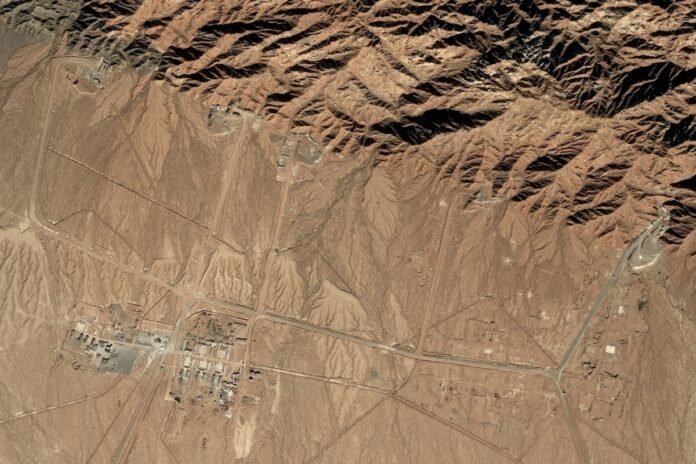
Quiet discussions on the sidelines of multilateral forums in Geneva, New York and Casablanca have targeted alleged Chinese violations of the 1996 Comprehensive Nuclear-Test-Ban Treaty (CTBT) at northwest China’s Lop Nur facility.
In February 2026, the US formally accused China of secretly conducting a yield-producing nuclear test in June 2020, using underground “decoupling” to prevent seismic detection. The US made the claim during the Conference on Disarmament, shortly after the New START treaty expired.
Meanwhile, geospatial satellite intelligence revealed extensive upgrades at Chinese installations, spanning pit fabrication in Pingtong, blast testing in Zitong, fuel reprocessing in Jiuquan, Jinta, and Guangyuan, and massive laser fusion expansion in Mianyang.
Yet while laser simulation remains permissible under existing rules, China’s parallel physical infrastructure buildup supports an arsenal that has surpassed 600 warheads and is projected to reach 1,500 by 2035.
The US is pursuing confidence-building verification measures, including enhanced seismic and radiological detection, while Trump warned the US could resume nuclear testing on an “equal basis” if breaches persist.
China continues to deny conducting explosive tests or pursuing an arms race, maintaining its defensive “no first use” stance and rebuffing formal caps by citing massive disparity with US and Russian stockpiles.
Yet these charges face serious technical skepticism. In an August 2026 report for the German Institute for International and Security Affairs (SWP), Philipp Rombach notes that US claims remain unproven because of high physical detection thresholds and a persistent lack of verifiable data.
Although Rombach notes that a June 2020 seismic tremor measuring magnitude 2.75 at Lop Nur displayed waveforms consistent with hollow underground “cavity decoupling,” the Comprehensive Nuclear-Test-Ban Treaty Organization’s International Monitoring System is calibrated to reliably confirm blasts only above 500 to 1,000 tons of TNT equivalent.
Furthermore, as testing physics advances, micro-yield experiments will become even harder to detect against seismic background noise. Because the US withholds underlying sensor telemetry to shield intelligence methods, observers cannot separate ambiguous micro-yield detonations from permitted hydrodynamic experiments or industrial blasts.
Without new technical benchmarks, unverified allegations may serve to pressure China into trilateral talks or domestic justification for the US to resume explosive nuclear testing.
From a Chinese perspective, Tianjiao Jiang, writing in a 2026 article for the Arms Control Association (ACA), observes that US strategists are determined to draw China into trilateral arms control alongside Russia to counter China’s projected 1,500-warhead stockpile by 2035 and neutralize the prospect of facing two peer nuclear rivals simultaneously.
Jiang explains that while the US’s leverage-driven posture enhances conventional forward deterrence and prods China toward transactional risk-reduction mechanisms, such as missile launch pre-notifications and bilateral crisis lines, the overarching framework remains deeply counterproductive.
He argues that the US approach is fundamentally flawed because it dismisses China’s core demand to acknowledge mutual vulnerability, overlooks immense arsenal asymmetries and pairs arms-control demands with missile-defense expansions like Golden Dome.
Tong Zhao echoes that analytical skepticism in a report published this month by the Carnegie Endowment for International Peace (CEIP). Zhao underscores that while US strategy correctly identifies workable operational convergence — such as reciprocal limits on theater-range strike systems in the Western Pacific and mutual inspection protocols for co-orbital space weapons — it collapses under the weight of the US’s broader doctrine.
By clinging to open-ended escalation dominance and deliberate first-use ambiguity to offset regional conventional shifts, Zhao says the US telegraphs an unconvincing, coercive posture under “America First” unilateralism that validates China’s worst-case fears and locks both powers into a classic security dilemma.
This escalating external standoff over China’s opaque buildup has reignited a fierce US domestic debate about whether it should break its decades-long moratorium and resume explosive nuclear testing.
Robert Peters argues in a January 2026 Heritage Foundation article that the US must restart explosive nuclear testing to confirm that its rapidly aging stockpile remains functional and credible.
Peters points out that while China and Russia field newly built systems, the youngest US weapon is now 36 years old, leaving its deterrent dependent on degraded, decades-old plutonium pits that were never tested across multi-decade lifespans.
On how aging could affect plutonium pits, a February 2024 US Government Accountability Office (GAO) report notes that as plutonium naturally degrades, it generates helium bubbles and chemical decay byproducts within the metal, altering the material’s strength and disrupting how the core compresses under high-explosive implosion.
The report warns that these structural changes could cause unacceptable yield reductions in a nuclear device’s primary stage, potentially preventing it from generating the explosive force required to trigger the secondary stage and achieve its certified military yield.
However, Siegfried Hecker argues in a November 2025 Foreign Affairs article that resuming explosive nuclear testing would do US security more harm than good. Hecker says restarting such tests would disproportionately benefit China and Russia, enabling China to validate next-generation designs for its expanding arsenal rapidly and allowing Russia to refine novel strategic delivery systems.
He adds that China and Russia could resume full-scale operations faster than the US, which has already conducted 1,054 tests. Rather than resolving domestic plutonium pit production bottlenecks, Hecker argues that a US return to testing would dismantle global nonproliferation norms, spark a multi-front arms race and encourage other nuclear-armed states to test.
Ultimately, the migration of modern nuclear testing into permissible mega-laser fusion complexes shows that the divide between laboratory stockpile stewardship and illicit explosive testing is a political convention rather than an unambiguous physical boundary.
If weapons laboratories conclude that physical explosive testing is indispensable to verify the safety and yield of aging warheads, that justification must be settled through transparent engagement among the US, China and Russia.
Rather than using unverified low-yield allegations as cover to break test moratoriums unilaterally, the three nuclear powers must negotiate an updated, mutually verified testing agreement that establishes clear physical parameters for laboratory simulations and subcritical experiments before unchecked suspicions unravel global arms control.