FBI Tip Leads to Arrest of Pakistani Teen in AI Poison Plot
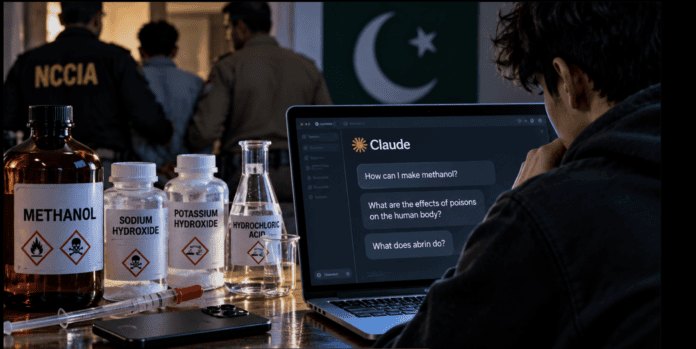
[ISLAMABAD] Pakistan’s cybercrime authorities have arrested a 17-year-old boy who allegedly turned to an artificial intelligence platform for guidance on poisoning his father, officials said.
The National Cyber Crime Investigation Agency (NCCIA) said information received from the FBI indicated that the teenager was allegedly planning to kill his father and had sought information from the AI platform Claude about carrying out the plan.
The NCCIA said in a statement that the suspect was influenced by the popular US television series Breaking Bad and had asked various AI chatbots for information on how to produce methanol.
An NCCIA investigating officer told the BBC that the suspect was still being questioned and that the case remained under investigation. The officer said the arrest was made on the basis of the suspect’s digital footprints.
According to the First Information Report (FIR) registered in the case, the FBI information was conveyed to the NCCIA by Pakistan’s Ministry of Foreign Affairs through an official communication on September 22.
The information alleged that a user of Claude AI had been conducting detailed research into lethal toxic substances, their use and potential effects.
The FIR said digital evidence shared with Pakistani authorities indicated that the user had allegedly made an initial attempt to poison his father by mixing laboratory-grade methanol into his food. After the attempt failed, he allegedly sought further information from the AI about abrin, a toxic substance derived from rosary peas.
Investigators also seized an iPhone 15 Pro Max during a search of the suspect’s home, along with several chemicals, including methanol, ethylene glycol, hydrochloric acid, potassium hydroxide, and sodium hydroxide. The FIR identified the substances as potential chemicals that could be used in preparing poison.
According to the preliminary report, the FBI also shared the email address linked to the account and information on multiple IP addresses with Pakistani authorities. Using these details, NCCIA Lahore began tracing the suspect digitally and verifying his identity through the National Database and Registration Authority (NADRA) system.
The suspect allegedly sourced chemicals from Australia and Islamabad before preparing a poisonous mixture at his home. The NCCIA spokesperson said the teenager reportedly administered the substance to his father on one occasion, but the alleged poisoning attempt was unsuccessful.
According to NCCIA director Hassam Bin Iqbal, the suspect had an interest in chemistry. His aim was to experiment with producing biodiesel from methanol by using sodium hydroxide and potassium hydroxide in the process. “After that, the suspect turned to AI and asked what reaction methanol would cause in the human body if ingested, and what effects it would have on the liver,” he said.
The case highlights a growing concern over the misuse of artificial intelligence, particularly by young users who may turn to AI tools for information that can have serious real-world consequences.
Trump administration takes Musk’s side in fight over EU tech rules
The Trump administration is seeking to join Elon Musk’s appeal against a €120 million EU fine of the billionaire’s social media platform X, the latest escalation in the transatlantic clash over Brussels’ efforts to rein in US tech companies.
The US Department of Justice on Thursday filed an application to intervene in a pair of cases brought by Musk and X seeking annulment of the penalty, which will be heard at the EU’s General Court in Luxembourg.
“The European Commission inappropriately attempted to expand its regulatory authority to reach American companies not present or operating within its jurisdiction,” assistant attorney general Brett Shumate said.
“We will not tolerate the European Commission engaging in regulatory overreach to try and control American engines of innovation and economic growth,” Shumate added.
The European Commission in December last year fined X €120 million for breaking the Digital Services Act, the first such penalty under the bloc’s online safety regime. It accused the platform of breaching its regulations for transparency, providing insufficient access to data and the deceptive design of its blue-tick system for verified accounts.
The DSA, a more aggressive set of rules to police online players, has become a flashpoint between Brussels and US tech companies. Donald Trump’s administration has supported claims by US companies that the EU is unfairly targeting American groups and infringing freedom of speech principles championed by the Maga movement.
Several senior figures of the administration, including US Vice President JD Vance, have criticized the EU’s fining X. Musk is one of the largest donors to President Trump and his favored Republican candidates ahead of the midterm elections.
In its statement, the DOJ said the DSA had improperly “extended legal scrutiny to Mr. Musk himself as a private individual and implicated entirely separate and unrelated American corporate entities under his ownership
The DOJ also asserted that the Commission inappropriately calculated the fine based on the combined global annual revenue of other companies that Musk controlled, rather than what X earned within its jurisdiction.
In March 2025, X was first merged with Musk’s artificial intelligence company xAI, which was subsequently acquired by his rocket maker SpaceX ahead of its public listing in June this year.
SpaceX declined to comment.
Separately, the EU is investigating X for other potential breaches under the DSA, including whether the company has assessed and mitigated risks associated with the integration of its AI chatbot Grok into X for EU users.
Apple is also appealing a €500 million fine imposed under the EU’s related Digital Markets Act for anti-competitive behavior in its app store.
Trump has railed against the penalties, calling them “overseas extortion” and called them a “form of taxation.” During his first administration, the president unsuccessfully tried to influence Apple’s challenge against a €13 billion Irish tax bill.
Jeff Hough did not pull any punches. What his fellow Republican county commissioners were about to do, he said to the packed courthouse, would violate America’s founding ideals. He quoted the Declaration of Independence to make his case.
The three-person commission was about to vote on an ordinance that would ban utility-scale solar and wind development in Bannock County, Idaho.
“We cannot deny the entire county the opportunity to exercise their property rights,” Hough said. “That goes against the principles this country was founded on.”
A few minutes after Hough’s emphatic speech, the ordinance passed by a 2–1 vote. Hough was the lone dissenter.
Since that consequential vote in March 2024, Hough has become the chair of the county commission and has dedicated himself to overturning that ordinance. He will soon have a chance to make that happen. This fall, Hough and the other two commissioners are set to vote on an ordinance with new language that would allow the development of solar and wind, along with nuclear energy, in the county.
The Bannock County vote is a test case of whether — and how — a community can revisit its assumptions about the costs and benefits of clean energy and decide to welcome development it once swore off.
In 2025, nearly 1 in 4 U.S. counties had some kind of ban, moratorium, or impediment to clean energy development, up from 15 percent of counties in 2023. More than 60 percent of counties with bans are rural, according to a Daily Yonder and Canary Media analysis of data from USA Today and the Sabin Center for Climate Change Law at Columbia University. (The Daily Yonder defines “rural” using criteria from the U.S. Office of Management and Budget.)
Bucking this national trend and reversing the ban would put Bannock County back in play at a moment when Idaho needs all the energy it can get. Idaho Power, the state’s largest utility, expects electricity demand to grow by 1 gigawatt by 2030, a roughly 26 percent leap from current levels.
“The need to build stuff now is critical to Idaho’s economic future,” said Aaron Menenberg, the Idaho policy manager for Renewable Northwest, a nonprofit working to decarbonize the region’s grid. “We can’t afford to say no to anything.”
Bannock County, nestled in a valley a few hours north of Salt Lake City and 100 miles west of Wyoming’s Teton Range, is a prime location for new power plants. It’s home to the Populus substation, a critical juncture for getting electrons onto the grid and into Idaho, Utah, Wyoming, and the Pacific Northwest. Building new power plants near a substation is cheaper, and those savings can help bring down costs for utility customers.
But the biggest opportunity for county residents, as Hough sees it, is not utility-bill savings: It’s economic development. In recent years, Bannock County’s population has grown far more slowly than Idaho’s. The county’s rural communities, meanwhile, are watching essential services disappear, and drought worsened by climate change is making it difficult for family farms to stay afloat.
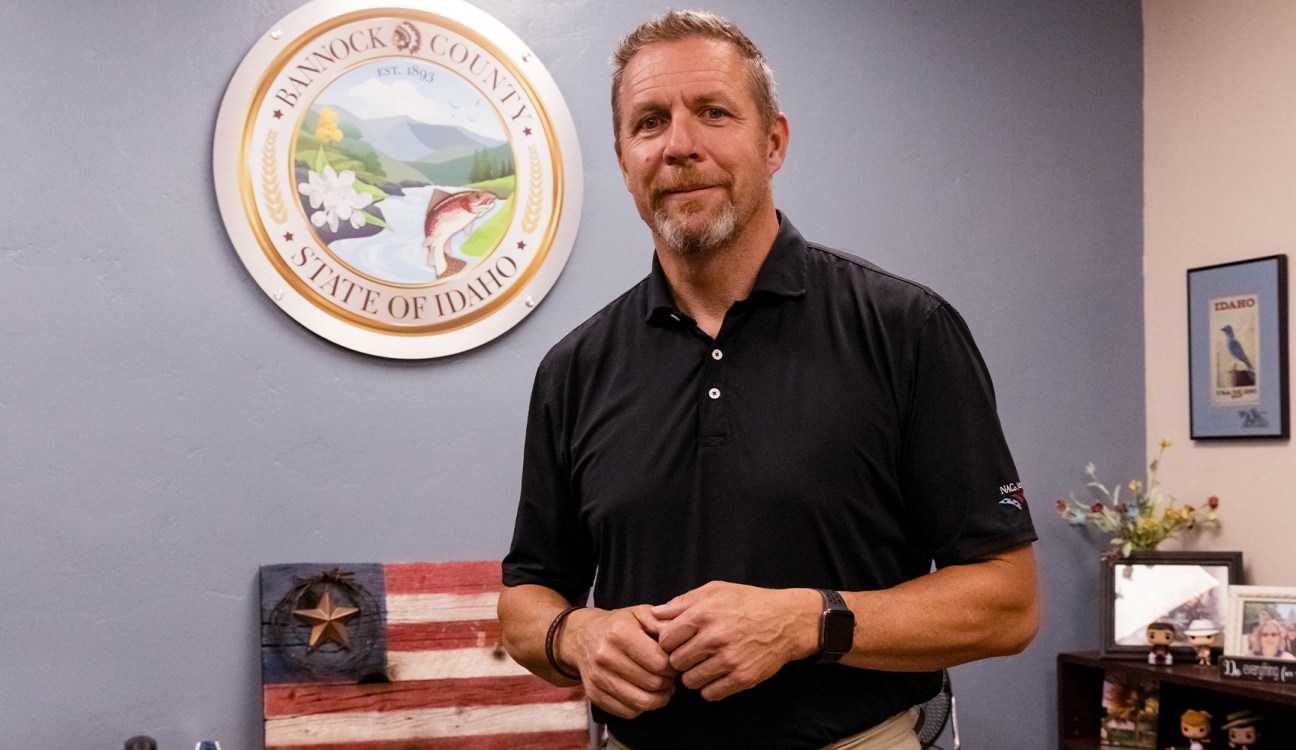
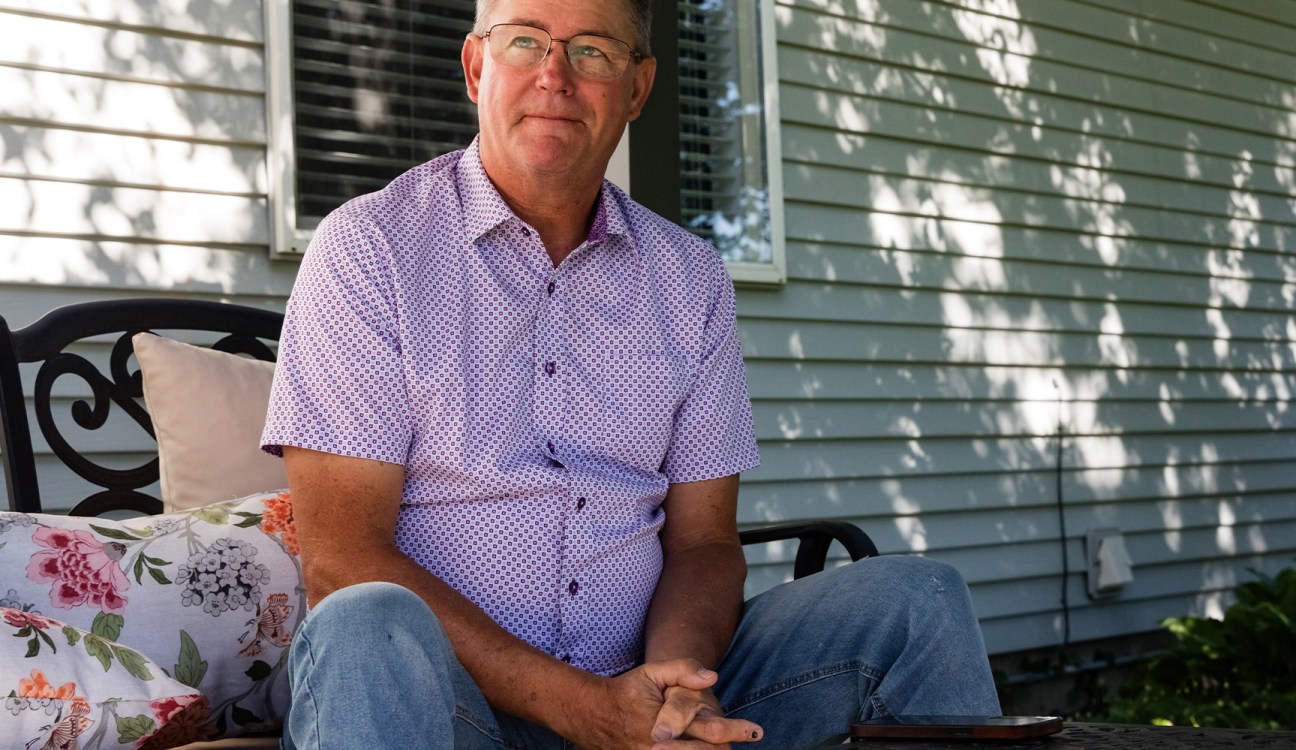
County Commissioner Jeff Hough poses for a photograph in Pocatello, Idaho. Otto Kitsinger
Hough believes renewables would bring money into the community. Bannock County’s neighbors offer local proof: In 2024, projects in nearby Power and Bingham counties generated $909,000 and $639,000 in tax revenue, respectively. Hough wants to send a message — to the renewables industry and others — that Bannock County is “open for business,” too.
“Rural America is in a transition state,” Hough said from his office in Pocatello, the county seat, in July. “How do we make or help rural America … transition to this new way of life, so that they can thrive and prosper?”
Read Next
Not everyone shares Hough’s vision of prosperity. In south Bannock County, Hough’s campaign has met with fierce opposition. Two camps exist: On one side are residents who are willing to lease their own land to solar energy developers or stand by their neighbors’ right to do so. On the other are those who are skeptical of renewables and believe that leasing land to developers is equivalent to selling out — many of them do, however, support nuclear.
Steve Criddle, a third-generation farmer and lifelong resident of south Bannock County, voiced his support for solar in 2024 before the ban passed. He described the situation today simply: “It’s confrontational.”
Bannock County’s moratorium on solar and wind stemmed from an unlikely source: Hough himself.
It was the fall of 2023, and he had just attended a conference of the Idaho Association of Counties in Boise.
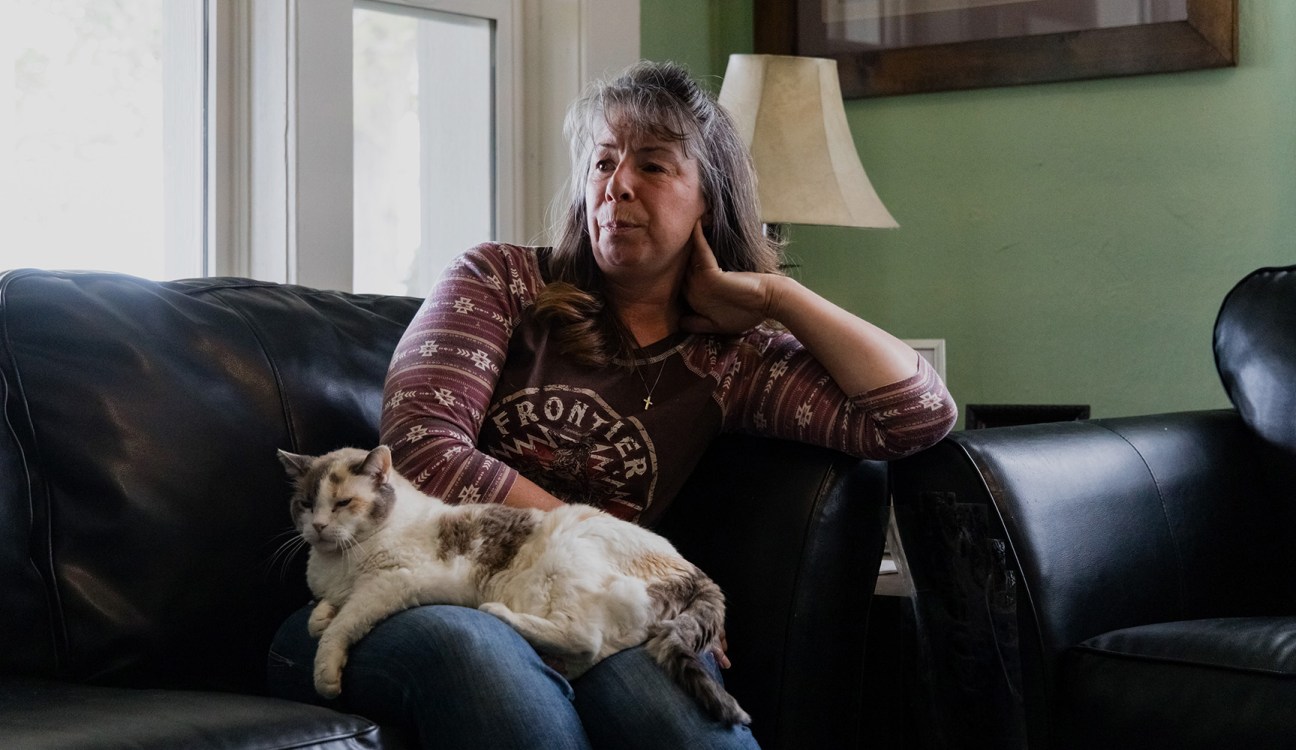
Rebecca Falcon and her cat, Baby, in her living room in Downey, Idaho. Otto Kitsinger
At the conference, the Lava Ridge Wind Project, a 1-GW development slated for more than 57,000 acres of federal land in southern Idaho, dominated the conversation. County leaders from around the state were concerned about clean energy developers running roughshod over their communities. (President Donald Trump’s Interior Department canceled Lava Ridge in August 2025.)
The discussion got Hough thinking. Months before the conference, he had learned that several developers, including Chicago-based Hecate Energy and Moab, Utah–based Balanced Rock Power, were approaching landowners about solar projects in Bannock County.
When Hough returned from Boise, the cautionary tale of Lava Ridge fresh in his mind, he took action.
“I realized that we didn’t have any kind of ordinance,” Hough said. “So I knew they’d come in and do whatever they wanted.”
On October 12, 2023, spearheaded by Hough, the county commissioners voted unanimously to enact a six-month moratorium on large-scale energy projects. The idea was not to ban solar and wind, but simply to give the county time to regulate the developments and ensure they balanced economic opportunity with responsible land stewardship. A public hearing on the topic was set for the following February, and the commissioners would vote on the future of the moratorium in March.
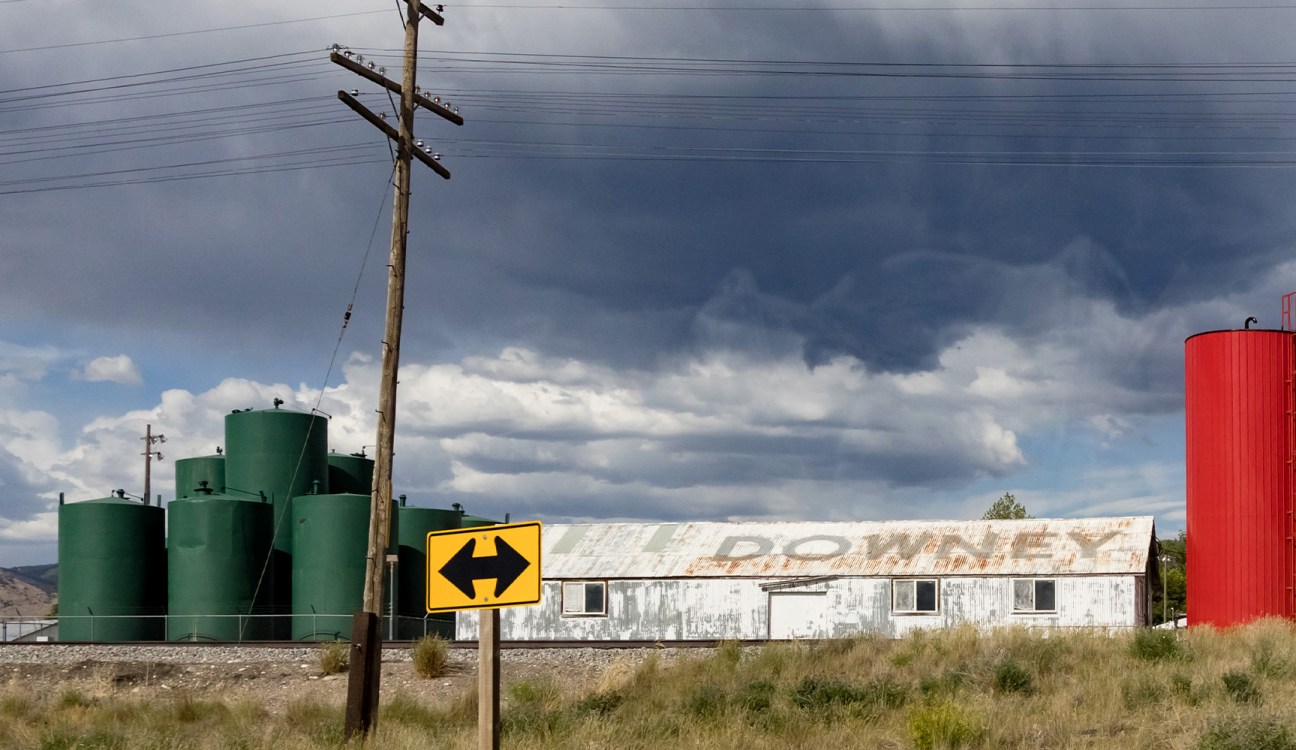
A building on the outskirts of Downey, Idaho, a rural community in south Bannock County. Otto Kitsinger
But Hough’s moratorium took on a life of its own. In the months that followed, a group of concerned residents organized to make it permanent.
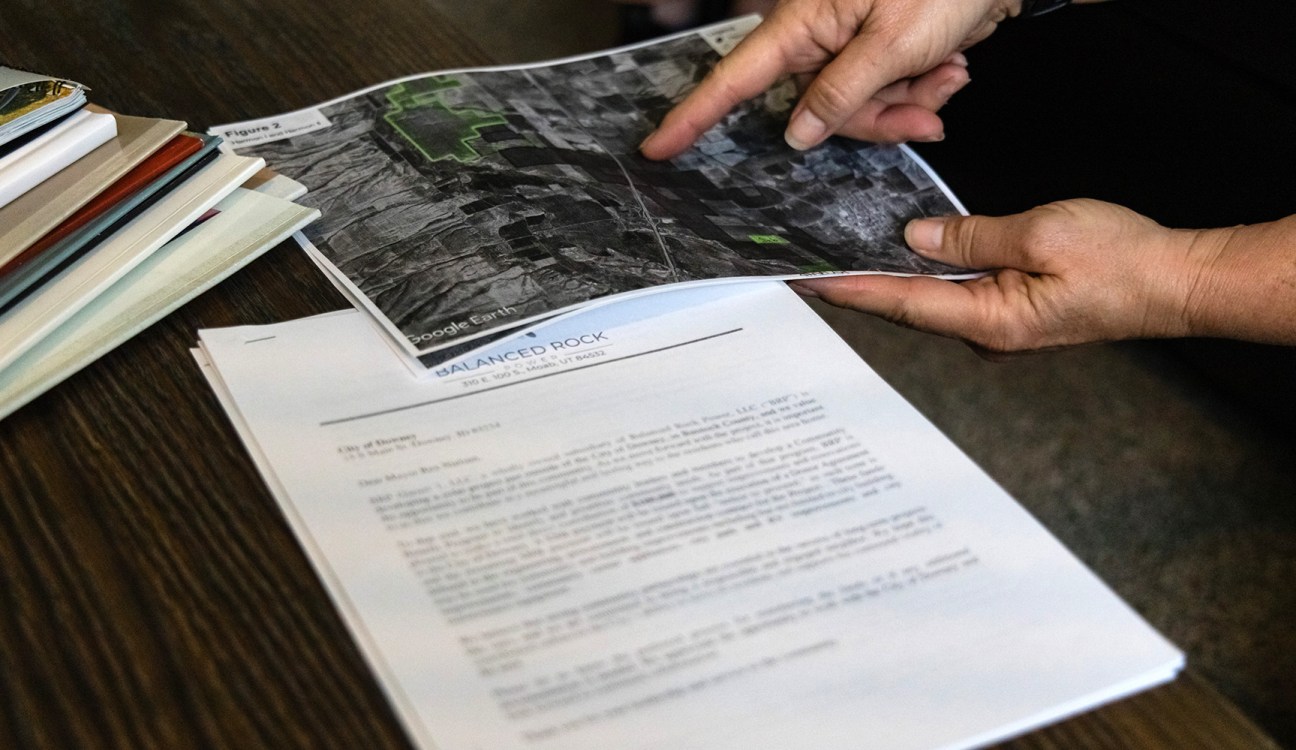
Rebecca Falcon led the charge. A decades-long resident of Downey, a town in south Bannock County, Falcon had been approached by Balanced Rock in September 2023 about leasing a portion of her 80 acres for solar. Appalled, she turned the company away. But Balanced Rock’s proposed Harmon Solar Project (aka Harmon I), a 300-megawatt solar facility with a 1,200-megawatt-hour on-site battery energy storage system, included her neighbors’ land. Stopping it would take more than just Falcon saying no.
Falcon and another neighbor, Dez Hauser, who had also turned away Balanced Rock, encouraged other concerned community members to show up to the February 2024 public hearing about the future of the moratorium.
By the time the hearing rolled around, residents had sorted themselves into two groups: for solar and against it. The meeting attracted such interest that it was moved from the county courthouse to a local high school auditorium in south Bannock County. The venue was still packed.
More than two dozen speakers, nearly all of them from south Bannock County, showed up to say their piece. The vast majority testified in opposition to solar.
Steve Criddle, a lifelong resident and farmer who considered leasing land to Hecate Energy for solar development. Otto Kitsinger
The commissioners convened the next month to decide what to do with the moratorium. Hough voted to repeal it. The other two commissioners voted to extend it. The commissioners framed it as an additional pause to study the potential effects of large-scale renewable energy development in the county. Yet as the controversy mounted through the spring and summer of 2024, the county declined to take further action.
The ban stayed in place. Falcon, Hauser, and the other opponents had won.
Dale Lish, a grain farmer based in Downey, was frustrated with the decision. Recently retired from a career at the U.S. Department of Agriculture, Lish became familiar with solar while working on projects in Idaho and Washington through the Rural Energy for America Program. He spoke in favor of the energy source at the same hearing where Falcon and Hauser expressed their concerns.
“The approach was just no to everything, which bothered me,” Lish said of the county’s decision, in a June interview on his property. “A straight-out ban — I don’t think that’s American. I think we, as private-property owners, ought to have a chance to do what we want within reason.”
The Old Downey Theatre, located on Main Street in the south Bannock County community. Downey has seen many services and small businesses close in recent years and currently lacks a grocery store or hospital. Otto Kitsinger
In 2023, Lish signed a one-year contract with Hecate to option about 400 acres of his land for solar development. Hecate declined to renew the contract in 2024 because of the county’s ordinance.
The company has since pulled out of the county altogether. Representatives from Hecate did not respond to multiple requests for comment.
For the two and a half years since that March vote, Hough has been beating the drum of private-property rights while also trying to educate the community on Idaho’s power needs and how they might be met in Bannock County.
While the commission won’t vote until later this fall on the new ordinance, which is still undergoing public review, at least one of Hough’s colleagues may have changed his tune. Ernie Moser, an incumbent who supported the ban in 2024, said in an interview in June that his fears about solar and wind are “not as big” as they were two years ago. Still, Moser, who’s retiring from the commission at the end of this year, stressed that he wants “to do it right” when it comes to revisiting the county’s energy policy. The other commissioner, Ken Bullock, declined to comment.
Lytton Bastian signed a contract in 2021 to lease Balanced Rock Power his “least productive piece of ground.” Otto Kitsinger
May’s primary elections offered another indication of the county’s divided views. In the Republican primary, Hough faced a challenger from south Bannock County with an anti-solar platform, and though he won his race by 14 percentage points overall, his opponent captured 70 percent of the vote in Downey. No Democrat is running in the race, so Hough won’t face competition in the November general election.
This year’s results mirror those of 2024, when former county commissioner John Crowder, who voted for the ban in March of that year, won big in Downey but lost to Ken Bullock, an ally of Hough’s.
“In south Bannock County, it’s a supermajority of residents that do not want this,” Crowder said about solar development.
Steve Criddle can trace his family’s roots in Downey back to 1876, when his ancestors first filed paperwork for water rights. His grandfather farmed grain, including wheat. Criddle’s father did the same. He’s kept the agricultural heritage alive himself, but because of a changing climate, grain farming is no longer enough to sustain him.
Lytton Bastian and one of his children in front of the land that he has agreed to lease to Balanced Rock Power for the Harmon Solar Project. Otto Kitsinger
“We don’t get enough moisture anymore,” Criddle said. The fields where he grows crops without irrigation now hardly produce enough to make ends meet. He’s turned some of his land over to cattle grazing and has worked odd jobs over the years to hold on to the farm.
On a sunny day in late June, Criddle drove me down a dirt road in his wife’s pickup truck. We were headed to one of his alfalfa fields. Three years ago, he said, the field produced some 800 bales of hay. This year, it produced only a dozen.
“The drought’s been tough,” Criddle told me. Before last year, he’d never had to buy hay for his cows. This year, he’ll likely have to buy hay again, as more than 87 percent of the county is now experiencing extreme drought conditions after a winter with record-low snowfall.
Lish, who also grows crops without irrigation, said that wells in the valley are limited.
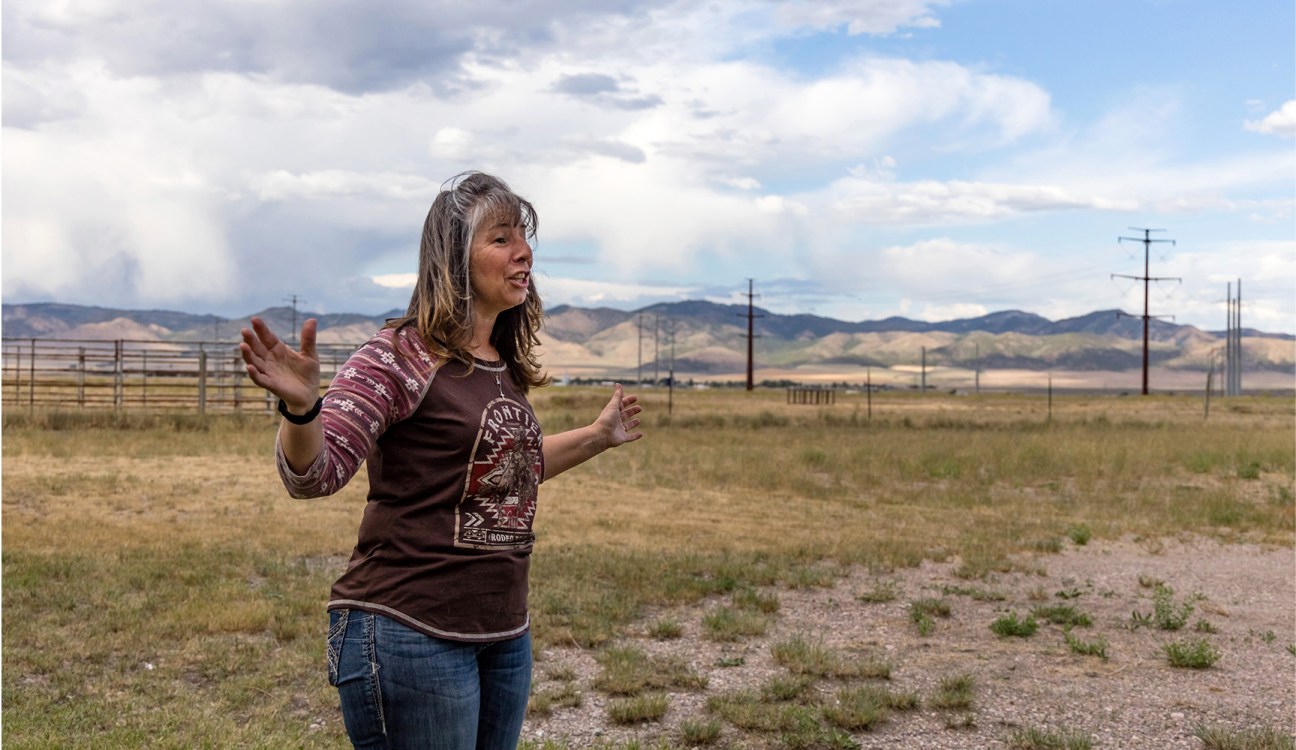
Transmission lines running across the valley in Downey, near Rebecca Falcon’s property. Otto Kitsinger
“That’s the Achilles’ heel of this area. There’s just a lack of groundwater, and then, of course, sparse rainfall,” he said. To accumulate enough moisture to grow wheat, Lish leaves his fields fallow every other year, allowing the soil to stock up on water.
While Criddle and Lish have fought to hang on to their land over the past six decades, climate change and the loss of small-scale farming have reshaped their community.
“You don’t have family farms anymore,” said Criddle’s wife, Keedrin. “The families can’t survive on a farm.”
As neighbors sold their land to corporations or moved out of Downey altogether, the town’s services have struggled to stay open. Over the years, the rural hospital closed, along with the town’s bank, pharmacy, movie theater, grocery store, and farm-equipment shop. Gone too are the dairies and granary.
Rebecca Falcon points out the location of the Harmon Solar Project in Downey on a printed map. Otto Kitsinger
So when representatives from Hecate knocked on the Criddles’ door in 2023 proposing a lease for solar development, Steve and Keedrin heard them out. And while the couple didn’t sign a contract, they realized how such a lease could bring them a stable source of income, which they could use to hire help and reinvest in the long-term sustainability of the farm.
The Criddles now have 11 grandchildren, with another one on the way. Steve thinks often about what he’ll leave for the next generations.
“I don’t want my kids to have to work this hard,” he said.
Lish, who did sign a contract with Hecate, said the decision didn’t come easily. But, he added, it would have been “kind of irresponsible” to not consider the opportunity. With solar, the per-acre income projections were four to five times higher than with wheat alone, Lish said.
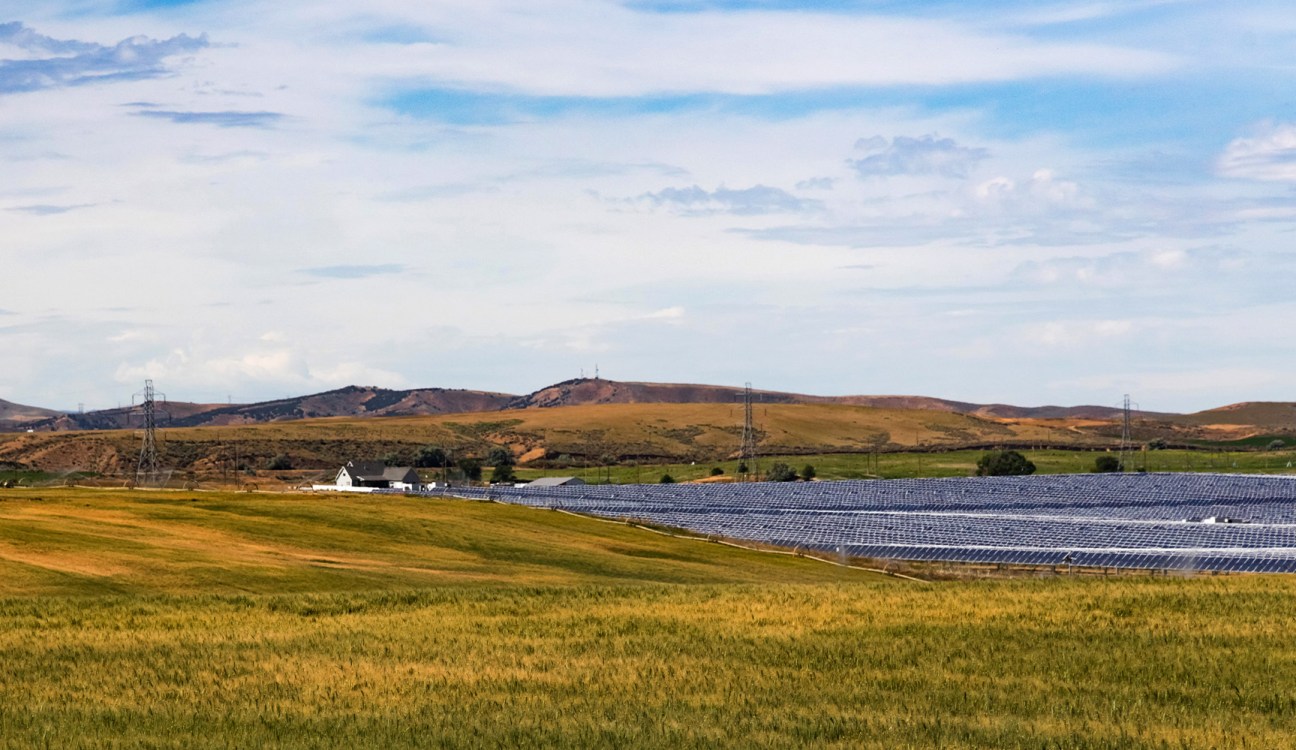
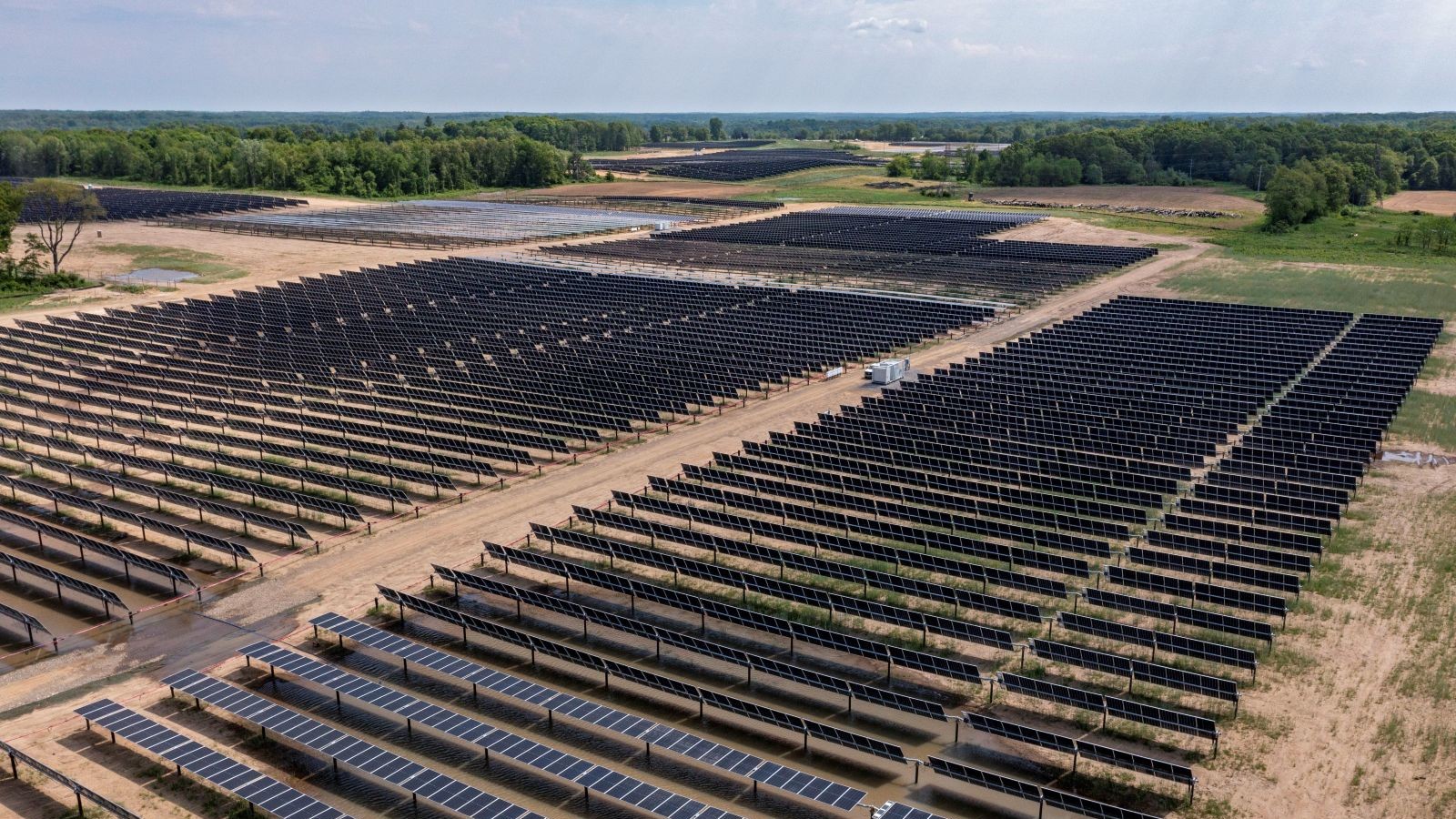
Solar panels in Power County, Idaho, which has seen substantial tax revenue from clean energy developments. Otto Kitsinger
“Lots of people have lots of opinions on what you’re going to do to your ground. I get that, and I can appreciate it. But we love this land too, and we’re not going to do something that’s going to be harmful,” Lish said. “We’re just looking at something that’s going to help us continue on to multiple generations.”
A few years earlier, Lytton Bastian, another farmer in Downey, had found himself contemplating the same questions.
Bastian, who was born and raised in Bannock County, is a multigenerational farmer and father of six. He owns over 2,000 acres in the valley. Balanced Rock was interested in 840 of those acres adjacent to the Populus substation, a parcel Bastian currently uses as a gravel pit and as cattle pasture for a month each fall and spring. In 2021, he signed a five-year contract with Balanced Rock that includes modest quarterly payments. If the ban lifts and Balanced Rock installs solar, the payments would increase.
Bastian’s neighbor is Falcon. She criticized his decision to lease to Balanced Rock, saying that he sold out to make more money than he could with agriculture.
Read Next
“My biggest issue is that it’s all ag land,” Falcon said. “They’ll take the grain; they’ll take the hay; they’ll take the cattle; they’ll take it all.”
Bastian said he only went through with the contract because Balanced Rock wanted his “least productive piece of ground.” An irrigated parcel would have been out of the question, he said. “Any normal farmer will not sell out good prime ground, because that’s hard to come by.”
At the February 2024 hearing at the high school, Bastian was among the few local farmers who spoke in favor of solar.
For Bastian, the stakes are getting higher. His contract with Balanced Rock is up at the end of this year. He thinks the renewal hinges on the county overturning the ban. Otherwise, he fears that the company could go the way of Hecate and look elsewhere.
“If the ban is lifted, the short answer is yes, we will move forward with our project,” said Katarina Bagri, a senior manager of development at Balanced Rock who’s leading the Harmon Solar Project, which includes Bastian’s land. “If there’s still a ban, there’s not many options, so we’ll just have to see what are the options left.”
Linda Engle of the Portneuf Resource Council, an environmental nonprofit advocating to lift Bannock County’s ban on renewables. Otto Kitsinger
It’s not just individual landowners who stand to miss out if the ban continues. Property tax payments from solar development would also deliver revenue to help the town bring back much-needed local services, like a grocery store. Balanced Rock, anticipating that the ban would be lifted, offered the city of Downey $100,000 in direct payments last fall via a community benefit program.
If Balanced Rock is unable to build, the city will not receive this money. Hough addressed this directly in an op-ed published in the local paper in February. Counties with bans in place, he wrote, “will watch the projects — and the money — go elsewhere.”
Just outside Downey, the northbound portion of Interstate 15 stretches over a pass and opens onto a sprawling valley. Golden fields give way to towering peaks. It’s part of why Falcon, who grew up in Utah, moved to Idaho: The landscape is all mountains and rolling hills. The idea that solar panels could become part of the view is unthinkable.
“I think, my goodness, why do you have to build it where we live?” Falcon said.
Falcon and her husband, Rudy, bought their 80-acre parcel of land in Downey more than three decades ago. That was before the Populus substation was built within view of their house. Now, transmission lines crisscross their land and that of their neighbors.
“It is the ugliest thing on this planet,” Falcon said about the substation. “I wish it wasn’t there.”
Read Next
In the coming years, two new high-voltage transmission lines will join the existing lines running through Populus. They’re part of the yearslong Energy Gateway project being built by PacifiCorp, one of the largest utilities in the West. The goal is to improve the region’s power transportation and reliability as energy demand grows, said Jonathan Whitesides, a spokesperson for Rocky Mountain Power, a division of PacifiCorp that operates in Idaho.
As much as Falcon doesn’t like looking at the substation, she understands the need for transporting power. Rudy works for the Bonneville Power Administration and is often on the road in Washington and Oregon building substations himself. But solar, to Falcon, is a different story. She said that she struggles with the amount of land it requires to produce power, a talking point that’s been popularized by the fossil fuel industry.
She and Hauser, her Downey neighbor, have continued to speak out against solar since the 2024 ban. Hauser is active on community Facebook pages, and Falcon runs an email chain to share information with friends and neighbors. “I wasn’t willing to be quiet about it,” Hauser said.
For years, the women have regularly filed public records requests with Bannock County and the federal government. That’s how they discovered that a month after Bannock County voted to maintain its ban, Balanced Rock applied for federal authorization for a second solar project, called Harmon II. The project, like Harmon I, was slated for 300 MW, and its application outlined solar and battery energy storage development on approximately 1,300 acres of public land administered by the U.S. Bureau of Land Management in Bannock County. Harmon II was proposed on land adjacent to Harmon I, which had stalled because of the county’s ban.
In July, Bagri from Balanced Rock acknowledged that the company had been sitting on the application. “All of our focus is on the private land, [the] initial 300 megawatts. So once we make progress with that, we’ll figure out whether we want to pursue an expansion,” she said. In August, Balanced Rock officially withdrew its application for Harmon II.
In Pocatello, the county seat, residents are more favorable toward clean energy than those in Bannock County’s rural communities. Otto Kitsinger
Falcon and Hauser saw the second project as evidence of a lack of transparency from the developer.
“The public has a right to know this will change this valley for 50 years,” Falcon said. “We will have left that mess to our children and grandchildren, because who’s going to guarantee who owns it in 50 years to decommission it and clean it up? You can’t make those kinds of guarantees.”
Bagri said the guardrails the county was considering in early 2024 — which are now baked into the ordinance the commissioners will vote on this fall — include provisions on decommissioning. The draft ordinance stipulates that in order to get projects permitted, developers must pay into a bond and submit a plan for the removal of all energy infrastructure at the end of the project’s lifetime. Bagri said these plans involve restoring project sites “back to as close to preconstruction condition as possible.” Today, project lifetimes range from 35 to 40 years, she said.
Still, for Hauser and Falcon, the feeling of disempowerment persists. Falcon pointed to other counties across the state, including Ada County, home to Boise, that have taken matters into their own hands to “put a limit” on development. In Ada County, solar is now prohibited on prime farmland, as defined by the U.S. Department of Agriculture. In southeast Idaho, some of Bannock County’s neighbors, like Caribou County, have also banned utility-scale solar, though others, such as Power and Bingham counties, have embraced it.
“If you don’t build in the brakes, they will run you over,” Falcon said.
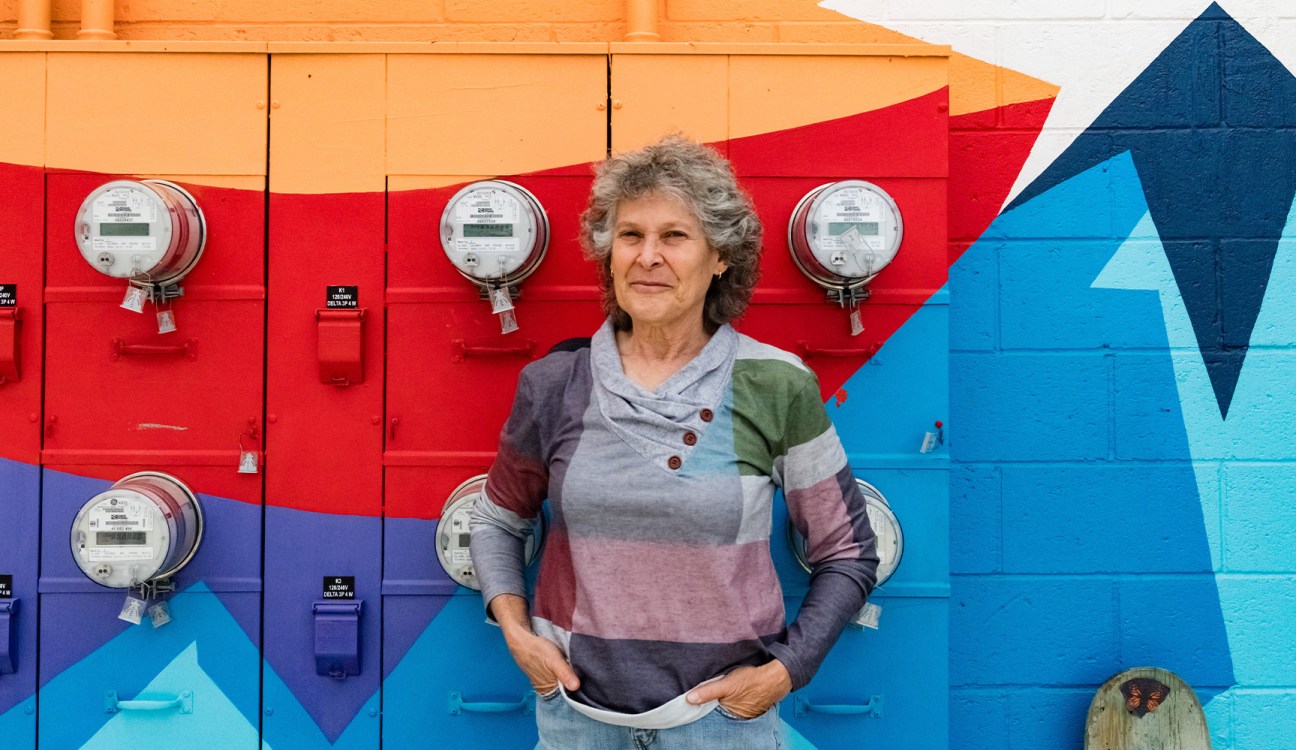
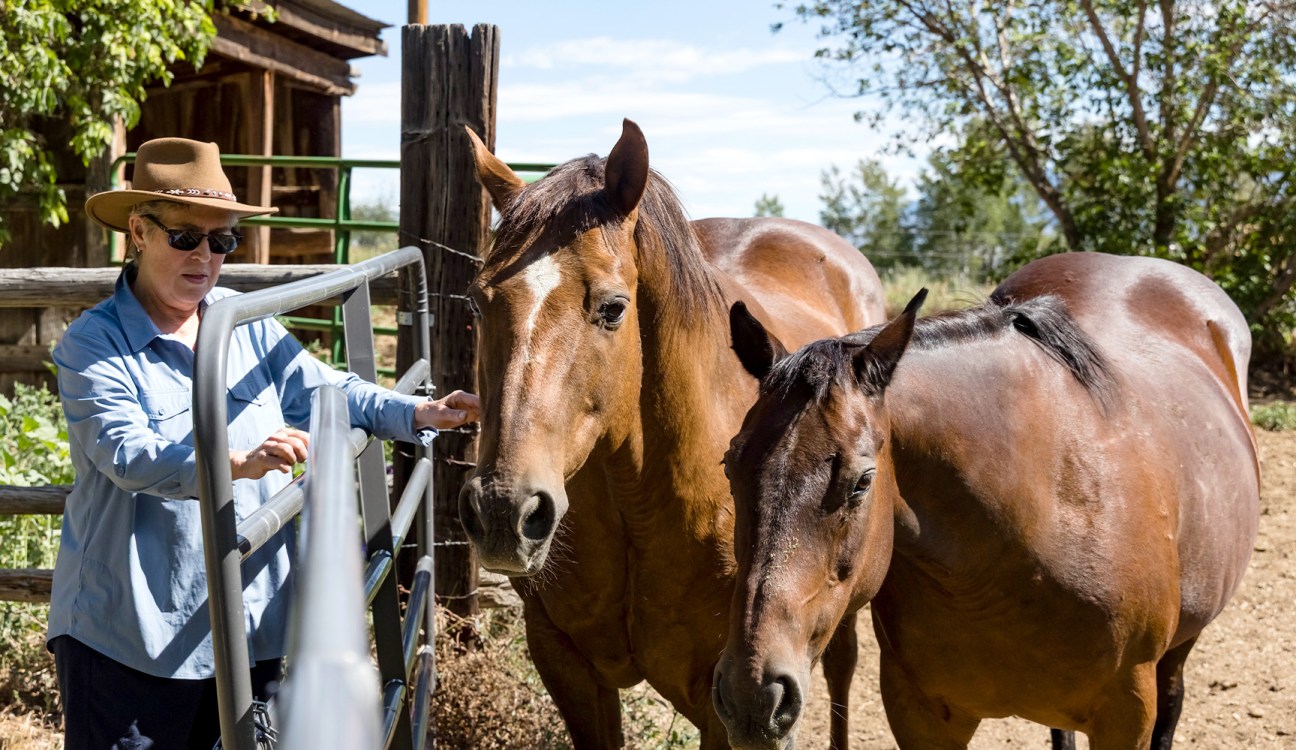
E.J. Zita on her property in Robin, Idaho, where she keeps horses and has installed solar to power ranch operations. Otto Kitsinger
For all their ire toward solar, Falcon and Hauser see promise in nuclear energy. That puts them in the majority: In January, Bannock County surveyed residents to gauge public opinion on nuclear energy. Over 700 people responded, with 90 percent indicating favorable views toward the industry.
Hough was surprised by the results. “I didn’t think our community could agree on anything,” he said.
Southeast Idaho is home to Idaho National Laboratory, or INL, which leads the nation’s advanced nuclear research. As part of the Trump administration’s embrace of nuclear energy, the lab was given priority in May 2025 to expedite construction of on-site microreactor test beds. The U.S. Department of Energy announced in July that INL will receive $60 million as part of a public-private partnership to use AI in nuclear energy development and operation. Buzzy nuclear startup Oklo aims to build its first fission reactor there.
Plus, next door in western Wyoming, the Bill Gates–backed TerraPower is building what it hopes will be the country’s first utility-scale advanced nuclear power plant. The project, now under construction in rural Kemmerer, is expected to be completed in 2030 and will supply PacifiCorp with up to 500 MW of power.
The excitement around INL and the TerraPower project leave many in Bannock County wondering when their big opportunity might come along. In July, the Bannock County commissioners hosted a public educational forum with INL to discuss how the county could get involved with small modular reactors (SMRs), microreactors, and nuclear manufacturing.
Falcon and Hauser were both in attendance. They said they’d much rather see the development of nuclear energy in Bannock County than renewables. “If you can have 30 acres with a semitruck-size nuclear plant on it, why wouldn’t you do that? Why would you give up thousands of acres to solar?” Falcon said.
E.J. Zita with her horses in Robin, Idaho. Otto Kitsinger
But the construction of SMRs and the broader nuclear revival touted by Trump remain highly uncertain prospects.
Only two next-generation nuclear projects in the U.S. have received construction permits: TerraPower’s Kemmerer 1 and Kairos Power’s Hermes 2 reactor in Oak Ridge, Tennessee. Neither has an operating license, however.
Even if more projects obtain licenses from the Nuclear Regulatory Commission amid Trump’s push to streamline permitting, the SMR industry is far from a sure thing. Most companies are proposing first-of-a-kind projects rife with engineering and economic unknowns. There’s little to no supply chain for the type of fuel many SMRs are designed to use. The United States’ first fully licensed SMR project was canceled in 2023 over cost concerns. Only two commercial SMRs operate in the world today — one in Russia and one in China.
Dustin Manwaring, a Republican state representative for Pocatello and a land-use and development attorney for Balanced Rock, is an ally of Hough’s. He said the commissioner wants to usher in a future where Bannock County leads Idaho’s burgeoning nuclear industry.
“[It’s] a worthy, noble thing to do,” Manwaring said. “If you take a step away, I don’t know how realistic that is. I love that he’s trying.”
In the near term, Hough recognizes that bringing nuclear power to Bannock County could take years. That’s why he doesn’t want to turn down other types of economic development — like solar and wind — in the meantime. “Everybody’s claiming nuclear is the future, which it is, but nuclear is 10 years away, maybe, so you’ve got to have something to help get you there,” Hough said.
Wade Egan, former chair of the county’s volunteer planning and development council, at his home near Pocatello. Otto Kitsinger
Some clean energy advocates, like Linda Engle with the Portneuf Resource Council, the region’s environmental nonprofit, are optimistic that the support for nuclear energy could help overturn the ban. “With the nuclear piece in there, hopefully it gets passed,” Engle said.
For all the community debate, the future of clean energy in Bannock County ultimately rests on the decision of the three commissioners. To Commissioner Moser, who in 2024 voted in favor of the ban, the choice isn’t black-and-white.
Hanging on the walls in Moser’s office are two landscape paintings depicting Idaho’s wilderness. In one, a crisp blue stream is flanked by forest and purple mountain cliffs; in another, two people perch on a log, fishing rods in hand, waiting patiently for a catch. Moser has arranged the paintings, which were created by his now-grown son, so he can see them while sitting at his desk. On another wall, a second pair of paintings depicts the American Revolution. In a snowy forest scene, George Washington kneels beside a horse, praying.
Five days before the Fourth of July, Moser sat in his office, considering the paintings. “I love our country, the freedoms that we enjoy — 250 years is amazing,” he said. “God created this for us. I’m a steward now. I’ve been called to take care of it.”
It is this ethos that guides Moser, a south Bannock County native, as he contemplates the county’s new energy ordinance.
Moser’s fears have to do with solar site cleanup and the risks of battery fires. Moser is not alone in these concerns; they are often cited by solar opposition groups, which point to rare but devastating instances of battery fires in California. Such anxieties are also spreading nationwide. In December 2025, the volunteer fire departments in Downey and Lava Hot Springs, another rural community in south Bannock County, sent letters to the county commissioners warning that they were unprepared to fight battery fires and would need special equipment and training to do so.
Rebecca Falcon on her land in Downey, with transmission lines behind her. Otto Kitsinger
Bagri said Balanced Rock has tried to ease concerns about decommissioning and fire risk. During the numerous public hearings in 2024, representatives from both Hecate and Balanced Rock responded to the community’s concerns. “They addressed every one of those fears head-on, concisely with facts, and I thought they communicated very well,” said E.J. Zita, a rancher in Robin, Idaho, who’s had residential solar on her property for over a decade. But she said the anti-solar camp had dug in. “People didn’t listen; they just didn’t hear it.”
Despite his fears, Moser said he understands the weight of his responsibility.
That’s why he’s tried to educate himself about Idaho’s energy needs over the past two years. In 2025, Moser visited a 40-MW solar project in neighboring Power County, a 20-minute drive west from Pocatello. The visit was organized for the Bannock County commissioners by Balanced Rock. The same year, Moser and Hough attended the energy academy hosted by Idaho Power in Boise and had conversations with Rocky Mountain Power. Language in Bannock County’s new draft ordinance requires energy developers to help local fire departments with training and equipment for dealing with battery fires.
In June, Moser said he recognized that there’s a need for growth in Bannock County. He’s not the only one whose opinion has shifted. Wade Egan, the former chair of the county’s volunteer planning and development council, was “neutral” about the ban passing in 2024. Egan grew up next door to Dale Lish in Downey and now farms around 5,000 acres in the area. He has friends on both sides of the issue.
This time around, though, Egan is pro-solar. Echoing Hough, Egan said he sees it as a matter of property rights. “I really do believe the right to control and own personal property is as fundamental as speech,” he said.
Moser, meanwhile, is focused on getting things right for future generations. Pointing to the landscape paintings in his office, he spoke about the Idaho wilderness that he wants his son, and grandchildren, to enjoy.
“It’s not a personal choice. It’s hard choices,” Moser said. “We wake up at two o’clock in the morning thinking about them, and it isn’t a simple deal.”
Princess Diana’s Mother ‘Hated’ Royals After Daughter’s Death
Princess Diana’s mother became deeply disillusioned with the Royal Family after her daughter’s death and eventually described herself as a republican, according to revelations in a new royal biography.
Frances Shand Kydd, who died in 2004 at age 68, reportedly grew increasingly bitter toward the monarchy in the years after Diana was killed in a Paris car crash on August 31, 1997.
The claims appear in royal biographer Ingrid Seward’s new book, Catherine & Diana: The Inside Story of How the Princesses of Wales Shaped the Modern Monarchy, released September 24.
Seward, the editor-in-chief of Majesty magazine and a longtime royal commentator who interviewed Diana shortly before her death, writes that Frances’ feelings toward the institution changed dramatically after losing her daughter. The book examines both Diana and Catherine, Princess of Wales, and their relationships with the monarchy.
According to excerpts attributed to Frances and published around the book’s release, Diana’s mother became openly hostile toward the Royal Family.
“The Royal Family are a disgrace,” she reportedly told a friend, before criticizing what she saw as coldness and selfishness inside royal life.
Another excerpt indicates Frances said she had not considered herself a republican before Diana married into the Royal Family, but that her views later changed.
It was a striking shift for a woman whose own family had been closely connected to the monarchy for decades.
Frances was the daughter of Ruth Roche, Baroness Fermoy, who was a longtime confidante and Woman of the Bedchamber to Queen Elizabeth the Queen Mother. Frances’ first husband, John Spencer, later became the 8th Earl Spencer.
Diana herself grew up with close proximity to the royals before marrying then-Prince Charles in 1981.
But everything changed after Diana’s death.
Diana’s Death Left Her Mother Devastated
Diana died at age 36 following a car crash in the Pont de l’Alma tunnel in Paris. Her death triggered extraordinary public mourning across Britain and around the world.
Her funeral was held at Westminster Abbey on September 6, 1997, before her coffin was taken to the Spencer family estate at Althorp, where she was privately buried on an island in an ornamental lake.
The Royal Family’s official historical account confirms that Charles, William, Harry, Prince Philip and Diana’s brother Charles Spencer walked behind her coffin during part of the funeral procession.
For Frances, however, Seward claims the period surrounding the funeral became another source of pain.
According to the book, she believed Diana’s family had been forced to fight for a meaningful role in the arrangements.
“We almost boycotted the service,” Frances reportedly said. “We had to fight for what we got.”
The account should be viewed as Frances’ recollection rather than an independently established account of the funeral negotiations. Royal and Spencer family memories of the days following Diana’s death have sometimes differed.
The official Royal Family record says Diana’s body was brought back from France by then-Prince Charles and Diana’s sisters, Lady Sarah McCorquodale and Lady Jane Fellowes. Her coffin later remained privately at St. James’s Palace before being taken to Kensington Palace and then Westminster Abbey.
Queen Elizabeth II also delivered a nationally televised address on September 5, describing Diana as an “exceptional and gifted human being” and praising her devotion to William and Harry.
Frances Said She Never Heard From the Queen
Despite that public tribute, Seward writes that Frances felt personally abandoned.
“The Queen did not get in touch after Diana’s death,” Frances is quoted as saying. “I did not see or hear from her.”
There does not appear to be an independently published palace record confirming or disproving private contact between the two women during that period, so the claim remains Frances’ reported account.
Her concerns soon extended to her relationship with her grandsons.
In July 1998, less than a year after Diana’s death, Frances visited then-Prince Charles at Highgrove.
Contemporary reporting described the visit as a two-day stay during which Frances spent time with Charles and Prince Harry while Prince William was away with friends.
The meeting suggested that relations were not completely severed immediately after Diana’s death, even as Frances apparently remained anxious about how much contact she would have with William and Harry.
Seward writes that Frances later complained that much of her communication with the boys consisted of letters and emails.
For a grandmother who had already lost her daughter, the prospect of becoming distant from Diana’s sons appears to have added to her resentment.
A Complicated Mother-Daughter Relationship
Frances’ grief was also complicated by the fact that she and Diana were reportedly not speaking during the months immediately before the princess died.
Contemporary reports after Frances’ own death noted the strain between the two women, although Diana’s brother later pushed back against suggestions that they were permanently estranged.
At Frances’ funeral in 2004, Charles Spencer said disagreements between the two had been typical tensions between a mother and daughter.
He also pointed to Diana’s will as evidence of their underlying bond, saying Diana had named her mother as an executor and a principal guardian for her sons.
That distinction is important because the relationship between Diana and Frances has often been portrayed in far more dramatic terms than the surviving record supports.
Frances Retreated to Scotland
After Diana’s death, Frances largely lived away from the royal spotlight on the Scottish island of Seil near Oban.
She had converted to Roman Catholicism years earlier and became heavily involved with her local church and charitable work.
Obituaries published after her death described a woman who had found a degree of peace through her faith despite decades of family turmoil and intense public scrutiny.
Friends said she helped with church life in the Oban area, including preparing meals and assisting visiting clergy.
Still, Diana’s death remained an enormous emotional burden.
Seward writes that Frances at one point told a friend she no longer prayed for peace because she did not believe she would find it.
Instead, she reportedly prayed simply for the ability to cope.
Frances died at her home on Seil on June 3, 2004, following a long illness.
Prince William and Prince Harry publicly said they were “very upset” by their grandmother’s death and would miss her greatly. William later gave a Bible reading at her funeral in Oban.
Buckingham Palace also confirmed at the time that Queen Elizabeth had sent a private message of condolence to Earl Spencer.
Nearly three decades after Diana’s death, the new accounts offer another glimpse into just how deeply the tragedy affected those closest to her — and how differently members of the Spencer and Windsor families remembered the painful years that followed.
What Does Your Data Reveal About Sports Betting Apps? Help ProPublica Find Out.
Illustration by Simone Noronha for ProPublica
What Does Your Data Reveal About Sports Betting Apps? Help ProPublica Find Out.
If you’ve bet on sports with FanDuel or DraftKings, you can help ProPublica understand how these apps respond to their users’ betting behavior. Use our browser extension to download your betting history, then drop the files here.
8
People have shared their data. Our goal is 250.
If you’re one of millions of Americans who have placed an online bet on a sporting event, you know how quickly you can go from celebrating your wins to feeling like the odds are stacked against you.
ProPublica is trying to understand how sports betting apps incentivize users to keep playing and when they warn users to pump the brakes. To do that, we need your help: We’re aiming for at least 250 people to upload their gambling history from apps like FanDuel and DraftKings. We’re not quite there yet, so if you’ve used these apps, you can help our journalists. If you’ve worked in the industry, you can also help us by answering a few questions. (You can also reach us on Signal.)
How Do I Help?
First, gather your data from sites like FanDuel or DraftKings. There are three ways of doing this. Any one of these works — you don’t need to do all three.
In each case, the process will likely take 5 to 10 minutes, and you’ll need to be on a computer. If you can’t do this right now, you can share your email address below and we’ll email you in 24 hours with a reminder.
Choose one option below:
Download and install our browser extension
This is our preferred data collection method. It does not collect any personally identifying information, and you control whether or not you upload it to us.
You’ll need to log onto your accounts on a computer to use the extension. It works only in Chrome and Firefox. We are working to feature the plug-in in the Chrome Web Store and the Firefox Add-ons Store, but until then you will need to load it in a temporary way. The whole process should take about 5 to 10 minutes.
First, pick a browser to install the plug-in on:
Then pick a site to use the tool on:
Request your data from DraftKings or FanDuel directly
You can request your data from FanDuel through this form and DraftKings through this form. This option is available only to people who live in states with certain privacy laws. You can find out if you’re eligible by visiting the FanDuel and DraftKings links. Users have told us that it’s taken the companies more than 30 days to provide their data.
Export your data from an app like Pikkit
If you already use a third-party bet tracker like Pikkit, you can likely download or export your transaction history. Once you have the CSV file, you can simply upload it below.
Get an email reminder to help at a later date:
Sharing your transaction histories and insights about the apps can help us understand when companies provide boosts, invite you into VIP programs and push responsible gaming notices. Without this data, there is no way to know how the companies truly operate.
We appreciate you sharing your records and take your privacy seriously. Our team may not be able to respond to everyone personally, but we will review everything you submit. We will contact you if we wish to publish any part of your submission.
What Happens to Your Data
Your file goes straight to ProPublica; it isn’t shared with the sportsbooks or anyone outside our newsroom. We use these files to understand patterns across many bettors. If we want to write about your individual experience, a reporter will ask you first.
By downloading and installing this extension, you agree to our terms below. Using this tool is at your own risk. Your betting app may terminate your service as a result.
With PRIMA, NASA will try to build a billion-dollar space telescope in record time
The first in a new class of space telescopes is on track to reach the launch pad in the early 2030s, NASA announced this week.
The PRIMA mission will be the first of NASA’s Probe Explorers, a new line of observatories intended to do more science for less money. The agency’s space telescopes typically fall into lower-cost “Explorer-class” missions, with cost caps in the range of a few hundred million dollars, or flagship observatories like the recently launched Nancy Grace Roman Space Telescope, which came with a price tag of some $4.3 billion.
With the Probe Explorers, NASA officials seek to find a better balance between the smaller Explorer missions and multibillion-dollar flagships. NASA has studied potential Probe Explorer mission concepts for several years after an independent panel of scientists recommended the new mission category. But it wasn’t clear until recently whether NASA’s science budget, which is under pressure from the Trump administration, would be sufficient to actually start developing one.
NASA announced Wednesday it will move forward with PRIMA, short for the Probe far-Infrared Mission for Astrophysics. PRIMA was the sole finalist for the first Probe Explorer mission after NASA disqualified a competing mission, an X-ray observatory known as AXIS, earlier this year. NASA said a concept study for AXIS indicated it would not meet the agency’s schedule and budget constraints.
The scientist leading the AXIS concept study blamed disruptions and mismanagement at NASA’s Goddard Space Flight Center in Greenbelt, Maryland, the NASA location charged with leading the AXIS mission if it moved forward into development. PRIMA will be led by NASA’s Jet Propulsion Laboratory in Pasadena, California, which has also found itself in an institutional crisis, with few missions in development and a series of layoffs.
Flagship missions can take decades to design, build, and test before they make it to the launch pad. The Roman Space Telescope was the exception. It took 10 years from NASA’s approval to proceed into development until Roman’s launch last month on the way to an observation post a million miles from Earth.
Leftovers from Webb
PRIMA, which has a cost cap of $1.2 billion excluding launch costs, will not be as big and complex as Roman, so it’s natural to assume a shorter development cycle. NASA wants to launch PRIMA seven years from now, in 2033. The telescope will observe the Universe in faint, far-infrared light in a range of wavelengths between 24 and 235 micrometers, requiring its primary optics to be cooled to 4.5 Kelvin, or minus 451° Fahrenheit.
This would usually require a brand-new build of a sophisticated cryocooler. PRIMA will instead use a spare leftover from the development of the James Webb Space Telescope, modified to use helium-3 instead of helium-4 as the cooling fluid. The focal planes of PRIMA’s kinetic inductance detectors will be chilled even lower to 100 milliKelvin, putting the mission’s optics in contention for the coldest ever sent into space.
Its far-infrared sensitivity will give PRIMA visibility into the origins of planets and their atmospheres, the coevolution of galaxies and black holes, and changes in the properties of dust and metals over cosmic time, according to the scientists heading the mission. PRIMA, with a 5.9-foot-diameter (1.8-meter) primary mirror, will set up shop in an orbit around the Sun-Earth L2 Lagrange point a million miles from Earth.
The mission will peer deeper into the infrared bands than any of NASA’s past or current infrared observatories, such as Spitzer and Webb, and will build on discoveries made by Europe’s Herschel space telescope, which gave astronomers new insights into the formation of cosmic filaments and the role of water in the formation of stars and planets.
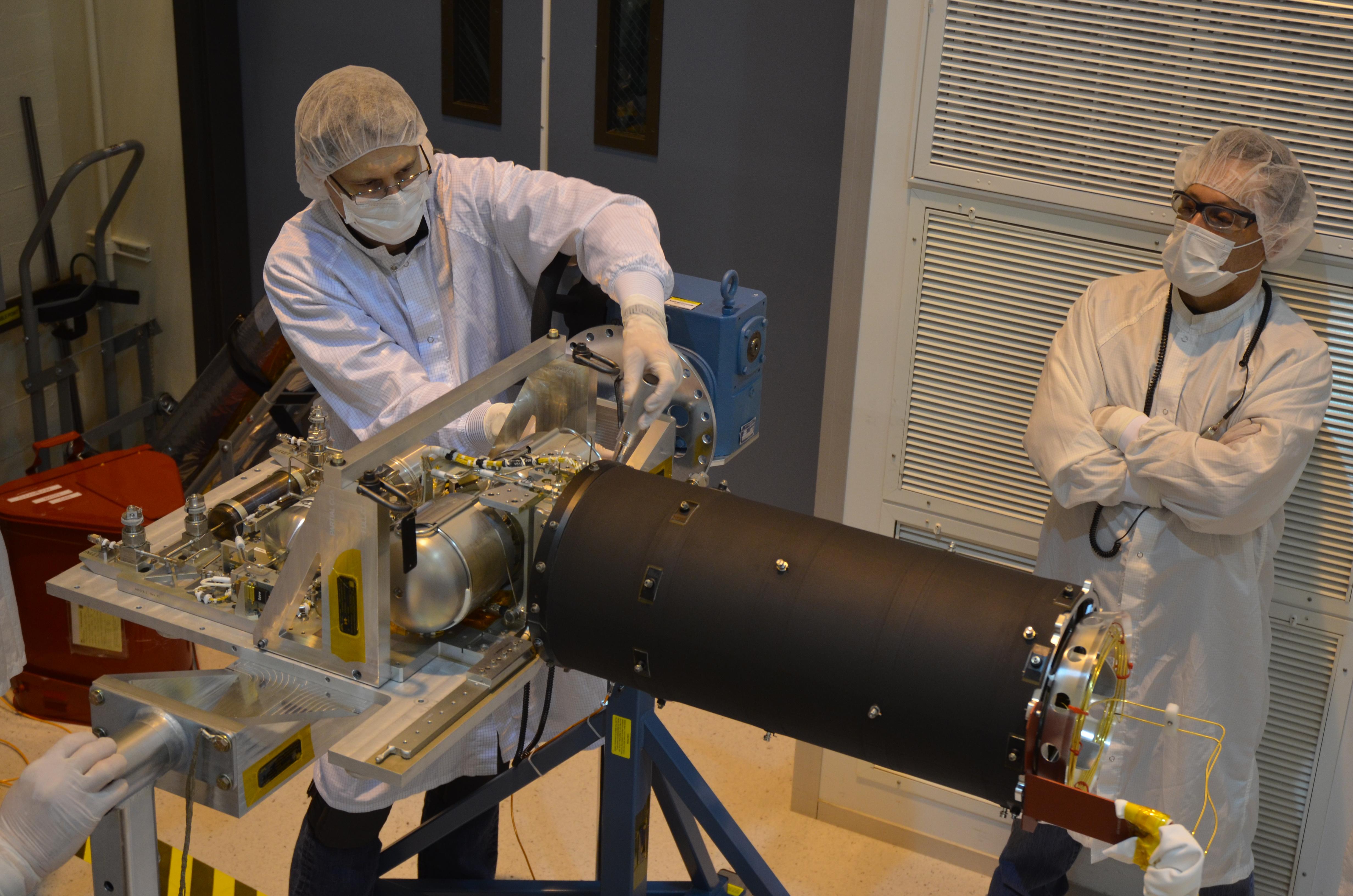
PRIMA uses a modified spare cryocooler from the James Webb Space Telescope. The cryocooler for Webb’s Mid-Infrared Instrument is seen here.
Credit: NASA/JPL-Caltech
PRIMA uses a modified spare cryocooler from the James Webb Space Telescope. The cryocooler for Webb’s Mid-Infrared Instrument is seen here. Credit: NASA/JPL-Caltech
“The PRIMA mission is humanity’s next window into the deep Universe,” said Nicky Fox, associate administrator for NASA’s Science Mission Directorate, in a statement. “It will unveil the obscure across cosmic time to better understand the formation of planets, stars, black holes, and even how water on Earth came to be.”
NASA’s announcement this week gave the green light to move into Phase B of development, working toward a preliminary design review before a confirmation review at NASA Headquarters a few years from now that will mark final approval to proceed into integration of flight hardware. The complete observatory is expected to weigh less than 3.4 metric tons (7,500 pounds) at launch.
“A single mission alone can’t probe all the Universe’s mysteries. But by extending the survey capabilities of our fleet into far-infrared wavelengths with PRIMA, we’re enabling an incredibly comprehensive look at the cosmos,” said Shawn Domagal-Goldman, director of NASA’s Astrophysics Division. “With our Webb and Roman space telescopes, we set a cadence of launching premier-class missions in both halves of the decade. We’re going to keep that up and kick off the next decade with PRIMA, as part of a pipeline that will consistently have missions of this caliber ready to go.”
Flagships are still hard
Meanwhile, NASA continues preliminary architecture studies and technology development for its next big flagship space telescope, the Habitable Worlds Observatory, planned for launch in the 2040s. It is expected to be at least as large as the James Webb Space Telescope, with the potential for an even bigger primary mirror if NASA can take advantage of new super-heavy-lift launch vehicles, such as SpaceX’s Starship. HWO will observe the cosmos in multiple wavelengths, ranging from ultraviolet to visible and near-infrared.
Early cost estimates for the Habitable Worlds Observatory come in at around $11 billion, on par with Webb, which far exceeded its original cost projection.
“This is a sufficiently ambitious observatory where it’s going to require an all-of-nation [approach],” Domagal-Goldman said Tuesday in a meeting of the National Academies’ Committee on Astronomy and Astrophysics. “Frankly, we’re going to need our partners internationally to be a big part of this as well. But we need the best and brightest from throughout the country, whether they’re at Goddard, another NASA center, an industry partner, a new space commercial partner, or a university, to be a part of what we’re doing.”
Domagal-Goldman said this week that NASA aims to use its experience in developing and launching the Roman telescope on budget to help bring future flagships like HWO under tighter cost controls.
“We have proven with the launch of Nancy Grace Roman, ahead of schedule and on budget, that it is not a law of nature that these projects will go over schedule and over budget,” he said. “That doesn’t mean they’re easy, and it doesn’t mean we can be cavalier that they will always be on schedule and on budget because that’s also been disproven.”
The lessons NASA has learned about implementing flagship projects include the importance of defining the mission’s architecture and requirements and ensuring its underlying technologies are well understood before engineers start building flight hardware, according to Domagal-Goldman.
“To put it succinctly, you need to understand the challenge, have a mission where the challenge is incredibly well understood, and then once you understand it, then you put your pedal to the metal and take that observatory to the launch pad as quickly as you can,” he said.
US intelligence warns of Russian drone operations in Mediterranean
US intelligence has warned European governments of a possible Russian drone operation targeting Spain, France or Italy, raising concerns about a potential new security threat in the Mediterranean. According to a report first published by Spanish newspaper El Mundo, Russia could use small Gerbera drones launched from commercial vessels operating in the Mediterranean. The drones can reportedly travel up to 600 kilometres and carry a limited explosive payload, meaning an attack could be intended to disrupt airports or critical infrastructure rather than cause mass casualties.
The warning is significant for southern Europe because it challenges the assumption that the Mediterranean is geographically removed from the security risks associated with Russia’s war against Ukraine. British military analyst Keir Giles told El Mundo that Moscow could target perceived vulnerabilities rather than countries closest to Russia, while NATO Secretary General Mark Rutte has previously warned that southern European states cannot assume they are outside the potential reach of Russian attacks.
Spain, France and Italy are particularly relevant because of their strategic position in the Mediterranean, while the possibility of drones being launched from civilian shipping would create a different type of challenge for European surveillance and air-defence systems.
The reports have not been publicly confirmed by the CIA or the three governments, but the warning has added to concerns over the security of Europe’s southern flank.
Too small to lead, too visible to hide: Jumblatt and the Druze framework calculus
Walid Jumblatt has held four distinct positions on the Washington framework agreement in sixty days. He has called it a capitulation, declared neutrality, labelled it a trap, and announced his support. The conventional reading is that this represents inconsistency, opportunism, or the erratic behaviour of an aging political operator who has lost his strategic compass. This reading is wrong. Jumblatt’s shifts are the most precise instrument for reading the actual balance of power in Lebanon at any given moment, precisely because they are not driven by conviction. They are driven by calculation. And the calculation reveals more about the structural dynamics of the framework’s viability than any official statement, diplomatic communique, or expert assessment produced in the last two months.
The logic governing Jumblatt’s behaviour is not personal. It is structural, rooted in the arithmetic of confessional survival. The Druze constitute approximately five percent of Lebanon’s population, a share that is declining with each updated voter roll.
Their geographic concentration in the Chouf and Aley districts of Mount Lebanon provides territorial coherence but not strategic depth. Five percent cannot lead a national coalition. Five percent cannot sustain a military campaign. Five percent cannot absorb the retaliation that comes from being on the losing side of a national conflict. Every political decision Jumblatt has made across nearly five decades in power has been governed by a single structural imperative that overrides ideology, preference, and alliance: do not be the last community standing with the losing coalition.
In a system where the winning coalition determines the distribution of state resources, security guarantees, and institutional access, being on the losing side is not a political setback for a community of five percent. It is an existential threat.
This imperative produces a specific behavioral pattern that is often mistaken for opportunism but is in fact a form of structural intelligence. Jumblatt does not choose sides based on which side is right. He chooses sides based on which side is winning. When the winner is not yet clear, he occupies the center. When the balance tips, he moves. The speed and direction of his movement are proportional to the clarity of the emerging outcome. This pattern has been consistent since 1977, when he inherited the leadership of the PSP and the Druze community after his father Kamal’s assassination. It operated during the civil war, when Jumblatt shifted between Syrian alignment and opposition. It operated in 2005, when he became a central architect of the Cedar Revolution against Syria after decades of cooperation with Damascus. It operated in 2024, when he threw his political weight behind Hezbollah as war with Israel intensified. And it is operating now, in real time, through the framework agreement.
READ: Jumblatt urges Syria’s Druze to beware of ‘Israeli plots’
The reference point that Jumblatt himself introduced into the current debate is the most revealing element of his positioning. When he declared in early July that he would neither support nor oppose the framework, he added: “I do not want a repeat of the 1983 scenario.” The May 17 Agreement of 1983 was a US-brokered peace treaty between Lebanon and Israel that bore structural similarities to the current framework. A young Jumblatt joined the opposition coalition that fought the agreement alongside Amal and Syria. The coalition prevailed. The agreement was abrogated in March 1984. Jumblatt emerged victorious.
But the cost of that victory shaped every calculation he has made since. The Mountain War that accompanied the anti-agreement campaign produced the sectarian cleansing of Christian communities from the Chouf. Thousands were killed. The Druze held the mountain but absorbed a political stain that took decades to manage. The lesson Jumblatt extracted was not that opposing international agreements is wrong. It was that opposing them carries costs that must be weighed against the probability of success.
In 1983, the opposition had Syria’s military backing, Amal’s armed capacity, and a Lebanese government too weak to enforce what it had signed. In 2026, the opposition has a degraded Hezbollah, a sanctioned Iran, and a Lebanese state that is implementing the framework through executive-military channels with CENTCOM coordination.
The structural conditions that made opposition viable in 1983 do not exist in 2026. Jumblatt knows this because he was there in 1983 and he can see the difference.
Each of his four positions maps precisely onto a specific reading of the balance of power at the moment it was articulated.
When he called the framework a capitulation on June 26, Hezbollah had just rejected the agreement in language that suggested it would resist implementation by force. Berri called it “incitement to civil war.” The opposition front appeared strong, unified, and potentially capable of destroying the agreement through the same combination of political pressure and armed resistance that destroyed May 17. Jumblatt positioned himself with the opposition because at that moment, the opposition appeared to be the stronger coalition. Aligning with it cost nothing and signaled solidarity with the Shia camp at a moment when Hezbollah was deciding who its allies were.
When he moved to neutrality days later, the government was not collapsing. The LAF was preparing to deploy to the pilot zones. International backing was holding. Hezbollah’s rejection was vocal but not operational. No ministers resigned. No military confrontation materialized. The opposition’s strength was rhetorical, not structural. Jumblatt recalibrated: neither coalition was clearly dominant. The center was the safest position. His formulation, “we will not support it and we will not bring it down,” is the textbook language of a minority leader who has concluded that the outcome is uncertain and that commitment in either direction is premature.
When he called the deal a trap on July 31, Israeli operations in southern Lebanon had intensified. The pilot zones were being obstructed by continued shelling. The framework appeared to be failing on its own terms, not because the opposition had destroyed it but because Israel itself was undermining the implementation it had signed onto. If the agreement was collapsing under the weight of its own contradictions, Jumblatt needed to be on the record as having identified those contradictions. He shifted back toward the opposition, but in language that criticized the deal’s structural design rather than calling for its active destruction. The distinction matters: calling a deal a trap positions you as analytically prescient if it fails, without requiring you to do anything to make it fail.
READ: Israeli army prepares for new phase of fighting in southern Lebanon: Report
When he announced his support approximately three weeks ago, the signals had shifted again. The pilot zones, however imperfect, were partially operational. The US remained committed. President Aoun was consolidating executive authority through the framework’s implementation mechanisms. The state was not collapsing. It was grinding forward with international backing and military deployment on the ground. Jumblatt met Aoun and announced support for the armistice framework, conditional on Israeli withdrawal and border demarcation. The conditionality is itself strategic: supporting the framework “if it leads to withdrawal” means that if withdrawal occurs, Jumblatt was an early supporter. If withdrawal does not occur, Jumblatt’s support was conditional on a promise that was broken, leaving him free to reverse without credibility loss.
The deeper analytical question is what Jumblatt’s trajectory reveals about the framework’s actual viability. If the most structurally sensitive political actor in Lebanon is moving, however cautiously, toward support, this is itself a signal about the balance of power.
Jumblatt does not move toward losing coalitions. He moves toward winning ones. His shift from opposition to conditional support suggests that his assessment, the assessment of the man who has read Lebanese power dynamics correctly for nearly fifty years, is that the framework’s trajectory is more likely to hold than to collapse.
This does not mean the framework will succeed. It means that the actor with the most to lose from miscalculation has concluded that the state track is currently the safer bet.
A May 2026 poll found that 84 percent of Druze respondents supported reaching a peace agreement with Israel, the highest percentage of any Lebanese sect. Jumblatt’s refusal to act on this preference until August, and even then only conditionally, reveals the fundamental distinction between representation and survival in confessional politics. If Jumblatt represented his community’s expressed preferences, he would have supported the framework on day one. He did not, because a Druze leader publicly endorsing an Israeli-backed agreement before the outcome is clear invites retaliation from forces the Druze cannot withstand. The 84 percent preference is a fact about the community’s desires. Jumblatt’s behavior is a fact about the community’s constraints. Desires are subordinate to constraints in a system where the penalty for miscalculation is not electoral defeat but physical vulnerability.
READ: Syrian president meets Lebanon’s Druze leader in Damascus amid tensions
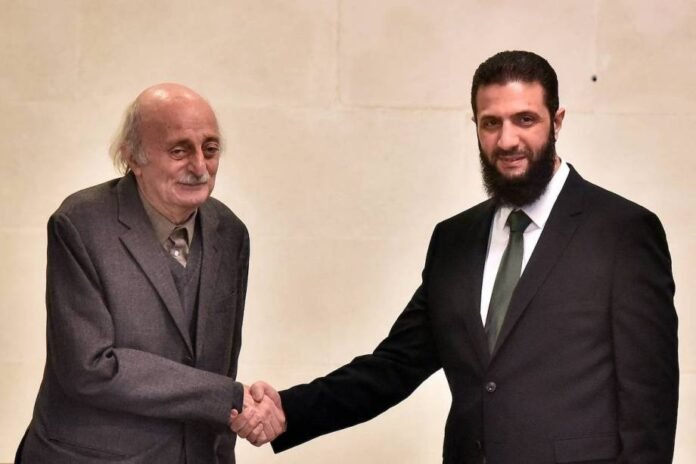
This logic extends across the border. Jumblatt met Syria’s Sharaa in Damascus to discuss the Sweida violence against Druze communities. He warned Syrian Druze against Israeli influence and rejected the “alliance of minorities” theory that would position the Druze as natural partners of Israel in a hostile Sunni environment.
Each of these moves reinforces the same imperative: the Druze must not be perceived as aligned with Israel by any regional actor, regardless of what the community’s polling preferences suggest, because perception determines targeting and the Druze cannot survive being targeted.
Jumblatt will continue to shift. If the framework advances and Israeli withdrawal materializes, he will deepen his support, positioning the Druze as reliable partners in the state’s sovereignty project and extracting institutional concessions in exchange for early endorsement. If the framework collapses and Hezbollah reasserts control, he will reverse, positioning the Druze as voices of caution who warned against a deal that was never viable. If the outcome remains contested, he will occupy the exact center, committed to no one and available to everyone, extracting maximum leverage from the uncertainty itself.
This is not leadership as political theory defines the term. It is something more specific and more durable: the management of a community’s survival within a power structure that the community is too small to shape but too visible to ignore.
Jumblatt does not make the weather. He reads it. And his four positions in sixty days are the most accurate meteorological record available for understanding where Lebanon’s political climate is heading. The four positions are not a record of indecision. They are a record of a community that has learned, across a century of confessional politics, that the last one to commit is the last one standing.
OPINION: When the money stops: Hezbollah and the economics of disarmament
The views expressed in this article belong to the author and do not necessarily reflect the editorial policy of Middle East Monitor.
IDF Rejects Police Claim of Qalqilya Tunnel, Says 2 Shafts Found
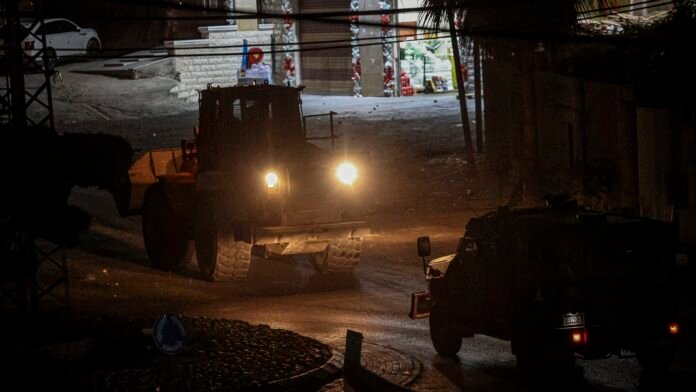
The Israel Defense Forces on Thursday rejected an earlier Israel Police announcement that officers had uncovered a 25-meter-deep tunnel in the West Bank city of Qalqilya, saying military engineers instead found two shafts about 12 meters deep with no connecting underground route.
The clarification followed a joint overnight operation by IDF troops, Border Police and Israel Police in Qalqilya after intelligence indicated weapons were being stored in the area. Four suspects were arrested and taken for questioning, while security forces continued searching for additional weapons and shafts.
Police said Wednesday that officers had found a tunnel still under excavation, along with the beginning of a second tunnel. They also reported seizing an M16 rifle, a sniper rifle, ammunition, magazines, phones, a digital video recorder and fertilizer that could be used in explosives.
After soldiers from the IDF’s Yahalom combat engineering unit examined the site, the military issued a sharply different account. It said two shafts approximately 12 meters deep had been located and that an M16 rifle, a hunting rifle, a handgun, and ammunition were found near them.
“Contrary to official and irresponsible statements that emerged on the matter, following an examination of the shafts, the presence of a tunnel route was ruled out,” the IDF said.
The military also said the shafts were not close to the security barrier separating parts of the West Bank from Israel, contradicting concerns that the excavations could have been intended to approach or cross the barrier.
Qalqilya, in the northern West Bank, lies close to the Green Line and the Israeli city of Kfar Saba. Much of the Palestinian city is bordered by Israel’s security barrier, making reports of underground excavation there particularly sensitive.
The IDF said forces were continuing searches in the area for additional weapons and possible shafts. Neither the military nor police immediately explained why their initial assessments differed so sharply.
Microsoft stops insisting you need a “Copilot+ PC”
Since 2024, Microsoft has tried to sell “Copilot+ PC.” The marketing initiative was aimed at making it easy for people to know which Windows systems were approved to run AI-accelerated workloads locally.
But Copilot+ PC branding is nowhere to be found on the new Surface PCs Microsoft announced this week.
Speaking with Windows Central, Brett Ostrum, corporate VP of Surface, said that the new Surface computers “are not called Copilot+ PCs” despite meeting the label’s requirements.
“They do meet all the requirements of our previous bar for what Copilot+ devices are. We still lean into the narrative around AI on the edge and being able to have a hybrid solution out there,” he said.
Copilot+ PCs require 16GB of RAM, 256GB of storage, and an integrated neural processing unit (NPU) with performance rated at 40 trillion operations per second (TOPS) or better.
The Surface Pro 12-inch (2nd Edition) and Surface Laptop 13-inch (2nd Edition), coming out on October 13, both run Qualcomm Snapdragon X2 Plus processors and have a Qualcomm Hexagon NPU rated at 80 TOPS.
“[T]he purpose for Copilot+ PCs was to be able to deliver [NPU] experience,” Kedar Kondap, SVP of compute at Qualcomm, told Windows Central. “So, it was to define a certain category of devices with a certain bar and metric, like, for example, a 45 TOPS NPU. … So from that perspective, it’s more offering the same experiences, probably without just using [Copilot+ PC] terminology now.”
AI PCs are old news
Copilot+ PCs are “a class of AI PCs and laptops” that represent “the fastest, most intelligent Windows PCs ever,” according to a Microsoft marketing page that was up as recently as May, per Internet Archive’s Wayback Machine. That Copilot+ PCs landing page, however, now redirects to a page for “performance PCs” that still names “Copilot+ PCs” but features the label far less prominently.
There are numerous reasons why Microsoft may be shying away from Copilot+ PC branding. One is the fact that the label was marred by the alarming, persistent security risks that accompanied its Recall feature, which remains concerning among privacy advocates.
Further, the Copilot+ PC marketing campaign may have served its purpose. It helped push the idea of “AI PCs” as the world’s expectations for generative AI reached new heights. The PC program also gave people a reason to think they needed a new computer, just as the PC industry was experiencing a post-COVID sales lull. In October 2024, Microsoft CEO Satya Nadella said Copilot+ PCs were “winning new customers.” In January 2025, he said that Copilot+ PCs represented 15 percent of premium laptop sales in the US during the holiday season.
Two years later, the idea of AI PCs is fading. PC manufacturers already had trouble pushing the AI PC message before the RAM shortage complicated things further, Jitesh Ubrani, research manager for worldwide mobile device trackers at IDC, told Ars Technica in January.
“General interest in AI PCs has been wavering for a while, since cloud-based options are widely available and the use cases for on-device AI have been limited. This indifference (between on-device and cloud-based) from a demand perspective might work in favor of PC OEMs, as they don’t need to provide large amounts of RAM,” he added.
More evidence of waning AI PC interest comes from Dell, which this year killed the laptop branding that it released in 2025. Dell’s 2026 laptop lineup makes minimal mention of AI PCs, which is starkly different from 2025.
Another reason that Microsoft could be putting Copilot+ PC marketing on the back burner is Nvidia’s incoming RTX Spark laptop GPUs. Microsoft has already confirmed it’s releasing a “Surface Laptop Ultra” with RTX Spark this fall. The use of RTX Spark may end up taking marketing precedence over the idea of PCs that run Copilot well, which have now been around for years.