Netanyahu, President Trump Discuss Renewed Iran Strikes Ahead of Elections
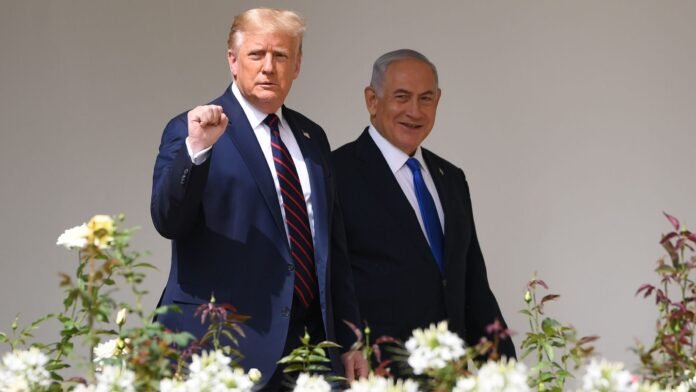
President Donald Trump has not committed to a new military campaign against Iran despite discussions with Prime Minister Benjamin Netanyahu over possible joint US-Israeli strikes on Iranian military and nuclear sites, N12 reported Tuesday.
The possibility of renewed fighting has been raised several times in conversations between the two leaders over the past two weeks. According to US officials, Netanyahu appeared to favor resuming attacks before Israel holds elections on Oct. 27, pointing to concerns over renewed Iranian nuclear activity.
President Trump has publicly said he would not attack Iran before the US midterm elections, while a senior US official described his position on renewed military action as repeatedly shifting.
A senior Israeli official offered another account of the discussions. Netanyahu told Israeli security chiefs in recent days that President Trump was the one who raised a potential new campaign before the elections and asked whether Israel would participate.
“Bibi spoke with the president about it several times, and the president told him, ‘Well, you know what, Bibi, go ahead and get ready.’ But he didn’t really give him any commitment. ‘Go ahead and get ready’ could mean now, it could mean later, and it could mean never,” a U.S. official said.
President Trump appeared initially inclined to approve Netanyahu’s proposal before his interest diminished, according to a senior Israeli official.
Preparations are continuing despite the absence of a decision. The Israel Defense Forces and US Central Command (CENTCOM) are on high alert and are completing readiness measures in case President Trump changes his position, according to the sources.
Renewed fighting could affect both Israel’s Oct. 27 elections and the U.S. midterm elections on Nov. 3.
Defense Secretary Pete Hegseth and CENTCOM are the leading supporters in the US administration of another large-scale military operation against Iran, a second senior US official said. Most of President Trump’s advisers instead support maintaining economic pressure and sanctions.
“They argue that this economic strangulation is working better and better. Let’s keep doing it,” the second US official said.
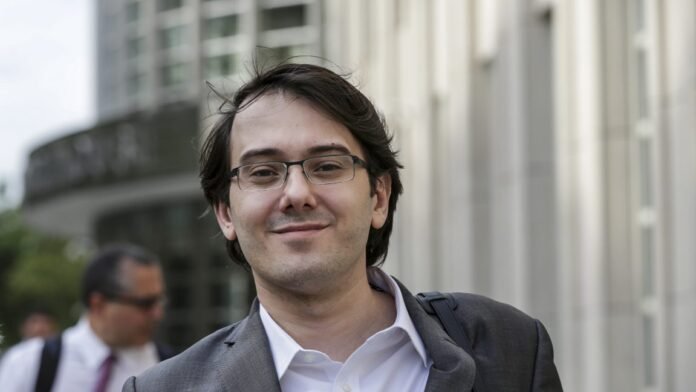
However, according to the Federal Trade Commission and the attorneys general of seven states, Shkreli has “flagrantly and repeatedly” violated that ban nearly the entire time—allegedly by trading stock in dozens of drug companies and discussing the industry during livestreams on social media.
On Tuesday, the FTC and the seven states asked a federal judge to hold Shkreli in contempt for the alleged violations. The states include New York, California, Illinois, North Carolina, Ohio, Pennsylvania, and Virginia—the same states that joined the FTC in suing Shkreli in 2020 over the “elaborate anticompetitive scheme” involving the anti-parasitic drug, Daraprim. The scheme raised the price from $17.50 per pill to $750 per pill virtually overnight, while blocking generic competitors from entering the market.
“Egregious” conduct
In 2022, the federal court recognized the “seriousness” of issuing such a lifetime industry ban, but ruled that “Shkreli’s egregious, deliberate, repetitive, long-running, and ultimately dangerous illegal conduct warrants imposition of an injunction of this scope.” The ban, among many things, “explicitly prohibits” Shkreli from owning stock in pharmaceutical companies and making public statements that could influence a pharmaceutical company’s business, according to the FTC and the states.
With the alleged violations, the FTC and the states are now seeking to force Shkreli to divest from all pharmaceutical companies and pay a fine equal to his profits from trading pharmaceutical company stocks. They also want the court to lay out “clear and escalating consequences” if Shkreli violates the ban in the future, including further financial penalties and incarceration.
“The extensive record compiled by FTC staff shows that Mr. Shkreli chose to blatantly disregard the order after leaving prison,” FTC Commissioner Mark Meador said in a statement. “Among other actions, he has traded pharmaceutical stocks and actively sought to influence the business and management of multiple pharmaceutical companies through public commentary, in violation of the terms of the injunction. … A lifetime industry ban is only effective if breaches are met with consequences commensurate with the seriousness of the order.”
In a response, Shkreli said he was surprised by the FTC’s filing. “I could see totalitarian NY AG Letitia James trying to limit a citizen’s free speech but not from Trump’s FTC,” he wrote on social media.
“Magic trick”
The brief filed by the FTC and the states breaks down Shkreli’s alleged violations in four phases:
(1) a 2022 trading competition with another YouTuber; (2) shorting a small biotech firm in 2024, along with trading in other Pharmaceutical Company stocks; (3) a 2025 trading challenge in which he shorted three small biotech firms along with trading in many other Pharmaceutical Company stocks; and (4) a trading challenge begun in June 2026 with a $10,000,000 account in which he is again trading in Pharmaceutical Company stocks.
In numerous livestreams on various social media platforms, Shkreli would sometimes show his accounts on screen, the filing said. He discussed pharmaceutical companies at length, evaluating stocks and predicting the outcomes of pivotal clinical trials. In 2025, he told his viewers about his “magic trick,” saying: “It doesn’t matter what trades I make because I can always find a couple of biotech stocks to smoke.” Later in the year, Shkreli advised his viewers to short one pharmaceutical company’s stock, and the company’s stock price quickly dropped 17 percent.
The FTC and the states wrote in their filing that the stocks Shkreli discussed in livestreams are “likely the tip of the iceberg.” FTC staff only reviewed a fraction of Shkreli’s social media activity, and Shkreli has made several references to other accounts he has.
“I have some other accounts that I’[d] show you, but, like, I know feds are watching, so f[*]ck that,” he said, according to the filing.
Rallye Sirocco, a nonprofit regularity rally with a humanitarian mission, will hold its first edition Dec. 18-23 in Morocco. The event is limited to 15 crews, or 30 participants, and will cover 1,035 kilometers (about 643 miles) from Marrakech to the edge of the Sahara.
Part of the participation fees will fund initiatives for 323 students in two Moroccan communities, organizers said.
A test of precision, not speed
In a regularity rally, crews must keep to set average speeds and reach checkpoints at scheduled times rather than race for outright speed. The inaugural edition will have four stages over six days. It is open to entrants without a motor racing competition license.
Organizers said the event rewards precision, consistency and teamwork in varied conditions.
The route
The rally starts in Marrakech and crosses the High Atlas mountains toward Ouarzazate, which organizers describe as the gateway to the desert. Crews then continue to M’Hamid El Ghizlane, at the edge of the Saharan dunes, before heading north through Zagora and the Drâa Valley, one of the world’s largest oases.
The route then passes through Foum El Oued and Taznakht, known for Berber crafts, and ends at the Ksar of Aït Ben Haddou, a UNESCO World Heritage Site.
What entrants receive
Each crew will receive an all-inclusive package that covers:
an official MG ZS Hybrid+ vehicle
fuel
accommodation
meals
cultural activities
official clothing
event logistics
Crew tracking and safety support will use Sirocco Tracker, built on Teltonika hardware. A companion tool, Sirocco Map, is also part of the event’s digital offering. Timing, regularity calculations and real-time standings run on a separate regularity system.
Support for students
The humanitarian initiatives target 323 students: 112 in M’Hamid El Ghizlane and 211 in Aït Ben Haddou. Organizers said they aim to promote responsible tourism, showcase the regions visited and pair a passion for motoring with concrete support for students in the two communities.
Organizers and partners
Two nonprofit associations are organizing the rally: ASACM and the Association de la Jeunesse Marocaine en France (AJMF). MG is the title partner. The Fédération Marocaine des Véhicules Anciens (Moroccan Federation of Vintage Vehicles) and the Association de la Jeunesse Marocaine à Toulouse (AJMT) support the event.
More information is available at rallyesirocco.com.
For most of the past thirty years, the semiconductor industry ran on a remarkably clean division of labor. Everybody knew their place.
The caricature was almost this simple: TSMC printed. Memory makers crammed capacitors. Designers drew. And the money followed the drawing.
TSMC took designs from Nvidia, Apple, AMD, Broadcom and others and reproduced them in silicon with a discipline nobody else could match. More importantly, it resolutely avoided becoming a product company competing with its own customers. That neutrality became one of its greatest assets. Companies that would reveal almost nothing to one another were willing to entrust TSMC with their most valuable intellectual property long before a product reached the market. TSMC’s prosperity depended on manufacturing their ideas, not replacing them with its own.
Memory occupied another well-defined lane. Samsung, SK hynix and Micron certainly designed extraordinarily sophisticated products, but economically they were treated largely as manufacturers: fit more bits into less silicon, improve yields, lower the cost per bit, and survive the next cycle. The products were relatively standardized. Pricing was brutal. Excess capacity could destroy profits almost overnight.
Much of the industry’s architectural power sat elsewhere. Nvidia, Broadcom, Apple and Qualcomm defined the architecture. TSMC manufactured it. Memory companies supplied a critical ingredient. The architects told the rest of the industry what to make and captured a disproportionate share of the value.
That arrangement is beginning to break. We’ve discussed the shifting power between designers and manufacturers in our notes before (here and here), but this note is about something different.
What is taking it apart is Samsung’s unusual shape and its sudden ability to pay for that shape.
Chip manufacturing has reached the point where the next gains require the old partitions to dissolve. Design and manufacturing. Logic and memory. Packaging and die-printing. What moves inside a package and what moves between packages. Power, heat and data movement are making those boundaries harder to preserve. A company that can optimize across several of them now holds something its competitors have to answer.
A few months ago, in Goliath’s World and the Encroachment Imperative, we wrote about giants eating the hardware middle class, moving into adjacent layers because complexity drew them in and because the specialists could no longer keep up. That was giants against everybody else. This is the sequel. The giants are still consuming the middle class. They have now started on each other.
It is also a sequel to Memory by Design, where we argued that memory and logic have begun to merge. The merging still looks elementary. Its consequences do not. Memory becoming architectural territory puts pressure on boundaries that TSMC and Nvidia once relied upon.
So the two layers that spent three decades taking what they were given, the foundries and the memory makers, are now pushing into the layer that used to tell them what to make. They can afford to. They are the richest companies in the industry. The layer being pushed has seen it coming and is pushing back downward. Nvidia is extending its design authority into the memory stack itself. SK hynix and TSMC have been deepening the kind of alliance neither of them needed while the old order held. Samsung, making both logic and memory, is the force they are arranging themselves against.
Much ink will be spent in the coming years on the shifting sands between the semiconductor and chip design giants. This mirrors what is already happening with the reduced monopolistic dominance of software and services giants today. An important aspect at present is how it all started with Samsung making more money than anyone ever in the history of human businesses and giving wings to its ambitions.
The company we said to own
Two years ago, we did something presumptuous: we wrote an open note to Warren Buffett suggesting that, if he ever wanted to own a semiconductor company, he should look at Samsung Electronics. We returned to the case a year later, asking whether Elon Musk’s manufacturing ambitions might lead him to consider a strategic stake in Samsung. The argument was never that Samsung was the best semiconductor company.
Samsung is not the world’s best foundry. TSMC is – by a margin that became painful enough, for Samsung, that we later devoted an entire piece to watching the two companies diverge over twenty years. TSMC won not merely the process race but the financial one: higher and steadier profits, better yields and eventually the valuation premium as well. Samsung has not lately been the best maker of high-bandwidth memory either. SK hynix took that crown.
Our case was about something else. Shape.
Samsung is the only semiconductor company of its scale with a leading-edge memory business, a leading-edge logic foundry, and advanced packaging capabilities within the same corporate structure. In the three-dimensional manufacturing era the industry is now entering, the control that shape makes possible is worth more than anyone has tried to put a number on.
This point is barely discussed anywhere, as far as we know, and the reason is, once again, in Samsung’s history. For much of the past twenty years, that shape looked less like an advantage than a tax.
The foundry consumed enormous capital while falling farther behind TSMC. Memory profits rose and fell with the cycle. Organizational silos meant that possessing several extraordinary capabilities did not automatically make Samsung extraordinary at combining them. Rather, given the paucity of resources, Samsung became a player far behind the cutting edge in the foundries, never seen as a threat because it just did not have sufficient capital to make an attempt. Samsung itself has been one of the best demonstrations of someone who had spread itself too thin.
What changed is the money. We have written about its scale twice: first when the profits arrived without precedent, then when we asked whether memory pricing had moved to a permanently higher plateau. The consequence is what matters here. The memory business now earns on a scale that lets Samsung fund all three legs at once, sustain the foundry through a prolonged development effort and pursue research whose commercial returns may lie beyond this decade.
The numbers are worth saying once. Samsung has committed around KRW110 trillion this year, roughly US$73 billion, to plant and research across the company: about $46-47 billion of capital expenditure and another $26-27 billion of R&D.
Samsung’s capex alone is larger than estimated mainland Chinese spending on semiconductor fab equipment this year. TSMC, however, has now raised its own 2026 capex guidance to an extraordinary $60-64 billion. Samsung’s rivals also have the resources to respond at extraordinary scale. The frontier itself has become a place where individual companies deploy capital on the scale of national semiconductor programs every year.
Samsung’s research budget still gives its peculiar corporate shape enormous new freedom. Group-wide R&D is running at roughly $27 billion this year, against about $8 billion at TSMC last year. In fact, TSMC’s total five-year spend on research is $30bn.
Samsung Electronics’ R&D spans businesses well beyond semiconductors, while TSMC’s is concentrated on semiconductor manufacturing. The totals therefore measure different scopes of research. The important point is that Samsung suddenly has more money than TSMC.
Memory profits now let Samsung fund memory, foundry, packaging, and speculative research at once. Samsung can now fund ambitions across memory, logic, and packaging on a scale that the company that has humiliated it for a decade cannot afford to ignore.
It is worth pausing on this comparison: For years, many have feared China’s semiconductor industry rise given its astronomical spending. Samsung’s annual capital expenditure alone now exceeds the estimate for mainland China’s semiconductor fab-equipment spending, although the measures cover different categories of investment.
This is the reason behind our title, the Frontier Express. Few have noticed how the resource-rich frontier has now begun to move forward. Even China’s catching up may be yesterday’s story.
Integration was always possible on paper. It has only just become affordable. The shape was a strength ahead of its time. The time has arrived. That is why Samsung’s competitors should be more worried today than they were before, when the organization chart looked identical.
The slab under the memory
High-bandwidth memory is built as a tower. Several layers of DRAM sit one above another. Underneath them sits a final piece of silicon called the base die. It is the foundation of the stack. It is the layer through which the memory communicates with the world outside.
For most of HBM’s life, that foundation was essentially plumbing. It moved signals, managed connections, and did the housekeeping required to make the memory above it work. Nobody thought of it as particularly valuable architectural territory. This was up until now.
The base die is moving onto increasingly advanced logic processes.
The same broad class of manufacturing technology is used to make processors. Its footprint is largely dictated by the memory stack sitting above it. The foundation has to sit underneath the building whether or not every square millimeter of that foundation is being put to sophisticated use. This creates a rather unusual situation. Beneath advanced HBM stacks, increasingly capable logic silicon is opening up new territory for whoever designs it.
Functions that once had to sit on the processor can begin migrating onto it. Decisions that once belonged entirely to the chip architect can begin being made inside the memory stack. The boundary between “the processor” and “the memory” starts becoming less obvious than the words suggest.
We explored the architectural possibilities in Memory by Design. Here, the question is: Who controls this increasingly valuable territory?
The EDA fabric hiding manufacturers’moats
It’s easy to misread what is happening. When a memory company or a foundry produces something clever, the instinct is to treat the cleverness itself as the advantage: Samsung has become better at design, perhaps TSMC has moved a little farther into system architecture, and therefore some value shifts toward manufacturing. But that explanation is too shallow. If the advantage were merely a better drawing, it would not last very long.
We have used the phrase “instant copyability” to describe the erosion of cognitive moats in a world suffused with generative AI. Once a design ships, competitors and their AIs can inspect it, understand it and reproduce much of what matters, increasingly quickly. A manufacturer therefore gains little durable advantage from becoming simply another clever designer. The real advantage lies in what an outside designer cannot inspect in a finished product: thousands of tiny manufacturing steps, tolerances, and process tricks that are hard to codify, yet collectively matter as much as a master painter’s brushstrokes.
For decades, the industry kept that knowledge on one side of the wall while letting thousands of customers design against it. A foundry did not give Nvidia or Apple a manual containing everything it had learned about making silicon. It translated the portion customers needed into process design kits, device models, design rules, standard cells, and verification decks. These were then embodied in the electronic design automation flows supplied by Synopsys, Cadence and others.
EDA became the membrane between manufacturing and design. The fab effectively said: keep these wires this far apart, make this connection no narrower than this, expect this transistor to behave within these parameters and we can manufacture what you draw. The designer did not need to know why a tolerance existed, how many failed experiments preceded it, or what the manufacturing line might already be capable of beyond it. Decades of process learning were distilled into a set of abstractions within which everybody could design.
That arrangement preserved the division of labor beautifully. Manufacturers could retain their deepest know-how while exposing enough of it for customers to innovate. Competing designers worked from broadly the same set of disclosed capabilities. But there was an important asymmetry buried inside the arrangement: the rulebook was never the manufacturing knowledge itself. It was only the part of that knowledge the manufacturer was ready to publish.
That distinction is becoming much more valuable.
New sequences of 3D manufacturing
Until now, design therefore sat downstream of manufacturing disclosure, by calendar as much as by construction. An architect could not confidently design around a capability that the foundry had not yet characterized, qualified and translated into a usable design environment. In a world dominated by two-dimensional chips, that delay was manageable. In the emerging world of three-dimensional semiconductor structures, it increasingly reaches into the architecture itself.
Consider a modern AI system bringing together logic, SRAM, HBM, and eventually optical I/O. The conventional assumption is that the architectural intelligence belongs primarily to companies such as Nvidia or AMD, while the manufacturers execute what those architects devise. But questions such as where heat should leave the structure, where power should enter, how far a vertical connection should travel, how two dies should be bonded, or where logic should sit relative to memory are no longer neatly divisible into “design” followed by “manufacturing.” Increasingly, the manufacturing choice and the architectural choice are the same choice.
More importantly, some of those choices must be made while the relevant manufacturing technology is still being developed. By the time a capability is sufficiently understood and repeatable to appear in a process design kit and become usable through standard EDA flows, the manufacturer may already have spent years learning what it can and cannot do.
The resulting asymmetry is not chiefly one of intelligence. It is one of information and time. A manufacturer can design against capabilities it knows are coming because it possesses the process data, defect history, thermal measurements and yield learning that indicate what may become feasible two or three generations ahead. An external designer sees the same capability later, once enough uncertainty has been removed for it to be exposed safely to customers.
That changes where architectural power can accumulate. Knowing today that a bonding process will reliably hold a certain tolerance in 2028 can justify a floorplan that an outsider cannot yet defend. Knowing where defects actually occur can determine where repair circuitry deserves its area. Knowing where heat concentrates can alter a structure before an external designer even knows that the hotspot exists.
None of those advantages can simply be copied from the finished product. The real asset is not the drawing. It is the accumulated measurement behind the drawing.
For decades, designers captured enormous value by drawing the best chip possible inside the rules manufacturers gave them. The emerging opportunity for manufacturers is to begin drawing before those rules have even been written.
Samsung moves first
Samsung has now begun to describe this opportunity in almost exactly those terms.
At its September keynote in Taipei, the company introduced CUBE, a framework for pushing three-dimensional structures across its memory business. Three of its four pillars are familiar enough:
Increase capacity by building upward.
Widen bandwidth by shortening the path between dies.
Reduce the energy required to move each bit.
The fourth is more consequential. Samsung calls it utilization, but the underlying question is architectural: Where should the logic sit, where should the memory sit, and which functions should move between them? Samsung’s claim is that owning both sides gives it more freedom to answer that question.
That is a subtle but important change in posture. Samsung is no longer presenting memory, foundry, and packaging simply as three businesses that happen to share a parent company. Increasingly, it is presenting them as ingredients that can be sold and developed together. The attraction to a customer is obvious. Instead of coordinating a memory supplier, a logic foundry and an advanced-packaging partner separately, a customer can potentially ask one organization to optimize the interfaces among all three.
The market is beginning to test the proposition. Broadcom has already engaged Samsung across memory, advanced logic, and packaging rather than through a single product category. Samsung is trying to deepen similar relationships with other large accelerator customers. AMD’s Lisa Su has visited Seoul twice in seven months. The company’s next-generation accelerators demand sharply more HBM. Korean reporting makes clear that Samsung wants the memory relationship to pull foundry and packaging work behind it.
That does not mean the bundle automatically wins. Samsung’s foundry still carries the scars of the past decade. Customers with access to TSMC have every reason to separate the attractive part of Samsung’s offering from the parts they trust less. The same AMD discussions reportedly illustrated that tension: Samsung had leverage through memory, yet the foundry work remained a much harder sell. Vertical integration is not the same thing as vertical competence. Owning memory, logic, and packaging under one roof only matters if Samsung can persuade customers that combining them improves the finished product more than mixing and matching best-of-breed suppliers would.
What matters at this stage is not whether Samsung can already displace TSMC or SK hynix in any particular account. It is that Samsung now has the financial resources, the technological breadth and, increasingly, the strategic intent to keep testing how far integration can be pushed.
If even part of that model works, the competitive question changes. The issue is no longer simply who makes the best memory, the best logic process or the best package in isolation. It is who can make those layers work together with the least friction and the greatest control. Just as the GPU stopped being merely a compute chip and became an architecture spanning memory, interconnect, networking and the rack, semiconductor manufacturing is beginning to stop being merely the act of printing a die and become the orchestration of logic, memory, packaging, power and thermals as one manufacturing system. Samsung is unusually placed to pioneer that transition.
Samsung also possesses one advantage that does not depend on winning every piece of business. It is the only major memory producer that does not have to invite another leading-edge foundry into the foundation of its most advanced memory products. As HBM base dies move onto more sophisticated logic processes, SK hynix and Micron increasingly need outside foundry partners. Samsung can keep that learning loop in-house.
Once one company can combine the layers internally, the others can no longer treat those layers as separate markets.
Everyone Answers
We should remember that none of the companies being encroached upon is short of money, technical depth, or ambition. These companies read technological tea leaves years before financial markets, which remain remarkably capable of staring at next quarter’s memory prices while missing what the resulting cash is about to finance.
SK hynix is the clearest example. Remarkably little serious work has been done on what it might build with a windfall that could take operating profit toward $200 billion this year. We get the headline capex number, roughly $35 billion, but mostly as a measure of how much capacity is being added rather than as a clue to the moats that may be getting built alongside it.
Samsung and SK hynix together are expected to finish the year with roughly $263 billion of net cash, more than twice Nvidia’s. They are beginning to deploy resources on a scale that only a handful of companies in history have possessed. This is not merely to make more memory, but to build capabilities unavailable to competitors without comparable money, process knowledge, and time.
TSMC’s resource pool is hardly standing still. At $60-64 billion, its capital expenditure this year will actually exceed Samsung’s. Almost all of it is concentrated on the manufacturing problem in which TSMC already leads. Its answer to Samsung’s breadth can therefore be greater depth: better logic processes, more advanced packaging, more capacity and a neutral integration platform through which many different memory and processor companies can meet. Samsung has the attraction of one roof; TSMC has the accumulated learning of being the roof under which much of the industry already operates.
It also begins this contest with something Samsung cannot buy overnight: a formidable lead in cutting-edge logic manufacturing, packaging execution and customer trust.
So Samsung’s breadth does not leave its competitors cornered. It changes the problem they have to solve. Samsung can integrate through ownership. The obvious answer is integration by contract.
SK hynix has moved closest to that model with TSMC. TSMC supplies the logic base die for its next generations of HBM. Memory design, logic process and advanced packaging are increasingly developed together rather than sequentially. What once looked like a straightforward relationship between a component supplier and a foundry is beginning to resemble a jointly assembled manufacturing platform. Micron is moving in the same direction for customized memory, though its ecosystem is less developed.
That is a much bigger change than the words “foundry partnership” suggest. A memory company is now inviting an outside logic manufacturer into one of the most consequential pieces of its highest-value product. The foundry is learning how that memory will be built, packaged, and connected years before it reaches the market. Samsung can keep much of that learning inside the company. SK hynix has chosen to recreate it across company boundaries.
TSMC, meanwhile, is becoming something rather different from the foundry of twenty years ago. It still does not need to design the customer’s accelerator. Maintaining that neutrality remains central to its model. But around the die it now orchestrates an expanding set of technologies: advanced logic, base dies, 2.5D packaging, 3D stacking, wafer-level integration and increasingly the electrical and optical connections between them. The more difficult it becomes to separate those pieces, the more valuable the company that defines the manufacturing environment in which they must all work together.
The partnership’s public scope is clear; its detailed division of intellectual property, economics and decision-making is not. Its effectiveness will depend on how well the companies coordinate across that boundary.
Neither model is obviously superior. Samsung avoids some coordination costs but carries weaker businesses and internal silos. The TSMC-SK hynix model combines companies that are individually stronger in their respective domains, but every important optimization must cross an organizational boundary.
And there is still a third elephant in the room. The companies doing this integration are suppliers to the firms that historically decided what the system should look like.
Nvidia takes the pen
The largest customer in this ecosystem has been watching the same boundaries move from the other side. For Nvidia, the danger is not that Samsung or SK hynix suddenly becomes better at drawing logic. It is that memory stops being interchangeable. Once a supplier owns an increasingly important piece of architecture inside the memory stack, switching suppliers becomes harder. Qualification takes longer. The component Nvidia can least afford to lose begins to acquire bargaining power over the entire accelerator. Apple’s plight in recent weeks shows why Nvidia would be reluctant to let memory makers and TSMC encroach unhindered.
Its answer is unusually revealing. In August, Nvidia introduced NVHBM, in which the memory controller moves off the accelerator and into the HBM base die. But instead of allowing the memory manufacturer to own that architectural layer, Nvidia designs the custom base die and controller itself. It has the memory companies validate and manufacture it. NVIDIA says the arrangement can deliver up to 30% more bandwidth, 15% lower HBM power and materially more usable compute area on the XPU. The engineering gains matter, but the strategic decision matters more: Nvidia has reached into the memory stack and taken authorship of the part that was becoming interesting.
There is another clue in the way Nvidia is commercializing it. NVHBM is intended to be available from multiple memory suppliers, not a bespoke technology tied to one manufacturer. That preserves something Nvidia has always valued enormously: substitutability. If Samsung, SK hynix and Micron can all build memory around an Nvidia-defined base die and controller, innovation can move deeper into the stack without handing any one memory vendor control of the interface.
Nvidia is also taking the idea beyond its own GPUs. NVHBM sits inside NVLink Fusion, the platform through which hyperscalers can connect their own custom accelerators to Nvidia’s interconnect and rack architecture. Amazon’s Annapurna Labs is the first announced collaborator. The company that once sold a GPU is therefore increasingly specifying how somebody else’s accelerator talks to memory, how it joins the scale-up fabric, and how the resulting machine fits into the rack.
This is encroachment running in the opposite direction. Nvidia has no reason to build a memory fab, just as it has no reason to build a leading-edge logic fab. Its defense is to move the boundary of what it designs farther downward, leaving manufacturing to others while keeping control over the interfaces through which their products connect to its architecture.
What is striking is how closely the engineering directions are beginning to converge. The controller is migrating toward the memory. Interfaces are becoming more customized. Logic and memory are being designed more intimately together. The disagreement is no longer primarily over what should happen. It is over who gets to draw it.
The circle tightens
These moves are beginning to reinforce one another. Samsung’s ability to combine memory, logic and packaging raises the value of integration. SK hynix cannot reproduce that structure internally, so it binds itself more tightly to TSMC. TSMC consequently moves deeper into the most valuable part of the memory system. Nvidia then sees memory gaining too much of its own architecture and pushes its specification down into the base die. Each company’s defense therefore shifts another boundary that the next company can no longer ignore. And this is before we see responses emerging from other giants in chip design.
There is no obvious resting point. If Nvidia succeeds in making several memory companies manufacture to one Nvidia-defined architecture, it will create pressure on other chip designers to get involved in their own HBM. Memory-makers will not mind such customization drives, even if the value of their own designed memory does not increase as much in the face of more design-led competition. All of this is hypothetical for now. The main point is about the loops of innovation we discussed in an earlier note.
The people between the giants
Our encroachment imperative note was about what happens to specialists when giants move sideways. This time, the pressure comes from several directions at once. Businesses whose value rested chiefly on an interface being standard and independently supplied look particularly exposed: memory-controller IP, generic die-to-die blocks, some package-design functions, and eventually parts of the design-service layer. If the interface becomes important enough for Nvidia, Samsung, a memory producer, or a foundry to own directly, there is less room for somebody whose business consists of sitting between them.
The outcome will be less tidy for packaging and testing. The leading foundries have pulled advanced packaging inward. Demand has repeatedly outrun their capacity and pushed work back towards outsourced semiconductor assembly and test (OSAT). Complexity can therefore destroy one specialist while making another indispensable.
Even the EDA companies are moving away from their old role as neutral translators of foundry rules. They are participating much earlier in customer-specific optimization. The common thread is that being an intermediary is becoming less valuable. Owning scarce knowledge, capacity, or qualification remains extremely valuable.
Terafab and the moving frontier
There is one important attempt to run the argument in reverse. If manufacturing companies can move toward architecture, why shouldn’t a sufficiently rich architect build its way into manufacturing?
Terafab is the cleanest experiment yet. SpaceX and Tesla describe a closed-loop facility combining advanced logic, memory, packaging and testing. Mask design and fabrication are brought much closer to the workloads that ultimately consume the chips. The first Grimes County phase commits more than $16.8 billion. The proposed complex will eventually exceed 100 million square feet. SpaceX’s own prospectus describes the objective explicitly: design, fabrication and deployment brought together so that each manufacturing cycle can feed the next design cycle more quickly. The ambition is enormous. The amount committed so far is not.
The headline Terafab numbers sound enormous until you put them beside the frontier it hopes to join. Its $16.8 billion first phase amounts to roughly one quarter of TSMC’s capital expenditure in a single year. Samsung will spend more than four times that amount on plant and research this year, while SK hynix is itself heading towards roughly twice that sum in annual capex. These incumbents will repeat much of that spending next year while learning from the factories already running.
That is the difficulty with entering this race late. Terafab does not have to catch TSMC, Samsung, or SK hynix as they are today. If meaningful production begins several years from now, it has to catch companies that will meanwhile have invested another hundred billion dollars or more, qualified several additional process generations, accumulated billions of additional manufacturing measurements and begun optimizing technologies that are still roadmaps today. The target is moving while the pursuer builds its starting line. Terafab need not match every incumbent capability to produce useful chips for its own customers. Matching their leading-edge economics, yields and breadth is the harder ambition.
Of course, semiconductor manufacturing does not yield its frontier merely to capital. Japan has supplied a useful contemporary experiment. Rapidus was created in 2022. It has around $15 billion of government backing, access to IBM technology and an ecosystem assembled specifically to restore Japan to the leading edge. Four years later, it has demonstrated serious technical progress and still targets mass production only in fiscal 2027, with commercial customers remaining the central unresolved question. Nobody regards that timetable as unusually slow; by semiconductor standards, it is extraordinarily fast.
Intel offers an even harsher lesson. It began with decades of leading-edge manufacturing knowledge, existing fabs, equipment relationships and thousands of experienced engineers. Yet recovering a lost process lead has consumed years and enormous amounts of capital. GlobalFoundries eventually decided the economics of remaining at the frontier no longer justified continuing its 7nm program at all. The difficulty is therefore not unique to new entrants. Once manufacturing leadership is lost, money shortens the journey only so far.
Terafab itself has already acknowledged part of that reality. Intel joined the project in April. Tesla intends to use Intel’s 14A manufacturing process rather than invent a leading-edge process from scratch. Last week, reports of possible TSMC involvement prompted Musk to clarify that Tesla and SpaceX intend to build and operate Terafab themselves. TSMC could potentially lease part of the site. The project remains genuinely vertically ambitious, but its first steps already draw upon manufacturing knowledge accumulated elsewhere.
That is precisely the point. Tools can be bought. Engineers can be recruited. Process technology can be licensed. What cannot be installed with the equipment is the history behind the equipment: years of defect maps, process-window adjustments, tool matching, contamination failures, thermal measurements, yield excursions, packaging mistakes and customer qualifications. Manufacturing leadership is partly a stock of machinery and largely a stock of accumulated learning.
Announcements are the easy part
None of this guarantees that the increasingly integrated structures described in this note will work. Three-dimensional integration compounds yield problems rather than abolishing them. Bonding tolerances narrow. Heat becomes harder to remove. Power delivery becomes more difficult. Package warpage and signal integrity become system problems. Qualification still has to be repeated customer by customer. An elegant roadmap structure may be impossible to manufacture economically at the required volume.
Even good ideas arrive with a bill. Moving a chip’s power supply to the back of the wafer is the headline feature of the next logic generation. It genuinely improves efficiency. It requires thinning the silicon so far that heat can no longer spread sideways. Simulation work shows the resulting hotspots are meaningfully hotter than the arrangement they replace. The change also lets designers pack circuits more tightly, which raises the power density that caused the problem.
Samsung does not have to win every contest for its ambitions to change the industry. It now has the money to pursue memory, logic, and packaging together. It can sustain expensive experiments and keep pressing where those businesses meet. Its rivals must make their own investment and architectural decisions while that challenge develops. Waiting for Samsung to prove every part of the proposition would mean waiting too long.
TSMC’s deeper integration platform, SK hynix’s network of foundry alliances, and Nvidia’s move into the HBM base die each has its engineering logic. Samsung’s expanding ambitions add competitive urgency to all three. Their responses, in turn, raise the demands on Samsung. The result is a frontier advancing through the interaction of exceptionally well-funded competitors, making the task harder for anyone still trying to reach it.
Markets can count the capacity that today’s profits will finance. The more consequential question is what those profits allow Samsung to attempt and what those attempts force others to do. The years ahead will contain fascinating developments in semiconductor technology, spurred ironically by memorymakers and foundries rather than the designers.
Nilesh Jasani is the founder and CEO of GenInnov Pte Ltd Singapore. Vibhu Sharma is a veteran of the semiconductor industry and a strategic technology advisor for GenInnov.
Originally published by GenInnov, this article is republished with permission.Read more at www.geninnov.ai/blog.
In this handout photo provided by the Houthi media center, fighters participate in a military exercise on March 12, 2024, in Sana’a, Yemen. [Photo by Houthi Movement via Getty Images]
The Saudi-led coalition said on Tuesday that it intercepted and destroyed two ballistic missiles launched by the Houthi group toward Dhahran and Haradh in eastern Saudi Arabia, Anadolu reports.
Coalition spokesman Turki al-Maliki announced in separate posts on the US social media company X that forces intercepted onw missile heading toward Haradh and another toward Dhahran.
The coalition said debris from the interception had fallen in a residential area in Dhahran and authorities are responding to the site.
It did not provide details on casualties or damage.
Saudi Arabia’s Civil Defense issued a warning earlier Tuesday of “potential danger” in the Eastern Province before announcing minutes later that the danger had passed.
Topgolf’s VMware costs were going to increase by 400 percent under Broadcom. To avoid that cost, the sports entertainment company moved 12,000 virtual machines (VMs) to VergeIO’s VergeOS and has saved over $11 million so far.
Before migrating, Topgolf’s VMware connection “ran very deep,” Scott Forehand, Topgolf’s global infrastructure manager, told Ars Technica.
Topgolf has over 100 locations worldwide featuring interactive golf games with real-time shot tracking and digital analytics. The company used vSphere and ESXi for decades and started using VxRail, the hyperconverged infrastructure (HCI) platform that VMware co-engineered with Dell, in 2017. Topgolf employees previously participated in numerous VMware customer councils and have been interviewed for books on how Topgolf used vSphere and Horizon (now Omnissa Horizon), per Forehand, who is a leader of the Dallas/Ft. Worth VMware User Group.
But Broadcom’s decision to stop selling VMware perpetual licenses and bundle VMware products into fewer, larger, and more expensive SKUs led Topgolf, as well as many other VMware customers, to look elsewhere. With VMware’s strategic changes complicating future planning, Topgolf decided to migrate its on-premises workloads, including those for its venues, offices, labs, and data centers.
Twenty Topgolf venues are still running VxRail with the VMware Cloud Foundation software stack. Forehand expects Topgolf to be completely off VMware by the second week of December. He added:
Overall, we reduced or eliminated over $11.3 [million] in combined infrastructure costs prior to the adjustments in hardware cost in the market. Comparatively, it’s much more now when you look at the cost of a solution similar to the configuration of the old VxRail solution we installed.
The money Topgolf saved by moving to VergeIO isn’t typical because Topgolf has larger needs than many organizations. However, saving money on software licensing and avoiding proprietary HCI appliances and separate tools for data protection, replication, and multi-site management is common for VergeOS users coming from VMware, VergeIO Chief Marketing Officer George Crump told Ars.
“Most customers who move from VMware see meaningful reductions in all three,” he said.
VergeIO gets about 70 new customers a quarter, “and most of them are coming off VMware,” Crump said. Most of those VMware migrators are facing renewal, are due for a hardware refresh, run many sites, or need multi-tenancy.
“Most customers bundle the [migration from VMware to VergeOS] with a hardware refresh or a modernization effort, as Topgolf did with its gaming architecture. Scheduling all of that together is the real work,” Crump said.
Topgolf’s migration
Since Broadcom’s takeover, VMware competitors have been aggressively courting VMware users. Topgolf ultimately chose VergeOS, a virtualization platform that combines compute, storage, disaster recovery, networking, and AI, because of its tenancy. Topgolf uses VergeOS’s Virtual Data Center offering for multi-tenant segmentation, where each tenant acts like an independent data center. Forehand explained:
VMware lacks the ability to segregate clusters into tenants, which has made it a nightmare to manage at scale. Even VMware’s [Software-Defined Data Center] Manager product couldn’t manage the number of vCenter instances we had in our environment. With VergeIO, we have been able to segregate our deployment into tenants by time zone, making upgrades and maintenance much easier. We’ve even been able to leverage tenancy to build nested labs within a single VergeIO cluster, which has saved [us] considerably on the requirement for lab hardware.
Topgolf replaced 650 VxRail hosts with about 400 Dell PowerEdge servers in about six months. Per a case study that VergeIO published, Topgolf moved from six-node VxRail clusters with 35TB of storage capacity to three-node VergeOS clusters with 5TB of storage capacity.
“Moving to Dell PowerEdge reduced comparative hardware spend by 87 percent,” Forehand said. “Obviously, with the shift in the market and massive increases in compute and storage cost, we have taken a hit to the original numbers, but it’s still exponential.”
Topgolf’s software costs, meanwhile, decreased by 77 percent. It also secured a five-year enterprise license agreement (ELA), compared to the three-year ELA that VMware reportedly offered.
Topgolf worked with VergeIO employees to develop a solution that accommodated some of its “weird” needs, such as performing machine learning-driven golf ball tracing via Topgolf’s proprietary Toptracer, which runs in the VergeIO cluster, Forehand said.
“Toptracer … pushes about 40TB of network data from the cameras in a typical 102-bay venue per day. That’s a lot of bandwidth, and the VergeIO team helped us solve some latency and pathing issues with that traffic to spread the load more effectively across the nodes in the cluster,” he said.
VergeOS also appealed to Topgolf because its end-to-end automation didn’t require Topgolf to retool its infrastructure-as-code. VergeOS being “API-first” was key here, Forehand explained, and its employees helped Topgolf develop support for infrastructure-as-code tools Terraform and Ansible early in migration.
Topgolf’s biggest challenge in ditching VMware has been coordinating all the projects it had to do alongside the server stack replacement. Forehand explained:
On VxRail, Topgolf gaming was powered by the servers. With VergeIO, we simplified the gaming stack and moved everything to the edge game panels in the bay. That meant we had to replace all of the game panels, rewire the columns, replace the server stack, and swap to our new Kubernetes gaming architecture. We also piled a few other projects in there with all of that to eliminate even more technical debt.
As Topgolf reduced its use of VMware, it also encountered challenges trying to integrate its new virtualization platform with third-party software, like Rubrik and LogicMonitor, which Topgolf uses to monitor its overall infrastructure.
VMware has been a leader in virtualization for decades, resulting in a wide range of enterprise products. This differs from newer competitors, which may not yet offer the same level of compatibility.
“Overall, the challenges have been pretty minimal,” Forehand said. “The real challenge has been a hearts-and-minds campaign to educate leadership on the gaps that do exist. With Rubrik, we moved to the VergeIO snapshotting to fill the data protection gap that not being able to use Rubrik left us, but we didn’t have an immediate answer for some of the Rubrik security features, like threat hunting and ransomware protection, so we’ve pivoted to Veeam to fill those gaps for us.”
VergeIO’s strategy for addressing product integration challenges includes building the capabilities delivered through third-party offerings into VergeOS and partnering “on the ones that matter most,” Crump said.
“Integration is the most common friction point, and it shows up after the migration. … A customer wants to keep using a tool it has already paid for and trained staff on. If that vendor doesn’t support VergeOS yet, the customer has to switch tools or run a workaround,” he said.
Why Google is paying to upgrade nuclear power plants
This coverage is made possible through a partnership between Grist and WABE, Atlanta’s NPR station.
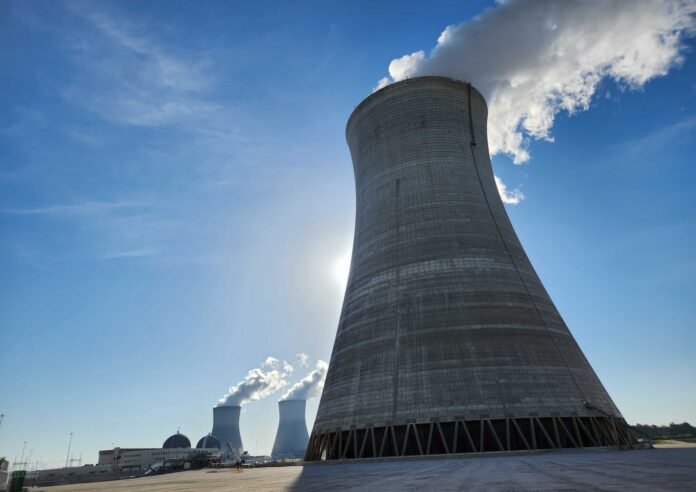
Last week, the Georgia Public Service Commission voted to approve a new deal between Georgia Power and the tech giant Google. Starting in 2028, Google will help pay for upgrades to the state’s nuclear reactors.
“So, around 100 megawatts of carbon-free energy, paid for by somebody else,” PSC Commissioner Stan Wise said to staffers shortly before the vote. “Why don’t you bring us some more of those deals?”
Georgia Power wants to upgrade four of the state’s older nuclear reactors at Plant Vogtle and Plant Hatch so they can produce more energy. State regulators approved the Vogtle upgrades last year, but the specifics of how to pay for the work weren’t hashed out. Now, the commission has voted to move ahead with the updates at Plant Hatch too — and approved a new subscription program so large customers like Google can pay for both.
“We appreciate Google’s continued leadership in this space and partnership in developing this program, which we see as the latest example of how large-load growth can benefit all electric customers,” said Aaron Mitchell, senior vice president of strategic growth for Georgia Power, in a statement.
Under the program, Google will pay a subscription fee on top of its electricity bill to help cover the cost of the nuclear upgrades. In exchange, Google gets credit toward its goal of using only carbon-free energy by 2030. Since nuclear plants don’t use fossil fuels, the power they generate qualifies; nuclear plants can also generate electricity around the clock, which solar and wind power can’t do.
Precise details of the agreement between Google and Georgia Power haven’t been made public. It’s expected to add 96 megawatts of nuclear capacity to the grid and provide “approximately $900 million in projected benefits to customers over the life of the units,” according to the utility.
“This collaboration with Georgia Power ensures that digital infrastructure growth goes hand-in-hand with positive local impact, helping to deliver hundreds of millions of dollars in direct customer benefits and supporting a more affordable, clean, and reliable energy system for all Georgia residents,” said Lucia Tian, director of advanced energy technologies for Google, in a statement.
Google also announced last week that it will partner with Constellation Energy to fund similar nuclear upgrades at reactors in Illinois, New Jersey, and Pennsylvania, adding 890 megawatts of energy to the grid for PJM, the largest grid operator in the country. Amazon has announced a deal to add capacity to a Constellation nuclear plant in Maryland.
Read Next
Around the country, many utilities are meeting the boom in energy demand from hyperscale data centers by building new natural gas generation and extending the life of coal-fired power plants. Similarly, many data centers are building their own fossil-fuel generation. Deals like this one could present an alternative, according to Priya Barua of the Corporate Energy Buyers Association, which advocates for non-fossil energy solutions for corporate customers.
“A number of large energy customers are looking kind of across the board at what are all of the tools in the toolkit in order to actually support a reliable, affordable grid,” she said. “I do think we’re going to see a lot more of those types of innovations and thinking across the board.”
In addition to nuclear improvements like the ones in Georgia, those tools could include energy efficiency programs, transmission line upgrades, and efforts to reduce energy demand at key times to relieve pressure on the grid — all solutions that can be scaled up relatively quickly with an infusion of cash from a large tech company, Barua said. That speed could prove critical in the coming years because there are significant delays in the supply chain for natural gas turbines and other key components in the gas expansion that Georgia Power and other utilities are planning to meet data center demand. A new nuclear plant can take decades to build, whereas upgrading an existing plant can take around five years.
“It can mitigate delays in projects coming online,” said Katie Southworth, also of CEBA, of programs like the Google-Georgia Power deal. “You’ve got a relay race, and who is going to get to [commercial operation date] first. In order to have the resources to sort of run a competitive relay race, you have to have a lane for them to go into.”
It’s one year since the US-brokered ceasefire for Gaza formally came into effect. On October 9 2025, Hamas handed over the 20 remaining hostages and the bodies of four Israelis who had died while being held captive. In return, Israel released almost 2,000 Palestinians held in Israeli jails.
The ceasefire officially began the following day, October 10, and humanitarian aid began to trickle into the beleaguered Palestinian territory. The UN security council formally endorsed the 20-point plan for the ceasefire and reconstruction of Gaza with Resolution 2803 on November 17.
At the time, the US president hailed it on his TruthSocial platform as “a moment of true historic proportion”. Yet 12 months on, the Israeli army continues to occupy Gaza, the Palestinian death toll continues to climb, and there is no sign of any lasting resolution.
By any possible metric, the situation in Gaza is catastrophic. About 94% of the population are in need of shelter – that’s nearly 2 million people. More than 1.4 million face crisis-level hunger or worse.
There’s a plague of rats and other vermin biting children and spreading disease. This is because three years of Israeli military assault has almost completely destroyed Gaza’s sanitation infrastructure, while also leaving much of the population with inadequate access to clean water.
Much of Gaza remains in ruins. Israel has destroyed 92% of its housing, 95% of its farmland, all of its universities and half of its hospitals – with the remainder barely functioning.
The UN has estimated that clearing the rubble alone could take 20 years – while the cost of rebuilding Gaza is estimated at more than US$70 billion (£53 billion).
There has been no progress on this front over the past year – reflecting a lack of political will from Israel and the US-led international community.
Ceasefire in name only
When the agreement was announced, Trump said it would end “3,000 years” of war. But in reality, the violence has continued.
Israeli violence is accompanied by a continuing blockade, which is responsible for many of the dire conditions described above. Despite the crisis, Israel continues to keep many essential supplies out of Gaza, leading the UN secretary-general, António Guterres, to flag the severe restriction of humanitarian aid as a major concern.
As well as destroying much of Gaza, Israel has also extended its occupation on the ground over the past 12 months. The terms of the deal proposed the Israeli military’s phased withdrawal from the Gaza Strip. The army initially redeployed to the yellow line: a newly established boundary that cut the Strip in two.
This confined virtually the entire population of two million Palestinians to around 60 square miles on its western side.
The yellow line was intended as a temporary measure. But Israeli officials have described it as “a new border”. Any Palestinian who crosses the line or even gets close to it risks being shot by the Israeli army. More than 200 people were killed in this way in the first six months after the ceasefire was announced.
Making matters worse still, the line’s exact location is unclear. It is indicated on the ground by yellow blocks that the Israeli military continually moves further west, extending its de facto territory.
The terms of the UN-approved ceasefire deal stated explicitly that: “No one will be forced to leave Gaza, and those who wish to leave will be free to do so and free to return.” But the Israeli prime minister, Benjamin Netanyahu, reportedly told lawmakers inside the Knesset, Israel’s parliament in May 2025 that Israel is “destroying more and more houses [in Gaza so that Palestinians] have nowhere to return”, adding: “The only obvious result will be Gazans choosing to emigrate outside of the Strip.”
These alleged remarks were leaked from a closed session of the Knesset – and this was well before the terms of the ceasefire were agreed. But in recent weeks both Katz and Israel’s national security minister, Itamar Ben-Gvir, have endorsed plans for the mass forced expulsion of Gaza’s Palestinians – and Netanyahu has done nothing to condemn them.
With Israelis preparing to go to the polls for the first time since the October 7 attacks, candidates are making increasingly extreme statements – a reflection of a shift to the right, particularly among first-time voters.
It would be foolish to assume that the election on October 27 will bring any real change in Israel’s Gaza policy. Both Netanyahu and his main rival, Gadi Eisenkot, are implacable opponents of Palestinian statehood.
So only international pressure – particularly from the US – can bring about a change in Israeli policy towards the people of Gaza and their future. But with the Trump administration itself reported to favour the transfer of Palestinians, few in Gaza are expecting any help from Washington in the foreseeable future.
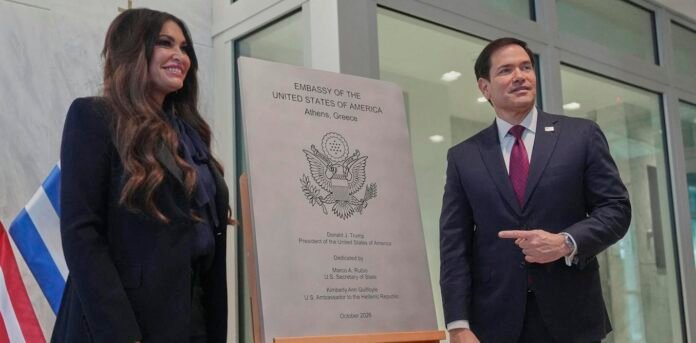
Guilfoyle resigns as ambassador to Greece – adding to the global vacancies sapping US embassies
The United States is down one more ambassador. On Oct. 13, 2026, it emerged that President Donald Trump had asked Kimberly Guilfoyle, a MAGA loyalist and ex-fiancée of Trump’s son Donald Jr., to resign her position as U.S. ambassador to Greece, a NATO ally. It follows allegations that the Trump adviser turned diplomat pushed for a Republican donor to pay off her six-figure American Express bill.
Guilfoyle later confirmed that she would comply with the request and resigned. In so doing, Athens became one of a number of U.S. overseas missions with a vacancy at the top. In fact, 93 out of 196 U.S. ambassador jobs are currently unfilled.
And that is after U.S. senators confirmed 10 new ambassadors before leaving town on Sept. 30, 2026. Among those nodded through before Congress closed for an extended midterm recess were new U.S. ambassadors for Kenya, Nicaragua, Malaysia and Kyrgyzstan.
With some of the vacancies the White House has not even sent names to Capitol Hill, despite the second Trump administration being a year and a half into the job. With others, the Senate, which is controlled by the same party as the White House, hasn’t acted on the names put forward. Should the Athens position be added to the list, the reason will be down to potential insufficient vetting or an ill-advised appointing strategy that promotes loyalty over experience.
Regardless of the reason, as a former ambassador and an expert in the process of diplomacy, I find the current vacancies concerning. Among those embassies still without a top person in place are key partners for the U.S. – countries that Washington needs to achieve its security, economic and strategic objectives.
What makes these vacancies more worrying, in my view, is that they come amid other concerning developments in the State Department’s staffing of embassies.
Politicizing diplomacy
Chief among them are the high percentage of politically appointed ambassadors relative to positions filled by career diplomats – that is, senior foreign service officers, usually with at least 20 years of diplomatic experience.
Though many countries send politicians abroad as ambassadors, America’s diplomatic service is unique in two ways. The percentage of U.S. ambassadors who are political appointees – those who haven’t followed a career civil service path – is higher than comparative countries across the world. Second, those political appointees are often donors with little to no government experience.
The practice has existed for decades, but in recent years the number of political appointees has increased. During the Obama administration, the percentage of political appointees was around 30%. The number rose to around 40% in the first Trump administration and the subsequent Biden administration.
And many of the people Trump has put forward don’t appear to have the credentials usually associated with holding important diplomatic positions. Rather, many are friends, associates or donors to Trump, often with little overseas experience or knowledge of the country they are going to.
Lee Lipton, ambassador to a key ally in the Philippines, is owner of a restaurant in Palm Beach – Florida Benny’s on the Beach – a member of Trump’s Mar-a-Lago Club and a contributor to his political campaign.
The system of political appointees has always had an element of handing ambassadorships to friends and supporters. But what has changed under Trump is the range of positions now available. In the past, ambassadors to key countries like Chile, Israel, Peru, the Philippines, Turkey and Egypt, for example, have almost always been career appointees. This has changed under the second Trump administration.
Appointing noncareer diplomats to small, faraway nations has the additional problem that the chosen individual may not actually spend much time there. The rule of thumb has long been that ambassadors should spend no more than one month every year back in the United States. But that is compromised if a noncareer diplomat with expansive business ties in the U.S. is selected.
The role of a deputy
A closely related problem is the State Department’s handling of an ambassador’s second in command, their deputy chiefs of missions – DCMs for short – under Secretary of State Marco Rubio.
During Trump’s first term in the White House, politically appointed ambassadors were often encouraged to swap out the DCMs they inherited from their predecessors. It meant going through a long hiring process, leaving those key jobs unfilled for months.
In 2025, the State Department went further, canceling the assignments of senior officers en route to take up embassy jobs and opening a new hiring process.
With more politically appointed ambassadors – some of them with no relevant experience – having an experienced DCM can be the difference between success and failure.
Looking for other friends
When you put all of these personnel changes together, the result is the degradation of what was once seen as one of the most effective diplomatic services in the world.
What makes this potentially more worrying is where the vacancies are. For example, Belarus and Bulgaria, neighbors to Russia and Ukraine, are without U.S. ambassadors. And important countries in the fight against terrorism or in geopolitical hot spots, such as Kuwait, Qatar and Mauritania, are in the same camp.
Other countries still without ambassadors include Indonesia, Southeast Asia’s largest nation and the most populous Muslim-majority country in the world; key Middle East ally Egypt and nuclear power Pakistan; and nations the U.S. needs to help manage inward migration, such us Haiti and Guatemala.
The problem of absent or inexperienced ambassadors goes both ways. It means Washington may not have a capable diplomatic figurehead in these countries to contact in times of need. There are also fewer avenues for host nations to successfully convey messages back to the U.S. administration.
When faced with absent ambassadors, amateurish political appointees and deputy mission chiefs who are very junior or career appointees with short resumes, host countries may conclude that they aren’t seen as important to the U.S. and start looking elsewhere for friends.
And the U.S. has hollowed out its ambassadorial corps at a time when it is facing growing international influence by the likes of Russia, China and Iran – rival nations hoping to capitalize on a perceived diplomatic void left by Washington.
For example, as the U.S. tries to contain Beijing’s influence in the Asia-Pacific region, Fiji, Indonesia and Laos remain without U.S. ambassadors. Similarly, China’s diplomatic relations with Pakistan – a former key security partner for Washington – have grown while the ambassadorial seat in Islamabad remains empty.
And former Soviet states including Georgia and Kazakhstan don’t have U.S. ambassadors even as Russia President Vladimir Putin attempts to consolidate Moscow’s regional influence.
In large areas of the world, such as Africa and the Pacific region, and in important areas of policy, the lights may be on in U.S. embassies, but nobody’s home. And that is a distinct problem for national security and strategic interests.
‘Tiger King’ Star Carole Baskin Defends Tiger After Deadly Zoo Attack
“Tiger King” star Carole Baskin is speaking out after a tiger fatally mauled a man at a British wildlife park, insisting the animal was simply following its natural instincts and should not be punished for the tragedy.
The outspoken animal rights activist defended the tiger after Saturday’s horrifying incident at Yorkshire Wildlife Park in Doncaster, England, where a man died after entering an enclosure housing endangered Amur tigers, also known as Siberian tigers.
“The tiger was not doing anything wrong by being a tiger. I am relieved to hear that the animal was not harmed,” Baskin told the New York Post in a written statement.
The tragedy unfolded on October 10, when South Yorkshire Police received reports of a man inside the tiger enclosure at approximately 1:35 p.m. local time.
The tiger attacked the man, leaving him with devastating injuries. Two ambulances, an air ambulance and a doctor responded, but emergency workers were unable to save him. He was pronounced dead at the scene.
Authorities have not publicly identified the victim or explained how he managed to enter the restricted area. His family has been notified and is receiving support from specially trained officers.
Baskin, who became a household name through Netflix’s hit documentary series “Tiger King,” expressed sympathy for the victim’s loved ones while urging the public not to blame the animal.
“My heart goes out to the family and loved ones of the man who lost his life today at Yorkshire Wildlife Park,” she said.
She also warned against jumping to conclusions before investigators determine exactly what happened.
“We don’t yet know all the circumstances that led to this man’s death, and it would be wrong to speculate,” Baskin explained.
The 65-year-old animal advocate emphasized that even tigers accustomed to human activity remain dangerous predators whose instincts cannot simply be trained away.
The tiger involved in the attack has since been identified as Altai, a male Amur tiger living at the park.
In an important update Sunday, October 11, wildlife park officials confirmed that Altai was unharmed and would not be euthanized.
The park reassured concerned members of the public that the tiger was safe and well, putting an end to speculation about whether the animal might be put down following the fatal encounter.
The park was evacuated immediately after the attack and remained closed Sunday. Officials said employees affected by the incident would receive specialist support.
Police also confirmed there was no continuing danger to visitors because the tiger had remained inside its enclosure.
Disturbing videos of the incident circulated across social media, prompting South Yorkshire Police to ask the public not to share the footage out of respect for those involved.
The wildlife park, which opened in 2009, introduced its Land of the Tigers attraction in 2011. The exhibit features a specially designed, two-acre habitat for Amur tigers, one of the world’s most endangered big cats.
Baskin, who leads Florida-based animal welfare organization Big Cat Rescue, said the tragedy highlights the risks associated with keeping powerful wild animals in captivity.
She hopes the incident will encourage greater awareness of the dangers facing both people and captive wildlife.
Baskin became internationally famous in 2020 after appearing in Netflix’s “Tiger King: Murder, Mayhem and Madness,” which documented her bitter feud with Oklahoma zoo operator Joe Exotic.
Exotic was later convicted in a federal murder-for-hire plot targeting Baskin, along with wildlife-related offenses. Their feud made Baskin one of the documentary’s most recognizable personalities.
Now, six years after the series became a worldwide sensation, Baskin is once again defending a big cat caught in the middle of a human tragedy.
For investigators, the central unanswered question remains how the man gained access to the enclosure in the first place.
While authorities continue examining the circumstances surrounding his death, wildlife park officials have made one decision clear: Altai will not lose his life over the attack.





![In this handout photo provided by the Houthi media center, fighters participate in a military exercise on March 12, 2024, in Sana'a, Yemen. [Photo by Houthi Movement via Getty Images]](https://i0.wp.com/www.middleeastmonitor.com/wp-content/uploads/2024/03/GettyImages-2079182188.jpg?fit=920%2C613&ssl=1)