It’s one year since the US-brokered ceasefire for Gaza formally came into effect. On October 9 2025, Hamas handed over the 20 remaining hostages and the bodies of four Israelis who had died while being held captive. In return, Israel released almost 2,000 Palestinians held in Israeli jails.
The ceasefire officially began the following day, October 10, and humanitarian aid began to trickle into the beleaguered Palestinian territory. The UN security council formally endorsed the 20-point plan for the ceasefire and reconstruction of Gaza with Resolution 2803 on November 17.
At the time, the US president hailed it on his TruthSocial platform as “a moment of true historic proportion”. Yet 12 months on, the Israeli army continues to occupy Gaza, the Palestinian death toll continues to climb, and there is no sign of any lasting resolution.
By any possible metric, the situation in Gaza is catastrophic. About 94% of the population are in need of shelter – that’s nearly 2 million people. More than 1.4 million face crisis-level hunger or worse.
There’s a plague of rats and other vermin biting children and spreading disease. This is because three years of Israeli military assault has almost completely destroyed Gaza’s sanitation infrastructure, while also leaving much of the population with inadequate access to clean water.
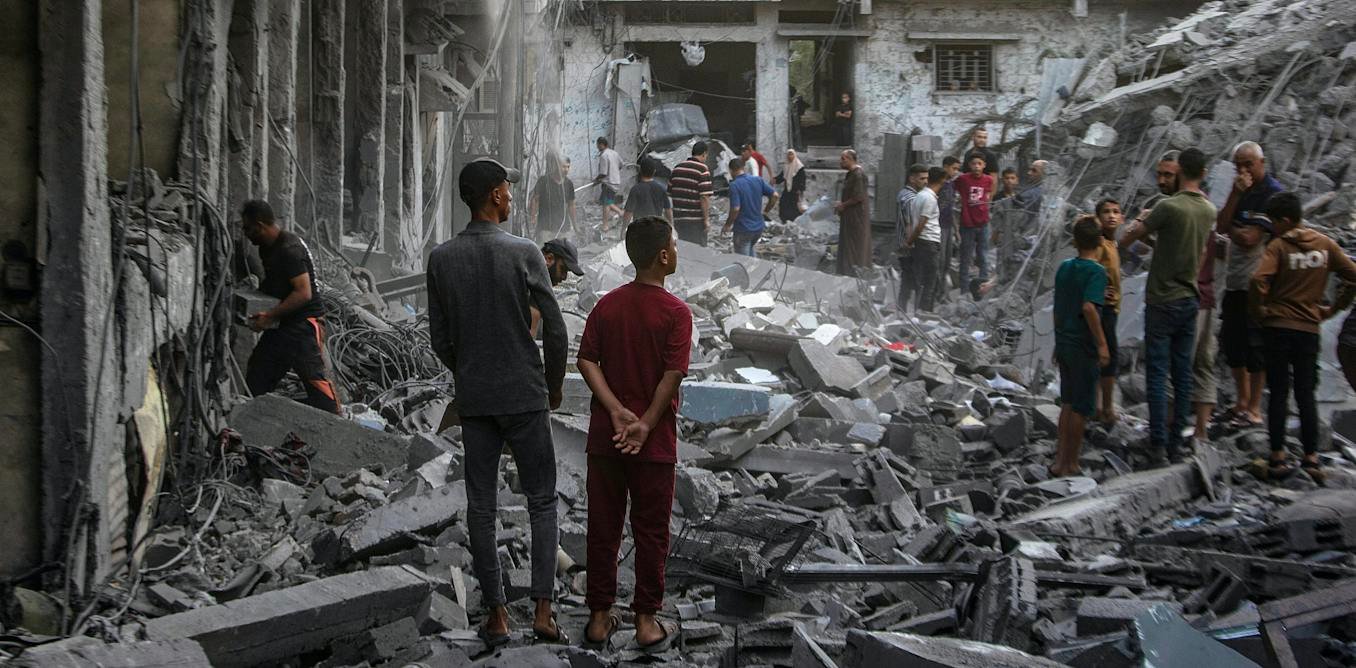
Much of Gaza remains in ruins. Israel has destroyed 92% of its housing, 95% of its farmland, all of its universities and half of its hospitals – with the remainder barely functioning.
The UN has estimated that clearing the rubble alone could take 20 years – while the cost of rebuilding Gaza is estimated at more than US$70 billion (£53 billion).
There has been no progress on this front over the past year – reflecting a lack of political will from Israel and the US-led international community.
Ceasefire in name only
When the agreement was announced, Trump said it would end “3,000 years” of war. But in reality, the violence has continued.
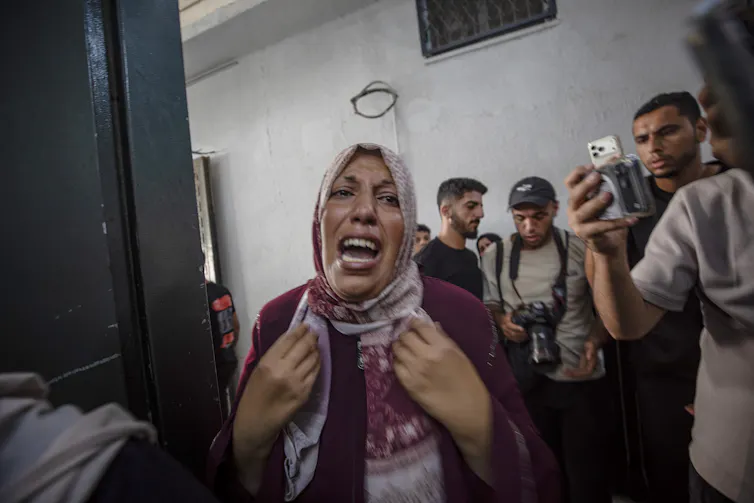
Israeli forces have launched more than 1,000 attacks on Gaza over the past 12 months, killing more than 1,400 Palestinians – including at least 300 children. For the Palestinians, it is a ceasefire in name only.
Israeli violence is accompanied by a continuing blockade, which is responsible for many of the dire conditions described above. Despite the crisis, Israel continues to keep many essential supplies out of Gaza, leading the UN secretary-general, António Guterres, to flag the severe restriction of humanitarian aid as a major concern.
As well as destroying much of Gaza, Israel has also extended its occupation on the ground over the past 12 months. The terms of the deal proposed the Israeli military’s phased withdrawal from the Gaza Strip. The army initially redeployed to the yellow line: a newly established boundary that cut the Strip in two.
This confined virtually the entire population of two million Palestinians to around 60 square miles on its western side.
The yellow line was intended as a temporary measure. But Israeli officials have described it as “a new border”. Any Palestinian who crosses the line or even gets close to it risks being shot by the Israeli army. More than 200 people were killed in this way in the first six months after the ceasefire was announced.
Making matters worse still, the line’s exact location is unclear. It is indicated on the ground by yellow blocks that the Israeli military continually moves further west, extending its de facto territory.
Israel is now in full control of more than 65% of the strip, and government figures – including Israel’s defence minister, Israel Katz – have explicitly stated that Israel “will never leave all of Gaza”.
This is especially striking given the ongoing campaign to re-establish illegal Israeli settlements inside Gaza – a campaign backed by some cabinet ministers.
‘Nowhere to return’
The terms of the UN-approved ceasefire deal stated explicitly that: “No one will be forced to leave Gaza, and those who wish to leave will be free to do so and free to return.” But the Israeli prime minister, Benjamin Netanyahu, reportedly told lawmakers inside the Knesset, Israel’s parliament in May 2025 that Israel is “destroying more and more houses [in Gaza so that Palestinians] have nowhere to return”, adding: “The only obvious result will be Gazans choosing to emigrate outside of the Strip.”
These alleged remarks were leaked from a closed session of the Knesset – and this was well before the terms of the ceasefire were agreed. But in recent weeks both Katz and Israel’s national security minister, Itamar Ben-Gvir, have endorsed plans for the mass forced expulsion of Gaza’s Palestinians – and Netanyahu has done nothing to condemn them.
Such plans would expel people who have already been displaced an average of six times during the three-year Israeli assault, identified as a genocide by a growing number of international observers and experts.
With Israelis preparing to go to the polls for the first time since the October 7 attacks, candidates are making increasingly extreme statements – a reflection of a shift to the right, particularly among first-time voters.
It would be foolish to assume that the election on October 27 will bring any real change in Israel’s Gaza policy. Both Netanyahu and his main rival, Gadi Eisenkot, are implacable opponents of Palestinian statehood.
So only international pressure – particularly from the US – can bring about a change in Israeli policy towards the people of Gaza and their future. But with the Trump administration itself reported to favour the transfer of Palestinians, few in Gaza are expecting any help from Washington in the foreseeable future.