Pink Supported Macklemore’s Firing. Now Activists Want UNICEF to Cut Ties With Her.
When the pop singer Pink took to social media to decry rapper Macklemore’s comments on Israel’s genocide of Palestinians — a slaughter that has taken the lives of more than 20,000 kids — she brought up her decadelong role as a UNICEF ambassador to show that she cares about children.
Now, a new petition signed by more than 160,000 people, including the backing of actor Javier Bardem, is calling for Pink’s removal from her UNICEF USA role. The petition organizers, Swifties Against Genocide, named for fans of the pop singer Taylor Swift, said that Pink’s remarks sidelined concern for Palestinian children and “fueled ongoing conflict and struggles for visibility and empathy.”
“As individuals who care deeply about the welfare of children around the world, we must hold UNICEF Ambassadors to the highest standards of neutrality and compassion,” the organizers wrote. “Palestinian children, like all children affected by genocide, deserve ambassadors who unequivocally extend support and empathy towards their plight.”
The petition is the latest example of the type of public pressure supporters of Palestine are seeking to exert amid a tidal shift of sentiment in the U.S. on Palestine and Israel over the past three years. Israel’s genocide in Gaza has dramatically soured U.S. opinion on Israel, with a majority viewing Israel unfavorably and more Americans taking a sympathetic view of Palestinians.
“UNICEF itself has called Gaza a graveyard for children. Its ambassadors are supposed to speak for those children, not attack the people who do.”
The transformations have played out in the current midterm election cycle, with candidates pushing to sever military ties with Israel winning in primaries across the country. In the past several weeks, the subject has upended mainstream popular culture, with battle lines being drawn over a stadium concert tour by pop icon Ed Sheeran.
The pressure on UNICEF to part ways with Pink is tied up with a strategy among Palestine solidarity activists to extract a price from Israel for its continued occupation and genocide of Palestinians.
For Tariq Kenney-Shawa, a policy fellow with Al-Shabaka U.S., the petition is “a clear attempt to draw a new line in the sand and make the point that choosing to take the moderate lane is unacceptable.”
“These past couple days have proven that being shamelessly pro-Israel, or even refusing to take sides in the face of a genocide, is no longer the safe route,” he said, citing a shift of the “cultural hegemony” in the West.
Though Sheeran himself — who said at his latest concert that he was listening to both sides — is not a target of Boycott, Divestment, and Sanctions against Israel, the cultural backlash to his move to take Macklemore off the tour reinforced the logic of the growing movement, Natasha Lennard recently wrote in The Intercept.
Representatives for Pink, UNICEF, and Change.org did not immediately respond to requests for comment.
Other advocates for Palestinian rights reaffirmed the petitioners’ aims.
“Pink should step down. UNICEF itself has called Gaza a graveyard for children. Its ambassadors are supposed to speak for those children, not attack the people who do,” said Raed Jarrar, the advocacy director of Democracy for the Arab World Now. “Whether UNICEF removes her or not, it’s time for her to step down.”
Attacking Pro-Palestine Speech
The controversy involving Pink kicked off during Sheeran’s show at MetLife Stadium in New Jersey on September 4.
Macklemore, one of the opening acts, spoke out against Israeli apartheid and the genocide of Palestinians, addressing Jewish people in the crowd to say that criticism of genocide and the Israeli government “is in no way a criticism of you.”
After backlash from pro-Israel groups like the Anti-Defamation League — and perhaps more critically, pressure from billionaire Robert Kraft, the deeply pro-Israel owner of the New England Patriots and Massachusetts’s Gillette Stadium — Sheeran dropped Macklemore from his tour. Then came the backlash to the backlash, with other opening acts on the tour and even Sheeran’s backing band dropping out in solidarity with Macklemore.
Pink, the pop star who rose to fame with a string of hits in the early 2000s, waded into the controversy early on. After attending the September 4 show, Pink reshared a social media post from the group Stop Antisemitism that said Macklemore’s claims of a genocide were “false” and that concertgoers were owed apologies and refunds.
“I don’t need anyone fired, and I don’t need a refund,” she later wrote on Instagram, explaining why she reshared the post. “What I need is to be able to say, as a Jewish mom, ‘That scared me, and it scared people I love’ — without being told our fear is just propaganda, and without being told I’m somehow cool with genocide because I noticed?”
She added that the protest slogan “From river to the sea” and the use of the term “Zionist” have become “a slur.”
Pink said that “nobody should ever celebrate the death of a child.” She mentioned her experience as a UNICEF ambassador visiting children born in war zones. She “grieved every one of them, on both sides of that fence,” she wrote.
Yet Pink’s grief, or any celebrity’s, has done little to change conditions on the ground for Palestinian children. Just on Monday, an 11-year-old boy was shot to death by the Israeli military in one of Gaza’s apparent “safe zones.”
UNICEF, which operates in Gaza, itself reported that Israeli attacks have killed at least 300 children in Gaza since the so-called ceasefire agreement last October. Food insecurity and lack of access to clean water also remain issues due to Israel’s blockade on humanitarian aid from entering the Strip.
In her social media post, Pink said she does not speak for Israel but reiterated her stance that “Hamas is a terrorist organization. Palestinians deserve a future that honors their humanity and their aspirations.” She said she was not “going to litigate a complex war in an Instagram caption, and I’m not going to recite anybody’s slogan to earn back a follower.”
Over the weekend, the petition calling out Pink also drew the support from Javier Bardem, an outspoken advocate for Palestine and major funder of the Palestinian film “All That’s Left of You,” who shared the petition on his Instagram profile.
“She can not defend children’s rights,” Bardem said, “while not condemning the genocide in Gaza.”
The FBI Anti-Corruption Squad Was Circling Susan Collins — Until Trump Got in the Way
Reporting Highlights
Probe: In 2024, the FBI sought to launch a sweeping pay-to-play investigation examining interactions between Sen. Susan Collins and a top donor, records and emails show.
Confession: The donor, an ex-defense contractor, told agents his company won millions in federal contracts by bankrolling campaigns of powerful politicians.
Shutdown: After Donald Trump returned to office, the investigation died, a casualty of his purge of the FBI. Its closure shut a potential window into how Washington works.
These highlights were written by the reporters and editors who worked on this story.
In the final weeks of 2019, a top fundraiser for Sen. Susan Collins walked into a perilous meeting at a Corner Bakery in Washington, D.C.
For the first time in her two-decade Senate career, the Republican lawmaker from Maine was in danger of losing her seat. President Donald Trump’s dismal approval ratings were dragging her down in the polls, and she was falling behind her likely 2020 Democratic challenger in fundraising.
Scott Reed, head of the Collins super PAC, was on a mission to close that gap. Reed was meeting that day with three executives from a Hawaiian defense contractor, Navatek. A year earlier, Collins had helped their company land a multimillion-dollar Navy research contract in Maine. Now, seated at a coffee shop not far from the U.S. Capitol, Reed asked them for a $500,000 donation.
Government contractors are banned from making political contributions. More consequentially, for the company to offer donations to Collins in exchange for an official action, or for Collins to accept, would constitute criminal bribery.
But the company did have such a proposal: Navatek was hungry for more government contracts in Maine. If they cut a big check, the CEO told Reed, Navatek wanted Collins to guarantee tens of millions of dollars in additional federal funding.
To skirt campaign finance laws and conceal the source of the funds, Navatek planned to funnel the donation through a shell company. The CEO wanted assurance that Collins would know where the money came from. Reed confirmed that she would, the executive said — and that Navatek would get its government contracts.
After the Corner Bakery meeting, Navatek’s CEO, Martin Kao, sent an initial $150,000 to the Collins super PAC using the shell company. Two months later, he told Navatek executives thatCollins committed to getting the company $32 million in naval contracts, according to an internal company email reviewed by ProPublica.
Three years later, Kao holed up in a conference room to recount the Corner Bakery meeting to a group of four FBI agents and federal prosecutors. The FBI had seen through his shell company ruse, and in 2022 a grand jury indicted him for making illegal campaign contributions. No one working for Collins was charged.
Facing years in prison, Kao hoped to do less time by revealing the entire scheme.
What he told them has never before become public. The Corner Bakery meeting, he asserted, was just one episode in a sprawling pay-to-play operation that embroiled some of the most powerful figures in Congress.
Over three days at the U.S. attorney’s office in Honolulu, Kao laid out in devastating detail how his operation worked. He gave agents a 50-page document naming dozens of lobbyists, congressional staffers and members of Congress who he said helped him trade cash for contracts. Kao and his close associates had donated nearly $900,000 to dozens of politicians, allowing Navatek to establish operations in half a dozen states with over $40 million a year in government funding.
Most damningly, Kao told FBI agents and prosecutors, the company’s work for the government was of no real value. Navatek’s research under his stewardship never resulted in products the military wanted to buy, ProPublica found.
Kao’s tell-all interviews with the FBI lasted into late 2024. His confessions opened up an entirely new phase of the investigation. Agents sifted through hundreds of thousands of records seized during Kao’s arrest and found that many were consistent with his account of widespread influence peddling.
Kao had credibility issues. He was now a felon trying to avoid a lengthy prison sentence. And there were other challenges. Building a corruption case against elected officials requires extraordinary proof of a quid pro quo arrangement, in part because the Supreme Court has narrowed what counts as bribery.
Even so, by the end of 2024, the agents had enough evidence to pursue a sweeping bribery probe that could ensnare top lawmakers of both political parties. They asked their supervisors to approve a new investigation and contemplated using undercover operatives to gather more evidence. Although their effort was in its early stages, and it was unclear where it would lead, FBI agents asked Kao extensive questions about his dealings with Collins and her office.
Then Trump returned to the White House. Consumed by a campaign of vengeance, he stacked the Department of Justice with his personal lawyers and demanded a purge of anyone who had ever investigated him.
The specialized FBI and DOJ teams handling public corruption investigations, some of which were involved in Trump-related cases, were eviscerated. One of the agents who had taken Kao’s confession was pushed out as retribution for her role in investigating Trump’s attempt to overturn the 2020 election. Dozens of agents and prosecutors quit amid the department’s destruction, including the career attorney assigned to Kao’s case.
Trump’s Justice Department no longer takes on public corruption in any meaningful fashion, former officials said. The investigation sparked by Kao’s revelations is dead. And the government is no longer talking to an informant who had offered a road map to corruption in Congress.
The White House referred ProPublica to the FBI.
FBI spokesperson Ben Williamson said the agency had investigated claims against Collins years ago “and ultimately found nothing implicating Senator Collins or Senator Collins’ campaign. Any suggestion otherwise is totally false.” Williamson said the Trump administration has removed agents only “if they have been found to have acted unethically, undermined the mission, or engaged in weaponization of law enforcement.”
Williamson did not respond to questions about the new investigation launched in 2024 based on Kao’s previously unreported cooperation with the FBI.
ProPublica is revealing the existence of the case for the first time. We reviewed a trove of evidence gathered by the FBI and thousands of pages of legal records, and interviewed dozens of people familiar with Navatek, its Washington operations, and the FBI inquiry to conduct our own investigation. We independently corroborated much of Kao’s account. Whether or not Kao’s dealings with politicians amount to criminal bribery, the Trump Justice Department has little interest in finding out, and his sheer success reveals how easily influence is purchased in Washington today. This is the first in a series of stories drawn from our reporting.
Of all the politicians Navatek courted under Kao’s leadership, Collins was its most important patron. The senator’s office steered government contracts worth millions toward the company while her campaign was pumping Kao and his network for donations, according to emails seen by ProPublica. Sometimes they cut checks within 24 hours of the annual defense spending bill, which funds military contracts, clearing a key Senate hurdle.
Republican Sen. Susan Collins walks in the annual Moxie Day Parade in July in Lisbon, Maine.Scott Eisen/Getty Images
Collins’ office did not specifically address questions about the Corner Bakery meeting, the senator’s relationship with Kao and the millions she helped appropriate for Navatek.
Annie Clark, Collins’ deputy chief of staff, told ProPublica in an email that Collins’ office “vigorously” denies allegations of bribery and pay-for-play made by Kao, calling his claims “outlandish.” Collins’ campaign was not part of the discussions between Kao and the super PAC, and her office “fully cooperated” with the FBI investigation, Clark said.
“The fact that the FBI and Biden-led Department of Justice thoroughly examined the Navatek matter demonstrates this,” Clark wrote. “These issues were resolved in 2021 and concluded when the Collins campaign disgorged the illegal contributions that Martin Kao had made without our knowledge.”
Collins is once again fighting to keep her seat, in a race that could determine control of the Senate. On the campaign trail, she spotlights the funding she directs to Maine while leading the appropriations committee, which she calls “the most powerful committee in the Senate.”
She demonstrated that power with Navatek. After the budgets became law, Collins’ office pushed the Navy to award specific contracts to Navatek, emails seen by ProPublica show, even though awards are supposed to be competitive.
“I spoke with Sen. Collins office regarding the $8M,” a naval official wrote in an email on Feb. 6, 2019. “The interested company is Navatek.”
In a meeting with Collins and two campaign officials, Kao said, the officials told him the senator expected his ongoing support. Collins told him: “You’ve seen me deliver,” Kao said.
Reed knew Kao was behind the $150,000 anonymous donation, emails showed, because Kao told Reed he planned to donate through a shell company. “Very smart,” Reed replied in an email viewed by ProPublica.
Reed did not respond to detailed questions about the Corner Bakery meeting, the $150,000 donation and Kao’s allegations. “I understand Martin Kao is now sitting in federal prison,” Reed wrote in a brief email. “I never had any communications with Senator Collins [or] her staff about Martin Kao and/or Navatek.”
But an email seen by ProPublica suggests that someone must have relayed the news of Kao’s donation to Collins, just like Reed promised to do in Kao’s recounting of the Corner Bakery meeting.
Seven days after the super PAC cashed the check from Kao’s shell company, one of Reed’s subordinates emailed a Navatek lobbyist asking for Kao’s phone number: “Senator Collins would like to call Martin to thank him.”
Martin Kao, second from left, with Collins, center, at a publicity event at Navatek’s Maine headquarters in August 2019.U.S. Sen. Susan Collins via Facebook
The Navatek Method
Before Kao’s doomed reign as CEO, Navatek was a sleepy Hawaiian engineering company with a few dozen employees. It was founded in 1978 by Steven Loui, a talented engineer and scion of a powerful Hawaiian shipping family. Navatek was not a profit center but a vehicle for Loui’s passion projects, like an experimental catamaran for navigating Hawaii’s choppy waters.
The company benefited from the largesse of the legendary Hawaii Sen. Daniel Inouye, multiple former Navatek executives and employees said, whose family had been close to the Loui family for generations. Inouye was a master of earmarks, a practice that allowed lawmakers to insert funding for specific companies by name in the federal budget. The self-styled “King of Pork” steered hundreds of millions in federal dollars to Hawaii. Former Navatek employees say he was affectionately referred to as “Uncle Dan.” “Before Inouye took an interest, Congress didn’t even know our companies existed,” a longtime Loui lieutenant wrote in a 1998 op-ed.
In response to ProPublica questions, Loui said that money appropriated by Inouye made up “a minority” of Navatek’s revenue.
Inouye’s death in 2012 made the company’s future uncertain. Not only was Navatek’s direct line to Capitol Hill gone, but Congress was doing away with the abuse-riddled earmark process. Now companies would nominally have to compete on the merits for government contracts.
Kao joined Navatek in 2008 as its chief financial officer. Loui charged him with replacing Navatek’s rainmaker and eventually named Kao CEO. He sold Kao the company in return for a share of the profits.
Kao was an unusual figure among the company’s low-key naval engineers and boat aficionados. He seemed to be aping a Wall Street tycoon, telling employees they could either be “a beast or a bitch,” a former executive said. He drove to work in a Ferrari and abruptly fired subordinates who displeased him — one time, in the middle of the night. “He had very little interest in the technology,” one former employee recalled. “Martin was only interested in dollar signs.”
Kao also exaggerated and lied. He told different people he had stepbrothers whose parents died in a fishing accident or an avalanche, a former employee recalled. He lied to Loui about having law degrees from both the University of California, Los Angeles and New York University. He once told a lobbyist who raised quarter horses that he owned a herd of polo ponies, just to one-up him.
Despite his erratic behavior, former employees agree Kao hit upon an effective way to replace the lost earmarks. If the company could not rely on a benefactor like Inouye, it would develop a stable of them.
Navatek targeted the powerful members who sat on the House and Senate appropriations committees. These members could no longer earmark money for specific military contractors. But they retained the power to budget millions of dollars for equipment orbespoke research and development. Because Pentagon budgets run thousands of pages and are largely prepared in secret, it is easy for appropriators to add a line item intended for a contractor like Navatek without leaving any fingerprints.
Soon, Kao had refined a playbook. Navatek would concoct a research project in partnership with a university in a member’s district or home state, and Kao would make a large initial campaign donation. Working with a team of pricey, well-connected lobbyists, Navatek would get meetings on Capitol Hill to pitch the research to congressional staff. Navatek kept spreadsheets, reviewed by ProPublica, that listed members of Congress as the “specialty” of certain lobbyists.
Separately, Kao later told the FBI, there would be a meeting of just the key players. One engineer, who traveled with Kao to D.C. to explain the technical side of a project, recalled being sent out of the room once the subject of money came up. Sometimes in these smaller meetings, members of Congress directly asked Kao for donations, he told the FBI. In other cases, he said, Navatek’s lobbyists would relay a request from an intermediary for a specific dollar amount.
Kao told the FBI that the lawmakers, lobbyists and Navatek brass understood these donations were bribes and that the payments were essential to the entire scheme. Kao believed he was buying Navatek’s way into the annual defense budget, not winning over members with innovative engineering proposals.
“I’m not red or blue, I’m green,” he would tell congressional staffers, a former Navatek employee recalled.
While a deal was being struck, Navatek and congressional staffers worked closely on the legislative process. Every year, Congress prefaces the defense budget with massive reports describing the purpose of inscrutable line items. Staffers would include a project description so specific that Navatek would be the only logical pick.
Often, Navatek composed language that ended up, word for word, in Senate funding requests, former employees said. In 2019, for example, Navatek’s priorities were tucked into page 185 of the 307-page report released by the Senate Appropriations Committee. The committee set aside $21.5 million for “hybrid composite structures research for enhanced mobility,” “electric propulsion for military craft and advanced planing hulls” and a “test bed for autonomous ship systems.” Although Navatek’s name does not appear on the page, these were all projects the company requested, according to internal documents and interviews with former employees.
Once the budget passed, lawmakers’ staff leaned on Navy officials to award Navatek the money. Former contracting officers told ProPublica they felt pressure to go along because money from those contracts funded their office — and because members of Congress had confronted dissenting naval officials in the past. “There’s only so many battles you can fight,” one said. So Congress sometimes got its way even when Navatek’s projects made little sense.
Inside Navatek, employees referred to this strategy as “the method.” And it enabled the company to string together tens of millions of dollars in contracts. The result was the same as getting earmarks: a reliable, growing revenue stream bankrolled by U.S. taxpayers.
“It was a simple enough play. Let’s find the small states that have complementary universities … [and] let’s get access to their senators,” Eric Schiff, a former Navatek executive, told ProPublica. “I’ve met Susan Collins. You can get access to Susan Collins. Once we got the first things working with Maine, then we said, ‘Well, let’s keep reaching.’ And so we did.”
In a statement to ProPublica, Navatek founder Loui said Kao’s “unethical and illegal method of winning contracts” was a departure from how he operated the company prior to Kao’s ownership.
Kao boosted Navatek’s annual revenue from $10 million around the time Loui sold him the company to almost $40 million when he was arrested in 2020. In the second half of 2019 alone, Navatek paid a roster of five lobbying shops more than $500,000.
Even Navatek’s executives were surprised at how far their money went in D.C. “It was eye-opening for me, frankly. ‘Oh my God, all of it is for sale. It’s all for sale,’” Schiff said.
The key players in Kao’s pay-to-play deals went to great lengths to meet in person and leave no trace of an actual quid pro quo, he told agents. “That is why I literally had to fly to D.C. almost every week,” Kao later told the FBI. “Sometimes for a 15-minute meeting.”
But the FBI compiled emails, which ProPublica reviewed, that were suggestive of illegal bargains. Navatek executives and lobbyists spoke openly as if they were buying lawmakers’ assistance. In one back-and-forth, a lobbyist and a company executive described another senator as “fundamentally transactional” and having “a reputation as a pay-to-play office.”
In another message, Andy Winer, who former executives said was Navatek’s chief strategist, reminded Kao to budget money for political contributions based on how much the company wanted in congressional funding the following year.
“Oh my God, all of it is for sale. It’s all for sale.”
Eric Schiff, former Navatek executive
Winer was his guide to the political underbelly, Kao said. A consummate insider, Winer had parlayed six years as chief of staff to Democratic Sen. Brian Schatz of Hawaii into a lucrative lobbying career with a firm called Strategies 360. One of Winer’s former colleagues compared him to the slick lobbyist on the Netflix show “House of Cards” who toggles between the political and corporate worlds.
In another email exchange scrutinized by the FBI, Kao asked Winer about making a $5,600 donation to nudge along a senator who seemed keen to work with Navatek: “Would that ‘help?’”
Winer, who had already donated himself, replied, “With my contribution, I think it sends the right message.” He suggested Kao split up his donation to be “less conspicuous.”
The method didn’t always work. Once, Kao complained that a senator had reneged on a deal and he ought to get his donations back.
“You should not feel aggrieved nor should you ever put that in writing,” Todd Webster, another lobbyist Navatek hired, replied. Webster did not respond to detailed questions.
Winer said he stopped working with Navatek following Kao’s arrest. “The political contributions I discussed with Kao were understood by me to be lawful political contributions. I never participated in, witnessed, or had knowledge of any illegal political contribution, bribe, or agreement to exchange a political contribution for an appropriation, contract, or other official action,” Winer said in an email to ProPublica. “I never advised Kao to make a contribution in exchange for official action.”
Strategies 360 has new ownership that did not oversee Winer while he represented Navatek, its CEO, John Oceguera, said.
Navatek employees began to notice members of Congress visiting their East Coast offices. “You would be like, ‘Oh, there’s this senator walking around,’ and we would get a picture with them,” one engineer recalled.
While some projects involved potentially meaningful research, Navatek’s bread and butter was R&D that went nowhere. As a slideshow prepared by an executive explained, “We thrive in the valley of death,” the term for the bureaucratic gap where research languishes without being developed into a product. The slideshow noted that none of the technology had ever actually been deployed.
The Office of Naval Research did not respond to a request for comment.
In Maine, Navatek was studying ways to modify small boats to reduce the “slamming” impact felt by passengers at high speeds. With the help of the University of Maine’s giant 3D printer, Navatek made a prototype and unveiled it at a press conference where a Guinness World Records representative declared it the world’s largest 3D-printed boat. But Navatek executives knew the Navy had no plans to use the new design, former employees said.
“[The work] got rolled into a few PowerPoint slides and a white paper, and that was the deliverable,” recalled one who worked on the project. “The boats weren’t delivered to the Navy — the Navy didn’t even want them.”
Kao to Collins: “Here to Help”
The first time Kao came face-to-face with Collins, in 2018, he told the FBI, he had to pay for the privilege.
Collins would not meet unless he agreed to donate to her campaign, he said. While it is not illegal for politicians to exchange face time for contributions — in this case, just a few thousand dollars — it was not the last time Collins would seek Kao’s support.
Navatek had been eager to expand beyond Hawaii, and Maine was a perfect beachhead — a small, coastal state hungry for high-tech jobs that happened to be represented by a senior member of the Senate Appropriations Committee. Collins, more than most appropriators, likes to trumpet the dollars she brings home.
To work with Collins, Navatek hired a lobbyist, Glen Mandigo, who also lobbied for the University of Maine and was tight with her office. Mandigo asked how much Navatek wanted in funding and how much Kao was willing to support Collins, Kao told the FBI. The University of Maine did not reply to a request for comment.
In that first meeting with Collins and her staff, Kao pitched an $8 million boat hull research project for Navatek and the university. Collins seemed supportive. Not long after, Mandigo called Kao and said Collins wanted him to bundle tens of thousands of dollars for her reelection, suggesting Navatek throw a fundraiser, Kao said.
In an email to ProPublica, Mandigo denied taking part in a pay-to-play arrangement.
“I did not advise Navatek officials, nor would I advise any client, that support from Sen. Collins was contingent on campaign donations,” Mandigo wrote. He said that in his 25 years of working with Collins and the Maine delegation, “I never saw or heard of such behavior from the Senator or her staff.” Clark, Collins’ deputy chief of staff, told ProPublica it was “wholly inaccurate” to say Mandigo was close to their office.
FBI agents had collected voluminous corporate records and email correspondence between Navatek and Collins’ inner circle. Much of that evidence aligned with the story they were now getting directly from Kao.
The FBI had spotted his out-of-the-blue donations in the summer of 2018, just before Collins included $8 million for Navatek’s proposal in the defense budget. Emails showed her staff made it clear to the Navy that it shouldsend the money to Navatek. FBI agents also had evidence of Kao and Mandigo planning a fundraiser starting in April 2019. Their emails — with her scheduler and her campaign’s finance director — freely mixed talk of Navatek’s Collins-backed contract with plans to raise money for her.
The principals settled on hosting Collins for a publicity event at Navatek’s Maine headquarters in August 2019, where she posed for pictures with Kao and a model of the company’s experimental boat. Behind the scenes, the FBI saw in emails and company records, Kao orchestrated over $40,000 in donations from extended family in advance of the event. To avoid the legal cap on individual campaign contributions, the emails show, he told Collins’ team to reallocate his excess contributions to his father — which an agent highlighted and noted is against election law in a presentation to prosecutors — and sent them his father’s full name and address.
“This is perfect,” Amy Abbott, the reelection campaign finance director, emailed Kao after discussing his father’s contribution. “We are so grateful for ALL the Kao support!”
Before the event, Kao said, Collins, Abbott and another staffer met with him in private. One of the staffers told Kao the campaign expected more donations. It was in this meeting that Collins said, “You’ve seen me deliver,” he told the FBI.
Less than one month after the event, the Senate released a draft of the defense budget containing $21.5 million for Navatek’s pet projects in Maine. Kao emailed a Collins campaign fundraiser — who would in theory have nothing to do with a government contract — four days later, saying, “Thanks again for all the support from Sen Collins.”
“I’ve been involved in many tight races in the past and understand last minute ‘needs’ come up,” he continued. “We are here to help anyway we can … financially or whatever.”
Kao’s desire to donate even more money led to the fateful Corner Bakery meeting with the head of the Collins super PAC, called the 1820 PAC, Kao told the FBI. Unlike Collins’ campaign, which could accept only $5,600 per election from individuals, the super PAC could accept unlimited contributions.
The super PAC emailed Kao a memo before the meeting stressing the need to raise money with “urgency.” At the meeting, Kao and Reed, the super PAC’s chair, hammered out a deal for a six-figure donation, Kao told the FBI. Over email, Kao informed Reed of his shell company scheme, saying he had clearedit with his lawyer. “They are super vague and very difficult to get any background info on,” Kao reassured him. “Thanks for doing this,” Reed replied.
The FBI spoke to the other Navatek executives at Corner Bakery, who confirmed the meeting took place. One, David Kring, the company’s top scientist, told ProPublica he had no memory of what was discussed.
The other, Duke Hartman, told an FBI agent it was just “a get to know you meeting” with the chair of the super PAC and they did not discuss the “particulars of a donation.” Agents, records show, came to believe Hartman was lying about his role in Kao’s pay-to-play operation and would name him as a formal subject of a future investigation. Hartman was not charged. He did not respond to a detailed request for comment.
A few weeks after the $150,000 check to the Collins super PAC cleared, in February 2020, Kao and his team met with Collins’ office and secured a new round of funding.
“We were very warmly received,” Kao reported to his colleagues in an email obtained by the FBI. “Excellent meeting. Total of $32M will be supported.” Records show the Senate allocated at least $10 million that year based on Navatek’s proposals.
Navatek’s ambitions peaked in mid-2020. As the company waited to see if Collins would survive her reelection campaign, executives prepared to ask their champion on the appropriations committee for even more funding the following spring, internal documents show.
Other documents from that time show the company was courting senators from seven additional states and gunning for more than $200 million in new appropriations. Navatek expected to have offices in more than a dozen states by the end of the following year, including a new 15,000-square-foot facility in the Portland, Maine, harbor.
Kao, meanwhile, closed on a $4.5 million beachside home in an exclusive Honolulu neighborhood; the backyard pool had a waterfall feature. He renamed the company Martin Defense Group after himself, joking that it would simplify his future takeover of Lockheed Martin.
“It was working well, and it would have continued to work well,” said Schiff, the former executive. “Martin got greedy. Just got damn greedy.”
Downfall, Cover-up
In early 2020, the Campaign Legal Center, a nonprofit good government group, noticed something strange in the public filings for the Collins super PAC. The PAC had received a $150,000 donation from a newly created LLC with a typo in its name: the Society of Young Women Scientist and Engineers, with no S at the end of “Scientist.”
This was the $150,000 Kao donated after the Corner Bakery meeting. The money had come from Navatek’s account, not Kao’s, violating a ban on government contractors making donations.
A check for $150,000 to the Collins super PAC 1820 from the Society of Young Women Scientist and Engineers — a shell company that obscured the actual donor.PacMar Technologies LLC, fka Martin Defense Group, LLC v. Kao
The center suspected the society was not a real group but a pass-through to hide the identity of a major political donor. It filed a complaint with the Federal Election Commission. It took only a few days for a Hawaii journalist to discover Kao’s wife’s name on the society’s paperwork, linking the shell company to Navatek.
Inside Navatek, Kao shifted into damage control mode. He spoke to Reed and the super PAC’s lawyer, Cleta Mitchell, and began to hatch a cover-up. In an email released in civil litigation, Mitchell suggested the society make charitable donations — preferably in Maine — which would make it seem like a legitimate nonprofit. “I want to be sure that the LLC proceeds with the ideas we discussed — giving scholarships and recognition to women in engineering, etc.,” wrote Mitchell. “That would help both of us, I think.”
Mitchell added, “We should develop a plan and timetable, so there are some scholarships given over the next several months, and particularly, perhaps in Maine, where the bad press was.”
Mitchell, who later played a major role in Trump’s attempts to overturn the results of the 2020 election, did not respond to requests for comment.
Kao and his team settled on donating scholarships to women in STEM. They offered between $5,000 and $25,000 apiece to state universities where they were angling to win government contracts — that way, the cover-up would benefit them politically, too.
But Navatek’s and Kao’s problems were just beginning. Undeterred by scrutiny from the FEC, Kao defrauded the COVID-era Paycheck Protection Program newly passed by Congress. He inflated Navatek’s payroll to amass loans of $13 million, according to a federal indictment. The Navatek founder, Loui, had long since soured on his chosen successor. This was the final straw. He reported Kao to federal authorities.
“This is not how Navatek behaved or conducted business before I sold the company to Martin Kao,” Loui wrote to ProPublica. He said Navatek was successful before Kao’s ownership and had many sources of government funding. After Kao’s arrest, he added, the company fully cooperated with law enforcement.
Loui has since regained control of the company and renamed it PacMar. He is dedicated to restoring its reputation and ability to execute government contracts, he continued. Loui said he fired employees hired during Kao’s tenure who were “not capable of performing quality, professional engineering and science tasks.”
“The company received no Collins-supported funding after Martin Kao’s arrest, nor should it,” Loui added. “What Martin Kao and his cabal did was wrong.”
On Sept. 30, 2020, law enforcement raided Navatek’s Honolulu offices and arrested Kao for fraud. Federal agents in windbreakers seized his laptop and ordered the company’s IT staff to copy the company’s internal servers.
Navatek’s public flameout attracted the attention of Michelle Ball and Kevin Gounaud, two experienced agents in the FBI’s elite anti-corruption unit. Gounaud was a 20-year FBI veteran who had worked on elaborate undercover operations. Ball had made a name for herself taking on politically sensitive cases. In 2018, she led the investigation into Maria Butina, the Russian agent convicted of infiltrating the National Rifle Association in an attempt to influence the Trump campaign.
The agents began digging through thousands of records for details of Navatek’s lobbying operation, donation strategy and ties to politicians.
They zeroed in on Kao’s relationship with Collins. In a 60-slide presentation agents prepared for prosecutors, they highlighted contributions that Kao and his wife made to the senator in 2018, right before Collins placed the $8 million in research funding into the federal budget. Kao had also given Navatek money to various relatives to donate to Collins in 2019, sending her around $33,000 through these illegal straw donors, the indictment said. Kao’s wife and father did not reply to requests for comment.
Collins christens a Navatek-designed boat at a University of Maine engineering lab in October 2019.U.S. Sen. Susan Collins via Facebook
The government charged Kao in two separate cases: one for defrauding the loan program and another for his campaign finance crimes. His love of talking like a wheeler-dealer — including over email — was a gift to investigators. In one email, he all but admitted the scholarships to young women were a diversion. “Whatever… just a pack of bitches getting free $,” he wrote.
In the face of overwhelming evidence, Kao pleaded guilty in both cases in the fall of 2022. Navatek by then was under court-ordered new management. Awaiting sentencing, Kao worked as a line cook at a Cheesecake Factory.
He began meeting with the same FBI agents and prosecutors who brought him down. For the agents, he was a rare witness: a contractor with deep ties to elected officials saying he would speak candidly about how Washington works.
Kao faced nearly a decade in prison. “My world and life imploded,” he would later recall in a letter to the Hawaii U.S. District Court. “I was fooled and foolish enough to believe that the power elected officials wielded, and [were] actively willing to sell to anyone wealthy enough to pay, was….‘smart business.’”
Over the next two years, Kao sat with agents for at least three dayslong interviews. He told them that politicians, Collins in particular, had been willing participants in his scheme. “It takes two to tangle,” he told them.
Taxpayers funded Navatek’s entire political operation, Kao said. “Most companies of our size do not have the resources to endlessly hire expensive lobbyists and make political donations,” he told the FBI. Navatek solved this by using money from government contracts to hire lobbyists and make campaign contributions, according to interviews, court testimony and internal company records. Diverting money from contracts for lobbying and political donations can be illegal.
For their final meeting, in September 2024, Kao handed the FBI the 50-page document detailing Navatek’s dealings with more than a dozen members of Congress and their staff. It was not only a confession but a road map, with the email addresses and phone numbers of people Kao thought agents ought to subpoena.
Last year, Kao was sentenced to 87 months in prison. The judge in his case offered no leniency based on his cooperation with the FBI. Loui is battling Kao in court to recover the millions he contends Kao stole from the company.
Both Scott Reed and Amy Abbott remain in Collins’ inner circle. Abbott is the finance director for her 2026 reelection effort, and Reed again chairs the main Collins super PAC. Abbott, who is married to Collins’ campaign manager, referred questions to the senator’s communications staff. Clark told ProPublica that Abbott and other campaign staff were interviewed by the FBI and that the campaign was never a target of the investigation.
Earlier this year, Kao agreed to meet a ProPublica reporter at the Federal Prison Camp in Yankton, South Dakota, where he is incarcerated. But on two occasions when guards summoned Kao over the intercom, he refused to enter the visitation room. Over email, he said he was no longer willing to meet, citing the ongoing litigation. He declined through his lawyer to respond to detailed questions.
By late 2024, Ball and Gounaud, the FBI agents, had come to believe there was enough evidence to warrant a broader investigation into bribery of members of Congress, according to a memo seen by ProPublica.
Before they could embark on their new mission, however, they became casualties of Trump’s retribution campaign.
Ball and Gounaud worked for the FBI’s elite anti-corruption unit known as CR-15, which specialized in investigating misconduct by elected officials. When Trump retook power, his new FBI director, Kash Patel, purged the unit agent by agent.
Ball was targeted for her work on the special counsel investigation of Trump’s failed bid to overturn the 2020 election. She was fired in October 2025 in a one-page letter stating she had “weaponized” the Justice Department. She is challenging her firing in a lawsuit. Gounaud was pushed out in early 2026. Both agents declined to comment through their attorney.
Trump also targeted the Justice Department attorneys who worked with CR-15. The team, known as the Public Integrity Section, collapsed spectacularly in February 2025 after staff were ordered to drop a case against New York City Mayor Eric Adams, a Trump ally. The unit’s leadership quit en masse. Trump appointees ordered the remaining prosecutors to halt new corruption cases, just months after Kao made his detailed confession.
Before Ball was fired, however, she managed to take a key step forward.
Based on all the evidence, she persuaded her supervisors to approve a new investigation. It centered on South Carolina, one of the states Navatek eyed for a rapid expansion. The FBI had questions about a steak dinner Kao shared with Sen. Lindsey Graham.
China neutralizes yuan tensions ahead of Trump-Xi talks
TOKYO – If US President Donald Trump plans to make a big issue of the yuan on Thursday, Xi Jinping’s team just complicated things for the White House.
The yuan started the week at its strongest level since July 2022. The People’s Bank of China is guiding the currency of the second-biggest economy higher in the days ahead of Trump’s high-stakes faceoff with President Xi.
It followed PBOC Governor Pan Gongsheng’s move to ratchet up the daily currency fixing for an eighth straight day, the streak unseen since 2023.
The timing is no coincidence. It essentially takes exchange rates off the Trump-Xi discussion table. That alone would ratchet down tensions as the two leaders sit down to discuss trade, tariffs and other impediments to global commerce.
And, perhaps, remind Trump and Treasury Secretary Scott Bessent that their real exchange-rate quarrel in 2026 is with Tokyo, not Beijing.
There’s ample room to criticize China’s policy mix. Its massive state subsidies, government-directed credit, forced technology transfers, land concessions, discriminatory regulations that disadvantage foreign firms and other non-tariff barriers warp global competition in sectors like batteries, chemicals, electric vehicles, green tech, manufacturing, and solar panels.
But arguably no major economy could make better use of a weaker exchange rate in 2026 than China. Though its deflation challenge has receded from global attention, “Japanification” risks abound. In the 1990s, bad loans in the banking system caused Japan Inc. to seize up. For China, it’s a cavitating property sector, where roughly 70% of household wealth is tied up.
“China’s property downturn has weakened household borrowing, construction and local government revenues, while industrial production and exports remain comparatively strong,” explains economist Daniel Muggleton, publisher of the Geopolitics Explained newsletter.
“The result is an economy where significant productive capacity exists in areas such as electric vehicles, batteries, artificial intelligence and other technologies, but domestic demand is not always sufficient to absorb it,” Muggleton says. “This creates the risk that continued investment produces overcapacity rather than the stronger growth China needs.”
As Xi’s men work on a broad restructuring plan to revitalize the economy, a weaker exchange rate could buy them some time. Yet Team Xi is going the other way, with Pan’s PBOC being extremely cautious about interest rate cuts.
One reason Pan isn’t cutting rates faster: a desire to preserve the progress Beijing has made in deleveraging the financial system in recent years. The PBOC worries cutting rates might incentivize bad lending and borrowing decisions all over again.
A weaker yuan also might trigger fresh defaults among property developers as they find it harder to make payments on offshore debt. Already, global investors are keeping close tabs on liquidity problems at China Vanke and others.
Putting yuan internationalization in jeopardy is another concern. For nearly a decade, Xi’s government has worked to increase the yuan’s use in trade and finance. Beijing stepped up cooperation with the BRICS — Brazil, Russia, India, China, South Africa — and Global South nations to pivot away from the dollar-centric world order.
Reverting back to the easy money policies and excesses of the past might alarm international funds. It also might hurt the yuan’s chances of securing reserve-currency status.
A weaker yuan might lead Japan, South Korea, and other top Asian economies to think they have political cover to meddle with exchange rates. That might precipitate a chaotic race to the bottom in markets. That would not go unnoticed by the Trump White House, which threatens the biggest trade war in world history.
The Trump factor is another wildcard. The last thing Xi’s Communist Party wants is to give Trump another reason to slap additional tariffs on Asia’s biggest economy. So Team Xi is going into Thursday’s summit making it very clear there’s little reason to discuss the yuan exchange rate.
Not that the issue can be ignored. Count economist Brad Setser at the Council on Foreign Relations is among those who view the yuan as being 30% undervalued.
As Setser points out, the International Monetary Fund recently revised its estimate of the yuan’s undervaluation up to 21%, based on a GDP current account surplus of 3.7 to 3.8%. “But that surplus is under-reported, and should be around 5%, implying a 30% undervaluation,” he says.
The yuan’s stability, despite deflationary dynamics, should equalize the exchange rate topic in Washington this week. Thursday’s summit is more about preserving the trade-war ceasefire than strategic wins.
The Trump-Xi summit is meant to “stabilize a fragile trade detente, rather than deliver a grand reset,” says analyst Miriam Schive at theWorld Economic Forum. “It comes, once again, amidst a turbulent geopolitical, technological and economic global situation.”
Since the leaders’ last meeting in Beijing in May, Schive says, China’s exports have surged, the artificial intelligence race has intensified and conflict in the Middle East has escalated further.
With the leaders’ 2025 Busan truce due to expire in November, both sides are under pressure to extend the pause on major tariff escalation and rare‑earth export controls while signaling progress on trade, AI and critical minerals.
Edgard Kagan, an economist at the Center for Strategic and International Studies, notes that “in many ways, the visit is the message” of this summit. Kagan adds that “neither of them has an interest in — at least at this point — an escalation on trade issues.”
The overriding issue, notes analyst Veasna Kong at Moody’s, is that “the bilateral relationship, strained by trade tensions and more, is nearing an important milestone—the 10 November expiry date for a trade truce reached in 2025.” A likely move to extend it would be a relief and, perhaps, a win for global markets.
Yet Bessent’s Treasury Department seems far more preoccupied with Japan right now. It’s something of a reversion to the mean. After all, 40 years ago, the weak yen preoccupied Tokyo. So much so that President Ronald Reagan’s White House orchestrated the “Plaza Accord” to strengthen the yen.
Today, talk of a “Mar-a-Lago Accord” concerns China. Yet Bessent is far more focused on the yen as the currency trades near 1985 lows. This is partly because Japan is the biggest foreign holder of US Treasuries, with US$1.1 trillion.
Bessent clearly fears how news of Japan dumping large blocks of US Treasuries would play out in world markets. In late July, when the US Treasury began its joint intervention efforts with Tokyo to stabilize the yen, Bessent’s team funded it by selling euros, not dollars.
Back in the Plaza Accord days, when Trump was a New York real estate mogul, the future US president rarely missed a chance to rail against Japan. Trumponomics, it follows, is ripped straight from the headlines of 1985.
The tariffs, the aggressive deregulation, the trickle-down-economics tax policies, and Trump’s obsession with a new “Plaza Accord” to produce a more advantageous exchange rate all point to a worldview that’s stuck in the mid-1980s.
A quick YouTube search will turn up myriad clips of 1980s-era Trump accusing Japan of having “systematically sucked the blood out of America – sucked the blood out! They have gotten away with murder. They have ended up winning the war.”
Around that time, Hollywood was churning out Japan-bashing blockbusters. One such production was “Gung Ho,” a comedy starring Michael Keaton. It depicted a culture clash between Japan Inc. salarymen and Detroit auto workers.
Bessent, of course, can’t be happy that global markets are calling his bluff. Over the last month, traders defied Bessent’s calls for lower oil prices and bond yields and a higher yen. Three weeks ago, the 10-year Japanese government bond (JGB) yield hit a 30-year high of 3%. Today, it’s just 2.95%, indicating that traders are handing Bessent his hat.
Of course, Xi has every reason to worry about Trump’s plans for the US dollar. During Trump’s first presidency from 2017 to 2021, China was the biggest holder of US Treasuries. Today, it’s No. 2 and, increasingly, a distant one. In July, China’s US debt holdings hit an 18-year low of $618 billion.
Beijing has many reasons to worry about its dollar stockpile. From Trump’s attacks on the Federal Reserve’s independence to his unhinged tariff policy to his geopolitical adventurism to this White House’s general erraticness, both Beijing and Tokyo have valid reasons to worry. Add in Trump’s well-understood desire for a weaker dollar.
All this has Xi’s Communist Party smelling an opportunity. For a decade now, Team Xi has worked to create a globally trusted yuan that rivals the dollar in global trade, finance and as a reserve currency. The Trump era is widening the road for Xi’s yuan ambitions in real time.
This won’t be clear from the summit agenda in Washington this week. But global markets are already looking ahead to next week and the week after that – when China quietly returns to confounding the yuan naysayers, one fixing at a time.
Ernie Accorsi, the longtime NFL executive who helped build the New York Giants team that stunned the undefeated New England Patriots in one of the most famous Super Bowls ever played, has died at 84.
The Giants announced that Accorsi died peacefully Saturday while surrounded by his family. A cause of death was not disclosed.
Accorsi served as the Giants’ general manager from 1998 through 2006, but some of the biggest results of his work came after he stepped away.
The Giants won Super Bowl XLII following the 2007 season, shocking Tom Brady and the previously unbeaten Patriots, then defeated New England again four years later in Super Bowl XLVI.
Many of the players and coaches behind those championship runs were brought to New York during Accorsi’s tenure.
“Ernie helped shape the course of New York Giants history through his vision, leadership and unwavering belief in building a championship organization,” Giants president John Mara said in the team’s tribute.
Perhaps no move defined Accorsi’s career more than his aggressive pursuit of Eli Manning in the 2004 NFL Draft.
The San Diego Chargers selected Manning with the No. 1 overall pick, while the Giants took quarterback Philip Rivers fourth. Accorsi then completed a blockbuster deal that sent Rivers and several draft picks to San Diego in exchange for Manning.
Manning went on to become the quarterback of both Giants Super Bowl championship teams and was named MVP of Super Bowls XLII and XLVI.
Former Giants coach Tom Coughlin said Accorsi deserves lasting credit for making the gamble.
“He’s the guy that made the trade for Eli Manning,” Coughlin said. “That will go down in Giants history as one of the great moves of all time.”
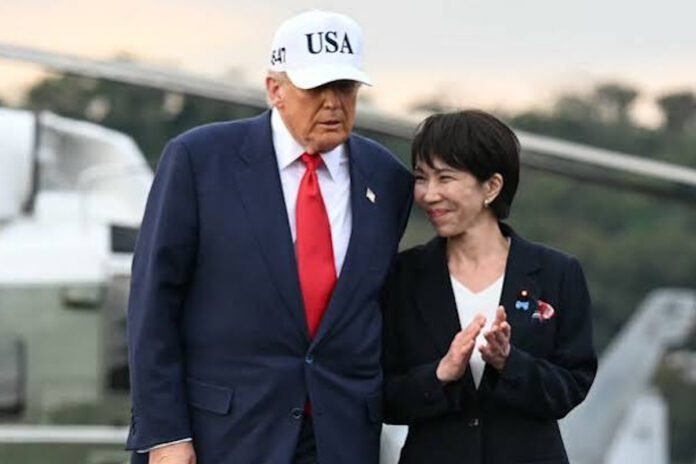
Takaichi scrambles to reach Trump before he sees Xi
Japan’s Prime Minister Sanae Takaichi is heading into an unusually consequential meeting with Donald Trump. The two are expected to meet in New York on September 22, just two days before Trump is due to meet Chinese President Xi Jinping in Washington.
The timing matters: Tokyo is not merely seeking another reaffirmation of the US-Japan alliance. It is trying to shape the political and economic parameters of the Trump-Xi summit before the two leaders sit down.
The concern in Tokyo is not that Washington and Beijing will negotiate — Japan has little interest in obstructing diplomacy between the world’s two largest economies. The concern is what that diplomacy could produce if transactional logic dominates the summit: a deal in which economic concessions are traded for strategic compromises, leaving allies’ security interests as an afterthought.
That possibility has grown more tangible as Washington and Beijing lay the groundwork for the summit. Treasury Secretary Scott Bessent and Chinese Vice Premier He Lifeng have been discussing trade, tariffs, critical minerals and artificial intelligence, as the two sides weigh how to extend their fragile economic truce. For Tokyo, the central question is not whether Trump and Xi can reach an agreement, but whether Japan can make certain strategic issues too costly to trade away.
The first issue is Taiwan. Recent reporting has heightened concern among U.S. allies that Taiwan could become a bargaining chip in that negotiation. Trump has described arms sales to Taiwan as a potential “negotiating chip,” even as Washington and Beijing explore broader economic compromises.
Japan therefore needs to ensure, before the summit, that Taiwan is treated not as an isolated bilateral matter between Washington and Beijing but as part of the wider security architecture of the Indo-Pacific.
Japan’s first objective
For Tokyo, Taiwan is not simply a matter of solidarity with another democracy. Geography makes it inseparable from Japan’s own strategic environment. A crisis in the Taiwan Strait would jeopardize the security of Japan’s southwestern islands, its sea lanes, energy flows and semiconductor supply chains. Any US-China understanding that altered the military balance around Taiwan could therefore carry consequences far beyond Taiwan itself.
That is why Takaichi’s immediate task is to establish a clear strategic boundary with Trump. Japan needs Washington to understand that a Taiwan arrangement negotiated exclusively through US-China bargaining could fundamentally alter its own security environment.
The objective is not to demand a rigid American commitment to every contingency; it is to prevent ambiguity from becoming an invitation to bargain over the regional status quo.
This is especially important because Japan’s own security posture is changing. Tokyo has been strengthening its defense capabilities, expanding its ability to respond to contingencies, and deepening security cooperation with countries beyond the United States. Japan’s Official Security Assistance program, for instance, has expanded rapidly, with its fiscal 2026 budget rising to 18.1 billion yen from 8.1 billion yen the year before.
The program is explicitly designed to strengthen the security and deterrence capabilities of like-minded countries and to prevent unilateral changes to the status quo by force.
But deterrence alone is not enough. Japan also needs to make the alliance economically indispensable to Washington — which explains the second pillar of Tokyo’s strategy: transforming the US-Japan relationship from a traditional security arrangement into an integrated economic, technological and industrial platform.
Central to this effort is Japan’s $550 billion investment commitment in the United States, a framework covering energy, semiconductors, critical minerals and other strategic industries; specific initiatives already include natural-gas generation and small modular nuclear reactors.
The logic is straightforward: if the alliance generates substantial American investment, industrial capacity and jobs, weakening it for a short-term bargain with Beijing becomes far more costly. This is especially true in sectors where Japan retains technological leverage.
Japanese companies hold key positions in semiconductor materials, specialty chemicals and manufacturing equipment; Tokyo Electron and other firms are deeply embedded in global semiconductor production, while Japanese suppliers provide critical materials that are difficult to substitute quickly.
Maintaining coordination between Washington and Tokyo on export controls therefore serves two purposes: it tightens pressure on China while preventing the U.S. technology-control regime from fragmenting in ways that could hurt Japanese industry.
The same principle applies to critical minerals. China’s willingness to restrict exports of strategic materials has already exposed the vulnerability of Japan and other advanced economies. Reuters reported that Chinese exports of heavy rare earths to Japan were sharply curtailed in June amid a diplomatic dispute, laying bare Japanese industry’s dependence on Chinese supplies.
Japan has responded with stockpiling, recycling and diversification toward alternative suppliers.
Institutional commitments
This is where Japan’s strategy grows more sophisticated than simple alliance reassurance.
Tokyo is trying to institutionalize its commitments before they can be reshaped by a Trump-Xi bargain. Personal diplomacy still matters: Takaichi has cultivated a relationship with Trump partly through the political legacy of Shinzo Abe, whose rapport with Trump helped establish a distinctive model of US-Japan diplomacy. But personal chemistry is inherently unstable, while institutional arrangements are harder to reverse.
Japan therefore has an incentive to embed the alliance in economic frameworks, technology agreements, critical-minerals arrangements, coordinated export controls and investment mechanisms. The goal is a network of commitments in which security and economic interests reinforce each other.
Critical minerals offer a useful example: Japan has been pursuing supply diversification while working with the United States on stockpiling and alternative processing capacity. Such arrangements reduce exposure to Chinese economic coercion while increasing the strategic value of cooperation with Washington.
The same logic extends across the wider Indo-Pacific. Japan is deepening security cooperation with Australia, Southeast Asian states and Pacific nations through OSA and other mechanisms.
In fiscal 2025, Japan supported maritime capabilities in Indonesia, including high-speed patrol boats, and has extended similar assistance to other regional partners. These initiatives are modest individually but strategically significant in aggregate, forming a regional network that makes unilateral changes to the status quo more difficult.
Japan’s broader objective, then, is not to stop Trump from negotiating with Xi, nor to push Washington into an unnecessarily confrontational posture toward Beijing. It is to shape the conditions under which US-China diplomacy unfolds.
That requires a delicate balance: Japan must make clear that Taiwan and the regional security order cannot simply become bargaining chips, without framing its position in a way that accelerates Chinese escalation. It must deepen economic integration with the United States without becoming excessively dependent on American policy preferences.
And it must diversify away from China without destroying the commercial ties that remain vital to the Japanese economy. The timing of Takaichi’s meeting with Trump reflects precisely this balancing act.
Tokyo wants to enter the Trump-Xi summit with several facts already established: that Taiwan is inseparable from Japan’s security; that the US-Japan alliance delivers tangible economic benefits to America; that Japan is becoming more capable of carrying its own strategic weight; and that the technological and supply-chain architecture linking the two countries is too integrated to be casually dismantled.
Japan cannot control what Trump and Xi ultimately discuss. It can, however, try to narrow the space in which a grand bargain could be struck at its expense. That is the real purpose of Takaichi’s pre-summit diplomacy: not to prevent a US-China deal, but to ensure that whatever deal emerges does not redraw East Asia’s strategic map over Japan’s head.
Ronny P Sasmita is senior international affairs analyst at Indonesia Strategic and Economic Action Institution, a Jakarta-based think tank. He holds a PhD in international political economy from the University of Tokyo.
Googlebooks launch October 4 starting at $899—here are the five models you can preorder today
Google is ready to take a swing at laptops… again. The company has had a lot of success in phones, but it has struggled to parlay that into an effective strategy for larger screens. Chromebooks have been fine as a budget option, but it seems like Google has accepted they’ll never compete with macOS or Windows. That’s where Googlebooks come in. These new Android-powered laptops are intended to be “real” computers, featuring premium hardware, on-device apps, and powerful development tools.
After the Googlebook reveal at I/O this year, Google’s partners are now ready to sell you one. The first Googlebooks are available from several OEMs that have been making Chromebooks over the years, but don’t expect Chromebook pricing. There’s only one model under a grand, and the rest are well above that.
Familiar hardware
The bulk of Chromebooks have been budget machines, and they looked the part. Googlebooks, however, feature bright OLED screens, metal builds, big haptic trackpads, and the Glowbar. All the machines have this illuminated bar on the lid, but it doesn’t do much for now. It lights up when the device boots and can display battery level, but Google says it’s going to release an API for developers to add more features.
There will be five Googlebooks at launch.
Credit: Google
There will be five Googlebooks at launch. Credit: Google
Across the full lineup, Google says you can expect 16GB of RAM with 32GB upgrades for some models. At launch, the machines will run either a Snapdragon X Elite or an Intel Core Ultra Series 3 (Panther Lake) chip. Both platforms have an NPU capable of 45 TOPS of on-device AI performance, and all the designs are fanless. Regardless of the exact model, Google says you can expect up to 14 hours of video playback and 16 hours of web browsing.
Here are all the launch models and their starting prices.
Acer Googlebook 14 (starting at $899)
CPU
Intel Core Ultra 5/7 (Panther Lake)
Memory
16 GB | 256 GB+
Display
14-inch 2.8k OLED touch display, 500 nits
Measurements
13.9mm, 2.7 lbs (1.22 kg)
Design
Aluminum and Magnesium chassis
Biometrics
Fingerprint sensor
Acer Googlebook 14
Credit: Acer
Acer Googlebook 14 Credit: Acer
Dell XPS Googlebook (starting at $1,199)
CPU
Qualcomm Snapdragon X Elite
Memory
16-32 GB | 512 GB+
Display
13.4-inch 2.5k touch display, 500 nits
Measurements
12.5mm, 2.5 lbs (1.13 kg)
Design
Machined Aluminum chassis, Haptic touchpad
Biometrics
Fingerprint sensor
Dell XPS Googlebook
Credit: Dell
Dell XPS Googlebook Credit: Dell
HP Googlebook 14 (starting at $1,299)
CPU
Qualcomm Snapdragon X Elite
Memory
16-32 GB | 256 GB+
Display
14-inch 2.8k OLED touch display, 500 nits
Measurements
14mm, 2.7 lbs (1.22 kg)
Design
All-Aluminum build, Haptic touchpad
Biometrics
Fingerprint sensor
HP Googlebook 14
Credit: HP
HP Googlebook 14 Credit: HP
Lenovo Googlebook 15 (starting at $1,299)
CPU
Intel Core Ultra 5 (Panther Lake)
Memory
16 GB | 256 GB+
Display
15.3-inch 2.8k OLED touch display
Measurements
15.95mm, 2.68 lbs (1.22 kg)
Design
Magnesium-alloy and carbon-fiber chassis, Haptic touchpad
Biometrics
Face auth and fingerprint sensor
Lenovo Googlebook 15
Credit: Lenovo
Lenovo Googlebook 15 Credit: Lenovo
Asus Googlebook 14 (starting at $1,299)
CPU
Intel Core Ultra 5/7 (Panther Lake)
Memory
16-32 GB | 256 GB+
Display
14-inch 3k OLED touch display, 500 nits
Measurements
14.0mm, 2.2 lbs (1.0 kg)
Design
Aluminum and Magnesium chassis, Haptic touchpad
Biometrics
Fingerprint sensor
Asus Googlebook 14
Credit: Asus
Asus Googlebook 14 Credit: Asus
The Acer model is the cheapest, and it’s also the only convertible in the lineup. The price jump from that device to the next cheapest (the Dell XPS) is a substantial $300, and the rest of the launch laptops are $100 more than that. Google’s partners launched a few Chromebooks in this price range, but they didn’t see wide adoption.
The apps you know but bigger
A major part of Chrome’s failure to truly compete with macOS and Windows is down to software availability. Google tried multiple ways to shoehorn local apps into its web-first platform, but it never took. The advantage of starting from scratch, according to Google, is that these new laptops share the same software stack as Android phones. That means you can run Android apps natively without all the VM weirdness of ChromeOS, and there are a ton of those.
Google is aware of the sordid history of running phone apps on desktop PCs. It’s often a clunky experience using a phone app designed for touch on a large screen with a keyboard and mouse, but the company claims you may be surprised how many apps in the Play Store are now optimized for laptops. The Play Store client will call out apps and games that have been optimized for bigger displays, and Google says more apps are being updated for laptops all the time. There will also be a “desktop-class” version of the Chrome browser preinstalled on Googlebooks.
Even if optimized, these are still going to be apps designed for, and primarily used on, smartphones. It’s unclear if they’ll offer the kind of power people expect for a $1,300 laptop. On the gaming side, Google notes that its Level Up program is delivering more experiences suitable for a keyboard and mouse, but the selection of desktop-ready games won’t be anything like what you get on Windows or macOS.
There is, of course, nothing stopping you from using phone apps on a Googlebook if you want. They’ll run in a window, and you may not even need to install them. With Cast My Apps, the apps installed on your Android phone are available instantly on a Googlebook. They appear in a dedicated app list on the laptop, allowing you to open and use them without touching the phone. The file manager can also seamlessly access files on your Android phone.
Continue On can let you pick up where you left off on a phone or Googlebook.
Credit: Google
Continue On can let you pick up where you left off on a phone or Googlebook. Credit: Google
Similarly, a feature called Continue On lets you pick up where you were in a phone app on the Googlebook version of the app. This requires developer support, so not all apps will carry over. Still, this level of integration with Android is not something you get on either Windows or macOS, which could make a Googlebook appealing if you’ve got a Pixel or Galaxy riding around in your pocket.
As you would expect, the Play Store is the primary source of apps for Googlebooks, and there will be some limits on sideloading. Google has confirmed to Ars that Googlebooks will enforce developer verification requirements for apps similar to Android phones. Under this system, only apps from developers who have verified their identities with Google will be eligible for installation from a downloaded APK file. This requirement will roll out broadly next year, but it’s being activated in a few markets in the coming weeks.
The AI play
Google is following through on its promise to make AI a core part of the Googlebook experience. Gemini models are going to be deeply integrated with the software, ready to work on your screen context with a cursor wiggle. Google calls this Magic Pointer, and it has a few suggestions about how to use it.
Let’s say you have an email or PDF with dates you need to add to your calendar. You can jiggle the cursor, point Gemini at the email, and get all the dates added in one go. If you get a suspicious email, you can invoke Gemini with your cursor and ask it to figure out if it’s a scam. You can also point Gemini at images and tell it to edit them or generate new versions without downloading anything. Useful? Maybe occasionally, but Google’s enthusiasm for Magic Pointer seems a bit premature.
Magic Pointer
Credit: Google
Magic Pointer Credit: Google
Rambler, the AI-powered voice input tool that debuted on Pixel 11 phones a few weeks ago, will also be included on Googlebooks. That means you can start talking to fill text in any field, with streamlined instant editing to remove “ums” and corrections. On phones, I’ve found this can make your writing voice sound like a sterile AI output, but if you’re just banging out a quick email, maybe that’s fine for most people.
AI-powered development is also a big part of the Googlebook experience. Devices will come with Antigravity, allowing you to task agents with development work. You can build, test, and even deploy apps right on your Googlebook, which might help fill some of the software gaps. For more serious developers, there will also be a full terminal environment for tools like Claude CLI and Antigravity CLI.
Nth time’s the charm?
The initial OEM Googlebook lineup looks nice enough—you might not be able to tell them apart from a premium Windows laptop at a glance, but this is a completely different animal. You’re relying on Google to follow through on its promise to make Android apps work for a large-screen environment, which has been a problem in the past. If Google can’t get developers to produce powerful desktop-class apps for Googlebooks, it’s going to be hard to justify buying one over Windows or macOS.
Google’s focus on Googlebooks as an Android companion makes sense given the shared software foundation, but it’s also a risky play. These are not cheap devices—by Google’s own admission, it’s going after the premium laptop market. While Android accounts for about half the phones across Googlebook launch markets, Google’s OS has a much smaller share of the premium segment (over $600) compared to Apple. People buying more expensive phones might also consider a high-end laptop like a Googlebook, but there’s little reason for iPhone owners to buy one of these in a world where the MacBook Air is around the same price and the MacBook Neo is even cheaper.
HP Googlebook 14.
Credit: HP
HP Googlebook 14. Credit: HP
Preorders for the five launch models are going live today, and they will be on shelves on October 4 in the US. Launch day is October 5 in Canada, the UK, Ireland, France, Germany, and Australia. Devices will be available from the Google Store, Best Buy, and other “select retailers.” All Googlebooks, even the cheapest $899 model, will come with a year of Google AI Pro, offering expanded Gemini usage limits and 5TB of Google Drive storage. All models will also include a year of GeForce Now for game streaming.
If you decide to order one of these laptops, you’ll have to go in somewhat blind. No one outside of Google and its OEM partners has spent considerable time using these devices, and we don’t expect anybody to have one for testing until launch day.
MEPs want stronger EU response to drug trafficking networks
MEPs call for a coordinated EU-wide response to increasingly interconnected drug trafficking networks, with action ranging from maritime surveillance and port security to international cooperation, financial crime and prevention. During a plenary session in Strasbourg, Parliament adopted a resolution by 601 votes to four, with five abstentions, urging stronger cooperation between customs, law enforcement and judicial authorities and greater resources for frontline officers.
MEPs want Europol, Eurojust, Frontex and the European Maritime Safety Agency to step up joint operations in EU waters and improve real-time intelligence-sharing with the Maritime Analysis and Operations Centre – Narcotics, a joint initiative involving eight EU member states and the UK. The resolution also calls for stronger cooperation with West African countries to tackle trafficking and transit routes, as well as collaboration with China to address drug precursor chemicals. Port security is another priority, with MEPs calling for stronger maritime surveillance, risk-based vessel tracking and inspections, alongside training and protection for port workers facing intimidation by criminal networks. The resolution also targets the financial proceeds of drug trafficking, calling for stronger anti-money laundering measures and improved tools to identify, freeze and seize criminal assets.
MEPs have also stressed that enforcement should be complemented by prevention, treatment, harm reduction and efforts to reduce demand. They also called for the experiences of victims, affected communities, children and vulnerable young people to inform EU drug policies, while highlighting the particular exposure of the EU’s outermost regions to trafficking.
Far Left and Far Right Score Major Victories in German State Elections
Die Linke’s Berlin triumph has brought scrutiny of its ties to pro-Palestinian activists and disputes over antisemitism into negotiations over the capital’s next government
Germany’s far-left Die Linke won Sunday’s election in Berlin while the far-right Alternative for Germany (AfD) captured Mecklenburg-Western Pomerania, delivering major gains to parties on the political margins and a severe setback to Chancellor Friedrich Merz’s Christian Democratic Union (CDU). The results are putting new pressure on Germany’s governing parties while raising immediate questions in Berlin over Die Linke’s relations with pro-Palestinian activists and allegations of antisemitism within parts of the party.
Die Linke finished first in Berlin with 25.7% of the vote, according to the provisional final result, more than doubling its support from the previous election. The CDU, which has governed the capital, finished second, while the AfD placed third with about 16%, its strongest result in a Berlin election.
Die Linke’s lead candidate, Elif Eralp, is seeking to form a coalition with the center-left Social Democratic Party (SPD) and the Greens, a combination that would give the three parties enough seats to govern the capital. A CDU-SPD-Green coalition is also mathematically possible. If Eralp succeeds in forming a government, Die Linke would lead Berlin for the first time.
Eralp, the daughter of Turkish asylum seekers, campaigned heavily on Berlin’s housing shortage and high rents. Die Linke wants large corporate landlords to be brought into public ownership, following a 2021 referendum in which Berlin voters backed the expropriation of major housing companies. The proposal could involve more than 200,000 apartments and has emerged as one of the major potential points of disagreement in coalition negotiations.
Farther north, the AfD won Mecklenburg-Western Pomerania with 38.2% of the vote, ahead of the SPD. The CDU received only 4.9%, leaving it below the 5% threshold required to enter the state parliament. It was the first time the CDU had failed to enter a German state legislature and its worst state election performance of the postwar era.
The results continued a broader shift away from Germany’s traditional center-right and center-left parties. The AfD has expanded sharply in eastern Germany, campaigning against immigration, support for Ukraine and existing energy policies, while Die Linke has drawn support in Berlin through housing, cost-of-living and redistribution issues. The simultaneous gains by the two parties have complicated coalition building and intensified debate over the durability of Germany’s established political alignments.
Merz described the CDU’s performance as a “disaster” but rejected suggestions that he should step aside. He said he intended to remain in office and pursue planned economic, tax and pension reforms. The chancellor’s coalition of the CDU and SPD has faced dissatisfaction over the economy and living costs, while the rise of the AfD has also increased pressure on the longstanding policy by mainstream parties of refusing cooperation with the far-right party.
In Berlin, the election result quickly became intertwined with a separate controversy over Die Linke’s relationship with elements of the pro-Palestinian movement.
On election day, Die Linke candidate Basem Said shared an Instagram appeal by Palestinian activist Majed Abusalama, a co-founder of Palästina Spricht, or Palestine Speaks, which Berlin’s domestic intelligence service has classified as a confirmed extremist organization. Abusalama described the election as a “Wahlintifada,” or “election intifada,” and called for votes for several Die Linke candidates, including Eralp. Said thanked him for the appeal. The episode was first reported by German media and detailed by Berlin newspaper Tagesspiegel.
Further controversy followed Die Linke’s election-night celebrations. Ibrahim Ibrahim, a pro-Palestinian activist identified by the research group Democ as a supporter of the Popular Front for the Liberation of Palestine (PFLP), was photographed at a party event with Die Linke Bundestag member Ferat Koçak. The PFLP is listed as a terrorist organization by the European Union and is described as a Palestinian terrorist organization by Germany’s Federal Office for the Protection of the Constitution.
Issa Remmo, identified in German reporting as a leading member of Berlin’s Remmo family, whose members have been linked to organized crime cases, also appeared at Die Linke celebrations. Eralp distanced the party from his presence.
“He was not invited and was sent out again,” Eralp said. “We have nothing to do with organized crime; we fight it.”
The disputes follow an earlier campaign controversy involving rapper Dahabflex, who performed at a Die Linke event in Berlin’s Neukölln district in late August. His performance included the lines “Yalla Yalla Intifada” and “Death to the IDF,” referring to the Israel Defense Forces. Eralp subsequently criticized the event and demanded that the Neukölln organization investigate what had happened.
“I stand clearly for the protection of Jewish life and against every form of antisemitism,” Eralp said at the time.
Those incidents have now become an issue in negotiations over Berlin’s next government. SPD lead candidate Steffen Krach has demanded a clear commitment against antisemitism from Die Linke’s entire parliamentary group, while Green lead candidate Werner Graf has called on the party to confront antisemitism within its ranks and explain how it intends to restrain members whose positions have caused controversy.
Josef Schuster, president of the Central Council of Jews in Germany, went further, urging the SPD and Greens not to enter a Die Linke-led coalition. Schuster said the party had repeatedly crossed antisemitic boundaries during the campaign and accused it of failing to deal credibly with antisemitism in its ranks.
Die Linke’s national leadership has rejected the broader accusation. Heidi Reichinnek, leader of the party’s parliamentary group in the Bundestag, said the party has a clear position against antisemitism and described that position as a “red line,” saying anyone who crosses it has no place in Die Linke.
The dispute leaves Eralp facing two negotiations at once: one over the policy program of a possible left-wing Berlin government and another over whether prospective coalition partners are satisfied that Die Linke can contain the elements of its organization that have generated controversy over Israel, antisemitism, and ties to radical pro-Palestinian activists.
The broader election results present a different problem for Germany’s national leadership. With the AfD consolidating support in the east and Die Linke recording a historic victory in the capital, the weekend’s votes showed voters moving away from the parties that have dominated German politics for much of the postwar period, less than three years before the next federal election is due in 2029.
This article first appeared on Pacific Forum and is republished with kind permission. Read the original here.
The US-China relationship stands at a perilous threshold, defined by military friction, accelerating technological competition, and shrinking margins for miscalculation. As Washington debates how to navigate Beijing’s ascent, American strategy should realign its ambitions with realities.
While the United States may desire enduring primacy, technological dominance, and economic sovereignty, material constraints dictate that the only viable relationship it can sustain with China is one of managed coexistence.
Framing the debate
Let us begin by rejecting two untenable extremes.
First, seeking the subversion of the Chinese Communist Party is as foolish as it is dangerous. Attempting to force the downfall of a nuclear-armed economic powerhouse governing 1.4 billion people risks uncontrolled escalation, unsecured strategic assets, global economic collapse, and unprecedented human disaster, assuming its success.
Second, ceding the Indo-Pacific (or more) to Beijing’s hegemony is equally disastrous. Unchecked Chinese dominance in the region would choke vital maritime trade lanes, undermine critical US security alliances and partnerships, and erode the global balance of power.
The real debate taking place in Washington pits two visions against each other. One is driven by primacists, who demand that the United States enforce dominance and escalation superiority over China while leading a containment strategy.
The other approach is championed by realists, who believe that the era of uncontested US primacy is over and that the United States should seek an equilibrium with China built on military denial, targeted economic de-risking, and managed coexistence.
The primacist ideal and material limits
Ideally, the United States desires enduring primacy.
Militarily, primacists seek escalation dominance, i.e., preserving the status quo in the Taiwan Strait and South China Sea through overwhelming offensive power. That’s because, as Matt Pottinger and Mike Gallagher have argued, managing competition “risks prioritizing short-term thaw at the expense of long-term victory” and “there is no substitute for victory.”
Similarly, in technology and trade, primacists treat competition with China as a zero-sum struggle. They advocate using state subsidies, federal investments in research and development, and export controls to maintain the US lead in artificial intelligence (AI), quantum computing, and semiconductors.
Primacists also push for industrial rebalancing, reversing Chinese mercantilist trade practices, reshoring vital supply chains (such as critical minerals and pharmaceuticals), and decoupling major economic sectors. Moreover, they frame the competition as a moral crusade of “democracy versus autocracy,” mobilizing US alliances to isolate China and press for internal reforms within China.
This vision, however, collides with unyielding material realities. Uncontested military supremacy along China’s perimeter is now out of reach.
China’s dense anti-access/area-denial networks mean the United States can no longer project unhindered power up to the Chinese mainland. Worse, trying to do so risks triggering a preventive war rather than deterring one. Beijing’s expanding nuclear triad has also rendered US strategic immunity obsolete.
As Brad Roberts has emphasized: “The United States is going to have a relationship of mutual vulnerability with China whether or not it accepts it in a political sense.” Even as it is adapting, as it should, its nuclear arsenal to deal with both Russia and China (two nuclear peers, or a peer and, in China’s case, a quasi-peer) plus North Korea, the United States will face constraints that make seeking nuclear dominance over its adversaries impossible.
Economically and technologically, broad blockades are not foolproof. China’s deep tech talent pool and capital reserves guarantee that Beijing will innovate around such blockades.
While advocating for aggressive competition to out-innovate China, Eric Schmidt has observed the following: “Not only will we invent this AI future, but so will our direct competitor, China. We cannot prevent it. We cannot hold it to ourselves for a few years of advantage. We are in a race that will shape the world’s future.”
Total decoupling is also cost prohibitive. Global supply chains are integrated, and aggressive trade weaponization risks retaliation, including Chinese export controls on critical inputs like rare earth elements.
Crucially, key regional allies and Global South partners reject binaries, preferring commercial ties with Beijing alongside security partnerships with Washington. Meanwhile, China’s deepening alignment with Russia, Iran, and North Korea creates an axis that counters Western efforts at complete isolation.
A realist strategy: The four pillars of managed coexistence
Acknowledging these limits does not mean surrendering. It means adopting a more practicable strategy anchored in hard-nosed realism. To many, opting for realism is synonymous with US retreat and restraint, even capitulation. To be sure, some realists, often labeled “offshore-balancers,” do advocate retrenchment.
In a recent report on US defense policy, for example, Jennifer Kavanagh recommends the withdrawal of American military posture from the First Island Chain to the Second Island Chain and the dissolution of mutual defense alliances, arguing that doing so “would reduce US military requirements and the risk of a war with China while still protecting US interests.”
Other realists, however, contend that voluntary withdrawal creates a dangerous power vacuum, inviting the very aggression deterrence is meant to prevent. So, instead of abandoning alliances or executing a retreat, these “forward-leaning” realists argue that American power is best preserved by maintaining a favorable balance of power directly along the First Island Chain.
They seek to deter aggression through military denial and, more broadly, manage rivalry through transactional statecraft. In short, they believe that the United States should seek equilibrium within the theater, not safety behind the horizon. This approach is the key to success, and it rests on the implementation of four pillars.
National power abroad rests on physical and economic solvency at home. That’s why the United States should prioritize targeted investments, next-generation AI infrastructure, green-energy supply chains, and domestic manufacturing capacity. Streamlining immigration pathways for top global tech talent and modernizing industrial infrastructure will also supply the engines needed to sustain long-term competition.
Crucially, domestic revitalization should be paired with collective resilience. Rather than demanding economic decoupling—which alienates partners—the United States should collaborate with its allies to establish joint critical-mineral processing networks, strategic reserves, and targeted anti-coercion trade mechanisms.
Such a collective resilience framework will ensure that neither Washington nor its partners can be singled out by Beijing’s economic leverage or export blockades, all while preserving open channels for non-sensitive trade.
Pillar 2: Deploy a posture of military denial and allied responsibility-sharing
The United States should transition away from vulnerable, concentrated forward platforms toward a distributed, resilient denial network. Priority should go to massed autonomous strike systems, long-range mobile anti-ship weaponry, hardened command-and-control nodes and undersea warfare assets capable of denying an amphibious invasion of Taiwan or maritime coercion without relying on escalatory strikes against the Chinese mainland.
US Undersecretary of War for Policy Elbridge Colby has argued that such an approach is essential “to prevent China from establishing hegemony” and the only realistic option given that “restoring military dominance over China is unfeasible given its size and capacity.”
Concurrently, this strategy demands robust allied responsibility-sharing. While reaffirming its extended deterrence commitments, the United States should insist that front-line allies shoulder a larger burden of their conventional defense.
This includes integrating Japan’s acquiring stand-off counterstrike capabilities into joint operational planning, encouraging Australia’s long-range strike expansion under AUKUS, and co-developing defense industrial production with regional partners to make the First Island Chain self-sustaining in long-term deterrence.
Pillar 3: Establish strategic and operational guardrails
As it strengthens deterrence, the United States should acknowledge mutual nuclear vulnerability with China to stabilize the strategic balance and eliminate incentives for worst-case force sizing. On this baseline, it should pursue risk reduction measures across both strategic and operational domains.
Drawing on historical precedents such as the 1988 US-Soviet Ballistic Missile Launch Agreement, the United States should coordinate with partners to push China toward formal pre-launch notification agreements for ballistic missiles and space-launch vehicles. (A recent Pacific Forum study on this topic finds that Beijing might be receptive to pressure.)
Beyond missile guardrails, the United States should secure bilateral commitments to maintain human control over nuclear assets, institutionalize 24/7 military-to-military crisis communications, standardize maritime and aerial avoidance protocols in the South China Sea and Taiwan Strait, and establish binding rules governing military AI, space-based targeting systems, and offensive cyber operations.
These measures will serve as prerequisites for the nuclear arms control initiatives currently out of reach given the asymmetry between US and Chinese forces.
Pillar 4: Institutionalize platforms for transactional diplomacy and reciprocal statecraft
Beyond military risk reduction, preventing broader friction from escalating into conflict requires resilient diplomatic channels to withstand political volatility.
The United States and China should establish task forces to process trade disputes, update targeted export control definitions, and coordinate on shared, non-zero-sum challenges, including global macroeconomic stability, climate mitigation, public health threats, and the suppression of illicit precursor chemical networks.
Such engagement should move beyond dialogue toward reciprocal statecraft: Washington should offer calibrated market access or narrowed regulatory restrictions in exchange for verifiable Chinese actions, such as enforcing controls on precursor fentanyl exports or committing to debt-restructuring standards in developing nations.
Anchoring these exchanges in multilateral bodies will further ensure that transactional statecraft remains grounded in regional consensus, making it harder for either power to walk away when political friction flares up.
Conclusion
Prudent statecraft requires aligning strategy with material realities rather than ideological ambitions. In the US-China relationship, shifting from primacy to realism need not mean retreating or capitulating.
Rather, it demands implementing a balance-of-power strategy, one that anchors power in domestic solvency, enforces stability through forward denial and burden-sharing, establishes strategic and operational guardrails, and pairs hard deterrence with crisis diplomacy.
David Santoro (david@pacforum.org) is President and CEO of the Pacific Forum.
Iranian president’s media team denied US visa, says official
An Iranian official said Monday that the US refused visas to the media team accompanying President Masoud Pezeshkian on his planned visit Tuesday to New York for the 81st session of the UN General Assembly, Anadolu reports.
The Iranian public would be kept informed of the latest developments regarding the bilateral meetings Pezeshkian would have during his visit, Habibollah Abbasi, director general of public relations at the Iranian presidency, said in remarks carried by Iran’s semi-official Mehr news agency.
He said Pezeshkian’s visit to the US would last five days, including two days allocated for travel.
Abbasi added that the Iranian president would be accompanied by Mohsen Haji-Mirzaei, chief of staff of the Iranian presidency, and Seyyed Abbas Mousavi, deputy head of presidential protocol and ceremonies.
He said Pezeshkian would meet with a number of leaders attending the UN meetings during his stay in New York.
US authorities have not yet commented on the matter.
The development comes amid continued tensions between the US and Iran, as their negotiations remain stalled over disagreements concerning navigation in the Strait of Hormuz, a strategic waterway for energy and commodity supplies.
On Feb. 28, the US and Israel launched a war against Iran, prompting Tehran to retaliate with strikes on Israel and other regional countries hosting US assets.