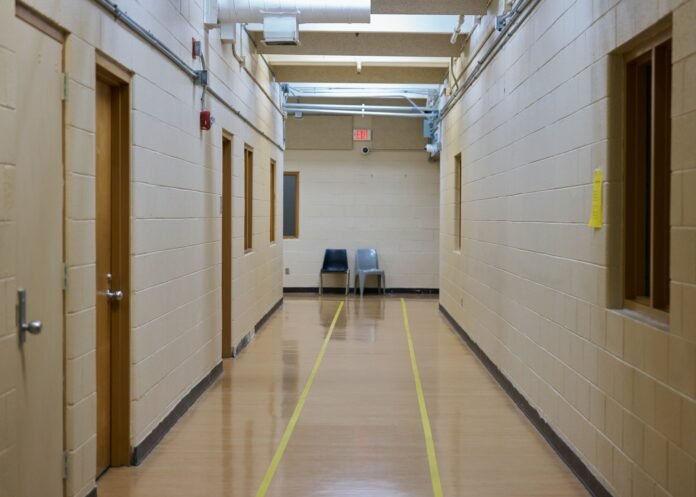
Marcia Levering nearly died at work on February 6, 2021. She was working as a prison guard at the former medium-security federal prison in Leavenworth, Kansas, a facility operated by the private prison company CoreCivic. One of Levering’s overwhelmed colleagues buzzed open the wrong door, releasing a high-risk prisoner directly into Levering’s path. “He kind of gave me this eerie green grin,” she said. Then boiling water hit her face.
The facility, which had long been plagued by overcrowding, chronic understaffing, and deadly violence, closed later that year after a Biden executive order against all private prison profiteering put its century-long run to an end.
Then came the second Trump administration and its plans to supercharge the business of incarceration in the United States.
As of March, the notorious prison is back up and running, and this time it’s being filled with immigrants, the majority of whom have no criminal conviction, as part of Immigrations and Customs Enforcement’s brutal deportation regime targeting noncitizens.
Last month, CoreCivic sold the facility to the Department of Homeland Security for $238.4 million, although it expects to keep operating the site under its existing ICE arrangement. But local officials tell the story of a massive for-profit prison company steamrolling community opposition as well as the city’s own established processes, and ultimately forcing their hand to participate in a project of mass detention — a system that advocates and former employees say has led to unsafe, violent conditions for both detainees and employees.
Current conditions for detainees held at the Midwest Regional Reception Center are hard to verify from outside. In its reporting on the sale, the Kansas City Star put the facility’s population at 365 men and 112 women, a count shared at a July 28 community advisory board meeting. The paper described two local groups in contact with detainees and their families, among them Northland Neighbors United, which said in a July statement that detainees have reported medical neglect, inadequate food, and prolonged lockdowns. CoreCivic spokesperson Ryan Gustin told the Star the allegations do not reflect how the facility operates.
This isn’t “manufacturing notebooks and pens. This is profiting off of people being put in cages.”
For Esmie Tseng, the communications director for the ACLU of Kansas, coverage of these city meetings sanitizes the reality for detainees.
“We’re making a contract out of putting people in cages,” Tseng said. “This isn’t just moving widgets from one place to another, or manufacturing notebooks and pens. This is profiting off of people being put in cages.”
The Pitch
By early 2025, the city of Leavenworth had already said “no” multiple times to deepening its involvement in immigration detention. After Trump’s reelection, CoreCivic tried again, working with city officials for three months before announcing on a Zoom call it would reopen the facility as an immigration jail without waiting for a special use permit, or SUP, to be approved. The city sued to force CoreCivic to go through its permitting process, and the company countersued, arguing its federal contract allows it to bypass local law. In June 2025, a Leavenworth State District Court judge granted a temporary injunction barring CoreCivic from operating without a special use permit.
During that first push on March 25, 2025 — the day the city commission was scheduled to meet in closed session about the ICE contract — John Malloy, CoreCivic’s vice president of federal partnership relations, emailed Leavenworth’s commissioners with what seemed like an attractive financial offer: “300 well-paying jobs at starting salaries of $28.58/hour,” more than $1,000,000 annually in property taxes, a $1 million one-time impact fee, and annual payments to the city and police department. The final permit set CoreCivic’s impact fee at $1.5 million, which City Manager Scott Peterson said covered the city’s legal bills.
Malloy also emphasized the city’s approval process must move quickly to meet growing demand to ramp up the number of available immigration prison beds.
“While ICE’s pressing need for capacity dictates the speed at which we must move to hire and ready the facility … we do not wish this speed to harm what we hope will be a long-term beneficial relationship with the City,” Malloy wrote in the email. He added this expedited timeline would not allow for “a protracted permitting process.”
He also touted that the community response to job postings had already been strong, with more than 500 applicants “in the hiring process” and more coming in every day.
Levering, an Army veteran and Native American, heard a version of that pitch five years earlier in a cold call from a recruiting agency. Back in 2020, when CoreCivic was contracted to run the facility as a federal prison by the U.S. Marshals Service, the recruiting agency offered her 12-hour shifts and only three days a week, she told The Intercept. The schedule sold her. With four kids in school, the promise of four days at home made the job feel like an ideal fit for her busy life. She saw the work as service, an extension of her years in the Army. In hindsight, she said, “Obviously, [that’s] not the case, because it’s a private prison.”
Mike Trapp, co-founder of the Carceral Accountability Council, said CoreCivic hires people the state prison system and Federal Bureau of Prisons might otherwise have turned away over physical and age limitations, because the company has “lower standards of entry.”
But Bill Rogers, a former guard at the facility under the Marshals contract, said there were effectively no hiring standards.
“Think about the people you’re going to get to work at a facility if you really just don’t care.”
“You gotta pass their background check … and you gotta be breathing,” he said. “Think about the people you’re going to get to work at a facility if you really just don’t care.”
One year after Malloy’s email to persuade city officials, the facility already had 150 employees on its payroll, halfway to the 300 jobs Malloy had promised. At a February 2 hearing, the city’s planning commission voted 5-1 to recommend approval of CoreCivic’s special use permit. The City Commission granted final approval on March 10 by a vote of 4 to 1.
The Arithmetic of Danger
Levering’s schedule amounted to a minimum six-day, often seven-day, workweek, with shifts of 12 hours or longer plus mandatory overtime, she said. Levering rarely saw her four children, who were then in middle and high school. The evenings she’d pictured spending time with them at home never came to pass.
After onboarding, officers were promised 40 hours of continuing training annually, Rogers said. He received that training for about his first two years, he said, until staffing ran too thin to pull officers off the floor. Left to teach herself, Levering said she learned more from prisoners than her peers or her supervisors. They told her who to keep an eye on, how to read danger on the floor, and where to set boundaries.
In response to questions from The Intercept, Gustin, the CoreCivic spokesperson, said the company’s training “meets or exceeds” the standards of the American Correctional Association.
Levering said that during her time at the facility, shifts that called for 24 to 25 officers often had just five or six. Within months, CoreCivic began eliminating bubble officers, who monitor units from a secure, elevated central control booth known as the “bubble.” These officers are critical for safety, as they control access to different zones of the prison by electronically opening and closing doors. Their elevated position also allows them an eye-in-the-sky perspective, where they can be the first to spot emergencies before they escalate.
In an interview, Shari Rich, who worked at the facility for nearly 13 years and counts Levering as a close friend, traced Levering’s assault to CoreCivic’s decision to eliminate bubble officers.
“It should never have happened,” she said of Levering’s assault. Rich placed the blame squarely on CoreCivic eliminating bubble officers. She said she previously watched a case manager get brutally attacked by an inmate while the bubble ran with one person, a post she understood was supposed to be staffed by two or three.
Rich is still speaking out against the company, she said, because of what happened to Levering.
Years earlier, a 2017 Justice Department inspector general audit had flagged the facility’s failure to staff mandatory security posts, warning it compromised safety and security.
Officers were increasingly posted alone, sometimes responsible for two 64-person units, Levering said.
“They were hiring kids right out of high school,” Levering said, calling them “sitting ducks.” Without enough officers, downstream everyday functions also collapsed. Recreation stopped when there was no one to run it, Rich and Rogers said. Officers were pulled off their units for weeks at a time, according to Rogers, which left inmates in day rooms with no one to turn to. The locks to the cells were breaking, Levering said, even as CoreCivic refused to put enough people on the units to keep them secure. The ACLU and federal public defenders confirmed that detainees, unable to lock their own cells, built makeshift barricades and armed themselves.
The day an inmate split Rogers’s head open with a food tray, he said he was covering three units alone with no bubble officer watching. He had already emailed the warden about the lack of coverage. He lost his radio in the assault, stranding him and unable to call for backup. The wound took 14 staples to close, he said. Rogers also said he was required to finish his shift before driving himself to the hospital. All the warden had to say to him about the incident was that “the takedown you did was a little rough,” he recounted.
“How do we expect them to act?” Rogers asked. “We have to bear some of that responsibility. … We lost control of that place.”
“We have to bear some of that responsibility. … We lost control of that place.”
Gustin said CoreCivic does not supply specific figures about staffing in any of its prisons for “safety reasons,” but added, “We are appropriately staffed based on the number of individuals in our care.” CoreCivic attributed staffing shortages to Covid, despite the 2017 audit, which found chronic understaffing years before the pandemic. In 2021, ACLU affiliates and federal public defender offices in four states jointly documented an average of nearly 37 violent incidents per month at CoreCivic Leavenworth between May and July of that year, just months after Levering was attacked.
Asked about the 2021 conditions, Gustin said “staffing was the main contributor to the challenges.” He also said incidents from “more than five years ago” do not reflect conditions in the facility today.
What the Machine Produced
On the day of the incident that would leave her permanently disabled, Levering said that she and her co-worker Diana Polanco were the only two officers on the floor. It was Polanco’s second day on the job, and she wasn’t yet OC certified, a prerequisite for carrying pepper spray.
Levering remembers the inmate being released directly into her path but little else about the assault.
“Where the hell is everybody?”
“My eyes were closed, and I was in the fetal position on the ground. I didn’t know he was stabbing me, because your adrenaline’s going,” Levering said. According to the Leavenworth Police Department report, she was stabbed four times in the ear, once in the arm, and twice in the abdomen. Before anyone reached her to help, she remembered wondering, “Where the hell is everybody?”
Polanco tried to step in to help Levering. She suffered a broken jaw, stab wounds to her back and face, fractured ribs, and lasting nerve damage.
Levering’s injuries were catastrophic. She lost 24 inches of her colon and spleen, according to the incident report. A punctured lung was not disclosed to her for a year, until she says a doctor seemingly mentioned it by accident. She has received 16 facial reconstruction surgeries, and five years later, she is still undergoing medical procedures related to her injuries. She lives with permanent facial paralysis, chronic vertigo, chronic gastrointestinal issues, and walks with a cane. Her PTSD, aggravated by serving in Iraq, is debilitating. After 10 months as a prison guard, she now lives on $825 a month in disability payments.
Warren Richardson, the federal prisoner who attacked Levering and Polanco, pleaded guilty to attempted murder and assault with a dangerous weapon, and was sentenced to 300 months. The federal record describes the attack as “nearly killing” both women.
Over roughly five years at the facility, Rogers said he was assaulted seven times, and no one from CoreCivic asked if he was OK or offered counseling. Since the injuries were on the job, Rogers said the company was responsible for his medical expenses. But the invoices remained unpaid and were forwarded to a collections agency instead, he said. Trapp, of the Carceral Accountability Council, has watched the job take its toll on Rogers.
“When he gets talking about some of the deaths that he witnessed, he’s re-experiencing it. I can see it in his eyes,” Trapp said. “I’ve worked with a lot of trauma survivors, and I’m not qualified to make a diagnosis in the state of Kansas, but I see it, the hauntedness.”
Rich couldn’t understand why other injured officers were paid settlements while Levering only had her initial medical bills covered, despite suffering from permanent disabilities. With no further support from CoreCivic, the Carceral Accountability Council launched a GoFundMe to help with her continued recovery.
CoreCivic did not respond to detailed questions about the February 6, 2021, attack, the uncertified officer on the floor, or its treatment of Levering afterward, including whether it provided any support for her injuries.
The ICE Escalation in a Town of Prisons
Widely known as one of the nation’s quintessential prison towns, Leavenworth, Kansas, has been in the corrections business for more than 150 years. The Army raised Fort Leavenworth above the Missouri River in 1827, and later established what remains the U.S. military’s only maximum-security prison. Kansas opened its state penitentiary in neighboring Lansing in 1868. By 1903, the federal penitentiary had taken its first prisoners. Convicts built much of it, marching over from the old military prison at Fort Leavenworth each day. For generations, guarding prisoners has been one of Leavenworth’s steadiest livelihoods, work that has employed hundreds across the fort, the state pen, and the federal walls.
In the U.S., the private prison industry is worth somewhere around $6 billion, much of which comes from government contracts. Corrections Corporation of America, which later rebranded as CoreCivic, opened the Leavenworth Detention Center in 1992 as the country’s first for-profit maximum-security prison under direct federal contract. Gustin, the company’s spokesperson, acknowledged “there were challenges as that contract neared expiration” but said the company was otherwise “proud of the operational track record we’ve built.”
CoreCivic, which owns more prisons and jails than any private company in the country, has a documented history of neglect, safety failures, and worker exploitation. In 2021, while still under the U.S. Marshals Service contract, Kansas federal Judge Julie Robinson called the facility “an absolute hell hole.”
“They don’t see us as humans, or the inmates as humans.”
But with the advent of the Trump administration’s mass detention and deportation system, the company is looking forward to a bright — and very profitable — future. On a February earnings call, CEO Patrick Swindle called Immigration and Customs Enforcement “our first customer 43 years ago” and “our largest customer for over a decade.” The company’s profits reached $116.5 million in 2025, a nearly 70 percent increase over the previous year, and ICE revenue more than doubled in the final quarter. The One Big Beautiful Bill Act, which Trump signed into law in July 2025, directed roughly $45 billion to expanding ICE detention, nearly quadrupling the agency’s annual spending. On the call, the company said it could supply ICE with nearly 13,000 more beds for the Trump administration’s expansion, a figure Swindle said “does not include additional capacity we may be able to provide through other means.”
Of those beds, 1,033 are in Leavenworth. Nine days after the city commission vote on March 10, CoreCivic reopened its doors and began housing ICE detainees. As a condition of approval, the special use permit required the city to establish a community oversight committee.
Behind every understaffed shift and unanswered emergency code at Leavenworth is a facility expected to generate $60 million a year. To Levering, CoreCivic’s profit incentive means “they don’t see us as humans, or the inmates as humans. … We’re all numbers to produce for them.”
Promises Made, Promises Broken
The warning bells about Leavenworth started ringing years ago. The 2017 inspector general report concluded the facility had concealed triple-bunking, where a third bed was installed in several cells meant to house two inmates, from auditors staging full staffing and cleanup on inspection days. Those concerns went unaddressed, Rich said, save for a scramble to paint and clean before each audit. CoreCivic’s own internal investigation concluded the bunks had been removed “intentionally to conceal” the practice, and the company responded to its own finding by instituting ethics training and a non-retaliation policy for employees reporting misconduct.
Among the promises that haven’t come to fruition are good-paying jobs for the community.
Among the promises that haven’t come to fruition are good-paying jobs for the community. Malloy, the CoreCivic vice president, had promised “starting salaries of $28.58/hour.” But CoreCivic’s current Leavenworth listings show multiple positions below his pledge: certified medical assistant at $21.19, medical records Supervisor at $23.92, facility locksmith at $26.08, and treatment counselor at $26.96. The detention officer rate, the most dangerous and high-turnover role, sits at $28.25.
Gustin called any notion of a wage discrepancy “false” and said the figures Malloy offered were “an approximate starting wage for a detention officer position.”
Malloy also pledged to use “area construction contractors and labor.” But a building permit dated March 19, dated six days before Malloy’s email, shows CoreCivic had already hired Texas-based Bass Roofing for $1,145,600. CoreCivic hired the contractor; the contractor employed the workers. Gustin confirmed the company chose an out-of-state contractor that “handled similar work at another one of our federal facilities, which required special clearances for workers,” and said it favors providers who meet “stringent labor requirements.”
Rogers, the former prison guard, had spoken at city commission meetings about the roofing project, alleging that instead of bringing jobs to the community, the project relied on undocumented laborers. On April 17, 2025, CoreCivic’s deputy general counsel sent him a cease-and-desist letter, copied to the Leavenworth Police chief, which sharply disputed those claims.
“To ensure that its contractors’ employees are legally authorized to work in the United States, CoreCivic requires all contractors, including Bass Roofing and Extra Squares Roofing (whose employees are working on MRRC’s roofing restoration) to strictly comply with Form I-9, Employment Eligibility Verification, requirements and participate in E-Verify,” the letter read. “Our review of this confirms that any representation that undocumented or unauthorized workers have worked on the MRRC project is false.”
Six days later, outside counsel sent a defamation threat demanding he retract his statements. The letter cited his 2020 termination for “excessive force,” setting an April 25, 2025, deadline for Rogers to publicly detract his allegations.
That date passed; no lawsuit has materialized. To Rogers, the letter was a clear attempt to intimidate him into silence. CoreCivic did not say whether the threatened lawsuit was ever filed, and Gustin dismissed former employees-turned-critics, saying there “have only been a few former employees who have spoken out” about the facility.
The Gap
Rogers said that at first, the schedule was easy: eight-hour training shifts, Monday through Friday. In Tennessee, a 2023 audit by the comptroller found turnover among correctional officers at the four prisons CoreCivic runs for the state averaged 146 percent, a staggering figure compared with 37 percent turnover at the state-run facilities. As of mid-August, Leavenworth reportedly holds more than 500 detainees, still well below the 1,033-bed capacity CoreCivic projected.
There has also been a worrying continuity in top leadership: The warden running the ICE operation, Misty Mackey, was the assistant warden at the same Leavenworth facility in February 2021.
The city commissioners faced an impossible task that stood to devastate Leavenworth no matter which way they voted.
“It’s a lot to ask five part-time citizen-legislators to put their city on the line to be singularly responsible for stopping the mass deportation agenda,” Trapp said.
“It’s a lot to ask five part-time citizen-legislators to put their city on the line to be singularly responsible for stopping the mass deportation agenda.”
Levering, who watched officers treat American inmates “like they’re subhuman,” expects immigrant detainees to fare even worse. “They’re still human beings first, just like you and I,” she said.
The chasm between what CoreCivic promises a community to set up its ICE operations and what it actually delivers may be measured in emergency rooms and disability checks. The same company that has now supercharged the mass detention of immigrants left Marcia Levering living on $825 a month with lasting disabilities and buried Bill Rogers in medical bills as he copes with PTSD.
“If they did to Marcia Levering what they did,” Rogers said. “If that’s how they treated her — then why would they care about a detainee?”
This time, the people on both sides of the door have less protection than before.