14.7 C
London
Thursday, September 17, 2026
Home Blog

Von der Leyen unveils sweeping EU plan to protect children online

0
von-der-leyen-unveils-sweeping-eu-plan-to-protect-children-online
Von der Leyen unveils sweeping EU plan to protect children online


European Commission President Ursula von der Leyen set out a ‌sweeping plan to keep children safe from online dangers on Thursday, proposing to ban under-13s from social media and require online services to design safe children’s accounts.

The move follows similar initiatives in Australia, Britain, China, India, Turkey and several European Union countries ​over concerns about the impact Meta’s Facebook and Instagram, TikTok, Google’s YouTube and ChatGPT have on ​children’s mental health and safety.

Months of debate ahead before it could become law

Australia’s challenges in enforcing its world-first social media ban for ⁠children under 16 could see Europe facing an uphill battle as well.

“Today, our children are engaging with ​some of the most sophisticated technology ever created, and it was not created with children’s well-being and development ​in mind,” von der Leyen told a press conference.

She said the proposed EU Kids Act “will set clear boundaries in the digital world just as we do it on a daily basis in the real world”.

PARENTAL CONTROL

Under the proposal, which must ​be negotiated with EU countries and the European Parliament in the coming months before it can become ​law, accounts for children aged between 13 and 15 will be under parental control.

Social media and video-sharing services, online video ‌games, AI ⁠companions and chatbots for children below 18 will be subject to a list of dos and don’ts.

These include a ban on addictive features, profiling-based recommender feeds, infinite scroll, reward tricks and unsolicited contact from strangers. AI companions and chatbots must be turned off by default.

Online platforms must design algorithms safe for children and ​provide easy-to-use parental controls ​and tools to block ⁠and mute users.

The companies, which must verify users’ age when they open an account via age assurance tools, risk fines as much as 6% of their global ​annual sales for non-compliance. They will also have to pay a supervisory ​fee to fund ⁠regulators’ supervision.

Tech lobbying group CCIA Europe, whose members include Google and Meta, warned of the privacy risks arising from the proposal and conflicting requirements under other EU laws.

“Collecting age information, identity credentials, and data linking children with ⁠parents ​or guardians at this scale would undoubtedly create an attractive target ​for cybercriminals,” CCIA head Daniel Friedlaender said.

“The Kids Act creates legal overlap and duplication that ultimately weaken protections for children and consumers,” ​he said.

Source:  Reuters

Houthi advance boosts Iran’s leverage over the US and Saudi Arabia – but may cost rebel group its legitimacy back in Yemen

0
houthi-advance-boosts-iran’s-leverage-over-the-us-and-saudi-arabia-–-but-may-cost-rebel-group-its-legitimacy-back-in-yemen
Houthi advance boosts Iran’s leverage over the US and Saudi Arabia – but may cost rebel group its legitimacy back in Yemen

It took just a few days for Houthi forces to seize most of Yemen’s Red Sea coast, including the shores of the Bab el-Mandeb Strait, a crucial Red Sea maritime choke point.

The offensive started on Sept. 3, 2026, with a push to cut the strategically important road linking the city of Taiz to the port of Mokha. By Sept. 11, Mokha, the town of Dhubab and the island of Mayyun, in the mouth of the strait, were under Houthi control.

The Yemeni rebel group seized some 2,100 square miles of territory, forcing more than 100,000 people to flee, according to the U.N., with many making the risky journey to nearby Djibouti by boats.

It is the largest shift in the front lines of Yemen’s civil war since a U.N.-brokered truce froze them in April 2022.

Most of the coverage has interpreted the offensive as a new lever for Iran – a key ally of the Houthis – in its ongoing war with the United States, or a fresh threat to Saudi Arabia and global shipping.

Such framing is not wrong, but it is incomplete. The more consequential question, I believe, is what the offensive means for Yemen itself, and where it leaves both a civil war that had quietly stalemated for years and the Houthis’ own unresolved problem of legitimacy.

Why advance now?

Years of Yemeni civil strife entered a new phase in 2014 when Houthis seized the capital Sanaa from the increasingly unpopular government of President Abdrabbuh Mansur Hadi.

A decade of subsequent fighting between the rebel group and a Saudi-led coalition brought famine and destruction across the impoverished nation. But since 2022 the conflict has largely been stalled, with Houthis controlling much of the country’s northwest and the Saudi-backed forces remaining dominant in parts of the country’s south and east.

So why have the Houthis advanced now? The group’s military spokesman, Yahya Saree, said it was triggered by years of Saudi aggression and blockade.

Such grievances are not invented. U.N. agencies have documented real, sustained damage from coalition restrictions on Yemen’s ports and airspace over the course of the civil war.

The Houthis also trace the latest round of fighting to a July 13 strike on the Sanaa airport’s runway by Yemeni government forces with Saudi backing. That attack forced an Iranian aircraft carrying officers of Iran’s powerful Islamic Revolutionary Guard Corps to turn back.

The Houthis declared their ceasefire with Saudi Arabia over that day, struck the airport of the Saudi city of Abha within hours and announced a naval blockade a week later. They then opened a missile campaign in early August, well before the ground offensive on Sept. 3.

But it is hard to read the Houthis’ sustained campaign and the landings on Bab el-Mandeb’s islands as simple payback for an airport strike. Rather, something more deliberate appears to have been in motion.

Another factor is Iran. Since Tehran closed the Strait of Hormuz in March following the U.S. and Israeli strikes on Iran, Saudi Arabia has routed crude oil through Bab el-Mandeb at roughly eight times the rate it did a year earlier.

Houthi control of that strait hands Iran a mirror-image choke point to the one it has over Hormuz. Indeed, Yemeni security sources say a senior Iranian commander, Abdul Reza Shahlai, was on the ground overseeing part of the latest operation in September.

There’s also a potential economic incentive for the Houthis. Since March, Tehran has been charging vessels up to US$2 million a ship for safe passage through Hormuz. The Houthis may likewise see economic leverage as a way to bolster a movement long battered by war.

Forcing Riyadh back to that table

Perhaps the most important factor, however, is that the Houthis reasoned conditions on the ground were increasingly favorable for an offensive. Their already fractured opposition has become even more divided in the country’s south, particularly after a Saudi rift with the United Arab Emirates in late 2025 led the latter to withdraw its support for anti-Houthi forces in the south altogether.

With the broader region engulfed in conflict and Saudi Arabia distracted, the Houthis made their move against a coastal Yemeni force that has been left exposed.

First and foremost, the Houthis are a Yemeni movement whose fight has always been about power inside Yemen. As such, Houthi officials have been careful to frame the Bab el-Mandeb operation as a national, sovereign act rather than one done for its Iranian ally; they are adamant that they are not a mere Iranian proxy.

As recently as 2023, Saudi Arabia and the Houthis had been negotiating a comprehensive nationwide ceasefire that would have, in part, ended Saudi restrictions and sanctions on Houthi governance. But the plan was never implemented following the Red Sea crisis of late 2023 and 2024, when the Houthis ramped up attacks on commercial shipping in response to the Israeli war in Gaza. Riyadh has shown little urgency to revive the diplomatic process since.

The Houthis may now be betting that escalating inside Yemen, where the cost to Saudi Arabia is high, is the surest way to force Riyadh back to that table. This time, they may believe they have leverage to receive the political recognition they have wanted all along, not just the economic terms Saudi Arabia was considering in 2023.

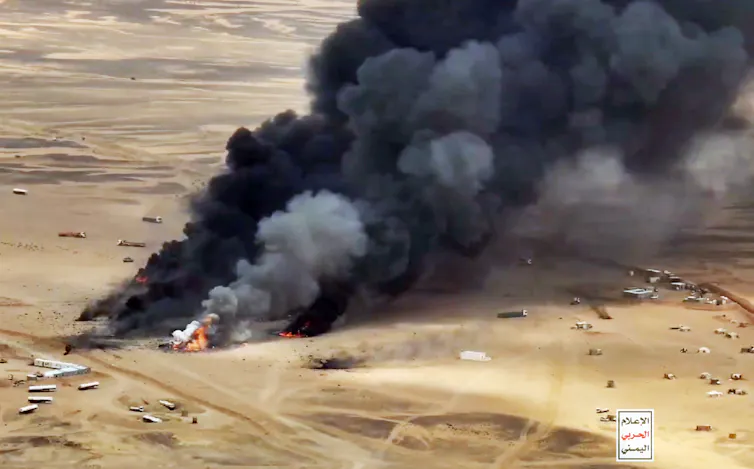
A black plume of sm okes rises from the desert.

A Houthi-provided image of vans carrying military supplies from Saudi Arabia on Sept. 7, 2026, in Hadramaut province, Yemen. Houthi Media Center via Getty Images

What the Strait operation cannot buy

The seizure of the Bab el-Mandeb Strait and the ongoing fighting in the country come with serious risks for the Houthis, however. The leverage the Houthis are gaining vis-a-vis Saudi Arabia and on the battlefield in Yemen could come at the cost of their broader standing in Yemen.

No government or entity has ever managed to hold both military and political supremacy over the entire territory of Yemen in modern history. While the Houthis have achieved military supremacy in the vast majority of the northwest, they have never pursued anything resembling a political bargain with the internationally backed government or even other parties. Their movement has always prized military dominance over political inclusion.

The latest coastal offensive is no exception.

According to Houthi-affiliated news sources, within days of taking Mokha the group had moved to reopen the port’s customs house, cut port fees and customs duties by as much as half and launched a drive to hand out 20,000 food baskets across Mokha and the neighboring coastal districts, while its authority in Sanaa offered a general amnesty to the fighters who had held the coast against it. A week later, its leader, Abdulmalik al-Houthi, told southerners directly that his forces were not targeting them, only the troops Saudi Arabia had brought in.

That is legitimacy performed through governance after a military conquest, more public relations than policy. It certainly isn’t the political bargain that could hold Yemen together for long. Moreover, a decade of Houthi rule in Sanaa suggests that they have no desire to work with others. Their modus operandi has been to rule by guns, not coalition.

More broadly, seizing the Arabian Peninsula’s other choke point and banning Saudi shipping through it makes the Houthis look, to much of the world and no small part of Yemen, like Tehran’s instrument – whatever their own objectives actually are.

And it invites the Houthis’ enemies to respond with force, potentially weakening the group’s capabilities.

Saudi Arabia is not a neutral party waiting patiently for good sense to prevail. It has prosecuted the war in Yemen for over a decade at enormous cost to the country’s civilians. Few in Yemen expect the Saudi-backed government to try retaking Sanaa by force, and a negotiated settlement will most likely be necessary eventually. But the Houthis have certainly now exposed themselves – and any Yemeni civilians caught up in escalation – to relentless airstrikes by Saudi Arabia and its allies.

For the Houthis, the gamble to advance now may backfire. It is one thing to take territory and quite another thing to hold it. Moreover, the Houthis may now find themselves controlling a strait the world wants reopened while still lacking the one thing that strait was never going to buy them: a whole country that actually consents to their rule.

Google announces new experimental “CC” AI agent for families

0
google-announces-new-experimental-“cc”-ai-agent-for-families
Google announces new experimental “CC” AI agent for families

Google’s AI models may not be in the lead by most measures right now, but the company does have one key advantage: your data. If you’re deep in the Google ecosystem, Gemini models have a lot of context on you already. Google’s latest Google Labs experiment, known as CC, aims to expand that kind of customization to the whole family.

CC is an evolution of something that Google announced in 2025. The original CC eventually became Gemini’s Daily Brief, which churns through the data in your Google account to offer daily action items and suggestions. The new CC has a similar goal, but it’s designed to be a shared resource for up to six users in a family.

Google says that CC has its own Google account, allowing each family member to interact with it (or not) as they choose. For example, CC only sees emails from its connected users if they are explicitly shared. You can do that by designating certain addresses as always available to the agent—something like school scheduling emails. You can also send content to CC via email or Google Chat. The agent can even monitor a shared Google Drive folder, into which you can dump invitations, documents, and other content.

Add family members to your CC and pull in relevant information for Your Day Ahead brief, delivered right to your inbox.

One of CC’s main functions is, unsurprisingly, a lot like Daily Brief. Each morning, all the registered users will get a shared “Your Day Ahead” email that pulls together the day’s events and updates on previous tasks. It can also add items to shared calendars, remind you about important tasks, and create documents based on your instructions that are accessible to all CC users.

As everyone uses CC more, it builds a memory of who you are and how you like to do things. The end goal is to hand off tedious tasks to the AI, be that managing your calendar or filling out school permission slips that show up in your email. So maybe the robot fills out almost all of the form without being asked, but it checks with the user about other details as needed. However, CC won’t send the document or anything else to addresses outside the group without confirmation.

CC can complete tasks like filling out PDFs.

Google says that each instance of CC runs on an isolated cloud instance, powered by Antigravity and the company’s latest Gemini models. Currently, that means Gemini 3.8 Flash. There hasn’t been a new Pro model since early this year despite Google promising one at I/O. It’s unclear how good CC will be at pulling together a family’s data and taking useful action without burning through a mountain of AI tokens. And CC isn’t even tied to Google’s paid subscriptions.

If you want to try CC, you can sign up for the waitlist now. Anyone who was using the earlier version of CC that became Daily Brief will be upgraded to the new experience in the coming days. Google notes that CC is only compatible with personal Gmail accounts for those 18 or older. So, functionally, this is an agent for parents to manage a busy household rather than one that kids will interact with. The latter comes with a lot of legal baggage that Google probably doesn’t want to accommodate for a Labs experiment.

Juneau can’t stop the floods, but it’s learning to see them coming

0
juneau-can’t-stop-the-floods,-but-it’s-learning-to-see-them-coming
Juneau can’t stop the floods, but it’s learning to see them coming

Two years ago, John Lowrey woke to the roar of water surging into his home. The 65-year-old retiree and father of five rushed toward his basement just as a 3-foot wave slammed through the door, tearing it from its hinges.

Water crashed through his bay windows, drowning the family’s piano and heirloom cedar chests. His 29-year-old daughter piled family photos on a bed until it started floating. The inundation ruined documents, appliances, and insulation, and repairs cost the family $150,000. “We lost everything,” Lowrey said.

What Lowrey didn’t know then was that the flood that wrecked his home would return the following summer. And the summer after that.

Alaska is warming at two to three times the global average, and the changing climate poses a particular risk to Juneau. Since 2011, meltwater and rain collecting in a basin beside the Mendenhall Glacier have periodically flooded neighborhoods along the Mendenhall River. For more than a decade, the floods remained relatively small. Then, in 2023, the river reached a record high of nearly 15 feet. New benchmarks followed in 2024 and again in 2025.

Another flood came last month. Scientists expect them to return annually for decades to come.

That has forced Juneau to confront a problem that communities around the world are increasingly facing: How do you prepare for a natural disaster when you know it will come back?

The Mendenhall Glacier is seen looming behind a residential neighborhood

The Mendenhall Glacier overlooks a residential neighborhood in Juneau. Marina Lopes

Juneau is beginning to find an answer. Scientists and local officials are putting increasingly sophisticated flood forecasts directly into the hands of residents. The online dashboard rolled out in 2025 translates complex glacier and hydrology data into information they can use to decide when to protect their belongings, prepare for rising water, or leave their homes.

The forecasts are changing how Juneau responds to the threat by providing officials and thousands of people in the flood zone more time to act before the water arrives. The approach could offer lessons far beyond Alaska as communities elsewhere contend with floods, hurricanes, and other climate-driven disasters that strike again and again.

Juneau sits amid the mountains and wilderness that define much of southeast Alaska. Although it is the state capital and home to 32,000 people, it is accessible only by air or sea. Lowrey’s family has deep roots in this rugged landscape. He recounted his story standing beneath the hide of a brown bear his grandfather shot decades ago. Still, the flood traumatized his family. His daughter tears up thinking about it. 

“We didn’t know anything,” he said. “We didn’t understand the nature of the basin. We thought it was a 100-year flood.”

They quickly learned otherwise. Each summer, the basin beside the Mendenhall Glacier fills with meltwater and rain. The glacier acts as a dam until enough water accumulates to trigger a flood downstream. In 2023, one of those floods inundated roughly two dozen homes, sweeping a house into the river and causing millions of dollars in damage. A year later, another flood damaged nearly 300 homes.

A man in a plaid shirt holding a child points to a mark on the wall of his home to show how high floodwaters rose

John Lowrey points to how high floodwaters rose inside his home in Juneau during a glacial flood. Marina Lopes

Glacial outburst floods are not unique to Juneau. They occur in Iceland, the Alps, the Himalayas, and other regions with glaciers. In Alaska’s capital, however, residential neighborhoods sit directly in the flood’s path, leaving thousands of residents exposed to the recurring threat.

“For Sale” signs dot the valley, but it’s a buyer’s market in the flood zone. Those within it have had little choice but to adapt to the annual floods. Some have dug moats. Others have raised their houses several feet above the ground. The city has built roughly 6 miles of barriers between the Mendenhall River and residents’ homes. 

Amid the uncertainty, the dashboard has become a source of comfort. Mark Miller, 75, checks it every day, waiting for the warning he knows is coming. “It’s pretty much on my mind constantly,” he said.

Two years ago, the sound of water pouring into the crawl space beneath his home jolted Miller awake in the wee hours. When he ventured into the garage and opened the door, a wall of gray slush surged toward him.

By the time the water receded, 16 inches of water filled the garage and mud and silt streaked the walls. Setting it all right took seven months and cost $35,000. Tears still fill his eyes at the memory of it all. Now, he prepares for each flood by placing sandbags on both sides of his doors to hold them in place against the water’s pressure. He turns to the dashboard to understand what happened and what is coming. 

“It can accurately predict the height of [glacial] floods within hours, which is pretty amazing,” he said.

A green wall erected as a flood barrier stands between a river and the banks

Barriers, installed by the city of Juneau with help from the U.S. Army Corps of Engineers, line the Mendenhall River to protect residential neighborhoods from recurring glacial floods. Marina Lopes

Last year, more than 15,000 people accessed the dashboard for real-time updates on the floods. In addition to flood maps and forecasts, it offers an interactive explanation of how the basin formed and how glacial outburst floods happen.

It was there that Miller learned the science behind the water that invaded his home.

The Mendenhall Glacier peeks out behind verdant mountains in the summertime, a vast block of ice streaked with blue and gray that has long drawn tourists and scientists to Alaska’s capital.

The basin beside the glacier is known as Suicide Basin. As the water accumulates, the pressure can lift the expanse of ice, creating a drain that sends a torrent rushing toward the Mendenhall River. During a large outburst flood, the basin can release upward of 15 billion gallons, enough to fill 22,000 Olympic-size swimming pools.

Mendenhall Valley first flooded in 2011, but scientists had no idea why. They hopped in a helicopter and discovered that water in the basin behind the glacier was leaking.

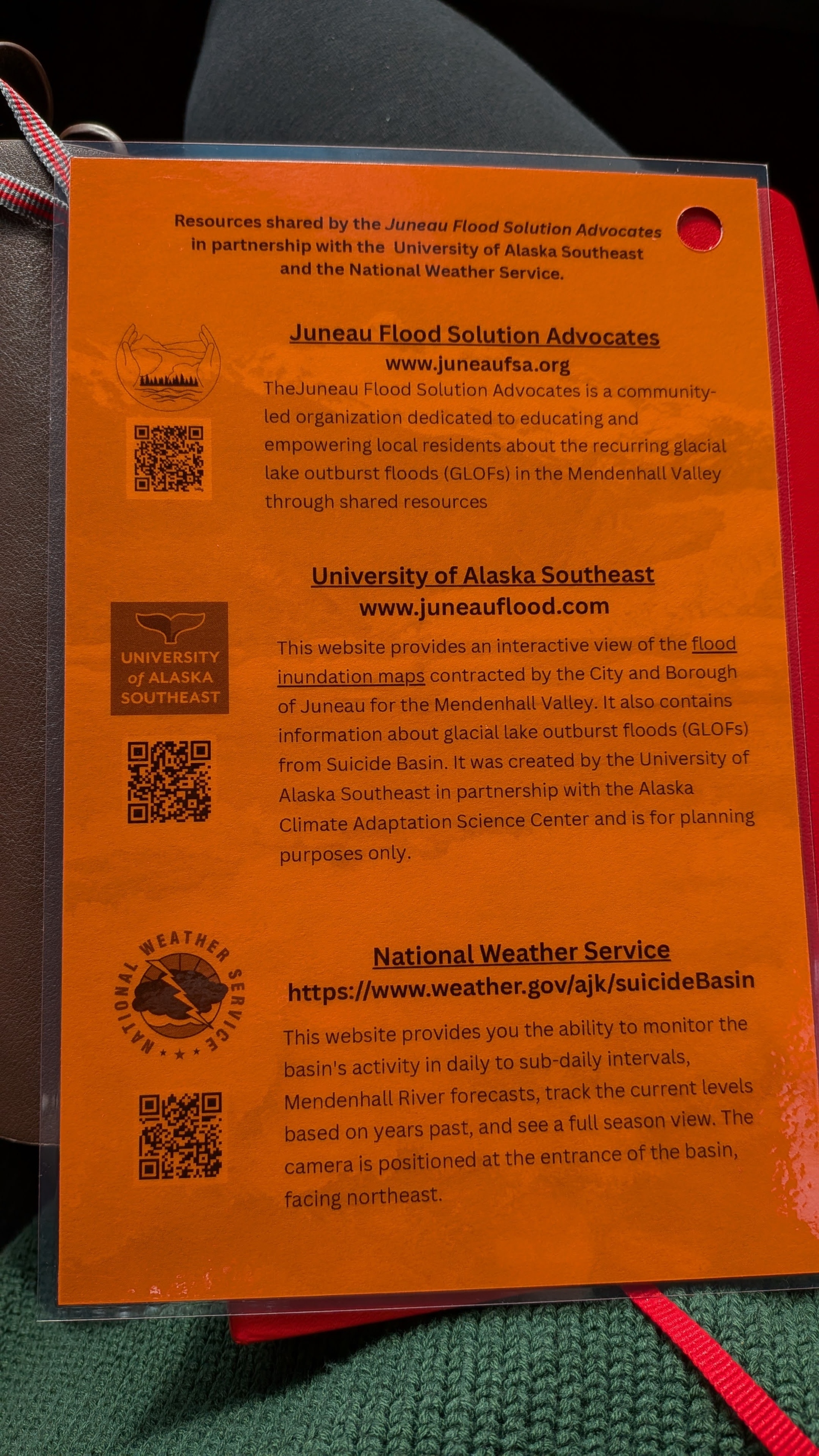
Looking for a way to communicate directly with residents, researchers at the University of Alaska Southeast and the Alaska Climate Adaptation Science Center collaborated with the city to develop the dashboard. They then worked with residents to distribute flyers and magnets with QR codes that directed people to the dashboard.

An orange flyer with a QR code and other written information

Residents created and distributed flyers with a QR code to the flood dashboard. Marina Lopes

Eran Hood, one of the environmental scientists who developed the tool, said he sees a broader lesson in Juneau’s experience.

“You can do the same thing with hurricanes, storm surges,” he said. “You could do the same thing with floods on rivers like the Mississippi.” The goal, he said, is to “find the best way to provide people with information that gives them the power to make decisions. That to me is the biggest lesson from this.”

The flood data and forecasts are also shaping the city’s response. In 2024, officials started studying them to determine where to build miles of temporary walls along the Mendenhall River to protect homes from future floods.

On a rainy July afternoon, Nate Rumsey, deputy director of engineering and public works for the city, stared up at stacks of army-green, dirt-filled barriers lining the river to protect residents from a deluge that came on August 13.

Another severe flood “could put the viability of our community at risk,” he said.

Read Next

The defenses, known as Hesco barriers, snake through town, behind the library and elementary school and past homes, sometimes coming within inches of windows. The fabric-lined wire-mesh baskets, which are filled with sand and gravel, connect like Legos, stacked two, three, or four high. Rumsey spent months working with the Army Corps of Engineers to map out and oversee their installation.

The dashboard helped homeowners watching soldiers carry barriers into their backyards understand the threat they faced and the city’s response, Rumsey said.

“We recognized early on that the community needs to have information pertinent to this available to them for their own decision-making,” he said.

Residents could use the online tool to see how high the water might rise on their property without the barriers, and understand what those defenses were designed to prevent.

Sandbags line a driveway to a residential home

Sandbags are deployed by residents to protect their homes in anticipation of the next glacial flood in Juneau. Marina Lopes

A green flood wall runs close to the side of a house

Flood barriers line the Mendenhall River, coming within inches of some homes. Marina Lopes

The dashboard has also changed how residents understand the landscape around them. 

Alyssa Fischer never gave much thought to the glacier towering over her house until she woke at 2 a.m. to find her street had turned into a river.

As the water rolled into her garage and swept away her front porch, the 33-year-old single mother decided it was time to go. She grabbed her 8-year-old daughter and 4-year-old son and carried them through knee-deep, icy water, shouting to wake her neighbors. She put her pet duck, quail, and goose in the bed of her red pickup as water rose above the wheels.

A woman with long hair looks into the camera while standing in a backyard holding a pet duck

Alyssa Fischer stands in her backyard with her pets. A glacial flood destroyed part of her home. She carried her children through the icy current and put her pet duck, quail, and goose in the bed of her pickup as water rose above the wheels. Marina Lopes

Like so many residents in Juneau, Fischer now speaks the language of the scientists studying the ice above her. She talks about how rainfall can change a flood’s timeline and how many cubic feet of water could spell disaster for her and her neighbors. During flood season, she checks the dashboard hourly.

“Before it impacted my life, it was, like, ‘Oh, that’s interesting,’” she said. “Now, I want to know what’s happening.” That knowledge shapes decisions about her home, her children, and her future. “It’s your life,” she said. “It’s your money and your investment, and understanding what’s actually happening in the world around you and how it’s going to affect you.”

Armed with a radio, flashlights, and the dashboard, she awaits the next flood.


China’s EVs, LLMs and the stopping power of the real world

0
china’s-evs,-llms-and-the-stopping-power-of-the-real-world
China’s EVs, LLMs and the stopping power of the real world

Is this the real life? Is this just fantasy?

Caught in a landslide, no escape from reality

Open your eyes, look up to the skies and see.

– Queen

Shortly after moving from Hong Kong to Beijing in 2022, yours truly saw a BYD Han with a deep crimson metallic paintjob and thought it looked amazing. Yours truly checked the BYD Han’s features, specs and pricing and was blown away. The BYD Han was a larger car than the Tesla Model 3, had similar features and performance and was priced at a 10% discount (22% vs US market).

Today, a 2022 BYD Han looks like a bald uncle’s DiDi (China’s Uber) ride with auntie specs.

Late November 2022, Han Feizi was one of the last travelers to be quarantined in China just a few days before the powers that be ripped off the zero Covid band-aid. It was during this time that OpenAI, a company very few people had heard of, introduced something called ChatGPT to the world. OpenAI was actually jumping the gun, releasing a janky large language model (LLM) to scoop what had been percolating in DeepMind, Google’s more conservative lab, among others. This ignited a competitive frenzy among tech companies across the world. 

BYD is going upmarket. The 2026 Seal 08 is a noticeably larger car than the 2022 Han with transformative improvements on its specifications from batteries to horsepower to self-driving to air suspension to rear wheel steering. The new DaHan (Great Han) has been upgraded to a different size category altogether.

image.png

image.png

The price of the 2026 Seal 08 is 25% lower than the 2022 Han for the top of the line version ($35.5k) and ~10-15% lower for entry and mid-level trims ($29.3-32.3k). The top of the line DaHan has all of the Seal 08’s upgrades in D-class size (Mercedes S/BMW 7 series/Audi A8 territory) and priced flat ($44.7k) with the 2022 Han.

For a while, the LLM landscape turned into a game of hopscotch as OpenAI, Anthropic and Google took turns one-upping each other’s models (with xAI straggling behind and Meta face-planting multiple times).

image.png

With the DaHan, BYD has stepped into the rarified realm occupied by flagship German luxury sedans. But in 2026 this class looks rather dusty, overpriced. Top of the line EV sedans from BMW, Mercedes and Audi sell in the US for for 3 to 4 times the price of a China-market BYD DaHan but offer broadly inferior specs and performance.

On September 2, in a speech at the Charlotte Economics Club, Treasury Secretary Scott Bessent lamented, “Anyone here ever seen a BYD car? It is the best $70,000 car $35,000 can buy – it is heavily subsidized.”

Similarly, the New York Times test drove a Geely M9 and reported:

The price for this top-of-the-line trim: an eye-popping $35,000. That’s if you’re in China. Made by Geely, this smooth-riding, driver-pampering crossover The New York Times tested for 10 days in February would cost more than twice that from any brand with an American showroom.

In addition to being the best advertising money can’t buy, Secretary Bessent complaining about BYD subsidies is economic nonsense. The bulk of EV subsidies across the world (79.4% in China according to CSIS) are for new car purchases (e.g. government rebates, tax exemptions etc). Historically, China’s per vehicle EV purchase subsidy has been substantially lower than those offered by the US and the EU. The difference is that China’s subsidies succeeded, driving 49 million EV sales since 2009, while those in the US and EU floundered, with 8 million and 12 million EV sales, respectively.

China succeeded because its subsidies coincided with the maturation of the country’s higher education pipeline. China’s EV industry has nearly 7 times the number of new engineering grads as the US to recruit from. In a few short years, China was able to birth over 100 EV makers and flood the market with over 300 EV models while the US, EU, Japan and Korea struggled to field a few dozen models.

image.png

Bessent’s lament that BYDs are “heavily subsidized” doesn’t pass the “best $70,000 car $35,000 can buy” test when per vehicle purchase subsidies are on average just over $2,000 in 2026. Even layering in a 30% appreciation of the Rmb doesn’t get us anywhere near BYD’s (and domestic competitors) price advantage.

On January 20th, 2025, an eccentric startup attached to a Chinese quant fund upended the AI world by releasing DeepSeek R1, an open-source near-frontier reasoning model trained on a minuscule budget. Since then, dozens of open source labs have sprouted in China pumping out near-frontier models priced at a fraction of US offerings. China’s open source challenge to the economic viability of American frontier labs has implications well beyond IPO valuations.

Secretary Bessent was selling BYD short. A 2026 ~$35k BYD Seal 08 would sell for well over $70,000 – in 2022. The Seal 08’s specifications are superior to a 2022 NIO ET7 which sold for $78,000 (longer range, faster charging, faster acceleration, four wheel steering) and far superior to a 2026 US market BMW i5 M60 whose $84,000 price tag and mediocre specs are scandalous in comparison.

Since 2022, China’s domestic car companies have been hedonically improving at +20% per annum rates. Hedonic (or quality) improvements give consumers better products over time. In the past four years, new cars in China have gotten more than twice as good – as in a 2026 spec EV would command more than twice the price in 2022. Or, conversely, a 2022 spec EV would sell for less than half the price in 2026.

Hedonic improvements are not nearly as noticeable in the US car market. Since 2022, offerings from legacy car makers, including Tesla, appear frozen in amber. The 2026 Tesla Model 3 is essentially the same car as the 2022 version. Tesla Autopilot may have improved substantially but so have Chinese self-driving systems. Self-driving is also usually included in the price of Chinese EVs – unlike Tesla’s subscription service. To Tesla’s credit, they have reduced the top of the line Model 3’s price by 7% versus the 2022 version.

Honda’s 2026 Pilot is one generation ahead of its 2022 version. It looks different. On specifications and features, however, one would be hard pressed to find any substantive improvements. Honda’s SUV is a little bigger with a little more power and perhaps a slightly more capable lane keep and adaptive cruise control system. And they increased the price by 9%.

Tracking hedonic improvements in cars is easy. Historical model specifications and prices are readily searchable.

But this isn’t just cars. There have been noticeable hedonic step changes across almost all consumer and industrial segments in China. While difficult to quantify, domestic travelers now expect luxury accommodations at budget prices. Leaving food quality for experts to judge, this non-foodie can confidently state that the interior décor arms race has flooded the country with trendy looking restaurants.

OpenAI publicly launched Astra on September 5.

On September 8, the company published a solution to the Navier-Stokes equation, completed by an as yet unreleased internal model.

The AI world has since spun itself into a frenzy about impending RSI and the end of the world while the math world sunk into a depression in all likelihood deeper than that experienced by the chess and go world after their grandmasters were felled by AI.

Not speaking for all of us but many mechanical engineers surely raised an eyebrow and wondered whether we are too dumb to understand the brouhaha. Many mechanical engineers likely had no idea that our lowly Navier-Stokes equation was held in such esteem by mathematicians – at least yours truly was genuinely dumbfounded. Our humble little equation to simplify fluid dynamics was never meant to be “solved.” It was always a scratchpad exercise, a rule of thumb, a mental model for how fluids “are supposed to” behave. Think of it as the Black-Scholes model for mechanical engineers.

Whatever “solutions” were useful in a mechanical engineering context could have been simulated by computer programs for decades (e.g. Ansys, Simcenter, OpenFOAM). The ultimate arbiter of whether the solution is correct is a working physical prototype. That’s how engineering in the physical world works.

The OpenAI “solution” of Navier-Stokes that satisfies mathematicians has zero, repeat, zero engineering implications. Real world fluids are affected by countless parameters – not the overly simplified four unknowns and four constants of the Navier-Stokes equation. The mathematician’s solution of Navier-Stokes would fall apart instantly in real world tests. Not one plane will fly more efficiently and not one submarine will travel more silently because of OpenAI’s “solution” of Navier-Stokes.

Ten thousand agents running a state-of-the-art LLM have produced a solution as useful to a mechanical engineer as a chess engine. Hey, America has the best chess engines but the country’s lead in LLMs over the past four years hasn’t helped Ford and General Motors close the gap with BYD and Geely – a gap that has, in fact, widened considerably.

The stopping power of the physical world has, so far, humbled America’s frontier AI labs. The frontier labs have been busy bolting physics, chemistry, engineering and biological science capabilities onto their LLMs. This has, so far, not had a measurable effect on real world science and engineering as China’s universities widen their lead in the Nature Index (see here) and the country’s industries out-compete global competitors using inferior open source LLMs.

In the paper “The Last AI Built by Humans: Towards Genuine Recursive Self-Improvement,” written by a team of AI researchers across China’s AI landscape (e.g. Tsinghua, Bytedance, Xiaohongshu), recursive self-improvement (RSI) is categorized into five stages summarized below:

L1, Execution stage – Human researchers fully design the improvement pipeline. AI only executes the pre-defined improvement steps; it cannot decide what to improve.

L2, Improvement-selection stage – AI autonomously selects which components to improve (prompts, weights, tools, memory). Humans still define the overall objective and evaluation system.

L3, Experience-curriculum stage – AI identifies its own weaknesses and designs new training data, tasks, or environments needed to fix those gaps. It builds its own learning curriculum.

L4, Deployment feedback stage – The AI continuously gathers real-world feedback during live deployment and uses this data to update itself autonomously, without human curation of feedback.

L5, Meta-improvement stage – The highest level. The AI can modify the improvement algorithm itself — changing the strategy, evaluator and mechanisms used to create better successor models. This is full recursive self-improvement, not yet achieved.  

According to the authors, the biggest hurdle RSI faces is speed of iteration. Physical sciences and engineering slow iteration to a crawl. Prototyping/testing car parts and conducting clinical trials take far longer than running new code generated by Fable. Because of the stopping power of the real world, all physical sciences and engineering are still stuck between level one and level two.

Self-driving cars are a good example of the stopping power of the real world. Impressive level four systems (no driver needed) are now operating pilot robotaxi services in cities in China, the US and the Middle East. These robotaxis are geo-fenced, lacking drive-anywhere capability. With the exception of a few highway stretches in Germany, Japan and China, consumer self-driving has yet to advance much beyond level 2 (driver vigilance required). Driving is a real world skill that teenagers can learn with 20 hours of practice. Tool and die machining is also a real world skill. An adult can become a tool and die maker with 10,000 hours of training.

Yours truly is not saying LLMs are not impressive. Han Feizi worries about rogue AI and cyber warfare as much as anyone. However, as a lapsed mechanical engineer, Han Feizi believes that AGI-pilled computer scientists underestimate how much of reality exists outside the digital domain. Those experiencing AGI psychosis should go outside, touch grass, change a tire, weld a fin to a missile – then come back to their desks and spin up a few hundred thousand Astra agents to increase America’s shipbuilding capacity 200 fold.

Israel poses ‘greatest threat’ to regional stability, Syria warns UN Security Council

0
israel-poses-‘greatest-threat’-to-regional-stability,-syria-warns-un-security-council
Israel poses ‘greatest threat’ to regional stability, Syria warns UN Security Council

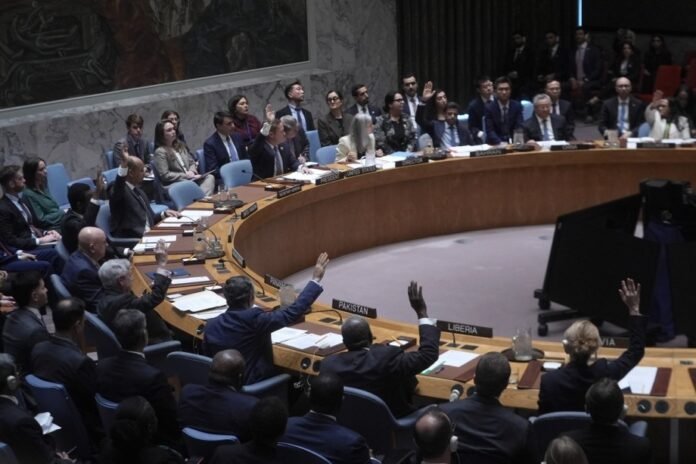
Israel represents the greatest danger to stability in the Middle East, Syria warned the UN Security Council on Thursday, Anadolu reports.

Permanent Representative to the UN Ibrahim Olabi told council members that Israeli aggression constitutes “the greatest threat facing the stability of the entire region, not just Syria,” pointing to an emergency declaration by 44 nations outside the council chamber that condemned a high-level visit by Israeli leadership to Mount Hermon as an unlawful act and a “blatant violation” of international law.

He emphasized that while Damascus approached US-sponsored security talks in good faith, Israel “responded to dialogue with airstrikes, incursions, and violations and attacks.” He underscored that pursuing a diplomatic arrangement does not mean Damascus will “accept occupation or relinquish the rights of our people,” while defending bilateral cooperation with regional partners as an exercise of sovereign state consent.

Rejecting Israeli claims on communal divisions, Olabi asserted that Syrian Kurds have integrated into state institutions, Syrian Jews are “back renovating their synagogues” and Druze figures who “rejected foreign support” are now in the parliament.

Turkiye acts as ‘responsible state’

Turkiye denounced Israeli operations in southern Syria, condemning “relentless attacks, which target Syria’s infrastructure and capabilities and violate its sovereignty and territorial integrity.”

The Turkish mission described high-level Israeli visits into occupied Syrian territory as “provocative,” firmly rejecting efforts to draw parallels between Israel’s occupation and Ankara’s security ties with Damascus.

Strengthening national capabilities remains a sovereign right of Syria and “is not any business of Israel,” said Turkish envoy Ahmet Yildiz, emphasizing that Turkiye acts as a “responsible state” committed to protecting civilians and supporting reconstruction with the consent of Syrian authorities.

READ: Turkey’s FM says Israeli strikes on Syria are indirectly benefiting ISIS

Global demand for immediate Israeli withdrawal from occupied territories

Council members and regional blocs are united in demanding an immediate halt to Israeli operations on Syrian territory and full adherence to the 1974 disengagement accords.

Russia denounced the “unacceptable nature of the aggressive actions by Israel against Syria,” urging Tel Aviv to halt “arbitrary” military operations in the Golan Heights and withdraw forces to established lines.

China reaffirmed that the Golan Heights constitutes occupied Syrian territory, demanding that Israel “cease all military operations in Syrian territory and withdraw its forces without delay” so UN peacekeepers can fulfill their mandate unhindered.

Speaking on behalf of the Arab Group, Oman condemned strikes targeting civil infrastructure, including the Abu al-Duhur airport, noting UN Security Council Resolution 497, which declared Israel’s annexation of the Golan Heights “null and void and without legal effect.”

The UK urged Israel to establish a clear timeline for withdrawal from occupied territory, while France demanded an “immediate cessation” of incursions that undermine regional stability.

The A3 bloc — Democratic Republic of the Congo, Liberia and Somalia — demanded an end to unilateral cross-border incursions and the release of detained Syrian nationals.

Bahrain and Pakistan reiterated their calls for Israel to vacate occupied lands.

The US took urged mutual restraint and continued engagement through diplomatic mediation.

Israel has occupied the Golan Heights since 1967 and annexed the territory in 1981, a move unrecognized by the international community. Following the collapse of the Bashar al-Assad regime on Dec. 8, 2024, Israeli forces advanced into the demilitarized buffer zone and areas of Mount Hermon, claiming the 1974 Disengagement Agreement had lapsed.

READ: ‘We are not like everyone else’ laws that bind other nations do not apply to Israel, says Likud lawmaker

Woman Accused of Murder for Leaving Husband on Toilet to Die

0
woman-accused-of-murder-for-leaving-husband-on-toilet-to-die
Woman Accused of Murder for Leaving Husband on Toilet to Die


A West Virginia woman is facing a felony neglect charge after authorities alleged she left her seriously ill husband sitting on a toilet for roughly 19 hours without food, water or medication — an ordeal investigators say contributed to his death.

Margaret Rog, 75, of Morgantown, was arrested Tuesday and charged with abuse or neglect of an incapacitated adult in connection with the death of her 76-year-old husband.

According to court records cited by local station WDTV, the man had been diagnosed with dementia, Alzheimer’s disease, legal blindness and several other medical conditions that left him dependent on others for care.

Authorities say the incident began around 3 p.m. on Aug. 20.

Investigators allege Rog’s husband went to the bathroom and was unable to stand afterward. Rog allegedly tried to help him up but could not.

Instead of calling 911, another relative or a medical provider for assistance, deputies say she left him sitting on the toilet.

He allegedly remained there until about 10 a.m. the following morning.

That means he was left in the bathroom for approximately 19 hours.

Court documents allege the man was not given food, water or his prescribed medications during that period.

Investigators also claim Rog heard him groaning in pain but still did not seek emergency assistance and eventually went to bed while he remained in the bathroom.

The situation was finally discovered the next morning when a speech therapist arrived at the couple’s home for a scheduled in-home appointment.

The therapist reportedly found the man unresponsive and in dangerously poor condition and immediately called for an ambulance.

He was rushed to a hospital, where doctors documented a long list of serious medical problems.

According to court records, those conditions included heart failure, respiratory failure, a pulmonary embolism, sepsis, dangerously elevated sodium levels, altered mental status and rhabdomyolysis.

Doctors also found wounds on his backside.

Rhabdomyolysis is a potentially life-threatening condition that occurs when damaged muscle tissue breaks down and releases proteins and electrolytes into the bloodstream.

It can be triggered by prolonged immobility or pressure on muscles, among other causes.

The man remained hospitalized for 11 days.

He died Aug. 31.

Investigators later concluded that his condition and injuries connected to the bathroom incident were “significant contributing factors” in his death, according to court documents.

Authorities have not publicly identified the victim by name in the reports reviewed.

The investigation appears to have begun after concerns were reported to Adult Protective Services and law enforcement while the man was being treated at Ruby Memorial Hospital.

Deputies with the Monongalia County Sheriff’s Department then investigated what happened inside the couple’s residence at Orchard Crossing Apartments.

Court documents also allege Rog made statements to law enforcement, Adult Protective Services and family members that investigators considered incriminating.

Authorities claim those statements showed she understood that her husband needed assistance but deliberately chose not to provide it.

Those allegations have not yet been proven in court.

Rog has pleaded not guilty.

She was initially being held at North Central Regional Jail with bond set at $75,000, though Fox News later reported that she posted bond following her court appearance.

She currently faces a charge of abuse or neglect of an incapacitated adult.

No additional homicide charge has been publicly announced.

The case is likely to focus heavily on whether prosecutors can prove that Rog knowingly failed to provide necessary care and whether that alleged neglect legally contributed to her husband’s death.

For now, the most serious allegation remains that a medically vulnerable man was left without help for nearly an entire day — and died less than two weeks later after doctors treated him for multiple critical conditions.

Republican bill would order ISPs, DNS providers, and VPNs to block piracy sites

0
republican-bill-would-order-isps,-dns-providers,-and-vpns-to-block-piracy-sites
Republican bill would order ISPs, DNS providers, and VPNs to block piracy sites

US Rep. Darrell Issa (R-Calif.) has proposed a law that would require Internet service providers and other network operators to block foreign piracy websites. Issa’s bill would help copyright holders obtain judicial blocking orders to be served to ISPs, domain name resolution services, and virtual private networks.

Issa, who is retiring from the House at the end of this year, is the latest in a string of Republican and Democratic lawmakers to propose a site-blocking regime that’s been sought by the Motion Picture Association (MPA). He submitted the bill this week, after indicating in a June 30 hearing that he planned to introduce site-blocking legislation.

“While millions of listings for copyright-infringing content are removed every day under [the] notice-and-takedown process set forth in the Digital Millennium Copyright Act, right-holders have raised concerns with the speed,” Issa said at the hearing. Issa asked, “Can we do it at the speed of sound? Can we do it at the speed of light? More importantly, in a 45-minute or sometimes a fraction of that live sports broadcast, can we do it soon enough to make it no longer profitable for those who pop up and sell their clandestine wares?”

Issa argued that online piracy helps fund terrorist groups and other criminal networks. Advocacy groups opposing his bill say it would impose a broad censorship regime and disrupt small businesses falsely accused of piracy.

“Rather than attacking the problem at its source by bringing the people running overseas piracy websites to court, Congress and its entertainment industry allies have decided to build out a sweeping infrastructure for censorship,” said Meredith Rose, senior policy counsel at Public Knowledge. “Site-blocking orders force any service provider, from residential broadband providers to global DNS resolvers, to disrupt traffic from targeted websites simply accused of copyright infringement.”

Judicial blocking orders

Issa’s bill was referred to the House Committee on the Judiciary. Issa is the chair of a subcommittee on courts, intellectual property, artificial intelligence, and the Internet.

The text of Issa’s “American Copyright Protection Act of 2026” is not on the congressional website yet, but it has been circulating, and Public Knowledge provided us with a copy. The bill proposes having courts issue site-blocking orders to ISPs, DNS providers, and VPN services that have at least 100,000 monthly users or subscribers in the US.

The bill specifies that blocking requirements would not apply to root nameserver operators and top-level domain registries. It would also exclude Wi-Fi networks offered on the premises of airports, libraries, restaurants, retail stores, and similar establishments.

Under Issa’s proposed system, a copyright owner could ask a court to issue a declaration that an online location is a “foreign piracy site” based on “a preponderance of the evidence” that it is a foreign site primarily designed for piracy. After a court makes that declaration, the copyright owner could petition for a court order requiring network operators to block the alleged piracy site.

Service providers would generally have 14 days to file objections, but judges would have authority to modify deadlines “to address time-sensitive events.” That provision would allow quicker blocking of websites that air pirated content live or within 24 hours of its release.

The Re:Create coalition said Issa’s bill would codify “a one-sided legal process modeled on European site-blocking laws, which have been shown to cause widespread censorship.”

“Forcing infrastructure providers, DNS resolvers, and VPNs to filter internet traffic threatens user privacy and risks catastrophic collateral damage to the open web,” Re:Create Executive Director Brandon Butler said. “This fast-track site-blocking scheme bypasses effective legal channels, undermines the digital ecosystem, invites copyright abuse—disrupting small businesses, nonprofit and Internet users across the globe.”

“Powerful weapons, ripe for abuse”

Compelling VPN services to block piracy websites may be difficult even with court orders, but site-blocking orders aimed at broadband and DNS providers would make many websites inaccessible. Rose said applying blocking orders to DNS resolvers “means that one court can cut off access to a website globally, based on a single individual’s filing and an expedited procedure. Blocking orders are incredibly powerful weapons, ripe for abuse, and we’ve seen the messy consequences of them being implemented in other countries.”

The MPA has stepped up its campaign for site-blocking over the last couple of years. In April 2024, MPA CEO Charles Rivkin said the group would “work with members of Congress” to require Internet service providers to block piracy websites.

Although the MPA hasn’t gotten a site-blocking law in the US yet, its push has support in both major parties. In January 2025, US Rep. Zoe Lofgren (D-Calif.) proposed a site-blocking law called the Foreign Anti-Digital Piracy Act. Another site-blocking bill, the Block Bad Electronic Art and Recording Distributors Act, was proposed in July 2025 by two Democratic senators and two Republican senators.

“Foreign websites pirating American movies, TV shows, art, and books steal tens of billions of dollars from the US economy each year,” Sen. Chris Coons (D-Del.) said at the time. Sen. Thom Tillis (R-N.C.) called the proposal “a smart, targeted tool to stop these criminal operations at the source without infringing on legitimate speech or due process.”

The MPA submitted a letter for Issa’s June 2026 hearing, saying the US should follow the lead of “more than fifty countries around the world” that have imposed site-blocking. “Unfortunately, the United States still lacks a site-blocking mechanism to combat digital piracy,” the letter said. “As a result, America’s creative economy is being robbed of billions of dollars in lost revenues and hundreds of thousands of jobs.”

Overblocking not a “solved problem”

Issa received a letter from other groups that warned site-blocking systems in other countries have disrupted legitimate websites while criminals found ways to evade enforcement.

“In Spain, overblocking has caused outages to payment processors and a national healthcare provider, as well as giving rise to multiple grassroots movements against site-blocking. The idea that site blocking is a ‘solved problem,’ politically or technologically, is a myth,” said the letter from the Computer & Communications Industry Association, the Electronic Frontier Foundation, Fight for the Future, the Internet Infrastructure Coalition, Public Knowledge, and the R Street Institute.

In a September 2025 report on Italy’s Piracy Shield system, researchers at the University of Twente in the Netherlands said they found that at least “hundreds of legitimate websites [were] unknowingly affected by blocking.” As we’ve previously written, Cloudflare has been fighting a fine issued by Italy over its refusal to block access to websites on its 1.1.1.1 DNS service. Cloudflare called Piracy Shield “a misguided Italian regulatory scheme designed to protect large rightsholder interests at the expense of the broader Internet.”

The response Public Knowledge issued to Issa’s bill this week said, “small businesses and nonprofits face the greatest risks for site blocking but have the fewest protections. In Europe, we’ve seen overblocking bring down digital infrastructure for hotels, car mechanics, retail shops, telehealth programs, and even a nunnery.”

Public Knowledge said operators of blocked sites would “have no remedy for the days or weeks (or more) of lost business that result from an overzealous blocking order. America’s small businesses cannot afford to be treated as ‘acceptable collateral damage’ for multibillion-dollar entertainment and sports industries.”

Yemen’s reignited conflict shows Iran war’s fire is spreading

0
yemen’s-reignited-conflict-shows-iran-war’s-fire-is-spreading
Yemen’s reignited conflict shows Iran war’s fire is spreading

The dormant conflict in Yemen has erupted once more, with the Houthi rebel group seizing control of the Red Sea port city of Mocha and a number of islands from Yemeni government forces in recent weeks. This has given the Houthis a foothold close to the Bab al-Mandeb Strait, a key trade gateway linking Asia and Europe.

The advance of the Houthis has alarmed Yemen’s northern neighbor, Saudi Arabia, for three main reasons. First, the Houthis’ drive down the coast constitutes a military setback for the Saudis and the pro-government forces they have long supported militarily and financially in Yemen.

Second, the Saudis have become more reliant than ever on access to Bab al-Mandeb to export their oil since the effective closure of the Strait of Hormuz following the outbreak of war between the US, Israel and Iran in February 2026. Control of Yemen’s western coast would allow the Houthis to further restrict Saudi Arabia’s energy exports.

And third, the Houthis are closely allied with Iran. This means Tehran now has the possible means to control two of the most important maritime chokepoints for the transit of global oil supplies. The Bab al-Mandeb Strait was carrying roughly 7% of global oil supplies by June.

A map of Yemen.
The Houthis have advanced down Yemen’s western coast in recent weeks. Rainer Lesniewski / Shutterstock via The Conversation

The renewed hostilities bring to an end a ceasefire in the Yemeni conflict that had been in place since 2022. The Houthis, in origin a movement that emerged in the 1990s to protect the interests of Yemen’s substantial Zaydi Shia Muslim population, had previously engaged in armed conflict with the longtime Yemeni president, Ali Abdullah Saleh.

In the aftermath of Saleh’s forced resignation in 2012, which followed popular mobilization against his autocratic rule, the country entered a period of instability. During this period, the Houthis moved from their stronghold in the north of the country to take control of the capital, Sana’a, in 2014.

Unwilling to see its southern neighbor come under the control of forces allied to Iran, Saudi Arabia launched an all-out war in March 2015. The objective was to restore the internationally recognized government of Abd-Rabbu Mansour Hadi, Saleh’s one-time deputy who had succeeded him in office, to power.

The fighting persisted for several years, but an effective stalemate was reached early on. While attempts to negotiate a lasting agreement to end the war failed, all sides agreed on a ceasefire in April 2022. The ceasefire lapsed in October of that year but both sides largely refrained from major escalatory actions and the level of conflict remained low.

Hopes for a more substantial deal between the warring parties were briefly raised in March 2023. That month saw China broker a rapprochement between Iran and Saudi Arabia, restoring diplomatic relations between the two countries after their 2016 suspension.

But in a clear assertion of its independence from Iran, Houthi leadership expressly rejected the notion that normalisation of relations between the two regional powers should lead to a deal between the Houthis and Saudi Arabia.

The prospects of a long-term deal to end the conflict were dealt a further blow by the Houthi response to Israel’s military campaign in the Gaza Strip, which followed the deadly Hamas-led attack on southern Israel on in October 2023.

Shortly after that war began, Houthi fighters fired several missiles and drones at an Israeli ship in the Red Sea. The US Navy also shot down Houthi-launched missiles and drones heading towards Israeli territory, in what was the first US action in defence of Israel since the start of the conflict in Gaza.

There was further escalation in January 2024, when the Houthis staged a large-scale attack on several US Navy vessels in the Red Sea. This was followed by US and UK airstrikes against Houthi targets. In May 2025, the US and the Houthis agreed a ceasefire which was mediated by Oman.

The relative peace that followed came undone in July 2026. On July 13, the Saudis attacked Sana’a International Airport in order to prevent a plane carrying the Houthi delegation to the funeral of Iran’s slain supreme leader, Ali Khamenei, from landing. The Yemeni government and Saudi Arabia claimed the flight represented a violation of Yemen’s sovereignty.

The Houthis launched missile attacks on airports in the south of Saudi Arabia in response, while also declaring the imposition of a strict maritime embargo against Saudi vessels. On Telegram, Houthi official Yahya Saree announced an end to what he called the “de-escalation phase” of the conflict.

The recent rapid advance of the Houthis along Yemen’s western coast has focused attention on the group’s potential to disrupt global oil supplies even further. However, the offensive also has major implications for Yemen itself.

It constitutes a major setback for the Saudi-backed forces in Yemen, which are far more diverse than is commonly assumed. These forces include those under the control of Tareq Saleh, nephew of the fallen autocrat, as well as southern groups with aspirations for autonomy and other tribal and local forces.

The advance also represents a challenge for the Houthis themselves. They now control a swathe of new territory, and with it a larger population. There are questions regarding the capacity of the Houthis to withstand the inevitable attempts to dislodge it from its new position.

Earlier in the conflict, in 2015, the Houthis won control of areas in the south such as Aden, Abyan and Lahj. But they were soon pushed back by government forces and resistance fighters, and forced to relinquish their control of these areas.

Recent reports suggest that the Saudi crown prince, Mohammed bin Salman, has requested that the US launch airstrikes against the Houthis. The invitation was apparently declined, but it is unlikely to be the final word in the seemingly endless conflict between Riyadh and its antagonists in its southern neighbor.

Vincent Durac is associate professor, School Of Politics & International Relations, University College Dublin

This article is republished from The Conversation under a Creative Commons license. Read the original article.

Ambassador Huckabee Predicts Another Iran Uprising, Makes a Pitch for Objective Truth

0
ambassador-huckabee-predicts-another-iran-uprising,-makes-a-pitch-for-objective-truth
Ambassador Huckabee Predicts Another Iran Uprising, Makes a Pitch for Objective Truth


In a wide-ranging interview with The Media Line’s Felice Friedson, the US ambassador to Israel discusses issues from UNIFIL and attacks on Palestinians to Iran and regional diplomacy, while warning of the dangers posed by AI

US Ambassador to Israel Mike Huckabee is not a conventional diplomat. A Baptist pastor, former Arkansas governor, presidential candidate, and television host, he came to the post after decades in American public life and an even longer relationship with Israel.

He also came with a style of his own. Huckabee can move from geopolitics to Scripture to a homespun analogy without much warning. He is direct, sometimes blunt, and rarely sounds as though his words have made a preliminary stop at the State Department’s diplomatic-language desk.

When Huckabee joined me at The Media Line studios, I began with Iran. Despite the damage inflicted on Tehran and its military capabilities, Iran could still move toward nuclear capability, threaten shipping through the Strait of Hormuz, and exert influence in the Red Sea through the Houthis. There are also concerns about what the Houthis might do next against Saudi Arabia.

Where, I asked, does Huckabee think Iran and its regional proxies stand today?

“The good news is, thanks to President Trump, in concert with Israel, Iran is at their weakest point in 47 and a half years,” Huckabee said. “They’re weaker militarily, they’re weaker economically, and they’re growing weaker by the month.”

Whether that weakness eventually produces regime change is another question.

“Will it lead to regime change? We can only hope,” he said.

Huckabee rejected the idea that confronting Iran is chiefly Israel’s problem.

“A lot of people, particularly in America, may think, well, what does that have to do with us? It has everything to do with America, because the ultimate target has always been the United States.”

President Donald Trump, he said, had decided that Iran could not be allowed to possess nuclear weapons, enrich uranium, or control shipping lanes through the Strait of Hormuz.

“It’s a process, but it is a process that I believe is working.”

What about the Iranian people? I asked where they stood now and whether another popular uprising was possible.

Huckabee said Iranians seeking to challenge their government face a basic problem: They are largely unarmed.

“At some point, I do believe we’re going to see another uprising,” he said, adding that perhaps next time the people could be “better prepared, armed, and be able to truly resist” a government he expects to be weaker still.

Lebanon presents Washington with another problem. With UNIFIL preparing to leave, the question is whether the Lebanese Armed Forces can extend state authority into the south, prevent a security vacuum, and confront Hezbollah at the same time.

Huckabee believes it can—but not overnight.

“Incrementally, they can. I don’t think it’s going to be the flip of a switch,” he said. “They’re going to have to grow into the role of being the only army, the only security force.”

Hezbollah, he noted, remains active and is trying to rebuild after being badly weakened by Israel. As long as Iran can continue financing and arming it, Huckabee said, Hezbollah will remain a threat.

He had considerably less patience with UNIFIL.

“UNIFIL is going to go out of business—way overdue for that to happen,” he said. “It’s been a totally ineffective entity.”

“I can’t say that I can point to one specific way in which UNIFIL has been instrumental in making Lebanon freer and better.”

When I pressed him on the timetable—months or years?—he answered, “It could be years.”

But Huckabee said his experience traveling between Jerusalem and Washington during talks over Lebanon had shown him “extraordinary progress.” One of the most important developments, in his view, was Lebanese recognition that Israel does not want Lebanese territory.

“They don’t want to annex one meter of Lebanese property. They don’t want to be there. They want to go home,” he said.

Israeli reservists, he said, are exhausted and want to return to their families, but Israel will not leave its northern communities exposed to renewed rocket, missile and drone attacks.

Huckabee said he longs for the day when the Lebanese army is strong enough to secure the area itself: “The Israelis can go home, the Lebanese will be at home, and there will be no Hezbollah.”

We also spoke about the new joint defense agreement involving Saudi Arabia, Turkey and Pakistan, which pledges to treat an armed attack on one as an attack on all. With three important US partners building their own collective security framework, I asked whether Washington sees that as a welcome development and what it means for the wider regional balance.

“It’s a wait and see,” Huckabee said.

These are sovereign countries entitled to make agreements they believe serve their interests, he said. All three have reasons to be concerned about Iran, while the arrangement could also be intended to protect them from the Houthis or other armed groups.

What he had not encountered was alarm in Washington.

“I never certainly saw or heard any anxiety in Washington that, ‘Oh my gosh, this is a terrible thing.’ I don’t think that anyone saw it that way.”

Would Israel help Saudi Arabia if the kingdom came under attack?

“I don’t know. I mean, that’s the honest answer. I don’t know.”

Huckabee said Israel would welcome a security agreement with Saudi Arabia and would like to see the kingdom join the Abraham Accords. He also pointed to existing military and intelligence contacts.

For what normalization can achieve, he looks to the United Arab Emirates.

“The UAE is the gold standard, the model of how this has all worked,” he said, pointing to gains in tourism, travel, trade and technological cooperation.

“I hope the Saudis will look next door and say, you know, this is working out pretty well for the Emirates. Maybe we ought to go the same path.”
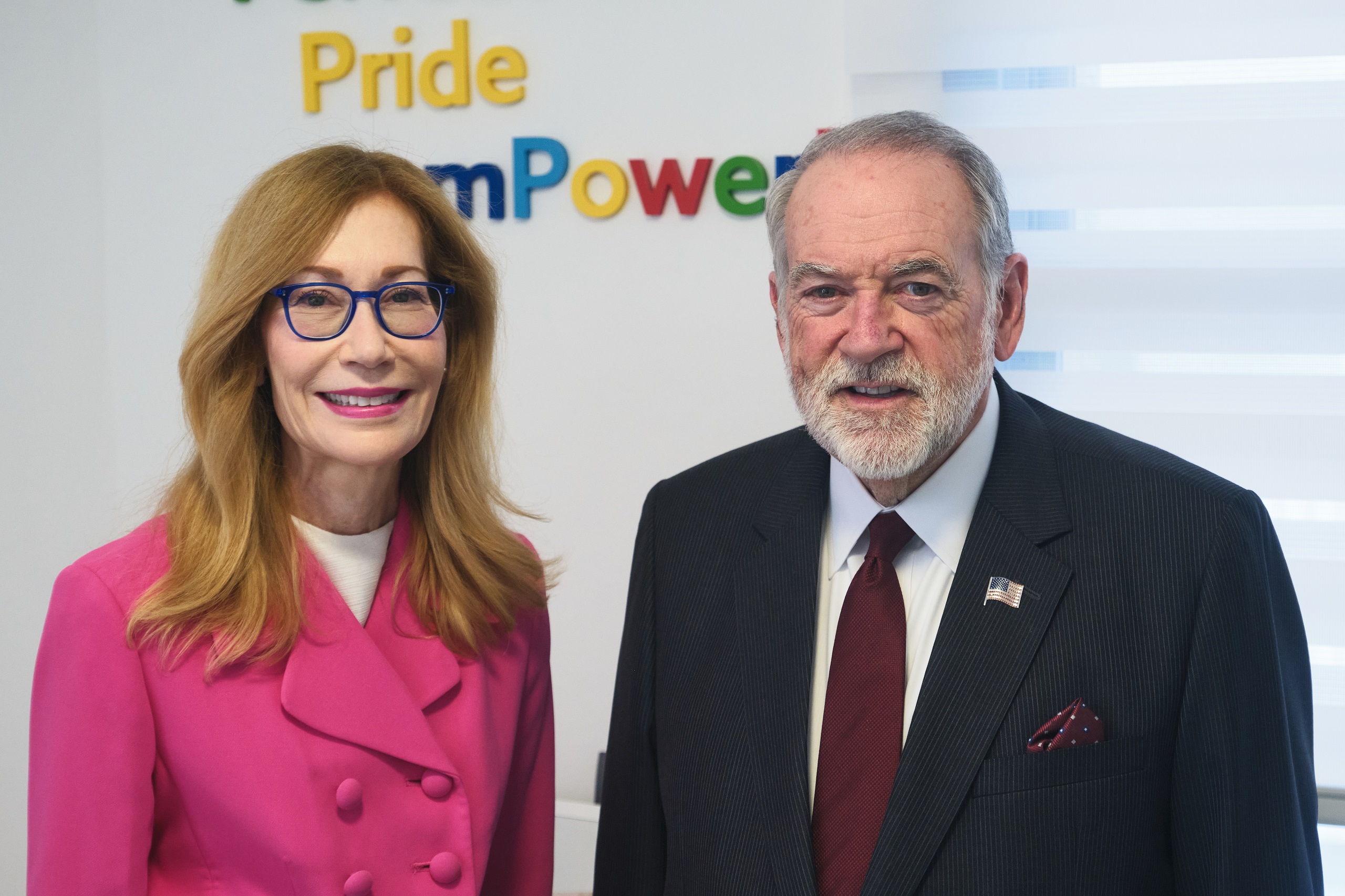
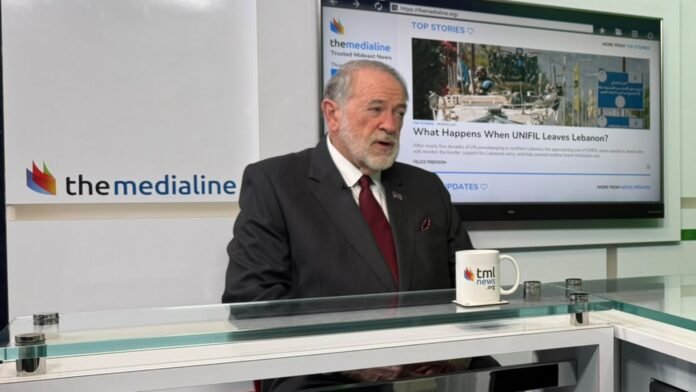
US Ambassador to Israel Mike Huckabee and Felice Friedson, at The Media Line’s office in Jerusalem, Sept. 17, 2026. (Dario Sanchez/The Media Line)

Few issues are more closely associated with Huckabee than the territory Israelis generally call Judea and Samaria and much of the international community calls the West Bank. He has strongly defended Israelis who live there, but he has also condemned recent attacks on Palestinians and described those responsible as terrorists.

Is Israel doing enough to stop them?

“Israel is increasingly aware that this has to be dealt with and dealt with in a very strong way,” Huckabee said.

He did not back away from his choice of the word terrorism.

“When you frighten people into changing the way they live because of things that you do to them, you don’t have to murder them, but you do terrorize them into being afraid to come out of their homes, being afraid to go shopping, being afraid to go to a place of worship,” he said. “So it’s unacceptable, whoever does it.”

At the same time, Huckabee stressed that those responsible represent a very small fraction of the Israeli population in the territory. He called them a “tiny, tiny sliver” and said many do not even live there.

“There are 500,000 Israelis living in Judean Samaria, living peacefully,” he said. “They don’t want to burn an olive tree. They don’t want to torch a mosque.”

I asked what more Israel should be doing.

Investigations and arrests need to be followed by real penalties, Huckabee said, particularly for offenses such as burning mosques, stealing livestock or taking over someone’s home.

“They need to be arrested,” he said of repeat offenders. “They need to spend a few nights, a few weeks, maybe a few months in jail.”

Our conversation then moved to a different source of friction over Israel: the changing American political debate.

Huckabee recently encountered Tucker Carlson at Ben-Gurion Airport and challenged several of Carlson’s assertions about Israel. Carlson has since argued that Israel is driving the war with Iran for its own regional interests while US interests are being sacrificed.

I asked Huckabee whether similar arguments about Israel are now converging from opposite ends of the American political spectrum—and how worried he is about the long-term implications for the US-Israel relationship.

“I’m very concerned about it because it’s based on things that are fundamentally not true,” he said. “Tucker Carlson’s allegations about Israel are off the mark.”

Huckabee also rejected accusations of genocide and apartheid and claims that Israel is unsafe or unfair for Christians.

“As a Christian living in Israel, I find that utterly offensive and totally factless,” he said.

He has known Carlson for years and said he does not understand what has changed.

“This is not the same person I once knew and once worked with,” Huckabee said.

With the US midterm elections approaching, I asked whether events in the Middle East would have much effect on American voters.

Probably less than domestic issues, Huckabee said. He then turned to the Democratic Socialists of America and what he sees as the radicalization of part of the American left. He cited liberal commentator Bill Maher as an example of someone who has also criticized that movement.

“The Democrats historically, they’ve been different than the Republicans, but they haven’t been crazy,” Huckabee said.

He was equally unsparing about calls for socialism, saying replacing the American economic system with one that he believes has repeatedly failed is more than a conventional political disagreement.

Felice Friedson interviews US Ambassador to Israel Mike Huckabee at The Media Line’s studio in Jerusalem, Sept. 17, 2026. (Dario Sanchez/The Media Line)

Another subject has become impossible for anyone in the news business to avoid: artificial intelligence.

At The Media Line, we spend considerable time sourcing, vetting, and explaining information. That becomes more complicated as AI makes fabricated images, voices and claims easier to produce and harder to detect. Technology leaders themselves have warned about the potential consequences.

What did Huckabee make of it?

“AI is like fire,” he said. “It can cook your food and warm your house. It can burn your house down and kill you.”

“How do you use it? That’s the question.”

For Huckabee, the danger is not theoretical. He pointed to his own long-running lawsuit against Meta, which he said stems from AI-generated material that damaged him professionally when he was hosting a television program in the United States.

“I saw firsthand what AI can do in creating perceptions, images, the misuse, the abuse of one’s name, image, and likeness,” he said. “And it has to be brought into some level of responsibility.”

Does that mean government regulation?

Huckabee is wary.

“I’m always hesitant to say I’d like to see the government get involved because the government usually messes up whatever they touch,” he said.

One possibility, he suggested, would be for the major AI companies themselves to establish ethical norms, much as other professions have developed standards without having every rule imposed by government.

“There was a sense of self-governing, self-regulation,” Huckabee said. “Maybe that’s the answer.”

With the anniversary of Oct. 7 approaching, more than 1,000 pastors are expected to come to Israel for events organized by Christian and Jewish groups. Antisemitism, meanwhile, has risen rather than receded.

Can visits like these make a difference?

Huckabee hopes they can remind people of the scale of what happened on Oct. 7.

He translated the attack into American terms, asking his audience to imagine an assault from Tijuana into San Diego that, adjusted for population, left 40,000 Americans dead in one day and another 10,000 taken hostage.

“Ask ourselves as Americans, what would we do? How would we respond?”

He also invoked Sept. 11, 2001, and the lasting changes it brought to American life after the deaths of nearly 3,000 people.

“Twenty-five years later, our whole world changed in the United States because of that,” he said. “Scale that up 10 times plus, and it’s hard to even fathom what the response would be.”

I saved a different kind of question for last.

Huckabee is a Baptist pastor who spent more than a decade in the governor’s office and now serves as America’s ambassador to Israel. He has lived in the worlds of faith, politics, and diplomacy—three places where people can look at the same set of facts and come away insisting on very different versions of reality.

Is truth actually attainable? And how do you know when you have found it?

“Truth is objective. Perceptions are subjective,” Huckabee said.

Three people can stand on a street corner, witness an accident, and each see something different, he said. Their perceptions may differ, but that does not change what actually happened.

“The truth is not what I think. It’s not what I feel. It’s not what I believe. It’s what is.”

That, Huckabee said, is something younger people in particular need to learn in an age when opinion and fact are increasingly difficult to separate.

“What we have to do, especially among younger people, is to force people to move beyond what I think, what I feel, what I believe, and get to what is the absolute concrete fact upon which then I can feel, believe, and think.”

He left it there.

“Without objective truth that from any angle looks the same, we are in real trouble.”

0FansLike
0FollowersFollow
0FollowersFollow
0SubscribersSubscribe
- Advertisement -
Google search engine

Recent Posts