21.3 C
London
Sunday, September 6, 2026
Home Blog

As family farms decline and the climate heats up, farmers weigh what to do with their land

0
as-family-farms-decline-and-the-climate-heats-up,-farmers-weigh-what-to-do-with-their-land
As family farms decline and the climate heats up, farmers weigh what to do with their land

This coverage is made possible through a partnership between Grist and Interlochen Public Radio in northern Michigan. ​​

John Boyer grew up on his family’s 131 acres of rolling fields of corn, oats, and wheat in a rural area near the tiny city of East Jordan in northern Michigan. The farm had changed ownership outside the family several times over the decades before Boyer rebought it in 2018. He felt an obligation to repurchase and farm the land to prevent development from encroaching on the area’s community of family farms.

“For any farmer, everything’s personal,” Boyer said. “Every piece of property, every stone you pick up, you spend countless hours out there.”

As millions of farmland acres around the country are expected to change hands in the next few decades, farmers are facing decisions about whether — and if so, how — to preserve farmland amid pressures from rising land values, a shifting climate, and a younger generation that doesn’t want to farm. The number of acres devoted to farming in Michigan has declined in recent decades, as it has in the rest of the country. And ownership of that land is changing. 

In 2022, an estimated 9.5 million acres, or about a quarter of the state, were devoted to farming, a roughly 3 percent dip from 2017, according to the most recent federal farm census. Farmland in Michigan where the majority of operations were family-owned decreased nearly 470,000 acres in those same five years. Conversely, land leased or rented for farming operations increased by nearly 30,000 acres.  

Despite shifts in farm ownership and acreage dedicated to agriculture, the number of farmland acres in Michigan protected by conservation programs has increased in recent years, reflecting a national trend. The state saw an additional 22,000 acres protected in easements between 2017 and 2022, according to the U.S. Department of Agriculture.

“It’s a matter of trying to figure out what exactly is going to be the best fit for everybody’s situation. And there’s a lot of pressure. There’s a lot of money,” said Jon LaPorte, a farm business management educator for Michigan State University Extension.

According to the USDA, Michigan farmland was valued at about $6,800 per acre last year, up 7.8 percent from 2024 and outpacing the national average of 4.3 percent.

The pressure to preserve farmland could be especially strong in northern Michigan. Farmers there are already confronting the effects of climate change, including more extreme precipitation, crop disease, and temperature swings, but some local farmers said those impacts are relatively easier to deal with than elsewhere in the country.

“As the world climate changes, this area could become more and more important for food production and food security,” said Dave Skornia, a farmer in Boyne City, Michigan. “So, you got to have land.”


A man stands in front of an agricultural field on a sunny, clear day.

farmland with silos and cows

But easements still have their challenges, he said. Conservancies pay landowners for a portion of the overall land value, and selling the development rights earns the landowner less revenue than outright selling the land. As land values rise in rural northern Michigan, the conservancy doesn’t see many farmers purely motivated by financial return entering into such agreements. 

“There can be a question of timing: ‘Is this the right thing to do? What might we be foregoing later?’” Graham said.

Boyer wants to prevent his land from being divided up down the line and sold in smaller parcels “to make a quick buck.” Once an acre is converted for built developments like houses or commercial buildings, it typically doesn’t return to farmland.

“Then suddenly a productive farm field or ground is gone, and it’s gone for generations,” Boyer said. “It’s gone forever.”


Rebecca Carlson, a cherry and apple grower who runs Overlook Orchards in Northport, a village at the tip of Michigan’s Leelanau Peninsula on Lake Michigan, also sees land division as a future threat to the farmland in her county. Aging farmers might split up land among multiple kids, leaving a patchwork of ownership that “breaks up multigenerational farms,” Carlson said, especially as younger people in the area choose not to go into the business.

She’s a fourth-generation farmer who married into another multigenerational farming family. She and her husband have grown the original farm from about 200 acres to 1,300 acres over eight years. To expand, the couple bought nearby land, but they also lease some parcels, mostly from family farmers who don’t have a younger generation to take over. 

“In order to be successful in farming, in some cases, it’s one of those, ‘Go big or go home,’ with the climate of farming today,” Carlson said. 

In Michigan, about 39 percent of agricultural land is leased, according to the 2022 USDA census, a number that mirrors the national average.

Leases keep farmland in production for the duration of the contract — most of Carlson’s leases are for 30 years. She pays annual fees that vary based on factors like location or crop productivity. Those fees can be significantly cheaper than owning farmland outright, because Carlson isn’t responsible for property taxes or other costs like insurance for infrastructure.

“It’s a great way to maintain your … farm and grow your farm,” she said. “They don’t make land anymore.”

Leasing does have some limitations. A 2026 MSU survey of Michigan farmers found high lease rates and locating land that matches their needs were the top concerns for those looking to lease. Farmers either have a “crop in mind but no ground, or they had the ground, but in some cases they weren’t sure what they could raise on it,” LaPorte with MSU Extension said.

It’s not just about land, either. LaPorte said the relationship between landowner and farmer is just as important. 

“You might have a great relationship where you never worry a single day about whether or not you’re going to have the property a year from now,” LaPorte said. “Other cases, there’s some differences in terms of what each party’s goals are that kind of create that sense of anxiety about, ‘Is this going to last long-term?’”

A sheep in a field stands in front of a solar panel.takes up a small share — 0.09 percent — of USDA prime farmland. Like in the rest of the U.S., it’s less than the acreage that’s been converted to suburban development or recreational uses like golf courses, according to the trade group Solar Energy Industries Association. 

Still, local opposition remains fierce. Earlier this year in Wexford County, on the northern end of Michigan’s Lower Peninsula, early plans from a renewable energy developer to build solar panels on nearly 1,500 acres of farmland sparked concerns about encroaching development on productive fields and the long-term impact on the ground.

Michigan researchers are hoping to address those concerns by looking at ways that solar panels and farming can coexist, a practice known as agrivoltaics. Solar panels can shade livestock or crops, and leases with renewable energy developers can be a way for farmers to offset declining farm incomes, said Charles Gould, a bioenergy educator with MSU Extension.

It doesn’t necessarily have to be a choice between producing power or food, he said.

“If we can do both on the same acre of land, why wouldn’t we?” Gould said. “We want to preserve the family farm. This is a very powerful tool.”


Dr. Phil Claims Lindsay Clancy Case was a ‘Psychiatric Emergency’

0
dr.-phil-claims-lindsay-clancy-case-was-a-‘psychiatric-emergency’
Dr. Phil Claims Lindsay Clancy Case was a ‘Psychiatric Emergency’


Dr. Phil McGraw is weighing in on the shocking Lindsay Clancy murder case after a jury failed to reach a verdict in the deaths of her three young children.

The television psychologist said the case raises disturbing questions about postpartum psychosis, mental health treatment and accountability — but stressed that the three children who died must remain at the center of the story.

Speaking on “Fox News Live” with Aishah Hasnie on September 5, McGraw said Clancy’s children — Cora, 5, Dawson, 3, and Callan, 8 months — are the ones who deserve the most attention.

“They are the real folks we need to give our attention to here,” McGraw said. “Three innocent children did lose their lives, and you can never explain these situations away simply.”

Clancy admitted to strangling her three children in 2023. Her attorneys argued that she was suffering from postpartum psychosis and was not in control of her actions at the time.

After days of deliberations, jurors were unable to reach a unanimous decision, forcing the judge to declare a mistrial.

McGraw said cases involving severe mental illness can quickly become emotional courtroom battles, with each side attempting to frame the psychiatric evidence differently.

He warned against treating mental illness as a “political, ideological football” instead of focusing on what actually happened and what role Clancy’s mental condition may have played.

Despite the mistrial, McGraw said Clancy is unlikely to simply walk away from the case.

“She’s not going home,” he said, adding that there will eventually be accountability.

McGraw said Clancy will have to live with the deaths of her children for the rest of her life and could potentially remain in a psychiatric facility if she is ultimately found not guilty by reason of mental disease or defect.

He also stressed that he was not attempting to excuse what happened.

“I think people underestimate the power of psychosis in taking over someone’s life,” McGraw said.

He compared severe psychosis to a physical condition such as a brain tumor that can dramatically affect a person’s behavior.

“I’m not excusing what she did in any way,” he said. “I think she should be held fully accountable, but I think we need to understand causation.”

McGraw also offered a blunt assessment of how prosecutors presented their case.

He described the prosecution’s presentation as “pretty clunky,” although he said prosecutors managed to pull their arguments together toward the end of the trial.

McGraw, who noted that he has spent much of his professional career working in trial sciences and studying juries, said jurors typically search for a clear and understandable explanation of what happened.

In his view, Clancy’s defense team gave them one.

He said the defense presented a story that was “much more understandable and much more coherent” than the prosecution’s explanation.

McGraw also warned about the broader cultural impact of the case, including the possibility of copycat incidents.

“We certainly don’t want that to take place here, so we need to look at what the cultural effects are,” he said.

One of McGraw’s biggest concerns was what he described as confusion between postpartum depression and postpartum psychosis.

“There’s a huge difference between postpartum depression and postpartum psychosis,” he said.

McGraw described postpartum psychosis as a psychiatric emergency requiring immediate hospitalization.

“It’s not a time to adjust medications,” he said. “It’s not a time to schedule an extra appointment during the week.”

Instead, he said someone experiencing postpartum psychosis should receive inpatient care and be separated from their children immediately.

“Not tomorrow morning, not tomorrow afternoon, but immediately,” McGraw said.

He described Clancy’s case as a “psychiatric emergency that wasn’t treated as such.”

McGraw said the tragedy could become a major “teachable moment for the country,” particularly when it comes to recognizing and responding to severe postpartum mental illness.

But he also warned against portraying Clancy as a sympathetic hero because of her mental health struggles.

“There’s nothing to be celebrated here,” he said.

McGraw said the larger lesson is that something in the system failed before three young children lost their lives.

“This was a woman who asked for help,” he said. “She admitted herself to the hospital. Was that enough?”

A hard-won rule to cut chemical plant pollution is being unraveled

0
a-hard-won-rule-to-cut-chemical-plant-pollution-is-being-unraveled
A hard-won rule to cut chemical plant pollution is being unraveled

This story was originally published by Yale E360 and is reproduced here as part of the Climate Desk collaboration.

In April 2024, Tish Taylor and her father, Robert, stood behind President Joe Biden’s Environmental Protection Agency chief, Michael Regan, as he signed a regulation designed to dramatically reduce toxic pollution from petrochemical plants like those that cluster near the Taylors’ homes along the lower Mississippi River, in Louisiana. 

Taylor struggled not to cry through the signing ceremony, which followed years of demands from communities like hers — in the 85-mile corridor between New Orleans and Baton Rouge that has become known as Cancer Alley — for tighter limits on plants’ emissions. The new regulation, known as the HON rule, was “a wonderful gift to generations ahead of us,” Taylor said. “It’s hard for me to find the words to say how validated we felt.” 

For decades, regulations on emissions of hazardous chemicals such as toluene, ethylene oxide, and vinyl chloride have been weaker than restrictions on more common pollutants, such as those emitted by vehicles. 

The Biden administration took major steps to strengthen Clean Air Act rules on those hazardous air pollutants, and the HON rule was a centerpiece of that effort. Toughening requirements on six different pollutants at more than 200 petrochemical plants, it was one of a slate of regulations the Biden administration enacted on air toxics, each covering a specific industry, from steelmaking to tire manufacturing.

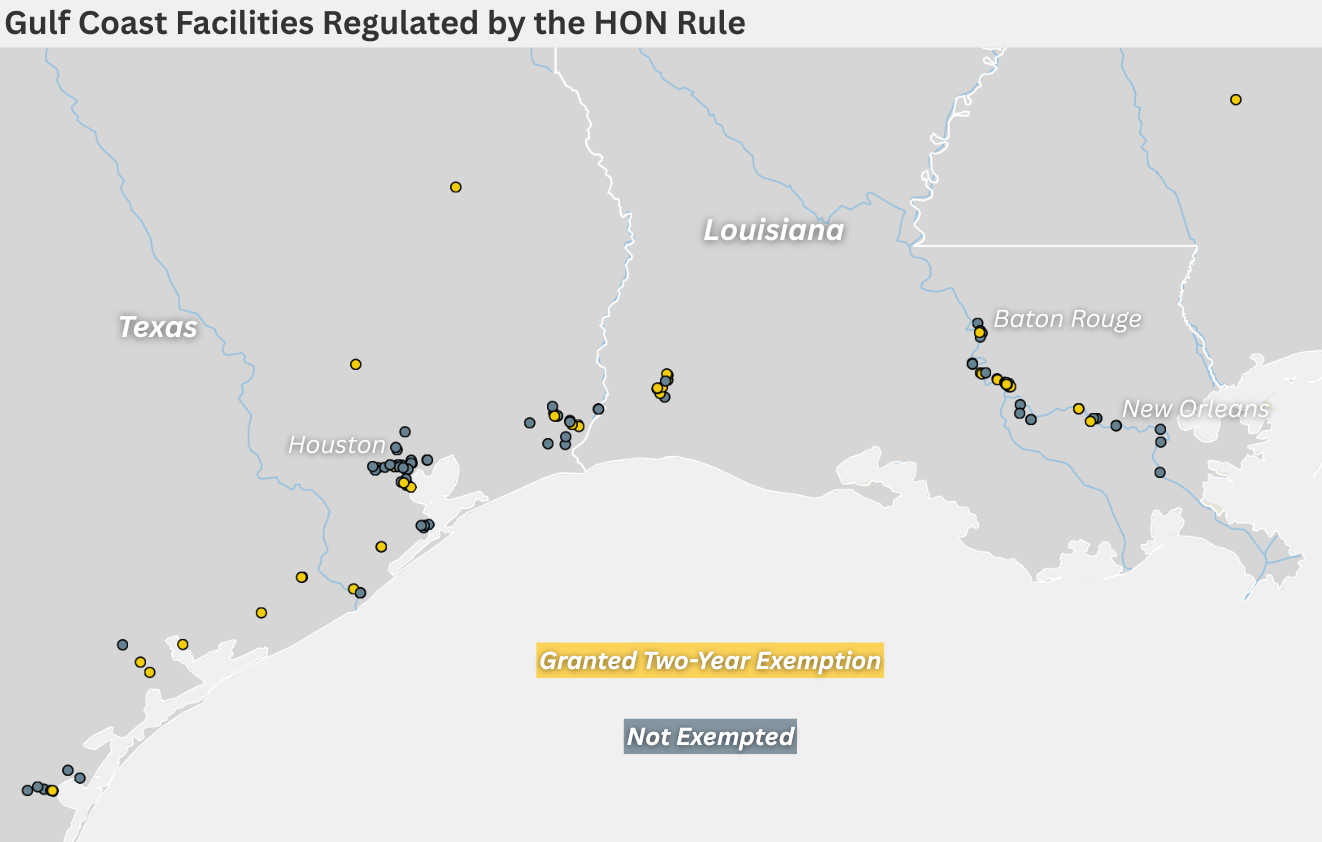
Gulf Coast petrochemical plants regulated by the 2024 HON rule. Source: Environmental Defense Fund. Yale E360

But shortly after President Donald Trump began his second term, his administration began unraveling those rules, including the one the Taylors had so recently celebrated. Last year, Trump granted two-year exemptions from the HON rule to more than 50 petrochemical facilities. This July, he issued 20 more temporary exemptions, and the EPA said it would propose a rewrite of the regulation this fall. The new version is all but certain to significantly scale back the rule’s protections. 

“Everything that the Biden administration did to help protect us was pretty much just thrown in the garbage,” Tish Taylor said in July, and replaced by “a death sentence.” St. John the Baptist Parish, where her family lives, has the country’s highest risk of cancer from air pollution — nearly 50 times the national average. A disproportionate percentage of those exposed to the highest levels of pollution in the region are Black.

A set of amendments to several existing regulations on toxic air pollutants, the HON rule — which stands for Hazardous Organic National Emission Standards for Hazardous Air Pollutants — requires petrochemical plants to upgrade their pollution control equipment to reduce emissions of two hazardous chemicals: ethylene oxide and chloroprene. It also mandates air monitors at plants’ fencelines to measure concentrations of those chemicals and four more — benzene, ethylene dichloride, vinyl chloride, and 1,3-butadiene — and requires operators to carry out necessary repairs if emissions exceed limits. 

Tracey Woodruff, a Stanford University epidemiology and population health professor who formerly worked on toxic assessments at the EPA, said the pollutants covered by the HON rule are “the classic bad guys of toxic chemicals,” compounds that raise risks for breast cancer, liver cancer, leukemia, lymphoma, and reproductive problems. “We’ve known about their toxicity for decades,” she said, and “they should have been more highly regulated a long time ago.” 

Read Next

The HON rule also closed a long-standing loophole that freed plants from emissions requirements when they were shutting down and starting up — for example when carrying out maintenance, or ahead of a storm. With climate change fueling more extreme weather, that loophole has “a massive impact on what is actually getting released,” said Shiv Srivastava, policy director at Fenceline Watch, a Houston environmental justice group.

The HON rule was one of nine new air toxics rules issued by the Biden administration. The eight other rules targeted emissions from sectors including iron- and steelmaking, copper smelting, tire manufacturing, and coal-fired power plants. All nine have been or are now being rescindedrevised, or reconsidered.  

The HON rule was among the most wide-reaching of those hazardous pollutant regulations. “This is a big rule,” said Joe Goffman, who headed the EPA’s air office under Biden. Because air toxics rules typically address very specific types of industrial facilities, an individual regulation sometimes applies to only a handful of plants in a few locations, with pollution reductions often measured in just hundreds of pounds, he said. But the HON rule covered approximately 220 large petrochemical plants, so its footprint promised to be both bigger and more wide-reaching geographically. Nearly 60 percent of the facilities it covered are in Texas and Louisiana, home to the nation’s largest petrochemical production zones. The rest are scattered across the country, in states including Tennessee, Kentucky, West Virginia, Ohio, Illinois, and Alabama. 

The EPA estimated when the rule was finalized that it would prevent 6,200 tons of toxic air pollution annually, and slash emissions of ethylene oxide and chloroprene from the plants it regulates by almost 80 percent. In communities near HON plants, the agency said the regulation would reduce the risk of cancers related to air toxics by 96 percent. Facilities affected by the rule produce ingredients for common products such as plastics, paints, antifreeze, and cleaning and personal care items like detergent and shampoo. 

Weeks into Trump’s second term, the EPA invited companies to email the agency with requests for exemptions from the HON rule and Biden’s other hazardous pollutant regulations. In granting the postponements, Trump invoked a Clean Air Act provision that environmental lawyers say has never been used: allowing temporary exemptions to emissions rules if they are “in the country’s national security interests” and if the technology required to comply with a regulation is unavailable.

Read Next

“The HON Rule imposes substantial burdens on chemical manufacturers already operating under stringent regulations,” Trump’s exemption proclamations said. “Maintaining a robust domestic chemical industry is vital to safeguarding the supply chains that underpin our economy and to reducing the Nation’s dependence on foreign control over materials critical to national resilience.”

Trump’s orders provided no evidence for their assertions. “That’s not how this works,” said Annie Fox, a staff attorney at the Clean Air Council, in Philadelphia. The law requires a president to set out specifics supporting each claim made in justifying an exemption, “not just state it,” she said. “These are supposed to be rare exceptions that are well-grounded in research and facts.” 

Last October, a coalition of local and national advocacy groups, including the Taylors’ Concerned Citizens of St. John, sued Trump and his EPA in the U.S. District Court for the District of Columbia over the exemptions, arguing that Trump’s claims are false and amount to “a pretext to relieve polluters from working to comply” with the HON rule while the administration works to undo the regulation.

The American Chemistry Council, a trade group representing petrochemical producers, said the exemptions “offer a pathway for relief for some sources from some of the unrealistic timelines” in the HON rule. It called the regulation “overly stringent” and said it “exceeds the EPA’s statutory authority, disregards relevant scientific evidence, and imposes some requirements without technological availability.” 

The EPA said in an emailed statement that all its proposals on air toxics aimed to “protect American industry and supply chains, while still minimizing Americans’ unnecessary exposure to hazardous air pollutants.” 

Read Next

The HON rule’s roots lay in a 2016 reevaluation of ethylene oxide gas that revealed it was much more dangerous to those inhaling it than had been previously understood. That reevaluation also led, in 2024, to a regulation that tightened emissions limits on ethylene oxide at facilities that use it to sterilize medical equipment.

In March, the EPA proposed replacing the medical sterilizer rule with a weakened version, arguing that the Clean Air Act gives regulators very limited scope to update rules in accordance with new science on health dangers.

In backtracking on efforts to limit exposure to hazardous air pollutants, Woodruff said, the Trump administration has signaled that “whatever the industry wants to do, that’s what we want to do.” She noted that former fossil fuel and petrochemical industry representatives hold top jobs across the EPA. The policy changes “will lead to people getting sicker and dying,” she said. “This is exactly opposite of what this administration claimed they wanted to do in terms of ‘Make America Healthy Again.’”

Read Next

HON rule exemptions are not the only change that will increase risks to Americans living near petrochemical facilities, advocates say. The EPA has also proposed undoing changes the Biden administration made to strengthen a safety rule called the Risk Management Program, which empowered workers dealing with hazardous substances to stop operations they believe to be dangerous, and required chemical facilities to prepare for natural disasters, undergo independent audits after accidents, and share information with the public. 

Nationally, there were 131 accidents resulting in reportable chemical releases last year. For those living near the Houston area’s nearly 700 chemical plants, “there are constant explosions, there are constant fires, there are constant black, dark plumes that linger over our communities,” Srivastava said.

The Biden-era update sought to address such dangers, but the Trump administration said the new rule was too costly and burdensome, and that it had made refineries and chemical facilities “less safe and less competitive.” Many of the plants it covered already had effective safety programs, the EPA said in a statement, and eliminating duplicative requirements would enable operators to focus on the most important changes. “Due to the varied, complex nature of chemical facilities, the facility operator is in the best position to assess risks and identify steps to mitigate these risks,” it said. 

Last year, the administration also removed an online data tool the Biden administration had created to give communities located near petrochemical plants information about their operations, including their accident history, emergency response plans, and the chemicals they handle. Srivastava said the tool’s loss cuts off neighbors’ access to even the most basic information about nearby plants — their names and locations, for example — making it hard for communities to even begin preparing for accidents. And easing safety mandates, he said, “makes us extremely, extremely vulnerable to having a massive, catastrophic disaster on the scale of something like what happened in Bhopal,” where a leak at a Union Carbide pesticide plant, in India, killed thousands of people in 1984.

Sharon Lavigne, founder of RISE St. James Louisiana, an advocacy group in “Cancer Alley,” still has the pen that the EPA’s Michael Regan gave her after he signed the HON rule, and her group is a plaintiff in the lawsuit challenging Trump’s exemptions. She said she believes the president’s disregard for the regulation reflects his belief that “we are nothing,” and she vowed to continue fighting to restore the HON rule’s original reach and strength. “When he gets out of office,” she said, “we’re gonna fix it back.”


A Mecca Pact Without a Playbook Puts India on Alert

0
a-mecca-pact-without-a-playbook-puts-india-on-alert
A Mecca Pact Without a Playbook Puts India on Alert


Kuwait invoked the UN Charter’s self-defense provision after Iranian attacks, while the Mecca alliance’s mutual-defense clause has not been publicly tested

[ISTANBUL] The newly established Mecca Defense Alliance has put a strategic question before India: Will the collective-defense pact linking Pakistan, Saudi Arabia and Turkey remain mainly political, or develop into an operational military arrangement?

The three countries signed the Mecca Joint Defense Agreement on Aug. 7 and met in Istanbul on Aug. 31 to establish a secretariat in Saudi Arabia, to be led by a Pakistani secretary-general for three years. Reuters reported that the agreement treats an armed attack on one signatory as an attack on all three, but the governments have not released a detailed public text setting out the commitments that would follow.

Turkish Foreign Minister Hakan Fidan said after the Istanbul meeting that the alliance was designed to expand and that officials had begun work on an accession roadmap. The talks addressed counterterrorism, defense production and interoperability, including possible joint land, sea and air exercises, air defense, drones, autonomous systems, electronic warfare and artificial intelligence.

The alliance is taking shape as Gulf states confront renewed Iranian attacks. On Sept. 3, Kuwait said its air defenses intercepted Iranian missiles and drones targeting the country. Reuters reported that Tehran had struck a US base there after a major escalation in the US-Iran conflict.

Kuwait invoked Article 51 of the UN Charter, which recognizes a state’s inherent right of self-defense, and said it reserved the right to take necessary measures to protect its territory. Kuwait is not a Mecca alliance member, and its defense cooperation with Pakistan remains centered on training, intelligence, logistics, capacity building, and border management—not a collective-defense guarantee.

India can measure the Mecca pact against Kuwait’s limited arrangement with Pakistan. The newer alliance uses broader mutual-defense language, but its practical military obligations have yet to be publicly defined.

American and Indian troops are training together this month in the Rajasthan desert, where India faces Pakistan, and in the Himalayas, where Auli is about 60 miles from the disputed frontier with China.

The US Embassy in New Delhi announced the exercise Tuesday, a day after the Istanbul meeting. Since 2004, the embassy said, Yudh Abhyas has strengthened the US-India Major Defense Partnership in support of a free and open Indo-Pacific.

Yudh Abhyas, Hindi for “training for war,” is in its 22nd edition. The three-week exercise involves 350 soldiers from each army, starting at the Mahajan Field Firing Range near Bikaner and moving to Auli. Mahajan focuses on live fire and mechanized maneuver, while Auli tests high-altitude logistics.

Dr. Arzan Tarapore, a research scholar at Stanford University, said the public record provides scant evidence that the pact is a binding mutual-defense treaty in the operational sense. He told The Media Line that he does not expect the three to conduct military operations together, whether against Iranian strikes on Saudi Arabia or in coordination against India.

He expects flows of money, arms and technologies, including drones, among the members and across the region. Pakistan already used Turkish drones against India in May last year, Tarapore said, and that is the kind of defense-industrial cooperation he expects to deepen.

Brig. Anil Raman, a retired Indian officer at the Takshashila Institution in Bangalore, reached a similar conclusion. India has asked Washington for nothing so far, he told The Media Line. It should seek tighter controls on American-origin weapons that could reach Pakistan through Turkey and urge Saudi Arabia and Turkey to limit the cooperation, he said.

Any expectation that Saudi fighter jets, Pakistani F-16s and Turkish F-16s are going to be running joint raids somewhere in the Middle East is Hollywood fiction

“Any expectation that Saudi fighter jets, Pakistani F-16s and Turkish F-16s are going to be running joint raids somewhere in the Middle East is Hollywood fiction,” Kabir Taneja, who directs the Observer Research Foundation’s Middle East office in Dubai, told The Media Line. “It is never going to happen.”

Taneja also cautioned against comparisons with NATO. Article 5 of the North Atlantic Treaty has been invoked only once in the alliance’s history, he said.

The alliance does not eliminate or replace Turkey’s obligations under NATO or its other agreements, Fidan said in Istanbul. It complements them.

Asked at the same news conference about Israeli statements calling Turkey a strategic threat, Fidan said Israeli Prime Minister Benjamin Netanyahu should be stopped and called him “an enemy of humanity.” He said hostility toward Turkey from Netanyahu’s government had grown since Israel’s election campaign began.

The three countries do not agree on the adversary either, Taneja said. Each has its own view of what the arrangement is for and a different neighbor in mind.

“Ankara and Riyadh were not on good terms until 2022 or 2023,” he added. “That can happen again.”

Islamabad has reportedly sent 8,000 troops, a squadron of JF-17 fighters and an air defense system to Saudi Arabia under the bilateral agreement the two countries signed in September 2025. Neither government has publicly provided a full account of the deployment. Pakistan has sent soldiers to the kingdom for decades. More than 20,000 served under the 1982 Joint Defense Protocol, and a Pakistani general commanded the Saudi-led Islamic Military Counter Terrorism Coalition beginning in 2015.

Pakistan raised $3 billion on the international bond market on Sept. 3, its largest single issuance, with orders near $6 billion. The proceeds will repay a $3 billion Saudi loan made in April, which Islamabad had used to repay the United Arab Emirates and which Riyadh had already extended once.

Saudi Arabia committed another $3 billion in support in April and extended an existing $5 billion deposit as Islamabad faced repayment obligations to the United Arab Emirates. The assistance ties Riyadh to Pakistan’s financial stability as well as its defense planning.

Pakistan spent decades treating the Gulf as its own ground, Taneja said. It lobbied hard to keep India out of the Organization of Islamic Cooperation when the bloc of Muslim-majority states was founded in the 1960s.

India’s economic rise changed the picture. Dubai was built by Indian hands in the 1990s, Taneja said, and Indians now come as engineers, managers and chief executives rather than as construction workers, while it has become more difficult for Pakistani laborers to obtain Emirati visas.

What we are seeing now with the Mecca agreement, with the mediation with Iran, with the—dare I say—good relationship with President Trump, is Pakistan finding a very good wedge to re-enter

“What we are seeing now with the Mecca agreement, with the mediation with Iran, with the—dare I say—good relationship with President Trump, is Pakistan finding a very good wedge to re-enter,” Taneja said. “And to be fair to them, they seem to be doing a decent job of it.”

“If you are going to build an architecture that will require mobilization at some level, you cannot mobilize if you are not trained, and you cannot mobilize if you are not experienced,” he said. “Pakistan brings all those things together.”

India’s national security adviser has visited Saudi Arabia four times in the past six months, Taneja said, and Riyadh kept New Delhi informed before signing its bilateral agreement with Islamabad so India would not read the arrangement as a coalition against it.

Asked at a New Delhi forum on Aug. 22 whether the pact worried him, S. Jaishankar said: “There are live military situations which each of the signatories face, what has the Mecca pact done in response to that?”

In my calculus, everything counts, everything will have a weight

He said India would not ignore it either. “In my calculus, everything counts, everything will have a weight,” he said, “and sometimes things need to play out.” India factors in developments involving countries whose policies are not favorable toward it, he added.

India’s quarrel with Turkey predates the pact. Days after the May 2025 fighting, New Delhi revoked the security clearance of Celebi Aviation, a Turkish ground-handling company operating at nine Indian airports. Indian officials said drones Pakistan launched at Indian towns came from Turkey.

The deeper irritant is Kashmir, Taneja said. President Recep Tayyip Erdogan raises it at the UN General Assembly almost every year, which India treats as a red line and an endorsement of Pakistan’s position. New Delhi has told Ankara so repeatedly.

For India, he added, the larger concern is Saudi Arabia’s membership. The relationship with Turkey was already contentious.

Indian commentators have also asked whether the pact responds to India’s closer ties with Israel. India and Israel upgraded their relationship in February to what the two governments call a special strategic partnership for peace, innovation and prosperity. Their bilateral investment agreement took effect in July; the three countries signed in Mecca on Aug. 7.

The Hindi-language outlet Webdunia asked whether the alliance was a direct response to India-Israel ties and to mechanisms such as I2U2 and the India-Middle East-Europe Economic Corridor. Netanyahu telephoned Indian Prime Minister Narendra Modi on Aug. 6, the day before the signing, and Modi posted about the call in English and Hebrew.

India’s Foreign Ministry has rejected reports that New Delhi approached Israel seeking a new defense treaty in response to the pact.

The Qatari Foreign Ministry welcomed the pact as a positive step but declined to discuss joining it. Doha is already present in more than one platform, the ministry said.

Qatar has a US security assurance that Washington did not extend to Saudi Arabia. After the Israeli strike on Doha in September 2025, President Trump issued an executive pledge that the United States would treat an attack on Qatar as a direct threat to itself. The US-Saudi defense agreement two months later provided Riyadh with F-35s, tanks, civil nuclear cooperation and major non-NATO ally status, but did not include the same formula.

Turkey has maintained about 3,000 troops in Qatar for almost a decade under several defense agreements. Their presence did not prevent Iranian strikes on Qatar in 2025 and 2026 or the Israeli attack on Hamas leaders in Doha.

The United Arab Emirates has kept its distance. Abu Dhabi has the Abraham Accords, ties to Israel, expanding relationships with India and China, and a defense industry of its own. It has less urgency than Riyadh to accept automatically triggered obligations.

Col. (res.) Dr. Hanan Shai wrote for the Misgav Institute for National Security and Zionist Strategy on Aug. 18 that “Israel cannot assume that the Mecca pact will also remain an empty declaration.” He proposed not a rival military alliance but an economic-security organization built around the India-Middle East-Europe Economic Corridor, with India, Israel, Greece, Cyprus and the United Arab Emirates at its core, Jordan providing land continuity and Saudi Arabia welcomed even while Riyadh remains in the Mecca pact.

Saudi Arabia has invited Bangladesh, a Bangladeshi official told Reuters, and Dhaka says it is interested. Turkish officials said after Istanbul that they had begun building a mechanism for other countries to join. Taneja is untroubled by the prospect. Bringing in countries from outside the region would dilute the agreement, he said, and he does not know what Bangladesh would add to it.

The idea is to build a regional security architecture in the Middle East, he said. Expand geographically before it has any depth, and other organizations offer the warning: the core mandate becomes diluted, and symmetry replaces purpose.

“There is very little unity in the Gulf right now,” Taneja said. “They have a lot of their own stuff to figure out first. It is going to be chaotic. It may be violent.”

Israeli army chief warns of ‘tense, volatile period’ across all fronts

0
israeli-army-chief-warns-of-‘tense,-volatile-period’-across-all-fronts
Israeli army chief warns of ‘tense, volatile period’ across all fronts

Israeli Chief of Staff Eyal Zamir warned Sunday that Israel is facing a “tense and volatile period across all sectors,” as the military continues its attacks on several regional fronts, Anadolu reports.

“We are in a tense and volatile period across all sectors, and are preparing for the upcoming holiday period,” a military statement quoted Zamir as saying during an assessment with the military’s top brass in a snap drill.

“The baseline posture of the entire Israeli army is readiness for a surprise attack,” he added.

Since October 2023, Israel has continued its genocidal war on the Gaza Strip, killing more than 73,000 people. Tel Aviv also fought two wars against Lebanon and Iran, and carried out attacks in Yemen and Qatar, in addition to near-daily ground incursions and artillery shelling in Syria.

Zamir said the drill simulates a multi-front war and seeks to test the army’s readiness at different levels and examine operational orders and plans, from the General Staff down to units deployed in the field.

He added that the drill forms part of military preparations for the Jewish holiday period, beginning with Rosh Hashanah on Sept. 11, followed by Yom Kippur on Sept. 20 and Sukkot on Sept. 25.

The surprise exercise was launched on Zamir’s orders to test the state of readiness at the General Staff and regional command levels, as well as the preparedness of emergency forces to respond to sudden, complex and multi-front scenarios, the Israeli newspaper Maariv reported.

The drill also includes testing procedures for raising the military’s alert level, mobilizing reserve forces, and assessing decision-making and operational response mechanisms across various command levels, it added.

Separately, the Israeli army announced Sunday morning that it would launch a large-scale exercise on Monday in the Red Sea coastal city of Eilat and the Araba Valley along the Jordanian border to simulate a surprise attack.

The military said forces would train for scenarios involving a sudden attack and infiltrations into Israeli territory by land, sea and air.

​​​​​​​For decades, Israel has occupied Palestinian lands as well as territories in Lebanon and Syria, refusing to withdraw from them or allow the establishment of an independent Palestinian state as stipulated in relevant UN resolutions.

Farmed salmon may not be as nutritious as it once was, new research suggests

0
farmed-salmon-may-not-be-as-nutritious-as-it-once-was,-new-research-suggests
Farmed salmon may not be as nutritious as it once was, new research suggests

Eat more fatty fish.

That dietary advice has changed the way the world consumes salmon, pushing consumer demand ever upward and production to higher and higher levels. Most of that demand is being met with farmed salmon: Today, nearly 70 percent of the salmon consumed on the planet are raised in pens and cages.

The US Department of Agriculture’s Dietary Guidelines for Americans recommend eating at least 8 ounces of fish a week and urges people to choose salmon or other species that are similarly high in “heart-healthy” Omega-3 fatty acids. But new research led by USDA scientists finds that levels of these fatty acids in farmed salmon have dropped considerably, potentially making the agency’s own advice, and similar recommendations, including from the American Heart Association, outdated and insufficient.

“These old figures are what are still used in their national dietary guidance,” said Laura Lee Cascada, director of the Aquaculture Accountability Project, a watchdog group. “So in the meantime, it’s going to stay the same and people will have this wrong idea of how much Omegas they’re getting.”

The report’s authors note in their research that the sample they examined was not large enough to require changing the government’s advice and that “a broader and more representative study is warranted.” The agency declined requests for an interview and did not answer questions via email.

The reason for the decline of the Omega-3s, the new study says, is a major shift in the diets of the naturally carnivorous salmon, from smaller fish species—which were over-exploited to feed farmed fish—to a mix that includes land-based oils and crops, including soy and canola. A 2016 study noted similar declines, also attributable to the shift toward a crop-intensive diet.

So, as the well-intended dietary advice has driven a surge in farmed salmon consumption, the corresponding surge in production appears to be depleting the very nutritional benefits that prompted the global salmon boom in the first place—and with consequences for both the marine and terrestrial environment.

Salmon has played a key role in the explosive growth of global aquaculture, becoming a mainstay in the diets of health-conscious eaters or those trying to cut down on terrestrially farmed protein, especially beef, for both health and environmental reasons. The amount of farmed salmon tripled between 2000 and 2020, far outpacing the production of any other type of finned fish.

Today aquaculture is the fastest-growing food production system in the world, much of it spurred by increasing appetites for species, including salmon, that have been identified and marketed as uniquely healthful.

But researchers and advocates have long criticized the environmental impacts of farmed salmon. Fish waste and feed pollute waters, threatening wild-caught salmon populations. Feeding ever-greater populations of pen-raised salmon has led to the degradation of both smaller fish species and the coastal fishing communities that depend on them and other wildlife, including seabirds.

With the world’s oceans becoming increasingly depleted of small fish, the industry has switched to feeding salmon a diet based more on terrestrially grown crops, including soy and soy oils.

That shift has come with a new set of problems.

Most of the world’s soy, roughly 50 percent, is grown in South America where rainforests and other climatically important ecosystems are being razed to grow feed for livestock and aquaculture.

“Soy is a major, important protein and oil ingredient in fish farming,” said Matthew Hayek, a researcher at New York University who studies the environmental impacts of protein production. “What we can tell is that, for all fish farming combined, soy consumption over the past two decades has amounted to the additional expansion and clearing of forested land that was equivalent to about the size of Nicaragua or Bangladesh.”

Hayek noted that it’s difficult to attribute soy consumption to individual fish species. But other research has found a rise in the use of crop-based ingredients fed to farmed salmon. In Norway, the world’s biggest producer of farmed salmon, 90 percent of feed ingredients were marine-based in 1990, but by 2020 that had dropped to about 23 percent. Advocacy groups there determined that 90 percent of the soy fed to farmed salmon in Norway comes from three Brazilian companies, each of which have sourced soy ingredients from illegally deforested patches of the Amazon rainforest.

Other research has found that the shift to crop-based ingredients doubled the greenhouse gas emissions, per kilogram, of farmed fish in Europe and the United Kingdom from 2000 to 2020.

“It’s trading one problem—marine exploitation—for another—land exploitation,” Cascada said.

The industry is projected to continue growing, along with the population and rising demand for seafood promoted as healthy. Nutritionists and researchers say that farmed fish, including salmon, will play a major role in providing protein, though some environmental groups note the surge in salmon demand has disproportionately come from wealthy countries that don’t have nutritional deficits.

“The claim is that the salmon industry is here to feed the world and provide this extra protein,” Cascada said. “But what it’s really doing is flooding the Global North with protein that is not necessarily needed at the expense of the Global South.”

In the United States, lawmakers are trying to help the industry expand by passing legislation that would make it easier for salmon producers to obtain licenses to farm fish in offshore federal waters.

In February, environmental advocates and fishermen sent a letter to members of Congress opposing the bill, the Marine Aquaculture Research for America (MARA) Act.

Proponents of the bill say that putting fish farms in deeper, offshore waters would reduce the environmental issues caused by farming fish in sensitive, nearshore environments.

Opponents say the legislation would enable a factory-farming model, much like the one that produces the vast majority of the world’s livestock, in the open sea.

This article originally appeared on Inside Climate News, a nonprofit, non-partisan news organization that covers climate, energy and the environment. Sign up for their newsletter here.

Music Icon to Flee U.S. Over ‘Shocking’ Trump Moves

0
music-icon-to-flee-us.-over-‘shocking’-trump-moves
Music Icon to Flee U.S. Over ‘Shocking’ Trump Moves


Music legend Art Garfunkel says he is so disturbed by the direction of the United States under President Donald Trump that he has considered leaving the country altogether.

The 84-year-old Simon & Garfunkel star opened up about his frustrations during a wide-ranging interview with The Guardian, admitting he is deeply unhappy with America’s current position in the world.

“I don’t like America’s position at all,” Garfunkel said. “I’m not aboard, and I’m thinking of leaving the country, frankly.”

Garfunkel, whose unmistakable voice helped turn Simon & Garfunkel into one of the most celebrated musical acts of their generation, has won multiple Grammy Awards during his decades-long career, including a Lifetime Achievement Award as part of the legendary duo.

He and longtime musical partner Paul Simon, also 84, created classics including “The Sound of Silence,” “Bridge Over Troubled Water” and “Mrs. Robinson.”

Their relationship has famously been rocky over the years, but the two reportedly reconciled during an emotional meeting in 2025 following a lengthy estrangement. Garfunkel told The Guardian that their relationship remains complicated despite the reunion.

Politics were also clearly on Garfunkel’s mind.

The longtime liberal, who has previously supported politicians including Bernie Sanders, said he is troubled by climate change, global hunger and actions taken by the Trump administration on the international stage.

“It’s real that the planet is getting warmer, that the water’s rising, that so many people are starving,” Garfunkel said.

He then pointed to Trump’s actions involving Venezuela as an example of what has alarmed him.

“When Donald Trump took over Venezuela, are those the new rules? Just take over a country and run it?” Garfunkel asked. “It’s shocking.”

Despite his grim assessment, the veteran singer said he still sees one reason for hope: presidents eventually leave office.

“You think: how on Earth are we gonna change the presidency?” Garfunkel said. “But Trump won’t last forever. So we’ve got to hope.”

Garfunkel, meanwhile, has no plans to disappear from public life. The legendary singer is preparing to return to the stage with his “What a Wonderful World” tour, which is scheduled to take him through the United Kingdom, France, Germany and Japan beginning in October.

‘I Am Going to an Arab Party. They Are Not Coming to Me’: Segalovitz Explains Ra’am Move   

0
‘i-am-going-to-an-arab-party.-they-are-not-coming-to-me’:-segalovitz-explains-ra’am-move-  
‘I Am Going to an Arab Party. They Are Not Coming to Me’: Segalovitz Explains Ra’am Move   


The former senior police commander will run second on Ra’am’s slate while joining its parliamentary faction rather than becoming a formal party member

Former Yesh Atid lawmaker Yoav Segalovitz will occupy the second position on Ra’am’s ticket in Israel’s October 27 election, putting a Jewish Zionist immediately behind the leader of a party built primarily around an Arab Muslim constituency. Segalovitz told The Media Line that he will join Ra’am’s parliamentary faction but will not become a formal member of the party, a distinction that allows him to retain his political identity while running on its slate.  

At a joint press conference in Nazareth, Segalovitz introduced the partnership by listing the differences between himself and Ra’am chairman Mansour Abbas. Segalovitz described himself as a Jewish, secular Zionist who served as an army officer and rose to one of the highest ranks in the Israel Police. Abbas, he said, is an Arab, a religious Muslim, and a social conservative. “What connects us is that we are all Israelis,” Segalovitz said. “That is our shared identity.”  

I do not see Ra’am or Mansour Abbas as a threat. They want to be part of the country, and I think we need to be strong enough to extend a hand in return.

The arrangement gives Segalovitz a prominent position in a party that could again become important to the formation of a government. Ra’am participated in the coalition that governed Israel from 2021 to 2022, but several opposition leaders now say they will not form another government dependent on an Arab party. Segalovitz argues that his candidacy can begin changing that calculation, even if it does not produce an immediate electoral shift.  

“I do not see Ra’am or Mansour Abbas as a threat,” he said. “They want to be part of the country, and I think we need to be strong enough to extend a hand in return.”  

Segalovitz, 67, previously headed the Israel Police Investigations and Intelligence Division and the Lahav 433 national crime unit. During the previous government, he became the official responsible for coordinating the state’s campaign against organized crime and violence in Arab communities. That work gave him relationships with Arab mayors and local leaders well before he began discussing a political partnership with Abbas. 

His decision to leave Yesh Atid and enter Ra’am’s slate has met resistance across much of the political system. Opposition Leader Yair Lapid said he believed Segalovitz was making a mistake, although he respected his former colleague for acting on his convictions. Yisrael Beiteinu chairman Avigdor Liberman has said Ra’am cannot be a coalition partner, while Prime Minister Benjamin Netanyahu has made the opposition’s potential dependence on Abbas a campaign issue, presenting voters with a choice between his government and a rival bloc supported by Ra’am.  

Segalovitz said those positions leave Arab citizens fully integrated into much of Israeli life but excluded when political power is discussed. Arab citizens account for approximately 21% of Israel’s population and work throughout its medical system, universities, industries and public services. The distinction becomes visible, he said, when people move from daily life into party politics. “At a hospital, nobody asks questions,” Segalovitz said. “You enter political life, and everyone puts on some kind of narrative; some kind of suit tailored to his measurements. That is where you see the lack of connection.”  

At a hospital, nobody asks questions. You enter political life, and everyone puts on some kind of narrative.

He rejected the argument that political cooperation with Arab parties became unacceptable after the Hamas-led massacre of October 7, 2023. In his announcement, Segalovitz said that more than 34 members of Israel’s Arab community were killed in the attack and that six Bedouin citizens were abducted to Gaza. Arab communities also suffered casualties and property damage from missiles fired during the conflicts with Hezbollah and Iran.  

Segalovitz acknowledged that October 7 increased fear among Jewish Israelis when Arab political participation is discussed. He said, however, that the responsibility of political leaders is not to reinforce that fear. “There is no future for the State of Israel as I see it without partnership with Arabs,” he said. “The differences are there. I emphasized that in my statement. I am not hiding them.”  

He described himself as a “bridgehead” between parts of Jewish and Arab society that rarely meet inside the same electoral framework. By accepting the second position rather than asking Abbas to join a Zionist party, Segalovitz said he intended to send a stronger message. “I am going to an Arab party. They are not coming to me,” he said. “A Jewish Zionist, a former police officer, number two in Ra’am. There is a powerful message in that.”  

Segalovitz said the initial response within Arab communities had gone beyond support from Ra’am voters. The day after the announcement, he visited Baqa al-Gharbiyye, where residents approached him in the street to wish him success, including people who told him they did not intend to vote for the party. In Nazareth, he said, Arab journalists privately described an unusual level of excitement surrounding the move.  

He also said he had received supportive messages from former commanders and senior figures in Israel’s security establishment, although he did not identify them. Segalovitz argued that excluding more than one-fifth of the population from meaningful political influence is damaging not only to democratic representation but also to Israel’s security and economy.  

The immediate policy test, he said, will be violent crime. Segalovitz wants the next government to restore the interagency programs he oversaw as deputy public security minister and consider expanding them. Data compiled by the Abraham Initiatives showed that the number of Arab citizens killed in criminal violence fell from 126 to 116 during his only full year in government. It rose to 244 the following year, after the government changed.

“Personal security comes first, and that means crime,” he said. “The situation is so serious that this must be at the top of the next government’s priorities. Root treatment will take longer, but significant action has to begin immediately.”  

Segalovitz also supports expanding civilian service among young Arab citizens, presenting it as both a contribution to the state and a means of providing structure and opportunities for those aged 18 to 24. He said the program should not be imposed by the government. “It has to come from Arab society to the state, not from the state to Arab society,” he said, adding that Ra’am is already pursuing initiatives in that area.  

Beyond crime, Segalovitz identified education, healthcare, welfare, employment, and infrastructure as priorities. He said the state has also avoided dealing seriously with the accumulated problems facing Bedouin communities in the Negev, including planning, housing, public services, and their relationship with state institutions. He did not place responsibility solely on the current government, saying the issue had been neglected for many years and could not be reduced to disputes over home demolitions.  

The longer-term challenge, he said, is moving more Arab graduates into fields such as technology and other higher-paying sectors rather than allowing educational advancement to remain concentrated in a limited number of professions. “Arab society, as I see it, is first of all a major economic, cultural and social opportunity for the State of Israel,” he said. “It is not a threat.”  

Asked what would constitute success four years from now, Segalovitz did not cite a seat target or government position. He said he wanted the partnership to become sufficiently established that Israelis would stop asking why he had joined Ra’am and begin asking what the alliance had accomplished, where it had failed, and what should be done differently. The work, he said, requires planning for the next 20 years rather than one parliamentary term. “If I have to put it in one phrase,” Segalovitz said, “I want the act I have taken not to be an episode.”  


German company becomes first in Europe to launch fully commercial orbital rocket

0
german-company-becomes-first-in-europe-to-launch-fully-commercial-orbital-rocket
German company becomes first in Europe to launch fully commercial orbital rocket

Isar Aerospace, founded in 2018 by three students at a German university, successfully launched a privately-developed rocket into low-Earth orbit Saturday from a Norwegian spaceport inside the Arctic Circle.

The two-stage rocket, named Spectrum, became the first fully commercial launch vehicle in Europe to reach orbit. With Saturday’s success, Isar is the clear leader among a pack of several European launch startups vying to inject some competition into Europe’s stagnant launch market.

Isar’s 92-foot-tall (28-meter) Spectrum rocket lifted off at 4:12 pm EST (20:12 UTC) Saturday from Andøya Spaceport in northern Norway, where it was 10:12 pm local time as the final bluish hues of daylight faded from the late summer sky. Seven minutes later, the rocket was in orbit.

“Today, Isar Aerospace opened space from continental Europe,” said Daniel Metzler, the company’s co-founder and CEO, in a press release. “Launch continues to be the largest bottleneck for the global space industry and from today on, there is a true alternative for commercial and institutional customers.

“We achieved within a few years what had taken the European space industry decades before,” Metzler continued. “Europe now has sovereign access to space. We have entered into a new chapter for European spaceflight. I am incredibly proud of our team, that has made this success story from Europe possible. We will now focus on rapidly scaling launch vehicle production, deliver on our order pipeline, and meet surging global demand.”

Metzler joined two classmates at the Technical University of Munich in 2018 to establish Isar, named for the river that runs through the Bavarian capital. Metzler, Josef Fleischmann, and Markus Brandl enjoyed tinkering with rocket parts in a campus workshop before deciding they might be able to make some money with their hobby.

It wasn’t easy. Europe boasts a robust space sector with an impressive pedigree, but the industry is not known for its dynamism.

“Especially early on, back in 2018, when, frankly, there was no ‘New Space’ industry, especially on this side of the Atlantic, people said it will never work,” Metzler told reporters in a press briefing Sunday. “People will continue to always say this will not work, and that will not work, until we just prove them wrong. Giving up is not in our DNA.”

It took eight years for Isar to get to orbit, a timetable similar to other successful commercial rocket startups in the West. In that time, the company raised roughly $1 billion through several private financing rounds, and now has a workforce of nearly 500 employees. This makes Isar, by far, the most well-capitalized private launch company in Europe.

“Generally, I think you very much overestimate what you can do in the short term, but I think you underestimate what you can do in the long term,” Metzler said. “Don’t forget the human element behind all of this. There are engineers, technicians, operators, a strong support team, who just dare to dream, and against all odds, that team delivered.”

The Spectrum rocket streaks into the sky over Andøya Spaceport, Norway, on Saturday evening.

The Spectrum rocket streaks into the sky over Andøya Spaceport, Norway, on Saturday evening. Credit: Isar Aerospace

Launch autonomy

Isar’s success is welcome news for the European Space Agency and Europe’s space industry as they seek lower-cost rockets to put their satellites into orbit. Europe’s incumbent launch providers, Arianespace and Avio, have relied upon billions of euros in funding from European governments to get their rockets off the ground. Those companies currently operate the Ariane 6 and Vega-C rockets, which have proven reliable but are only marginally competitive, even with the assistance of government subsidies.

European space officials hope a jolt of competition will light a fire under the continent’s rocket industry. European governments are accustomed to footing the bill and having a say in where rockets are built, a procurement model known as geographical return, or geo-return. The paradigm is different with companies like Isar, which established themselves on a privately-funded basis, with ambitions to eventually attract commercial and government business.

There is an important geopolitical angle to Isar Aerospace’s success Saturday, too. European startups have a harder time attracting venture capital investment than US companies, and the top-down architecture of Europe’s legacy space industry is often incompatible with the entrepreneurial culture of Silicon Valley. These headwinds are hitting Europe’s space industry as officials seek to bolster the continent’s strategic autonomy amid rocky relations with the United States and the Trump White House.

Today, Europe’s governments have to a pay a premium to launch their satellites on a European rocket. It is less expensive, but not politically palatable, to sign a contract with SpaceX to launch those payloads from the United States.

“I think that it is important to realize that Europe can also move fast and deliver,” Metzler said. “Everybody across Europe, I think, realizes what this actually means because strategic access to space and not being dependent on a monopoly … is extremely important for our own security, for our own economy, for strategic autonomy. Everything [is] there for Europe to drive those things.”

Daniel Metzler, CEO of Isar Aerospace, joined German Chancellor Friedrich Merz and Norwegian Prime Minister Jonas Gahr Støre on a visit to see Isar’s Spectrum rocket at Andøya Spaceport in March.

Daniel Metzler, CEO of Isar Aerospace, joined German Chancellor Friedrich Merz and Norwegian Prime Minister Jonas Gahr Støre on a visit to see Isar’s Spectrum rocket at Andøya Spaceport in March. Credit: Isar Aerospace

Isar’s Spectrum made history in another way Saturday. It is the first rocket built predominately in Germany to reach orbit. Spectrum also supplants the V-2, the World War II weapon of terror, as the largest German rocket in history. Many of the V-2’s engineers, led by Wernher von Braun, emigrated to the United States after World War II to work on rockets for the US military and NASA. Germany’s domestic space industry developed a handful of small suborbital sounding rockets and manufactured upper stages for Ariane rockets. Since the 1970s, France has provided the bulk of the funding for the development of Europe’s Ariane program, taking charge of building engines and booster stages.

Germany, meanwhile, has historically preferred to spend money on satellites, scientific missions, and payloads. For example, the service modules for NASA’s Orion spacecraft are manufactured in Germany. Isar didn’t obtain a substantial up-front investment from the German government to get off the ground, but German leaders are keen to frame the company’s successful launch as key to European sovereignty.

German Chancellor Friedrich Merz visited Andøya Spaceport and toured Isar Aerospace’s launch pad in March. He congratulated the company Saturday in a post on X, heralding the launch as the “beginning of a new era.”

Walther Pelzer, director general of the German Space Agency, DLR, said Isar’s successful test flight “redefined the path to independent European access to space, a clear sign of the innovative strength of a young ambitious company.” DLR awarded the company $13 million (11 million euros) in 2021 to support development of the Spectrum rocket and arrange for the launch of the CubeSats on Saturday’s flight.

“The Spectrum rocket was not developed under a government contract,” Pelzer said in a statement. “It was developed to serve a global market.”

Worth the wait

The Spectrum rocket fits in an underserved segment of the launch market, with the ability to place up to a metric ton (2,200 pounds) of payload into low-Earth orbit. Spectrum’s lift capacity is comparable to that of Firefly Aerospace’s Alpha rocket in the United States. Alpha has achieved several successful launches, but setbacks and failures have kept Firefly from establishing a routine launch cadence.

Isar’s rocket can lift heavier payloads than Rocket Lab’s Electron launch vehicle, the market’s workhorse for dedicated launches of small satellites. Isar’s Spectrum slides in below the performance envelope of the Vega-C rocket from Italy’s Avio.

The Spectrum rocket faltered on its first test flight in March 2025, when the launcher spun out of control less than 20 seconds after liftoff and crashed near the launch pad. Engineers identified the unintentional opening of a vent valve and a loss of attitude control as the cause of the failure.

There were no customer payloads onboard the test flight last year. That changed with the second flight of Spectrum, christened “Onward and Upward” by Isar. There were five small CubeSats and a non-separating technology experiment packed inside the Spectrum rocket’s payload fairing during Saturday’s launch.

The exhaust plume from the Spectrum rocket’s second stage was illuminated by sunlight, creating a “jellyfish effect” as the vehicle climbed into space from Andøya Spaceport, Norway.

The exhaust plume from the Spectrum rocket’s second stage was illuminated by sunlight, creating a “jellyfish effect” as the vehicle climbed into space from Andøya Spaceport, Norway. Credit: Isar Aerospace/NSF

Spectrum’s second flight began with ignition of the rocket’s nine Aquila main engines, burning a mixture of propane and liquid oxygen propellants to generate more than 150,000 pounds (675 kilonewtons) of thrust. The rocket climbed away from the launch site at Andøya, then turned north over the Norwegian Sea. Spectrum’s first stage booster fired for two-and-a-half minutes, then separated to fall into a predetermined downrange drop zone.

The rocket’s second stage ignited a single Aquila engine and accelerated to orbital velocity—some 5 miles per second—about seven minutes into the flight. The second stage was expected to coast halfway around the world before reigniting to circularize its orbit at an altitude of about 300 miles (500 kilometers).

Isar officials did not immediately specify the exact altitude and inclination of the Spectrum rocket’s final orbit. At least one of the CubeSats deployed by the Spectrum’s upper stage made contact with ground teams, an apparent confirmation that the rocket hit its target.

“I can tell you the atmosphere here in Norway was a bit crazy because orbit has a lot of meaning for a rocket company,” said Alexandre Dalloneau, Isar Aerospace’s vice president of mission and launch operations.

A series of technical problems, poor weather, and scheduling constraints on the launch range at Andøya forced repeated delays since Isar first attempted to launch the second Spectrum test flight in January. The long wait paid off Saturday.

“We knew the system could perform, but you only find out if the system actually performs when you actually hit that launch button and you see the rocket fly because you cannot simulate your way into orbit,” Metzler said.

Funding secured

The European Space Agency added $230 million (197.8 million euros) to Isar’s coffers last month with a contract through the European Launcher Challenge, which aims to support commercial launch vehicle development in Europe. Isar’s contract was the most valuable of the three awarded through the launcher challenge.

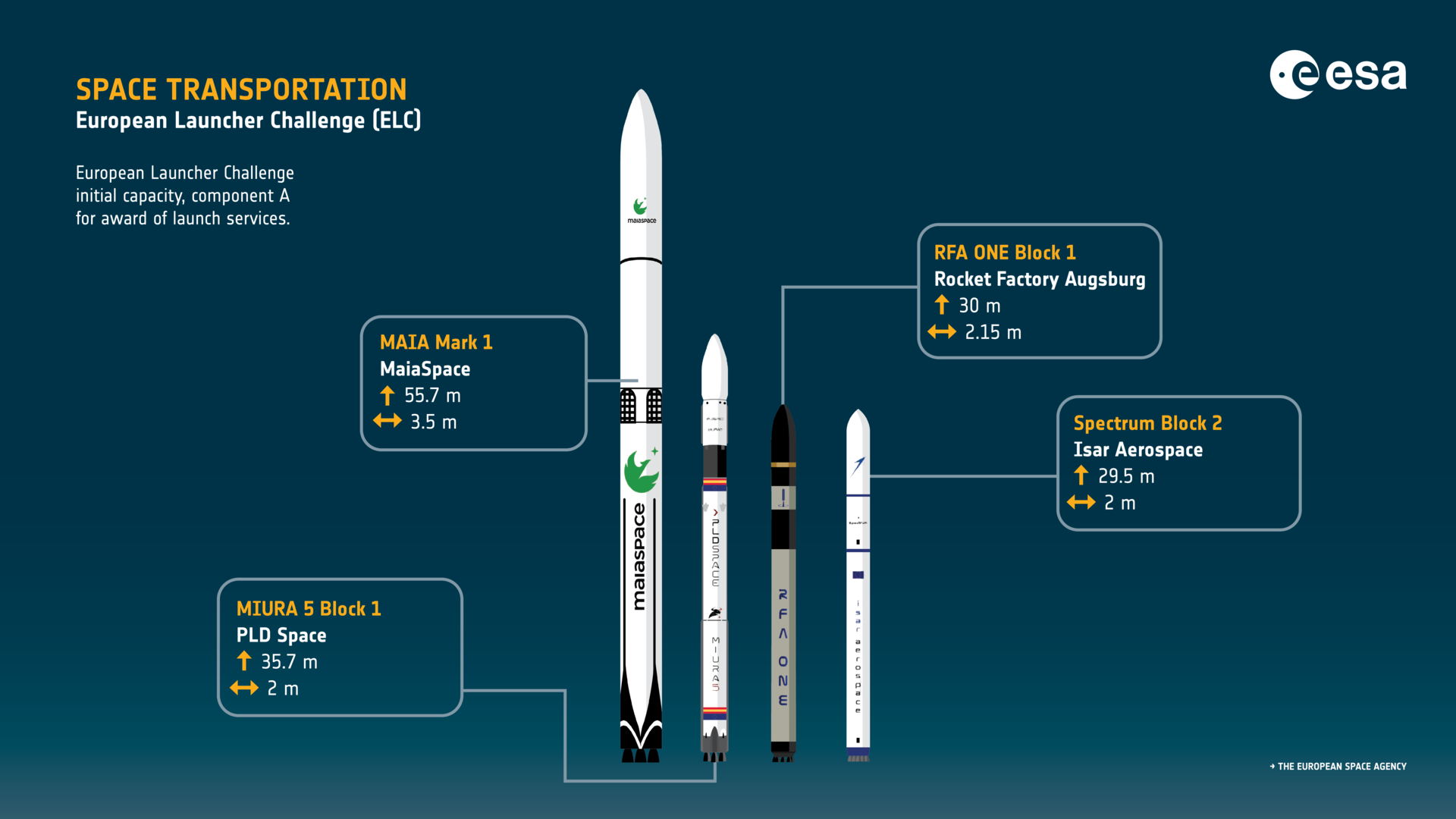
Saturday evening’s flight confirmed Isar’s pole position among European launcher startups. The other two awardees in ESA’s European Launcher Challenge—Germany’s Rocket Factory Augsburg and Spain’s PLD Space—claim to be targeting their first orbital launch attempts by the end of the year. MaiaSpace, a subsidiary of Ariane rocket-builder ArianeGroup, is in negotiations with ESA to become the fourth company participating in the European Launcher Challenge.

The challenge imposes several requirements for the participants, including a stipulation that they accomplish an orbital launch no later than 2027. Isar has now cleared this milestone just days after receiving its European Launcher Challenge contract.

European launch providers chosen for funds to ramp up their activities.

European launch providers chosen for funds to ramp up their activities. Credit: ESA

“Spectrum quite literally rose to the challenge and delivered its payloads in low-Earth orbit,” said Josef Aschbacher, ESA’s director general.

Isar’s next task is to repeat Saturday’s feat over and over again. It often takes several years for new rockets to scale to a consistent launch rate. Isar has customers lined up to launch on Spectrum, including the European Space Agency and several commercial satellite companies, like Astroscale, an enterprise focused on in-orbit servicing and space debris mitigation.

Isar has five more Spectrum rockets in production, according to Metzler. A new 10-acre factory near Munich will have the capacity to manufacture up to 40 launch vehicles per year. “Realistically, it’s going to take a few years until we will actually be there,” Metzler said. “We’ll try to push it as hard as we can, while making sure that the quality we put out of the factory is also actually good quality.”

Isar is in the early stages of developing a second launch site in Canada, and the company may eventually base launches from Kourou, French Guiana, home to Europe’s primary spaceport on the northeastern coast of South America.

But the factory in southern Germany has to churn a lot of rockets for Isar to fully take advantage of additional launch sites. The funding from ESA’s European Launcher Challenge will help Isar simplify and standardize its design to improve manufacturability.

“Ramping production is probably one of the hardest and most underrated challenges out there,” Metzler said. “Our margins of error are so small when you compare it to other industries. Sometimes, even a tolerance of a few micrometers on a single part out of 100,000 parts can make the difference between a payload that gets separated in orbit versus the rocket exploding somewhere during the flight.”

Metzler hinted that Isar has a “much bigger” launch vehicle in its roadmap, and the company has a “dedicated team” working on technologies for a reusable rocket. He declined to offer more details.

The Spectrum rocket will also grow slightly larger to carry heavier payloads. Isar aims to sell Spectrum launches somewhere between $10 million and $15 million.

“We’ve got to basically take the design and further streamline it, almost in a bit of an IKEA approach, where you can really build a lot of units,” Metzler said. “And you’ve got to make sure that every one of those units is actually good quality.”

A True-Crime Star’s Lurid Claims Sent a Man to Die. Her Key Witness Just Recanted.

0
a-true-crime-star’s-lurid-claims-sent-a-man-to-die-her-key-witness-just-recanted.
A True-Crime Star’s Lurid Claims Sent a Man to Die. Her Key Witness Just Recanted.


Twenty-four years after he provided crucial testimony that helped send a man to Texas’s death row, DNA expert William Watson has recanted his opinion and called out Harris County prosecutors — including an assistant district attorney turned true-crime TV star — for distorting his conclusions to win a conviction.  

In a new court filing seeking to overturn Jeffrey Prible’s 2002 conviction for the murder of a Houston family, Watson said he would never give the same testimony today. “Based on … changes in the field and my own increased experience and scientific knowledge, if I were asked to testify today, my answers to many of the questions asked by the State at trial would be different,” he wrote in a declaration filed on August 28. “Today I would provide more thorough and nuanced explanations.”

Watson also wrote that prosecutors “misrepresented” his testimony in both their opening and closing statements, and made “inflammatory” remarks that twisted both the science and his opinions.

Prible was accused of murdering his friends Steve Herrera and Nilda Tirado, who were found shot to death at their home in North Houston in 1999. A fire was started in an apparent attempt to cover up the crime; the couple’s three young children died from smoke inhalation. Prible had been hanging out at the couple’s home in the hours before they were killed, which made him an early suspect. But there was no evidence linking him to the scene — save for a DNA sample taken from semen collected from Tirado’s mouth. Prible had an explanation for this; as he told investigators at the time, he and Tirado had been having an affair behind Herrera’s back, and she had performed oral sex on him earlier that evening.

The case went cold until Harris County Assistant District Attorney Kelly Siegler took it over, reexamining the evidence and concluding that there was no innocent explanation for the presence of Prible’s DNA. Instead, Siegler decided, the semen was evidence of a brutal sexual assault that took place just seconds before Tirado was shot in the back of the head.

The theory was central to Prible’s conviction. “I would suggest to you what the evidence indicates is that the Defendant after killing Steve forced Nilda to orally copulate him at gunpoint and executed her as soon as he finished,” Siegler’s co-counsel, Vic Wisner, told the jury during the state’s closing argument. “As horrific as that sounds, that is the only logical conclusion that you can draw from that evidence.”

Siegler reiterated the claim to maximum effect: “She left this world with his penis in her mouth,” she told jurors in her closing, “hoping to God that her babies would survive the nightmare that is Jeff Prible.”

Prible was convicted and sentenced to death in October 2002; he maintains his innocence.

Prible’s case was at the heart of a three-part series published by The Intercept in 2023. The investigation explored how Siegler, who won 19 death sentences over the course of her nearly 22-year career in Houston, went on to become a true-crime celebrity in the decades after sending Prible to death row. The series also showed how her Oxygen Network true-crime reality shows — “Cold Justice,” now in its eighth season, and “Prosecuting Evil With Kelly Siegler,” starting its third season this fall — portray Siegler as a gifted crime-fighter and compassionate crusader for victims, even as she left a trail of questionable convictions in her wake.

In Prible’s case, as The Intercept’s reporting showed, Siegler built her prosecution not only on questionable claims about the DNA evidence, but also on the highly dubious account of a jailhouse informant who claimed that Prible confessed to him. This witness, it turned out, was part of a ring of snitches who cooperated with Siegler in exchange for assistance getting their own sentences reduced. During Prible’s federal appeals, multiple members of this snitch ring testified that informants offered Siegler false evidence against Prible — and one said that Siegler actually provided him with details about the case.

At best, Siegler was careless about scrutinizing the information they provided. At worst, as Prible’s lawyers argued to a federal district court, she actively conspired to win a conviction despite knowing the case wouldn’t otherwise hold up — framing an innocent man for murder.

In 2020, U.S. District Court Judge Keith Ellison overturned Prible’s conviction, finding that Siegler had withheld key information about her dealings with the informants from Prible’s defense. “Without question, the prosecution in this case engaged in a pattern of deceptive behavior and active concealment. And the evidence suppressed sufficiently serves to contravert the primary basis for Prible’s conviction,” Ellison wrote. “Siegler intentionally and knowingly withheld information,” he went on, and “was deceptive about her efforts to do so.”

“This new evidence shows that Prible is actually innocent.”

Texas appealed the ruling to the 5th U.S. Circuit Court of Appeals. Rather than considering the evidence that Siegler had violated Prible’s constitutional rights, the court instead reinstated Prible’s conviction based solely on procedural grounds. In the new state court filing, Prible’s legal team, led by Austin attorney Gretchen Scardino, reupped their previous allegations while also arguing to the Texas Court of Criminal Appeals that Watson’s recent recantation further undermines Prible’s conviction.

“This Court has not had the opportunity to review the trove of new evidence that came to light during the federal habeas proceedings, until now,” they wrote. “And even beyond that new evidence, there has been a significant development in Prible’s case.” Watson’s declaration cites “significant changes in the field of forensic biology, in the progression of the scientific methods used to analyze the evidence in Prible’s case, and in his own scientific knowledge,” they continued. “This new evidence shows that Prible is actually innocent.”

Watson first expressed misgivings about his trial testimony and the way it was weaponized in an interview with The Intercept in 2023. His answers were more definitive than they should have been, he said, and he certainly did not intend to endorse the state’s insistence that there was “no way in the world that semen wasn’t deposited either moments before or seconds after Nilda died.” “‘No way in the world’ is not something I would have said,” Watson told us.

The DNA from Tirado’s mouth was one of three samples collected after the murders. DNA matching Herrera, Tirado’s boyfriend, was also found on vaginal and anal swabs. At Prible’s 2002 trial, Watson testified he’d never before been able to extract a male DNA profile from an oral swab, and that his understanding was that sperm wouldn’t persist in the oral cavity absent Tirado’s murder. Siegler crudely emphasized these findings during her closing argument. To believe Prible’s claim that he and Tirado had engaged in consensual sex, she declared, jurors would have to believe that he had “some kind of magic semen … that somehow lives longer than any of y’all’s or any other man’s in this whole universe.” Moreover, “you’ve also got to believe that his semen is so tasty that she walked around savoring the flavor of it in her mouth for a couple hours. That’s the only way it’s going to end up still in her mouth after she’s dead.”

“These inflammatory remarks are not only scientifically baseless, but also highly inappropriate.”

In his new declaration, Watson took exception to Siegler’s closing. “I never testified to this, nor would I,” he wrote. “These inflammatory remarks are not only scientifically baseless, but also highly inappropriate.” Not only has his original understanding changed, Watson wrote, there is also no way to determine which of the three DNA samples was left first. In other words, while the state’s case was built on the assumption that Prible’s DNA was deposited last, in reality it was not scientifically possible to make such a claim.

Central to Prible’s new filing is a Texas law that explicitly offers defendants an opportunity to challenge their convictions based on new scientific evidence. “Although there was little available literature on the subject at the time, the scientific consensus today is that spermatozoa can survive in the oral cavity of a living person for up to fifteen hours — and even longer in a deceased person,” his legal team wrote. Their argument is supported by a new report from a second DNA expert, who explains that recent scientific advancements show that Watson’s testimony was, as Prible’s attorneys write, “wholly unsupportable.”

How the Harris County DA’s office responds to the new evidence remains to be seen. Kelly Siegler did not respond to a request for comment. In a statement, Assistant Federal Public Defender Nat Lombardo wrote, “Jeff Prible has spent nearly half his life on death row for a crime he did not commit. … This evidence supports Jeff’s account, from the very beginning, of what happened that night. Put simply: if Jeff were tried today, the State would have no case. We hope the DA and the courts do the right thing and give Jeff Prible his life back.”

Prible, who has been on death row for nearly 24 years and has seen dozens of his neighbors taken to the execution chamber, remains hopeful. “The way I see it, it is a true test of faith,” he wrote in a message to The Intercept. “I know in my heart of hearts my best days in this life are still yet to come!”

0FansLike
0FollowersFollow
0FollowersFollow
0SubscribersSubscribe
- Advertisement -
Google search engine

Recent Posts