21 C
London
Friday, September 4, 2026
Home Blog

Journeying through Syria’s shattered cities as they move from war to peace

0
journeying-through-syria’s-shattered-cities-as-they-move-from-war-to-peace
Journeying through Syria’s shattered cities as they move from war to peace

It was around seven o’clock in the evening when we arrived at a church in the city of Hama, Syria, to attend the wedding of a friend. As guests gradually filled the courtyard, music began to echo through the building. One by one, the bride, groom, and their relatives entered the church accompanied by songs, applause and cheers.

After the religious ceremony concluded, groups of young men and women began performing Ewiha, a traditional wedding chant in Syria and the Levant. Their voices rose and fell in a rhythmic dialogue as verses praising the bride and groom were answered by equally poetic responses from across the room.

Each verse concluded with a joyful zalghouta – the high-pitched ululation that has accompanied celebrations across the Arab world for generations.
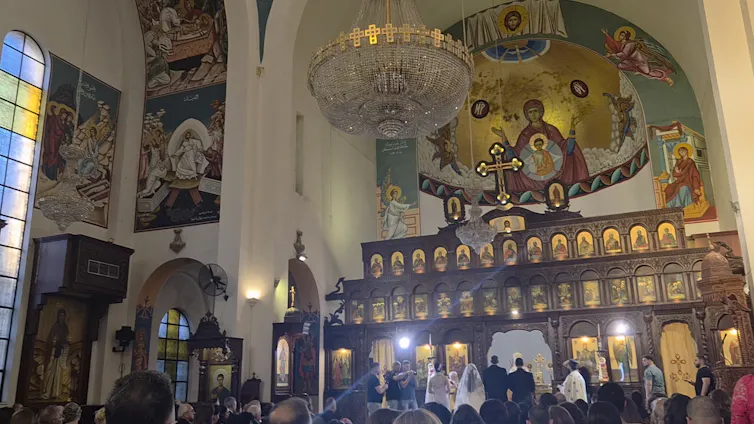
The inside of an ornate Syrian church

Inside the church in Hama for the wedding. Osman Bahadir Dincer

At first glance, there was nothing extraordinary about the wedding. Yet after more than a decade of war, the celebration felt like something more than a family gathering. It offered a powerful reminder that cultural traditions, social bonds, and everyday celebrations continue to endure, and that Syrians are trying to rebuild ordinary lives amid an uncertain transition.

But we were not in Syria to attend a wedding. As peace and conflict researchers, the three of us have long worked on questions of displacement, refugee return and post-conflict recovery; combining research on Syria with broader comparative perspective.

For this particular field trip, two of us, Bahadir and Zeynep, had spent the previous week travelling across Damascus, Rural Damascus, Aleppo and Raqqa observing firsthand how Syrians are navigating the country’s transition.

The journey, from June 1 to June 7, 2026, was part of a broader research programme that has involved more than 200 interviews over the past two years with Syrian returnees, internally displaced people, local officials, humanitarian workers and civil society representatives. These conversations, together with our wider research, have informed a series of peer-reviewed publications and policy reports on refugee return and reconstruction.


The Insights section is committed to high-quality longform journalism. Our editors work with academics from many different backgrounds who are tackling a wide range of societal and scientific challenges.


For years, researchers had studied Syria from afar, unable to conduct fieldwork across government-controlled areas during the Assad era. Although we made several short visits to Damascus after the regime’s collapse, this was our first opportunity to travel across the country and observe firsthand how people were rebuilding their lives – and how Syria’s transition was unfolding beyond the headlines.

We encountered destroyed neighbourhoods standing alongside reopened shops. Abandoned industrial sites and damaged infrastructure coexisted with busy cafes and crowded restaurants. Communities continued to struggle with unemployment, rising prices and unreliable electricity while many people nevertheless spoke cautiously of hope and new beginnings.


Read more: ‘My home city was destroyed by war but I will not lose hope’ – how modern warfare turns neighbourhoods into battlefields


The contrast captured something important about Syria today: hope and hardship coexist. So do recovery and destruction.

Between recovery and ruin

The scale of the challenge remains immense. More than 90% of Syrians live below the poverty line, and nearly 16.5 million people in Syria need humanitarian aid, alongside 2.5 million returnees.

Almost a quarter of the country’s housing stock has been damaged or destroyed, and reconstruction costs are estimated by the World Bank to exceed US$200 billion (around £150bn). Yet international support remains far below what is needed: as of mid-2025, the UN’s humanitarian response plan had received only a small fraction (14 %) of its required funding.
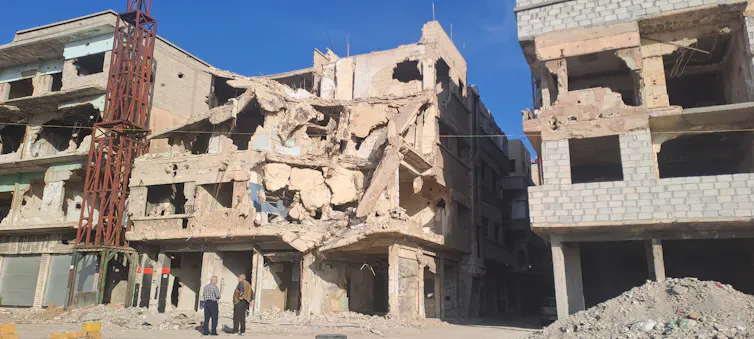
Men talking amid city ruins

Two men talk in a devastated part of Yarmouk. Osman Bahadir Dincer

Food insecurity affects millions of people, while years of conflict have severely weakened the country’s productive capacity.

These figures help explain the scale of Syria’s crisis, but they reveal little about how it is experienced in everyday life. That became much clearer during our journey: in conversations over tea, on long drives between cities, while walking through damaged neighbourhoods, and in discussions with residents, civil society representatives, local officials and business owners. Across these encounters, one impression emerged again and again.

Many Syrians welcomed the political changes, but few believed that political change alone would improve their lives. Economic concerns dominated almost every conversation.

Basic infrastructure remains under severe strain, with large parts of the country’s electricity, water and sanitation networks still non-functional. More than two million children remain out of school, while a shortage of teachers continues to undermine the education system.

Yet the challenges facing Syria are not distributed evenly.

What struck us most was how fragmented people’s experiences of the war had become. The contrast between affluent neighbourhoods such as Abu Rummaneh and heavily damaged areas like Jobar in Damascus could hardly be greater. The availability of basic services and living standards vary dramatically across regions, cities and even neighbourhoods. In Abu Rummaneh, restaurants are full, cafés are crowded and daily life appears relatively stable. Nevertheless, as one local resident told us:

“We sit on the ashes, and everything remains extremely fragile.”

Elsewhere in Damascus, entire districts still bear the scars of war. We were struck by how many residents had not visited Jobar since the fall of the Assad regime, despite living only a few kilometres away.

For many, the district remained a place known through photographs rather than personal experience. We were equally surprised to find that many humanitarian workers, NGO staff and policy professionals based in Damascus rarely ventured beyond the city’s central neighbourhoods. In many ways, Jobar felt as distant to them as it did to visitors from abroad.

These uneven realities are further complicated by the ongoing return of displaced Syrians. During a brief break between meetings, the Syria country director of one of the largest humanitarian organisations operating across the country welcomed us into her office.

As we cooled down with glasses of water and cups of coffee, after walking through the summer heat of Damascus, our conversation turned to the growing pressures facing Syria’s cities. “Returns to cities lead to rising prices, higher utility costs, more expensive housing and additional pressure on already scarce services”, she explained. For many returnees, settling in the capital is currently more feasible than returning to their original communities.
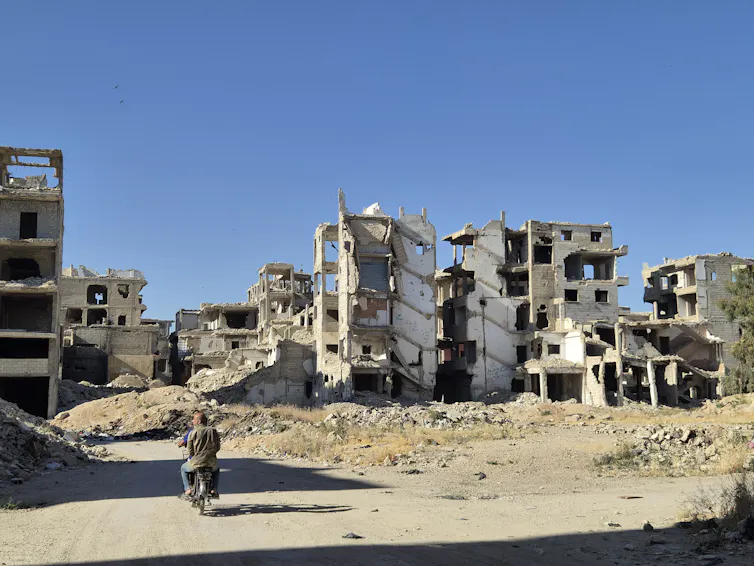
Man on a bike riding through broken city

Travelling through Jobar, Damascus. Osman Bahadir Dincer

The individual stories reveal what return looks like in practice. For example, Ahmad, our local research assistant, returned from Turkey to Damascus immediately after the fall of the Assad regime, even though his hometown is Raqqa. Unable to find suitable employment there, he now works as a sports trainer at a youth centre in Damascus. Despite earning an income, he cannot afford to rent an apartment and instead lives in a room within the sports complex.

We heard a similar story from a taxi driver in Damascus who had returned from Turkey five years earlier after years of displacement. Originally from Idlib, he picked us up outside our hotel and, as we crawled through Damascus traffic, told us that despite holding a university degree, driving his ageing taxi was the only steady work he had been able to find.

“This taxi is my only reliable source of income,” he said, tapping the dashboard. “It constantly needs repairs, but without it, I wouldn’t be able to support myself.”

By the time he dropped us off in Bab Touma, our short journey had become another reminder that returning home is only the first step toward rebuilding a life.

On the road across Syria

Our journey towards Rural Damascus, Aleppo, Raqqa and Hama began at 7:30 on a warm Damascus morning, when Ahmed – our driver, research assistant and guide for the days ahead – picked us up from our hotel. Although the city was only beginning to wake up, the summer heat was already building. Before continuing towards rural Damascus, we asked Ahmed to take a short detour through Jobar and Yarmouk.

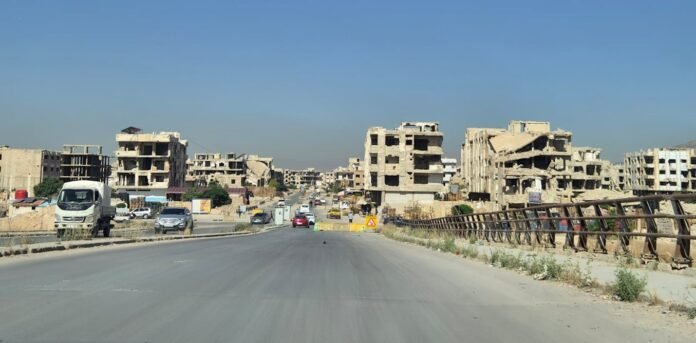
Jobar, once one of the fiercest frontlines between government forces and rebel factions from 2013 to 2018, remains perhaps the most heavily damaged district of the capital. Entire blocks have been reduced to rubble.

As we walked through the shattered streets, Mohammed, a young activist who had recently returned to Syria and now worked in a local government office, reflected on what the neighbourhood had endured.

“Even though Jobar has always been part of Damascus, it was forgotten during the war and remained forgotten afterwards,” he told us. Gesturing towards the collapsed buildings around us, he continued:

“Since the fall of the regime, most of what you see has been done by people who have returned. They are clearing the rubble, repairing what they can and trying to rebuild their lives. But many Damascenes still haven’t set foot here. Jobar cannot truly recover unless the rest of Damascus comes back too – not only to rebuild it, but to see it, remember it and make it part of the city again.”

Yarmouk, once the largest Palestinian refugee camp in Syria, presents a similarly sobering picture. While a small number of homes have been partially repaired, much of the neighbourhood remains scarred by destruction.

As we walked through the area, we noticed an elderly couple sitting quietly on plastic chairs outside one of the few inhabited houses, surrounded by rubble and the remnants of damaged buildings. They appeared to be watching the street – or what remained of it.
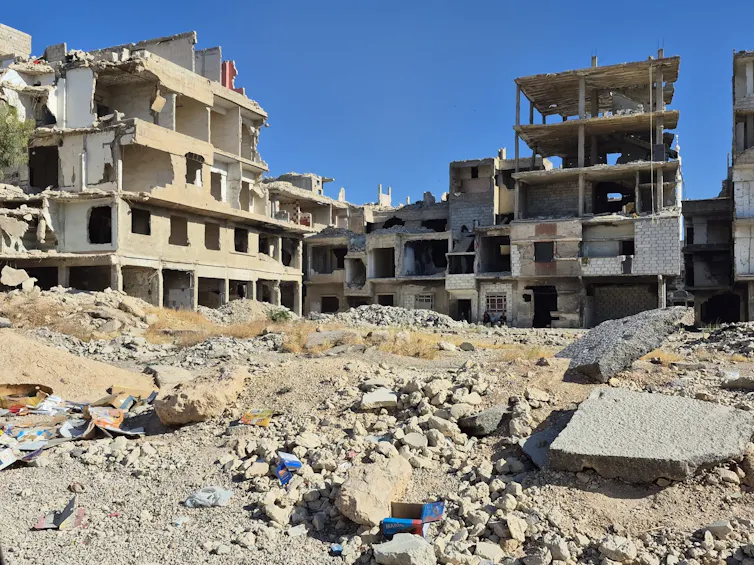
People living in ruins

Two Yarmouk residents sitting on chairs maid ruins. Zeynep Sahin-Mencütek

The scene captured the contradictions of post-war Syria: life has returned, but often under conditions that would be difficult to imagine from a distance. For many residents, rebuilding has meant learning to live alongside the ruins rather than beyond them.

Travelling further into Eastern Ghouta and Harasta offers another stark reminder of the scale of destruction that still shapes much of the country.
The road into a Syrian city.

Entering Ghouta. Osman Bahadir Dincer

Yet what is striking is not only the destruction, but the coexistence of destruction and recovery.

Beside a ruined apartment block, a small shop may have reopened to sell bread or construction materials. On streets where fighting once took place, children play or collect scrap to sell, while a father, mother and children ride together on a single motorcycle. Life is returning, often much faster than reconstruction. Small shops and derelict children’s playgrounds can be seen amid the war-damaged buildings.
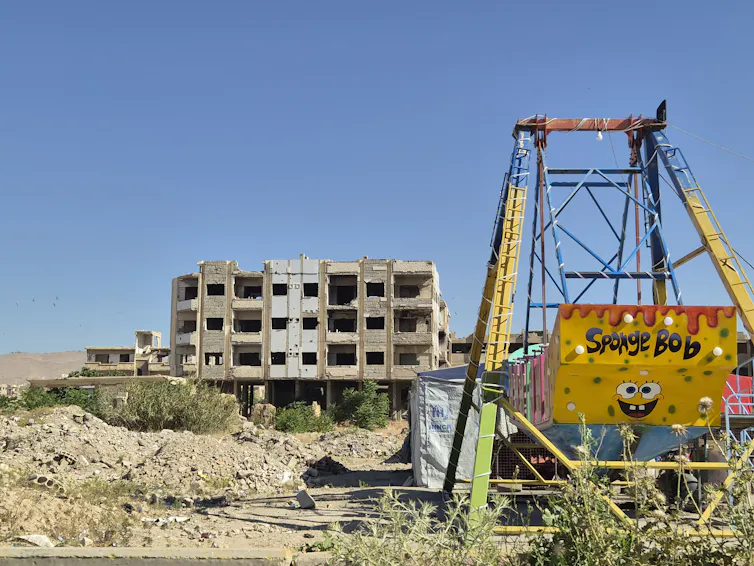
Broken down playground amid city ruins.

A derelict playground. Osman Bahadir Dincer

After this brief but sobering visit to Rural Damascus, we set off for Aleppo. The journey itself proved almost as revealing as the cities themselves. Along the M5 highway, abandoned buildings, depopulated settlements and damaged industrial facilities stand as reminders of the conflict’s enduring legacy.

Yet signs of recovery appeared just as frequently: roadside fruit vendors selling seasonal produce, families stopping at newly reopened shops and a steady stream of traffic where ageing vehicles now shared the road with new cars. Ahmed smiled as he pointed to several recently imported SUVs passing us. “Before 2025,” he said, “you almost never saw new cars on Syrian roads. They’ve only started appearing recently.”

Near Hama, we stopped at a large roadside supermarket. Workers stocked shelves while families shopped for groceries. Ahmed insisted that we try a local milk-based dessert, a small gesture of hospitality that would be repeated throughout our journey. Such moments served as reminders that alongside destruction and hardship, everyday life and customs continue.

Aleppo: a broken city

The last time we had travelled through Aleppo countryside was in 2013. More than a decade later, we found ourselves approaching the city with a mixture of curiosity, anticipation and unease. We did not know what awaited us.

For years, Aleppo had existed for us through news reports, and the testimonies of those who had fled. The prospect of finally seeing, with our own eyes, a city that had occupied so much of our research and conversations over the years was both exciting and deeply humbling.

The city that greeted us reflected both its long history and the profound transformations brought about by the conflict. After checking into our hotel in the Aziziyeh district, we wasted little time before heading straight to the Old City. For years, we had heard about the devastation that had befallen Aleppo’s historic heart.

Walking through its narrow streets, it was difficult not to imagine the vibrant markets, workshops and cafés that had once animated these neighbourhoods. Although restoration has brought parts of the old souq and several historic landmarks back to life, large sections of the Old City remain scarred by war, making it impossible to ignore the scale of what Aleppo has lost.
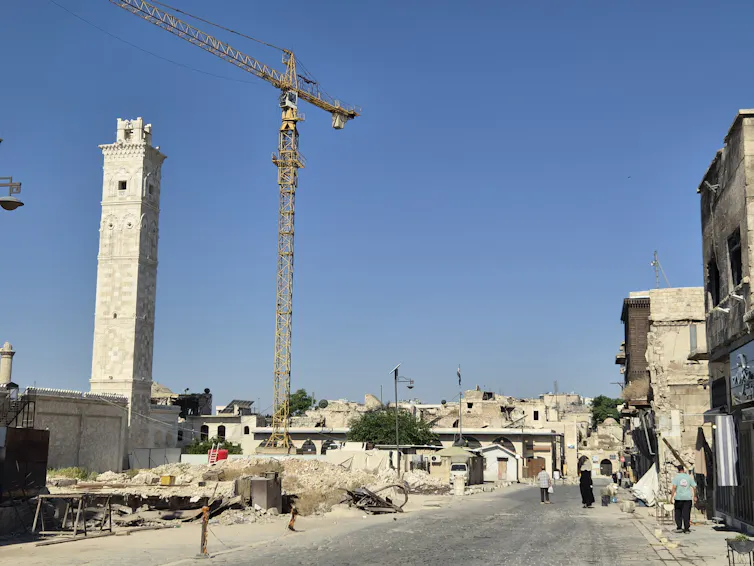
Work in the Old City of Aleppo

A part of the Old City in Aleppo. Osman Bahadir Dincer

Together with Amr, an Aleppo native who guided us through the city, we spent hours walking through some of the hardest-hit districts, including parts of the Old City, Shaar, Hanano, Karm al-Jabal and Qadi Askar.

The scenes were overwhelming. Destroyed apartment blocks, mountains of rubble and damaged infrastructure remain an integral part of the urban landscape. Walking through the crowded streets with Amr, he pointed to a recently cleared road. “Many of the people returning to Syria are coming back to Aleppo,” he told us. “Many of these streets were blocked by rubble. People cleared them themselves. Otherwise, they couldn’t even get to their homes.”

We also visited Sheikh Maqsoud and Ashrafiyah following the political and military changes that took place earlier this year. Aleppo felt neither fully recovered nor frozen in the past.

As evening fell, the streets filled with families, cafés buzzed with conversation, and restaurants were packed with people enjoying the cooler hours after the summer heat. All this was in stark contrast with the destruction we had witnessed only hours earlier.
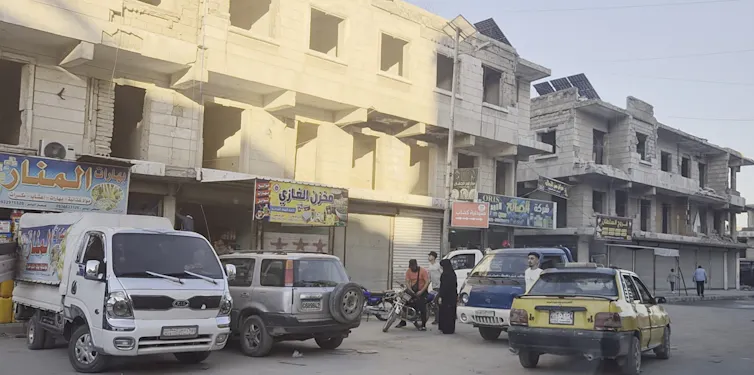
Cars parked in a busier part of Aleppo

The buzz of Eastern Aleppo. Osman Bahadir Dincer

Raqqa and the weight of multiple conflicts

Early the next morning, after a simple breakfast of falafel and tea, we began the long drive east towards Raqqa with Ahmed.

Now in his late-thirties, Ahmed had grown up in Raqqa as one of 11 siblings before moving to Damascus for university. Like many Syrians of his generation, the war had disrupted much of what might otherwise have been an ordinary life. Years of displacement, uncertainty and constant upheaval had postponed plans that many of his peers elsewhere might have taken for granted – including getting married, something he now hoped to do in the near future.

Ahmed had not travelled this route, from Aleppo to Raqqa, for more than 15 years. Throughout the conflict, the route had been effectively closed to ordinary civilians as frontlines shifted and different armed groups controlled different stretches of the highway. As we drove further east, the journey became as much about his personal memories as about Syria’s recent history.

Every so often, he slowed the car to take a photograph. When we asked what had caught his attention, his answer was rarely political. “It just reminds me of my childhood,” he said with a smile. A weathered wall by the roadside, an abandoned building, or a familiar landmark would suddenly unlock another memory from a life interrupted by war.

As we passed an abandoned cement factory on the outskirts of Aleppo, he eased off the accelerator and looked towards the empty building: “Whenever we saw that factory, we knew we had arrived in Aleppo”, he recalled. After a brief pause, he looked at the complex and quietly added “now it is no longer working.”

A little later, he slowed down again, this time pointing towards an old roadside wall. Smiling, he said: “My brothers and I used to play games here whenever we travelled to Aleppo.” It was a simple memory, yet one that revealed how Syria’s roads hold far more than the traces of war.
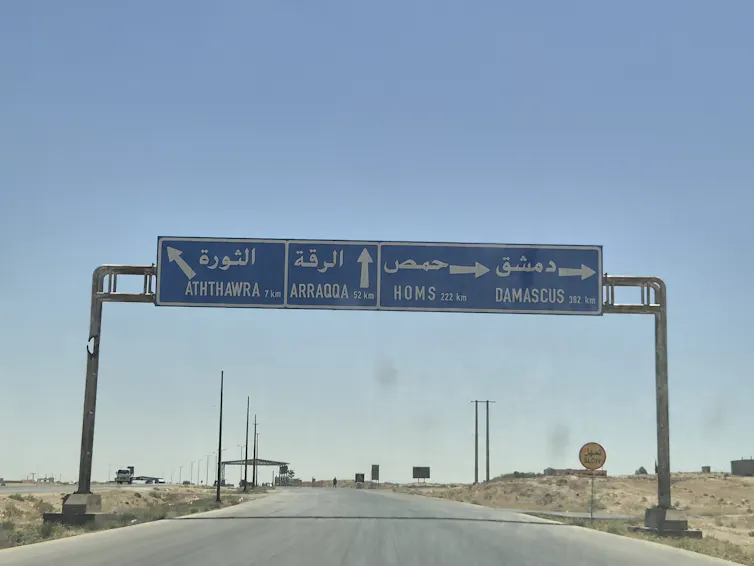
Image of a road and road sign.

The road from Aleppo to Raqqa. Osman Bahadir Dincer

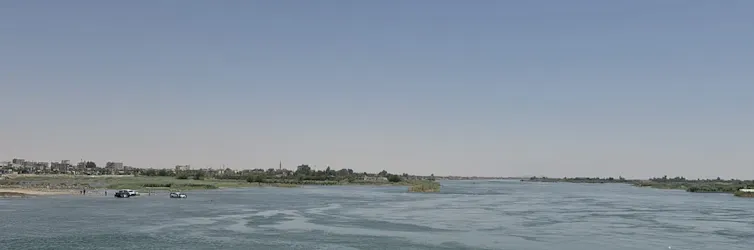
As we approached Raqqa, the scenery began to change. The dry, dusty landscape gave way to greener fields nourished by the waters of the Euphrates. After hours on a highway that alternated between smooth stretches and cratered sections – forcing Ahmed to brake, accelerate and swerve repeatedly to avoid potholes – the sight of the river valley was refreshing.

Crossing the Euphrates over bridges hastily repaired, we entered what Syrians often refer to simply as east of the river – a vast region encompassing Raqqa, Deir al-Zor and Hasaka.

Only a few months earlier, reaching Raqqa had been significantly more complicated. Until recently, the city was controlled by the Syrian Democratic Forces (SDF), a Kurdish-led coalition that governed much of north-eastern Syria separately from the authorities in Damascus. Now, following the SDF’s withdrawal from the city in early January, we were able to enter Raqqa freely.

Raqqa feels different from Damascus or Aleppo. It is not necessarily the most physically destroyed city, but it may be one of the most exhausted. Long before the war, Raqqa was among Syria’s least developed and a neglected province. It later became a centre of anti-regime mobilisation, endured years of conflict, served as the de facto capital of Islamic State (IS) and subsequently came under SDF administration.

The cumulative weight of these experiences is visible everywhere. Not only the people seem tired; the roads, buildings and public spaces carry a similar sense of exhaustion. Even the remains of the summer palace associated with Harun al-Rashid, the eighth-century Abbasid caliph, who ruled one of the most powerful empires of the medieval Middle East, appear worn by history.
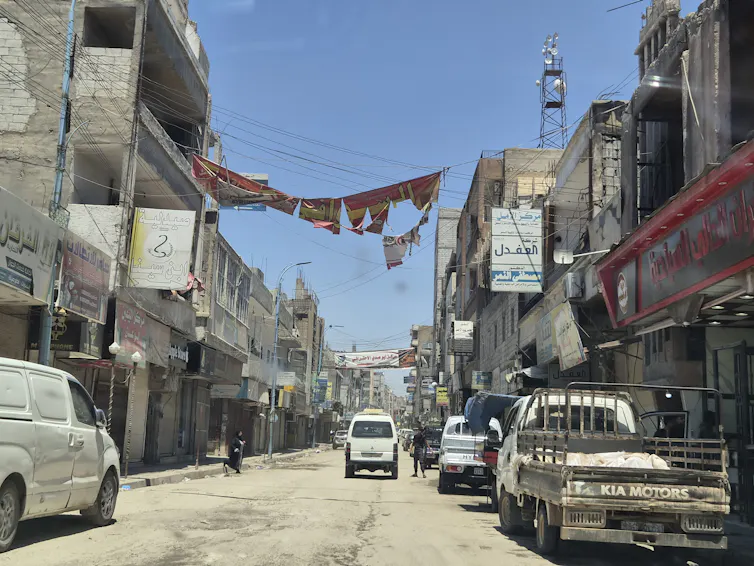
A city street

Raqqa City. Osman Bahadir Dincer

Our visit to Raqqa coincided with Friday prayer, so we briefly went our separate ways. Bahadir joined our local host at one of Raqqa’s largest mosques, while Zeynep spent the time with a local family in their home.

The mosque was packed. One detail stood out immediately: the large number of visibly disabled worshippers, a quiet reminder of the human costs of years of war. Yet what left an even stronger impression came at the end of the sermon. The imam announced that donations would be collected after prayers for communities affected by recent flooding in Deir ez-Zor. Similar collections, he explained, were taking place in mosques across the country. The moment may seem unremarkable elsewhere, but in a country fragmented for years by conflict, competing authorities and shifting frontlines, the idea that communities across Syria were contributing to a common cause felt significant.

Meanwhile, Zeynep was sitting in the guest room of a modest apartment on the third floor of a six-story building, listening to the stories of two sisters who had returned to Raqqa.

Among two brothers and eight sisters, almost every major migration trajectory was represented. One sister, a middle-aged schoolteacher, had spent four years in Turkey before returning to reclaim her teaching position in Raqqa. Another had sought refuge in Jordan, she returned only a few months earlier, while her husband and son remained behind, hoping to join her later. Other siblings and relatives were scattered across Turkey, Germany and different parts of Syria. Yet despite the distance separating them, the family remained closely connected, constantly exchanging news, coordinating plans and talking about when they might be together again.

Looking around the room, one of the sisters smiled sadly. “Before the war,” she said, “this room was always full. There was hardly any space because our whole family gathered here. Now it’s just the two of us. The others have scattered like leaves in the wind. But, God willing, our mother will return soon. Then perhaps our brother, and one day our children and grandchildren too.”

For many Syrian families, displacement has become a long-term condition that generates complex patterns of mobility, transnational connection, return, separation, and reunion, continuing to shape everyday life long after the guns have fallen silent.

Once the visit to the mosque was over, we reunited to the sisters’ apartment, where Arabic coffee and homemade cake were waiting for us. After one last conversation and our farewells, we set off for Hama, where we had been invited to a wedding, before continuing to Damascus later that evening.

The road from Raqqa back toward western Syria revealed both change and continuity. Burnt-out military vehicles still lined parts of the route, while former checkpoints stood abandoned, reduced to empty plots of land and crumbling structures. Yet another feature caught our attention: long queues of ageing trucks moving slowly along the highway, a reminder that commerce and mobility are gradually returning.
Old trucks lining the road

Long queues of ageing trucks. Osman Bahadir Dincer

These signs of renewed movement, however, should not be mistaken for a broader economic recovery. Along much of the route, we saw little evidence that major industrial facilities, food-processing plants, or energy infrastructure were being restored at the scale required to revive local economies. This was particularly striking given the importance of agriculture and energy for Syria’s future recovery.

By midday, the heat had become almost unbearable, and we pulled over at a small roadside shop to buy water. The makeshift building stood alone beside the highway, surrounded by an otherwise empty landscape. Inside, most of the large room was bare. In one corner, a few tables displayed biscuits and wafers, while an old refrigerator held a handful of cold drinks.

A young shopkeeper, probably in his early twenties, came over to greet us. He first asked in Arabic where we were from. When we replied that we lived in Germany but were originally from Turkey, he immediately switched to fluent Turkish. Having recently returned after several years there, he was eager to share how much had changed since coming home. “Five months ago,” he said as he handed us bottles of water, “I would have been stopped at ten checkpoints to get here. Sometimes I would wait for hours. Economically, life may have been easier then. But we had no freedom of movement. Now I can travel without anyone stopping me.”

In fact, despite being foreigners, we experienced something of that change ourselves. Travelling with a Syrian colleague, and perhaps also because one of us was a woman, we passed checkpoint after checkpoint without ever being asked to stop. Each time, Ahmed simply slowed the car, exchanged a brief greeting with the soldiers and continued on our way.

One of the changes people mentioned most often was the simple ability to travel freely. Whether moving between cities or crossing from one neighbourhood to another, no longer being stopped, questioned, or delayed represented a profound shift after years in which movement had been shaped by checkpoints, frontlines and competing authorities. As one Syrian after another told us, “the road has become a road again.”

Freedom amid ruins

Many Syrians describe the post-Assad period as a “liberation”. Across different regions and social backgrounds, people repeatedly spoke about the end of fear, the ability to express opinions more openly and the possibility of imagining a different future. While political views remain diverse and uncertainties abound, there is nevertheless a widespread sense that a new chapter has begun.

What struck us was that people rarely explained this through abstract political language. Instead, they pointed to small changes in everyday life. In Damascus and Aleppo, many drew our attention to functioning traffic lights and police officers managing busy intersections. “Look around you,” they would say. “The traffic lights are working again. The police are back on the streets. These are small things, but they make people feel that life is becoming normal again.”

Around Raqqa, following the withdrawal of the SDF from parts of the region, residents expressed a similar sentiment. “For the first time in years,” one resident told us, “we feel free.” For many, this was not primarily a political statement but a reflection of how they experienced everyday life.

Hope was visible not only in what people told us, but also in what they were doing. In Aleppo, we visited a community centre where we met Esma, Mustafa and several other staff members working to support women, children and returning families through educational and rehabilitation programmes.

The building itself reflected Syria’s changing realities. Once the Baath Party’s youth centre, where generations of young Syrians were exposed to state ideology, it has recently been transformed into a place for learning, vocational training and community support.

Esma, who returned from Turkey despite holding Turkish citizenship, now teaches Turkish/Arabic at the centre. Mustafa, who returned from Germany, serves as its director, coordinating its educational and rehabilitation programmes. As we walked through the building together, moving from one classroom to another, we asked Esma why she had chosen to return despite having opportunities to remain abroad. Her answer came without hesitation: “My country is trying to stand up again. People here need us. If not now, then when we will contribute?” Standing beside her, Mustafa nodded quietly, a smile spreading across his face as she spoke. He did not add anything; he didn’t need to. His expression said he fully agreed.

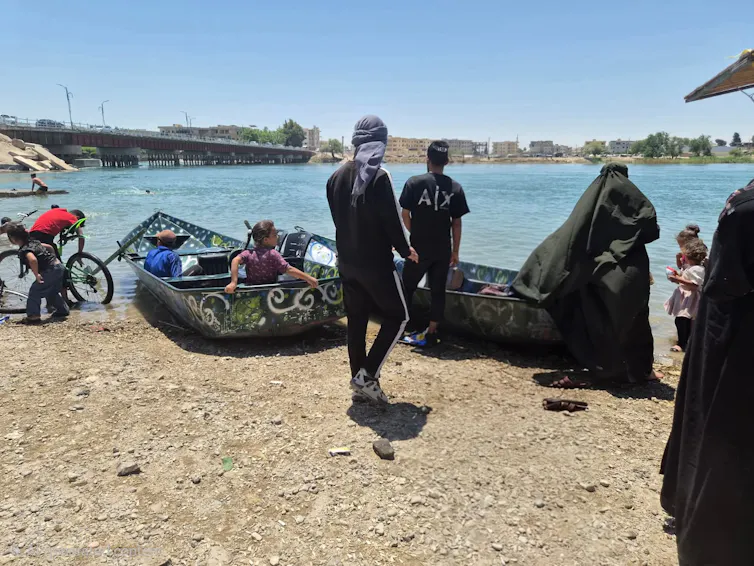
We encountered similar positive scenes in Raqqa. Along the banks of the Euphrates, families gathered for picnics while young boys plunged into the fast-moving current without hesitation. Nearby, young men ferried visitors along the river in small boats fitted with rows of plastic chairs, offering short sightseeing trips. Vendors moved between the groups selling tea and coffee, while others washed their cars along the riverbank. Much of this everyday activity unfolded beneath the partially repaired bridge connecting the eastern and western sides of the city.

At first glance, it looked like an ordinary summer afternoon by the river. Yet there was something profoundly symbolic about people reclaiming a space that had once been synonymous with war.
People and boats by the river

Everyday life along the river. Osman Bahadir Dincer

Reconstruction projects in Syria often carry a significance that extends far beyond their practical purpose.

Driving back from Hama to Damascus late one evening, we found ourselves unexpectedly caught in a celebration. Earlier that day, President Ahmed al-Sharaa had officially reopened the Rastan Bridge, a strategic crossing that had remained closed for years. Only a few days earlier, we ourselves had been forced to bypass the bridge and drive through Rastan because the crossing was still inaccessible.

Now the atmosphere was entirely different. Families strolled together, young men waved Syrian flags, children ran between the crowds and motorcycles carrying two or three passengers moved slowly back and forth as people stopped to take photographs and celebrate on the bridge.

Yet the optimism we encountered during our travels was almost always accompanied by reminders of the challenges that remain. Across much of the country, the physical, economic and social consequences of war continue to shape everyday life.

Economic difficulties are only one dimension of the challenges Syrians continue to face. Another lies beneath the ground itself. As we were leaving Raqqa, Ahmed pointed towards the open fields stretching alongside the road. They looked calm and ready for cultivation, yet he shook his head. “Hardly a week passes without reports of new casualties,” he said quietly. “People still lose their lives because of mines.”

His remark immediately brought us back to a meeting a few days earlier at the United Nations Development Programme office in Aleppo. Standing in front of a large wall map of the city, one UNDP official traced neighbourhood after neighbourhood with his finger as he explained the scale of destruction and contamination. Large areas of farmland, villages and former frontlines, he told us, remain littered with landmines and unexploded ordnance, preventing people from farming, rebuilding, or even returning safely.

We heard the same concern echoed by government officials. During a meeting in Damascus, one ministry representative described mine clearance as one of the country’s most urgent priorities. “We need to clear the mines,” she told us. “They are everywhere in Syria.”

Returning to Syria is difficult

Our journey across Syria reinforced a finding that has emerged repeatedly from our research on refugee return: crossing the border is only the beginning. Experiences from Bosnia and Herzegovina, Kosovo, Iraq and other post-conflict settings show that return often remains partial, temporary, or circular when employment opportunities, public services, social trust and functioning institutions are absent.

Across these cases, return has proven to be a long-term process of reintegration. As one adviser involved in Syria’s return and recovery policies, told us: “We aim to bring 80 percent of Syrian refugees from Germany, as the German Chancellor requested. However, this requires the creation of 200,000 jobs and housing beforehand. Refugee returns should be conducted in a dignified manner to ensure they go back to safe areas, both psychologically and politically. For example, returning refugees should have access to a roof and non-mined environments.”
The river outside Raqqa

The dry, dusty landscape gave way to Raqqa’s greener fields nourished by the Euphrates. Osman Bahadir Dincer

The real question is no longer whether Syrians want to return, but whether the conditions exist for them to remain. With widespread housing shortages, limited employment, fragile public services and millions of people still relying on remittances from relatives abroad, many returnees risk exchanging one form of uncertainty for another. Without meaningful reconstruction and economic recovery, return is unlikely to mark the end of displacement – it may simply become another stage of it.

Across Europe, discussions about Syria increasingly focus on whether the conditions for refugee return are finally emerging. Yet our journey across the country suggests that these debates often overlook Syria’s current realities. Even government officials acknowledged that rebuilding homes, restoring infrastructure, reviving the economy and supporting displaced communities are already stretching the country’s limited resources.

Under these circumstances, a rapid increase in refugee returns could place additional pressure on communities that are themselves still struggling to recover. As one resident in Damascus put it “returnees will drown Syria” – not because their return is unwelcome, but because the country’s economy and institutions are simply yet not able to absorb large numbers of people.

Our journey ended shortly after 1am, when Ahmed dropped us off at our hotel in Damascus. In just a few hours, we would be boarding our flight back to Germany. Yet as we said our goodbyes, our thoughts returned once again to the wedding in Hama.

For a few hours, conversations shifted away from war, displacement, politics and economic hardship. Families gathered, children played, music filled the courtyard and guests celebrated the beginning of a new chapter in the lives of the bride and groom. It was not that people had forgotten Syria’s challenges.

Everyone present was fully aware of them. Rather, it was the determination to celebrate despite them.


For you: more from our Insights series:

To hear about new Insights articles, join the hundreds of thousands of people who value The Conversation’s evidence-based news. Subscribe to our newsletter.

War lingering, Pentagon extends Mideast troop deployments into ’27

0
war-lingering,-pentagon-extends-mideast-troop-deployments-into-’27
War lingering, Pentagon extends Mideast troop deployments into ’27

Secretary of Defense Pete Hegseth addresses U.S. military personnel at Panama Pacifico Airfield, Panama, April 9, 2025. Photo: US Marine Corps / Lance Cpl. Mya Seymour

The Pentagon has reportedly extended Middle East deployments of American troops, fighter squadrons, and warships into next year as the deadly, expensive, and deeply unpopular Iran war drags on with no end in sight.

The Wall Street Journal reported late Wednesday that Pentagon Secretary Pete Hegseth – who, like President Donald Trump, insisted the Iran assault would be over swiftly – has decided that the US military will maintain a “presence of 50,000 troops in the region in part to give the president flexibility on next steps.” The Pentagon “could also keep elements of the Army’s 82nd Airborne Division in the Middle East well into 2027,” the Journal added, citing a letter that military leaders sent to families.

The Journal also reported that Trump, who has falsely called Iran a “dead” country, is “having discussions with senior aides about whether to declare the Iran war over,” even as the bombings continue, American troops remain in the region, and the administration ratchets up economic sanctions.

Trump administration seems to excel at bombing schools and weddings,” Brian Finucane, senior adviser to the US Program at the International Crisis Group, wrote on Wednesday. “Winning the illegal and unnecessary war with Iran – not so much.”

Hegseth has reportedly backed a plan that would involve “periodic” bombings of Iran in an attempt to keep ship traffic flowing through the Strait of Hormuz, a strategy that analysts say would lead to a “permanent state of war.”

Trita Parsi, executive vice president of the Quincy Institute for Responsible Statecraft, argued earlier this week that Trump appeared to be leaning toward “maintaining a low-level conflict until the midterms – neither securing a diplomatic deal nor allowing the situation to deteriorate into full-scale war.”

“Iranian officials say, both publicly and privately, that they expect the US and Israel to resume the war after the midterms regardless of the impact of the D-Day sanctions,” Parsi wrote. “Regional diplomats have largely reached the same conclusion. If sanctions weaken Iran over time while the global economy recovers and adjusts to the new reality in the Strait, a prolonged pause will work against Tehran. Iran may therefore decide to escalate dramatically, taking full advantage of Trump’s perceived vulnerability in the run-up to the elections.”

Thousands of Iranians—including hundreds of children – and at least 18 US servicemembers have been killed during the war so far, and the conflict has cost the average American household $1,200 in extra costs as gas prices remain at record levels. Trump has said he doesn’t “think about Americans’ financial situation” when he makes decisions pertaining to the Iran war.

The war is fueling the Trump administration’s push for a record $1.5 trillion in military spending for the coming fiscal year—a budget demand that has intensified concerns of a “forever war” against Iran.

“ Washington is betting that sustained military and economic pressure will eventually force Tehran to retreat,” the National Iranian American Council wrote in a blog post on Wednesday. “Iran appears to be betting that it can survive long enough to force Washington to do the same. For ordinary Iranians, American servicemembers, and civilians across the region, the danger is that testing those two assumptions will require a much longer and more destructive war.”

-Common Dreams

Trump calls US ammunition shortage reports ‘treasonous’ amid Iran war

0
trump-calls-us-ammunition-shortage-reports-‘treasonous’-amid-iran-war
Trump calls US ammunition shortage reports ‘treasonous’ amid Iran war

US President Donald Trump on Thursday accused people and media outlets questioning US ammunition supplies of being “treasonous” as he defended the country’s ongoing military action against Iran, Anadolu reports.

“The people and Media Outlets that keep harping on the fact that we have no ammunition … are actually treasonous,” Trump said in a post on his Truth Social platform.

He accused critics of wanting to see the US lose a war that he said the country was “easily WINNING,” rather than see him succeed.

In a second post, Trump insisted that the US has “virtually unlimited amounts” of ammunition.

He said the US has more mid- to high-grade ammunition than it could use in the current operation or any other potential war, while claiming that the country is producing munitions at “levels never seen before.”

“We are stockpiling and preparing for any contingency that could happen,” he said.

Trump added that Washington was retaining ammunition for its own military rather than selling it to other countries, but said arms sales to US allies would resume “soon.”

He also criticized the administration of former President Joe Biden over military assistance provided to Ukraine, claiming his predecessor gave Kyiv more ammunition, free of charge, than the US has used in Iran.

“Hundreds of Billions of Dollars was given to Ukraine and NATO, free of charge, that Europe would have paid for,” Trump said, without providing evidence to support the claim.

He added that his administration would seek reimbursement from European countries for the assistance, saying Washington would ask for the money “somewhat belatedly.”

Trump’s comments come amid scrutiny over US military resources and ammunition consumption as Washington continues its operation in Iran.

The president has repeatedly defended the US military’s capacity while criticizing reports and commentary that he says portray the country as lacking sufficient weapons and ammunition.

Reports: RFK Jr. ordered measles deaths deletion; CDC still secretly counts them

0
reports:-rfk-jr.-ordered-measles-deaths-deletion;-cdc-still-secretly-counts-them
Reports: RFK Jr. ordered measles deaths deletion; CDC still secretly counts them

The Centers for Disease Control and Prevention is still secretly counting two measles deaths that were deleted from the agency’s public measles data—a deletion that occurred at the direct request of anti-vaccine Health Secretary Robert F. Kennedy Jr., according to two reports released today.

Early today, Reuters reported that Kennedy instructed new CDC director Erica Schwartz to delete the two deaths from the agency’s website. CDC staff had reportedly already reviewed information about the deaths and accepted the characterization that they were measles-related. Still, Schwartz deleted the deaths without objection, insiders told Reuters. According to previous reporting, the two deaths were added and then removed from the CDC’s website within hours on August 30.

The deaths were of a newborn and a child, and they were reported last week by health officials in Pennsylvania. The state’s ongoing measles outbreak has sickened 540 so far, including 119 just in the last week.

This afternoon, Inside Medicine reported that an internal CDC database still includes the two deaths, according to a screenshot that was reportedly verified by CDC staff. The database, called “One CDC Data Platform,” is accessible to state and local health officials as well as CDC employees.

Ars Technica reached out to the Department of Health and Human Services (HHS) about the discrepancy, but it did not immediately respond.

Compromised CDC

Historically, state and local health departments are the ones that make determinations about cases and deaths in an outbreak, and the CDC collects the reports for nationwide reporting.

Soon after Pennsylvania health officials announced the deaths, Kennedy got into a heated exchange with Governor Josh Shapiro, who criticized Kennedy’s anti-vaccine rhetoric and misinformation as helping to fuel such outbreaks. Kennedy fired back on social media, posting misinformation about the measles vaccine and claiming without evidence that the state may have “fabricated” the deaths.

When the CDC initially publicly reported the deaths on August 30, the agency included an unusual note saying that “Health departments make determinations about measles-associated deaths and share relevant information with CDC.” But now the two deaths have been deleted and what remains is an even more unusual note saying that the CDC was not reporting the deaths because “available information does not establish whether measles caused or contributed to the deaths or whether the individuals died from other causes while infected with measles.”

In an earlier statement to Ars Technica, HHS said that the two deaths in Pennsylvania “have not been confirmed based on the information currently available to CDC.” A spokesperson did not respond to a follow-up question about what information the CDC was lacking and/or awaiting from the state.

Pennsylvania’s state health department has said that it has provided the CDC with all the required information.

Why Pacific Island states should seek collective security

0
why-pacific-island-states-should-seek-collective-security
Why Pacific Island states should seek collective security

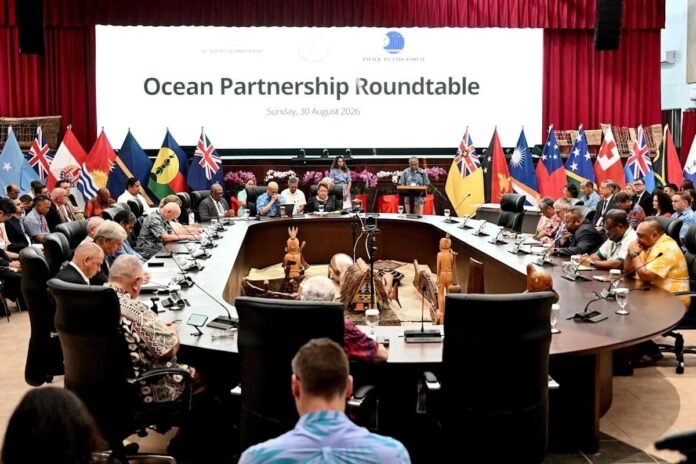
Many participants at the Pacific Islands Forum in Palau this week would like to talk about anything but great power rivalry: transnational crime, energy security, climate change, development finance, seabed minerals, transport links.

Instead, the meeting has been pulled toward the question that now shadows every Pacific regional gathering: What happens when the world’s great powers decide your part of the world is strategically important?

The answer does not have to involve choosing between them. For the Pacific’s small states, a more useful approach could be to seek shelter collectively.

Shelter theory was developed to explain a basic problem of small-state politics: countries with limited military, economic and diplomatic resources cannot provide everything they need for themselves.

They can instead choose to get collective protection and support from international and regional institutions or a larger power. In the Pacific, sheltering together is becoming painfully urgent.

Growing pressure from China

In June this year, a Chinese Liberation Army (PLA) submarine fired a long-range nuclear-capable ballistic missile with a dummy warhead into waters near Tuvalu.

Last year, a PLA air force and navy flotilla, which included a submarine, conducted live-fire drills in the Tasman, without any warning to Australia or New Zealand. The flotilla traveled through Papua New Guinean waters and sent a military drone into PNG airspace.

The Chinese media said the live-fire exercises signalled the beginning of the “normalization of the deployment” of PLA forces in the South Pacific.

China is attempting to create competing regional architectures to undermine the existing Pacific order, including the 18-member Pacific Island Forum.

Beijing has become increasingly aggressive in its interventions in Pacific Island Forum events, trying to exclude Taipei’s participation in Pacific diplomacy.

Both the Republic of China (ROC, Taiwan) and the People’s Republic of China (PRC) are partners of the Pacific Island Forum. Three forum members – Tuvalu, the Marshall Islands and Palau – recognize the Republic of China while all other forum nations have diplomatic relations with the PRC.

Beijing is widely believed to have pressured some Pacific leaders not to attend the forum this week.

Acting collectively

Meanwhile, the Trump administration’s foreign policy has exacerbated the crisis in Pacific security, from withdrawing aid to most states in the Pacific in 2025 to launching the war in Iran in 2026, which created an energy crisis in the region.

Increasingly, mainstream narratives portray Pacific nations as pawns on a chessboard and portray the Pacific Island Forum as “fractured” by the China-US contest.

But Pacific nations are not passively waiting for their loyalties to be switched from Beijing back to Washington. They are states with their own agency, interests and histories. Nor is the Pacific Island Forum broken. Its members have been together for 55 years and have weathered many upheavals.

The question is not which great power the Pacific should follow. It is how Pacific countries can acquire enough shelter, collectively, so they do not have to follow anyone.

A useful security partnership should help make a nation more resilient, without requiring it to surrender diplomatic choices. Development finance should build self-sufficiency, not create political dependency.

This is why the Pacific Islands Forum matters.

Strengthening regional cooperation

The forum is imperfect. Its members have different diplomatic relationships and security concerns, and different views on matters such as seabed mining. They will not always agree.

But diversity is an argument for stronger regional institutions, not weaker ones. A Pacific country negotiating alone with a great power is negotiating from weakness. Eighteen countries negotiating together have a collective voice.

They also have something the great powers want: access to an ocean whose strategic and economic significance is rising rapidly.

The Pacific’s leverage lies partly in its geography. Its maritime spaces are vast and its nations are key nodes along routes and resources that have always been valuable to larger powers.

The Solomon Islands’ recent proposal for a region-wide security arrangement should be recognized as an attempt to ensure no Pacific country faces coercion alone.

While the initiative’s proponent, Prime Minister Matthew Wale, is absent from the forum due to political upheaval back home, his delegation remains in Palau to speak up for the motion.

The expansion of bilateral agreements involving Australia, New Zealand and Pacific partners has created opportunities for Pacific small states to gain shelter from two larger Pacific Island Forum nations. Deepening cooperation across the forum could add another layer of resilience.

The overarching goal should be to move from bilateral agreements to collective capability. That means more shared maritime surveillance across the Pacific, better disaster response capacity, energy security, climate adaptation and infrastructure standards.

The strongest form of Pacific security will be the ability to prevent the region from becoming militarized by outsiders. The Pacific needs an order in which its own governments have room to say no. That may be the most important test of sovereignty in the years ahead.

The great powers will continue to compete in the Pacific. Will Pacific states face the challenge individually or collectively, with enough shelter to preserve their freedom of action?

For small states, independence has never meant standing alone. The Pacific now needs to build that shelter together.

Anne-Marie Brady is a professor in political science and international relations, University of Canterbury.

This article is republished from The Conversation under a Creative Commons license. Read the original article.

MEPs urge EU to act against Meta over protections for children online

0
meps-urge-eu-to-act-against-meta-over-protections-for-children-online
MEPs urge EU to act against Meta over protections for children online


European lawmakers are urging the European Commission to force Meta to change the “addictive” design of its platforms in Europe, arguing that children in the European Union should receive protections at least as strong as those recently agreed for users in the United States.

Meta agreed last month to pay a coalition of U.S. states as much as $16.7 billion and introduce sweeping new restrictions on how teenagers use Facebook and Instagram, including an automatic nighttime block, as part of a landmark court settlement.

The 27-nation EU has been seeking similar changes. In July, it told Meta to address what it described as the platforms’ “addictive design,” findings the company said it disagreed with at the time.

A letter dated Wednesday from French EU lawmaker Stephanie Yon-Courtin and signed by 51 other members of the European Parliament from across the political spectrum urged the Commission to act quickly.

“European children are worth no less than American ones,” the lawmakers said.

They argued it would be “untenable” for European minors to receive weaker protection when the EU’s regulatory framework is among the most demanding in the world.

Lawmakers call for penalties and possible platform shutdown

The MEPs called on the European Commission, the EU’s digital regulator, to conclude its investigation into Meta “without further delay” and issue a non-compliance decision accompanied by penalties.

If the Commission accepts commitments from Meta, they said, those measures “must on no account fall short” of the protections recently granted to American users.

The lawmakers also urged the EU to be prepared to seek a court-ordered temporary block on access to Meta’s platforms if necessary, once other enforcement powers have been exhausted and violations continue to cause serious harm.

They said such a measure would not amount to censorship or a ban on social media, but would demonstrate that enforcement threats have consequences.

The lawmakers argued that technology companies could absorb fines as a business expense, while a shutdown ordered by a judge would directly affect their business model.

They also accused European Commission President Ursula von der Leyen of failing to deliver on a political commitment to make online spaces safer for children.

“Will the protection of minors online still be among your priorities?” they asked. “The Commission speaks but does not deliver.”

The EU opened its investigation into Meta in 2024 under the Digital Services Act, a sweeping content law that has faced strong criticism from the United States.

The DSA is a central part of the EU’s expanded legal framework for regulating major technology companies.

The EU is expected to announce some form of social media ban or restriction for children later this month, although the full details have yet to be disclosed.

Syria Begins Destroying Assad-Era Chemical Weapons Remnants

0
syria-begins-destroying-assad-era-chemical-weapons-remnants
Syria Begins Destroying Assad-Era Chemical Weapons Remnants


Syria has begun destroying remnants of the chemical weapons program maintained under former President Bashar Assad, Syrian and United Nations officials said Thursday, in the first verified destruction of such material in the country in more than a decade.

The process follows the discovery in May by Syria’s new authorities of chemical-weapons-related materials, including raw substances and empty munitions similar to equipment used during the country’s civil war. Reuters first reported the discovery at the time.

Izumi Nakamitsu, the United Nations high representative for disarmament affairs, told the Security Council that the Organization for the Prohibition of Chemical Weapons (OPCW) had verified the destruction of chemical munitions in Syria for the first time since 2014.

An OPCW team deployed to Syria last month to verify the destruction of Category 3 chemical weapons, a classification that includes unfilled munitions and equipment intended to deliver chemical agents. Nakamitsu said inspectors confirmed “the irreversible destruction of 42 aerial bombs.”

She said Syrian authorities had also identified an additional chemical-weapons production facility, a previously undisclosed chemical used to make nerve agents, and two storage facilities.

Syria’s UN ambassador, Ibrahim Olabi, described the work as a contribution to wider security. “This is the very first destruction process since we have been liberated from the previous regime,” he told the Security Council. “It’s also the first of its kind to destroy chemical materials on Syrian territory for over a decade.”

The new Syrian government has also detained 18 people accused of involvement in the Assad-era program, including former military, political and technical officials. Olabi said Syria was preparing for its first court hearing involving suspects in the program.

Assad’s government joined the Chemical Weapons Convention in 2013 after a sarin attack in Ghouta, near Damascus, killed hundreds of civilians and brought international condemnation. Syria agreed to surrender its declared chemical-weapons stockpile, but the OPCW later attributed several chemical attacks to Syrian government forces during the civil war.

Olabi said repeated Israeli strikes had complicated some search and destruction work and put Syrian personnel at risk. The Israeli military did not immediately comment on that allegation.

The effort will face continued international scrutiny, with the OPCW responsible for verifying whether Syria’s remaining chemical-weapons infrastructure and materials are fully and irreversibly eliminated.

150 research primates got diarrhea, flooding lab with priceless vaccine data

0
150-research-primates-got-diarrhea,-flooding-lab-with-priceless-vaccine-data
150 research primates got diarrhea, flooding lab with priceless vaccine data

Having more than 150 non-human primates at a research center fall ill with diarrhea in a stomach-churning outbreak that flowed for over two years doesn’t sound much like good fortune. But for some scientists, it kind of was, providing a heaping pile of valuable data on how they might finally defeat a foul foe.

In a study published in the latest issue of Science Translational Medicine, scientist sifted through the dump of immunological data from the infections, logging new ways to train immune cells to defeat the bacteria behind the outbreak, a type of Shigella. Researchers were able to pluck out specific bits of the bacteria that the immune system could most effectively attack, linking specific target molecules to specific types of germ-busting immune responses. The researchers even precisely homed in on some of the tiny notches within those craggy target molecules where the most potent antibodies attached.

In all, the study “revealed unexpected features of the anti-Shigella antibody response in naturally infected [non-human primates] and represents a step toward the rational design of Shigella vaccine candidates,” the authors write.

Shigella is a gastrointestinal horror, striking more than 200 million people in the world each year and killing more than 200,000, mostly children. Those who survive typically develop some protective immune responses. But, given that there are a variety of species and serotypes of Shigella, protective immune responses tend to only work against a narrow range of the bacteria’s family. And, on top of that, Shigella strains are only becoming more resistant to antibiotics.

The need for a Shigella vaccine—one that can combat the whole cruddy clan—is clear. As such there are many vaccine development efforts underway. Still, scientists have been toiling without some of the detailed molecular and structural data needed to design a sophisticated vaccine. That’s where the outbreak came in.

Data deluge

The outbreak began in December 2022 at the Wisconsin National Primate Research Center in Madison. Non-human primates are natural hosts for Shigella, like humans, and it’s not uncommon for outbreaks to flare at such facilities now and then. But it is unusual for an outbreak to be so big and last so long. Even some of the people who worked at the facility fell ill.

In all, there were 169 microbiologically confirmed shigellosis cases among the non-human primates. Researchers collected 151 Shigella isolates for serotyping and did whole genome sequencing on 95 representative isolates. The outbreak was caused by two related clusters of Shigella flexneri, a species that commonly strikes captive non-human primates. (Human outbreaks are more often driven by Shigella sonnei, but both species can infect either type of primate.) Of the 90 isolates tested for antimicrobial resistance, more than half (63 percent) were multidrug resistant. Most of the cases caused only mild diarrheal symptoms, but there were some asymptomatic cases and some cases that led to severe symptoms. Infants were the hardest hit, similar to what’s seen in humans.

The researchers drew serum, plasma, and specific types of immune cells from 41 infected animals across their infections, taking samples at 1, 2, and between 4 to 6 weeks after an infection was detected. Then they went to work dissecting the immune responses.

The researchers started by looking for antibodies that attacked a known target on Shigella, the O-antigen. This is the outer-most component of a large molecule that juts out from the bacteria’s outer-most membrane. The molecule is called LPS, or lipopolysaccharide. LPS is found exclusively on bacteria, specifically Gram-negative bacteria, a group that includes E. coli and Salmonella, as well as Shigella. The molecule functions as a structural component of the outer membrane, among other things. But given its position on the rim of these bacterial cells, it—and specifically, the outer-most O-antigen component—is a common target of the immune system. However, in Shigella, it’s variable, so antibodies against one serotype’s O-antigen may not be helpful in fighting off other serotypes.

Key findings

The researchers found a variety of antibodies that bound to the Shigella’s O-antigen. But some seemed to have been honed from repeat exposures to the bacteria. And most interestingly, they seemed to develop the ability to attack O-antigen from many different Shigella serotypes—a feat that would be critical for the success of a vaccine. Moreover, they found that the antibodies that bound tightly to the O-antigen could trigger cascading reactions of plasma proteins that end with the bacterial cells being disintegrated—another useful feature.

Next, they looked at antibodies that attacked part of a type 3 secretion system, or T3SS for short. This is a common apparatus that bacteria assemble to attack their victims. When the components come together, a T3SS forms a syringe-like structure, complete with a needle that pokes out from the bacterial cell into a cell it’s trying to attack. The bacteria then pumps in a suite of proteins, called effectors. These can have a variety of specific functions but generally work to dampen the host cell’s defenses and promote a comfy environment for the invading bacteria.

At the very tip of Shigella’s T3SS, there are two proteins, IpaB and IpaD, that antibodies from the non-human primates attacked. These, the scientists found, were generally able to spur protective responses from immune cells, including T cells. Sorting through the antibodies, the scientists found some of them seemed to backfire, sparking reactions that helped Shigella burst blood cells. Others, however, prevented blood cell bursting. They found that these two types of antibodies bound to the tip proteins at different niches within the proteins. The researchers were able to identify the exact spot where the helpful antibodies bound, giving vaccine developers a precise mark to attack.

Together, the findings provide new insight and directions to develop an effective vaccine against Shigella. Though we’re still far from having one, the researchers are hopeful that the data from the outbreak can help overcome existing challenges and that their strategy of using such structural and immunological data will help researchers better design bacterial vaccines generally.

The summer we love is slipping away

0
the-summer-we-love-is-slipping-away
The summer we love is slipping away

From the Southwest to the Jersey shore, climate change is altering the traditions and norms that have defined summer for generations.

There was a time when summer felt easy to recognize. In childhood, summer was a time of freedom and adventure. Even into adulthood, it is a time many of us feel most free to enjoy each other and the natural world — from lazy afternoons at the beach to camping trips and swimming holes, from family cookouts and neighborhood block parties to the simple pleasure of biting into peaches and tomatoes so ripe the juice runs down your wrist. It’s when our time of dreaming through the cold comes to fruition. The time when the vegetables and fruits we planted in the spring are harvested, the time when we finally spend our precious accrued vacation time and hard-earned cash, when we treat our children to the best of what life has to offer.

But summer is changing. Over the past half-century, annual hot-season temperatures in parts of the United States have warmed by as much as 4 or 5 degrees Fahrenheit, driving heat waves, droughts, and downpours. This past July was the hottest month ever recorded for the contiguous U.S., according to the National Oceanic and Atmospheric Administration. We are witnessing the slow erosion of our old summer normal. As climate change makes the season more extreme, our habits, traditions, and pastimes are also evolving, in ways both subtle and truly seismic. 

The swarm of flickering fireflies at dusk in Georgia, the cool afternoon monsoon rains in Arizona, and the mild mountain summers in the Rockies — none of these are as reliable as they once were. As the planet warms, our relationships with the places we love are evolving, and the summer we once knew is becoming harder to find. Here are some of the changes Grist staff have witnessed in the places they love most.

Southwest

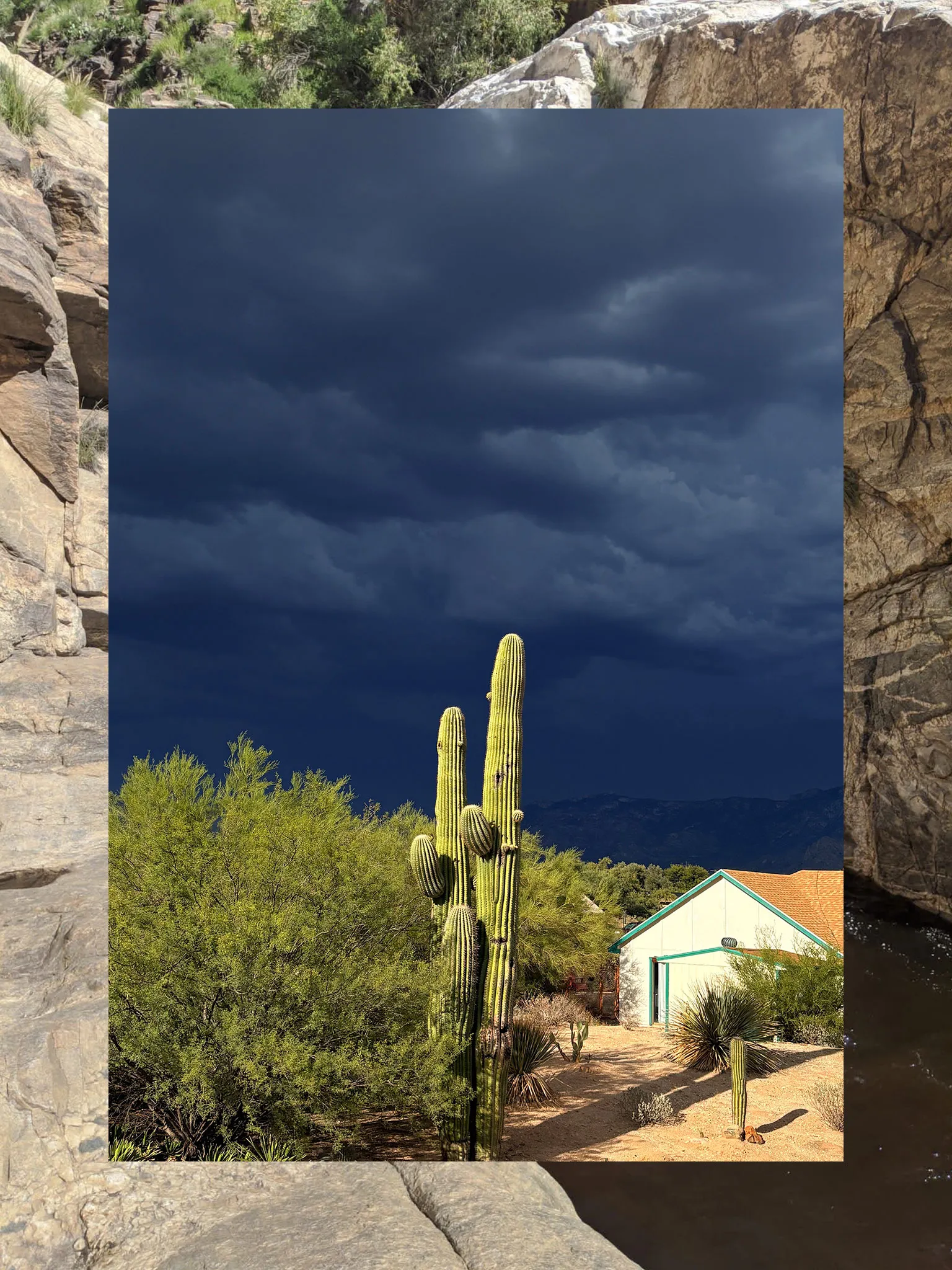
A collage consisting of two vertical photos, the outside functioning a border and the inside fully visible. The outside photo is a rocky formation. The inner photo is a cactus against a dark sky.

Rachel Glickhouse / Grist

Arizona

In the Sonoran Desert, rain is a cause for celebration — especially the summer monsoons.

On stormy days, you’ll often see massive curtains of rain in the distance, and rainbows arching against pitch-black clouds in one direction as the sun beams brightly in the other. When a downpour starts, I run to tell my husband and usually head outside to the patio to watch. When it rains as infrequently as it does here in Arizona, it’s easy to revel in the sight of raindrops and inhale the heady scent of petrichor and the herby smell of creosote. I’ll often text my friends or family across town to see if it’s raining there, too, since the storms here are incredibly localized. In other places, the weather may be a source of small talk; in the desert, it is a legitimate conversation topic. 

If it rains a decent amount, I’ll go to a state or national park in search of running water, natural pools, or waterfalls. When there’s a lot of water in those ephemeral streams and pools, I’ll often encounter families with chairs and coolers, and see kids playing in the water like they’re at the beach. When I recently went out of town and my area got a huge downpour, I felt a pang of grief to have missed it.

Summer storms weren’t always such a novelty, though.

In Tucson, annual precipitation has declined by nearly 3 inches since 1970, according to the research nonprofit Climate Central. That’s a lot considering the average annual rainfall is roughly 11 inches. Most of it comes in the summer.

People who have lived here for more than a decade all say the same thing: The monsoon has become more erratic and unpredictable, which sometimes means less rain than normal. During the summer months, the monsoon used to arrive like clockwork nearly every afternoon. Now, it often feels like a happy surprise, and people often post photos and videos of the storms in local social media groups. Even in the five years I’ve been in Arizona, each year has been different: One year, the monsoon brought so much rain that it carved temporary rivers in our nearby state park and flooded the entry road; another year, the rains barely reached our house. 

But it’s not just less predictable precipitation; we’re getting more days of triple-digit temperatures, too. On those rainless, oppressive days, all one can do is stare longingly at the empty sky from the safety of air-conditioning.

— Rachel Glickhouse, director of partnerships

A collage consisting of two vertical photos, the outside functioning a border and the inside fully visible. The outside photo is a sunny view of El Paso. The inner photo is of a storefront sign that says 'I buy my Levis here' with an image of a cowboy.

Frida Garza / Grist

Texas

I live in New York City, but I grew up in Texas and Mexico, so I brag a lot about being from a warm place. When my peers threaten to wither like grapes on the vine as temperatures reach 88 degrees Fahrenheit, I like to say, Keep it coming. Dry heat, wet heat, I like it best when it’s 90 degrees or higher. I wait all year for the summer heat: I feel most myself with the sun on my bare arms and legs, or when I am reapplying sunscreen (do NOT sleep on sunscreen) and powerful bug spray to said bare arms and legs. These are smells I’ve grown deeply fond of, because they signal that something good could happen any moment now. That was how I felt about summer, at least, until this year. 

For me, trips back home to visit family in El Paso usually involve playing basketball with my brother, swimming in my parents’ backyard pool, counting down the days until my relatives come over for a night of grilling, and telling stories outside late into the night. This year, there was none of that. Even though summers in El Paso are hot (did you get that already?), and in that arid desert climate, triple-digit days are not uncommon, this year’s heat was particularly unrelenting. So far this summer, there have been 45 days where the temperature has been 100 degrees or higher — or roughly half of each month. 

This uptick of very hot days — which this year is expected to last into September — has been driven by climate change. Global warming pushes summer temperatures up, making heat waves in West Texas both more frequent and more intense. On top of the heat, poor air quality disrupted my El Paso summer plans. Dust is an ordinary part of living in the desert, but pollution from vehicle emissions, along with contamination from a local petroleum refinery around the time of my visit, exacerbated the poor air quality. Not wanting to admit the pesky air quality bothered my throat, I ventured into the backyard during my August visit to spend the afternoon with a good book. When my parents asked what I was doing, I remained steadfast: I was going to enjoy being outside! But despite my initial determination, I couldn’t hack it and soon retreated inside. The whole experiment only lasted about 10 minutes. 

I am not much of a hiker, but it is sad to think of how my advice for friends visiting El Paso has changed over the years. The city is home to stunning mountains and ancient caves that are perfect for hiking, and I always recommend them to out-of-towners. But now I caveat that recommendation with statements like, “It’s beautiful, just stay safe! Go early to beat the sun! Bring lots of water!” 

The city I call home is being remade in other ways, too. When my brother and I recently visited downtown, usually a bustling strip of shops, restaurants, and bars, I noticed much less foot traffic than usual — a sign he chalked up to increased fears of apprehensions by immigration officials. El Paso is an international city, bordered by the Franklin Mountains to the north and the U.S.-Mexico border to the south. One of the main strips downtown leads right to a port of entry to Ciudad Juarez, but it was mostly empty that day. A key feature of the city, its binational culture, seems at risk of being dampened by both extreme weather and a national mass deportation agenda, making people practice extreme caution in their day-to-day lives. We spotted very few other people on our walk, mostly office workers heading to or from lunch — as I saw them, I too longed for air-conditioning. 

— Frida Garza, staff writer

The Rockies

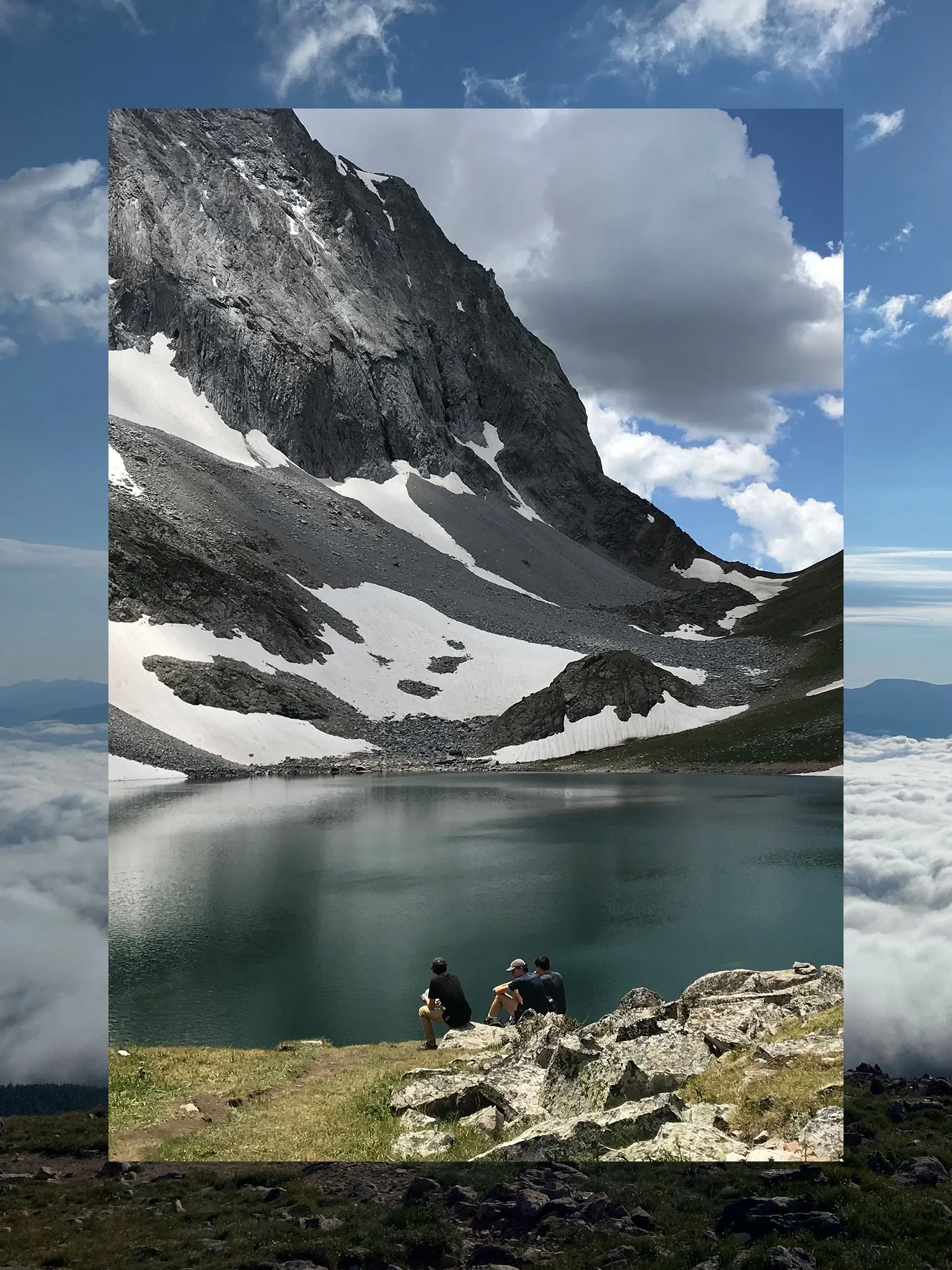
A collage consisting of two vertical photos, the outside functioning a border and the inside fully visible. The outside photo is a misty mountaintop with clouds. The inner photo is of hikers sitting beside a lake.

Austin Corona / Grist

Colorado

Every summer, thousands of Texans make an uphill journey to the Rockies, drawn by the mild mountain weather. Though you won’t find them in any botany books, Lone Star state license plates seem to bloom like an alpine wildflower from June to August.

Many Coloradans complain about the southerly visitors, but they also quietly acknowledge their importance to local economies. The high country’s biggest summer export is its cool, dry days; and Texans, along with fellow travelers from other sweaty states, are willing to pay big for it.

But drought, wildfire, and heat have whittled down the luxuries of high-mountain summers. Weather stations above 9,000 feet are recording near-90-degree days at an unprecedented rate. The peaks regularly lose their white winter veils earlier, and then shed their ragged definition entirely as oceans of wildfire smoke obscure the mountain air. Swimming in creeks and rivers often really means squatting on uneven stones beneath the water’s sinking surface. When the rivers are full to brimming, it usually means a federally managed reservoir has released emergency flows to quench the fields of desperate downstream farmers. Servers in mountain resort restaurants overhear harrumphing from tables of Texans: “And to think, we came here to get away from the heat!”

As temperatures climb, one would expect tourist numbers to fall. But even as Colorado saw its second hottest July on record in 2026, resort lodging occupancy at mountain towns is up from the previous summer. Perhaps even a hot, smoky alpine summer is still preferable to an infernal Texas one. Shrunken streams are still full of squatting bathers, and baking streets are still full of lily-white Texas license plates. The trend has left mountain summers feeling less blissful, and more crowded, than ever.

— Austin Corona, energy reporter

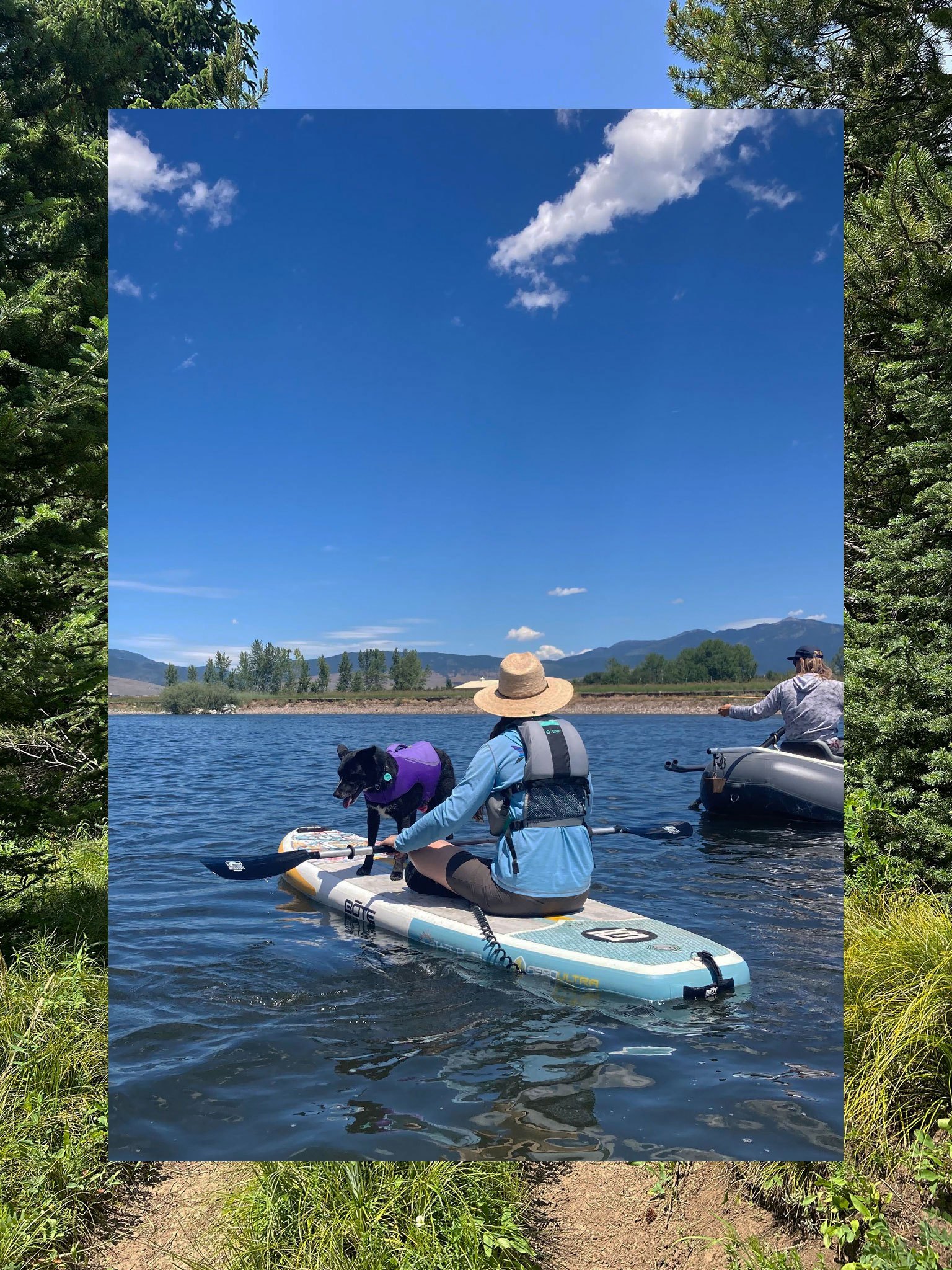
A collage consisting of two vertical photos, the outside functioning a border and the inside fully visible. The outside photo is a wooded path. The inner photo is a person on a stand-up paddle board with a dog.

Ellis Juhlin / Grist

Montana

In Montana, there are several peak events that define summer. For some with seasonal depression, it may be the solstice when we hit almost 16 hours of daylight. For anglers and tourists eager to enjoy blue ribbon trout streams, it’s the salmonfly hatch: Bugs the length of your finger swarm the skies as the trout feast indiscriminately on insects — and their foam replicas at the end of a fishing line. 

And just as the bugs seem to know how to emerge into the world during the right time of the summer, so too do the tubers. As the days grow longer and warmer, flotillas of inner tubes dot the surface of any moving river, along with hordes of paddleboards, inflatable rafts, and even the occasional blow-up shark. It’s a phenomenon known by many as the tube hatch.

But climate change means Montana is warming quickly. Snowpack averages have declined steadily since the 1980s, and snowmelt is happening earlier than ever before. That means rivers run lower, and levels start dropping well before peak floating season — sometimes, before the heat even fully hits. With more summer days over 90 degrees than ever before, traffic on the river is increasing as larger crowds seek a way to cool off while still enjoying the outdoors. Tubers, anglers, and wildlife reliant upon shady shorelines are competing for space across an ever smaller stretch of river. 

Montana isn’t a place that’s always been hot, which means when the heat hits, we’re a lot less prepared for it. We have one of the lowest average number of homes with air-conditioning out of any state in the country. Rivers and lakes can be one of the only effective ways to cool off when the mercury rises. 

That can make for a much less pleasant floating experience. Take this year, when for my birthday in mid-July I decided on a river float. My friends and I loaded up the cooler with ice and beer, blew up tubes ’til it felt like our cheeks would pop, and buckled my dog Zayda into her purple life jacket. We clipped our tubes together with an elaborate rigging of paracord and carabiners, while Zayda and I opted to ride on a paddleboard. 

The first few minutes as the cold water washed over us were a relief, until we rounded the corner to find possibly every other resident of Missoula County floating along, too. I let my pup jump off the boat and swim ashore, her favorite activity. But when it was time to hop back on before the next wave train, she couldn’t figure out which flotilla was ours. I watched in horror as my timid, anxious rescue dog panic-swam between clusters of floaters and for the first time wondered if there really was enough river for us all.

— Ellis Juhlin, regional reporter, Montana

The West Coast

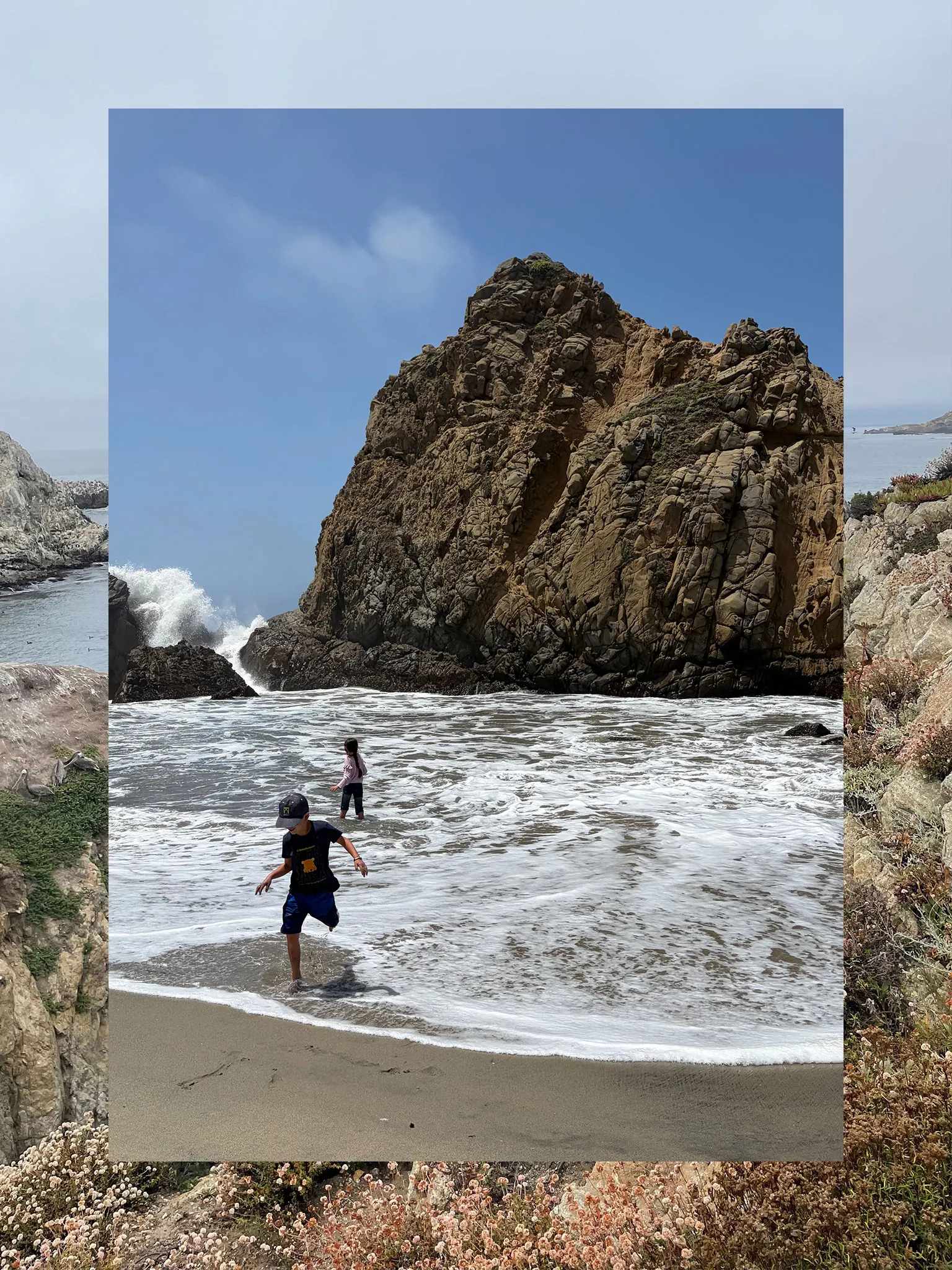
A collage consisting of two vertical photos, the outside functioning a border and the inside fully visible. The outside photo is a coastal trail and sea. The inner photo is two children playing in the surf near a rock formation with a spray of waves hitting in the corner.

Teresa Chin / Grist

California

California is big — a region unto itself, one might say — and summer can mean a lot of things to those lucky enough to call it home. In sun-baked SoCal, it might be playing in suburban sprinklers during the day and heading to the beach for sunset. Inland, there are county fairs and harvest festivals (don’t miss out on Gilroy’s garlic ice cream). Along the Central Coast, Highway 1 beckons road trippers with panoramic views of gnarled Monterey cypress and thrashing ocean waves. Farther north, summer is the upside-down of seasons, where cool temperatures can prompt locals to don parkas and unprepared tourists scramble for overpriced “I left my heart in San Francisco” sweatshirts.

But climate change is altering many of these quintessential experiences. Where I live in the Bay Area, cool (nay, cold) summers are part of our DNA. Mark Twain may not actually have said that the coldest winter he ever spent was a summer in San Francisco, but that doesn’t make it feel any less true. The combination of cold ocean and hot inland creates an enhanced marine layer, or as many here like to call it: Karl the Fog. Yes, our fog is so iconic, he has a name and a social media following. 

But climate change is making Karl less predictable due to factors like warming ocean temperatures. One study found that coastal California’s summertime fog hours declined by 33 percent over the last century. That’s bad news for both locals and coastal redwood trees, which rely on fog as a critical source of water. Even though I grew up in sun-loving Southern California — where summer mornings were so warm that I would often eat my breakfast while lying on a towel in my parents’ backyard — I’ve become attached to the cold and moody mornings here. There’s something so peaceful about watching the mist roll in over the hills with a steaming hot cup of coffee in hand.

Across the state, hotter, drier conditions are increasing wildfire risk. Emergency go-packs now live in closets alongside beach bags, and road trippers need to check for route closures and evacuation orders. While most of California is not currently in a drought, water shortages are expected to worsen over time, which in the past has led local regulators to restrict lawn watering and pool use. For kids on break from school (and harried parents trying to keep them engaged), those conditions can mean sprinklers and splash time often have to give way to screens. That’s a real loss, especially considering that the gorgeous California outdoors is how many of us justify living in such an expensive state.

— Teresa Chin, executive editor of data & design

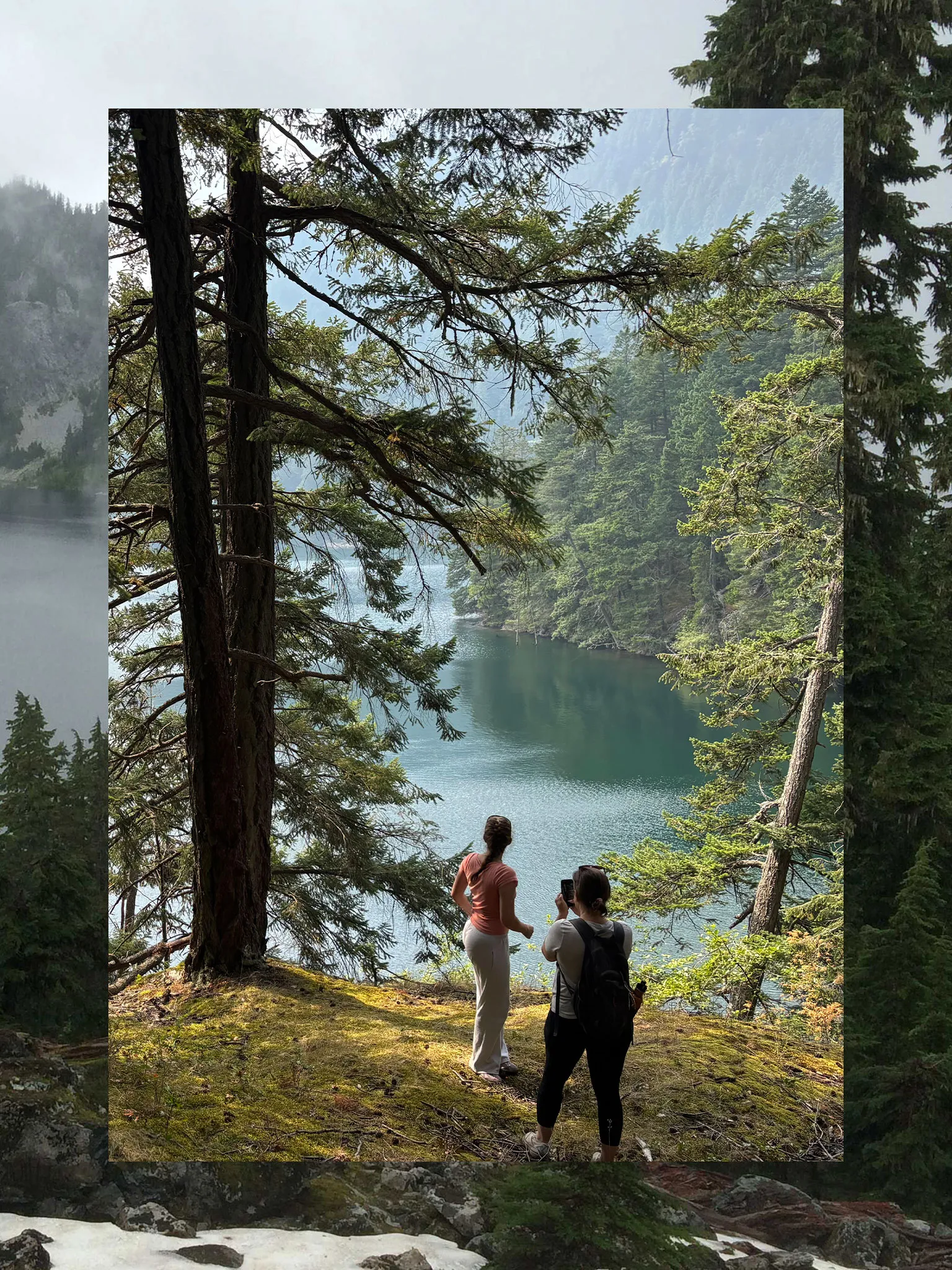
A collage consisting of two vertical photos, the outside functioning a border and the inside fully visible. The outside photo is a misty trail with trees and mountains. The inner photo is two people on a hike near a wooded lake.

Kate Yoder; Matthew Craft / Grist

Pacific Northwest

According to an old adage, summer in the Pacific Northwest doesn’t actually start until after the 4th of July. The cool, temperate month before is instead known as “Juneuary.” Growing up, I remember donning a specific summer outfit suited to the weather: a light hoodie or fleece on top (for the typical 50-degree mornings) and shorts on the bottom (for the afternoons in the high 60s or low 70s). Few people had air-conditioning, because a breeze from open windows and fans were more than enough to stay comfortable. 

But in the last decade, these idyllic summer days have become rare. Today, Northwest summers are hotter, and the heat starts earlier in the year. This was best exemplified by the infamous heat dome in June 2021, when temperatures in Seattle reached a record-breaking 108 degrees Fahrenheit — roughly 38 degrees hotter than the typical Juneuary highs. According to an attribution study of that event, climate change made the heat dome 150 times more likely compared to preindustrial conditions. 

Climate change is also reducing snowpack across the Pacific Northwest, and the dry, hot conditions have turned the region into a potential tinderbox. Wildfire smoke has become a regular feature of our summers. Checking the air quality index, or AQI, in August has become as routine as checking the weather, and many locals factor smoke levels into their summer activity plans. 

The combination of heat and smoke has made it harder to stay cool the old-fashioned way, with open windows and fans alone. During long periods of smoke, windows might stay shut all week, causing homes to heat up like greenhouses. As a result, Northwesterners are increasingly installing air-conditioning — so much so that Seattle recently lost its rank as the nation’s least air-conditioned big city. 

After enduring months of gray drizzle — known locally as the “big dark” — the promise of an extremely pleasant summer day always felt like the ultimate payoff. While extreme heat and smoke pollution are alarming and dangerous on their own, for many Northwesterners, losing our beloved summer weather is an additional sting.

— Jesse Nichols, senior visual producer

Midwest

A collage consisting of two vertical photos, the outside functioning a border and the inside fully visible. The outside photo is a blue-turquoise lake and sky. The inner photo is a person walking a nature trail with the Chicago skyline in view.

Juanpablo Ramirez-Franco; Mia Torres / Grist

Illinois 

When I first moved to Chicago about a decade ago, it was in the middle of a still-warm September. My timing was terrible, I was told. I’d missed it — the completely singular experience of a Chicago summer. The golden season, they explained, is a hard-earned reward for a city under siege by long, bitter winters. The parties are outrageous, the beer cheap, and the big, blue lake free. 

At the time, I thought they were laying it on thick. But now I can attest to its truth. It’s hard to say exactly what makes a Chicago summer special — and why people here are convinced we have the best version of the season. My sense is that everyone who lives here knows you need to make it count: to be outside, to swim in the lake, to eat ice cream and hotdogs too, to stay up late, to dance, to kiss strangers, to go to the farmers market, to see your friends, to move in with your boyfriend, to wash away the failures and sorrows of the last year and start all over again. Whatever you want, Chicago summers can deliver. 

A lot of people talk like that around here; it’s a kind of boosterism that runs against my own sensibilities and can make us look desperate on the internet. But come to the Windy City in the summer, and you might find yourself drinking the same Malört-laced Kool-Aid. (Don’t actually mix those.) I don’t know if we’re all collectively redirecting 15 one-sided rivalries with other major American cities, but our summer really is something else. 

Which is why it was such a disappointment when this summer played out differently. For one, it was wetter than usual; the city’s emergency 11-billion-gallon reservoir and tunnel system very nearly hit capacity. Canadian wildfire smoke pushed local air quality readings to the unhealthiest levels the city has ever seen. More than 200 tornadoes made landfall in Illinois this year, a record-breaking figure for the state that’s very close to topping the national record. The same powerful winds also caused a terrible power outage in Gary, Indiana, just south of Chicago, where tens of thousands of people were without power for over two weeks. 

A less smoky, less humid, less rainy, less tornado-y do-over would be nice. But that’s not in the cards. Summer temperatures in Chicago are projected to keep climbing and are forecasted to coincide with increased variability between heavy rain and drought. 

The meteorologists tell us summer is technically over, but I’m wondering how much longer our summer will actually last.

— Juanpablo Ramirez-Franco, regional reporter, Illinois

Southeast

A collage consisting of two vertical photos, the outside functioning a border and the inside fully visible. The outside photo is a field with rolling slopes and a blue sky with mountains. The inner photo is a field with faraway trees and sloping hills.

Katie Myers / Grist

Tennessee

Small farms and lush backyard gardens are a way of life in the Mountain South.  The growing season is long. But farmers and gardeners are faced with difficult decisions as the region’s humid summer extremes have grown more chaotic and intense.

This was a lesson that really hit home for me the last time I tried farmwork: a brutally hot summer day in 2020 in East Tennessee. I was working in a hundred-plus-degree greenhouse, up to my neck in spiny tomato plants as I strung them up and suckered them, itching, head pounding, blinded with sweat. Later, in the field, as I planted a bed of onions, the landscape seemed to undulate in front of me, and I dashed off to a nearby tree and vomited discreetly behind it. It wasn’t the first time this had happened. 

As I drove home, I thought, the $8 an hour just isn’t worth it.

In 2023, the U.S. Department of Agriculture updated its plant-hardiness zones, which guide gardeners and farmers based on the annual lowest temperature in their location. Much of the mid-South moved half a zone up — from 7a to 7b, or 7b to 8a — toward the humid subtropics. The USDA cautioned against understanding it as directly linked to climate change but acknowledged that the zones for most plants will shift northward as the planet warms. That’s in addition to the cyclical temperature swings gardeners deal with year to year.

Increasingly ferocious summer storms and flash flooding, interspersed with more extreme flash droughts, have also made growing food even more tenuous. Kelsey, a friend of mine who works as a flower farmer in nearby southeastern Kentucky, told me she had to switch to what she called an Andalusian daily schedule, getting up early and breaking for most of midday, sometimes only returning to the field with a headlamp after dusk. When the financial margins are thin, little costs like replanting, fungicides, and even electrolyte drinks add up. 

Even more than the heat, the uncertainty wears on people. Aside from the financial unpredictability, farmers and gardeners are also feeling the loss of tradition and ritual, like the old-timer’s practice of planting by moon phases and zodiac signs.

As the planet warms, many are focusing on the cool periods of seasonal transition, investing in plants that return annually, experimenting with tropical varieties like amaranth and malabar spinach, or trying to grow crops in the shade to keep them from withering. Kelsey is pinning her hope in seed saving, the ancient art of paying close attention to the plants that seem to survive most easily and preserving their genetics, in hopes of creating hardier varieties that can withstand the summers to come.

— Katie Myers, regional reporter, Appalachia

A collage consisting of two vertical photos, the outside functioning a border and the inside fully visible. The outside photo is a lake or river with trees and blue sky. The inner photo is a riverfront with bridge on a sunny day.

Jaime Buerger; Lyndsey Gilpin / Grist

Kentucky

Going outside on a Kentucky summer day has always felt a bit like stepping into a rainforest. And if you live in mountainous eastern Kentucky, you actually are — the southern Appalachians are a lush temperate rainforest. It’s hot and sticky and beautiful. There are a thousand shades of green. The migratory tanagers and perulas chatter all day; the cicadas scream all night. Deep yellow goldenrod, coral honeysuckle, and purple coneflowers bloom. 

But the temperature and humidity are becoming unbearable: Multiple times a summer over the last three years, Kentucky has had prolonged extreme heat waves with heat index values up to 108 degrees, resulting in air quality alerts and heat advisories. These extreme temperatures usually break with huge thunderstorms that bring heavy rain and violent wind and sometimes lead to tornadoes and flash floods. 

Evenings aren’t the respite from the heat they once were. Last year, for instance, Waterfront Wednesday, Louisville’s free evening summer concert series, fell on heat advisory days two months in a row. It was still 94 degrees when a band took the stage at 7 p.m. (the crowd was large, regardless).

Kentucky’s summer average temperatures have risen by 2 degrees Fahrenheit since 1970. Louisville has seen temperatures rise by over 4 degrees; according to a 2016 study, the city had one of the fastest-growing urban heat islands in the country, and new research shows the problem has grown in the years since. Louisville is working on efforts to address the urban heat, but for the most part, event hours, amenities, and locations remain unchanged. As parents of young children, my friends and I find ourselves skipping out or cutting our day short unless there’s a water source — a playground splash pad, a pool, a decently clean creek — to cool off the kids in. 

In any city in the state in the summer, you’ll find festivals, church picnics, county fairs, and flea markets. But most are still taking place in the middle of the day, often on hot concrete, without fans or mist or free water or enough cooling centers. Of course, the bourbon is still flowing — but even with ice, it doesn’t go down quite as smoothly in 100-degree weather.

— Lyndsey Gilpin, senior manager of community engagement 

A collage consisting of two vertical photos, the outside functioning a border and the inside fully visible. The outside photo is a lawn with trees. The inner photo is a lake scene with dense trees and blue sky.

Anila Yoganathan / Grist

Georgia

Summers have always been hot in Georgia. There’s the dread of getting in your car and burning yourself on the seats while smelling the acrid fumes from the pleather melting. The slick feeling of perpetual moisture on your skin as the humidity surrounds you most days. And there’s the knowledge that, when the sun is at its peak, you should only be outside for the minute it takes to go from your air-conditioned car to the air-conditioned building.

Having been raised in metro Atlanta, it’s something I grew up planning life around, like scheduling outings on days when the heat was tolerable or making plans after sunset. My favorite pastime during the season used to be sitting outside at twilight: the sky a burst of bright colors, the heat receded to the edge of pleasant, and the humidity just enough to feel a little cool moisture on your skin like dew. In those peaceful moments just before it got dark, I would quietly watch the fireflies create a magical scene in my parents’ yard. Now? The conditions of a Georgia summer just feel more intense.

For one thing, the heat from the day doesn’t drop as much as it used to at night. From June through July this year, the minimum temperature in Georgia was 2.5 degrees Fahrenheit above the average from 1901 to 2000.

If I’m not tired of the heat and can tolerate the humidity, I still have to prepare to be eaten alive. Rising nighttime temperatures can “enhance mosquito growth” during the summer, according to the University of Georgia. So I don’t go outside at dusk as often as I did growing up.

Things have also changed inside the house. In the summertime, my dad and brother often argue over the thermostat. My brother wants cooler temperatures so he can sleep better, and my dad worries about the rising electric bills, an issue that other Georgians are also grappling with. My parents’ late-1960s house, while beautiful, is energy-inefficient. The old attic fan that used to keep us pretty cool years ago kept breaking down, and we no longer use it. While we’ve debated upgrades, the costs are still high. So the inter-generational thermostat war continues.

These days when I visit Georgia, I still try to venture outside at dusk to see my favorite lightning bugs. And while I may see a few, I’m all too aware that they face growing threats from light pollution, pesticides, development, and yard management, which can impact larvae. Without them, summer in Georgia feels just a little less magical.

Anila Yoganathan, regional reporter, Nebraska

A collage consisting of two vertical photos, the outside functioning a border and the inside fully visible. The outside photo is a beach at sunset. The inner photo is a house on stilts near a lake with Spanish moss growing overhead.

Sachi Mulkey / Grist

Florida

The pleasures of a summer in Florida were once simple: the sensation of hot concrete pushing through the soles of your recently air-conditioned feet. A cold gas station Slurpee in one hand and a bag of boiled peanuts in the other. The steam from an afternoon rainstorm, rising from the sun-baked roads. A frozen custard from Rita’s Italian Ice truck by the beach, where you spent the afternoon collecting sand dollars and bouncing in waves with your family.

But Florida’s subtropical climate, low elevation, and exposure to warm ocean waters on three sides leave it with little buffer against the changing climate. Scores of tourists are now passing out amid 100-degree heat at Disney World. In many neighborhoods, sidewalks become hot plates after 10 a.m., scalding dogs’ paws into pink blisters. It may not rain at all, for weeks at a time. And when it does, scientists say it’s raining harder. You can feel it — gripping your steering wheel during a sudden deluge that whiteouts the road and floods sidewalks. At night, the air is muggy and laden with mosquitoes while, somehow, still unbearably hot.

So if your family is like mine, you might hop in the car and head to the beach in the hopes of trading the pavement for sand, and reconnecting with the magic of summer.

But if that beach is near Miami or the Florida Keys, you might find yourself facing thousands of tons of sargassum, brown seaweed that can clog shorelines and prevent sea turtles from nesting. In recent years, the kelp has been growing relentlessly thanks to the right conditions: bathwater-like ocean temperatures and shifting climate patterns that boost ocean nutrients. The result is a rotting mass that releases hydrogen sulfide as it decomposes, making beachgoers’ eyes and lungs burn with noxious fumes.

Or if you drive toward Tampa, you might encounter a monthslong surge of red tide, shorthand for toxic algae blooms, also caused by warm waters and similar nutrient patterns. From Sarasota to Clearwater, locals know to stay away when piles of dead fish (and sometimes manatees, dolphins, or sea turtles) litter the beaches. In smaller beach towns like Sanibel and Cedar Key, rising sea levels and hurricane damage have crumpled the economy and closed the vintage shops I once loved to peruse. Whether your refuge is cooled by AC or whirring ceiling fans, summer in the Sunshine State has increasingly become a time to stay indoors.

Sachi Mulkey, reporter

Northeast

A collage consisting of two vertical photos, the outside functioning a border and the inside fully visible. The outside photo is a rocky beach. The inner photo is a child walking up a hiking path under tall trees and dappled sunlight.

Katherine Bagley / Grist

New Hampshire

After harsh winter temperatures and muddy spring months, summer in New England feels like a well-earned prize. The peaks and lakes of the Appalachian Mountain range, rocky coastlines, and cool waters of the Atlantic Ocean are a venerable playground after months of being largely stuck inside. There’s hiking and boating, lobster rolls and ice cream, and blueberry fields ripe for picking. We New Englanders don’t let a single moment during the precious months between Memorial Day and Labor Day go to waste.

But a warming planet has changed the conditions in which we are engaging in these activities. The region is heating up faster than any other place in the contiguous United States. The weather whiplashes between intense rain and flash droughts. And then there are the ticks. So. Many. Ticks.

Growing up in the 1980s and ‘90s, these blood-sucking insects were not a thing I worried much about. Their populations were isolated to small patches of coastal regions and stands of long grass. My friends and I played outside all day before crawling into our beds when the streetlights came on. Parents didn’t conduct nightly tick checks or spray their yards with pesticides. People didn’t keep tick-removal devices on their keychains or lint rollers in their cars to swipe down bodies after being in the woods. They didn’t capture embedded ticks in clear tape, waiting to submit them to a doctor if a bull’s-eye rash appeared at the bite site. 

Now, I do all these things. The ticks are everywhere. My son was just a year old when I found his first one on him, embedded in his upper thigh. We were at a lake where I spent my summers, and where I had never once gotten bitten growing up.

New Englanders still cherish their summers — our iconic stubbornness ensures that never goes away — but these months are a little less carefree, and the woods and lakes and coastlines a little less safe.

— Katherine Bagley, editor-in-chief

A collage consisting of two vertical photos, the outside functioning a border and the inside fully visible. The outside photo is a street scene of New York City at sunset. The inner photo is a person resting on a towel with a book at Rockaway Beach.

Jake Bittle / Grist

New York

I’ve always thought of New York City as a summer town. There are a lot of people who disagree with me, as evidenced by the clogged outbound highways heading upstate and out to the Hamptons, but to me the best times to live here are when you can stroll a hot street with a Mister Softee cone and take the subway out to Rockaway Beach. The city has been getting hotter and muggier for some time now. The panel of scientists who ran the National Climate Assessment reclassified the city in 2020 from “humid continental” to “humid subtropical,” meaning it now has more in common with the lowlands of the Southeast than it does with the crisp pine forests of New England. 

I’m originally from Florida, so humidity and sudden afternoon thunderstorms don’t bother me. What does get to me, and the millions of other New Yorkers, is the smoke. This past summer, a curtain of smoke from wildfires in Ontario blanketed the city for days, elevating the air quality index so high that it was unsafe to step outside. I made the mistake of trying to attend a party in Lower Manhattan on what should have been a sultry Thursday night and found myself returning home through empty streets with a headache. I had planned to go to the beach the next day and the day following, but I canceled my plans. (A few weeks later, when I tried to go to the beach again, my friend Chris and I got caught in an apocalyptic thunderstorm.)

This year was nowhere near as bad as the smoke drift from Canada in 2023, which blocked out the sun and raised air quality to levels exceeding that of polluted cities like Mumbai, causing a jump in emergency room asthma visits. That time I went days without stepping outside, until I got a cold from prolonged exposure to my window AC unit. When I did go outside, I had to wear an N95 mask, as did the construction workers and delivery bikers who were still laboring for hours at a time in air that was toxic enough to make one faint. In both cases, scientists have found that climate change made the wildfires in Canada at least twice as likely.

Most of the Midwest and Northeast experienced at least some smoke this summer, but it felt acute in New York, where the line between inside and outside is always a little blurry in the summer. Most New Yorkers have at least one window air-conditioning unit, but around 1 in 5 residents of the poorest neighborhoods don’t. Even in homes that do have window units, they don’t cool down whole apartments, and many people leave other windows open to air out other rooms and save on power bills. When we leave the house, most of us can’t get anywhere without walking for 10 or 20 minutes to the subway. The whole premise of life here is freedom, the freedom to go wherever you want, to go nonstop day and night. In two different summers now, I’ve seen the impossible — climate change brought the city that never sleeps to a standstill.

— Jake Bittle, staff writer

A collage consisting of two vertical photos, the outside functioning a border and the inside fully visible. The outside photo is a beach at sunset and the inner photo is a sandy beach and fence.

Samantha Swinsburg

New Jersey

The Jersey Shore is famous for a reason. It’s the quintessential summer destination for New Jersey and its neighboring states. The long series of barrier islands shielding the mainland boasts wide, white-sand beaches that have attracted summer visitors since the 18th century. Easy access from the nearby population centers of Philadelphia, North Jersey, and New York has guaranteed hordes of tourists enjoying the beaches and boardwalks from Memorial Day weekend through Labor Day for more than a century.

But for the people who actually live here, the day after Labor Day is the best of summer.

As if the atmosphere can read the calendar, the weather shifts from the brutal heat and humidity of August to the more temperate warmth of September. The ocean, cold enough to be uncomfortable throughout most of the summer, finally accumulates enough heat to be the perfect swimming temperature. Most of the crowds depart, leaving the usually-packed beaches open for those who live close enough to steal one more day of summer before the school year begins.

It’s a day for getting to the beach late because there’s no need to stake out territory, and staying until the sun sets because there’s no reason to leave. A day for long, lazy floats in the Atlantic, for finishing the last dregs of ice cream left in the freezer, for sneaking the dog onto the deserted beach even though dogs are technically still banned for a few more weeks.

At least it was. Now the warming air and water have made that crisp turn-of-the-page fuzzier. The warm September water is arriving sooner: In the third week of August this year, sea surface temperatures were already hitting the upper 70s, according to satellite data compiled by Rutgers. In the air, August’s dog days are bleeding into fall. Average temperatures from September through November in Atlantic City have already increased 3.4 degrees Fahrenheit since 1970, according to the research group Climate Central, with 14 more days of above-normal temperatures annually.

Or as my mom — a lifelong denizen of the shore — put it, “October is the new September.”

But October can’t be that first Tuesday in September, not with school in session and island businesses closed for the season. And the more summer temperatures bleed beyond their former season, the more that perfect, final, magic day of summer becomes just … another hot day at the beach.

— Emily Jones, regional reporter, Georgia

Disgraced Actor Dies Following Battle with Pancreatic Cancer

0
disgraced-actor-dies-following-battle-with-pancreatic-cancer
Disgraced Actor Dies Following Battle with Pancreatic Cancer


British actor Chris Langham, best known for his roles in the political comedy “The Thick of It” and the sketch series “Help,” has died at the age of 77.

Langham died from pancreatic cancer on June 24, 2026, according to an obituary confirmed by The Times.

He is survived by his second wife, Chrissie, and their two children, Emily and James, as well as three children from his first marriage to Sue Jones-Davies.

Langham was once one of Britain’s most acclaimed comedy actors, earning widespread praise for playing hapless government minister Hugh Abbott in the first two seasons of the BBC satire “The Thick of It.”

In 2005, he was named comedy actor of the year at the British Comedy Awards.

But just two days later, news emerged that Langham had been arrested two weeks earlier over child sexual abuse material found on his computer.

He was later charged with 15 counts of downloading indecent images of children. Prosecutors said some of the material included videos showing the rape of a teenager and the sexual abuse of an eight-year-old child.

Other material found on his computer included images involving sadism and non-consensual sexual acts between adults and children, according to the Crown Prosecution Service.

Langham was sentenced to 10 months in prison and ordered to remain on the sex offenders register for 10 years.

His sentence was later reduced to six months on appeal.

During the case, Langham argued that he had viewed some of the material while researching a role for the TV series “Help,” in which he played a character named Pedro who was described as a “Peeping Tom.”

Police strongly rejected the idea that viewing such material could be harmless.

“Viewing such images simply perpetuates child abuse,” Detective Inspector Derek Cuff of Kent Police said outside court. “Our thoughts are with all victims of child abuse, which has such a devastating effect on young people’s lives.”

Following his arrest, Langham was dropped from “The Thick of It,” and his character was written out of the show off-screen between its second and third seasons.

After leaving prison, Langham said his “conscience is clear” and argued that media coverage had ignored what he described as the court’s acceptance, based on evidence and expert testimony, that he did not have a sexual interest in children.

He later offered a harsher assessment of his own actions, saying that his “arrogance” and “ego” had led him to view the material and that the decision had “completely f—– up my own life.”

In a 2011 interview with The Guardian, Langham said he knew what he was doing was wrong but convinced himself that his status as an artist somehow placed him above normal rules.

“I thought after ‘Help’ I’ll reveal I’d researched it, and people would say gosh, you’ve taken this really difficult subject and done something amazing,” he said.

Langham admitted he believed the decision would win him praise and admiration.

“I thought if I pulled it off, everyone would admire me,” he said. “And I’m a slut for approval.”

Langham’s conviction effectively ended his mainstream television career, overshadowing the success he had previously enjoyed as one of Britain’s best-known comedy performers.

0FansLike
0FollowersFollow
0FollowersFollow
0SubscribersSubscribe
- Advertisement -
Google search engine

Recent Posts