Syria Begins Destroying Assad-Era Chemical Weapons Remnants
Syria has begun destroying remnants of the chemical weapons program maintained under former President Bashar Assad, Syrian and United Nations officials said Thursday, in the first verified destruction of such material in the country in more than a decade.
The process follows the discovery in May by Syria’s new authorities of chemical-weapons-related materials, including raw substances and empty munitions similar to equipment used during the country’s civil war. Reuters first reported the discovery at the time.
Izumi Nakamitsu, the United Nations high representative for disarmament affairs, told the Security Council that the Organization for the Prohibition of Chemical Weapons (OPCW) had verified the destruction of chemical munitions in Syria for the first time since 2014.
An OPCW team deployed to Syria last month to verify the destruction of Category 3 chemical weapons, a classification that includes unfilled munitions and equipment intended to deliver chemical agents. Nakamitsu said inspectors confirmed “the irreversible destruction of 42 aerial bombs.”
She said Syrian authorities had also identified an additional chemical-weapons production facility, a previously undisclosed chemical used to make nerve agents, and two storage facilities.
Syria’s UN ambassador, Ibrahim Olabi, described the work as a contribution to wider security. “This is the very first destruction process since we have been liberated from the previous regime,” he told the Security Council. “It’s also the first of its kind to destroy chemical materials on Syrian territory for over a decade.”
The new Syrian government has also detained 18 people accused of involvement in the Assad-era program, including former military, political and technical officials. Olabi said Syria was preparing for its first court hearing involving suspects in the program.
Assad’s government joined the Chemical Weapons Convention in 2013 after a sarin attack in Ghouta, near Damascus, killed hundreds of civilians and brought international condemnation. Syria agreed to surrender its declared chemical-weapons stockpile, but the OPCW later attributed several chemical attacks to Syrian government forces during the civil war.
Olabi said repeated Israeli strikes had complicated some search and destruction work and put Syrian personnel at risk. The Israeli military did not immediately comment on that allegation.
The effort will face continued international scrutiny, with the OPCW responsible for verifying whether Syria’s remaining chemical-weapons infrastructure and materials are fully and irreversibly eliminated.
150 research primates got diarrhea, flooding lab with priceless vaccine data
Having more than 150 non-human primates at a research center fall ill with diarrhea in a stomach-churning outbreak that flowed for over two years doesn’t sound much like good fortune. But for some scientists, it kind of was, providing a heaping pile of valuable data on how they might finally defeat a foul foe.
In a study published in the latest issue of Science Translational Medicine, scientist sifted through the dump of immunological data from the infections, logging new ways to train immune cells to defeat the bacteria behind the outbreak, a type of Shigella. Researchers were able to pluck out specific bits of the bacteria that the immune system could most effectively attack, linking specific target molecules to specific types of germ-busting immune responses. The researchers even precisely homed in on some of the tiny notches within those craggy target molecules where the most potent antibodies attached.
In all, the study “revealed unexpected features of the anti-Shigella antibody response in naturally infected [non-human primates] and represents a step toward the rational design of Shigella vaccine candidates,” the authors write.
Shigella is a gastrointestinal horror, striking more than 200 million people in the world each year and killing more than 200,000, mostly children. Those who survive typically develop some protective immune responses. But, given that there are a variety of species and serotypes of Shigella, protective immune responses tend to only work against a narrow range of the bacteria’s family. And, on top of that, Shigella strains are only becoming more resistant to antibiotics.
The need for a Shigella vaccine—one that can combat the whole cruddy clan—is clear. As such there are many vaccine development efforts underway. Still, scientists have been toiling without some of the detailed molecular and structural data needed to design a sophisticated vaccine. That’s where the outbreak came in.
Data deluge
The outbreak began in December 2022 at the Wisconsin National Primate Research Center in Madison. Non-human primates are natural hosts for Shigella, like humans, and it’s not uncommon for outbreaks to flare at such facilities now and then. But it is unusual for an outbreak to be so big and last so long. Even some of the people who worked at the facility fell ill.
In all, there were 169 microbiologically confirmed shigellosis cases among the non-human primates. Researchers collected 151 Shigella isolates for serotyping and did whole genome sequencing on 95 representative isolates. The outbreak was caused by two related clusters of Shigella flexneri, a species that commonly strikes captive non-human primates. (Human outbreaks are more often driven by Shigella sonnei, but both species can infect either type of primate.) Of the 90 isolates tested for antimicrobial resistance, more than half (63 percent) were multidrug resistant. Most of the cases caused only mild diarrheal symptoms, but there were some asymptomatic cases and some cases that led to severe symptoms. Infants were the hardest hit, similar to what’s seen in humans.
The researchers drew serum, plasma, and specific types of immune cells from 41 infected animals across their infections, taking samples at 1, 2, and between 4 to 6 weeks after an infection was detected. Then they went to work dissecting the immune responses.
The researchers started by looking for antibodies that attacked a known target on Shigella, the O-antigen. This is the outer-most component of a large molecule that juts out from the bacteria’s outer-most membrane. The molecule is called LPS, or lipopolysaccharide. LPS is found exclusively on bacteria, specifically Gram-negative bacteria, a group that includes E. coli and Salmonella, as well as Shigella. The molecule functions as a structural component of the outer membrane, among other things. But given its position on the rim of these bacterial cells, it—and specifically, the outer-most O-antigen component—is a common target of the immune system. However, in Shigella, it’s variable, so antibodies against one serotype’s O-antigen may not be helpful in fighting off other serotypes.
Key findings
The researchers found a variety of antibodies that bound to the Shigella’s O-antigen. But some seemed to have been honed from repeat exposures to the bacteria. And most interestingly, they seemed to develop the ability to attack O-antigen from many different Shigella serotypes—a feat that would be critical for the success of a vaccine. Moreover, they found that the antibodies that bound tightly to the O-antigen could trigger cascading reactions of plasma proteins that end with the bacterial cells being disintegrated—another useful feature.
Next, they looked at antibodies that attacked part of a type 3 secretion system, or T3SS for short. This is a common apparatus that bacteria assemble to attack their victims. When the components come together, a T3SS forms a syringe-like structure, complete with a needle that pokes out from the bacterial cell into a cell it’s trying to attack. The bacteria then pumps in a suite of proteins, called effectors. These can have a variety of specific functions but generally work to dampen the host cell’s defenses and promote a comfy environment for the invading bacteria.
At the very tip of Shigella’s T3SS, there are two proteins, IpaB and IpaD, that antibodies from the non-human primates attacked. These, the scientists found, were generally able to spur protective responses from immune cells, including T cells. Sorting through the antibodies, the scientists found some of them seemed to backfire, sparking reactions that helped Shigella burst blood cells. Others, however, prevented blood cell bursting. They found that these two types of antibodies bound to the tip proteins at different niches within the proteins. The researchers were able to identify the exact spot where the helpful antibodies bound, giving vaccine developers a precise mark to attack.
Together, the findings provide new insight and directions to develop an effective vaccine against Shigella. Though we’re still far from having one, the researchers are hopeful that the data from the outbreak can help overcome existing challenges and that their strategy of using such structural and immunological data will help researchers better design bacterial vaccines generally.
From the Southwest to the Jersey shore, climate change is altering the traditions and norms that have defined summer for generations.
There was a time when summer felt easy to recognize. In childhood, summer was a time of freedom and adventure. Even into adulthood, it is a time many of us feel most free to enjoy each other and the natural world — from lazy afternoons at the beach to camping trips and swimming holes, from family cookouts and neighborhood block parties to the simple pleasure of biting into peaches and tomatoes so ripe the juice runs down your wrist. It’s when our time of dreaming through the cold comes to fruition. The time when the vegetables and fruits we planted in the spring are harvested, the time when we finally spend our precious accrued vacation time and hard-earned cash, when we treat our children to the best of what life has to offer.
But summer is changing. Over the past half-century, annual hot-season temperatures in parts of the United States have warmed by as much as 4 or 5 degrees Fahrenheit, driving heat waves, droughts, and downpours. This past July was the hottest month ever recorded for the contiguous U.S., according to the National Oceanic and Atmospheric Administration. We are witnessing the slow erosion of our old summer normal. As climate change makes the season more extreme, our habits, traditions, and pastimes are also evolving, in ways both subtle and truly seismic.
The swarm of flickering fireflies at dusk in Georgia, the cool afternoon monsoon rains in Arizona, and the mild mountain summers in the Rockies — none of these are as reliable as they once were. As the planet warms, our relationships with the places we love are evolving, and the summer we once knew is becoming harder to find. Here are some of the changes Grist staff have witnessed in the places they love most.
Southwest
Rachel Glickhouse / Grist
Arizona
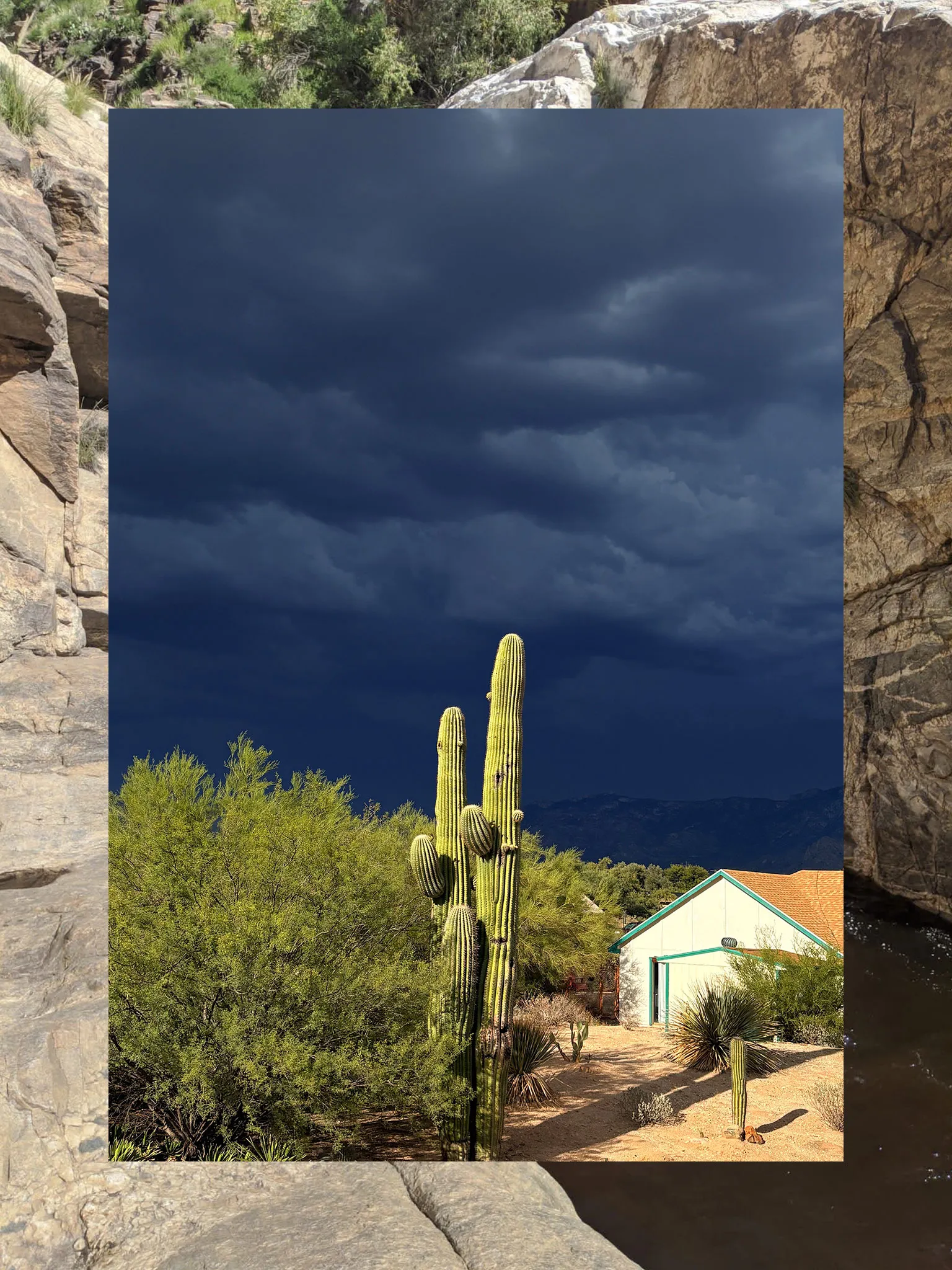
In the Sonoran Desert, rain is a cause for celebration — especially the summer monsoons.
On stormy days, you’ll often see massive curtains of rain in the distance, and rainbows arching against pitch-black clouds in one direction as the sun beams brightly in the other. When a downpour starts, I run to tell my husband and usually head outside to the patio to watch. When it rains as infrequently as it does here in Arizona, it’s easy to revel in the sight of raindrops and inhale the heady scent of petrichor and the herby smell of creosote. I’ll often text my friends or family across town to see if it’s raining there, too, since the storms here are incredibly localized. In other places, the weather may be a source of small talk; in the desert, it is a legitimate conversation topic.
If it rains a decent amount, I’ll go to a state or national park in search of running water, natural pools, or waterfalls. When there’s a lot of water in those ephemeral streams and pools, I’ll often encounter families with chairs and coolers, and see kids playing in the water like they’re at the beach. When I recently went out of town and my area got a huge downpour, I felt a pang of grief to have missed it.
Summer storms weren’t always such a novelty, though.
In Tucson, annual precipitation has declined by nearly 3 inches since 1970, according to the research nonprofit Climate Central. That’s a lot considering the average annual rainfall is roughly 11 inches. Most of it comes in the summer.
People who have lived here for more than a decade all say the same thing: The monsoon has become more erratic and unpredictable, which sometimes means less rain than normal. During the summer months, the monsoon used to arrive like clockwork nearly every afternoon. Now, it often feels like a happy surprise, and people often post photos and videos of the storms in local social media groups. Even in the five years I’ve been in Arizona, each year has been different: One year, the monsoon brought so much rain that it carved temporary rivers in our nearby state park and flooded the entry road; another year, the rains barely reached our house.
But it’s not just less predictable precipitation; we’re getting more days of triple-digit temperatures, too. On those rainless, oppressive days, all one can do is stare longingly at the empty sky from the safety of air-conditioning.
— Rachel Glickhouse, director of partnerships
Frida Garza / Grist
Texas
I live in New York City, but I grew up in Texas and Mexico, so I brag a lot about being from a warm place. When my peers threaten to wither like grapes on the vine as temperatures reach 88 degrees Fahrenheit, I like to say, Keep it coming. Dry heat, wet heat, I like it best when it’s 90 degrees or higher. I wait all year for the summer heat: I feel most myself with the sun on my bare arms and legs, or when I am reapplying sunscreen (do NOT sleep on sunscreen) and powerful bug spray to said bare arms and legs. These are smells I’ve grown deeply fond of, because they signal that something good could happen any moment now. That was how I felt about summer, at least, until this year.
For me, trips back home to visit family in El Paso usually involve playing basketball with my brother, swimming in my parents’ backyard pool, counting down the days until my relatives come over for a night of grilling, and telling stories outside late into the night. This year, there was none of that. Even though summers in El Paso are hot (did you get that already?), and in that arid desert climate, triple-digit days are not uncommon, this year’s heat was particularly unrelenting. So far this summer, there have been 45 days where the temperature has been 100 degrees or higher — or roughly half of each month.
This uptick of very hot days — which this year is expected to last into September — has been driven by climate change. Global warming pushes summer temperatures up, making heat waves in West Texas both more frequent and more intense. On top of the heat, poor air quality disrupted my El Paso summer plans. Dust is an ordinary part of living in the desert, but pollution from vehicle emissions, along with contamination from a local petroleum refinery around the time of my visit, exacerbated the poor air quality. Not wanting to admit the pesky air quality bothered my throat, I ventured into the backyard during my August visit to spend the afternoon with a good book. When my parents asked what I was doing, I remained steadfast: I was going to enjoy being outside! But despite my initial determination, I couldn’t hack it and soon retreated inside. The whole experiment only lasted about 10 minutes.
I am not much of a hiker, but it is sad to think of how my advice for friends visiting El Paso has changed over the years. The city is home to stunning mountains and ancient caves that are perfect for hiking, and I always recommend them to out-of-towners. But now I caveat that recommendation with statements like, “It’s beautiful, just stay safe! Go early to beat the sun! Bring lots of water!”
The city I call home is being remade in other ways, too. When my brother and I recently visited downtown, usually a bustling strip of shops, restaurants, and bars, I noticed much less foot traffic than usual — a sign he chalked up to increased fears of apprehensions by immigration officials. El Paso is an international city, bordered by the Franklin Mountains to the north and the U.S.-Mexico border to the south. One of the main strips downtown leads right to a port of entry to Ciudad Juarez, but it was mostly empty that day. A key feature of the city, its binational culture, seems at risk of being dampened by both extreme weather and a national mass deportation agenda, making people practice extreme caution in their day-to-day lives. We spotted very few other people on our walk, mostly office workers heading to or from lunch — as I saw them, I too longed for air-conditioning.
— Frida Garza, staff writer
The Rockies
Austin Corona / Grist
Colorado
Every summer, thousands of Texans make an uphill journey to the Rockies, drawn by the mild mountain weather. Though you won’t find them in any botany books, Lone Star state license plates seem to bloom like an alpine wildflower from June to August.
Many Coloradans complain about the southerly visitors, but they also quietly acknowledge their importance to local economies. The high country’s biggest summer export is its cool, dry days; and Texans, along with fellow travelers from other sweaty states, are willing to pay big for it.
But drought, wildfire, and heat have whittled down the luxuries of high-mountain summers. Weather stations above 9,000 feet are recording near-90-degree days at an unprecedented rate. The peaks regularly lose their white winter veils earlier, and then shed their ragged definition entirely as oceans of wildfire smoke obscure the mountain air. Swimming in creeks and rivers often really means squatting on uneven stones beneath the water’s sinking surface. When the rivers are full to brimming, it usually means a federally managed reservoir has released emergency flows to quench the fields of desperate downstream farmers. Servers in mountain resort restaurants overhear harrumphing from tables of Texans: “And to think, we came here to get away from the heat!”
As temperatures climb, one would expect tourist numbers to fall. But even as Colorado saw its second hottest July on record in 2026, resort lodging occupancy at mountain towns is up from the previous summer. Perhaps even a hot, smoky alpine summer is still preferable to an infernal Texas one. Shrunken streams are still full of squatting bathers, and baking streets are still full of lily-white Texas license plates. The trend has left mountain summers feeling less blissful, and more crowded, than ever.
— Austin Corona, energy reporter
Ellis Juhlin / Grist
Montana
In Montana, there are several peak events that define summer. For some with seasonal depression, it may be the solstice when we hit almost 16 hours of daylight. For anglers and tourists eager to enjoy blue ribbon trout streams, it’s the salmonfly hatch: Bugs the length of your finger swarm the skies as the trout feast indiscriminately on insects — and their foam replicas at the end of a fishing line.
And just as the bugs seem to know how to emerge into the world during the right time of the summer, so too do the tubers. As the days grow longer and warmer, flotillas of inner tubes dot the surface of any moving river, along with hordes of paddleboards, inflatable rafts, and even the occasional blow-up shark. It’s a phenomenon known by many as the tube hatch.
But climate change means Montana is warming quickly. Snowpack averages have declined steadily since the 1980s, and snowmelt is happening earlier than ever before. That means rivers run lower, and levels start dropping well before peak floating season — sometimes, before the heat even fully hits. With more summer days over 90 degrees than ever before, traffic on the river is increasing as larger crowds seek a way to cool off while still enjoying the outdoors. Tubers, anglers, and wildlife reliant upon shady shorelines are competing for space across an ever smaller stretch of river.
Montana isn’t a place that’s always been hot, which means when the heat hits, we’re a lot less prepared for it. We have one of the lowest average number of homes with air-conditioning out of any state in the country. Rivers and lakes can be one of the only effective ways to cool off when the mercury rises.
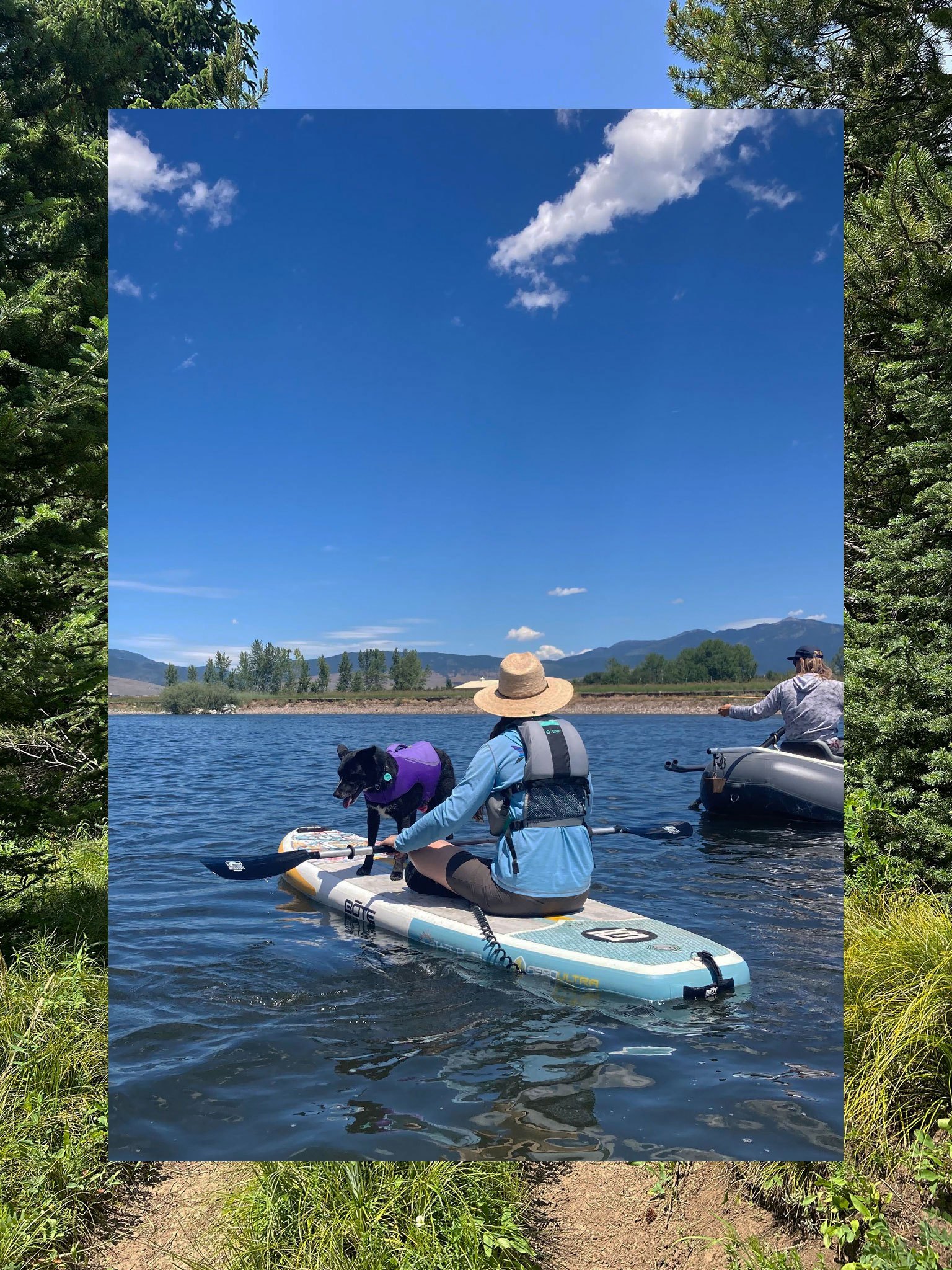
That can make for a much less pleasant floating experience. Take this year, when for my birthday in mid-July I decided on a river float. My friends and I loaded up the cooler with ice and beer, blew up tubes ’til it felt like our cheeks would pop, and buckled my dog Zayda into her purple life jacket. We clipped our tubes together with an elaborate rigging of paracord and carabiners, while Zayda and I opted to ride on a paddleboard.
The first few minutes as the cold water washed over us were a relief, until we rounded the corner to find possibly every other resident of Missoula County floating along, too. I let my pup jump off the boat and swim ashore, her favorite activity. But when it was time to hop back on before the next wave train, she couldn’t figure out which flotilla was ours. I watched in horror as my timid, anxious rescue dog panic-swam between clusters of floaters and for the first time wondered if there really was enough river for us all.
— Ellis Juhlin, regional reporter, Montana
The West Coast
Teresa Chin / Grist
California
California is big — a region unto itself, one might say — and summer can mean a lot of things to those lucky enough to call it home. In sun-baked SoCal, it might be playing in suburban sprinklers during the day and heading to the beach for sunset. Inland, there are county fairs and harvest festivals (don’t miss out on Gilroy’s garlic ice cream). Along the Central Coast, Highway 1 beckons road trippers with panoramic views of gnarled Monterey cypress and thrashing ocean waves. Farther north, summer is the upside-down of seasons, where cool temperatures can prompt locals to don parkas and unprepared tourists scramble for overpriced “I left my heart in San Francisco” sweatshirts.
But climate change is altering many of these quintessential experiences. Where I live in the Bay Area, cool (nay, cold) summers are part of our DNA. Mark Twain may not actually have said that the coldest winter he ever spent was a summer in San Francisco, but that doesn’t make it feel any less true. The combination of cold ocean and hot inland creates an enhanced marine layer, or as many here like to call it: Karl the Fog. Yes, our fog is so iconic, he has a name and a social media following.
But climate change is making Karl less predictable due to factors like warming ocean temperatures. One study found that coastal California’s summertime fog hours declined by 33 percent over the last century. That’s bad news for both locals and coastal redwood trees, which rely on fog as a critical source of water. Even though I grew up in sun-loving Southern California — where summer mornings were so warm that I would often eat my breakfast while lying on a towel in my parents’ backyard — I’ve become attached to the cold and moody mornings here. There’s something so peaceful about watching the mist roll in over the hills with a steaming hot cup of coffee in hand.
Across the state, hotter, drier conditions are increasing wildfire risk. Emergency go-packs now live in closets alongside beach bags, and road trippers need to check for route closures and evacuation orders. While most of California is not currently in a drought, water shortages are expected to worsen over time, which in the past has led local regulators to restrict lawn watering and pool use. For kids on break from school (and harried parents trying to keep them engaged), those conditions can mean sprinklers and splash time often have to give way to screens. That’s a real loss, especially considering that the gorgeous California outdoors is how many of us justify living in such an expensive state.
— Teresa Chin, executive editor of data & design
Kate Yoder; Matthew Craft / Grist
Pacific Northwest
According to an old adage, summer in the Pacific Northwest doesn’t actually start until after the 4th of July. The cool, temperate month before is instead known as “Juneuary.” Growing up, I remember donning a specific summer outfit suited to the weather: a light hoodie or fleece on top (for the typical 50-degree mornings) and shorts on the bottom (for the afternoons in the high 60s or low 70s). Few people had air-conditioning, because a breeze from open windows and fans were more than enough to stay comfortable.
But in the last decade, these idyllic summer days have become rare. Today, Northwest summers are hotter, and the heat starts earlier in the year. This was best exemplified by the infamous heat dome in June 2021, when temperatures in Seattle reached a record-breaking 108 degrees Fahrenheit — roughly 38 degrees hotter than the typical Juneuary highs. According to an attribution study of that event, climate change made the heat dome 150 times more likely compared to preindustrial conditions.
Climate change is also reducing snowpack across the Pacific Northwest, and the dry, hot conditions have turned the region into a potential tinderbox. Wildfire smoke has become a regular feature of our summers. Checking the air quality index, or AQI, in August has become as routine as checking the weather, and many locals factor smoke levels into their summer activity plans.
The combination of heat and smoke has made it harder to stay cool the old-fashioned way, with open windows and fans alone. During long periods of smoke, windows might stay shut all week, causing homes to heat up like greenhouses. As a result, Northwesterners are increasingly installing air-conditioning — so much so that Seattle recently lost its rank as the nation’s least air-conditioned big city.
After enduring months of gray drizzle — known locally as the “big dark” — the promise of an extremely pleasant summer day always felt like the ultimate payoff. While extreme heat and smoke pollution are alarming and dangerous on their own, for many Northwesterners, losing our beloved summer weather is an additional sting.
— Jesse Nichols, senior visual producer
Midwest
Juanpablo Ramirez-Franco; Mia Torres / Grist
Illinois
When I first moved to Chicago about a decade ago, it was in the middle of a still-warm September. My timing was terrible, I was told. I’d missed it — the completely singular experience of a Chicago summer. The golden season, they explained, is a hard-earned reward for a city under siege by long, bitter winters. The parties are outrageous, the beer cheap, and the big, blue lake free.
At the time, I thought they were laying it on thick. But now I can attest to its truth. It’s hard to say exactly what makes a Chicago summer special — and why people here are convinced we have the best version of the season. My sense is that everyone who lives here knows you need to make it count: to be outside, to swim in the lake, to eat ice cream and hotdogs too, to stay up late, to dance, to kiss strangers, to go to the farmers market, to see your friends, to move in with your boyfriend, to wash away the failures and sorrows of the last year and start all over again. Whatever you want, Chicago summers can deliver.
A lot of people talk like that around here; it’s a kind of boosterism that runs against my own sensibilities and can make us look desperate on the internet. But come to the Windy City in the summer, and you might find yourself drinking the same Malört-laced Kool-Aid. (Don’t actually mix those.) I don’t know if we’re all collectively redirecting 15 one-sided rivalries with other major American cities, but our summer really is something else.
Which is why it was such a disappointment when this summer played out differently. For one, it was wetter than usual; the city’s emergency 11-billion-gallon reservoir and tunnel system very nearly hit capacity. Canadian wildfire smoke pushed local air quality readings to the unhealthiest levels the city has ever seen. More than 200 tornadoes made landfall in Illinois this year, a record-breaking figure for the state that’s very close to topping the national record. The same powerful winds also caused a terrible power outage in Gary, Indiana, just south of Chicago, where tens of thousands of people were without power for over two weeks.
A less smoky, less humid, less rainy, less tornado-y do-over would be nice. But that’s not in the cards. Summer temperatures in Chicago are projected to keep climbing and are forecasted to coincide with increased variability between heavy rain and drought.
The meteorologists tell us summer is technically over, but I’m wondering how much longer our summer will actually last.
Small farms and lush backyard gardens are a way of life in the Mountain South. The growing season is long. But farmers and gardeners are faced with difficult decisions as the region’s humid summer extremes have grown more chaotic and intense.
This was a lesson that really hit home for me the last time I tried farmwork: a brutally hot summer day in 2020 in East Tennessee. I was working in a hundred-plus-degree greenhouse, up to my neck in spiny tomato plants as I strung them up and suckered them, itching, head pounding, blinded with sweat. Later, in the field, as I planted a bed of onions, the landscape seemed to undulate in front of me, and I dashed off to a nearby tree and vomited discreetly behind it. It wasn’t the first time this had happened.
As I drove home, I thought, the $8 an hour just isn’t worth it.
In 2023, the U.S. Department of Agriculture updated its plant-hardiness zones, which guide gardeners and farmers based on the annual lowest temperature in their location. Much of the mid-South moved half a zone up — from 7a to 7b, or 7b to 8a — toward the humid subtropics. The USDA cautioned against understanding it as directly linked to climate change but acknowledged that the zones for most plants will shift northward as the planet warms. That’s in addition to the cyclical temperature swings gardeners deal with year to year.
Increasingly ferocious summer storms and flash flooding, interspersed with more extreme flash droughts, have also made growing food even more tenuous. Kelsey, a friend of mine who works as a flower farmer in nearby southeastern Kentucky, told me she had to switch to what she called an Andalusian daily schedule, getting up early and breaking for most of midday, sometimes only returning to the field with a headlamp after dusk. When the financial margins are thin, little costs like replanting, fungicides, and even electrolyte drinks add up.
Even more than the heat, the uncertainty wears on people. Aside from the financial unpredictability, farmers and gardeners are also feeling the loss of tradition and ritual, like the old-timer’s practice of planting by moon phases and zodiac signs.
As the planet warms, many are focusing on the cool periods of seasonal transition, investing in plants that return annually, experimenting with tropical varieties like amaranth and malabar spinach, or trying to grow crops in the shade to keep them from withering. Kelsey is pinning her hope in seed saving, the ancient art of paying close attention to the plants that seem to survive most easily and preserving their genetics, in hopes of creating hardier varieties that can withstand the summers to come.
— Katie Myers, regional reporter, Appalachia
Jaime Buerger; Lyndsey Gilpin / Grist
Kentucky
Going outside on a Kentucky summer day has always felt a bit like stepping into a rainforest. And if you live in mountainous eastern Kentucky, you actually are — the southern Appalachians are a lush temperate rainforest. It’s hot and sticky and beautiful. There are a thousand shades of green. The migratory tanagers and perulas chatter all day; the cicadas scream all night. Deep yellow goldenrod, coral honeysuckle, and purple coneflowers bloom.
But the temperature and humidity are becoming unbearable: Multiple times a summer over the last three years, Kentucky has had prolonged extreme heat waves with heat index values up to 108 degrees, resulting in air quality alerts and heat advisories. These extreme temperatures usually break with huge thunderstorms that bring heavy rain and violent wind and sometimes lead to tornadoes and flash floods.
Evenings aren’t the respite from the heat they once were. Last year, for instance, Waterfront Wednesday, Louisville’s free evening summer concert series, fell on heat advisory days two months in a row. It was still 94 degrees when a band took the stage at 7 p.m. (the crowd was large, regardless).
Kentucky’s summer average temperatures have risen by 2 degrees Fahrenheit since 1970. Louisville has seen temperatures rise by over 4 degrees; according to a 2016 study, the city had one of the fastest-growing urban heat islands in the country, and new research shows the problem has grown in the years since. Louisville is working on efforts to address the urban heat, but for the most part, event hours, amenities, and locations remain unchanged. As parents of young children, my friends and I find ourselves skipping out or cutting our day short unless there’s a water source — a playground splash pad, a pool, a decently clean creek — to cool off the kids in.
In any city in the state in the summer, you’ll find festivals, church picnics, county fairs, and flea markets. But most are still taking place in the middle of the day, often on hot concrete, without fans or mist or free water or enough cooling centers. Of course, the bourbon is still flowing — but even with ice, it doesn’t go down quite as smoothly in 100-degree weather.
— Lyndsey Gilpin, senior manager of community engagement
Anila Yoganathan / Grist
Georgia
Summers have always been hot in Georgia. There’s the dread of getting in your car and burning yourself on the seats while smelling the acrid fumes from the pleather melting. The slick feeling of perpetual moisture on your skin as the humidity surrounds you most days. And there’s the knowledge that, when the sun is at its peak, you should only be outside for the minute it takes to go from your air-conditioned car to the air-conditioned building.
Having been raised in metro Atlanta, it’s something I grew up planning life around, like scheduling outings on days when the heat was tolerable or making plans after sunset. My favorite pastime during the season used to be sitting outside at twilight: the sky a burst of bright colors, the heat receded to the edge of pleasant, and the humidity just enough to feel a little cool moisture on your skin like dew. In those peaceful moments just before it got dark, I would quietly watch the fireflies create a magical scene in my parents’ yard. Now? The conditions of a Georgia summer just feel more intense.
For one thing, the heat from the day doesn’t drop as much as it used to at night. From June through July this year, the minimum temperature in Georgia was 2.5 degrees Fahrenheit above the average from 1901 to 2000.
If I’m not tired of the heat and can tolerate the humidity, I still have to prepare to be eaten alive. Rising nighttime temperatures can “enhance mosquito growth” during the summer, according to the University of Georgia. So I don’t go outside at dusk as often as I did growing up.
Things have also changed inside the house. In the summertime, my dad and brother often argue over the thermostat. My brother wants cooler temperatures so he can sleep better, and my dad worries about the rising electric bills, an issue that other Georgians are also grappling with. My parents’ late-1960s house, while beautiful, is energy-inefficient. The old attic fan that used to keep us pretty cool years ago kept breaking down, and we no longer use it. While we’ve debated upgrades, the costs are still high. So the inter-generational thermostat war continues.
These days when I visit Georgia, I still try to venture outside at dusk to see my favorite lightning bugs. And while I may see a few, I’m all too aware that they face growing threats from light pollution, pesticides, development, and yard management, which can impact larvae. Without them, summer in Georgia feels just a little less magical.
— Anila Yoganathan, regional reporter, Nebraska
Sachi Mulkey / Grist
Florida
The pleasures of a summer in Florida were once simple: the sensation of hot concrete pushing through the soles of your recently air-conditioned feet. A cold gas station Slurpee in one hand and a bag of boiled peanuts in the other. The steam from an afternoon rainstorm, rising from the sun-baked roads. A frozen custard from Rita’s Italian Ice truck by the beach, where you spent the afternoon collecting sand dollars and bouncing in waves with your family.
But Florida’s subtropical climate, low elevation, and exposure to warm ocean waters on three sides leave it with little buffer against the changing climate. Scores of tourists are now passing out amid 100-degree heat at Disney World. In many neighborhoods, sidewalks become hot plates after 10 a.m., scalding dogs’ paws into pink blisters. It may not rain at all, for weeks at a time. And when it does, scientists say it’s raining harder. You can feel it — gripping your steering wheel during a sudden deluge that whiteouts the road and floods sidewalks. At night, the air is muggy and laden with mosquitoes while, somehow, still unbearably hot.
So if your family is like mine, you might hop in the car and head to the beach in the hopes of trading the pavement for sand, and reconnecting with the magic of summer.
But if that beach is near Miami or the Florida Keys, you might find yourself facing thousands of tons of sargassum, brown seaweed that can clog shorelines and prevent sea turtles from nesting. In recent years, the kelp has been growing relentlessly thanks to the right conditions: bathwater-like ocean temperatures and shifting climate patterns that boost ocean nutrients. The result is a rotting mass that releases hydrogen sulfide as it decomposes, making beachgoers’ eyes and lungs burn with noxious fumes.
Or if you drive toward Tampa, you might encounter a monthslong surge of red tide, shorthand for toxic algae blooms, also caused by warm waters and similar nutrient patterns. From Sarasota to Clearwater, locals know to stay away when piles of dead fish (and sometimes manatees, dolphins, or sea turtles) litter the beaches. In smaller beach towns like Sanibel and Cedar Key, rising sea levels and hurricane damage have crumpled the economy and closed the vintage shops I once loved to peruse. Whether your refuge is cooled by AC or whirring ceiling fans, summer in the Sunshine State has increasingly become a time to stay indoors.
— Sachi Mulkey, reporter
Northeast
Katherine Bagley / Grist
New Hampshire
After harsh winter temperatures and muddy spring months, summer in New England feels like a well-earned prize. The peaks and lakes of the Appalachian Mountain range, rocky coastlines, and cool waters of the Atlantic Ocean are a venerable playground after months of being largely stuck inside. There’s hiking and boating, lobster rolls and ice cream, and blueberry fields ripe for picking. We New Englanders don’t let a single moment during the precious months between Memorial Day and Labor Day go to waste.
But a warming planet has changed the conditions in which we are engaging in these activities. The region is heating up faster than any other place in the contiguous United States. The weather whiplashes between intense rain and flash droughts. And then there are the ticks. So. Many. Ticks.
Growing up in the 1980s and ‘90s, these blood-sucking insects were not a thing I worried much about. Their populations were isolated to small patches of coastal regions and stands of long grass. My friends and I played outside all day before crawling into our beds when the streetlights came on. Parents didn’t conduct nightly tick checks or spray their yards with pesticides. People didn’t keep tick-removal devices on their keychains or lint rollers in their cars to swipe down bodies after being in the woods. They didn’t capture embedded ticks in clear tape, waiting to submit them to a doctor if a bull’s-eye rash appeared at the bite site.
Now, I do all these things. The ticks are everywhere. My son was just a year old when I found his first one on him, embedded in his upper thigh. We were at a lake where I spent my summers, and where I had never once gotten bitten growing up.
New Englanders still cherish their summers — our iconic stubbornness ensures that never goes away — but these months are a little less carefree, and the woods and lakes and coastlines a little less safe.
— Katherine Bagley, editor-in-chief
Jake Bittle / Grist
New York
I’ve always thought of New York City as a summer town. There are a lot of people who disagree with me, as evidenced by the clogged outbound highways heading upstate and out to the Hamptons, but to me the best times to live here are when you can stroll a hot street with a Mister Softee cone and take the subway out to Rockaway Beach. The city has been getting hotter and muggier for some time now. The panel of scientists who ran the National Climate Assessment reclassified the city in 2020 from “humid continental” to “humid subtropical,” meaning it now has more in common with the lowlands of the Southeast than it does with the crisp pine forests of New England.
I’m originally from Florida, so humidity and sudden afternoon thunderstorms don’t bother me. What does get to me, and the millions of other New Yorkers, is the smoke. This past summer, a curtain of smoke from wildfires in Ontario blanketed the city for days, elevating the air quality index so high that it was unsafe to step outside. I made the mistake of trying to attend a party in Lower Manhattan on what should have been a sultry Thursday night and found myself returning home through empty streets with a headache. I had planned to go to the beach the next day and the day following, but I canceled my plans. (A few weeks later, when I tried to go to the beach again, my friend Chris and I got caught in an apocalyptic thunderstorm.)
This year was nowhere near as bad as the smoke drift from Canada in 2023, which blocked out the sun and raised air quality to levels exceeding that of polluted cities like Mumbai, causing a jump in emergency room asthma visits. That time I went days without stepping outside, until I got a cold from prolonged exposure to my window AC unit. When I did go outside, I had to wear an N95 mask, as did the construction workers and delivery bikers who were still laboring for hours at a time in air that was toxic enough to make one faint. In both cases, scientists have found that climate change made the wildfires in Canada at leasttwice as likely.
Most of the Midwest and Northeast experienced at least some smoke this summer, but it felt acute in New York, where the line between inside and outside is always a little blurry in the summer. Most New Yorkers have at least one window air-conditioning unit, but around 1 in 5 residents of the poorest neighborhoods don’t. Even in homes that do have window units, they don’t cool down whole apartments, and many people leave other windows open to air out other rooms and save on power bills. When we leave the house, most of us can’t get anywhere without walking for 10 or 20 minutes to the subway. The whole premise of life here is freedom, the freedom to go wherever you want, to go nonstop day and night. In two different summers now, I’ve seen the impossible — climate change brought the city that never sleeps to a standstill.
— Jake Bittle, staff writer
Samantha Swinsburg
New Jersey
The Jersey Shore is famous for a reason. It’s the quintessential summer destination for New Jersey and its neighboring states. The long series of barrier islands shielding the mainland boasts wide, white-sand beaches that have attracted summer visitors since the 18th century. Easy access from the nearby population centers of Philadelphia, North Jersey, and New York has guaranteed hordes of tourists enjoying the beaches and boardwalks from Memorial Day weekend through Labor Day for more than a century.
But for the people who actually live here, the day after Labor Day is the best of summer.
As if the atmosphere can read the calendar, the weather shifts from the brutal heat and humidity of August to the more temperate warmth of September. The ocean, cold enough to be uncomfortable throughout most of the summer, finally accumulates enough heat to be the perfect swimming temperature. Most of the crowds depart, leaving the usually-packed beaches open for those who live close enough to steal one more day of summer before the school year begins.
It’s a day for getting to the beach late because there’s no need to stake out territory, and staying until the sun sets because there’s no reason to leave. A day for long, lazy floats in the Atlantic, for finishing the last dregs of ice cream left in the freezer, for sneaking the dog onto the deserted beach even though dogs are technically still banned for a few more weeks.
At least it was. Now the warming air and water have made that crisp turn-of-the-page fuzzier. The warm September water is arriving sooner: In the third week of August this year, sea surface temperatures were already hitting the upper 70s, according to satellite data compiled by Rutgers. In the air, August’s dog days are bleeding into fall. Average temperatures from September through November in Atlantic City have already increased 3.4 degrees Fahrenheit since 1970, according to the research group Climate Central, with 14 more days of above-normal temperatures annually.
Or as my mom — a lifelong denizen of the shore — put it, “October is the new September.”
But October can’t be that first Tuesday in September, not with school in session and island businesses closed for the season. And the more summer temperatures bleed beyond their former season, the more that perfect, final, magic day of summer becomes just … another hot day at the beach.
Disgraced Actor Dies Following Battle with Pancreatic Cancer
British actor Chris Langham, best known for his roles in the political comedy “The Thick of It” and the sketch series “Help,” has died at the age of 77.
Langham died from pancreatic cancer on June 24, 2026, according to an obituary confirmed by The Times.
He is survived by his second wife, Chrissie, and their two children, Emily and James, as well as three children from his first marriage to Sue Jones-Davies.
Langham was once one of Britain’s most acclaimed comedy actors, earning widespread praise for playing hapless government minister Hugh Abbott in the first two seasons of the BBC satire “The Thick of It.”
In 2005, he was named comedy actor of the year at the British Comedy Awards.
But just two days later, news emerged that Langham had been arrested two weeks earlier over child sexual abuse material found on his computer.
He was later charged with 15 counts of downloading indecent images of children. Prosecutors said some of the material included videos showing the rape of a teenager and the sexual abuse of an eight-year-old child.
Other material found on his computer included images involving sadism and non-consensual sexual acts between adults and children, according to the Crown Prosecution Service.
Langham was sentenced to 10 months in prison and ordered to remain on the sex offenders register for 10 years.
His sentence was later reduced to six months on appeal.
During the case, Langham argued that he had viewed some of the material while researching a role for the TV series “Help,” in which he played a character named Pedro who was described as a “Peeping Tom.”
Police strongly rejected the idea that viewing such material could be harmless.
“Viewing such images simply perpetuates child abuse,” Detective Inspector Derek Cuff of Kent Police said outside court. “Our thoughts are with all victims of child abuse, which has such a devastating effect on young people’s lives.”
Following his arrest, Langham was dropped from “The Thick of It,” and his character was written out of the show off-screen between its second and third seasons.
After leaving prison, Langham said his “conscience is clear” and argued that media coverage had ignored what he described as the court’s acceptance, based on evidence and expert testimony, that he did not have a sexual interest in children.
He later offered a harsher assessment of his own actions, saying that his “arrogance” and “ego” had led him to view the material and that the decision had “completely f—– up my own life.”
In a 2011 interview with The Guardian, Langham said he knew what he was doing was wrong but convinced himself that his status as an artist somehow placed him above normal rules.
“I thought after ‘Help’ I’ll reveal I’d researched it, and people would say gosh, you’ve taken this really difficult subject and done something amazing,” he said.
Langham admitted he believed the decision would win him praise and admiration.
“I thought if I pulled it off, everyone would admire me,” he said. “And I’m a slut for approval.”
Langham’s conviction effectively ended his mainstream television career, overshadowing the success he had previously enjoyed as one of Britain’s best-known comedy performers.
Moscow has a long history of paranoia about Britain’s support for Russia’s enemies
Relations between London and Moscow reached another peak of tension in August over the UK’s support for Ukraine. The success of Ukraine’s long-range strikes against targets deep inside Russia, with the help of UK-made drones, and the UK’s commitment to supply blueprints to help it manufacture long-range missiles, led the Kremlin to accuse the UK of deliberately escalating the conflict.
Russia’s London embassy promised that the deeper the UK’s involvement in the war “the higher price it will pay”.
The embassy accused the UK government of “seeking to contain Russia and inflict maximum damage on it by proxy”. Kremlin spokesman Dmitry Peskov, meanwhile, described Britain as “methodically and regularly” fuelling war and “hatching schemes” to sabotage peace. Foreign ministry spokeswoman Maria Zakharova warned that British military targets could now be attacked because of Ukrainian strikes using British weapons.
The UK prime minister, Andy Burnham, responded by reaffirming Britain’s position, saying the UK would “support Ukraine 100%”.
But Russia is presenting Britain not simply one of Ukraine’s principal supporters, but an influential member of an anti-Russian coalition, operating behind the scenes and pursuing its objectives through proxies.
The Kremlin’s messaging is crediting the UK with outsized influence. But this image of British power closely resembles Soviet thinking exactly 100 years ago. In the mid-1920s, the Soviet leadership made similar accusations about British support for another country on its western border. This time it was Poland.
Poland and Soviet Russia had fought a bitter war in 1919–20, ending in a stunning Soviet defeat. Soviet hostility towards Poland was therefore hardly surprising. Nor was distrust of Britain, which had intervened in the early years of the “Russian civil war” in support of the Bolsheviks’ enemies, the counter-revolutionary “White Armies”.
But by the mid-1920s, these real antagonisms had become entangled with a conspiratorial understanding of international politics. Britain, still the world’s preeminent imperial power, increasingly appeared in Soviet thinking as the hidden hand behind apparently independent threats to the USSR.
Poland, in this way, occupied a position remarkably like that assigned to Ukraine in Russian rhetoric today. Soviet officials struggled to imagine Poland acting entirely on its own. From the early 1920s, Soviet military intelligence and the security services reported that Britain was actively organising an anti-Soviet bloc including Poland and other border countries that could be pushed into war against the fledgling Soviet Union.
These suspicions deepened in May 1926 when Józef Piłsudski, a nationalist figure who had led the Polish Army to victory in 1920, seized power in Poland. Senior Soviet officials interpreted Piłsudski’s coup as having been inspired by Britain.
Marshall Józef Piłsudski and political allies during the May 1926 coup in which he seized power in Poland.Marian Fuks/Wikimedia Commons
The head of the increasingly powerful soviet secret police, the OGPU, Feliks Dzerzhinsky, was convinced the coup was “entirely supported by England” and warned Josef Stalin that Poland now intended to seize Ukraine and Belarus. Another intelligence assessment from senior police officials described Piłsudski vividly as Britain’s “guard dog” in eastern Europe.
Reports from influential figures such as the Soviet representative in Warsaw, Pyotr Voikov and Soviet diplomat Maxim Litvinov – who arguably had access to better information and who contradicted this narrative – struggled to be heard. When Litvinov complained about the Soviet tendency to see “the malevolent hand of the British government everywhere”, Stalin disagreed. He insisted that there was an international conspiracy against the Soviet Union, which would make another war inevitable.
The ‘hand of England’
Fears that Britain would manipulate Poland into war intensified in June 1927, when Voikov was assassinated by a Russian émigré in Warsaw. Stalin immediately wrote to his closest ally, Vyacheslav Molotov: “I feel the hand of England in the murder of Voikov. They want to provoke a conflict with Poland. They want to repeat Sarajevo.”
Soviet hostility was not entirely detached from reality. Only weeks earlier, British authorities had raided the Soviet trade mission in London and uncovered what it said was evidence of clandestine Soviet activity and had broken off diplomatic relations. This was seen in Moscow as evidence of British hostility towards the Soviet Union.
But Stalin went considerably further, insisting that Britain was coordinating hostile activity against the Soviets by countries such as Poland and sponsoring assassinations. In the days following the Voikov murder, the main Soviet newspaper Izvestiia accused Winston Churchill of directing a secret group of assassins, charged with the elimination of Soviet officials.
All smiles as US president, Harry Truman, joins hands with Winston Churchill and Josef Stalin. But Russia was always deeply suspicious of Churchill.Winston Churchill collection.
The Soviet commissar of foreign affairs, Georgy Chicherin, summarised this understanding of British power clearly. In 1928, in discussion with the king of Afghanistan, he argued that Britain was “always striving to push others instead of itself into military actions against us”. This image of Britain persisted into the early 1930s, until the rise of Nazi Germany reorientated Soviet perceptions of the principal military threat.
A familiar view of British power
Things are very different today. The Soviet leadership badly exaggerated the danger it faced in the 1920s. Neither Britain nor Poland was preparing an anti-Soviet war that Stalin increasingly forecast. By contrast, Britain is not only providing substantial military and political support to a country fighting Russia, it is playing a prominent role in coordinating a coalition of other countries to do the same.
There is a strong parallel in the way that British power is perceived in Moscow. As in the 1920s, the Russian government’s rhetoric once again presents Britain as a malevolent force, working behind the scenes in the war in Ukraine. This is in tune with the Russia government’s wider framing of Nato’s role in the war – yet Britain has been given an outsized role in this.
As former Russian president Dmitry Medvedev remarked in 2023: “Britain was, is and will be our eternal enemy.”
It’s interesting to note that Russia’s new standard history school textbook, first published in 2023, has an account of the events of the war scare in 1927 which reinforces this idea that Britain was playing a leading role in an international campaign against the Soviet Union.
As relations with Britain have deteriorated, these ideas have found fresh relevance in the official history now being taught to a new generation of Russian students.
Israel is methodically emptying the West Bank countryside of hamlets and farms to spur Palestinians to either flee into exile or move into cities hemmed in by Israeli settlements ramshackle “outposts” and military bases.
Western governments and the United Nations complain. These actions are illegal and damage chances for Middle East peace. Israel ignores the objections and creates “facts on the ground” that preclude territorial compromise with Palestinians.
Spearheading the project are civilian militants known as Hilltop Youth who inhabit pop-up encampments known as “outposts” throughout the West Bank. The camps are constructed close to Palestinian towns and rural homesteads that have been targeted for harassment,
The settlers, backed by the Israeli army, employ a broad menu of intimidation: physical violence, destruction of homes, barns and corrals, theft or slaughter of farm animals, incineration of wheat fields and sabotage of piped-in water supplies.
Palestinians get no protection from the Israeli Defense Forces, the armed institution in charge of most of the West Bank. IDF leaders say it is not their job to discipline Israelis attackers. Their role is only punishing Palestinians who do harm to Israelis or are suspected of planning to do so.
Preventing crime by Israelis is the job of civilian police, asserts the IDF. However, police forces in the West Bank work solely within Israeli settlements. In effect, “outpost” dwellers are beyond the reach of either the army or the police.
“It’s almost impossible to enforce the law on violent settlers and very easy to do whatever we want to Palestinians,” said Nadav Weiman, a former IDF sniper who belongs to Breaking the Silence, a group that collets and publishes testimony of soldiers who have done duty in the West Bank and Gaza Strip.
During more than two decades, Weiman has collected testimony from soldiers who object to standing by and doing nothing. “I can tell you that in the majority of the units, nothing is being told to the soldier on what they can do with settlers,” he said.
Prime Minister Benjamin Netanyahu downplays settler assaults as the work “of a handful of extremists.” They are but “a minority that does not represent the larger settler community,” he says.
These random troublemakers will soon face arrest, he insists. “We are a state of law and will act according to the law,” he told reporters.
Pledges aside, Netanyahu’s ruling coalition depends on politicians who reject any crackdown on settler gangs. They believe that unrelenting pressure is the way to eliminate Palestinian ambitions to create a nation state of their own. In February, Finance Minister Bezalel Smotrich laid out the goal. “Finally, formally,” he said, the country would “embark on a path toward sovereignty, while encouraging emigration. There is no other long-term solution.”
Netanyahu himself has since the beginning of his political carer considered Palestinians interlopers on Israeli land who should find a homeland elsewhere. In the 1970s, he associated with an American lobby organization called Jordan is Palestine, Inc. – Jordan already being by then the residence of tens of thousands of Palestinians.
Arab observers view the settler drive as revived Nakba, the “catastrophe” of the 1948 and 1967 Arab-Israeli wars in which hundreds of thousands of Palestinians were driven into the West Bank, the Gaza Strip or Arab countries abroad. Neither refugees then nor their descendants since have been allowed to return.
In an interview with told The New Arab, a London-based journal, Amina Khalil, a 1948 refugee, said fear of a repeat Nakba is now sweeping new generations. “My grandchildren don’t ask me, ‘What happened?’” Khalil, 78, said. “They’re asking, ‘Is this possible now? Will it happen again?’”
The government provides monthly $50 stipends to members of settler groups that harass Palestinians, human rights groups say. Human Rights Watch, the New York-based research organization, has reported that 5,900 people have fully or partially fled 107 communities since 2023.
“The Israeli government and the settlers share the same goal of maximum land and minimum Palestinians, with the authorities not only failing to stop settler violence, but actively enabling it,” wrote Sarah Sanbar, an HRW researcher specializing in Israel and Palestine issues. “Settlers shoot, attack and expel Palestinians from their land, and the state provides the weapons, the legal cover, and the budget to do it.”
“The government has no such policy,” a government spokesman said in response to such accusations.
Obtaining official Israeli protection requires that Palestinians get access to an orgnization that is out of reach: Only Shin Bet, Israel intelligence service, is authorized to order the IDF to arrest Israeli civilians. If Shin Bet so orders, soldiers can detain Israeli civilians and then turn them over to Israeli police for transfer to jail inside Israel. It perhaps goes without saying that Palestinians do not have a Shin Bet emergency customer service number to call for help.
Israel does not publish statistics of arrests of settlers who might be suspected of attacking Palestinians – unless an incident creates a negative public relations issue or interferes with military activity.
In June, six Hilltop Youth members were arrested at the central West Bank village of Deir Dibwan on charges of setting fire to a mosque. The settlers had also burned grassland and barns and had stolen two cars. The arson was captured on video and made public on social media. A trial date has not been set.
On August 24, Shin Bet did order soldiers to detain five members of the Hilltop Youth. Their alleged victims, however, were not Palestinians but Israeli security forces. “These acts of terror as a grave threat to national security and will continue to work to thwart such activity,” authorities announced. No details of the alleged crimes will be released until October.
Incidents of settler violence have apparently become common enough to prompt Defense Minister Israel Katz to suggest police take over the task of curbing settler violence. “The IDF’s role is to fight Palestinian terrorism, focus on defending borders and communities against threats, not chase boys on the hilltops,” Katz said in mid-August. Katz said he was drawing up a plan, though he did not provide a timetable and no proposal has emerged.
Hilltop Youth outposts are composed of mobile homes or campers supplied by the government. The name Hilltop Youth refers to comment made by late-Israeli Prime Minister Ariel Sharon, who urged settlers to take vigilante action against Palestinians. “Everyone that’s there should move, should run, should grab more hills, expand the territory,” he said. “Everything that’s grabbed will be in our hands. Everything we don’t grab will be in their hands.”
After Hamas’s October, 2023, attacks from Gaza into southern Israel that killed more than 1,200 Israeli civilians, Netanyahu authorized the creation of armed settler militias. He described the program as a means to avert further Palestinian sneak attacks.
The program soon turned into armed vigilantism. A rundown of recent settler assaults displays the variety and growing intensity of settler attacks.
No siege too small
For the past two weeks, armed Hilltop Youth members have besieged a single house in the village of Qusra, near the north-central West Bank city of Nablus. One family of residents is hosting a dozen neighbors driven out of their two nearby houses.
Hilltop men and teenagers broke into one of the abandoned homes and stayed. Soldiers occasionally drop by to talk with the intruders. The troops make no move to remove them.
A United Nations Children’s Fund team delivers water, food, medicines, hygiene items and recreational kits for a pair of female toddlers. Settlers had cut a water pipe, but Palestinians from elsewhere repaired it.
There’s no end in sight to the sieges.
Bye, bye Bedouins, hello settlers
In the mid-1990s, Israeli and Palestinian negotiators signed a peace plan and designed a complicated interim map of the West Bank that temporarily placed much of it in control of Israel until formation of a Palestinian state.
One such areas was an eight-square mile chunk known as E1. About 33,000 Bedouins inhabit the area, which sits between Jerusalem and a Jewish settlement known as Ma’ale Adumim.
Neranyahu aims to take it all.
Last week, Netanyahu announced a takeover of a stretch of E1 where more than 1,200 apartments are to be built. Eventually all of E1 will be filled with 8,000 residences and annexed to Jerusalem.
With its municipal bounds extended, Jerusalem will become the first Israeli city whose boundaries bleed into the West Bank. The Bedouins will be expelled to somewhere else in the West Bank.
Unfortunately the town of Khan al-Ahmar, home to about 6,000 residents, sits in the way of the new apartment blocs. As part of the current efforts to dominate the West Bank, ministers say, the town will soon be removed.
The United Nations High Commissioner for Human Rights said, “The Israeli government must immediately cease its measures to forcibly displace the Khan al-Ahmar community … and stop its settlement expansion plans there.”
The pressure on the town is not new. For years, the Netanyahu government has refused to link it to a pipe that also feeds Ma’ale Adumim, to an electricity grid and roadways, according to a recent report by B’Tselem, the leading Israeli human rights organization.
“Now, Israel is planning to demolish every single structure in the community and expel the residents. The demolitions are set to include the local school, which serves the children of 11 other Palestinian communities slated for transfer,” B’Tselem noted.
“Demolition and transfer are a war crime for which Israel’s government and military leadership will bear primary criminal liability.”
Netanyahu appears unfazed. He has authorized US$92 million toward the construction of a new Palestinians-only road built around the far eastern edge of Ma’leh Adumim , so that Israeli traffic from Jerusalem will not cross paths with Palestinian roads.
Figs under fire
The West Bank village of Tel, population 8,000, is known for its plentiful harvest of figs. The first sweet fruit is usually ready to be picked in late June.
But this year, as in recent seasons, the harvest is being interrupted by Israeli soldiers, as well as settlers, who have descended onto the town.
“The sweetness of Tel’s figs has turned into bitterness,” said Omar Ishtayeh, a Tel resident reached by phone. “The fruit that once symbolized prosperity has become a witness to a new reality threatening both the land and the people who live on it.”
Over the past 38 years, settlements have sprung up in the west and east of Tel, along with a military base to the south. The construction required the uprooting of hundreds of olive trees, another town specialty.
I first visited Tel in 1988 and witnessed the inception of what was to become an annual affair. A Palestinian uprising known as the intifada, or “shaking off,” had started a few months before. When word reached Tel, teens decorated the village with red, green, white and black Palestinian flags. They also threw stones at passing military convoys.
The army responded by prohibiting fig-bearing trucks from leaving for market.
To save the 1988 harvest, elders persuaded the stone-throwers to stop it and to take down the flags.
But most years ever since, the army has raided. In recent years, settlements and outposts appeared on the outskirts of the town.
In parallel, youthful enthusiasm for Palestinian statehood grew. But no state arrived. More and more violence did.
Last month, a score of settlers raided. There was a fistfight. Then gunfire. Four Palestinians and two Israelis were shot dead.The army intervened and arrested 40 Tel residents. The town was sealed off.
The figs are rotting on the trees.
Refugees made refugees anew
Four refugee camps that date from 1948 and 1967 wars are clustered at the cities of Nablus, Tulkarem and Jenin. Over the year the towns, and especially the camps, have grown into centers of resistance to Israel’s West Bank occupation and settlement.
This year, refugees were rousted out of the camps. Each was razed to the ground. Camps located in the central and southern West Bank were also partially bulldozed.
The military rationale for the destruction is simple: The camps’ narrow alleyways impede the entry of an army that prefers open field combat. Tanks and jet bombers are the preferred tools of flattening the enclaves. Similar damage was done to camps in the Gaza Strip.
At least 700 resident refugees have died and 23,000 have been arrested in the area’s camp wars. A total of 33,000 men, women and children have fled, according to the United Nations Refugee and Works Agency, which is responsible for refugee welfare.
UNRWA issued plans for reconstruction of Gaza refugee compounds, but the organization has made no such proposals for the West Bank. For now, the job is “to address urgent humanitarian needs” of the displaced.
No residents have been permitted to return to inspect the ruins or collect belongings.
Christian conundrum
The Israeli government has put few restrictions on marauding settlers when their targets of intimidation are Muslim.
But when Christians are assaulted, such raids becomes a public relations problem. Netanyahu has been active in trying to persuade at least evangelical Christians to take Israel’s side in Middle East tensions.
In any event, many Christians in Western countries keep an eye on danger to their co-religionists.
Take the village of Taybeh, population 1,200. It has been trying to fend off violent settlers who graze their sheep on village land, set fire to agricultural fields, tear down fences and slice fences, break into homes, pitch tents on private property, cut water lines, rip down electric cables and smash security cameras.
Pope Leo XIX appealed, “for an end to the ongoing violence against the Palestinian civilian population in the West Bank.”
Before the pontiff’s intervention, Joseph Hazboun, who heads’s the Vatican’s Near East Welfare Association, visited Taybeh and described Israeli settlers’ “systematic intimidation” of Palestinians.
“The human cost of the West Bank’s expanding outposts became starkly evident,” he wrote, “Leaving families stranded away from the very homes they built, caught in a cycle of displacement and daily intimidation.”
The ecumenical World Council of Churches stated flatly that, “Taybeh has been subjected to numerous attacks and acts of arson by Israeli settlers.”
The organization demanded “that the Israeli government act with moral clarity and commitment to hold accountable those responsible for these crimes without delay; ensure effective and consistent protection for the people of Taybeh and all vulnerable communities.”
To avert more problems, the IDF created a “closed military zone” to keep the settlers away from Taybeh.
But the closure also blocks passage to and from Taybeh’s agricultural fields and for anyone coming for business or pilgrimage, as well as for providing charity. And Hilltop Youth made a mockery of the IDF restrictions by approaching the town’s perimeter to loudly taunt the residents inside.
EU and DC: all talk, no action
The European Union criticized Israel’s recent West Bank expansion. “The EU position is clear: Israel’s settlements in the West Bank, including in the E1 area, are illegal under international law,” said the European Commission, the organization’s executive.
However, calls from members of the EU parliament for the all-powerful European Commission to cancel trade deals that benefit Israel were rejected.
In Washington, President Donald Trump “has clearly stated, the US does not support Israel annexing the West Bank,” said a State Department spokesperson. His ambassador to Israel, Mile Huckabee, called violent setters “terrorists,” though he has is a supporter of West Bank settlements.
He once said “There’s no such thing as a settlement. They’re communities.”
In any case, no actions followed any of these words.
Just like a fruit fly, a new algorithm never forgets old scents
Fruit flies aren’t exactly famous for their brainpower; you’ve probably drowned more than one in a wine glass left too long on the patio table. And yet, working with roughly 140,000 neurons—a brain smaller than a poppy seed—Drosophila can sort through a huge range of smells in a fraction of a second, and then retain the memory of that scent for a long time.
In this, they do much better than current “electronic noses.” Even the most advanced ones on the market tend to be expensive, painfully narrow in what they can detect, and quick to forget an odor the moment they learn a new one.
So why not just copy the fly? That’s the question a growing number of researchers have been asking—including Kevin Max and Yang Shen at the Okinawa Institute of Science and Technology, whose new algorithm, Spi-Fly, is described in a paper just published in the journal Neuromorphic Computing and Engineering.
A rather obscure sense
Smell is a strange sense, mechanically speaking.
Vision and hearing both reduce to a single physical dimension you can plot on a graph—wavelength—which makes them relatively tidy to study. Odor molecules, by contrast, can’t be reduced to any single physical dimension. Biology had to find a messier solution instead: hundreds of different receptor proteins, each shaped to grab onto specific molecular features, firing in combinations that the brain then has to decode. It’s a system so combinatorially complex that it took until 1991 for Linda Buck and Richard Axel to even identify the receptor gene family behind it, work that won them a Nobel Prize in 2004.
Despite the difficulties in our understanding of smell, “electronic noses” exist on the market. Companies like Alpha MOS, Aryballe, and Odotech sell them for food-quality control, environmental monitoring, and security screening.
What these noses are bad at is generalizing. A device with software that is tuned to sniff out spoiled olive oil isn’t the same as a device that flags a specific explosive at an airport checkpoint. Retooling one for a new task usually means retraining its software almost from scratch.
Two technical bottlenecks sit behind that limitation. First, these systems typically need a mountain of hand-labeled examples before they can reliably tell one smell from another. Second, teaching them a new odor tends to scramble what they already knew, a problem researchers call “catastrophic forgetting”—the electronic equivalent of forgetting how to ride a bike right after learning to swim.
Odor barcodes
Fruit flies—and plenty of other insects—don’t have this problem, despite their minuscule brains. How do they tell odors apart and remember them with so little brainpower to work with? The secret, according to the paper’s authors, is something called sparse coding.
Think of it as the fly’s brain assigning a barcode to every smell. Its olfactory system relies on roughly 2,000 specialized cells, called Kenyon cells, that receive sparse, randomly wired signals passed on from the fly’s odor receptors. Those Kenyon cells all report to a single relay point: the anterior paired lateral neuron, or APL (actually a symmetrical pair of them, one per brain hemisphere). The APLs respond by firing strong, global inhibition back at every Kenyon cell at once, silencing nearly all of them. The cells that remain active after that crackdown are what Max and Shen call the barcode for that particular odor.
Spi-Fly picks up the story only after a sensor has already done its job—everything here happens in simulation, using pre-recorded sensor data, and the algorithm itself has nothing to do with capturing the smell in the first place.
In Max and Shen’s work, sensor readings become a stream of spikes, projected sparsely and randomly onto a hidden layer that stands in for the Kenyon cells, with neurons inhibiting each other instead of relying on a single APL-like referee. From there, the hidden layer connects to an output layer, one neuron per labeled odor, waiting to learn which barcode belongs to which smell.
A simple rule
What actually gets learned is the connection between a barcode and its label, following a simple, decades-old neural network rule: Every time a hidden neuron fires alongside the correct answer, that link gets a little stronger.
Nothing more. There’s no need for backpropagation, the technique co-invented by 2024 physics Nobel laureate Geoffrey Hinton that trains most modern neural networks by working backward through every layer to calculate exactly who’s to blame for a mistake.
In their tests, the simplified system works. On a set of odors picked up by common gas sensors, Spi-Fly peaks after just three exposures to each one, while backpropagation needs roughly 70 to get there.
Feed the network new odors a couple at a time—a stress test for catastrophic forgetting—and Spi-Fly barely blinks, holding onto old smells with almost no accuracy loss, while backpropagation crashes down into near random-guessing territory.
There’s another practical hurdle: memory. The whole point of designing a network this simple is to eventually run it on neuromorphic chips—a fast-developing technology that builds hardware that mimics the brain directly by processing spikes instead of running conventional software. Those chips typically don’t have much memory to work with. Any algorithm running on one has to make do with a fraction of what a regular computer takes for granted. Spi-Fly degrades far less than backpropagation does under those constraints.
There’s a ceiling, though, as Max himself admits. “If the sparse code layer contains 100 neurons, and each odor is represented by 5 neurons, the theoretical upper limit of odor capacity is ‘100, choose 5,’” he explained in an email—roughly 75 million possible “barcodes.” But real-world noise erases nearly all of that headroom. “The same odor is almost never represented by the same sparse code in two exposures, due to noise, airflow conditions, etc.,” Max wrote. “Given the parameters of our model, it should be able to represent a couple hundred odors, but it also depends on what type of odors, and the similarities between them.”
Same story with the tests themselves: Every one of them, like the rest of the study, ran entirely in simulation, using single, isolated odors—nothing like the tangle of competing smells a device would meet in an actual kitchen, forest, or airport terminal. There’s no guarantee Spi-Fly would hold up once real molecules start interfering with each other outside a computer.
A disputed comparison
Then there’s EPL net, which the paper singles out as its closest competitor. It manages middling results on the gas sensor dataset, but performs poorly on the synthetic Drosophila data. Max attributes that gap to, among other reasons, timing: EPL net samples odors in discrete snapshots, mimicking how animals actually sniff, while Spi-Fly reads a continuous stream, discarding nothing.
Thomas Cleland, a Cornell psychology professor who co-designed EPL net, disputes the comparison itself. In his account, EPL net and Spi-Fly were never built to solve the same problem. EPL net is meant to filter out sudden, unpredictable background odors, the smell equivalent of a stranger’s cigarette smoke drifting into the room, for example. It does so by using one-shot learning rules and wasn’t designed to learn the gradual, repeatable variation Spi-Fly is trained on. “EPL and Spi-Fly are based on different layers of the olfactory system and are built for different noise models,” he writes in an email. He’s blunt about the upshot: In his view, the comparison doesn’t tell you much of anything.
Spi-Fly exists purely as code, tested against prerecorded datasets rather than an actual whiff of anything. The next step is folding it into the odor-sensing hardware Max and his collaborators are building at TU Eindhoven and Kiel University—real, physical neuromorphic chips, manufactured with all the tiny inconsistencies that come from actually being built rather than simulated.
Max does not put a date on it, only promising that there’s more to come soon. For now, though, the fly you watched drown in your wine glass still wins.
ICE Gave New Hires Access to Restricted Info on Palantir App Before They Passed Background Checks
During the height of President Donald Trump’s winter immigration enforcement surge in Minneapolis, a new AI-driven “alien” targeting app appeared on the phones of U.S. Immigrations and Customs Enforcement deportation officers.
Created by tech giant Palantir, a CIA-backed firm known for data mining and using artificial intelligence for everything from warfighting to “predictive policing,”the ELITE app helps ICE target immigrants and issues a “confidence score” for how accurate the information on a target is. The app analyzes data from government agencies and other sources, producing dossiers on targets, compiling them into lists, and mapping their locations.
Thousands of the new ICE hires, then, were able to hit the streets without cleared background checks, according to reporting by Reuters in early 2026.
“Some of these guys should’ve never been hired, let alone have access to the information on ELITE.”
The hiring spree at ICE’s Enforcement and Removal Operations division, coupled with the powerful new handheld technology of the ELITE app, created potential civil liberties nightmares and threats to national security, according to ICE whistleblowers, former Department of Homeland Security officials, and legal experts who spoke to The Intercept.
“No one should have been hired by DHS before background reviews were completed. This never happened in previous administrations,” said Mary Ellen Callahan, former chief of staff to the deputy secretary of Homeland Security. “Furthermore, giving the newly hired ICE ERO staff access to sensitive databases such as ELITE threatens public safety by allowing non-vetted teams to access and potentially misuse data.”
The ELITE app, Callahan said, did not go through the usual process government tools undergo to prevent abuses and ensure privacy rights.
“It’s one of the first applications they give new officers so they can start working,” said one ICE deportation officer who came through the hiring surge. “You can access it without full background clearance.”
“Some of these guys should’ve never been hired, let alone have access to the information on ELITE,” the officer, who asked for anonymity to protect their livelihood, told The Intercept.
Every ICE deportation officer is issued a phone, where the ELITE app comes standard, according to five ICE officials who spoke to The Intercept. (Neither the Department of Homeland Security nor Palantir responded to requests for comment.)
The five ICE officials, who each work in different regions across the country, said deportation officers without completed background checks continue to work in all their jurisdictions, some of whom were hired nearly a year ago.
No Privacy Assessment
ELITE’s user guide identifies a dozen distinct sources that the app draws from. The databases include sensitive data sets like addresses, criminal histories, immigration records, court rulings, and other personal information about both immigrants and U.S. citizens.
Much of that information would constitute what the government calls PII, or personally identifiable information. According to a Department of Homeland Security document that catalogs the agency’s use of artificial intelligence, the ELITE app does involve PII.
A 2002 law, however, says that government agencies must conduct and publish the findings of a “privacy impact assessment” for “all new or substantially changed technology that collects, maintains, or disseminates personally identifiable information (PII),” according to a Justice Department summary of the statute.
The processes are designed to assess how technology affects personal privacy and outline what safeguards are in place to ensure accountability if systems are misused.
“You can access it without full background clearance.”
Yet the Department of Homeland Security privacy office hasn’t published an assessment for ELITE, according to Callahan, the former Homeland Security official, who also served as the department’s chief privacy officer.
“The DHS privacy office should have worked with ICE to publish a privacy impact assessment,” said Callahan, noting a general lack of productivity by the privacy office. “In fact, the DHS privacy office has only published one PIA all year. In comparison, I published 228 PIAs in my three-and-a-half years as privacy officer.”
The failure to conduct a privacy impact assessment has a profound impact on transparency and accountability, the very aspects of privacy policy the E-Government Act of 2002 was intended to regulate.
“This is not a technicality,” said Clare Garvie, a privacy lawyer and deputy director of technology policy at the New York University Law School’s Policing Project. “PIAs are an essential component of transparency and privacy governance, they are how the public understands what information is collected about us, how long it is kept, who can use it, and what remedies exist if it is wrong or subject to misuse.”
“If ICE can’t fulfill this prerequisite,” Garvie said, “I lack confidence in its ability to use the tool in a lawful, privacy-protective manner in the field.”
The Department of Homeland Security site for cataloging its uses of AI does list a privacy impact assessment on its page for ELITE, but the assessment is not actually for the ELITE app. Instead, the link goes to a 2019 privacy assessment for ICE’s Enforcement Integrated Database.
The Enforcement Integrated Database is just one of the systems ELITE incorporates into its searches, meaning the PIA only scratches the surface of what personally identifying information appears in ELITE and how the app organizes the data.
“The document DHS points to as fulfilling this obligation was updated in 2019, years before it acquired ELITE,” said Garvie. “This PIA completely fails to describe the app’s data sources, its AI analysis, or the inferences it produces that are used to focus immigration investigations and removal operations.”
Public concerns surrounding the incorporation of AI surveillance in law enforcement — including ICE’s new AI initiative to combat doxing of its staff — are reaching a boiling point in the U.S. today, leaving some ICE officials concerned.
“I know I sound crazy, but this is 1984 shit,” said another ICE official familiar with ELITE who requested anonymity to protect their job. “ELITE is used on illegal immigrants right now but can easily be used on Americans.”
EU moves to give cities greater power to curb Airbnb and second-home purchases
The European Commission will propose new housing rules that would give national and local authorities clearer rules for restricting short-term holiday rentals and the purchase of homes or land that are not used as someone’s main home, according to a document seen by Euronews.
The prospect of a tougher crackdown comes as prices have skyrocketed faster than local incomes across most European capitals, rising 64.9% between 2015 and 2025 and rents 21.8%, according to EU data.
Even people who cannot afford to buy are facing rising rents, which consume 40% of household income, and middle-class families are also increasingly facing a reality where they can’t afford to buy or rent, but also aren’t eligible for social housing.
Many residents in cities like Lisbon, Barcelona and Prague complain that short-term rental platforms like Airbnb have removed homes from the market and pushed prices up, often forcing them to move. EU data from 2024 reveals that nearly 10% of people living in EU cities spend more than 40% of their disposable income on housing.
Short-term rentals represent only 1.2% of the EU’s total housing stock, but they can account for up to 20% in some tourism hotspots. With too few homes being built where demand is strongest, Brussels estimates it needs more than 2 million new homes every year to fix the problem.
However, the Commission’s upcoming restrictions would be allowed only in areas with clear evidence of serious housing pressure.
For Airbnb-style rentals, the EU is particularly concerned about commercial operators running several properties as holiday lets, rather than people occasionally renting out their own home. Under the proposal, cities would be able to target professional multi-property operators, but a person’s ability to rent out their main residence would be protected.
“In order to limit the negative impact on the internal market of any measure restricting access to, or the provision of, short-term accommodation rental services or restricting acquisition and use of land and residential property, such measures should be limited to areas where the acute pressure on the availability and affordability of residential property justifies action to safeguard affordability and availability of residential property,” reads the document.
However, the Commission acknowledges that short-term rental restrictions and limits on second homes can’t solve Europe’s structural housing shortage. Other challenges include high construction costs, expensive land, planning restrictions and lengthy permitting processes.
According to Housing Europe, the Brussels-based European Federation of Public, Cooperative and Social Housing, housing needs far exceed supply. Latest data show that France requires 518,000 homes annually (198,000 social), Germany 400,000 (140,000 social), the Netherlands nearly 1 million by 2031, and Sweden over 500,000 by 2033 – yet new provision consistently falls short of need, often by as much as 50%.
The Commission is working on a “Housing Simplification Package” aimed at cutting administrative barriers that slow down construction due in 2027.
Housing has also become an investment asset, making it increasingly difficult for younger people and middle-income households to buy.
EU lawmaker Leïla Chaibi (The Left/ France) told Housing Commissioner Dan Jørgensen on 2 September that financialisation and the widespread use of housing as an asset are among the main drivers of the lack of affordable housing in EU cities.
“It is time for the EU to act, and we know short-term rentals have an impact on the housing crisis, in our city centres, in our neighborhoods, as well as in the countryside everywhere in Europe now,” Chaibi said.
The Commission is also considering encouraging national governments to step in when a particular area has house prices at least eight times higher than incomes, prices have risen over the previous decade, and the situation is not expected to improve within the next three years.
Housing is a national and local responsibility, leaving the Commission powerless to order member states or cities to build more of it. Instead, Brussels is trying to use EU funding, state-aid rules, investment and legislation to influence the market.
Commenting on a 2025 S&D study on short-term rentals, EU lawmaker Gaby Bischoff (S&D/Germany), vice-president for Sustainable Economy and Social Europe, warned that too many Europeans are facing evictions or are even at risk of homelessness. She attributed the crisis to growing socio-economic inequality and unsustainable housing systems that “prioritise profit over people”.
An estimated 1.2 to 1.3 million people experience homelessness across the EU on any given night, driven heavily by the deepening housing crisis and rising living costs, according to the European Federation of National Associations on Homelessness (Feantsa).
The Commission is set to present its housing plan on 9 September.
Hurricane Helene Killed His Wife and Destroyed His Mobile Home. New Tenants Are Now Renting the Same Flood-Prone Land.
Reporting Highlights
Policy Gap: A federal program meant to reduce the risk of death from natural disasters often excludes mobile homes, the country’s largest source of affordable housing.
Repeated Flooding: Multiple storms have swept homes out of a North Carolina trailer park, but new residents continue to move to those same flood-prone plots.
Having Little Say: Former residents think no one should live so close to the water. A federal buyout could keep homes off the riskiest areas, but that decision is up to the park’s owners.
These highlights were written by the reporters and editors who worked on this story.
Dave Masters could no longer ignore the storm as trees cracked and the swollen river roared. It was dark outside, but through the window he could see his father’s house, usually 100 feet away from the Pigeon River, was surrounded by water. Masters, tall and slender, forded the frigid waist-deep water to wake up his father and convince the 63-year-old to evacuate.
From the son’s trailer on the hillside, the two watched the water rise as Hurricane Frances wreaked havoc on Western North Carolina in early September 2004. Within an hour, his father’s home floated up like a bobber on a fishing line and then sailed down the middle of the road before veering into a telephone pole and cracking in half. The two pieces finally stopped when they got caught under a bridge downstream.
Just 10 days later, Hurricane Ivan dumped more rain in an unprecedented double whammy for the mountainous region far from the coast. Haywood County realized it needed to prevent further harm. It condemned several neighboring mobile homes along with a wood-frame house across the river.
Recognizing the threat of flooding, the county eventually bought out that house, making the land near the town of Clyde permanent open space under a federally funded program to reduce the risk of future loss of life and property damage. The state also paid to relocate Masters’ father and another family from the trailer park on Hyder Mountain Road out of the floodplain “to mitigate the possibility of future damage to life and property should subsequent events occur.”
But although federal floodplain maps showed that the land where the trailer park sat was at risk, the county didn’t buy out the mobile home park or stop the park’s owners from again renting out the lots where trailers were destroyed, including the one where Masters’ father had lived.
It was a decision that would have great consequence. In 2021, the Hyder Mountain Road park flooded again during Tropical Storm Fred, damaging five of the six trailers that fronted the river, including one on the plot where Masters’ father had lived. Despite the damage, all the trailers in that first row remained. Then, in 2024, flooding from Hurricane Helene swept one of those mobile homes into the river, driving it into the same bridge and killing a resident and three of her dogs.
The repeated losses at the Hyder Mountain Road mobile home park are in part the result of a gap in disaster policy that allows mobile home residents to be put in harm’s way again and again.
Hurricane Helene devastated trailers at the Hyder Mountain Road mobile home park near Clyde, North Carolina.Courtesy of Michael Foster
The federal government’s programs to buy out disaster-prone buildings are “the cornerstone of the Nation’s system for emergency management,” according to the Federal Emergency Management Agency. But the program was developed with traditional homeowners in mind, and mobile homes, the country’s largest source of affordable housing, are often left out. Trailers, even when they become immovable and lifelong homes, aren’t typically considered real estate but instead personal property, like motorcycles and boats.
That still leaves people living on flood-prone land. For the state to actually buy that land, mobile home park owners have to take the buyout, and FEMA’s program offers little incentive for them to do so: They can’t collect from the government for lost rent or for the value of the mobile homes on top of the land.
Some park owners say the payouts are not high enough to allow them to relocate; others aren’t even aware of the buyout program. So park owners regularly allow new trailers to move into the vacant spots. Art and Lynne Heinmiller, who own the Hyder Mountain Road mobile home park, did not respond to questions — which were emailed, texted and mailed via certified letter — about allowing trailers and campers to move back to where they’d washed away.
What to do about such properties is now a big question for counties and Renew NC, Gov. Josh Stein’s billion-dollar Hurricane Helene recovery program. Renew NC’s manual states that it can help relocate mobile-home owners whose damaged trailers face future flood risks. But the program doesn’t keep new families from moving onto lots with a record of flooding.
At the Hyder Mountain Road park, families now live in recreational campers on plots where mobile homes have twice washed away. The county knows it’s a problem. The mobile home park is one of the spots Wentfard Henson, chief of the Clyde Volunteer Fire Department, watches during storms. Twice ahead of Helene in 2024, his team visited the community, knocking on doors and telling people to evacuate.
“Where they’re at, it’s not if, it’s just when,” Henson said. “It’s going to flood again, there’s no doubt, because it flooded every time we’ve had a storm. It’s flooded four times.”
Asked why residents are again allowed to live by the river, Cody Grasty, Haywood County’s recovery officer, told The Assembly and ProPublica that until a neighboring county bought out a park decimated by Helene, he “did not know it was even possible” to buy out a mobile home park. Small counties like Haywood, which has 60,000 residents, often look to the state for direction.
North Carolina Emergency Management, which reviews buyout applications and often completes these transactions for local governments, said there is no specific guidance for mobile home park buyouts and that the process is no different than it is for commercial or residential properties. In a statement, Justin Graney, the agency’s spokesperson, said, “It is entirely the property owners and the local jurisdiction’s decision on whether or not they wish to participate in the program.”
Neither Haywood County nor the state of North Carolina maintain a list of high-risk properties where they believe mitigation is necessary for public health and safety, a standard practice in many states.
That disturbs Masters, an auto mechanic who moved out of the mobile home park before the 2021 floods.
“Without a doubt in my mind, it’s going to happen again,” Masters said. “They need to remove it.”
Dave Masters at his auto shop in Clyde, North CarolinaJesse Barber for ProPublica and The Assembly
A Second Disaster
Joe Rogers was 38 and living less than a mile away on the other side of the Pigeon River when hurricanes Frances and Ivan struck in 2004. He walked down and saw the destroyed mobile homes at the Hyder Mountain Road park.
He didn’t expect that two years later, he’d move to the lot next to where Masters’ father once lived.
But Rogers’ own father, whose health was declining, gave him a single-wide trailer in 2006, intending to help him stay in the increasingly expensive Appalachian region where his family had lived for generations. The trailer’s roughly 900 square feet was enough space for Rogers to raise his son. And at $200 a month, renting the lot on the river was affordable on his wages as a Waffle House cook.
In the front yard, he and his high school crush, Sandra Justus, planted two peach trees for shade and a pink rose of Sharon for the birds, and they put up a fence so the dogs Justus was prone to rescuing could play outside.
Caring for others was at Justus’ core. In addition to raising her daughter, she often took in other children and animals in need. She was a wildlife rehabilitator and hair stylist who loved Renaissance fairs, rock ’n’ roll and Halloween.
Sandra Rogers devoted much of her life to rescuing animals, including opossums, dogs and birds. One opossum she cared for became an educational animal for a local wildlife rehabilitation center.A peach tree blossoms outside the Rogers’ former home on Hyder Mountain Road.Sandra shared her love for wildlife with Joe Rogers’ son, Kody.
Courtesy of Joe Rogers
Rogers’ lot was only 100 feet from the Pigeon River, but he’d heard that large floods should happen only once every 40 years and figured he’d have a few decades before he’d have to worry about that.
During heavy rainstorms, the Pigeon River would sometimes creep over Hyder Mountain Road 40 feet away. But the river spared their home for 15 years, until Tropical Storm Fred in August 2021. Water flooded all but one of the six trailers closest to the river. Inside the couple’s home, muddy water rose 3 inches, damaging the particleboard floors and the foundation — a burden made lighter when FEMA’s assistance paid for repairs.
The couple got married in 2022, and Sandra changed her last name to Rogers. Two years later, they were planning to move when, in September 2024, Helene hit Florida as a Category 4 hurricane and was spinning fiercely toward Western North Carolina. The county sheriff warned residents that “a catastrophic, life-threatening event” that could surpass the 2004 and 2021 storms was “about to befall Haywood County.”
But none of the park’s residents had been there during the 2004 storms, so they only had memories of the minor damage from Fred. So most residents of the Hyder Mountain Road park stayed, as did the couple, who wanted to look after their army of dogs and pet birds. “We thought that maybe it would be just like the last flood,” Joe said.
The Hyder Mountain Road mobile home park sits on the banks of the Pigeon River and has flooded four times in 20 years from hurricanes and tropical storms.Jesse Barber for ProPublica and The Assembly
On the night of Sept. 26, 2024, the couple went to bed. Within hours, the river, usually about 5 feet deep, crested at a record 30 feet. It took less than an hour for the water in their home to go from ankle-deep to chest-high. They packed the birds into travel boxes and cages, and Joe moved two of their cars to higher ground, giving up on the third when its wheels spun in the waterlogged soil.
Sandra told Joe she thought they should leave but changed her mind when she found out she’d need to swim through water now above her head. Sandra sat on a wooden chair on top of their saturated foam mattress in the bedroom. In the living room, Joe dodged floating furniture, trying to figure out what to do, as the cold, murky water rose.
Suddenly, the water pulled the back door off the trailer. Joe watched several of the dogs make their way toward the opening, where they could swim toward higher ground.
The water had reached his neck when, for a moment, it seemed to recede. He thought the worst was over, only to realize it was because the home had been pushed off its foundation. The trailer lurched, thrusting Joe toward the ceiling. His fingers gripped the top of the bedroom door frame as he called into the darkness to his wife.
Thinking the only safe way to get Sandra out would be by breaking a window, Joe swam through the kitchen and escaped out the back doorway. He clung to a sharp metal gutter, fighting the raging water, and yelled for someone to call 911, hoping emergency responders would be able to reach Sandra by busting a hole through the roof.
Rogers at his new home in Candler, North Carolina, with five dogs that his wife rescued Jesse Barber for ProPublica and The Assembly
Buyout Program’s Fatal Flaws
Most homeowners at the Hyder Mountain Road mobile home park didn’t want to endure another flood after Helene, but they didn’t own the land underneath them so they couldn’t pursue a buyout. It was the park’s owners who would need to apply to the government and ask it to buy the land.
But that’s not what the owners of the mobile home park did. After Helene, Haywood County officials spoke with local mobile home park owners about “how they wanted to recover” and “based on those conversations, none of them seemed interested to be done” with running the mobile home communities, said Grasty, the county’s Helene recovery officer.
The buyouts he manages are voluntary, and the county will not consider condemning the land, Grasty said, noting the property owner could choose to not lease out the low-lying lots, to require homes to be elevated as part of lease agreements or to use the land for something else.
“It comes back to that property rights thing,” Grasty said. “We can work on solutions, but not until the property owner or homeowner even says, ‘I want to do this.’”
Pam Quinn, who owned the wood-frame home that Haywood County purchased across the Pigeon River in 2007, said she is baffled that the county still hasn’t bought out the neighboring mobile home park.
“It’s right across the river. It’s so close, but they got treated so differently,” Quinn said.
Pam Quinn stands outside the Clyde home she bought after the Pigeon River destroyed her wood-frame house in 2004.Jesse Barber for ProPublica and The Assembly
The Assemblyand ProPublica reached out to the current and former owners of the Hyder Mountain Road mobile home park on multiple occasions. They briefly spoke to a reporter in person but declined to be interviewed. Terry McCracken owned the property with her husband, who died in 2013, before selling it in 2019. McCracken told a reporter outside her home that she thought the 2004 floods were “once in 100 years” and she didn’t know if her husband ever considered a buyout.
The park’s current owners, the Heinmillers, have experienced two floods in the seven years they have owned the park. From behind a screen door, Lynne told a reporter that she was not offered an application for a buyout and would need to confer with her husband as to whether the couple would consider one now. Neither Heinmiller returned follow-up calls.
A buyout is often a financial loss for park owners, said John Richardson, who until this year owned a small mobile home park in neighboring Buncombe County. With a housing shortage, even decades-old mobile homes will bring in at least $1,000 a month in rent, and a lot to park one on yields upward of $300 monthly, he said.
“The cash flow is so good once you’re established in it that there isn’t an incentive to take a buyout,” Richardson said.
Still, after the Swannanoa River washed seven of the nine homes in his park off their foundations during Helene, Richardson decided to pursue a buyout. He didn’t want other families to face similar destruction, and, unable to pay his mortgage without the rental income, he felt he had no other choice.
Hurricane Helene Floods the Hyder Mountain Road Mobile Home Park
Thelma Jent purchased her double-wide trailer on the Hyder Mountain Road mobile home park’s hillside in 2010. After growing up in Kentucky, she was familiar with the potential for floods, but her plot was high enough to avoid the rising waters from Hurricane Helene. Her yard became a refuge for neighbors who kept climbing higher on the hill, escaping their homes as they filled with water.Thelma Jent
Foreseeing future disasters, local governments in at least 11 states have fully funded buyouts and relocation assistance for mobile home parks, benefiting the park owners and residents of the mobile homes.
Central Pennsylvania’s Greene Township bought out the property owner and paid to relocate residents of a 54-home park after excessive rainfall rendered all but four homes uninhabitable in 2006. In Harris County, Texas, the owner of a mobile home park that endured severe, repetitive flooding received a multimillion-dollar sum for the lot while homeowners were offered up to $210,000 to purchase a home outside of the floodplain and renters received up to 42 months of assistance.
North Carolina attempted to implement its own solution after Hurricane Floyd struck the Cape Fear region in 1999. The state legislature funded a Crisis Housing Assistance Fund that paid to repair homes or relocate families that didn’t qualify for federal programs, like homeowners in mobile home parks. It also provided funding for families whose buyout did not cover a comparable home.
A lot of the families the program assisted were in mobile homes, said Yolanda Abram, the retired director of the North Carolina Redevelopment Center, which oversaw the program. In almost every circumstance, the program would not allow new homes to go back in the floodplain and paid to help families relocate.
The program got additional state funding in 2005 to relocate homeowners in flood and landslide zones impacted by the past season’s hurricanes. Roughly 40 Haywood County families participated, including Masters’ father.
But the program did nothing to prevent new families from moving to the same lots.
At the Hyder Mountain Road mobile home park, staircases have been built to reach utility boxes mounted more than 8 feet in the air. That’s the height a future mobile home would need to be lifted to meet the county’s current floodplain regulations.Jesse Barber for ProPublica and The Assembly
“I Watch the River”
As homeowners started to rebuild after the devastation wrought by Helene, Haywood County required homes in the floodplain to be elevated and securely anchored into the ground to limit catastrophic damages.
At the Hyder Mountain Road park, that means new mobile homes along the river would need to be raised at least 8 feet off the ground. So far, only staircases leading to raised electrical boxes have been added, but no mobile homes have returned to those lots as the elevation costs could reach tens of thousands of dollars.
Recreational vehicles can be in the floodplain, so long as they can be driven or towed away in case of a storm. After the floods, the county issued permits for five campers to occupy the same lots the formerly flooded homes did.
But at least here, those campers have become year-round homes, their undercarriages wrapped in insulation. The county approved them for water, sewer and electric hookups. Yet without elevation and anchoring, fast-moving waters could easily sweep them downstream.
The image of homes going back in where others have repeatedly washed away astonished Abram, whose team helped relocate past residents of the park.
“It continues to happen where homes are being placed in floodplains, and maybe that shouldn’t be happening now,” Abram said.
K.K. Bautista, a single mother, lives in one of the campers in the same row where Masters’ father and Rogers lived. She never wanted to be this close to the water again. The Pigeon River tore through her trailer at another mobile home park during Helene, ripping off the siding so passersby could see through her entire house.
Bautista lost almost everything except her car. A nonprofit gave her a small Jayco Eagle travel trailer, and the lot at Hyder Mountain Road was the only place she could afford. She knew the river had also surged there during Helene but felt she had no other choice.
“When it rains, I don’t sleep and I watch the river,” Bautista said, clutching a cup of McDonald’s coffee, her eyes jumping between the river, her 2-year-old daughter and the road.
K.K. Bautista, left, and her adoptive mother hold their respective children outside a camper at the Hyder Mountain Road mobile home park. Bautista moved there because it was the only place she could afford after Helene destroyed her previous home.Jesse Barber for ProPublica and The Assembly