Trump Admin Tells Court: Let OpenAI Rip Off The Intercept’s Articles
President Donald Trump’s Justice Department took the side of tech giant OpenAI in its court battle with The Intercept and other media companies over the company’s use of others’ creative work to train its artificial intelligence tools.
In a federal court filing in New York, the Justice Department argued that the U.S. has a vested interest in OpenAI having access to a vast array of intellectual property. The Trump administration warned that restricting OpenAI’s access to the data could hamper scientific progress and harm the country’s dominance in the race for artificial intelligence.
“The United States has a strong interest in continuing to develop a robust and competitive artificial intelligence industry that sets the standard for the practice and procedure of AI use globally,” said the filing, which was signed by associate attorneys general Stanley Woodward Jr. and Brett Shumate, along with the attorney general’s senior counsel Michael Weisbuch.
Matt Topic, the litigating attorney representing The Intercept in its lawsuit, warned that the Trump administration’s position was out of touch and a threat to the financial survival of media outlets.
“This is pretty reflective of the administration’s pro-AI policies, which are out of step with the public skepticism of AI and out of step with our long tradition in this country of protecting human expression,” said Topic. “If the administration’s position was accepted, it would result in an unprecedented, uncompensated transfer of IP rights from news organizations to tech companies.”
“If the administration’s position was accepted, it would result in an unprecedented, uncompensated transfer of IP rights from news organizations to tech companies.”
The Intercept originally filed its lawsuit against OpenAI and its partner Microsoft in February 2024, arguing that OpenAI’s use of work reported and written by its journalists constituted a breach of copyright law. In November 2024, the judge then presiding over the case dismissed all of The Intercept’s claims against Microsoft, but allowed its claim against OpenAI to proceed under the Digital Millennium Copyright Act.
The Intercept’s case was later consolidated under U.S. District Judge Sidney Stein alongside a number of other media plaintiffs, including the New York Times, Tribune Media Company, and Ziff Davis.
OpenAI has argued that its practice of hoovering up staggering amounts of copyright-protected materials to feed its large language models — the underlying technology powering generative AI tools like ChatGPT — falls under the domain of “fair use,” a doctrine protecting the unlicensed use of copyrighted material under certain circumstances.
In its filing, the Justice Department supported OpenAI’s fair-use defense, accusing the Times and other plaintiffs of taking an overly narrow definition of the doctrine. OpenAI’s use of the material, the government argued, met the criteria for “transformative” use, one of the ways in which “fair use” comes into play.
“In this litigation, the New York Times seeks to narrow fair-use doctrine to exclude the training of OpenAI’s large language models (LLMs). That result would be inconsistent with basic copyright law principles and severely hamper ‘the Progress of Science and useful Arts,’” the filing says. “An erroneous fair use ruling would hamper competition in the market for LLMs, because only the largest technology companies might have the capital necessary to pay licensing fees.”
The filing is the latest move from the Trump administration to protect the interests of U.S.-based artificial intelligence companies amid an AI arms race with companies based in other countries, most notably China.
In December 2025, Trump signed an executive order aimed at creating a federal standard, applicable in all 50 states, to “ensure that the United States wins the AI race, as we must.”
Topic, The Intercept’s attorney, said this position — combined with the fact that the Justice Department has not been privy to any discovery in the case — shows that the Trump administration is operating from a fixed position in support of tech companies, rather than arguing the merits of the case.
“What they’re saying isn’t based on any understanding of actual facts,” Topic said. “It just reflects what Microsoft’s and OpenAI’s PR machines have been putting out into the public.”
Several States Rejected This Private School Chain as a Charter. Now It’s Eligible for Texas’ Taxpayer-Funded Vouchers.
Reporting Highlights
A New Model: Alpha School is a fast-growing chain of AI-driven private schools that claim academics take up only two hours of the day.
Repeated Rejections: Texas is one of at least nine states that have rejected Alpha School’s pitch to open a publicly funded charter school.
A Pivot: But after the state board of education voted down its charter bid, another state agency accepted most of Alpha’s private schools into Texas’ new school voucher program.
These highlights were written by the reporters and editors who worked on this story.
The rejections piled up one after another as leaders of Alpha School, a growing network of private school campuses, tried to convince states that their artificial-intelligence-led teaching model belonged in publicly funded charter schools.
The Alpha system is centered on the idea that students can “crush academics,” like reading and math lessons, in just two hours a day. AI software teaches the lessons. The human teachers, referred to as guides, focus on motivation and emotional support. “School is broken, and we’re here to fix it,” Alpha’s “2 Hour Learning” tagline claims.
But over the last two years, officials in numerous states have questioned the model, characterizing it as “untested” and ”experimental.” In North Carolina, one charter school board member feared two hours was “not nearly enough” to teach required subjects. A month earlier, in August 2024, an official in Utah worried that the school’s instructors may act more like “a life coach” than a teacher.
Even the largely conservative Texas State Board of Education, which had approved most charter applications over the last decade, rejected Alpha’s pitch last summer.
“I’m just a little skeptical of those types of gains,” said Keven Ellis, a Republican board member in Texas, in response to Alpha’s claims of massive improvements in student academic outcomes over short periods of time.
By this spring, Alpha had applied to form charter schools in at least 10 states, according to an Instagram post from co-founder MacKenzie Price in March. Only Arizona had said yes.
“I’ve met with White House representatives. Policy makers at the federal and state level. Decision makers who hold the fate of our society in their hands,” said Price in the Instagram post, months after Texas rejected the company’s charter pitch. “Unfortunately, change is hard.”
What Price didn’t mention in her post was that Texas leaders were rolling out a new education program that would allow private schools to earn state funding, and Alpha School was set to benefit. The inaugural voucher initiative would award tax dollars for select students’ homeschooling or private school tuition. Price and her husband, Andy, had personally pushed for vouchers by donating over $2 million, before and after the program was approved, to Texas legislators and political action committees that helped pass the controversial program and oversee it.
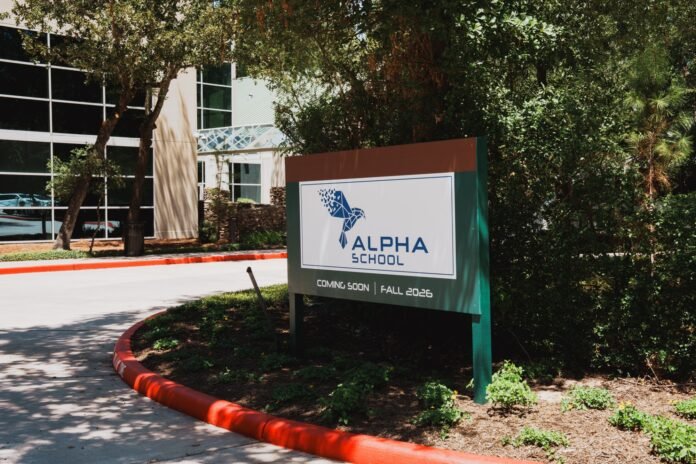
Now, just one year after the state rejected its charter school application, Alpha has roughly quadrupled its Texas private schools, with more than 30 virtual and in-person campuses, most of which were accepted into the voucher program, ProPublica and The Texas Tribune found. This rapid expansion has made Alpha among the largest private school chains participating in the voucher initiative.
MacKenzie Price, Alpha School’s co-founder, and Texas Education Agency Commissioner Mike Morath speak during a visit to an Alpha School campus on Sept. 9, 2025.Kaylee Greenlee for The Texas Tribune
“They took a backdoor approach,” said Democrat Tiffany Clark, one of several Texas State Board of Education members who voted against Alpha’s charter school application last summer and were concerned with its entrance into the voucher program. “They said, ‘You know what, we can’t get in as a charter, but we can continue to be a private school and take these funds.’”
Texas and Arizona appear to be the first states where Alpha’s campuses have been approved to participate in school choice programs, though they could qualify in others. After starting with one campus in Austin, the chain now has private schools in 17 states and Puerto Rico. Most of those states run voucher programs.
As ProPublica reported in July, private schools across the country have multiplied in recent years, often with little oversight, alongside the growth of state voucher programs. The result is that taxpayer dollars sometimes go to school leaders who have misused public funds or have documented histories of abusing children. Elected leaders in Texas, which has one of the newest andlargest voucher programs in the country, promised that they had implemented strong guardrails, including some that other states had not.
But Alpha School’s acceptance into the voucher program, after state education leaders rejected the same model just last year, underscores the limitations of those standards, according to education experts. Alpha leaders didn’t apply again to the state education board but to the Texas comptroller’s office, essentially the state’s chief financial officer, which legislators designated to run the voucher program. The comptroller checked for only four criteria: that a school operates in Texas, that it’s accredited by an approved organization, that it’s been in operation at least two years and that it administers annual standardized tests.
None of Alpha’s private schools had to meet state curriculum standards or show how the company’s model would lead to student success. None of the concerns raised by the Texas board just last year about Alpha’s rejected charter applications, test scores or use of AI to teach mattered.
“That wasn’t relevant,” said Travis Pillow, a spokesperson for the voucher program. “Our role is to make sure that a school meets the requirements in the law.”
Have you had trouble finding a school or using a voucher-style program? Do you have concerns about schools — public or private — in your area? Help us understand how families across the country are navigating their school options.
None of the Alpha leaders named in this story, nor the company’s press office, agreed to interviews, nor did they answer most of the newsrooms’ questions, including about their test scores. An Alpha spokesperson provided an emailed response only to questions about previous reporting by other news outlets. Alpha officials have defended their model in interviews and podcasts, saying it has drastically improved student outcomes and test scores that it says place their kids in the top 1% to 2% in the country.
Price has said she co-founded the school in 2014 to allow students to learn at their own pace after her oldest daughter grew bored and felt held back in public schools, according to multiple interviews.That mission was supercharged four years ago, when tech mogul Joe Liemandt poured $1 billion into the school and its AI-guided platform with the goal of reaching 1 billion students worldwide. Since then, Alpha has transformed into a sprawling education company with a fast-growing national profile. The schools have caught the attention of Trump endorser and billionaire hedge fund manager Bill Ackman and Elon Musk, whose Starlink internet will be used to launch more Alpha schools across the world.
Education experts have raised skepticism about Alpha’s bold claims, noting that private schools can self-select affluent students, who are likely to perform well academically. ProPublica and the Tribune interviewed five such experts, who noted that private schools aren’t required to share their internal data and so can easily cherry-pick positive examples.
The newsrooms also examined some of Alpha’s outcomes among lower-income students and charter schools, including a partnership the company had with an existing charter in Texas that has not yet been reported. The experts ProPublica and the Tribune spoke with said in those examples, Alpha either didn’t release enough data to verify its alleged successes or the test scores released by state education agencies fell far short of the academic growth that company leaders predicted.
“I don’t believe their claims that typical students will see rapid improvements,” said Justin Reich, director of the Teaching Systems Lab at the Massachusetts Institute of Technology. “There are tons of reasons to be skeptical of that claim.”
Rejection After Rejection
To achieve their ambitions of teaching a billion students, Alpha leaders had to break into the same public education system they aimed to revolutionize.
By 2024, the company was in the midst of a nationwide sprint, hoping to open virtual or in-person charters in over half the country.
The concept intrigued some state leaders, who liked the self-paced learning or the opportunity to pioneer AI instruction in classrooms. “My mind is kind of blown by all this,” one North Carolina education official said in September 2024.
But charter leaders across the country raised similar concerns that led them to reject Alpha’s pitches, according to ProPublica and the Tribune’s review of applications, interviews and written feedback from the six states where the newsrooms were able to verify the company had applied: Texas, Arizona, Arkansas, North Carolina, Pennsylvania and Utah.
Officials in every state the newsrooms reviewed worried about what would happen to the role of teachers if Alpha’s AI-led platform, rather than certified educators, provided lessons to students. Many state charter leaders also doubted students could master necessary lessons in just two hours a day or questioned whether Alpha’s courses covered each individual state’s required curriculum. In at least one instance, in Utah, Alpha leaders admitted they had not checked the curriculum standards before applying.
In several states, charter leaders criticized Alpha’s habit of projecting multiplying enrollment year after year, or the little community support and outreach they’d secured to back up the claims. Alpha leaders told education officials at times that they surveyed Price’s social media followers to measure parent interest in a state.
At least two state education boards also took issue with Alpha’s plan to keep Price and her husband on the charter’s oversight board while the school simultaneously paid their companies, which provide services like the two-hour learning platform. The Prices acknowledged the conflict of interest and repeatedly promised to correct it. In Arizona, the only state to approve the Alpha-affiliated charter, Andy Price said in 2024 that they were “fully committed to having a majority board of 100% independent Arizona folks by the end of this year.” MacKenzie and Andy Price were still serving on the board as recently as this June, according to board meeting minutes.
Among state officials’ most consistent concerns was the fact that Alpha’s model had been tested only among affluent students whose families could afford expensive private schools or among students who’d received scholarships. They questioned whether the learning platform would work in charter schools, where there could be more students behind academically, who had special education needs or were learning English as a second language. (In at least four of its charter applications, Alpha said it incorporates programs like the language app Duolingo to help students with their English.)
A new Alpha school near Houston opened this year.Hope Mora for ProPublica and The Texas Tribune
Alpha leaders often countered concerns by referencing successful student test scores in two more diverse campuses in Texas where they’ve operated. But the achievements they highlighted were not so clear-cut as they made them seem, experts said.
In one instance, Alpha partnered with an Austin charter called Texas Preparatory School that was already facing a potential state-imposed closure because of low student test scores and failed financial audits. An Alpha leader told Texas education officials in May 2025 that after they implemented their two-hour learning platform at the charter, outcomes changed from most students failing state exams to 50% to 60% of students passing them.
Test results published by the Texas Education Agency don’t back up that claim. The scores indicate that students may have performed worse on state tests than before Alpha’s involvement, according to several education experts who reviewed them. The portion of students who achieved “approaches grade level,” the lowest category that counts as passing the test, slightly rose, from 19% to 21%. The share of students that the test showed were at their grade level dropped from 10% to zero after the Alpha partnership.
Texas Preparatory School received its third consecutive F rating, largely based on the test scores it received during the partnership with Alpha.
“I don’t see the extreme growth,” said Toni Templeton, a research scientist at the University of Houston Education Research Center who reviewed the records at the newsrooms’ request. “If you’re such a high-performing school, you should have no problem demonstrating it.”
The state decided to shut down the charter permanently last year in the middle of the Alpha partnership, but it allowed the campus to finish out the school year.
Alpha leaders also pointed to its private school campus in Brownsville, a majority-Latino city in South Texas, as another example of their success. Alpha boasted to state charter boards that its Brownsville students, located in one of the poorest school districts in the nation, still excelled using the company’s AI program.
“We don’t care if a student is white, Black or brown, rich or poor. An AI tutor is infinitely patient,” Price said during an interview with education officials in Utah about opening a charter campus there. “I believe this is the most kind of equitable answer to the problem of education.”
However, reports from Wired and CNN have detailed families leaving the school after students fell behind academically or developed anxiety trying to keep up with learning expectations. Alpha has vehemently denied the findings, which a spokesperson wrote in an email to ProPublica and the Tribune “contain inaccurate reporting, misleading context and potentially defamatory representations.” “Prior to publication, WIRED was provided with documentation that directly contradicted its central claims, yet the piece did not accurately reflect that information,” the spokesperson wrote. She did not share that documentation with ProPublica and the Tribune, saying some of the “strongest evidence involves sensitive mental health records, personal records and individual data related to minor children.”
ProPublica and the Tribune specifically looked at the Brownsville student outcome data that Alpha self-published, which does not include detailed test scores to prove academic growth for all students, according to several education experts who reviewed it. There was also inconsistency in how Alpha presented the data. An Alpha leader told Texas education officials that students across grade levels in the Brownsville campus had scores that jumped from 30% to 80% mastery. But Jennifer Steele, an education professor at American University, said that Alpha’s published report shows those improvements for only its second graders, who may not be representative of the entire school.
“The bottom line is that if you desperately want your child to drill on screens two hours a day and you are prepared to pay a lot of money for that, you might have the kind of child who will test well after doing so. These kids do exist, and the Alpha schools are built to attract their parents,” Steele said. “But as a scalable model for public schools — even public charter schools — there is no evidence that it works.”
Even in Arizona, the sole state to green-light Alpha’s charter pitch, the academic outcomes appear to again fall short, based on the preliminary state test scores recently presented to the charter school’s oversight board ahead of their official release this fall. (The Arizona Education Department would not provide ProPublica and the Tribune with the underlying scores.)
In their application to form a charter school in Arizona, Alpha leaders had predicted 65% of their students would test proficient in English at the end of the first year, but just 28% did, the state test scores showed. They projected 60% could reach that level in math. Only 10% achieved it.
The Expansion Continues
Kaylee Greenlee for The Texas TribuneJordan Vonderhaar for ProPublica and The Texas Tribune
One of Alpha School’s Austin campuses
Even as many states have rejected Alpha’s charter applications, the company’s push to expand its footprint hasn’t slowed. It’s only intensified. By this summer, Alpha had announced the launch of private campuses in 50 cities across the country, each catering to a different type of learner: Athletes can attend one of Alpha’s 13 sports academies. There are options for kids who play video games like Fortnite or who like to spend time in nature. One high school campus in New York challenges students to launch business ventures and net $1 million by the time they graduate, or else Alpha will pay back their $150,000 annual tuition. In another program, students spend their year abroad in Kenya and Ecuador. Their mission: help start new Alpha schools.
As the number and types of schools multiplied, so did Alpha leaders’ efforts to win support from public officials, particularly those who have pushed voucher programs.
In 2023, the Texas Observer reported that an LLC called Future of Education, whose incorporation address is the same as the Prices’ Austin home, donated $1 million to the campaign committee affiliated with then-Virginia Gov. Glenn Youngkin, an outspoken voucher advocate. In Texas, Andy Price gave over $250,000 to a political action committee that helped elect pro-voucher candidates, and MacKenzie Price gave $10,000 to Rep. Brad Buckley, the Republican lawmaker who successfully carried the Texas voucher bill last year. She also donated to the leaders whose office oversees the state’s voucher program: $200,000 to Kelly Hancock and $100,000 to Don Huffines, who have both served as Texas comptroller.
MacKenzie Price personally donated the most money in Texas to the main fundraising committee of Gov. Greg Abbott, who led the charge to bring a voucher program to the state. She contributed over $1.5 million to the governor’s campaign in the last three years.
Alpha even got a mention in a press release the governor’s office issued in September 2025, after Abbott met with U.S. Education Secretary Linda McMahon. McMahon had toured an Alpha campus in Austin earlier that day. “The Secretary noted the innovation of Texas schools using artificial intelligence as a beneficial tool to assist students in learning how to ask the right questions to better understand educational materials,” the press release said.
Joining McMahon on that tour was Texas Education Commissioner Mike Morath, though about two months earlier the state board of education — which oversees his initial charter decisions and often agrees with Morath — had rejected Alpha’s charter proposal despite his recommendation.Morath has been a supporter of Alpha’s model before and after the vote, which he doesn’t have the power to override.
Read More
State board member Julie Pickren was thrilled to learn from ProPublica and the Tribune that Alpha private schools were accepted into the voucher program. Pickren, who voted in favor of Alpha’s Texas charter last summer, thought the model brought a promising individualized learning solution that could improve student outcomes, especially in academically struggling districts.
“I would say thank you to them,” said Pickren, referring to Alpha. “Thank you for not giving up and looking for a way to serve children.”
Fellow Republican and education board member Evelyn Brooks disagreed. She was shocked to learn about Alpha’s acceptance into the voucher program and rapid expansion in Texas.
“You’re just making money. You’re reproducing a model, regardless of the region, regardless of the state,” said Brooks, who voted against Alpha’s charter proposal last year.
And Alpha continues to open campuses where its leaders say there is enough demand.
Last month, the company sent out a news release announcing a new school in a suburb of Houston.
Thami carried out preliminary research on the results of extreme heat on European cities this summer. The study looked into how many buildings have adequate shade from trees. The results were striking.
In London, Paris and Madrid over 90% of buildings did not have enough shade around them to prevent urban heat island effects. These were among the worst results in cities we studied, but even the best performers had a majority of residents without adequate heat protection – cities like Hamburg (56% unprotected) and Barcelona (70% unprotected).
This builds on past research that shows how major cities around the world – including in Europe – tend to struggle to reach useful levels of tree canopies to create shade close to homes and workplaces. It suggests that that homes should have a view of three trees and be within a 300 m walk of a park.
Early results for my research suggests that huge portions of European cities are exposed to avoidable heat island effects.
Map showing tree cover and heat in European cities
How urban heat islands work
On many days during summer 2026 it didn’t get much cooler in the evening. This is because of what is known as the urban heat island effect. Cities typically lack shade, due to high rates of tree removal, sparse planting, and poor tree health and there are vast amounts of asphalt, clay and concrete. These are almost the perfect materials to soak up and hold heat from all that direct sunshine. Unshaded asphalt can reach over 70°C on heatwave days.
Even after sunset, cities stay hot because roads, buildings and footpaths begin to radiate their absorbed heat back at us as they cool. The urban heat island effect can add significantly to ambient temperatures, making a day that is already very hot (perhaps 35°C) even more dangerous in high-asphalt, low shade locations (over 40°C).
What could help?
Tree shading is an effective strategy to address this urban heat, with a range of other mental and physical health benefits to local residents. Trees prevent solar radiation reaching heat-absorbing materials such as asphalt, and also keep the sun off our bodies. Tree shade has been shown to reduce the heat absorbed by pedestrians by up to 18°C.
Healthy trees also push water out of their leaves as they photosynthesise, which soaks up heat as it evaporates. This evaporative cooling effect adds an extra few degrees of cooling, in addition to shading people and preventing heat island effects, even during heatwavesas long as trees still have access to water.
Where trees are needed
Planting more trees in cities in the wake of this summer’s heatwaves is going to help cool urban areas down. The thinktank, the Create Streets Foundation, found the temperature on an exposed paved area in London during one heatwave was 55°C but was 25-30°C in a shaded area metres away.
Looking at a city such as London, you might argue that it already has plenty of trees: around 8 million.
But trees are only effective tools against urban heat when they’re close to homes. A lush shady park 800m away isn’t going to prevent dangerous localised heat island effects for you and your neighbours.
The other crucial factor is that there are thresholds of shade cover that have to be reached for trees to actually offer substantial cooling. A few isolated trees creating small islands of shade aren’t enough. Adding more tree canopy has been shown to be effective at preventing urban heat islands when it reaches 30-40% overall shade cover, within 60m of homes and workplaces.
It will also be important to plant trees that are best able to cope with increasingly hot temperatures in Europe.
Adding just a few degrees to an already hot day sharply ramps up the danger that heat poses. In locations where heat islands bump up the ambient air temperature from 33°C to 37°C, or 35°C to 41°C, there’s an increase in patients attending hospital admissions’ rooms due to heat related illness. When air temperature increases above 35°C the human body’s ability to manage the heat is greatly reduced; cardiovascular strain, dehydration, potentially leading to heatstroke and the need for medical intervention.
When it makes nights hotter there are other ramifications. It is during the cooler night hours that the body loses heat to reset for the following day. If the body is still trying to cope with warm temperatures, 24°C and above, this impacts recovery and impairs sleep quality. This means we start the next day in deficit, both physiologically and cognitively, to cope with another hot day. Repeated exposure to days of high heat mean that the deficit builds over time.
Adding more trees works
Medellin in Colombia is an example of what happens when more plants are added to urban streets.
There are signs that Paris and London are aware they need to make changes. The recently announced Heat Ready London plan includes a focus on urban greening.
Paris is already starting to add more green space. The city’s school streets programme not only creates safe, car-free areas close to local schools, but also has added more trees. Evidence already suggests that surfaces in school streets are 5°C cooler than their traffic-heavy counterparts, with fewer trees.
As Europe prepares for more hot summers, planting trees close to homes needs to be high on the agenda to help people cope.
For most countries, electricity is an economic input. For Syria, it is something more fundamental: a test of whether the state can again provide basic services, reconnect its regions and translate political transition into material improvement. Factories cannot reopen, hospitals cannot function reliably and displaced families cannot be expected to return where power remains intermittent. Syria’s first peace dividend, therefore, must be electricity.
Yet the central question is not simply how many megawatts Syria can add. It is whether Damascus can transform foreign fuel, finance and technology into durable national capacity. If it succeeds, energy diplomacy could become an instrument of reconstruction and sovereignty. If it fails, Syria may merely exchange one form of external dependence for another.
A new map of energy dependence
Syria’s emerging energy system is already regional. Qatar began financing gas deliveries through Jordan to the Deir Ali power station, with two million cubic metres per day intended to generate around 400 megawatts. Gas from Azerbaijan has also flowed through Türkiye’s Kilis connection, with financial support from Qatar. The initial plan envisaged supplies of up to six million cubic metres per day, potentially supporting about 1,200 megawatts of generation.
These arrangements demonstrate energy diplomacy in practice. Qatar provides financial support, Jordan and Türkiye offer transit routes, Azerbaijan supplies gas, and Syria receives the energy needed to restart economic life. What appears to be a fuel transaction is, in reality, a new network of political relationships.
Doha and Ankara are not acting solely out of humanitarian or commercial considerations. Energy assistance gives both governments an opportunity to consolidate their influence in post-war Syria and help shape the emerging political and economic order in the Levant. Damascus must benefit from this competition without allowing reconstruction to become a division of strategic assets among external patrons.
The scale of foreign ambition is even larger. In May 2025, Syria signed a Memorandum of Understanding with a consortium led by Qatar’s UCC Holding for an estimated $7 billion investment programme. The proposal includes four combined-cycle gas plants with a total capacity of 4,000 megawatts and a 1,000-megawatt solar project.
READ: Syria says foreign policy focused on restoring ties with Europe as Denmark reopens embassy
Meanwhile, the upstream sector is reopening. In June 2026, the Syrian Petroleum Company signed an agreement with ConocoPhillips and Novaterra to develop gas fields and increase production. Syrian gas output had fallen from 8.7 billion cubic metres in 2011 to approximately three billion in 2023. Reviving domestic production matters not only for revenue, but also because gas remains essential to reliable electricity generation.
Megawatts are not sovereignty
These projects create an opportunity, but announcements should not be confused with an energy system. New power plants will achieve little if transmission lines remain damaged, substations fail, cables are looted and households cannot afford electricity. Syria’s crisis extends across the entire chain—from fuel supply and grid management to maintenance, billing and public access.
The legal environment has also changed significantly. Washington dismantled its broad Syria sanctions programme in 2025, while the Caesar Syria Civilian Protection Act was repealed in December that year. These measures removed major barriers to foreign investment, but they did not eliminate every legal and financial risk. Targeted sanctions remain, while international banks and investors still face strict compliance requirements.
The persistence of banking de-risking may prove particularly important. Financial institutions can remain reluctant to process transactions even when they are legally permitted, especially where ownership structures, regulatory responsibilities or beneficiaries are unclear. Syria therefore needs credible investment laws, transparent ownership records and enforceable contractual safeguards if political openings are to become long-term financial commitments.
Foreign investment is not politically neutral. The supplier of gas, the operator of a power plant, the financier of a transmission line and the company controlling technical maintenance can all acquire influence over national choices. Poorly designed agreements may lock in dependence precisely when they are presented as instruments of recovery.
Syria cannot rebuild alone. It must instead practise diversification by design: multiple suppliers, several transit routes, competitive investors and a balanced mix of gas, solar and other domestic resources. Dependence distributed across partners can be managed; dependence concentrated in one capital, company or corridor becomes leverage.
Energy must reunify, not redivide
The most difficult question lies inside Syria. Important oil and gas resources are located in the north-east. The Kurdish-led Syrian Democratic Forces formally dissolved in August 2026 as their military and administrative structures were integrated into the Syrian state. This ended one phase of territorial fragmentation, but it did not resolve deeper questions about institutional integration, local rights and resource governance.
READ: Syrian Sovereign Fund, UAE developer sign $7B deal for major Damascus project: Report
The return of oil and gas fields to national administration should not mean a return to opaque centralisation. A durable framework must protect Kurdish and other local rights, involve producing communities in development decisions and preserve energy resources as national assets.
Part of the revenue should support local development, while the wider system finances reconstruction across Syria. Transparent accounts, published contractual principles and an auditable formula for distributing energy revenues would strengthen national cohesion more effectively than another opaque agreement signed in Damascus.
Access also matters. A policy that adds thousands of megawatts but leaves poorer districts dependent on expensive private generators cannot be considered successful. Progress should be measured not only by installed capacity, but also by hours of supply, household affordability, geographical coverage, industrial reconnection and the restoration of water and health services. Energy justice is not an optional social policy; in post-war Syria, it is part of political stability.
A Syrian doctrine of energy diplomacy
Syria now needs an energy diplomacy doctrine built around five commitments: diversifying partners and routes; preventing foreign monopolies over strategic infrastructure; requiring technology transfer and Syrian workforce training; publishing clear rules for contracts and resource revenues; and linking every major project to measurable improvements in public access.
Renewables should be treated as a source of resilience rather than international branding. While utility-scale solar projects can expand total capacity, decentralised off-grid systems for clinics, water-pumping stations and schools can provide immediate, ground-level resilience while the national grid is rebuilt. Gas can stabilise the system today; renewables can prevent the reconstruction of yesterday’s fragile model.
Syria needs foreign power to illuminate its cities. But only national institutions can ensure that imported fuel, Gulf finance, Turkish transit, Western technology and domestic resources strengthen Syrian society rather than create competing spheres of influence.
The success of Syria’s energy diplomacy will not be measured by the number of agreements it signs. It will be measured by how much power—in both senses of the word—those agreements return to its people and its state.
OPINION: Jordan’s energy diplomacy: The power of being in between
The views expressed in this article belong to the author and do not necessarily reflect the editorial policy of Middle East Monitor.
Spending deal comes with a bonus: Blocking political control of grants
On Tuesday, the House of Representatives passed a stopgap measure that would continue funding the US government through early December. While the measure still requires the signature of President Trump, it’s widely expected that he will act to avoid a government shutdown immediately before the midterm elections.
This is a normal part of how the US government has operated in recent years, as it’s often difficult to build the political support needed to pass a full year’s budget in advance. In fact, dissent within the House’s Republican caucus prevented them from agreeing on their own measure to keep the government open; instead, the House simply adopted a version of the spending bill that had previously passed the Senate.
From the perspective of scientists and their supporters, that adoption turned out to be a very good thing. Because the Senate’s budget bill, passed in early August, contains a provision that blocks the Office of Management and Budget (OMB) from implementing new rules that would give political appointees full control over what science is funded and allow them to cancel any grant at any time. The proposed rule has been widely decried as catastrophic for science, and it faced widespread opposition from scientific and health-focused organizations.
That opposition likely contributed to two senators, Patty Murray (D-Wash.) and Susan Collins (R-Maine), inserting language into the budget deal that prevents the OMB from implementing it prior to the expiration of the stopgap measure on December 11.
While this is not a permanent reprieve, it does signal that the legislature is not interested in handing OMB and other administration officials that much control over federal spending—the bill passed the Senate by a 90-6 margin, and by 370-48 in the House, where opposition largely focused on other aspects of the measure. Those margins raise the prospect that similar language could be inserted into any further budget deals without triggering opposition.
The search for a new US frigate is becoming a test of whether allied shipyards can buy enough time to rebuild the country’s shipbuilding industrial base against China.
This month, USNI News reported that the US is evaluating guided-missile frigate designs from Japan, South Korea and Turkey as part of a new class of warships intended to rapidly expand the US fleet.
Under an August 2026 directive from the Trump administration, the US Department of Defense (DoD) is reviewing Mitsubishi Heavy Industries’ Mogami class, South Korea’s Chungnam class, and Turkey’s Istanbul class to bridge critical capability gaps in surface forces following the cancellation of the Constellation-class program.
The initiative breaks with over a century of domestic naval construction policy by invoking a national security interest waiver to bypass statutory prohibitions against foreign-built combatants entering naval service.
Acting Secretary of the Navy Hung Cao ordered a formal review due in November 2026 to explore a “Finland model” in which allied yards could build up to the first two hulls before transferring technology, investment and serial production to US yards. The approach seeks to put ships in the water sooner while seeding follow-on production capacity at home.
However, the proposal faces steep pushback from the US Congress, where draft versions of the Fiscal Year 2027 defense policy bill in both chambers seek to eliminate the executive waiver and restrict funding for foreign-manufactured warships.
The US Navy designed the Constellation-class frigate as an affordable, general-purpose combatant to relieve overburdened destroyers and rapidly expand fleet mass against China by adapting Italy’s proven FREMM design.
However, US redesigns to meet strict survivability standards backfired, triggering acute design instability, weight growth exceeding 10%, and severe workforce bottlenecks at the Marinette Marine shipyard.
After the Constellation-class cancellation, the US Navy launched the FF(X) frigate program, based on the US Coast Guard’s National Security Cutter (NSC), with a planned procurement of 50 to 65 units.
But the first FF(X) version trades combat depth for speed: its baseline design lacks an integrated VLS and instead uses an aft modular payload area that can carry up to 16 Naval Strike Missiles (NSM) or other containerized weapons.
That limits organic air defense and anti-submarine options, while adding VLS and higher survivability standards on later flights could recreate the design churn that plagued the Constellation-class.
Displacing 6,200 metric tons at 142 meters in length and a 17-meter beam, the upgraded Mogami class is substantially larger than South Korea’s 4,300-metric-ton, 129-meter Chungnam class and Turkey’s compact 3,000-metric-ton, 113-meter Istanbul class.
Despite its greater mass, the Mogami class achieves the leanest manning profile with an automated crew of 90, compared to 120 sailors on the Chungnam class and 123 aboard the Istanbul class.
The Mogami class also leads in long-range endurance and magazine capacity, offering an 18,500-kilometer cruising radius on combined diesel and gas (CODAG) propulsion, a top speed of 56 kilometers per hour, and a 32-cell vertical launch system (VLS), while both regional competitors carry 16-cell configurations.
South Korea’s Chungnam class uses a 16-cell K-VLS-II, a 127-millimeter main deck gun, and combined diesel–electric or gas (CODLOG) propulsion to reach 56 kilometers per hour and achieve an 8,330-kilometer range.
In contrast, Turkey’s gas-and-diesel Istanbul tops out at 54 kilometers per hour on CODAG propulsion, with a 10,556-kilometer range, and mounts an indigenous 16-cell Midlas VLS, a smaller 76-millimeter naval gun, and 16 canister-launched Atmaca anti-ship missiles boasting an operational range exceeding 222 kilometers.
That disparity gives China far greater capacity to replace losses, expand fleet numbers and sustain serial warship construction over time. It is not merely a fleet-size gap but a sustained gap in industrial mobilization.
China’s Type 054 has been one of the People’s Liberation Army Navy’s (PLAN) workhorse ships, with incremental design improvements since it first entered service in 2005. As of January 2026, China is estimated to have 40 Type 054 hulls in service.
The Type 054B variant displaces roughly 6,000 metric tons and measures around 146 meters long with an expanded beam, representing a substantial size increase over its predecessor to anchor fleet escort missions.
Armament includes a bow-mounted 32-cell VLS system, while satellite imagery of a newer hull suggests that subsequent ships may receive an expanded 48-cell configuration, alongside a 100-millimeter main naval gun, an 11-barrel 30-millimeter H/PJ-11 Gatling gun and a hangar-mounted HQ-10 missile launcher for close-in defense.
The stealth-shaped warship integrates a rotating dual-sided active electronically scanned array (AESA) primary radar, twin 24-cell Type 726 decoy launchers, and a comprehensive acoustic suite featuring bow, variable-depth, and towed-array sonars designed to support Z-20F anti-submarine warfare helicopters.
As China iterates a mature frigate family, the US is still trying to settle on an affordable workhorse of its own. Importing an in-production allied design could narrow that gap quickly, but only by accepting technical, political and strategic trade-offs.
On the technical side, the Mogami, Chungnam and Istanbul classes were designed around the doctrines, construction standards, combat systems and supply chains of their home navies.
Bringing any of them into US service could require substantial retesting, redesign and recertification for US standards and equipment, potentially recreating the customization spiral that contributed to the Constellation class’s failure. Continued dependence on overseas components and suppliers could also complicate maintenance, repair and wartime sustainment once the ships enter US service.
Politically, foreign construction cuts both ways. Allied yards could deliver proven hulls faster and ease near-term fleet pressure, but US yards already possess much of the technology, infrastructure and know-how to build capable warships. The harder problem may be political will: sustaining demand, workforce investment and cost discipline over decades.
If foreign procurement becomes a substitute rather than a bridge to domestic production, the US could further weaken its industrial base and trade one shipbuilding bottleneck for a strategic dependence on partners for future construction, maintenance and wartime replacement.
Ultimately, whether the US chooses a Japanese, South Korean or Turkish design or comes up with a new frigate will matter less than whether it can turn that stopgap into a durable shipbuilding model that produces capable warships at scale before China’s industrial advantage becomes effectively irreversible.
Kallas calls Leipzig drone attack ‘state-sponsored terrorism’ as EU backs Germany
The European Union’s top diplomat, Kaja Kallas, said Wednesday that a thwarted drone attack at Leipzig-Halle Airport bore “all the hallmarks of state-sponsored terrorism” after Germany blamed Russia for the incident.
Speaking as EU foreign ministers gathered in Wicklow, Ireland, Kallas said Germany’s attribution sent a “very strong signal” and praised member states for standing behind Berlin.
“We have already summoned the Russian ambassador, so have also many member states,” Kallas said. “We will discuss what more can we do.”
Other European ministers also took a hard line.
French Foreign Minister Jean-Noel Barrot described the incident as part of a “long-running attempt by the Kremlin to destabilize the European Union, its democratic processes” and weaken support for Ukraine.
“We will not let an act of such gravity go without consequences,” Barrot said. He added that France would support Germany’s proposals for sanctions and would propose measures targeting additional Russian vessels.
Irish Foreign Minister Helen McEntee said Europe had moved beyond simply discussing “hybrid threats.”
“We’re talking about significant activity,” McEntee said, accusing Moscow of a “very, very clear attempt” to divide EU governments and “put fear into citizens.”
EU members summon Russian diplomats
Germany formally blamed Moscow on Tuesday for the Aug. 4 incident, in which three drones carrying explosives were detected around Leipzig-Halle Airport. Berlin announced retaliatory diplomatic measures, including the closure of a Russian consulate and a cultural center in Berlin, and said it would seek new EU sanctions.
Russia has denied involvement and said it had seen no evidence supporting Germany’s accusations. Russian Foreign Ministry spokeswoman Maria Zakharova said Moscow would respond to what she described as Berlin’s “anti-Russian action,” according to Interfax. She provided no further details.
The EU’s diplomatic service summoned the Russian ambassador in Brussels over the incident, Kallas said.
Barrot said he had summoned Russia’s charge d’affaires in Paris and argued that European sanctions should be imposed, particularly against Russia’s so-called shadow fleet.
Dutch Foreign Minister Tom Berendsen said the Leipzig incident was completely unacceptable and said he had summoned Russia’s ambassador to the Netherlands.
Belgian Foreign Minister Maxime Prevot said Tuesday that he had summoned the Russian ambassador to Belgium, describing the attack as part of a wider series of “unacceptable incursions” on the territory of EU and NATO allies.
Russia’s ambassador to Germany was also summoned Tuesday.
The Russian Embassy in Berlin had previously dismissed the accusations as a “fabricated provocation” and a new wave of “anti-Russian hysteria in Germany.”
Kallas said another 1,600 listings targeting Russia’s military-industrial complex were already “in the pipeline.”
No decision on new measures was expected at Wednesday’s meeting. Kallas said, however, that Germany had the political backing of its EU partners.
“This is the unified response that we need,” she said.
My driver’s license is one of 153 million for sale on a new dark website
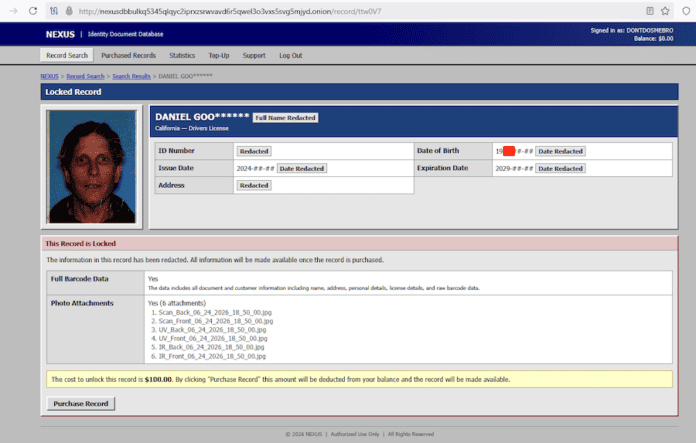
Not long ago, I rented an SUV from a well-known car rental company. Within hours of an employee scanning my driver’s license, a high-resolution scan of my ID was available for sale on the dark web.
An exposé published Tuesday by KrebsOnSecurity reports that my license was one of more than 153 million that were available through Nexus, the name of the new ID theft service. Like other driver’s licenses available there—including some belonging to journalist Brian Krebs, his mother, an FBI assistant director, and several security researchers—my license was purported to include multiple image files showing both the front and back of the ID. Besides a basic image scan, the files also captured the images in the infrared and ultraviolet spectrums. Presumably, the additional formats may allow cloned-based counterfeit IDs to pass hologram tests.
Growing by the day
Besides advertising the availability of driver’s licenses, Nexus offered to sell a bevy of other forms of ID. They included:
identification cards
travel cards
international DL/ID
medical cards
common access cards
residence cards
employment authorizations
Krebs said the FBI is investigating.
Some of the records Krebs observed listed their “source” as “CDL,” which may be short for “commercial drivers license.” Other records identified the source notation as “CAC,” which may refer to Common Access Cards, which Krebs said are “government issued identity cards that grant physical access to government buildings and secure rooms.” Nexus also claimed to provide scans of marijuana dispensary cards. One of the victims he talked to reported visiting a Las Vegas outlet of Planet13, a multi-state dispensary chain.
The timing of newly available scans—typically within a day if not hours of me and a small sample of other victims presenting them at rental companies or others—likely means that Nexus has near real-time access to data flowing through the third-party scanning service these businesses are using. Over a span of 24 hours, Krebs said the number of driver’s licenses listed as available grew by almost 400,000. That’s another indication the breach has been ongoing and new cards become available shortly after they’re harvested.
Using publicly available information, Krebs found that IDScan.net, a New Orleans-based ID scanning service, has announced an exclusive arrangement with Planet13. It also listed Hertz and 11 other companies as using its services. IDScan.net went on to say that its scans capture both infrared and ultraviolet spectra. The information suggests that the scanning service is connected to the breach.
Representatives from IDScan didn’t immediately answer questions sent by email. An IDScan.net spokesperson told Krebs the company is investigating. My car rental company representatives also didn’t immediately answer questions.
The availability of my driver’s license to anyone willing to cough up a fee isn’t exactly a comforting thought. Yes, my personal details—including current and former addresses, Social Security number, demographics, and more—have been breached before, just as they have for millions, if not billions, of others around the world. This dump is more troubling because of the purported availability of scans in ultraviolet and infrared. Fortunately, Nexus went dark within hours of the KrebsOnSecurity scoop. Also somewhat consoling is the ongoing investigation by the FBI.
Gen Z is using ‘polyester’ as an insult. It’s actually a throwback.
Even if you’re not wearing polyester now, it’s probably sitting somewhere in your closet — after all, it is the most ubiquitous fabric for textiles on Earth. Is that bad?
Judging by social media, the answer is solidly “yes.” Influencers want you to know it’s a form of plastic, fashioned from melted crude oil or PET bottles and extruded into threads. That disgust factor (“ugh, I’m wearing plastic?”) might help explain why “polyester” is now trending as an insult on TikTok.
“Polyester lifestyle,” says the top comment on a viral video in which an 18-year-old imagines his oddly specific dream life — wearing blue-light glasses in a coffee shop while a Claude agent does half his job during lunch break; getting a call that he has to pack for a sudden business trip to Europe while watching the sunset from the tennis court — as a 1987 composite sketch of the Unabomber gradually fades into view.
There’s just one problem with the story that “polyester” is, as Mashable put it last month, “Gen Z’s new way to call you fake”: The term has already been used this way for about half a century. The Oxford English Dictionary gives examples from 1979 (“A gleaming brazen polyester clown”) and 1987 (“Clifton wears polyester suits and a polyester smile”).
“TikTokkers just seem to be leaning into the ‘inauthentic’ and ‘low-quality’ edge of that meaning,” said Kory Stamper, a lexicographer and author.
Read Next
While it may be hard to imagine now, polyester was once sold as “miracle” fabric. Wrinkle-free, quick-drying polyester promised housewives liberation from the drudgery of ironing. The 1950s and ’60s were the era of “plastic fantastic,” when chemical companies promoted plastic and synthetic materials as convenient and durable. As polyester became less expensive, chemical companies ramped up its production, outpacing cotton starting in the ’60s.
As cheap polyester flooded the market, the novelty wore off, and it turned from “treasure to trash,” as the anthropologist Jane Schneider once wrote. The environmental movement was born on Earth Day in 1970, and awareness of pollution spread alongside a suspicion of artificial fibers. As hippie culture took off, people longed for a more authentic, “back to nature” kind of life. (It’s not a coincidence that people started using “plastic” as an adjective meaning superficial or insincere, too.)
As the ’70s came to an end, the shiny, synthetic men’s suits that once seemed modern now felt cheap and tasteless. In 1981, a John Waters film called Polyester played on the fabric’s tacky associations, starring a father in a polyester-clad suit who owns an adult movie theater. “Polyester and pornography — the fabric could hardly sink lower,” wrote Anneke Smelik, an emeritus professor of culture and history at Radboud University in the Netherlands, in a study detailing the cultural history of polyester.
That same anti-synthetic sentiment is back in force today. The vitriol isn’t exactly subtle: One TikTok influencer with a clothing brand said that polyester makes you “sweat like a dog and smell like f***ing shit.” (Those qualities were true of the polyester suits of the ’70s, but textile manufacturers worked to improve the sweat problem and polyester is widely used in athletic wear today, partly because it can be designed to wick sweat away from your skin.) Wellness influencers on both the right and the left warn about the microplastics shed by synthetic clothing; scientists are concerned about the health effects of exposure to PFAS and other toxic chemicals that are used to treat the fabric during production, in order to help it repel water and resist stains.
But the line between “synthetic” fabrics and “natural” ones like wool, silk, bamboo, and cotton is blurrier than you’d think, Smelik said. It’s not like rolls of cotton grow off the plant: The raw materials all undergo intense chemical processes in order to become the soft, huggable fabric we enjoy putting next to our skin.
There isn’t even an obvious winner from an environmental standpoint, she said. Growing natural fabrics requires resources like land and water: It can take more than 700 gallons of water to produce a single cotton shirt. The cotton industry was a major driver in drying up the Aral Sea in Central Asia, turning what was once the world’s fourth-largest lake into its largest dry lakebed. Polyester is less resource-intensive to make, but, as it’s fashioned from oil, it does generate more greenhouse gas emissions. A new report from the Apparel Impact Institute found that the global fashion industry’s emissions rose 7.5 percent in 2023 and 6.3 percent in 2024, in part because of the increased production of fiber, particularly polyester. The fabric’s durability also becomes a curse when you throw it away: Polyester breaks down very slowly, fragmenting into microplastics that persist in ecosystems for generations.
Read Next
There’s also consumer behavior to keep in mind: The perception that cotton is natural and better for the environment allows people to buy more clothes and not feel bad about it, because hey, at least I’m not buying polyester. The truth is that the most environmentally friendly solution is simply buying less and wearing the clothes you already have as long as you can. “Fast fashion remains fast fashion, and that is a huge problem,” Smelik said.
As good as the new generation of polyester insults are — including “Polyester Prince,” the new nickname for one prominent influencer who sells polyester clothes, and “polyester jester” to mock anyone wearing synthetic fast-fashion outfits — Smelik sees the current social media discussion around polyester as a regression to the 1970s. “It is so uninformed, and it leaves out all complexity,” she said. “You know, it becomes very polarized — like, ‘natural is good, and artificial is not.’”
Police Advice Public About ‘Fugitive’ Reality TV Star
Below Deck Star Wanted by Police After Allegedly Fleeing Country Amid Choking Charges
A Below Deck Mediterranean star is at the center of an international manhunt after allegedly fleeing Australia while wanted on serious domestic violence charges involving his former girlfriend and co-star.
Australian police have warned the public not to approach Nathan Gallagher, 28, saying he is wanted on an outstanding arrest warrant and could pose a danger.
New South Wales Police released Gallagher’s mugshot while asking anyone with information about his whereabouts to come forward.
The dramatic warning came after Gallagher failed to show up in court Tuesday, where he was scheduled to face three charges tied to an alleged confrontation with his former partner, Below Deck Mediterranean co-star Gael Cameron.
Gallagher and Cameron share a child.
Gallagher was arrested in December after police responded to reports of an alleged assault involving a 29-year-old woman near Sydney.
Court documents allege Gallagher covered Cameron’s mouth and nose during the incident, leaving her unable to breathe at times, according to Rolling Stone.
He is facing charges including assault occasioning actual bodily harm and intentionally choking a person without consent.
Police now believe Gallagher may have left Australia while the case remains unresolved.
Authorities have urged members of the public not to confront him if they believe they spot him.
Gallagher has previously acknowledged that he has “made mistakes,” but has also suggested there is more to the story.
He claimed he has “evidence” that could present a different version of what allegedly happened.
The allegations mark a stunning turn for the reality TV personality, who became known to viewers through Bravo’s Below Deck Mediterranean.
Gallagher’s current whereabouts remain unknown as police continue searching for him.