Footage broadcast by Chinese state television in July showed a YJ-20 hypersonic anti-ship ballistic missile fired from the vertical launch system of a Type 052D destroyer, marking a quiet but significant shift in the region’s naval balance.
Until now, the YJ-20 was thought to be reserved for China’s 12,000-ton Type 055 super destroyers, its most advanced ships. It’s now being rolled out across the far more numerous Type 052D fleet, too.
That’s not just a technical upgrade – it’s a sign the weapon is moving from a flagship showpiece to standard fleet equipment. It suggests China’s sea-based hypersonic strike system has matured to the point where it can deny access to the Western Pacific and potentially render traditional surface warships obsolete.
Technologically, the YJ-20 stands at the apex of modern anti-ship missilery. It uses a biconic glide vehicle and a solid-fuel booster, reaching speeds above Mach 6 in mid-course before diving nearly vertical at speeds close to Mach 10.
That’s different from older ballistic missiles, which fly predictable arcs that air-defense computers can calculate in advance. The YJ-20 instead employs quasi-ballistic “skip-glide” maneuvers through the upper atmosphere, changing altitude and direction as it flies.
By dynamically altering its altitude and direction, the hypersonic weapon effectively invalidates the predictive interception algorithms of the US Navy’s premier shipborne defense systems, such as the Aegis-integrated Standard Missile-3 and Standard Missile-6.
This seaward expansion also changes how the roles are divided within China’s People’s Liberation Army (PLA). Historically, Beijing’s anti-access (A2/AD) strategy leaned mainly on the PLA Rocket Force’s road-mobile missiles, like the DF-21D and DF-26. Those are powerful, but they’re tied to the mainland and can be tracked by satellite once they leave their bases.
By integrating the YJ-20 into the universal vertical launch systems of mobile, highly survivable surface combatants, the PLA Navy (PLAN) has unmoored its hypersonic strike capacity from the mainland.
Guided by real-time targeting data from the Yaogan-Beidou satellite constellation, these mobile naval nodes can generate multi-axis, unpredictable attack vectors directly from the open ocean.
In turn, that pushes China’s reach well past the First Island Chain. With an effective range of 1,000 to 1,500 kilometers, and potentially closer to 2,000, a single Type 052D patrolling the Bashi Channel or the Philippine Sea can threaten enemy ships hundreds of miles from China’s coast.
Strategic chokepoints that once served as natural barriers protecting allied naval movements are now transformed into forward launchpads. As a result, the maritime sanctuary that foreign Carrier Strike Groups historically counted on east of Taiwan has effectively vanished.
Saturation math
The strategic weight of this capability lies in the staggering industrial velocity of Chinese naval shipbuilding.
The PLAN currently has 10 Type 055 destroyers, but more than 35 Type 052D destroyers, with new ones joining the fleet every year. Together, these ships carry over 3,800 universal vertical launch cells capable of firing long-range surface-to-air, cruise and hypersonic weapons.
By putting the YJ-20 on both ship classes, China is shifting the operational math from qualitative deterrence to quantitative saturation.
In any major confrontation, a single Surface Action Group can launch a coordinated, multi-directional hypersonic salvo that rapidly exhausts the finite interceptor inventories of allied escort fleets.
Releasing the footage of the YJ-20 was a deliberate move. Timed alongside other state media coverage of military readiness, the imagery sends a blunt message to Washington and its regional allies: intervening in a Western Pacific crisis would come at a steep cost in ships.
This public display is likely designed to manipulate Western risk calculus, raising the political and military costs of intervention to levels Washington decision-makers may find unacceptable. Domestically, it reinforces nationalistic confidence in the military’s technological superiority under President Xi Jinping.
The timing of this operational rollout correlates directly with intelligence projections regarding a potential conflict over Taiwan around 2027.
The year 2027, marking the centennial of the PLA’s founding, represents a critical threshold where the volume of sea-based hypersonic munitions and compatible surface hulls is expected to achieve a tipping point.
Beyond this point, the sheer density of forward-deployed Chinese hypersonic firepower will be capable of neutralizing American forward intervention capabilities before allied strike groups can establish operational dominance.
Escalation dilemma
The proliferation of shipborne hypersonic missiles strikes at the core assumption of Western naval doctrine. For decades, the carrier strike group has been the US Navy’s main tool for projecting power worldwide.
In response to growing A2/AD threats, the US Navy formulated the concept of Distributed Maritime Operations (DMO), spreading its warships across vast ocean spaces to complicate enemy targeting while pooling sensor data.
However, the YJ-20 severely undermines that strategy. To coordinate with each other, spread-out US destroyers need to use active radar, which instantly reveals their position to Chinese space-based and naval reconnaissance networks.
Once spotted, those isolated ships could face high-speed, maneuvering missiles that current defenses offer slim chances of survival against.
Beyond tactical vulnerabilities, the extreme speed and flight characteristics of hypersonic anti-ship weapons create a dangerous instability crisis. With flight times compressed to mere minutes, naval commanders face an acute “use-it-or-lose-it” operational dilemma, forcing pre-emptive decisions under severe time pressure.
Furthermore, because the aerodynamic profile and launch signatures of hypersonic boost-glide vehicles can mirror those of strategic systems, radar operators may struggle to distinguish between conventional strike weapons and nuclear payloads during the heat of a crisis.
In the absence of bilateral crisis communication protocols or hypersonic arms control agreements between Washington and Beijing, this payload ambiguity exponentially elevates the risk of unintended nuclear escalation.
Recognizing this shifting threat matrix, regional powers are aggressively reshaping their defense architecture. Japan has accelerated its adoption of stand-off counter-strike capabilities, procuring long-range Tomahawk cruise missiles and fortifying its southwestern island chain.
Australia, under the AUKUS partnership, is prioritizing the acquisition of nuclear-powered attack submarines and collaborating on counter-hypersonic technologies to bypass China’s surface denial grid.
Meanwhile, the Pentagon is pouring billions of dollars into the Guam Defense System (GDS), seeking to construct a 360-degree integrated air and missile defense shield over its most critical power-projection hub in the Second Island Chain.
New Pacific order
For Taiwan, the distribution of sea-based hypersonic weapons alters the fundamental calculus of cross-Strait survival.
The presence of YJ-20-equipped destroyers operating off Taiwan’s eastern coast eliminates the island’s traditional geographic rear, exposing vital ports, airbases and critical infrastructure to near-instantaneous strikes from the Pacific side.
This capability allows Beijing to execute a tight maritime blockade or quarantine without ever initiating a risky, large-scale amphibious assault. By cutting off energy imports and maritime trade from standoff ranges, China can exert intense coercive pressure while holding foreign rescue fleets at bay.
This reality forces Taipei to execute a rigorous recalibration of its defense posture. Conventional capital assets, such as large surface combatants and centralized airfields, have become liability-heavy targets in a hypersonic engagement zone.
To maintain a credible defense, Taiwan must fully commit to an aggressive “Porcupine Strategy,” prioritizing low-cost, highly survivable, asymmetric capabilities.
This includes mass-producing mobile land-based anti-ship missiles, deploying uncrewed surface and aerial drones, stockpiling smart sea mines, and fortifying decentralized command nodes capable of operating under persistent electromagnetic and missile bombardment.
Looking toward 2030, the integration of the YJ-20 across China’s surface fleet marks the definitive end of unshared naval supremacy in the Western Pacific. The maritime domain is rapidly transforming into a contested arena governed by automated sensing networks and hypersonic reaction times.
As the boundary of Chinese anti-access capabilities expands toward the Second Island Chain, the international order in the Indo-Pacific will no longer be underwritten by the unchallenged presence of foreign aircraft carriers, but by a precarious equilibrium of high-tech deterrence.
Navigating this era will require not only new weapons and doctrines, but an urgent commitment to establishing strategic guardrails before the speed of warfare outpaces the capacity for diplomacy.
Ronny P Sasmita, PhD,is senior international affairs analyst at Indonesia Strategic and Economic Action Institution, a Jakarta-based think tank
Trump tried to curb clean energy. It’s booming anyway.
Donald Trump is presiding over an unexpected clean energy boom, as rising electricity demand spurs investment in new capacity despite the US administration’s efforts to thwart a solar and wind rollout.
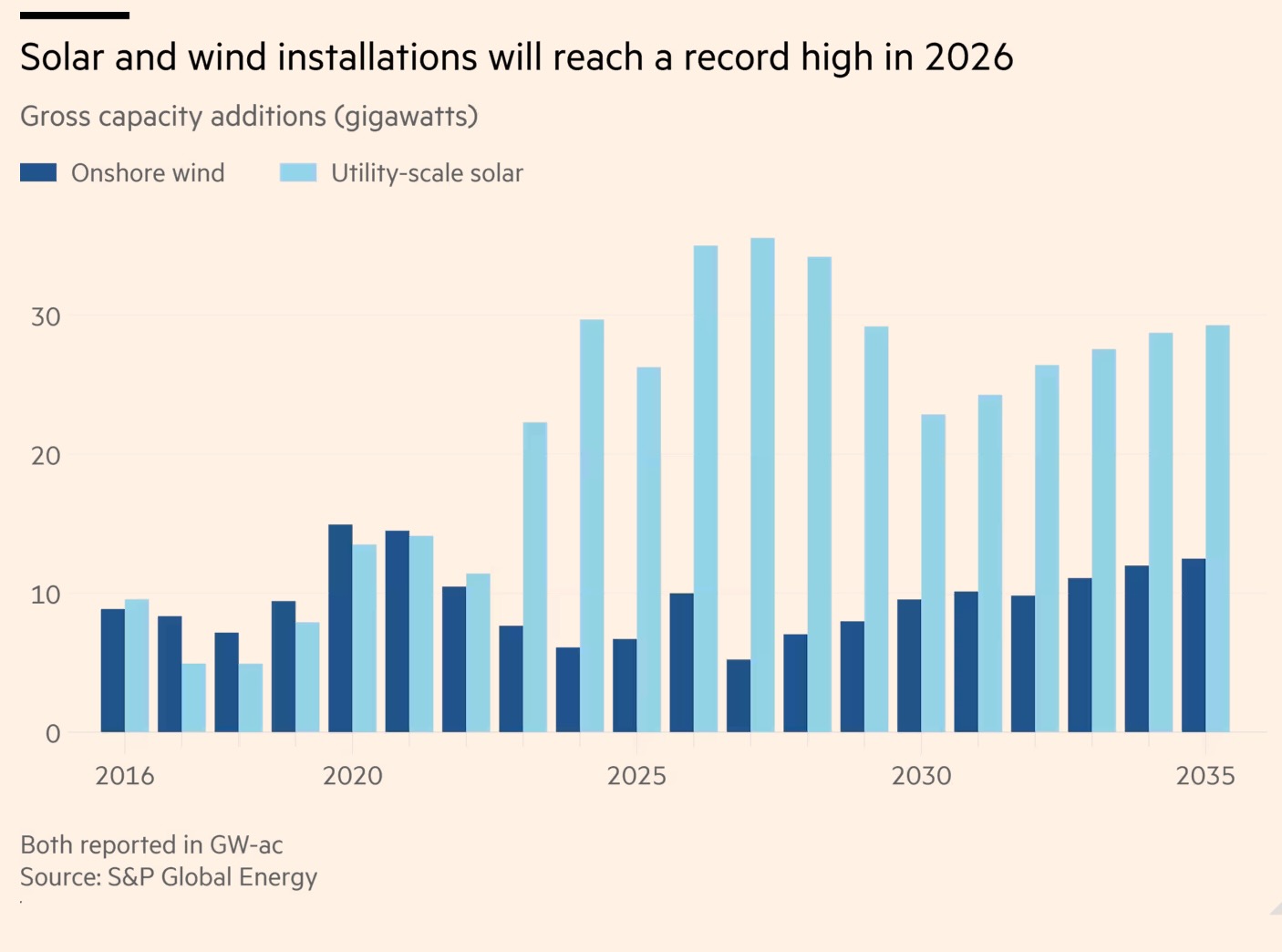
Clean energy additions will rise by a record 45 gigawatts this year, according to S&P Global Energy—equivalent to the average electricity demand of Turkey. The increase is roughly 25 percent higher than the record set in 2024.
The US president’s war in Iran, which has driven up global energy prices, along with surging power demand from AI data centers and developers’ rush to capitalize on expiring tax credits, are driving the cleantech boom, said analysts. Trump’s administration has also been pragmatic in the face of its energy needs.
“There was a campaign promise to go against renewables, but at the same time they’re realizing that you can’t do without it,” said Izzet Bensusan, chief executive of Captona, an energy infrastructure investment group. “I don’t see a world where power demand is flattening out.”
S&P said new solar and wind capacity will jump in 2026 by nearly a third and almost 50 percent respectively. Solar will set another record in 2027, while wind falls back before recovering.
White House spokesperson Taylor Rogers, however, touted “record-high oil and gas production” under Trump.
“The president has delivered on his promise to unleash American energy,” Rogers said. “At the same time, the administration has ended subsidies for costly and unreliable energy sources that American taxpayers were unfairly forced to fund.”
The solar and wind additions come despite Trump’s early efforts to kill an energy transition pushed by his predecessor, Joe Biden.
The Trump administration broke up Esmeralda 7 in Nevada. It would have been the largest single solar project in the US.
The president’s One Big Beautiful Bill Act also slashed tax credits for solar and wind, and his administration has interfered with routine project approvals, including for more than 150 onshore wind projects. But under the terms of the OBBBA, solar and wind developers had until July 4 to begin work on projects and until 2030 to finish them.
The deadline “prompted developers to hurry and begin construction,” said S&P Global renewables analyst John Murray.
Expectations for sharply higher electricity demand are also driving the pace of the rollout.
US power consumption is expected to grow 39 percent by 2035, according to consultancy ICF, driven by energy-hungry data centers and the electrification of household appliances and transport. The surge comes after demand remained steady for more than a decade.
Solar and wind are among the quickest, cheapest forms of energy to add to the grid. According to RMI, a think-tank, new solar and wind sites have a lead time of less than two years, compared to at least three years to develop gas projects.
Producers can break even by selling solar and wind power for as little as $38 and $37 per megawatt-hour, respectively, compared to at least $48 per megawatt-hour for gas, according to investment bank Lazard. However, these figures do not fully account for system upgrade costs and batteries to smooth out intermittency.
Renewable power developers also stand to profit, as electricity prices are expected to rise 40 to 120 percent once Biden’s Inflation Reduction Act subsidies expire.
“Candidly, it’s a good time to be a developer,” said Ethan Zindler, head of country and policy research at BloombergNEF. “Data centers need power, and they need it basically yesterday.”
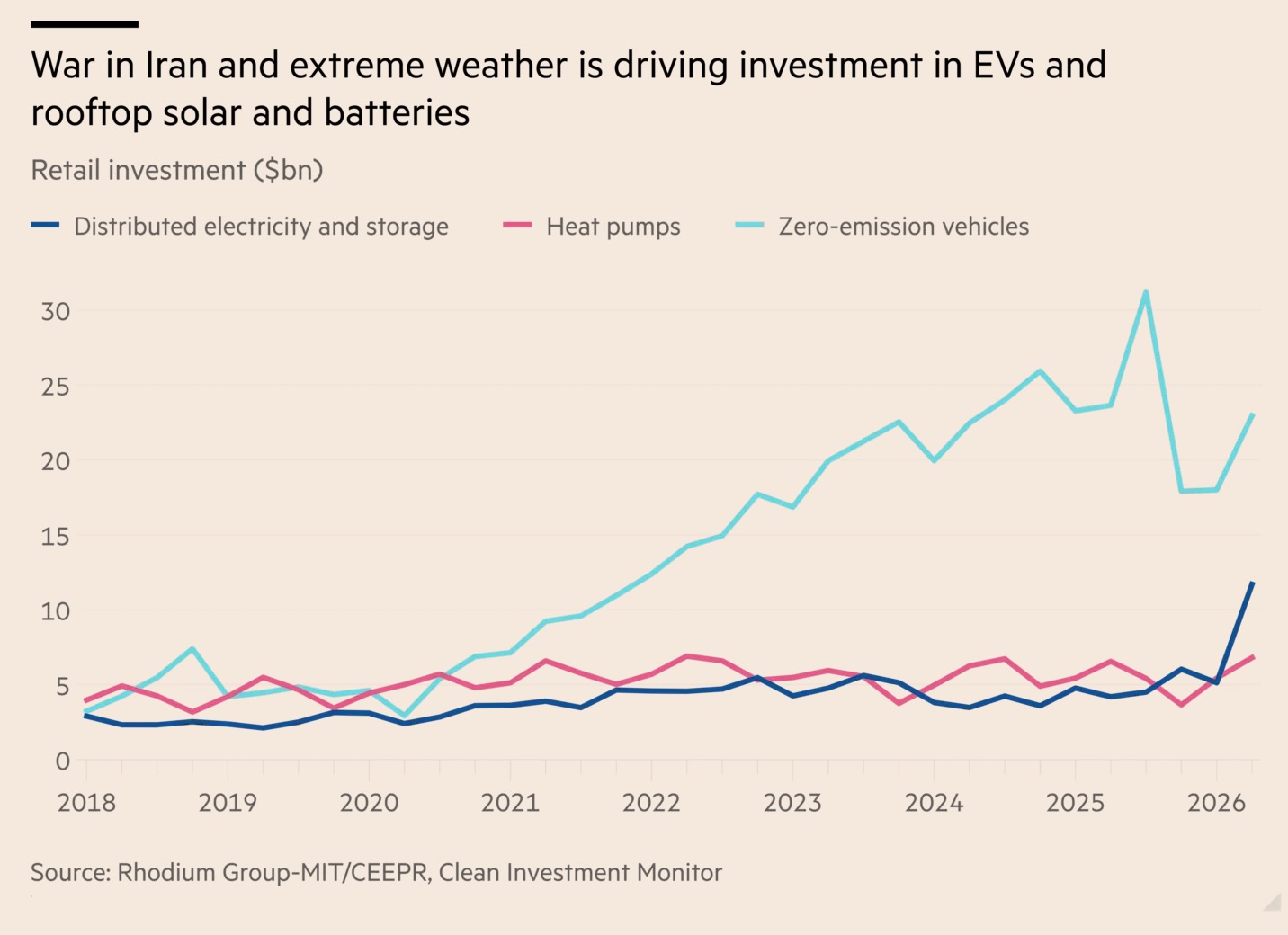
Extreme weather and Trump’s Iran war have also contributed to the growth.
Consumer investment in residential solar panels, batteries, and zero-emission vehicles led clean energy spending in the second quarter of 2026, increasing 45 percent from the previous quarter and 21 percent from the same period in 2025, according to researcher Rhodium Group.
“People in Florida are installing a lot of home batteries to ensure their house still has power in a hurricane,” said Hannah Hess, a director with Rhodium’s energy and climate practice. “And with the Iran war driving higher fuel prices, we’re seeing more EV and hybrid [vehicle] purchasing.”
US courts have slowed Trump’s war on green energy. A district court judge in Oregon recently ordered the Pentagon to cease blocking onshore wind development. The courts have blocked all five of the administration’s attempts to halt construction at wind projects off the US’s East Coast.
Developers are having some success lobbying the administration directly, leaning on people with ties to the administration to advocate for individual projects, people familiar told the FT. Among the arguments is that the projects will not displace fossil fuels—Trump’s preferred source of energy.
“What we found on the permit side is that the administration is pretty pragmatic,” said Cliff Graham, chief executive at clean energy company Avantus. “There’s a lot of land between Reno, Tucson, and Barstow, where there’s no better use than solar-plus-storage.”
Barron Trump Targeted in ‘Assassination’ Threat on Iranian State TV
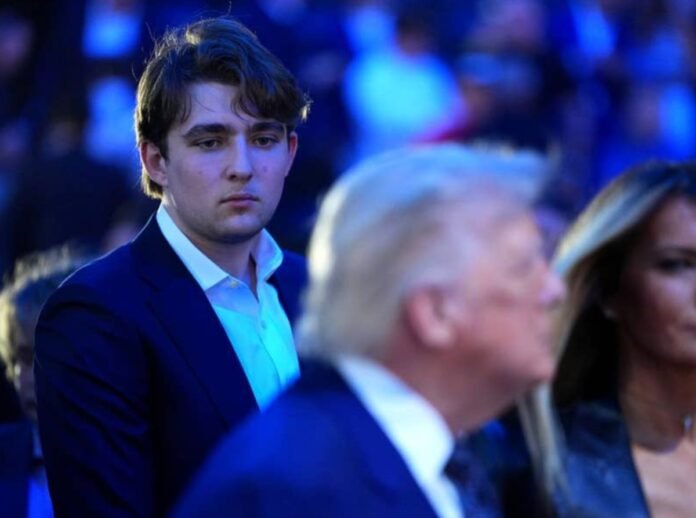
Iranian state television has aired a disturbing video targeting President Donald Trump’s youngest son, Barron Trump, while touting an alleged $10 million reward connected to efforts against the 20-year-old.
The roughly three-minute segment went far beyond ordinary political rhetoric, claiming Barron’s movements and security arrangements had been closely watched.
The broadcast reportedly showed locations connected to Barron, alleged details about his Secret Service protection and even purported efforts to identify people in his social circle.
But there is a major caveat: there is no public evidence that Iranian operatives have actually breached Barron’s security or successfully carried out the surveillance claimed in the video.
Iran International, which reported on the broadcast Monday, said the segment relied heavily on dramatic, stylized graphics and that its operational claims could not be independently verified.
Barron Trump Put in the Crosshairs
The video reportedly focused on supposed ways of getting close to Barron, who has largely stayed away from the public spotlight despite being the president’s youngest son.
Iranian state media claimed it had identified locations connected to Barron and attempted to map out his friendships and online activity.
Some reports said the video also referenced supposed Xbox, Discord and FIFA accounts linked to Barron and people around him.
Even more alarming was the reference to $10 million.
Toward the end of the broadcast, the narrator reportedly suggested there would be people willing to take the multimillion-dollar reward connected to targeting Barron.
Exactly who was supposedly offering the money was not made clear, and the existence of an actual bounty has not been independently verified.
The Iranian broadcast was reportedly given an ominous title explicitly referring to killing Barron and concluded with a direct warning aimed at the president’s son.
Secret Service Aware of Threat
The U.S. Secret Service is reportedly aware of the threatening material.
The agency told media outlets that it investigates threats involving people under its protection, although officials have not publicly revealed details about any specific security response surrounding Barron.
Barron receives Secret Service protection as a member of the president’s immediate family.
The disturbing broadcast represents an escalation in years of threats and alleged plots involving Iran and members of Trump’s orbit.
Iranian state-linked media has previously pushed menacing imagery and rhetoric aimed at President Trump and other senior American officials.
Last month, Iranian state television reportedly aired a similarly threatening video focusing on First Lady Melania Trump, claiming to reveal information about locations she visits and details surrounding her protection.
Trump Has Faced Iranian Threats Before
President Trump himself has been the subject of alleged Iranian assassination plots.
In 2024, U.S. prosecutors disclosed accusations that an Iranian operative had been tasked with developing a plan to kill Trump.
American authorities have also accused people tied to Iran’s Islamic Revolutionary Guard Corps of plotting attacks against former U.S. officials, including former National Security Adviser John Bolton.
Those alleged plots have often been described as retaliation for the 2020 U.S. drone strike that killed powerful Iranian commander Qasem Soleimani.
The threats have taken on new urgency as tensions between Washington and Tehran have exploded.
Iran International reported that hardline calls for revenge have intensified following the outbreak of the latest U.S.-Israeli conflict with Iran earlier this year.
That makes the decision to publicly target Barron especially notable.
Rather than threatening government officials involved in American foreign policy, Iranian state television has now turned its attention directly toward the president’s family.
And while there is still no proof that the frightening surveillance claims in the broadcast are real, the fact that such a threat was aired on Iranian state television is raising alarms all on its own.
Children in a Faith-Healing Sect Keep Dying. The State Lets It Happen.
Reporting Highlights
Death After Death: Almost every year since 2015, Idaho children in a faith-healing sect have died of treatable conditions such as pneumonia and bacterial infections that turned to sepsis.
Church Doctrine: Former members of the Followers of Christ sect say parents are pressured to follow doctrine that forbids medical care. Those who stray risk shunning, they said.
No Legal Pressure: Oregon officials say after the state put legal boundaries on faith healing, more parents sought care for kids. Idaho, by contrast, has kept its faith-healing protections.
These highlights were written by the reporters and editors who worked on this story.
A sheriff’s deputy opens the door of an Idaho farmhouse where a newborn baby has just died. It’s almost 10 p.m., but the house is filled with adults and children seated anywhere they can find a spot: in reclining chairs, on the wood-stove hearth, on a chest of drawers. Some of the women hold babies in their laps.
“Sorry,” the deputy whispers as the door creaks.
No one greets the officer. No one speaks or even looks at anyone else, casting their eyes instead at the floor or around the room.
The deputy’s video camera records as he walks through the front room and past a bedroom door adorned with children’s artwork. Inside the bedroom, newborn Malachi’s mother sits in a recliner. His body lies in her lap, covered by a blue blanket.
As people in uniform ask Malachi’s parents about his birth, death and the two days in between, members of the family’s church — one of at least four Followers of Christ churches in Idaho — watch from folding chairs. People come and go from the bedroom; one woman cradles a sleeping toddler.
Malachi died from pneumonia and bleeding lungs, according to an autopsy.
It would have been treatable with antibiotics and newborn care in a hospital, said doctors who reviewed his death records for ProPublica.
But Malachi’s parents belong to a faith-healing sect that doesn’t believe in medical care, based on a literal interpretation of several Bible verses. The Followers of Christ sect believes that God heals the faithful and that life and death must be left to God’s divine will.
When the coroner’s deputy lifted Malachi’s body to take it away that night in October 2023, there was no wailing or sobbing from his parents. Malachi’s father stood quietly as his mother hung her head and rested it in her hand.
A pediatrician who reviewed Malachi’s death records said a baby in his condition would have been gasping for air, turning blue from lack of oxygen and breathing so hard that the outline of his rib cage was visible.
It was the first time the coroner and sheriff sent their deputies out to that house, to interview those parents and document the slow suffocation of a newborn boy.
The next time was 13 months later, when their next newborn, Liam, died from the same treatable condition that killed his brother Malachi.
“This Is Needless”
In any Idaho household not steeped in faith-healing, those two deaths would be investigated as crimes. Idaho law says parents can’t endanger, injure or neglect their children or let them suffer. To do so is a crime, and if the child dies as a result, the parent could be charged with manslaughter.
But those laws do not apply to children like Malachi and Liam. Since the 1970s, Idaho’s criminal and civil laws have allowed parents who belong to Followers of Christ and the state’s other faith-healing sects to pray rather than seek medical care as their children die.
Lawmakers in Oregon, where the same religious groups exist, removed the state’s faith-healing exception to child abuse laws nearly 30 years ago, countering the overwhelming pressure former Followers say parents face from their congregations. More parents chose to get medical care for their children after the change, Oregon prosecutors and detectives said.
Idaho lawmakers have chosen a different path.
Since 2014, they have rejected repeated efforts to dial back Idaho’s faith-healing exemption, instead crafting legislation to further limit the role of anyone but a parent when it comes to children’s health and safety. The state has codified “parental rights,” banned vaccine requirements in schools and childcare centers, and made parental consent a prerequisite for medical care of minors. Legislators also have tried to narrow the definition of “medical neglect” for all families to only the most life-threatening situations, but those attempts have failed.
Local and nationalmedia outlets have reported on deaths among Followers of Christ families in Idaho. ProPublica went further, enlisting the help of experts to determine which of those deaths could have been prevented.
ProPublica gathered death records from coroners and police in five Idaho counties and shared them with more than a dozen pediatricians and birthing specialists.
At least 15 babies and children from the faith-healing sect died between 2015 and 2025 from illnesses that doctors could have successfully treated, the experts concluded.
The estimate of preventable deaths is almost certainly an undercount. The experts could not evaluate six more deaths because coroner records were incomplete or unavailable. In another four cases, they couldn’t say with confidence whether medical care would have changed the outcome.
Separately, the experts identified numerous preventable losses of babies who died during birth or in utero very close to their due dates, cases that coroners labeled as stillbirths.
For some families like Liam and Malachi’s, the death of a child wasn’t a one-time tragedy: Records show at least five sets of parents have lost multiple children, a phenomenon that has not previously been reported.
None of the parents responded to letters or text messages from ProPublica, and one declined to comment during a brief phone call. (ProPublica is choosing not to identify them or use the children’s full names out of respect for their privacy.)
But Nathan Kangas, a patriarch in the sect’s Caldwell, Idaho, church, defended faith healing and its legal protection during an interview with ProPublica.
Children and babies can’t make their own decision to rely on faith healing. Kangas said their parents must keep them away from the doctor to set an example, so the young ones won’t be cursed later in life by turning to medicine.
Kangas lost his own wife and their last child during labor 23 years ago. Three of his 65 grandchildren also have died.
Asked why God would not want children to live full and healthy lives, Kangas said he had no answer but quoted a verse from the Book of Psalms: “Precious in the eyes of the Lord are the death of His saints.” The Followers believe that life on Earth is “a preparing ground,” Kangas said. He pointed to the Book of James, which tells people to “be afflicted and mourn and weep” and “let your laughter be turned to mourning.”
“It isn’t necessarily that we’re supposed to have a joyous life here,” Kangas said. “It’s actually quite the opposite.”
Canyon County Sheriff Kieran Donahue has opposed Idaho’s faith-healing laws that shield parents from prosecution.Sarah A. Miller for ProPublica
Some outsiders take a very different view.
Canyon County Sheriff Kieran Donahue, one of the most vocal opponents of Idaho’s faith-healing laws, has sent deputies to follow up on the deaths of at least 10 Followers’ children and infants since he took office in 2013.
“This is needless,” Donahue said. “This shouldn’t be happening.”
David Peterman, a retired Idaho pediatrician, reviewed the deaths of 18 infants and children at ProPublica’s request.
Peterman saw patients for 40 years and did his residency at a center that offered special training in child abuse and neglect. He said the vast majority of the deaths he reviewed for ProPublica “are the result of neglect and unequivocally preventable.” (He couldn’t tell whether a few deaths were preventable, and he surmised that one infant had a fatal, untreatable chromosomal defect.) He said it is “beyond comprehension” that the Idaho Legislature has refused to change the law.
“How is this tolerable?” he said. “I don’t understand how there could be an exception in Idaho law that allows for these children to die.”
The Deaths
Maicy was 16 years old but the size of a third grader: 62 pounds and just shy of 4 feet tall. She had suffered from a constellation of ailments: stomach irritation, severe anemia, erratic menstrual periods, a blocked artery, thickened aorta and thinning hair. An autopsy after she died on New Year’s Day 2019 traced it all back to a benign, treatable pituitary tumor.
Doctors who reviewed her death records said her stunted growth would have been obvious earlier in childhood, when her tumor could have been diagnosed and treated. Instead, it sent her body into a hormonal tailspin that destroyed her organs. She died in bed, lying on a towel and absorbent pad, wearing a diaper under her sweatpants and a T-shirt that read “LOVE.”
“I don’t understand how there could be an exception in Idaho law that allows for these children to die.”
David Peterman, retired Idaho pediatrician
Some of the children who died preventable deaths over a decade were sick for hours or days; others endured months or — in Maicy’s case — years of disease. Most died in their parents’ arms. Many would have experienced pain and distress from their untreated conditions, the healthcare professionals consulted by ProPublica said.
“I don’t know how to come to terms with that,” said Beth Hartman, an Idaho midwife and former chair of the state’s midwifery licensing board. “Because when you see respiratory distress, and when you have seen a person pass, it’s not pretty. They don’t just close their eyes.”
In America at large, the risk that a child will die is highest during the first year of life. The vast majority of Followers’ children who died were infants. But nationally, fatalities in this age group tend to follow premature birth or profound congenital disorders. The deaths among Followers’ infants came from ailments that rarely take children’s lives.
At least three children died from sepsis caused by common infections that antibiotics can easily stop. Camden died in 2024. Weston died in 2025. They were brothers. Stanley, a newborn whose parents said he was “alert and happy” for his first 36 hours, spent the next 29 getting darker in color, coughing up phlegm and clenching his limbs in convulsions. He died in 2017.
The deaths almost never came without warning.
Members of the Followers of Christ use Peaceful Valley Cemetery in Caldwell, Idaho, to bury their loved ones. Weston, whose grave is pictured at right, was one of at least three children who died from sepsis caused by common infections. Experts said doctors could have stopped the infections with antibiotics before they became life-threatening.Sarah A. Miller for ProPublica
In the case of Malachi, the police and coroner reports don’t say how long before his death his parents first noticed him breathing fast, making a gurgling noise “like stuff was in his throat or chest.” Nor do the documents say what the parents did in the interim other than that they “chose not to perform life saving measures.”
But when they noticed their next newborn, Liam, was struggling to breathe and his “color was not good,” they again did not call for help, and he died over the course of at least 12 hours. While he was dying, members of their church came to see the baby and pray for him. Ten people were in the room when the boy died, and more had gathered outside the room, Liam’s father told police.
It’s rare in developed countries for children to die from pneumonia as Liam and Malachi did, wrote Barton Adrian, a retired Idaho pediatrician who reviewed the death records for ProPublica. The annual pneumonia-related death rate in the U.S. for infants is 1 in every 30,000 to 40,000, according to federal data. Adrian wrote that with a total of 12 children in Malachi and Liam’s family, the death rate was 1 in 6, “equivalent to third-world countries.”
Several healthcare professionals who reviewed the death records for Malachi and Liam suspected their problems originated from a birth-related strep infection so dangerous that expectant mothers in the U.S. are routinely screened for it. Women who test positive get antibiotics to keep the baby safe. In cases where a full-term newborn does become infected, almost all who receive treatment survive.
Dallas, a 2-year-old, was sick for six weeks with an untreated bacterial infection that settled into a valve in his heart and slowly destroyed it. He had fevers, abdominal pain, vomiting and swelling that started in his feet, then spread to his hands and finally to his face. He died in his father’s arms in 2020. Although an autopsy found Dallas was born with a heart condition that made him susceptible to infections, doctors who reviewed the document for ProPublica said the condition was treatable and antibiotics would have halted the infection.
Had his parents taken him to a doctor at any point during the six weeks they knew he was sick, Dallas could have been saved, the doctors said.
“Normal Still Isn’t Normal”
Whenever a child dies in the Followers of Christ, the scene is unlike anything police see in deaths outside the sect.
Police describe what seems to be a phone tree the church members use to call on the congregation to pray and go to the family’s home — sometimes before the death, sometimes after. A church elder or family member calls the coroner directly, instead of calling 911.
The sheriff’s deputies and local police who accompany the coroner’s team to the death scene have learned what to expect. There won’t be an ambulance parked outside. There won’t be a frantic, inconsolable parent. There won’t be children’s ibuprofen in the medicine cabinet or a pediatrician’s phone number to call for medical records. All the police will find is a crowd sitting in silent vigil and a bottle of olive oil for anointing the ill.
There is little for police to do besides offer condolences, ask questions and carry out their legal duty to confirm the parents did nothing that constitutes a crime in Idaho.
Yet some of these cases are etched into officers’ memories.
For Chuck Gentry, a captain in the Canyon County Sheriff’s Office, it was a baby girl named Jolene who died at 3 months old from a congenital heart defect. Some doctors told ProPublica that a cardiologist’s care could have saved her, although some suspected she also had a chromosomal defect that only 10% of babies survive past their first year.
What haunts Gentry was the lack of medical attention for the baby’s cleft palate, which he recalls was severe.
She died at an address that’s become familiar to local police because children from four Followers families have died there since 2017.
(Jolene’s father, reached by phone, declined to talk with ProPublica.)
Gentry echoed what other investigators told ProPublica: By the time detectives arrive, the congregation has already assembled. Dozens of people, Gentry said. So many vehicles that he’d sometimes struggle to find a place to park his patrol car.
“It isn’t necessarily that we’re supposed to have a joyous life here. It’s actually quite the opposite.”
Nathan Kangas, an unordained elder in the Caldwell, Idaho, Followers of Christ congregation
Once he’d get inside, he said, the grandparents of a dead child would make it hard for him to get the child’s parents alone to ask them questions. “They’re very hover-y. They don’t want you to separate them off,” he said. “They kind of seem overprotective of what they might say.”
(Kangas, the Caldwell church elder, said the congregation’s presence at a dead child’s home isn’t meant as intimidation. “They’re not there to keep from saying anything. That’s absolutely false,” he said. “We, as a people, when somebody suffers, we go there to suffer with them.”)
Gentry said it wasn’t until he got the parents alone in another room that their grief would spill out. “You see the mom crying. You see the dad kind of pacing,” he said. “It’s normal behavior for someone who has lost a child,” but the death itself and the scene that follows it are “so bizarre that normal still isn’t normal.”
Jolene was her parents’ first child to die, they told police. Other investigators arrived at the scene for the next, the couple’s toddler son, Malone, in 2021.
Written reports from a pathologist and death investigators describe the body that detectives saw: arms and legs skinny from malnourishment, a belly swollen to the size of a basketball.
Malone never had normal bowel movements in his 16 months of life, his parents would later tell investigators. His belly would swell, then he’d have an enormous poop, and the cycle would repeat. As his condition worsened, his mother brought him to his grandparents’ house on a busy country road. She held him while he died.
An autopsy determined that the boy’s bowels had compressed his lungs and heart, which stopped beating. His rib cage had grown outward to accommodate his backed-up intestines, and his lungs were so cramped they’d stayed the size of a newborn’s.
One detective wrote that Malone’s abdomen was “distorted to the extent of nothing like I’ve ever seen before.”
The day Malone died, investigators arrived to find dozens of family and friends at the house. Malone’s mother sat in the front room, in a chair holding the child’s covered body in her lap. Malone’s father knelt beside them.
A detective asked the parents questions in a quiet voice, according to audio recordings from the scene. Did Malone have trouble going to the bathroom? Had he been to a doctor? Did they have any other children? Where was Malone when he died? They gave brief answers, volunteering few details. The entire interaction took about 10 minutes.
The paperwork wrapped up, and the case was closed.
Disciples of a New Religion
The Followers of Christ sparked curiosity in Idaho from the time they arrived in 1899. Two “wayfarers from Oklahoma” appeared in a mining town near what is now Sun Valley, calling themselves “the disciples of a new religion.” They said God sent them to spread their gospel, according to reporting from the time in the Idaho Statesman.
“One was tall and dark, about 30 years of age, and wore a pair of greasy overalls, black, baggy sweater and flaring yellow mackinaw coat,” a reporter wrote. That man went by “Brother Charley.” He was “decidedly illiterate” and preached that education wasn’t necessary but had an impressive knowledge of Scripture, able to recite entire books of the Bible by memory, the reporter wrote.
They held their first worship service a week later in a schoolhouse.
Over time, Followers of Christ formed congregations across southern Idaho. It went on to become the state’s largest faith-healing religion and later spread into Oregon.
The first few generations of holy men who led Idaho’s congregations died, and no one took their place. Each church was left with, at most, a loose hierarchy and leadership structure. Each operates independently, with subtle differences in how it interprets doctrine. Although congregations have elders, families are the main conduit for ritual and belief.
The religion also breaks with most Christian denominations in that it does not recruit or proselytize. Other than on the rare occasion an outsider marries in, the sect grows only through existing families. This insularity causes the same surnames to show up over and over in public records from Followers communities in Idaho, and, just as happened in the faith’s earlier generations, the sprawling Followers families tend to intermarry.
Linda Martin, a former Follower who traced her genealogy, calls her family tree “a trunk.”
When the Followers began, healthcare on the Western frontier was primitive, unsanitary and riddled with con artists peddling fake cures. Hospitals and medical practitioners could treat many ailments and save lives, but medications like insulin for diabetes and antibiotics for bacterial pneumonia didn’t exist.
Like other faith-healing sects, the Followers sought answers elsewhere. They looked to Bible verses such as in the Book of James: “Is any sick among you? let him call for the elders of the church; and let them pray over him, anointing him with oil in the name of the Lord. And the prayer of faith shall save the sick, and the Lord shall raise him up.”
Kangas said “the whole Scripture” informs faith-healing doctrine and that no one went to the doctor in Christ’s time.
“It was a matter of trusting in God to heal them,” he said.
When someone dies despite fervent prayers, the Followers believe it is God’s will. When someone sees a doctor, the Followers see it as a sin. When someone recovers without medication or surgery or a 911 call, it seems to validate the sect’s doctrine.
No mainstream Christian denomination today accepts this interpretation of the Bible.
Baby blocks decorate a tombstone at the cemetery in Caldwell where Followers of Christ bury their dead.Sarah A. Miller for ProPublica
“I think over time, it’s kind of morphed into, ‘This is one of the things that separates us from all other faiths or religions, is that we don’t go to the doctor,’” said Laren Eells, who left one of Idaho’s Followers of Christ churches about a decade ago. He now believes that because of cherry-picked passages of biblical Scripture, “my eyes were completely clouded with presupposition.”
As a child, Eells watched his father endure what Eells believes was a burst appendix. The man was bedridden for over a month and had foul waste coming out of his mouth, but he emerged alive.
As an adult, though, Eells watched his younger brother die of an ear infection that spread to his blood. He sat by his brother’s side around the clock, “praying and wringing my hands,” he said. “An infection that some antibiotics could have probably taken care of, relatively simple, but we just say, ‘Well, we trust God with our life.’”
By the time Followers are grown, the idea that they could lose their own children isn’t foreign. They may have been present for their own siblings’ or cousins’ deaths. Their parents have likely taken them for vigils at other congregants’ houses.
The possibility of being isolated from their congregation can be a concern for Followers because of how much their lives revolve around extended family and church.
Former members say that someone who visits a doctor might be shunned, reprimanded or simply left out of social events — although Kangas said only “a few people here and there” in his church would go that far.
Kangas believes some ex-Followers perceive condemnation where none exists because of a guilty conscience. A single doctor’s visit can be chalked up to fear or weakness that “people can be forgiven of,” Kangas said.
What matters, he said, is that the person repents and never goes again.
Israeli media claim Kushner warned Hamas during meeting with its leader
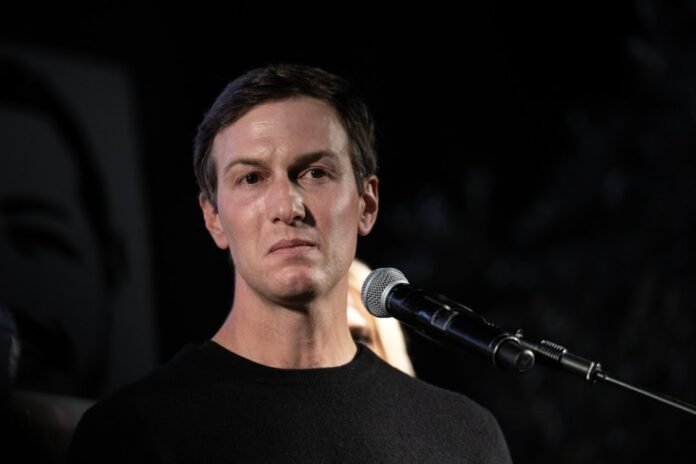
Israeli media claimed that US envoy Jared Kushner issued a direct warning to Hamas during a meeting with the group’s leader, Khalil al-Hayya, in Cairo.
Israel’s Channel 12 reported that the warning was that any attempt to violate the understandings or conceal weapons would lead to the suspension of the political process and give Tel Aviv full freedom to take military action.
It claimed that the meeting followed intelligence information received by the United States and mediators suggesting that some members of Hamas were planning not to honour their commitments to disarm and halt the rebuilding of its military capabilities.
According to the Israeli channel, Kushner told Hamas that “The test of trust will be in the implementation, and if you try to cheat, the process will stop and no one will stand in Israel’s way.” He stressed the need for the group to comply with all the terms of the agreement, particularly full disarmament and a halt to military mobilisation.
Kushner met Hamas leaders in the Egyptian city of El Alamein earlier this month to discuss US President Donald Trump’s plan to end the war in the Gaza Strip, following Israel’s rejection of the proposed roadmap.
Hamas has announced its acceptance of the roadmap for the second phase of Trump’s plan for the Gaza Strip, saying it was ready to proceed with its implementation to achieve a permanent ceasefire and the withdrawal of Israeli forces from the territory.
In a statement, Hamas said its leadership delegation, headed by al-Hayya, had met, under Egyptian auspices, with representatives of the mediators and guarantors of the Gaza ceasefire agreement. The meeting discussed several issues related to implementing the agreement and the roadmap.
Nvidia senior manager linked to Supermicro scheme smuggling AI servers to China
Taiwan has indicted nine people—reportedly including an Nvidia senior manager and two Supermicro employees based in the country—who allegedly helped forge documents to cover up illegal exports of high-end AI servers to China in violation of US export controls.
On Monday, Reuters reported that prosecutors in Keelung did not release any names but confirmed that the suspects were “charged with breach of trust and document forgery.” One suspect linked to a related case remains at large, accused of the “siphoning of funds from a distributor company involved” in helping China get access to restricted Nvidia chips.
Since 2022, the US has required a license to export semiconductors to China, with the intent of protecting national security by staying ahead of China in the AI race. But after the US arrested Supermicro co-founder Wally Liaw in March for allegedly funneling $2.5 billion in restricted AI servers to China since 2024, Taiwan launched a separate probe to learn more about the scheme.
Taiwan’s investigation found that co-conspirators attempted to falsify documents to make it appear that 130 B300 servers were installed and in use at a Taiwan facility. But 74 of those servers “were ultimately exported and delivered to Chinese customers,” Reuters reported, while the rest, 56, were intended to go to China but were blocked once Taiwanese customs officials “detected irregularities.”
Ars could not reach Supermicro or Nvidia for comment.
Huang urged Supermicro to “fix” problem
In a statement to PC Mag, Supermicro has previously confirmed that it’s cooperating with Taiwanese investigators.
“Supermicro is committed to protecting our advanced technologies and intellectual property. We are working closely with Taiwanese authorities on recent events, which underscore the importance of continued collaboration across industry and government to strengthen safeguards, enhance supply chain visibility, and facilitate the enforcement of export control laws,” Supermicro said.
The firm is not a target of the probe, Supermicro emphasized, which so far has targeted at least 12 locations to uncover suspected smugglers. Although US employees are believed to be integral to the scheme, Lauren Barden-Hair, an expert in China’s power over multinational firms across Southeast Asia, posted an op-ed in The Hill, noting that the US found that “a nameless Southeast Asian firm” was “at the heart of the operation.” That firm allegedly coordinated with co-conspirators at Supermicro and Nvidia, succeeding for years at ensuring that China wasn’t completely blocked from accessing Nvidia’s most advanced AI chips.
Both US firms will likely need to assess the steps they take to comply with US export controls. In May, before any Nvidia employees were linked directly to the scheme, Nvidia CEO Jensen Huang was highly critical of Supermicro for its failing compliance program, urging that a fix was needed, Tom’s Hardware reported.
“We insist our partners are compliant. We hope that they will enhance and improve their regulation compliance and prevent that from happening in the future,” Huang said at the time.
Supermicro has confirmed that it has already made changes. It also fired several employees that an internal investigation connected to the Chinese AI server scheme, Tom’s Hardware reported. Conducted by a third party, that probe cleared Supermicro’s current senior officials of any involvement. However, the company may have been neglectful in not noticing that “billions of dollars’ worth of hardware was being sent to questionable clients,” Tom’s Hardware noted. Spooked investors have even sued Supermicro for securities fraud, fearing that the company’s sales may be dominated by such illicit sales.
Taiwanese prosecutors said that all employees indicted were “fully aware” that Nvidia and Supermicro have “rigorous internal control procedures” regarding exports to China, Reuters reported. The US and Taiwan have recently tightened those controls, prosecutors said, yet employees’ scheme only got more brazen, Barden-Hair’s op-ed suggested. Supermicro’s team allegedly was so confident that it could evade US and Taiwanese export controls that it made “increasingly daring deals” to get China the computing power it wanted.
Taiwan officials announced that they recently uncovered more of the same misconduct. They alleged that Nvidia’s manager and Supermicro employees “colluded with one another at various levels for enormous profit, illegally exporting high-end servers, increasing corporate compliance costs, and severely damaging our nation’s international image,” Taiwan authorities said Monday.
US may cut off China’s remote access to AI
The US is determined to cut off China’s access to Nvidia’s AI chips and servers, and it seems to be taking a two-prong approach to tighten controls even further.
First, lawmakers are weighing a bill called the Remote Access Security Act (RASA), which would allow US export controls to extend to include remote cloud-based access to critical hardware and software, CNBC reported.
Passing that law would allow rule-making that could cut China off from exploiting a known loophole that currently impedes the US from interfering with its remote access to Nvidia chips via data centers in Southeast Asia. According to industry experts, remote access to computing power is a key factor driving Chinese models’ capability gains for companies including Alibaba, ByteDance, and Tencent, CNBC reported. And China will apparently soon have more data centers nearby to potentially expand remote access to compute, as hyperscalers plan to multiply the number of facilities in the region, leaping from two data centers today to 31 planned projects underway.
That bill will likely face industry pushback, CNBC suggested, since cloud providers would bear the cost of that new compliance regime, including implementing better know-your-customer protocols.
For the US, ending remote access may seem like an increasingly urgent priority, but the Supermicro scandal shows that evading controls can often be as easy as forging a document in an overburdened system where neither top executives nor customs officials managed to flag billions of dollars in fraudulent diversions.
However, the global crackdown on employees who are striking shady deals to export AI servers to China does come as Nvidia recently announced it’s increasing the prices of AI servers by 15 percent. So, at the very least, any employees motivated by the potential of gaining even higher profits from illicit sales will seemingly be on notice.
In her op-ed, Barden-Hair suggested that the US was blindsided by Chinese AI server smuggling because it failed to learn from its own history. In 1998, the Senate Committee on Governmental Affairs investigated “Chinagate,” a campaign finance scandal where China used Southeast Asian companies as a cover to try to influence election outcomes.
In that scheme, China learned that cultivating ties with business moguls—particularly those who had deep financial investments in China but were based just outside its sovereign territory—provided the “ideal cover,” Barden-Hair said. And similarly, the unnamed Southeast Asian firm at the heart of the Supermicro scandal appears to follow the same playbook, she said.
“It is easy to point out errors in judgment after a disaster, and US export control authorities deserve support and praise for their efforts to protect national security,” Barden-Hair said. “But it is important that we take the right lessons from the Supermicro scandal amid our shaming of the guilty, and remember the hard-earned lessons of the past. With the anonymous company the Justice Department refers to, China is showing us, again, that its pawns are scattered beyond its borders, and that its financial tentacles have a real and devastating influence.”
It’s hardly news that Americans are not happy with the state of their nation. Confidence in the country’s direction crashed hard during the Bush years and never recovered. But what’s notable about more recent years is Americans’ increasing dissatisfaction with their personal lives: [1]
For intellectuals and commentators such as myself, for many policy wonks and academics, and even for many politicians, the question is how to make the American people happier. And the answers we come up with are usually economic ones — ideas for policies that will improve the material well-being of either the whole populace, or some segment of it.
This is common on both sides of the aisle. On the left, centrists have embraced the Abundance movement, whose main idea is to give Americans more stuff — more housing, electricity, health care and so on. For progressives and leftists, meanwhile, Medicare for All is probably the centerpiece idea.
On the right, Trump’s trade agenda has usually been justified with claims that it will return good manufacturing jobs to the American working class. Even immigration restriction is usually couched in economic terms — the MAGA people claim that mass deportations will open up jobs for Americans, lower the price of housing and so on.
The roots of the country’s malaise, too, are often described in economic terms. Many people claim that the First China Shock — and the loss of good blue-collar jobs to offshoring more generally — left a disappointed, angry working class in its wake.
Progressives decry corporate landlords that they claim raise the cost of housing, and blame grocery stores’ greed for the rising cost of food. Practically everyone agrees that inflation was the biggest reason Trump won the 2024 election.
I’ve spent a lot of time arguing against a lot of these ideas (and in favor of a few of them). But I almost always accept the basic frame that A) many of America’s problems are due to economic malaise, and B) we ought to focus on finding ways to make Americans richer.
Partly, this is because I was trained as an economist; I recognize that things like culture wars are also important to Americans, but I don’t have much special expertise in that area. But partly, I think I just subscribe to the general tendency of American intellectuals to focus on the material.
I was thinking of this as I read Jay Caspian Kang’s essay, “Subaru Socialists and the Great Disappointed.” Kang argues that the young, educated, angry voters who currently form the Democrats’ base can be separated into two basic groups: Millennials who are mad about the raw economic deal they received during and after the Great Recession, and Zoomers who are mad about Covid and Palestine. Here he describes the first of these groups:
This new voting bloc has two similar but distinct components. There are what I call the Subaru Socialists: college-educated millennials in their thirties and early forties who earn a somewhat steady income but not what they expected. These voters arrived at their politics via the Great Recession, Occupy Wall Street, and the continual escalation of housing prices in urban areas—all of which heightened the contrast between what they were promised when they took on student debt and their current circumstances.
For a long time, I basically bought the narrative that at least some of the unrest of the 2010s was due to angry Millennials who had gotten screwed by the Great Recession.
It makes intuitive sense that a generation who were on the losing end of such a vivid demonstration of economic risk would turn toward policies that decrease economic risk — like government health insurance and rent control. It also makes sense that they’d want student debt forgiveness.
But as time has gone on and I’ve seen Millennials do better and better economically, I’ve begun to doubt this narrative. Corinth and Larrimore (2026) write:
We find that Millennials had a real median household income that was 20% higher than that of the previous generation, a slowdown from the growth rate of the Silent Generation (36%) and Baby Boomers (26%), but similar to that of Generation X (16%). The slowdown for younger generations largely resulted from stalled growth in work hours among women…Additionally, lifetime income gains for younger generations far outweigh their higher educational costs.
It’s not just government redistribution giving Millennials a boost. By the time they hit their mid 30s, their market income was well ahead of Gen X or the Boomers (and yes, this is adjusted for the cost of living). They had caught up in wealth, too:
Now, is it possible that even though Millennials eventually did OK, the disruptions of their 20s created a scarring experience that they’ve never forgotten? Yes, it is absolutely possible.
But it’s also notable that the kind of economic policies lefty Millennials demand — especially universal health insurance — don’t really address the main kinds of risks they experienced in their youth (unemployment and wage declines).
On the right, it’s notable that the economic policies Trump has unleashed have not helped the people they were supposedly designed to help. Manufacturing employment has fallen since Trump took office and started putting tariffs on anyone and everyone:
So much for those blue-collar jobs coming back. Meanwhile, mass deportations and a near-cessation of net immigration to the US have spectacularly failed to raise employment rates for native-born Americans:
The core economic pitch for Trump’s mass deportations was “fewer immigrants means more jobs for Americans”
Unsurprisingly, that’s just not happening
Prime-age employment rates for native-born Americans fell to the lowest levels in more than four years in data released today pic.twitter.com/GYV30WMScg
The core economic pitch for Trump’s mass deportations was “fewer immigrants means more jobs for Americans” Unsurprisingly, that’s just not happening Prime-age employment rates for native-born Americans fell to the lowest levels in more than four years in data released today
It’s possible, of course, that Trump’s supporters think his policies will take a long time to work, or perhaps they simply aren’t very aware of what’s going on in the economy. I kind of doubt this, though.
Americans as a whole have noticed, which is why Trump’s approval rating is in the gutter and inflation — the most important economic issue at the moment — is the issue on which voters are most angry at Trump:
So it’s possible that Trump’s voters were just tricked into thinking he was better on economics than he was. On the margin, that’s probably true. But the fact that Trump’s base has stuck with him strongly implies that economics was not their primary concern.
In fact, there was a whole huge debate among political scientists and economists about whether Trump’s victory in 2016 was due to “economic anxiety” or to sociocultural issues. In the end, the “economic anxiety” hypothesis generally lost out. Here’s Margalit (2019):
Empirical findings indicate that the share of populist support explained by economic insecurity is modest. Second, recent evidence indicates that voters’ concern with immigration—a key issue for many populist parties—is only marginally shaped by its real or perceived repercussions on their economic standing.
On the left, I think there’s pretty good evidence that economic issues are not foremost in the minds of the progressives who dominate the Democratic Party. The political analyst David Shor has found that the issues Democratic donors and activists care about are just different from the bread-and-butter economic concerns that motivate swing voters:
In reality, Shor says, young party staffers are far to the left of the median Democratic voters on relatively uncontroversial, bread-and-butter Democratic priorities like combatting income inequality or addressing climate change. In their 2015 paper, for instance, Enos and Hirsch found that 23 percent of Obama staffers cited income inequality as the single most important issue facing the country, whereas polls from that election cycle found that fewer than one percent of all voters listed “the gap between rich and poor” as the most important issue. Enos and Hirsch also found that campaign workers were more likely to cite health care and inequality as an important issue to voters — even though most voters did not list those as high-priority issues and said they were more concerned about things like war and inflation.
And although much has been made of the fact that low-income highly-educated voters tend to break strongly for the Democrats, it turns out that high-income highly-educated folks also vote blue:
In fact, in his essay, Kang describes Gen Z voters as caring less about the economy than about Palestine:
Then there are the Great Disappointed, a younger set. They don’t have strong memories of the 2008 financial crash, as their millennial elders do, but they came of age during the pandemic and saw that seemingly invincible institutions could, in fact, sputter and fail when placed under duress. Like the Subaru Socialists, these twenty-two-to-thirty-year-olds aren’t exactly happy with the return on their educational investment. But their political views have seemingly coalesced less around the economy than around the war in Gaza, which serves as a character test for any politician who asks for their vote…A majority of young Democrats believe that their tax dollars are funding a genocide; candidates like Melat Kiros, who defeated the longtime Colorado Congresswoman Diana DeGette in a primary, are running to the left of progressive incumbents not so much on economic issues as in their condemnation of Israel and of America’s continued military aid to the country.
The name Kang assigns to these voters — the “Great Disappointed” — seems at first to imply some kind of economic disappointment. But it turns out he just means they’re angry about foreign policy stuff that they see in the news.
In fact, a lot of committed DSA types are actually post-economic. The Gen Z political strategists who recruited Graham Platner to run for Senate, Morris Katz and Daniel Moraff, were found to be scions of very wealthy families. Similar stories keep popping up:
Absolutely extraordinary. The co-chair of the NYC DSA is a self-described “union electrician”, has an arts degree from Yale, a 1.5 million brownstone gifted by his parents, a trust fund, and has worked for a total of about 6 months in his entire life.
If people like this are “disappointed”, their disappointments have little to do with their material standard of living.
In other words, over the past decade I’ve increasingly come to doubt that economic policies and programs can address the true concerns of the people driving American politics. Yes, economics still matters, of course — for humanitarian reasons, if nothing else.
And yes, there are still a lot of voters who care about inflation, jobs and other economic issues. But these are not necessarily the people setting the agenda in American politics or causing unrest in American society.
Even where “normie” voters are concerned, though, it’s proving maddeningly hard to craft economic policies that give them what they want. Even though inflation fell from 9% in the summer of 2022 to just 3% in the summer of 2023, voters still seemed to punish Democrats at the polls in 2024.
And although inflation during Trump’s current term has never approached anything resembling 2022, voters still say they’re incredibly mad at Trump over inflation.
With a robust job market, low-ish inflation, and decent economic growth, analysts have struggled to figure out why consumer sentiment — at least, as measured by UMich — is at all-time lows. At a loss, commentators have been reduced to talking about “vibes” — basically a label for our ignorance.
Every time a policy wonk thinks about some measure that would increase GDP by 0.4%, or create 200,000 jobs, or lower inflation by 40 basis points, they need to think about the unpleasant reality that Americans may simply not care very much.
That doesn’t mean it’s bad to help people economically, but it means that economics may ultimately not be the lever we need to pull if we’re going to make the people of this country happy and satisfied again.
We should therefore think about whether our primary social problems are actually about material scarcity. The vast majority of Americans now possess not only the basic necessities of life, but a degree of economic security unimaginable to their forebears a century ago.
It seems plausible to think that a great many Americans have climbed to the higher rungs of Maslow’s Hierarchy of Needs — that instead of where to get their next meal or how to save for retirement, they’re thinking about how to feel like they belong in their society, or how to get more status and respect.
A large contingent of Americans may now simply care less about adding to their bank accounts than about questions like “Who are the real Americans?”, or “Does one race deserve special treatment in the eyes of the law?”, or “Why do some of the people I went to college with have 10,000 times as much wealth as I do?”. As long as those questions remain unanswered, boosting Americans’ economic fortunes could have little effect on their happiness.
Neither the discipline of economics nor our typical policy discourse is set up to deal with issues like belonging, social status or respect. There’s no market for these things; people with wealth might be more respected, but you can’t buy respect on Amazon. And some of these psychological needs are positional goods — for the status of one person or group to be higher, someone else’s status often has to be diminished.
Not only is modern economics poorly set up to deal with those kinds of things, it often bothers us to even talk about them. A world dominated by positional goods — where one person having more requires that someone else have less — is a dark, zero-sum world. We would much prefer to work toward a world where everyone wins.
And yet like it or not, this may now be the world in which we find ourselves. Just as the great challenge of the 20th century was to provide broad-based material plenty, the great challenge of the 21st century may be to make everyone feel high-status at the same time — or at least to create a world where status differences don’t lead to mass resentment.
USA’s ‘economic D-Day’ against Iran begins with a ‘warning shot’
American Treasury Secretary Scott Bessent on Monday unveiled a sweeping new effort to economically isolate Iran, warning foreign governments and companies that they could lose access to the U.S. financial system if they continue doing business with Tehran.
The campaign, which Bessent dubbed “Operation Economic Outcast,” stopped short of immediately imposing penalties against financial institutions located in China and other countries that facilitate trade with Iran for oil and other commodities.
Senator @MarshaBlackburn on Operation Economic Outcast: “Iran is suffering from unprecedented inflation. We hear that the military and the police are not able to meet their payroll… I think it is important to note that @SecScottBessent alluded to the fact that there’s going to… pic.twitter.com/WkyyInCcgd
Instead, Bessent delivered what he called a “warning shot” to countries around the world that they should get in line behind the Trump administration’s efforts to isolate Iran or face significant financial repercussions.
Bessent and the Trump administration for days had signaled its plans to drastically step up economic pressure on Tehran, which the Treasury secretary had likened to an “economic D-Day” operation.
Pressed during a press conference Monday on why Treasury was not immediately imposing those penalties, Bessent said the U.S. wanted to give countries a “cure period” to comply. He said the clock “just started ticking.”
“We are giving everyone the opportunity to remedy bad behavior,” Bessent said. “Why would I want to blow up the global financial system?”
Bessent said Treasury expects to sanction a major foreign financial institution by the end of the week as part of the new effort.
Read full statement by the U.S. Department of the Treasury HERE
The Treasury Department expanded its ability to penalize foreign companies that operate in or support five sectors of Iran’s economy: digital assets, technology, gold, aviation and shipping. Treasury also imposed fresh direct sanctions on dozens of people and entities tied to Iran and ended waivers that had permitted the flow of remittance payments to the country and allowed Iranians to access the U.S. cultural and academic universities.
Bessent said President Donald Trump was calling foreign leaders with “specific requests” to cut economic ties with Tehran. Officials from Treasury, the State Department and the Pentagon are also pressing their counterparts for “immediate action” to cut off economic ties to Tehran, Bessent said.
Bessent said every country had been given a deadline to shut down specific Iran-related activities identified by the U.S., though he declined to disclose the nature of those requests or the timelines.
“It’s no longer acceptable to operate in the gray spaces of this conflict,” Bessent said.
The move marks the Trump administration’s latest attempt to force an end to an increasingly unpopular war that has stretched into its sixth month. The war has disrupted global energy markets, raised the price Americans pay for gas and become a growing political liability for Republicans ahead of the midterm elections months away.
It also puts Bessent at the center of the administration’s war efforts after months of military strikes, a blockade of Iranian ports and diplomatic talks have failed to secure a lasting agreement to end the conflict.
The latest strategy could significantly raise tensions with China, which is a large buyer of Iranian oil. Treasury has already sanctioned smaller Chinese refineries, shipping companies and financial networks accused of helping Tehran sell oil.
But targeting larger Chinese banks or companies that facilitate Iran-linked transactions could provoke retaliation from Beijing as Trump prepares for expected talks with Chinese President Xi Jinping.
Asked about whether the U.S. would move forward on sanctioning Chinese banks on Monday, Bessent said that “no one is above the reach of U.S. sanctions.”
Those who have been involved in past negotiations with Iran are skeptical the announcement will move the needle with Tehran — and especially Beijing.
“The announcement itself was a nothing burger,” said Ali Vaez, the International Crisis Group’s Iran project director, who helped work to bridge differences between Iran and world powers during negotiations over the 2015 nuclear agreement. “The only thing that would make a difference at this stage is the U.S. delivering on its threats, not threatening. ”
Trump allies welcomed the Monday announcement, but they were skeptical it would work.
“Doubt it,” said one person close to the White House, who was asked whether the move would help end the war with Iran and granted anonymity to speak candidly on administration policy. But “I support all non-war avenues to pressure Iran.”
A second person close to the White House, who was also granted anonymity to discuss a sensitive issue, added, “I think it has the potential to be impactful if they actually execute. However, without addressing the China angle it leaves an economic escape route for Iran.”
Bessent’s refusal to say the word “China” during a press conference despite repeated questioning about whether the threatened sanctions would hit Beijing, underscores the administration’s aim to avoid derailing Trump’s summit with Xi next month.
Beijing provides Tehran an economic lifeline by purchasing around 90 percent of Iran’s oil exports via the “shadow fleet” of vessels that sell those cargoes to small-scale “teapot refineries” in China.
The Chinese government is likely equally skeptical that the Trump administration will impose disruptive sanctions on its Iran trade ahead of a summit at which President Donald Trump is seeking to expand U.S. agricultural exports to China while avoiding disruption to Chinese supplies of rare earths.
“Beijing is betting that Washington will be reluctant to jeopardize the current leader-level dynamic by targeting major Chinese entities before the summit,” said Craig Singleton, senior China fellow at the Foundation for Defense of Democracies.
The Chinese embassy in Washington did not immediately respond to a request for comment.
European diplomats were cautious about the new pressure campaign, with some noting that relatively few countries maintain significant trade with Iran, one of the world’s most heavily sanctioned nations.
“The risk here is that the regime may react in a way that will further aggravate the situation,” one European ambassador said, warning that Iran’s Revolutionary Guard could see the campaign as a question of survival.
A senior European diplomat said it remained unclear how quickly the campaign would produce results, noting that sanctions typically take time to have an impact.
European officials are also concerned Washington could demand that they impose matching sanctions on Tehran.
“The big question now is whether Europe will be asked to match the U.S. sanctions,” said Giuseppe Spatafora, a policy analyst at the EU Institute for Security Studies.
Iran’s neighbors, former negotiator Ali Vaez said, have their own reasons for maintaining ties with Tehran and may resist U.S. demands.
US Intelligence Warned President Trump Khamenei Killing Could Backfire
US intelligence officials warned President Donald Trump shortly before the United States launched an operation against Iran in February that assassinating Supreme Leader Ali Khamenei could bring a more extreme government to power rather than cause the Iranian regime to collapse, The Wall Street Journal reported.
Then-Director of National Intelligence Tulsi Gabbard delivered the assessment to Trump before the conflict began, warning about the potential consequences of killing Khamenei.
Intelligence officials assessed that a more radical leadership replacing Khamenei would be more willing to pursue nuclear weapons. The briefing also warned that Iran could block the Strait of Hormuz and launch attacks against US troops and American allies in the region.
Senior Pentagon officials separately raised concerns about potential American casualties and the pressure a conflict would place on US stockpiles of precision-guided munitions.
Vice President JD Vance opposed going to war and urged a more cautious approach. Senior Pentagon officials, however, ultimately persuaded Trump that US military power could prevail.
Other senior aides presented President Trump with a different assessment of the opportunity presented by Iran’s condition. Prime Minister Benjamin Netanyahu and senior US officials told the president that Iran was weaker than it had been in decades, creating an opportunity to topple the regime and strike Tehran’s nuclear program.
Efforts to negotiate an end to the war have since reached a stalemate, while Iran continues to interfere with shipping through the Strait of Hormuz.
The Trump administration is now pursuing increased economic pressure against Tehran.
President Trump and US Treasury Secretary Scott Bessent have announced an “economic D-Day” strategy aimed at bringing down the Iranian regime through sanctions and other financial pressure.
Inaudible sounds used to fingerprint browsers catch AliExpress red-handed
Chinese retailer AliExpress has been caught fingerprinting visitors after one of the metrics—an outdated technique that measures inaudible sounds it sends to browsers—impeded a researcher’s ability to use his bluetooth headphones.
Researcher Matthew Callaghan said he stumbled on the stealthy tracking by mistake. After loading the AliExpress homepage, audio from his phone stopped playing over his multipoint headphones, which accept connections from more than one device at a time. He set the headphones to play sounds from his phone except when his PC was producing audio. Each time he loaded AliExpress, the phone audio stopped. Each time he closed the tab the site was loaded into, the phone was once again audible.
Users can’t hear it, but browsers can
While investigating the odd behavior, Callaghan said he found two highly obfuscated scripts. Together, they rendered a graph that analyzed the WebAudio readings of each visiting browser. This graph acted as an oscillator that measured Sawtooth waves, which are common in output from digital audio.
“The oscillator generates a known waveform,” Callaghan wrote. “The analyser measures the result after it has passed through the browser’s audio implementation, and the script reads frequency data from it.”
The scripts set the gain to zero to prevent users from hearing anything. But because the graph is still connected to the selected system audio, the browser continues to process it and, eventually, sends it to AliExpress.
Variability in different math libraries, which are used when audio is produced through browsers, were once high enough to provide a massively large number of uniquely different signatures when combined with different CPUs and other system differences. After the audio soundprinting technique became well known, Firefox implemented a fix, starting in version 118 released in 2023. Beginning then, the browser used its own unique math libraries, rather than relying on ones that shipped with the OS it ran on. Tom Ritter, a Firefox developer who has also volunteered for the Tor Project, said the move to constant libraries reduced the entropy enough to stop the technique from working.
The technique is ineffective in Chrome because it, too, ships with its own libraries, a Google spokesperson said. Safari users are likely safe for the same reason, although Apple didn’t immediately confirm that.
An artifact from years past
AliExpress’ use of an obsolete fingerprinting method raises the question: Why is it bothering to use it? The likely answer has to do with the more than a dozen other fingerprinting methods the online retailer is using. Callaghan said the other techniques included:
canvas rendering and toDataURL()
WebGL renderer information, extensions, and shader precision
audio oscillator and analyzer output
screen and viewport dimensions
device pixel ratio
hardware concurrency and device memory
installed browser plugins
supported audio and video formats
WebRTC behavior
browser performance timing
mouse, touch, focus, and scroll events
device motion and orientation
properties commonly associated with browser automation
It’s likely the web audio trick is left over from years earlier and no one noticed it until now.
It’s comforting to know that browser makers have taken precautions. At the same time, it’s not yet clear how effective the rest of the metrics AliExpress is using are. Less reassuring still: it’s almost a certainty that thousands of sites are employing similar tracking. Browser developers are in a dynamic race with site publishers, who are constantly looking for new ways to break the latest protections.