Here’s the number that tells you more about this crisis than any missile count:
War-risk insurance on a tanker passing through Hormuz used to run about 0.15 percent of the vessel’s value. Barely worth mentioning on a shipping company’s books. At the height of the fighting this year, that same premium climbed to somewhere between 5 and 10 percent and briefly, by some accounts, thousands of times higher than pre-war levels.
Do the math on a $100 million tanker and you’re looking at the gap between a $150,000 line item and one closer to $5-10 million, per single voyage. Daily transits, which used to average around 178 ships, reportedly dropped by as much as 95 percent at the worst points.
That’s the part of this story that doesn’t get enough attention. Iran doesn’t have to close the strait. It just has to make the insurance market flinch.
A problem the Navy can’t actually solve
For decades, American strategy in the Gulf rested on one assumption: Overwhelming force keeps everyone in line.
For a long time, it worked. But Iran never tried to match the US Navy hull for hull. It built up mines, fast boats, drones and missiles – not to win a fight outright but to generate exactly enough uncertainty that Lloyd’s underwriters end up doing Tehran’s work for it, repricing risk and pulling coverage until owners simply stop sailing.
Which is part of why it feels like treating a symptom when the US Navy escorts ships through, or the Trump administration directs the International Development Finance Corporation to backstop war-risk coverage reportedly up to $40 billion in reinsurance capacity.
A convoy gets one ship through. It doesn’t convince an underwriter in London that the Gulf is safe again. A Crisis Group analyst put it plainly: there’s no military fix here, the strait reopens through negotiation, not escort.
That’s the asymmetry in a sentence. Iran can’t beat the US Navy and isn’t trying to. It just needs the insurance markets rattled long enough that “freedom of navigation” starts costing more than Washington’s partners are willing to pay.
Every option costs something different
Not a one of Washington’s choices is free. More strikes risk pulling Gulf infrastructure into the crossfire and pushing premiums even higher. Sanctions have had decades to prove they can grind an economy down without necessarily producing surrender.
Negotiation is on the table. There’s reporting that Iranian President Masoud Pezeshkian has pushed internally to end the confrontation from a position of strength, against factions arguing for continued resistance.
But neither side wants to be the one seen backing down first – which is probably the real reason the Islamabad Memorandum’s ceasefire fell apart as quickly as it did. It managed the politics of a pause. It never touched the economics underneath the fact that every fresh tanker attack resets the risk pricing all over again.
What Pakistan has at stake here
Most of the commentary on Pakistan’s role in this stops at the obvious: It shares a border with Iran, has Gulf security ties, leans on China, still deals with Washington so naturally it hedges. Fine, as far as it goes. But it misses the more interesting question, which is what a Hormuz-shaped insurance shock actually does to Pakistan’s own books.
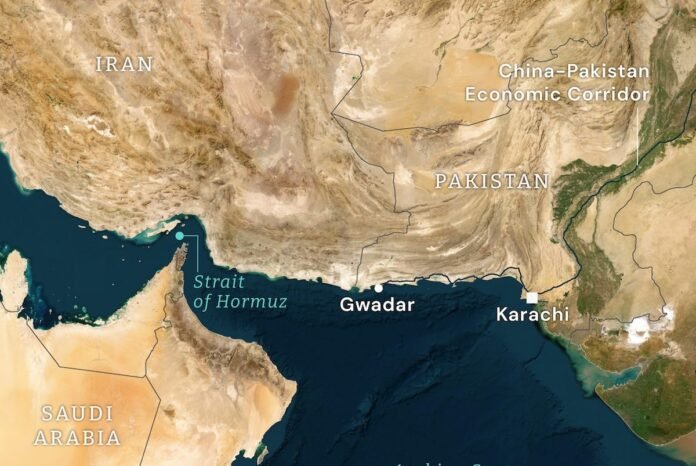
Three things are worth saying plainly. Pakistan imports its oil through the Gulf, so a war-risk premium tacked onto every tanker bound for Karachi or Port Qasim isn’t some faraway geopolitical curiosity. It shows up in fuel prices and the current account. That’s not abstract for whoever’s managing the macro numbers in Islamabad right now.
Then there’s Gwadar. It sits on the open Arabian Sea, outside the strait entirely, usually framed as a CPEC talking point and not much else. But in a Hormuz-disrupted world, that location means something more specific: it’s one of the few Gulf-adjacent ports that don’t force shippers to run the same insurance gauntlet everyone transiting Hormuz is now stuck with.

Few advocates have really pitched that to shippers or energy traders looking to de-risk their routing. More probably should.
And then there’s the Makkah Joint Defense Agreement with Saudi Arabia, plus the financing moving through Reko Diq and the Project Vault minerals framework. These aren’t side stories to Hormuz. They’re Pakistan’s actual insurance policy against a shock exactly like this one. A Gulf security relationship paired with a minerals-and-connectivity stake with both the Gulf and China gives Islamabad something more useful than a neutral posture.
Which is the trap, honestly: treating “active neutrality” as a stance rather than a plan. Neutrality without an economic strategy attached to it is just exposure dressed up as diplomacy. The version worth pursuing turns geography – Gwadar’s position outside the strait, the border with Iran, ties to both Riyadh and Washington – into contracts and financing, not just praise for staying out of the crossfire.
The bigger pattern
Step back from Pakistan and there’s a wider mechanism at work here, and it isn’t unique to the Gulf. The Red Sea saw something similar during the Houthi campaign: premiums up roughly fivefold, shipping collapsing without a single mine actually detonating near most vessels.
Analysts who study this stuff point out the formula applies anywhere you get a narrow chokepoint, few alternative routes and a functioning private insurance market: Malacca, Taiwan, the Turkish Straits. Pricing risk has become its own coercive tool, one that doesn’t need a shot fired, and the reinsurance backstops that Washington is now building for Hormuz might turn out to be less of an emergency measure and more of a template.
For the US, that’s an uncomfortable lesson: You can dismantle an adversary’s military assets and still lose the argument that actually matters to a shipowner deciding whether to route through the Gulf at all. For Pakistan, the lesson is more useful than uncomfortable. Few countries sit this close to the chokepoint without being direct parties to the war, and few hold the kind of assets – Gwadar, Gulf security ties, Chinese capital – that can turn that proximity into real leverage if Islamabad actually treats this as an economic opening rather than just another tightrope to walk.
The strait will probably reopen eventually, through talks rather than force, as most people expect. But the insurance markets that just repriced the entire Gulf aren’t going to forget this in a hurry. Whoever understood that shift early is going to be in a better position than whoever only understood the politics of it.
Mansoor Qaisar is an independent writer based in Islamabad, writing on foreign and public policy and social issues shaping Pakistan and the region. He can be reached at mansoor.qaisar@gmail.com and found on X at @MansorQaisar.