The Saudi-Pakistani-Turkish alignment could keep the region “in the ideological framework of political Islam” and block commercial prosperity, Bijan warns
In Pejman Bijan’s view, the battle over Iran is also a battle over the map of the Middle East—and the balance of power far beyond it. The stakes, as he sees them, stretch from the Strait of Hormuz to Europe, Washington, Beijing and Moscow.
The question is not only whether the Islamic Republic can withstand mounting pressure, he told The Media Line, but whether a regional order built on commercial ties, political freedom and new alliances can take shape before a competing bloc gains momentum.
Today, we are in a moment of reshaping the balance of power, not only of the Middle East but of … world politics
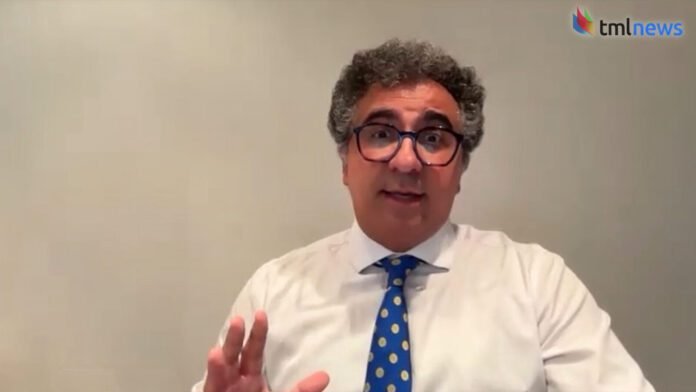
“Today, we are in a moment of reshaping the balance of power, not only of the Middle East but of … world politics,” said Bijan, an Iranian-Italian associate professor of international relations at the University of Trento in Italy and a recent visiting scholar at the University of California, Berkeley. His research focuses on the Middle East.
Bijan places the region within a broader contest involving the United States, China and Russia. “There is a sort of soft and sometimes hard clash between these great spheres of power,” he said. The European Union is part of that system, as is the Middle East, which he called “one of the big players.”
Developments in the region over the coming months could help determine “who will prevail in the next years between the United States, somehow like the freedom democracy area of the world,” and the authoritarian rulers and propaganda he associates with China and Russia, Bijan said. Iran and the Arab states of the Persian Gulf are among the central actors.
Europe, in his assessment, is constrained by its own political structure. The continent is “paying the price” for becoming too institutionalized, he said—a democratic system that has failed to act effectively enough in foreign affairs.
“At the moment, … we don’t have a common foreign policy, which is able to dictate an important common line against, on one hand, Russia and China, and also in relation with our ally, which is the United States,” he said.
That has left Europe playing “a weak role,” Bijan said, despite its democratic history and potential influence.
He sees a split in Europe’s approach to Iran. Political forces he associates mainly with the center-left have sought engagement with figures in the Islamic Republic whom they regarded as reformists. He cited former Iranian presidents Hassan Rouhani and Mohammad Khatami, as well as former European Union foreign-policy chiefs Federica Mogherini and Josep Borrell.
“They always somehow flirted with a part of the elite of the Islamic Republic,” he said.
Centrists and some center-right figures, by contrast, have supported political change in Iran and what Bijan calls the country’s “golden generation”—“this amazing new Iran, which is fighting for freedom and democracy.”
For Europe, he said, that division now demands a choice. “You can’t anymore close your eyes in front of the regime,” he said. “It’s time to have a decision.”
Bijan also views the recently signed Mecca Joint Defense Agreement among Saudi Arabia, Pakistan and Turkey through the lens of competing political and commercial futures.
One possible future centers on the India-Middle East-Europe Economic Corridor, known as IMEC. Announced at the Group of 20 summit in 2023, the proposed shipping and rail network would connect India with Europe through the Persian Gulf, Arab states and Israel. Bijan envisions the route extending from Mumbai through the United Arab Emirates and Israel’s port of Haifa before reaching the Mediterranean and, eventually, the Italian port of Trieste.
Building that commercial network, Bijan said, would require the Abraham Accords to be fully implemented. The US-brokered agreements established or expanded diplomatic relations between Israel and several Arab states beginning in 2020.
To that framework he adds the proposed Cyrus Accords—an initiative calling for future normalization between Israel and a democratic Iran. Israel and the United Arab Emirates would be especially important players in such a regional alignment, he said.
If realized, Bijan argued, that project would serve regional stability, Israel’s interests and US efforts to counter Chinese and Russian influence.
He interprets the Mecca agreement as part of a competing alignment, though the pact’s signatories have described it as defensive and not directed against any country.
“Pakistan is playing a game, in my opinion, geopolitically, more on behalf of China than Washington,” Bijan said.
The contest between those paths could shape both the Middle East and European security, he argued. If the Saudi-Pakistani-Turkish alignment prevails, “we will keep the Middle East in the ideological framework of political Islam, of insecurity system, and not going through the commercial prosperity.” Such an outcome, he said, could help the Islamic Republic survive.
His alternative is what he calls the “New Middle East,” distinct from the “Greater Middle East” initiative associated with President George W. Bush.
“The New Middle East is everybody wants freedom of democracy, needs that, and particularly free commerce,” Bijan said.
His vision rests on the Abraham Accords, a politically transformed Iran and an alliance linking Iran, Israel and Arab Gulf states “based on commercial routes and historical basis.”
Qatar and Pakistan, in Bijan’s analysis, are markers of the changing regional balance. Qatar, he said, “has been together with the Islamic Republic of Iran for many years, the promoter of political radical Islam,” with one operating in the Sunni sphere and the other in the Shiite sphere.
Pakistan has played a comparable role in South Asia, he said, but its growing prominence as a mediator reflects a wider shift in international influence.
Bijan described Qatar as more closely connected to what he called “London-istan”—political and institutional networks centered in London that, in his view, have retained influence in the Arab Gulf and parts of Europe. He believes that influence is now weakening.
Pakistan, by contrast, “is more playing the card of China.” Its expanding role indicates that “China, together with Russia, are more sensible on what is happening,” he said, while “the UK’s control over the game is getting less.”
The Strait of Hormuz offers another example of the tension between national history and international power. Responding to President Trump’s characterization of the strait as an American asset, Bijan called it “an international waterway, and it doesn’t belong.”
Iran, rather than the Islamic Republic established in 1979, has a deep historical connection to the passage, he said. “The word itself for Hormuz come from the Ahura Mazda … so that’s something very important as an identity.”
US policymakers should also distinguish between Iran as a nation and the government ruling it, Bijan argued. “They have a nation in Iran, which is their ally,” he said.
Reports that Iran could attack American facilities in Europe, including in Bulgaria, Cyprus and Italy, fit Bijan’s broader warning about the regime’s response to pressure. He described recent US measures against Iran as “a sort of medieval closing” of the country.
“Never happened that Islamic Republic has been so much under economic pressure,” he said. “Even the help of China and Russia are not enough at the moment to stop a possible fall down of the Islamic Republic system in the next month.”
The government could respond by seeking to create instability, he warned, calling it a tactic the Islamic Republic has used to preserve itself. “The possibility that they would provoke in Europe something is realistic,” he said.
Washington should act “sharp and attentive” in helping Iranians pursue democracy and freedom, Bijan added.
Iran’s internal power structure, he said, is more layered than that of a conventional authoritarian state.
“Islamic Republic of Iran has been always, since 1979, a very complex system,” he said. “That is the hybrid regime.”
Unlike North Korea or what he called “a fully authoritarian regime,” the Islamic Republic rests on several institutional and political layers. “It means if you kill the Supreme Guide, you are not making the system fall down.”
Bijan divides the ruling establishment into two broad factions. The first, which he calls “the oligarch pragmatist,” combines figures from the Islamic Revolutionary Guard Corps and the diplomatic establishment who favor negotiation and have allies in Washington policy circles. The second favors confrontation and rejects an agreement with the West.
The first faction seeks survival through engagement, he said. “They are not going to make freedom in Iran, but they might … become less dangerous for the West.” The second “would go ahead with … these attacks and this kind of thing.”
“This has been the game of good cop and bad cop of the Islamic Republic, which still continues,” Bijan said.
Assessing Washington’s handling of the war with Iran, he said the United States under President Donald Trump, beginning in the president’s first term, had developed a broad strategy that advanced the prospect of regime change.
Bijan supported the Feb. 28 attack that killed Iran’s supreme leader but argued that it came too late.
“It was right, but it was a bit late,” he told The Media Line.
President Trump’s appeal for Iranians to enter the streets was powerful because people who had long felt abandoned believed they finally had US support, Bijan said. “The only thing I think we have been missing was the timing,” he added, arguing that the expected assistance should have arrived sooner.
Still, “the alliance is there,” he said. Bijan views President Trump and Secretary of State Marco Rubio as more closely aligned with what “the new Iran could be.”
He was more critical of Vice President JD Vance, whose approach he compared with the Obama administration’s willingness to negotiate with Iranian figures presented as moderates. Bijan said Washington think tanks continue to promote that approach despite its record and expressed hope that Vance would reconsider because he was “not … going to the right part.”
The people confronting the government in Tehran and other cities should not be described merely as an opposition movement, Bijan argued.
“I don’t call it even opposition, it is Iranian society, because they are 85% of Iran,” he said. “So, they are not anymore even political opposition. They are the society.”
He pointed to demonstrations in December, January and February, along with the Woman, Life, Freedom protests, as evidence of the public’s political aspirations.
“They showed that there is a new Iran, secular, beautiful, chic, that they want freedom,” he said. “They say Azadi, they want democracy, they want pluralism.”
“They are probably the most secular society of the Middle East, definitely more than Turkey,” he added, saying many regard the United States as an ally.
That opportunity could be lost, Bijan warned. “If we’re going to lose this stance, then we’re really going to have to deal with regimes, authoritarian systems…”
Iranians will not return to the streets unless they believe meaningful support will follow, he said. “Iran is ready again. But of course, they would not come out if they are not secure to be supported.”
“We can’t ask those marvelous golden generation to come out without having support,” he said. “We should really guarantee them the support.”
Threats against journalists and others who speak to foreign media have made it harder for information to emerge from Iran. Even so, Bijan believes continued economic pressure has weakened the governing system and created an opening for political change.
There are millions in Iran ready to go ahead and to change all the panorama of the Middle East
“There are millions in Iran ready to go ahead and to change all the panorama of the Middle East,” he said. “We should help them.”
Bijan did not specify what that assistance should involve, saying only that there are “different kinds of possibility to help.”
“We know people who want to know, they know how to do, they have to be helped,” he said. “If we don’t help them, it’s done.”
This is the last moment for the Middle East
For Bijan, the stakes are historical. “This is the last moment for the Middle East,” he said, contrasting the political Islam that followed Iran’s 1979 Islamic Revolution with a secular generation he believes could redirect the region.
“Now you have the golden generation, freedom and secular, that can change all the Middle East and make an important ally of [the] US against China and Russia,” he said. “So, let’s use this moment.…”
His advice to Western policymakers was unequivocal: “Do not listen to those people who are keeping saying from London and Washington, we can make a deal with this system.”
Europe’s central failure, Bijan said, has been “closing the eyes for many years in front of the repression.” European governments pursued agreements with Tehran, while members of national parliaments and the European Parliament visited Iran and wore head coverings in what they described as respect for local culture. Bijan contrasted those gestures with Iranian women who, he said, lost their lives showing “that the veil is not their culture.”
The task now, in his view, is simply put: “trying to open the eyes.”