Political Assassinations: Libya’s Yesterday and Today
The killing of Libyan journalist and BBC broadcaster Mohamed Mustafa Ramadan outside London’s Central Mosque in 1980, and the recent assassination of Major General Fawzi al‑Mansouri, head of military intelligence in eastern Libya, as he left a mosque in Benghazi, are separated by nearly half a century. Yet the architecture of eliminating opponents has barely changed. The mindset that governs political violence in Libya remains stubbornly intact, as if frozen in time.
Ramadan was a journalist whose voice challenged Muammar Gaddafi’s authoritarianism from London’s airwaves, becoming a familiar presence to Arabic‑speaking audiences. Al‑Mansouri, by contrast, operated within a far more fragmented and combustible landscape: a Libya split between east and west, where rivalry is no longer ideological but existential—rooted in competing claims to resources, legitimacy, and power.
What binds the two murders, despite the gulf in time and context, is a chilling symmetry: both men were killed moments after leaving a house of worship. It is a stark reminder that Libya’s political history has not moved forward. The era of Gaddafi and the era that followed his death are twins in their reliance on elimination as a political tool.
To understand this continuity, one must look at what analysts at Chatham House describe as Libya’s “violent deep state.” The security institutions inherited from Gaddafi were never rebuilt on professional foundations. They remained networks of personal and tribal loyalty, where violence is not an aberration but a structural feature. As one study notes, regimes that rely on informal power networks tend to reproduce violence even after the ruler falls.
Ramadan’s assassination in London and al‑Mansouri’s killing in Benghazi are not isolated episodes; they are chapters in a book Libya has never managed to close—a book written in the language of fear.
The repetition of such scenes is not a coincidence. It reflects the reality that today’s political and military elites—east and west alike—are modernised versions of the old system. Warlords and militias have resurrected the “Gaddafi operating manual” with remarkable fidelity: dissent is erased, and political or military disagreement is translated into bullets or explosive devices. Gaddafi may have left the stage physically, but his philosophy of rule—through intimidation and destruction—remains embedded in the minds of those who inherited the vacuum.
For years, authorities in eastern Libya projected an image of relative stability compared to the armed chaos in the west. The assassination of al‑Mansouri shattered that illusion. It exposed the fragility of the supposed calm and underscored how deeply violence is woven into Libya’s political fabric.
International Crisis Group analyses describe Libya today as an “economy of violence,” where assassination is part of the mechanism through which resources are allocated. Violence is not merely a tool to silence rivals; it is a way of reshaping the balance of power within networks of influence. A 2023 report notes that militias use force not only to secure political gains but to guarantee continued access to Libya’s vast rent‑based economy.
READ: Libyan leaders discuss advancing political process to end transitional phases
In this sense, al‑Mansouri’s killing is not just a security breach—it is a political and economic message. Those who control the means of violence control the flow of oil, and by extension, the state itself. Assassination becomes an extension of the spoils system, not a criminal anomaly.
Libya today is governed by two rival administrations: the Government of National Unity in Tripoli, led by Abdulhamid Dbeibah, and the eastern government appointed by the House of Representatives, led by Osama Hamad. The United Nations mission has spent years attempting—and failing—to broker a settlement that could restore a sense of direction to a country floating atop immense reserves of oil and gas.
The core of Libya’s crisis is structural. The struggle between east and west has never been about building a national project or constructing state institutions. It has always been a competition over power and access to rent.
The “spoils economy” has replaced citizenship. The ongoing division provides a convenient smokescreen for corruption, the entrenchment of armed elites, and the protection of their interests.
As long as this stalemate persists, Libya’s rulers will continue operating in the “grey zones” where the state is absent, the law is suspended, and oil revenues cloak every abuse.
Western scholarship on democratic transitions—particularly research from Carnegie—describes Libya as a textbook case of a “broken transition.” The old state collapsed, but no new one emerged. The absence of a national project after 2011 allowed armed actors to fill the void, turning Libya into a battleground of competing authorities.
In such an environment, assassination becomes part of the political landscape. When judicial and security institutions fail to monopolise force, killing becomes a language understood by all parties. Al‑Mansouri’s assassination is a symptom of this failure: a country without institutions, authorities without legitimacy, and a society without protection.
The crisis goes beyond administrative dysfunction. It strikes at the very idea of the nation‑state. While factions divide the spoils and trade accusations, millions of Libyans remain the only true victims—trapped between two governments, two geographies, and two imagined states, with no access to stability or justice.
Al‑Mansouri’s killing is not a passing criminal incident. It is an alarm bell that exposes the myth of “cautious calm” and confirms that Libya’s culture of political assassination did not die with Gaddafi. It merely splintered into multiple centres of power.
As research from Columbia University on divided states argues, assassination becomes a tool of governance when the state fails to monopolise violence. That is precisely Libya’s condition: the state is absent, violence is present, and armed actors are the ones writing the country’s political script.
From London in 1980 to Benghazi today, death remains the most consistent vocabulary in Libya’s political dictionary. And the state remains the missing word.
OPINION: Fear: The new tax on power
The views expressed in this article belong to the author and do not necessarily reflect the editorial policy of Middle East Monitor.
Ready, Fire, Aim: In a rushed process exempted from normal rules, the Army hired General Dynamics, which brought on a Turkish subcontractor with little vetting, to make artillery shells.
Money for Nothing: Despite being paid $533 million, General Dynamics did not produce a single usable shell at its new factory — and has not been held publicly accountable.
Wages of Failure: Since the Army halted two production lines at the factory, the General Dynamics unit responsible for the debacle has received contract awards totaling $2.5 billion.
These highlights were written by the reporters and editors who worked on this story.
A robot was on fire. Again.
It was the summer of 2024, and the cutting-edge robots inside General Dynamics’ sweltering artillery factory near Dallas were catching fire with startling regularity, according to four former workers there. This wasn’t ideal, as the plant was supposed to be churning out urgently needed artillery shells for Ukraine. The robots, giant metal arms with clamps for hands, would end up drenched in oil, which would then — no surprise — combust as they moved steel blocks heated to 1,800 degrees into and out of a machine that periodically erupted columns of fire. One blaze that summer melted a robot’s cables, putting it out of commission for a week.
Only weeks earlier, defense officials and executives had touted the factory’s innovative new machinery, imported from Turkey, at a gala opening ceremony. But employees were already used to spectacular mishaps, fiery and otherwise. “After the second, third, fourth time, it just became almost normal,” one former worker said. “It got to the point where I was not surprised by anything that happened there.”
Instead of producing shells in an efficient and streamlined fashion, the pricey machines kept failing in bizarre ways. The robot arms would swing out of control, smashing into carefully calibrated equipment, and sometimes they would unexpectedly drop hunks of steel 5 feet down to the floor. The factory’s signature device, meant to precisely stretch the steel for the artillery shells, instead often cracked it beyond repair. Then there were the giant press machines, which required regular pounding with a sledgehammer to function properly but still botched the shaping of nearly every shell. “We really didn’t have any standardized practice,” said Quantel White, a former employee. “It was just a bunch of guys taking turns going at the machine with a sledgehammer every night.” To workers, even the factory buildings themselves came to feel doomed, with acrid smoke hanging in 100-degree heat over foundations seemingly sinking into the earth.
A press machine at the General Dynamics artillery factory near DallasObtained by ProPublica
The situation never improved. The U.S. Army, which funded the factory, ordered work halted on two of its three production lines in August 2025. By then, General Dynamics had blown eight deadlines. Work on the third production line continued, but the facility never produced a single usable shell, according to a report from the Department of Defense’s inspector general in July.
The fiasco has cost American taxpayers $533 million, according to the Army. But the Army has not held General Dynamics or a key Turkish subcontractor — which provided the factory’s much-hyped but little-proven equipment — publicly accountable for the failures. Nor has it made General Dynamics pay a penny back.
Just the opposite: General Dynamics, one of the world’s largest defense companies, has been showered with new contracts, continuing its track record as one of the greatest beneficiaries of Pentagon spending. The company is still in charge of the factory. It recently announced that it will fix things there by bringing in another much-hyped but little-proven technology.
“It’s an absolute disaster,” said one former official in an Army office supervising the project. “The Army should’ve gone after recovering money from General Dynamics,” added the official, who, like others interviewed for this story, spoke on the condition of anonymity.
Publicly, the Army has been tight-lipped about what, exactly, went wrong at the factory, located in a sprawling suburb called Mesquite. The inspector general report described the failure but offered few specifics. It didn’t name the companies involved, much less any of the individuals responsible. The report’s recommendations were tepid: The Army should determine whether the contract was “appropriately issued,” how “the money was spent” and whether it can recoup any of it. It should also “identify and implement a solution” for producing more artillery. Army officials deflected blame, telling the inspector general that they didn’t do anything wrong.
In a detailed statement to ProPublica, the Army said it will recover funding for the project by getting unspecified discounts from General Dynamics on production orders. “The Army is exercising rigorous oversight to ensure every dollar invested delivers capability to the warfighter,” the statement read. “Where vendors fail to meet contract specifications, as seen at the Mesquite facility, we are evaluating contract performance, seeking recoupment of funds, and pivoting resources.”
As for General Dynamics, it has given no public explanation whatsoever. The company has said that it “met or exceeded requirements,” according to the inspector general report. General Dynamics declined an interview request from ProPublica. Company spokesperson Jeff Davis said ProPublica’s reporting “fundamentally mischaracterizes the circumstances and falsely impugns our record of employee safety and truthfulness with our customer.” He continued: “An article based on this foundation would be a materially false and misleading hit piece.” Davis did not respond to ProPublica’s request that he specify the alleged errors.
ProPublica reconstructed how the project went awry through interviews with 36 current and former employees of General Dynamics, the Army, the Pentagon and the White House. ProPublica also reviewed internal company documents as well as photographs and videos taken inside the factory.
Those involved described a project that was rushed and ill considered from the start. Congress paved the way, removing government contracting guardrails — meant to ensure taxpayer money isn’t wasted — so that Ukraine-related defense projects could be funded quickly. The Army took advantage, handing General Dynamics lucrative no-bid awards without knowing whether the machines it planned to use could perform the desired work. The Army’s due diligence was inadequate, four former Army and General Dynamics officials told ProPublica.
Compared to the multibillion-dollar budgets of other DOD projects, the financial cost of the Texas debacle is small. But the lack of consequences for the companies involved, in the view of defense-spending critics, is symptomatic of a larger problem: a deep-rooted culture at the Pentagon and in Congress in which expensive failures lead only to more spending. Such critics fear that extreme cases like this one could become more common if the Trump administration succeeds in boosting the defense budget from $1 trillion to $1.5 trillion. The administration is also seeking tens of billions of dollars for its war against Iran and pressuring defense companies to quickly ramp up weapons production.
“Too often the contractors have no accountability for their mistakes,” defense budget researcher William Hartung said. The Texas failure, he said, “is a foreshadow of what’s to come if the Trump administration gets the budget it asked for.”
The Pitch
Russia’s invasion of Ukraine in February 2022 felt like an emergency to the Biden administration. For General Dynamics, it was an opportunity. And Firat Gezen was ready with a pitch.
In six years running General Dynamics’ Ordnance and Tactical Systems business, Gezen had earned a reputation as a deft strategist and salesman. At 50, he wasn’t an engineer, and he had no experience running factories. He had spent decades working on the financial side of the weapons business. With a ready smile and a delivery as smooth as his perfectly bald head, he knew how to woo corporate leaders and Pentagon arms buyers alike.
Gezen was also shrewd. In 2020, after the Army sought to diversify its artillery supplier base by contracting with a small Pennsylvania company, Gezen swooped in and bought that company. That allowed General Dynamics to maintain its stranglehold over the production of metal bodies for the standard American artillery shell, referred to by its caliber: 155 mm. “Firat throws his arm around you and talks to you nicely,” one former Army official said. “But he’s got, like, five things that he’s the sole provider of, and it’s exclusive. He’s got you locked up forever.”
Firat Gezen, former president of General Dynamics Ordnance and Tactical SystemsU.S. Army photo by PFC Brandon L. Perry
That put General Dynamics in an ideal position. Russia and Ukraine were firing thousands of shells back and forth each day. The United States was a key supplier to Ukraine, but decades of disinvestment had left the U.S. artillery industry emaciated. In March 2022, Congress passed the first in a series of bills allocating billions of dollars for Ukraine-related causes, including boosting artillery production. The next month, President Joe Biden pledged to send shells to Ukraine, and he wanted to move fast. But first someone had to make them.
The 155 mm shell has been a military workhorse for a century, owing to its simple, lethal power. Packed with TNT, the 33-inch cylinder can travel 10 miles when shot out of the barrel of a howitzer and send fragments flying hundreds of feet upon impact. But decades of asymmetric warfare in the Middle East, in which the United States relied largely on drones and bombs, had led some to believe the days of artillery battles were waning. By 2022, General Dynamics was the only producer of 155 mm metal shell bodies in the country, mainly in a century-old facility in Scranton, Pennsylvania.
Given that, the company was an obvious candidate to meet the sudden new demand. General Dynamics could simply replicate Scranton’s traditional manufacturing method, which dated back to the time of the Korean War. But in meetings with Pentagon officials in the fall of 2022, Gezen proposed an alternative: What if the Army funded a state-of-the-art production line that used a promising new technique?
A soldier attends to 155 mm shells in Ukraine in March 2025.Dmytro Smolienko/Urinform/NurPhoto/Getty Images
Central to this proposal was a virtual unknown in the world of American defense: Repkon. The company had been operating in its home country of Turkey for decades, providing “turnkey production facilities in the metal forming industry.” (Coincidentally, Gezen himself was born to Turkish parents in the United States.)
But Repkon had never received a Pentagon contract, and certainly not for its signature metalworking process called “flow-forming.” Whereas the Scranton method mainly involves molding ultrahot steel in giant forging presses, Repkon added a step in which a fast-spinning machine squeezes and rolls out the metal like clay on a potter’s wheel. The advantage, Gezen told defense officials, is that the same equipment could produce shells of various calibers. Most important, Repkon had a production line already available, meaning General Dynamics could start making shells faster than if it had to procure traditional equipment piece by piece.
Warning signs abounded. Army officials learned that the production line that Repkon wanted to sell had been designed to produce an older, simpler model of 155 mm shells, which was made with different steel. It wasn’t clear that the Turkish equipment could even work with the steel used to make the newer 155 mm model, as the equipment had never actually produced it, according to four former General Dynamics and Army officials. Repkon said other countries were using the machines to produce the older model. But the Army and General Dynamics could not inspect those active production lines, Repkon told them, citing customer privacy.
The Army could have balked at all of this and insisted on learning more about the capacity of the Repkon machines to perform the desired work. But learning more would’ve taken time, and time seemed in short supply. “There was incredible pressure to go fast,” a former Army official said. Everybody moved forward.
In November 2022, the Army raced to give General Dynamics the first in a series of contract awards for the project that would ultimately be worth nearly $600 million if carried to completion. The next month, Congress granted the DOD extraordinary powers to award money for Ukraine-related causes without the usual contracting safeguards, dropping competitive bidding requirements and restrictions on so-called undefinitized contracting actions. UCAs allow a company to begin work even before finalizing the terms of its contract with the government. One defense executive compared them to “building the airplane as you’re flying it.”
The Army made the most of its expanded powers, awarding General Dynamics a number of UCAs without considering alternate proposals in a competitive bidding process. (The Army told ProPublica it selected the company because of its unique artillery production experience.)
In fact, the Army was so enamored with the proposal that it decided to order even more than Gezen had pitched. Instead of contracting for one Repkon production line, the Army signed up to buy three. Without knowing whether any of them would work.
Gezen had never overseen a project this ambitious. Until then, he had mainly presided over smaller expansions of existing factories that used traditional methods.But he was optimistic it would work.“He’s extremely aggressive, willing to take risks,” one former colleague said.
Some of the Army’s scrutiny of the proposal occurred only after it began awarding contracts for it. The service and General Dynamics sent staffers to Turkey to inspect Repkon’s machinery, but they never inspected a full production line in action and there weren’t enough experts who could spot potential defects in the equipment, four former General Dynamics and Army officials said. Crucially, before greenlighting the deal, the Army did not require General Dynamics to demonstrate that it could use the Repkon equipment to complete the entire production process and make shells that met the Army’s specifications. (The Army told ProPublica that “formal testing could not occur prior to full machinery installation.”)
If the typical contracting safeguards had been in place, perhaps everything that followed could have been prevented. If the Pentagon had been forced to open the project to competitive bidding, it would have had to consider other proposals in a painstaking review process. If restrictions on UCAs had been in effect, the Pentagon would have had to slow down and finalize the terms of the deal before allowing it to proceed, which might have surfaced its fatal flaws.
But one man’s due diligence is another man’s red tape. Soon, Repkon’s flow-forming machines were sailing across the Atlantic, heading eventually for Mesquite.
“This Is Actually Hell”
On May 29, 2024, the mood in Mesquite was triumphant. After two short years of planning, the factory was opening, and defense officials and executives gathered there to celebrate.
Former Army Secretary Christine Wormuth at the opening of General Dynamics’ artillery factorySgt.1st Class Nicole Mejia/U.S. Army
“Our nation’s defense relies not only on our soldiers and other servicemembers in uniform but on production facilities like this one,” then-Army Secretary Christine Wormuth told seated dignitaries. She stood at a podium branded with the General Dynamics logo, with two howitzers posed behind her. She thanked the company’s CEO, Phebe Novakovic, and Gezen by name. “It’s a pleasure to highlight the fantastic work you all have done,” she said.
But everything was not as fantastic as it appeared. Artillery shells displayed around the plant that day had been shipped in from elsewhere, three former workers told ProPublica. A worker picked one up and was startled to discover it was fake — seemingly made of plastic. General Dynamics had already failed to perform a scheduled first article test, meant to demonstrate the facility could produce shells that met the Army’s specifications. The facility was supposed to start cranking out shells soon, but machines were barely functioning.
Soon problems seemed to explode out of every corner, according to interviews with 12 former factory workers. For one thing, the flaming robot arms also kept smashing into things. They slammed into computer numerical control machines, breaking their windows and bending their doors. They knocked over shells. They bashed into safety fences. Workers talked about the arms going “rogue” and began calling one of them “Johnny 5” after a sentient military robot from a 1980s movie.
Even simple equipment failed with slapstick regularity, six workers said. Conveyor belts broke down. Automated carts got lost. Safety gates meant to shut down machines when workers approached did not shut down machines when workers approached. A pipe exploded, spraying water up to the ceiling. Parts on Repkon machines deformed, leading a worker to discover that they were made with Chinese steel, possibly in violation of federal regulations. (The Army said it has no evidence of such violations.)
Artillery shells at various stages of production were displayed at the factory in Mesquite when it opened.Desiree Rios
Smoke hung in the air; it rolled off the press machines when robots sprayed them with lubricant. Workers could feel the smoke in their lungs. When they blew their noses after shifts, their mucus was black. A worker complained to the Occupational Safety and Health Administration about a “respirable hazard” at the factory, according to an OSHA record and spokesperson. The agency opened an investigation in October 2024, and an inspector visited the facility. The smoke-spewing press machines were scheduled to be operating on the day of the visit, but for some reason they weren’t running during the inspection, according to four former workers. OSHA issued no penalties, the agency told ProPublica. Staffers started to think it wasn’t just Repkon’s faulty equipment to blame for problems at the factory — it was General Dynamics’ management, too.
The plant could reach Sahara Desert temperatures when the furnaces or presses were on. “This is actually hell,”one worker thought to himself. It was hotter still inside cabinets containing drives that controlled critical machines, where it was regularly 140 degrees, two former workers told ProPublica. An outside inspector warned in an email reviewed by ProPublica that, at that temperature, “you would not only have drives failing but also human lives failing.”
Every day seemed to bring more of the same: another machine broken, another frantic effort to repair it, another batch of misshapen shells tossed into the discard pile. As 2024 became 2025, little seemed to get better.
With so few shells passing inspection stations along the production line, many workers had nothing to do. A cat-and-mouse game ensued. Bored staffers spent endless hours gazing at their phones, leading supervisors to restrict phone use. So workers began bringing crossword books. Managers nixed those. Some workers were seen sleeping, so supervisors took away chairs.
“We sat around twiddling our thumbs, trying to find work, trying to figure out what was going on,” said Natashia Passmore, a former production technician in the plant. “It was a waste of government money, and it was a waste of our time.”
The Dumpster Fire
Tension rose between the Americans hired by General Dynamics and Turkish workers sent over by Repkon. The Repkon team was there to install the equipment, but it seemed equally flummoxed by the problems. General Dynamics workers found them evasive. They would give curt responses to questions in English but then be seen holding long, animated conversations in Turkish outside during frequent smoking breaks. A carelessly discarded cigarette butt sparked a real-life dumpster fire, three former workers said.
Repkon was especially secretive about the flow-forming machines, refusing to answer most questions about their operations. General Dynamics workers could tell when Repkon was testing one of them, because they would find metal shards scattered on the floor around it later. The shards looked like alligator teeth. “Oh, the tooth fairy was here,” one worker would think to himself.
Paranoia set in. Repkon refused to share passwords needed to control important equipment, according to five former General Dynamics employees. Sometimes workers would be startled by the sight of a machine moving by itself and realize it was being controlled by someone in Turkey. Spooked, General Dynamics workers tore out hardware to cut off remote access to the machines, two former workers said.
Rumors swirled among the Americans that the Turks were purposefully sabotaging machinery — or perhaps even engaged in some convoluted form of espionage. “It was astonishing how little progress we would make, month after month, year after year,” one former General Dynamics worker said. “People started speculating, ‘I wonder if they’re spying on us.’” General Dynamics assigned someone to shadow the Repkon workers in the factory, two former staffers said. (The Army said it has no evidence of sabotage or spying.)
Even the buildings themselves — a trio of vast, anonymous boxes tucked into the crook of two freeways — were plagued with problems. Walls cracked, and daylight became visible around window frames. Doors began dragging on concrete floors. When it rained, water would flood in — “like a tsunami,” one former worker said. The foundations appeared to be shifting or sinking, six former employees said. It was as if the whole dysfunctional factory — its fires and smoke, its idle workers and haywire machines — was being slowly sucked down into the earth.
Faced with the kaleidoscopic array of problems, the response from General Dynamics managers always seemed to be to plow forward. “Every single time they opened their mouths, it was: ‘We need to get into production,’” one former worker said. “Production is the only thing that mattered.”
“Nobody Wins”
As the situation at the factory deteriorated, General Dynamics and the Army told a very different story to the public.
In April 2024, General Dynamics CEO Novakovic told investors: “In the U.S., we are rapidly increasing ammunition production with the opening of our Texas facility.” General Dynamics failed to conduct a scheduled first article test in Mesquite that same month.
That July, two months after the opening ceremony, Novakovic told investors that “thefirst line is running and producing as we anticipated.” In fact, the first line was not producing any usable shells, six former plant workers told ProPublica.
In September Doug Bush, then the Army’s acquisition czar and a key figure overseeing the project, said “there have been no major delays” to the Army’s goal of producing 100,000 artillery shells each month — a goal for which the Mesquite factory was critical. “Any delays you’ve had have been measured in, I would call them weeks, not months, certainly not years,” Bush told reporters. He downplayed the problems, describing them as merely a matter of adjusting a machine “so that it puts out shells just so, versus a little bit off.”
The next day, a laborer in Mesquite photographed the work of a machine meant to begin giving the shells perfectly smooth noses; it had instead mangled the metal into something that resembled the swirl of soft-serve ice cream.
A machine at the factory sometimes mangled artillery shells, meant to be perfectly smooth, into swirls that looked like soft serve.Obtained by ProPublica
Also in September, Secretary Wormuth touted the Army’s artillery ramp-up at a conference, saying, “part of what’s enabling that are things like the brand-new plant that we opened up in Mesquite.” One month later, an Army contracting officer sent General Dynamics a letter of concern about its performance at the facility. The company missed the Army’s deadline for completing the first production line one month after that. (Wormuth declined to comment.)
Despite it all, Gezen remained optimistic through the fall of 2024. The issues in Mesquite were mere delays, he thought, and there were plans in place to fix them, according to a person familiar with his thinking. “If Firat’s guilty of something, it’s not wanting to see the truth in the matter,” a former colleague said. He “has a tendency to not want to listen to bad news.” General Dynamics announced Gezen’s retirement in January 2025. Some industry insiders believe he was pushed out in part over Mesquite. (Gezen denied that but declined to sit for an on-the-record interview.)
The split screen of blown deadlines and rosy public comments continued into the second administration of President Donald Trump. In April 2025, General Dynamics missed the completion date for the second production line. That same month, Novakovic told investors, once again: “We are rapidly increasing munitions capacity and production with the opening of our projectile facility in Texas.” The company missed another first article test two months later.
As the failures mounted, a sinking feeling took hold in Army offices. The service assembled a team to assess the situation in the factory, which produced a report that gave little confidence the problems could be fixed. Finally, in June 2025, the Army told General Dynamics it was considering terminating the contract awards for the plant, a defense trade publication reported at the time. Two months later, the service ordered work halted on two of the factory’s three production lines.
But the Army did not unilaterally terminate the contract awards. “A termination for default would’ve taken years through the legal system, because General Dynamics wasn’t going to accept that,” a former Army official told ProPublica. “Nobody wins except the lawyers.”
This would not be the last act of generosity from the Trump administration to General Dynamics. In December 2025, according to the inspector general’s report, the government paid the company $26.3 million in “progress payments” for the second and third production lines in Mesquite, although neither line had ever produced a usable shell.
General Dynamics’ factory in Mesquite, photographed in AugustDesiree Rios for ProPublica
A Novel Solution
Two months ago, General Dynamics made an announcement that conjured a sense of déjà vu. To fix the problems at the factory, the company would team up with yet another unheard-of partner promising technological innovation. The solution this time? Artificial intelligence.
A news release from General Dynamics and the new company, Deterrence, was filled with techno-business jargon. “AI-enabled capabilities” and “intelligence and connectivity” would be added at Mesquite and other General Dynamics factories, the companies wrote. “AI transforms production facilities into strategic assets,” Deterrence’s CEO said in the release. “We’re building autonomous manufacturing systems that learn, adapt, and scale in real time.”
These pronouncements have baffled former Mesquite workers. “What are they talking about? There’s nothing to learn or adapt or scale,” one said. “It’s all broken.”
General Dynamics is doing this even as it replaces most of the Repkon equipment with traditional machines like those used in Scranton. How AI will wrest miracles from decades-old technology is unclear. But General Dynamics told investors it expects to be in production next year, and the Army told the inspector general that’ll amount to 20,000 shells a month.
Compared with Repkon, Deterrence is perhaps an even less conventional choice. Deterrence was established just three years ago and has never received a DOD contract. Its website gives no indication it has ever helped to manufacture anything. Its three founders have no prior defense experience. One of them worked at Tesla; the other two created a startup that enabled people to lock and unlock buildings with smartphones. Deterrence did not respond to a request for comment.
General Dynamics also pledged to put $200 million into the project. That’s a small sum for a company that generated more than $50 billion in revenue last year and gave CEO Novakovic a compensation package worth more than $25 million. (Meanwhile, the company furloughed or laid off most of the Mesquite workers.)
The Army says it won’t spend any more money on the project, but it has hardly blackballed General Dynamics. Since the Army shut down work on two production lines in Mesquite one year ago, General Dynamics Ordnance and Tactical Systems has received contract awards totaling $2.5 billion, the Army told ProPublica. (The service said this was for “distinct production lines and critical national defense requirements” unrelated to Mesquite.)
Repkon’s American offshoot is now at work setting up a TNT factory after receiving a no-bid contract from the Army worth $435 million. TNT is the primary explosive fill in 155 mm shells. Repkon Turkey’s CEO co-founded the American company, which was originally named Repkon USA. In March, it changed its name to Paligen Technologies. Some interpreted this as an effort to create distance from the Mesquite disaster. Paligen told ProPublica that it and Repkon are “different and wholly separate companies.” Repkon Turkey did not respond to requests for comment.
The one thing that key decision-makers appear to agree on is that they are absolutely not to blame. Gezen, the former General Dynamics executive, told ProPublica that the company and the Army did nothing wrong. In a brief conversation at his apartment door in a ritzy section of Washington, D.C., in May, Gezen maintained his sunny optimism. The Repkon equipment was a good option, and it may still be a good option, he said, holding an iced coffee in one hand and restraining a large dog with his other. In any case, he added, “it was the fastest option available.”
Bush, the Army’s former acquisition chief who had assured reporters there were “no major delays” to increasing artillery production, also declined to be interviewed. In a terse conversation in May, peering out from his half-closed front door in Northern Virginia, he told ProPublica: “All of this was done through appropriate procedures.”
Others who were involved, speaking on the condition of anonymity, engaged in mutual finger-pointing: The White House demanded too much too fast, Repkon and General Dynamics overpromised, the Army didn’t perform due diligence and Congress underwrote the whole thing.
The United States still is not close to producing the promised 100,000 shells per month, a former Army official told ProPublica in June,although otherinvestments to increase 155 mm production have turned out better. Ukraine still needs those shells, the official said, but attention has once again shifted. In the Middle East, it’s other munitions that the Trump administration has rapidly burned through during its war with Iran. Trump officials are now calling for ramping up production in those areas — and fast.
“Conventional ammo is back on the back burner,” the official said. “Everything now is about interceptors, missiles.”
Feces fueled a flurry of evolution during the Cambrian, study suggests
The Cambrian explosion may have been fueled by poop.
The first animals on Earth emerged about 600 million years ago, and 60 million years later, those simple early animals evolved into wildly different directions, branching out into a diverse menagerie of complicated new forms and conquering new ecological niches. Known as the Cambrian Explosion, this flurry of rapid evolution produced most of the animal phyla and ecosystems we see around us today.
And it may have taken off because some of those early animals evolved a bizarre new ability: pooping. According to a recent study, the first poo pellets helped spread nutrients to deeper parts of the ocean, fueling the evolution of bigger animals in more diverse ecosystems.
Powered (partly) by poop: The ocean’s biological pump
Karlsruhe Institute of Technology paleontologist Julien Kimming and Flinders University paleobiologist Russell Bicknell recently dug through the scientific literature for every fossilized digestive system and Cambrian-period coprolite (fossilized fecal matter) they could find, plotting how digestive tracts and feces evolved over time. They also examined the nutrient cycles that support life in today’s oceans and compared them with what—based on simulations and geological evidence—the oceans’ chemical makeup would have been 540 million years ago. All that data pointed to something we’ve overlooked: the raw nutrients that fed the ancestors of today’s animal phyla may have reached the ocean depths thanks to feces.
In today’s oceans, the water is chock-full of poop from everything from zooplankton to blue whales, and it’s a key part of a system called a biological pump, which moves nutrients like carbon, iron, nitrogen, and phosphorus around the ocean. Without that biological pump, the deeper reaches of the ocean would be much less habitable than they are now. And “less habitable” was pretty much the case before about 540 million years ago, toward the end of what’s called the Ediacaran Period. Kimming and Bicknell argue that when animals evolved the first digestive systems, they sent the first poop drifting down through the depths, which gave the early biological pump a sort of kickstart.
“The advent of fecal pellets,” wrote Kimming and Bicknell, “provided an additional source of organic carbon, as well as iron, nitrogen, and phosphorus, to deeper waters. … In this framework, fecal pellets significantly boosted support for marine animal life and possibly supported the diversification and increased Cambrian biomass.”
This coprolite still contains remnants of an unlucky trilobite, dating to somewhere between 520 and 506 million years ago in what’s now Australia.
Kimming and Bicknell 2026
This coprolite still contains remnants of an unlucky trilobite, dating to somewhere between 520 and 506 million years ago in what’s now Australia. Kimming and Bicknell 2026
This 520-506-million-year-old coprolite from what’s now Greenland contains some shell fragments. All things shall pass.
John Peel
This 520-506-million-year-old coprolite from what’s now Greenland contains some shell fragments. All things shall pass. John Peel
Macroscopic coprolite preserving shell fragments and organic matter from the Wulongqing Formation (Cambrian Series 2, Stage 4) Yunnan Province, South China. YPM IP 421925.
Kimming and Bicknell 2026
Macroscopic coprolite preserving shell fragments and organic matter from the Wulongqing Formation (Cambrian Series 2, Stage 4) Yunnan Province, South China. YPM IP 421925. Kimming and Bicknell 2026
This 520-506-million-year-old coprolite from what’s now Greenland contains some shell fragments. All things shall pass. John Peel
Macroscopic coprolite preserving shell fragments and organic matter from the Wulongqing Formation (Cambrian Series 2, Stage 4) Yunnan Province, South China. YPM IP 421925. Kimming and Bicknell 2026
This 520-506-million-year-old coprolite from what’s now Nevada looks more like familiar, modern poop, with a distinctive pellet shape.
Kimming and Bicknell 2026
Macroscopic coprolite preserving unidentified organic matter from the Paseky Shale Member, Holšiny-Hořice Formation (Cambrian Series 2, Stage 4), Czech Republic. I261.
Petr Kraft
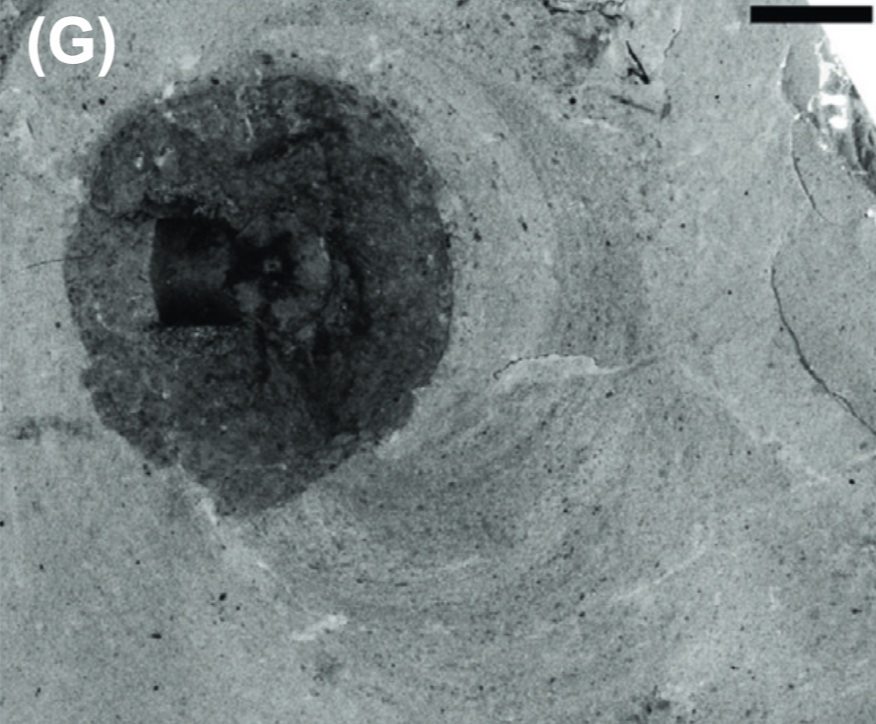
These coprolites are arrayed around the exit of a burrow at the Raven’s Throat River site, suggesting they may have been the work of the burrowing creature.
Kimming and Bicknell 2026
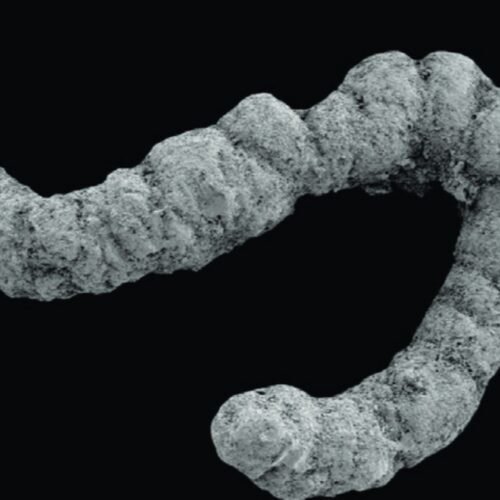
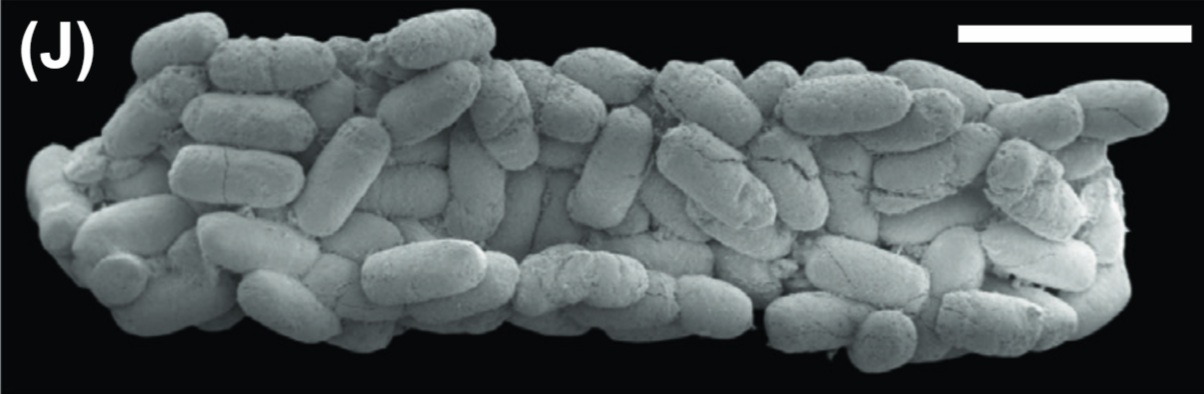
These microscopic pellets of poo are rich in phosphate. They were dropped by an unknown defecator 520-506 million years ago in what’s now Greenland.
John Peel
More phosphate-rich fecal pellets, this time from what’s now China, seen under an electron microscope.
Xi-guang Zhang
This phosphate-rich microscopic poop from Cambrian China is made up mostly of bits of shell.
Xi-guang Zhang
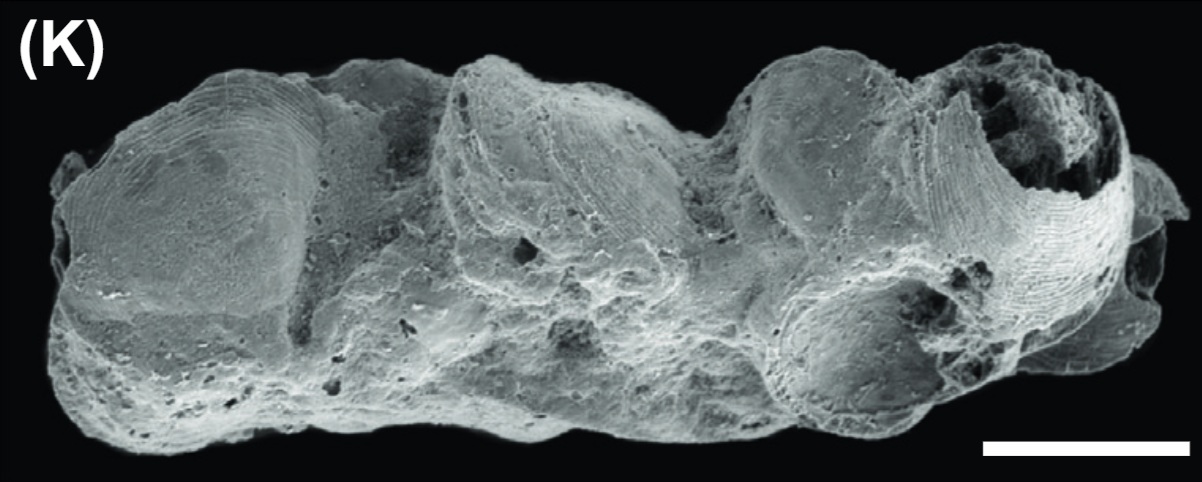
This pair of carbon-rich coprolites came from what’s now Canada. Note the difference in shape, suggesting they came from creatures with very different digestive tracts and probably different diets.
Tom Harvey
How defecation changed the world
The first animals on Earth were mostly simple creatures that lived in the sunlit upper layers of the ocean or on the shallowest parts of the seafloor. Depending on which set of scientists you ask, those early animals were similar to either sponges or jellyfish. Organs hadn’t been invented yet, so “eating” just meant waiting for tiny particles of food, like bits of plankton or bacteria, to float into the only opening in the animal’s body. Its cells would then engulf the food particle and break it down into its constituent molecules.
What these early animals released back into the ocean were mostly just chemical byproducts of their cells’ metabolism, not nutrients most other animals could use. So the deeper reaches of the ocean were largely unoccupied, because they didn’t offer enough nutrients to keep animals alive. Digestive tracts and poop changed everything.
By around 580 million years ago, some animals had started to evolve simple organs. Suddenly, these animals could swallow macroscopic chunks of food and digest them in their very simple—but still revolutionary!—guts, outside their cells, which probably really scandalized the sponges. That meant animals could eat more at a time, to support more complicated bodies, but it also meant they needed to dump the parts they couldn’t digest or absorb. Hence the advent of poop.
So far, paleontologists have unearthed Cambrian coprolites from about 35 sites around the world, spanning a period from around 540 to 494 million years ago.
“They range from microscopic to several centimeters in size and include forms such as elongated, cylindrical, ellipsoid, circular, and ‘exploded’ fecal ‘carpets,’” wrote Kimming and Bicknell, rather evocatively. Some of the larger coprolites contain bits of shell or exoskeleton, revealing a bit about the diets of whatever produced them. The sheer diversity of the size and shape of all that fossilized feces suggests that the animals that produced it must also have been diverse (although scientists haven’t yet managed to match very many Cambrian fossil animals to the corresponding coprolites).
Mats of bacteria thrived on this fecal feast, and some animals came to graze on the bacteria. Other, larger animals show up to eat them, converting at least some of their biomass back into poop. (Ah, the circle of life.)
At a fossil site in northwestern Canada called Raven’s Throat River, the mudstone still holds 500 million-year-old coprolites, some as wide as five centimeters, along with complete fossils of trilobites and mollusc-like hyoliths with conical shells. “In many cases these associated fossils are preserved fully articulated and appear to be in feeding position,” wrote Kimming and University of Saskatchewan paleontologist Brian Pratt in a 2016 paper about the site. The researchers concluded that the Cambrian animals were probably snacking on either the coprolites themselves or on the microbial communities growing on them.
Behold the single greatest science graphic ever created. We can all go home now.
Russell Bicknell
Behold the single greatest science graphic ever created. We can all go home now. Russell Bicknell
Everybody poops, including these animals fossilized in the Burgess Shale formation.
Smithsonian Institution
Everybody poops, including these animals fossilized in the Burgess Shale formation. Smithsonian Institution
Hyoliths were mollusc-like creatures (which may or may not be actually related to today’s molluscs) with two long, curving spines and narrow, cone-shaped shells.
Danielle Dufault/(C) Royal Ontario Museum
Hyoliths were mollusc-like creatures (which may or may not be actually related to today’s molluscs) with two long, curving spines and narrow, cone-shaped shells. Danielle Dufault/(C) Royal Ontario Museum
Everybody poops, including these animals fossilized in the Burgess Shale formation. Smithsonian Institution
Hyoliths were mollusc-like creatures (which may or may not be actually related to today’s molluscs) with two long, curving spines and narrow, cone-shaped shells. Danielle Dufault/(C) Royal Ontario Museum
Evolving bigger and better BMs
As Kimming and Bicknell looked at how coprolites changed through the Cambrian Period, they noticed a definite trend: Over time, feces got bigger and came in a wider array of shapes. That matched what they saw in fossilized guts, which started as simple, straight tubes; over 40 million years or so of evolution, animal guts developed twists and turns, specialized foreguts (the ancestor of the esophagus and stomach), and digestive glands. All of these innovations made it possible to digest larger and tougher morsels, a process we just carried on through the invention of cooking.
It’s a sign that animals in general were getting larger and more complex, and species were branching out into more and more diverse descendants. Bigger animals meant bigger poop, but bigger poop also helped support bigger animals, Kimming and Bicknell argue.
“The rapid acceleration of organism size during the Cambrian radiation increased coprolite size, which yielded a positive feedback loop, further accelerating the establishment of these ecosystems,” they wrote.
In other words, we’ve been dramatically underrating poop.
Why China’s war on deflation is faltering in real time
NEW YORK – Earlier hopes that China had beaten deflation took a hit this week.
China’s consumer prices rose just 0.5% year-on-year in July, down from June’s 1% rate — the slowest pace in six months and the third straight month of deceleration, despite surging energy prices amid Strait of Hormuz disruptions. Producer prices slowed too, rising 3.5% year-on-year in July versus 4.1% in June.
Few are less surprised by this than Yale economist Stephen Roach. “However 2026 shakes out, hopes Xi’s team is successfully deflating China’s deflation could be in for a rude awakening,” he says. “Japan’s example shows that even if headline data suggest that reflation is afoot, the deflationary mindset is very hard to change.”
The bottom line, Roach argues, is that “deflationary pressures can persist long after headline inflation turns positive, quietly eroding confidence. That’s why markets are buzzing about the possibility of People’s Bank of China easing in the months ahead — a move that could weaken the yuan and widen China’s trade surplus.”
That surplus is the unspoken subtext, according to Brad Setser of the Council on Foreign Relations. “Of course, no one explicitly says they would welcome a bigger surplus,” he says.
“But if an international institution’s policy advice is monetary easing — to fight deflation — and fiscal consolidation because of off-balance-sheet risks, plus more exchange rate flexibility, it is effectively advocating for the country to export its way out of its domestic troubles.”
Yet Beijing has resisted letting the yuan slide. A stable or appreciating currency serves three strategic aims: reducing offshore default risk among heavily indebted property developers; supporting yuan internationalization, a long-term goal to elevate it as a reserve currency; and managing tensions with Washington, where the Trump administration remains highly sensitive to any hint of competitive devaluation.
Right now, a firm yuan also helps China avoid importing even more inflation. The harder problem, as Roach warns, is psychological — and Japan has spent decades proving how stubborn that psychology can be. Recent data reflect “stalling reflationary momentum,” notes Union Bancaire Privée economist Carlos Casanova.
In the short run, he says, it’s notable that the data show “weak domestic demand,” retail sales “remaining contractionary,” and “fading commodity cost pressures,” at least for now.
Casanova says that the PBOC itself has highlighted “growing structural divergence, with AI-related sectors outperforming even as broader consumption remains sluggish. Subdued credit demand also further limited monetary transmission.” That leaves scope for a 25 basis-point cut in the reverse repo ratio.
Setser is skeptical that currency policy is doing much of the work either way: “There’s no evidence that the nominal depreciation of 2022-2023 materially reduced the pace of deflation in China, and also zero evidence that the modest nominal appreciation of the last year led to a faster pace of deflation. If anything, the pace of deflation has moderated, though I fully accept that higher oil prices have had something to do with that.”
Still, many fear the PBOC is behind the curve. Société Générale economist Michelle Lam notes that “China’s growth likely cooled notably in the second quarter to 4.4% as weak consumption and property activity outweighed resilient exports and a modest quarter-end industrial rebound.”
She adds that “while producer-led reflation supported nominal growth, policy easing is likely to remain incremental rather than a precursor to large-scale stimulus.”
The bigger question is just how incremental. Japan’s long struggle shows how stubborn deflationary psychology can be to defeat: though Japanese consumer and producer prices are rising, households still lack the confidence to increase spending enough to hasten economic growth or lift business confidence over the long run.
For Chinese President Xi Jinping, the most urgent reforms are resolving a chronic housing crisis that increasingly resembles Japan’s 1990s bad-loan spiral, and building a real social safety net so 1.4 billion citizens feel confident enough to spend rather than hoard savings.
These priorities are tightly linked — with roughly 70% of household wealth tied to property, stabilizing the real estate market across China’s 70 biggest cities is essential to reviving consumption and sustaining 4.5%-5% economic growth.
The longer Xi’s government lets these pressures fester without decisive action, the more a deflationary mindset takes hold — and the harder it becomes to shake.
Japan remains the cautionary tale. Even as the Bank of Japan struggles to lift short-term rates above the current 1% level — the farthest from zero in more than three decades — deflationary undercurrents still run through the economy, particularly in wages, which continue to lag inflation.
The result has been a slow-burn form of stagflation, and Tokyo has yet to deliver the structural reforms needed to close the gap between rising prices and stagnant household incomes.
Toshihiro Nagahama, economist at the Dai-ichi Life Research Institute, argues that for Japan “to fully break free from its long-standing deflationary mindset, it’s imperative for the government and the central bank to align, articulate their risk assessments, maintain honest and transparent dialogue with financial markets, and resolutely execute bold, long-term growth investments.”
Nagahama speaks for many when he argues that today’s global economy is being reshaped before investors’ eyes by wars in Ukraine and the Middle East, alongside a series of historic turning points in central bank policies amid rising global inflation and a strong dollar.
Amid so much uncertainty, governments can’t anchor their strategies to hopeful scenarios — they must instead plan around worst-case risks, including the possibility of a multi-year disruption in the Strait of Hormuz, a chokepoint that would reshape global energy flows and inflation dynamics.
“While these shifts present a formidable trial for Japan, they also represent a historic opportunity,” Nagahama notes. “As the country sheds its decades-long deflationary mindset and restores nominal growth, these external shocks serve as a critical test for fully escaping the paradigm of contracting equilibrium.”
Back in China, the gap between surging producer prices and muted consumer prices is now the widest since June 2022. That divergence suggests manufacturers are struggling to pass higher input costs on to consumers, leaving profit margins under pressure.
If that squeeze persists, it could have serious implications for wages across a $21 trillion economy, undermining household spending and complicating Beijing’s reflation narrative.
This China “deflation trap” problem worriesgeopolitical experts like Eurasia Group CEO Ian Bremmer. The concern, he says, is that Team Xi continues to “prioritize political control and technological supremacy over the consumption stimulus and structural reforms that could break the cycle. Beijing has the means to prevent a crisis, but living standards will deteriorate, the fallout will spread abroad, and the world’s second-largest economy will remain stuck in a trap of its own making.”
The plunge in home prices since 2020, Bremmer warns, means “household wealth destruction on par with America’s 2008 crash, except it’s still accelerating.” Consumer confidence, investment, and domestic demand have cratered with it. “Beijing,” he adds, “bet big that high-tech manufacturing would fill the gap left by property. Instead, state-driven investment has created overcapacity, and weak domestic demand means there aren’t enough buyers to absorb it.”
The good news is that Xi’s Communist Party is working to turn the nation’s $28 trillion stock and bond markets toward funding its chip rivalry with the US. This means moving away from subsidies and state backing toward a model closer to Xi’s pledge to let market forces play a “decisive role” in economic decision-making.
The worry, though, is that cracks in the underlying financial system — China’s “old economy” — limit the growth of the new one Xi aspires to create.
Roach worries that with Xi “fixated on a growth model that draws unsustainable support from innovation, new technologies, and other trappings of what they now call new quality productive forces,” he’s only “paying lip service to Chinese consumption but unwilling to take the big steps required of consumer-led rebalancing.”
As Japan taught the world, Roach says, “the problem was not so much its technological successes but the sustainability of its growth model.” He adds that the “same lesson might be very much applicable to China,” at a moment when the Chinese growth model is “showing unmistakable signs of sputtering.”
For now, China is focused on halting the capital outflows leaving mainland stocks. In recent weeks, it reactivated the so-called “national team” of state-owned investment funds Xi’s party mobilizes to boost the markets. What’s needed, though, are bold steps to revive economic confidence in the longer term, which are currently in short supply.
Beyond Oil: The Resources Reshaping the Middle East and Africa
Oil may dominate every conversation about the Middle East and North Africa, but it is only one layer of a far stranger resource map. In a wide-ranging explainer, The Media Line examines a region where enormous petroleum reserves coexist with vanishingly scarce water, narrow strips of farmland, mineral deposits crucial to global industry and coastlines capable of feeding both people and export markets.
The Gulf Cooperation Council states hold some of the world’s largest and cheapest-to-produce oil and gas reserves. Hydrocarbon revenue finances government salaries, infrastructure, schools and social benefits, while leaving budgets exposed to price swings. Algeria, Libya and Egypt are North Africa’s energy powers. Israel offers a different model: Offshore discoveries such as Tamar and Leviathan have turned a country with almost no oil from a gas importer into a regional supplier.
Yet water, not petroleum, may be the resource that most tightly controls the region’s future. The Middle East and North Africa has about 6% of the global population but less than 2% of its renewable water supply. Jordan has only about 60 cubic meters of renewable water per person annually, far below the threshold for absolute scarcity. Agriculture consumes most available water in several countries, even as cropland contracts and populations grow. Desalination, efficient irrigation and food imports are becoming matters of national survival.
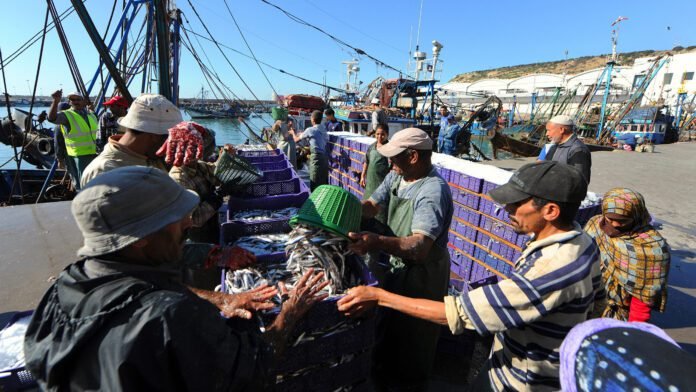
The underground picture holds further surprises. Morocco possesses about 70% of known global phosphate reserves, linking it directly to fertilizer production and the world’s food supply. South Africa holds roughly 75% of platinum-group metals and vast manganese resources, giving it a major place in clean-energy, automotive and steel supply chains. Above ground, Morocco’s fishing industry produces about 1.4 million tons of seafood a year, supporting jobs and valuable exports.
The central lesson is blunt: Natural wealth does not guarantee prosperity, and scarcity need not dictate failure. Governance, political stability, technology and investment often matter more than what lies beneath the soil. Libya and Algeria show how instability and weak institutions can blunt energy wealth; Israel and Jordan show how constraint can spur specialization.
The full explainer by The Media Line Staff is worth reading for its country-by-country detail—and for a fresh view of a region shaped as much by aquifers, fertilizer and fish as by oil.
Norway wealth fund posts record $184 bln profit in first half of 2026
Norway’s $2.3 trillion sovereign wealth fund, the world’s largest, posted a record profit of 1.75 trillion Norwegian crowns (€159.7 billion) for the first half of the year, lifted by technology stocks.
Investing the Norwegian state’s revenues from oil and gas production, the fund owns on average 1.5% of all listed companies globally, making it the world’s largest single investor.
“The result is driven by good returns in the equity market, particularly from Asian technology stocks,” CEO Nicolai Tangen said in a statement accompanying the half-year results.
The fund also announced for the first time that it held a 0.05% stake in SpaceX worth $1.22 billion as of 30 June, in an updated list of its holdings.
That stake was modest when compared with its other tech holdings.
It held a 1.28% stake in Nvidia worth $62 billion, a 1.24% stake in Apple worth $52 billion, a 1.17% stake in Alphabet worth $50 billion, a 1.27% stake in Microsoft worth $35 billion, and a 1.7% stake in Taiwan Semiconductor Manufacturing, worth $34 billion, fund data showed.
Overall the fund is invested in around 7,100 companies globally. It also invests in stocks, property and renewable projects.
Oprah Winfrey Steps Out with Stedman in Rare Sighting (Video)
Oprah Winfrey and Stedman Graham are reminding everyone that one of Hollywood’s longest-running romances is still going strong.
The television icon made an ultra-rare public appearance with her longtime partner in Chicago as she marked a major milestone — the 40th anniversary of The Oprah Winfrey Show.
Oprah, 72, and Stedman, 75, were photographed together during the celebration, posing alongside her former private chef, Art Smith, while holding an enormous platter of fried chicken.
Oprah looked relaxed and glowing in a cream-colored matching outfit, white sneakers and tinted sunglasses. Stedman kept things classic in a black suit with a crisp white button-down shirt.
The sighting immediately stood out because the notoriously private couple has largely disappeared from the public eye together in recent years.
Oprah and Stedman began dating in 1986 — the same year The Oprah Winfrey Show launched nationally — and their relationship has now lasted an incredible four decades.
Despite Oprah becoming one of the most famous women in the world, the pair have deliberately kept much of their romance behind closed doors.
Their last major red carpet appearance together came all the way back in October 2019, when they attended the grand opening gala for Tyler Perry Studios in Atlanta.
Oprah has previously revealed that the nonstop tabloid attention surrounding their relationship played a major role in their decision to stop appearing together so often.
During an appearance on Gwyneth Paltrow’s Goop podcast, Oprah recalled turning to her late friend and mentor Maya Angelou for advice whenever false stories about her personal life became overwhelming.
“Every time I would get so upset about it, Maya would say, ‘Babe, you don’t have anything to do with that,’” Oprah recalled.
She said she would become frustrated when stories were published that she knew were untrue.
According to Oprah, Angelou reminded her that tabloids were constantly searching for something new that would sell.
“Whoever’s sitting at the typewriter, they’re thinking, ‘What can we say this week that’s going to sell some stories?’” Oprah recalled Angelou telling her.
That experience ultimately changed the way Oprah handled her relationship publicly.
“It’s also why I stopped making as many public appearances with Stedman because I realized that every time there’s a new photograph, there’s a new story,” she explained.
The couple has also famously chosen a very different path from many celebrity romances.
Although Stedman proposed and the pair became engaged, they never made it down the aisle.
Their planned 1993 wedding was called off, but instead of splitting up, Oprah and Stedman stayed together — a decision Oprah later said may have actually saved their relationship.
In a 2020 essay for O, The Oprah Magazine, Oprah admitted that she eventually realized she wanted the proposal more than she wanted an actual marriage.
“I realized I didn’t actually want a marriage. I wanted to be asked,” she wrote.
Oprah explained that being chosen by Stedman meant something deeply personal to her, but the reality of marriage was another matter.
“I wanted to know he felt I was worthy of being his missus, but I didn’t want the sacrifices, the compromises, the day-in-day-out commitment required to make a marriage work,” she wrote.
At the height of her career, Oprah said her television show was her biggest priority — something both she and Stedman understood.
“My life with the show was my priority, and we both knew it,” she wrote.
Oprah went even further, saying she and Stedman believe their relationship might not have survived if they had gotten married.
“He and I agree that had we tied the marital knot, we would not still be together,” she wrote.
The couple also chose not to have children together.
Despite avoiding the traditional marriage-and-family route, Stedman has repeatedly made it clear that he remains fiercely supportive of Oprah.
During a 2019 appearance on The Ellen DeGeneres Show, he explained that much of their relationship has revolved around encouraging each other to succeed independently.
“The thing about our relationship is, so I’m dedicated to her happiness, so that’s great for her,” Stedman said.
“And I want her to be the best she can possibly be, and she’s done a pretty good job of doing that.”
Stedman added that he has also worked to create a fulfilling life of his own instead of simply existing in Oprah’s massive shadow.
“For me, I’ve been able to find my own happiness, my own skills, my own talents, my own abilities, and I’m satisfied with that,” he explained. “I’m happy with that.”
Stedman has built his own career as a businessman, author and public speaker, and he operates a marketing firm.
After 40 years together, Oprah and Stedman remain one of entertainment’s most unusual success stories — no wedding, very few public appearances and decades of speculation surrounding their romance.
And judging by their rare Chicago appearance, their unconventional formula still appears to be working.
A Google insider spills the tea on how the company forsook its founding ideals
In 2018, 20,000 Google employees worldwide made headlines when they staged a walkout to protest how the company had handled sexual misconduct allegations against key corporate executives, among other grievances. One of the organizers was Claire Stapleton, a communications specialist whose distinctive voice and ability to channel the corporate ethos had once earned her the internal moniker “Bard of Google.”
Stapleton didn’t set out to be a rabble-rouser. When she joined Google out of college in 2007, it was like “getting the golden ticket in Willy Wonka,” she told Ars. Awareness of her good fortune offset any initial uneasiness or skepticism, although Stapleton was sufficiently independent-minded not to move into what was then Google’s new corporate housing development in Mountain View, California. Stapleton was very good at her job, and she quickly moved up the ranks, playing a key role in shaping the company’s public image.
Her first truly toxic experience came when she transferred to Google Creative Lab in New York, an environment she describes as “half utopian, half dystopian and unable to tell the difference.” She received little direction or guidance from management and found that much of the Lab’s work was simply advancing a kind of “cloying techno-optimism” she found uninspiring. Stapleton lasted about a year and ended up joining the marketing team at YouTube. But the cultural changes and her own shifting priorities and growing disquiet culminated in the 2018 walkout and Stapleton leaving the company she once championed.
Stapleton wrote an essay for Elle magazine shortly after that she describes as “a psychic attempt at wrapping up my time” at Google, to help process her complicated feelings about her former employer. “It was such an abrupt and kind of traumatic ending after such a long time at the company,” she said. “And a lot of my experience was really positive.” The essay garnered enough attention to draw the interest of book agents, but at the time, Stapleton wasn’t interested in writing a book, feeling that she didn’t really have much more to say. Instead, she started a workplace advice column and did freelance marketing communications for a venture capital firm founded by another former Googler, Bill Maris.
“There were a lot of ex-Googlers there, and we talked a lot about our experiences,” Stapleton said. At some point, she started wondering if they had unwittingly been in a cult, she said.
“The way we were processing the separation was a bit like that,” she said. “It’s bigger than a job. It’s like an identity. It’s very emotional and psychological. It got me thinking. How did we, as an industry, end up with such whiplash from our experience of working at these companies? Big Tech in general has gone from being incredibly admired, like Google, to being parables of the perils and pitfalls of large corporations, corporate overreach, and having way too much power and personal data.”
A turning point
William Morrow
William Morrow
Courtesy William Morrow
Courtesy William Morrow
William Morrow
Courtesy William Morrow
What happened to change a company that once famously embraced the altruistic motto “Don’t be evil”? Stapleton identifies one major turning point: When Larry Page replaced Eric Schmidt as CEO in 2011. Her job in communications gave her a unique inside perspective on the impact of that critical transition on Google’s corporate culture. “Everyone would have said that Eric was the corporate guy and Larry Page was the pure tech guy,” said Stapleton. “Larry had incredibly lofty rhetoric about the company’s ambitions and his hopes that it would solve all the world’s problems.”
What actually happened was a significant shift in Google’s organizational structure, with every executive being given their own communications team. The marketing department ballooned. “I think it created a culture that was more corporate—the opposite of what Larry said he wanted to happen,” said Stapleton. “The company became much more complex and inefficient. The irony was Larry was calling this out: ‘We’re going to become sclerotic, and we’re going to stop innovating if the company gets too bloated.’ But that’s exactly what happened: Google became a bloated Borg. And all of a sudden, Google wanted to do cool branding, like Apple.”
That led to a number of failed innovations as leadership sought to lock onto the next big thing. Longtime consumers of technology are no doubt familiar with the many missteps. Google Glass? The few who embraced it were ridiculed as “Glass-holes.” Google+? Stapleton sees that as a prime example of chasing the competition rather than innovating. (I was an early adopter and found it significantly inferior to the other social media options available at the time.) The one good product that was genuinely useful from that era was Google Reader—and the company killed it to focus on Google+ and to launch Google X.
Meanwhile, the storied worker-friendly corporate culture was proving to be anything but. “Radical accountability” in practice actually meant that individual workers absorbed blame for any issues, and questioning authority was dismissed as “whining.” The place where empathy was touted as “king” now viewed it as a weakness, Stapleton writes. Formally appealing to Human Resources about workplace issues resulted in gaslighting, Stapleton says, and what she calls “PR jujitsu,” professing support while never doing anything concrete to resolve the conflict.
“You point out a problem, you become the problem,” Stapleton said.
Stapleton cites a book by the former head of Google’s HR, Laszlo Bock, entitled Work Rules, as being particularly insightful about these dynamics. “He talks about how organizations can get out of control,” she said. “If you let managers have too much power over people, it’s corrupting, and so you have to constrain that power however you can, and that takes a strong HR function. But as my story shows, the managers had gotten control and HR had no ability to rein them in.”
Stapleton also witnessed the opportunistic shift in the tech industry’s political leanings in recent years. “I think we now all have a greater understanding that everyone’s just currying favor and power, and it’s all a big club at the top and we’re not in it,” said Stapleton. “People have broadly become disillusioned. It’s quite bipartisan to be skeptical of Big Tech. The net effect on the average tech worker is that people no longer are so hornswoggled into the image that we’re the good guys, part of something that’s changing society on the whole for good. Workers being so bought in gave these companies a kind of purchase. We haven’t figured out how to push back yet. We haven’t figured out how to solve for the excesses in tech culture. But it seems like there are some interesting sprigs of green. “
A grief observed
Perhaps the most moving sections of the book are those that address Stapleton’s close relationship with her older brother, Scott, a vital sounding board whose skepticism about corporate double-speak gave Stapleton a much-needed outlet for her occasional doubts. His tragic, sudden death in a motorcycle accident in Turkey in 2008 shattered her world.
A grief-stricken Stapleton threw herself into her work—“performing functionality to deal with grief”—and Google’s culture encouraged that single-minded avoidance. She admits that she never fully processed her grief at the time. That made it challenging to write about his death and the aftermath in Don’t Be Evil. Initial feedback from test readers on her first draft was largely positive, but several noted that the sections about her brother came off as being very arms-length and less personal in tone, unlike the rest of the book. “I was just describing what happened because at the time, I really couldn’t go there,” Stapleton said.
She ended up revising those sections while staying with her parents in Santa Barbara and going through Scott’s old emails and G-chats. “I just sobbed the entire time,” she said. “Because even though it’s been 18 years, it still feels fresh. There’s still this huge hole. But in a way, it brought him back to life a little bit. The waves of grief still come back to me now and then, but I feel like now I can welcome them a bit more because I’m also grateful to have had this wonderful sibling relationship.”
Detroit knows China’s eating its EV lunch but can’t change course
One of the things that surprised this tourist in Oslo last February was the vast number of electric vehicles. EVs were everywhere. Every taxi I rode in was electric. I shouldn’t have been surprised. Norway has long been a leader in adopting electric cars. Last year, encouraged by government subsidies, EVs accounted for 95.9% of Norway’s new car sales, up from 88.9% in 2024. Here is an article; you’ll need to run it through a translator for English.
More are coming. Though EVs seemed ubiquitous in Oslo, two out of three passenger cars in Norway still run on fossil fuels. The country’s goal is none. It’s making progress. Besides essentially eliminating fossil-fuel vehicles from new car sales, electric cars in 2025 surpassed diesels for the first time to become the largest single powertrain on Norway’s roads.
Other countries are headed in the same direction. At first, climate change drove the trend. Then the Iran war gave it a boost by raising concerns globally about the price and availability of oil-derived fuels.
Last year EVs accounted for 55% of all new car sales in China and 28% in Europe. The International Energy Agency predicts 28% of all new car sales worldwide will be EVs this year, with 50% growth in Asia-Pacific countries outside China and 45% growth in Latin America. By 2035, the IEA expects 50% of global new car sales to be EVs.
The United States is an outlier. Last year, fewer than 10% of US new car sales were EVs. This year, sales are declining. The Trump administration, which loves oil, has undone the previous administration’s pro-EV policies.
Detroit’s big-three car makers, which had invested heavily in new EVs and EV-battery development, got Trump’s message and reversed course. Several previously announced new vehicles were canceled.
Tens of billions of dollars in EV-related investments were written off as losses. Detroit still sells EVs and has plans for new ones, but the interest is much diminished. Meanwhile, China is moving fast into EVs.
This, alas, is a movie I’ve seen before.
In early 1984, I became the Wall Street Journal’s Detroit bureau chief. I had spent the previous three-plus years in Tokyo for the Journal.
I’d covered the negotiations leading to Japan’s “voluntary restraints” on car exports to the US. I’d written about the manufacturing advances that had given Japanese cars high quality. I’d witnessed the prominence of small cars in Japan, and elsewhere.
That was why the Journal sent me to Detroit. “Japan is kicking Detroit’s ass,” the Journal’s managing editor said. “We need someone shaping our worldwide auto coverage who understands Japan.”
Introducing myself in Detroit, I found a pronounced lack of curiosity about Japan. Twenty seconds after learning I’d recently arrived from Tokyo, the car executives I was meeting were changing the topic to the Tigers, the Lions or the Red Wings.
Some had a vague idea what their Japanese competitors were up to. None seemed much interested in digging deeper into the matter.
Denial, I think they call it.
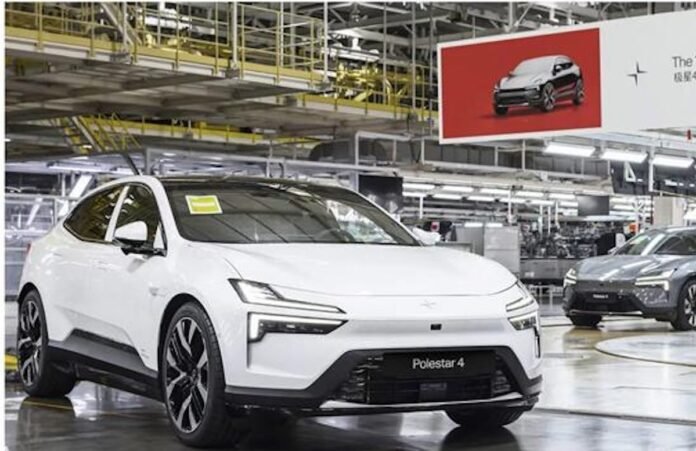
Today the competitor to be feared is China. According to the IEA, China manufactured nearly 75% of the world’s EVs last year and accounted for nearly 80% of battery-cell production.
Competition between Chinese EV makers is fierce. They’re moving up the learning curve fast. Their cars keep getting better.
The US has 100% tariffs on China’s EVs so Detroit is safe in the short run. But Ford’s executive chairman recently warned that Detroit “can’t expect to keep them out forever.”
In China, some EVs are cheaper than conventional cars. As batteries improve, they’ll eventually be price-competitive everywhere, even without subsidies. They’re already quicker, quieter and have lower maintenance costs, and their range keeps improving.
No one should be surprised if someday EVs are so far superior to fossil fuel-powered cars that the public demands them. If Chinese EVs are the gold standard then, Detroit will be playing catch-up.
I’m more sympathetic to the big three than I was when Japan was their problem. Detroit’s executives know what’s going on in China. They’re even willing to talk about it.
They have the disadvantage of a domestic market with vast open expanses of territory and limited EV-charging infrastructure. Being whipsawed by Washington’s changing whims every four years doesn’t help.
With Chinese EVs banned in the US, the inroads they make in Norway or Brazil or Thailand won’t impress American consumers. They won’t see them.
Watch, however, what happens in Mexico and Canada the next few years. If Chinese EVs win big there, some of those cars will show up on roads here. Americans may well like them.
The US is an EV outlier, but how long will it remain one? Detroit doesn’t want a remake of this movie.
Less than 2.5% of Taylor Farms’ recalled lettuce went to Taco Bells
Although shredded iceberg lettuce at Taco Bell restaurants has been a prime suspect in an explosive outbreak of the diarrheal parasite Cyclospora, a new report from the Food and Drug Administration finally reveals where all the contaminated lettuce was sold—and only a sliver of it went to Taco Bell locations.
The feces-tainted lettuce was sourced from Mexico and sold by Taylor Farms, a mammoth produce provider based in California. Taylor Farms has drawn scrutiny for its ties to the Trump administration and reluctance to provide information amid the outbreak, which has now sickened over 23,000 people across 47 states, killing two and sending over 500 others to the hospital. Taylor Farms reportedly attempted to delay issuing a recall amid the illnesses and, since then, has refused to clearly report how much tainted lettuce it recalled and where all of it had been shipped.
The FDA’s Enforcement Report finally provides some answers: Taylor Farms recalled 236,192 cases of lettuce due to potential Cyclospora contamination. Of those, only 5,900—just shy of 2.5 percent—were sold to Yum, the parent company of Taco Bell, Pizza Hut, and KFC. The other 97.5 percent of the lettuce that potentially sickened Americans was distributed elsewhere.
Walmart—under its brand Marketside—received the lion’s share, 109,476 cases, a little over 46 percent. The second-largest lot went to Taylor Farms’ own brand, which received 68,897 cases, a little over 29 percent.
The remaining 25 percent went to various food service entities and two restaurants. Cross Valley Farms, a brand from US Foods with the tagline “Fresh Produce Sourced and Selected With Strict Standards,” received 19,016 cases (8 percent). Sysco received 11,519 cases (4.9 percent), Markon got 7,459 cases (3.15 percent), and Peak Fresh Produce (Performance Foodservice) got 720 cases (0.3 percent).
The restaurant chains besides Taco Bell were Subway, which received 8,075 cases (3.4 percent), and Jack in the Box, which received 5,130 cases (about 2.2 percent).
Information void
The information in the FDA report is significantly more detailed than what Taylor Farms provided in its recall information, which only lists abbreviations for the companies that received the recalled lettuce. For instance, one brand is identified as just “CV,” while the FDA report identifies it as Cross Valley Farms. Walmart’s Marketside brand was listed as MKTSD, while food service company Markon was listed as MARK. The notice provides no quantities.
It’s unclear why Taylor Farms did not publicly reveal that the majority of the recalled lettuce had been shipped to Walmart stores while Americans were focusing on Taco Bell locations. Ars Technica reached Taylor Farms for comment about the lack of information, but the company did not respond to questions and instead sent links to its recall notice and the FDA’s outbreak investigation webpage.
It also remains unclear where the food service companies that received the lettuces ultimately sent them and if they were sent to more states than the 27 Taylor Farms reported in its recall. For instance, New York and California have reported cyclosporiasis cases, but those states are not included in the recall notice.
The FDA and the Centers for Disease Control and Prevention based warnings about Taco Bell lettuce on epidemiological investigations. With widespread distribution of the lettuce, investigators were able to detect a clear signal from Taco Bell. On July 17, the CDC told Americans in no uncertain terms, “Do not eat shredded iceberg lettuce served at Taco Bell locations in Indiana, Kentucky, Michigan, Ohio, and West Virginia.” The FDA, meanwhile, noted that Walmart’s Marketside brand was part of the recall, but it did not indicate that it constituted the bulk of the recall.