17.4 C
London
Saturday, August 8, 2026
Home Blog

How snails engineer their slime

0
how-snails-engineer-their-slime
How snails engineer their slime

Snails are well-known for their mucus. The slime is highly valued as an anti-inflammatory and anti-aging ingredient in certain skin care products, and snails can secrete different kinds of mucus with properties tailored to specific functions. A team of German scientists has determined a recipe for how snails achieve that so-called tunability: Collagen and calcium work in tandem to achieve the varying mechanical properties, according to a new paper in the journal Science.

Snail mucus is mostly water; it’s the mucins (glycoproteins) and complex carbohydrates that give it that slimy, viscous texture. In addition to cosmetics, the mucus holds great potential for drug delivery. In 2020, scientists found that combining snail slime from a common garden snail with gold nanoparticles helped accelerate wound healing and exhibited anti-inflammatory properties in mice. Most relevant to this latest paper is a 2023 study on garden snail slime that identified three distinct types of secreted mucus: a hydrating version to protect its skin, one that acts as an adhesive glue, and a third that serves as a lubricant so the snail can more easily glide across a surface.

The team focused their research efforts on the grove snail/lemon snail (Cepaea nemoralis), which they deemed well-suited as subjects because the snails secrete five different kinds of mucus with distinct functions. As with the garden snails, there is one that acts as a lubricant to help with locomotion and an adhesive mucus to help the snail stick to various surfaces. Then there’s a mucus layer known as the epiphragm that the snail secretes when it hibernates in winter, which contains calcite and effectively seals the shell to protect the snail from predators and harsh environmental conditions.

C. nemoralis also secretes two different kinds of protective mucus when disturbed. One is a sticky yellow mucus similar to that produced by certain mollusks that is highly resistant to breakage or tearing. The other is a bubbly substance scientists believe is secreted to smother small predators and/or wash them out of the shell.

The researchers analyzed all five types of mucus using various techniques, including proteomics, X-ray fluorescence, X-ray diffraction, cryoscanning electron microscopy, and liquid chromatography.  They found that all five kinds of mucus share a similar protein composition and that collagen IV is the main structural component. It’s the different quantities of protein and the addition of amorphous calcium carbonate (ACC) that determine a given mucus’s distinct mechanical properties. The two defensive kinds of mucus had the highest number of proteins.

Those results “indicate that these proteins are used to tune the degree of cross-linking and therefore their network density, which has an immediate effect on their mechanical properties,” the authors concluded. “Each mucus type shows a distinct and complex hierarchical structure that is influenced by the processing of the mucus material.”

Furthermore, calcium “is actively secreted together with the mucus, serving as an ion source for cross-linking or a mineral precursor for reinforcement.”

Science, 2026. DOI: 10.1126/science.adx7367 (About DOIs).

Trump Imposes New Tariffs on Polysilicon to Curb China’s Supply Chain Dominance

0
trump-imposes-new-tariffs-on-polysilicon-to-curb-china’s-supply-chain-dominance
Trump Imposes New Tariffs on Polysilicon to Curb China’s Supply Chain Dominance


US President Donald Trump has announced new tariffs on imported polysilicon and related products, aiming to reduce US reliance on China for key materials used in semiconductors and solar panels. The measures, which take effect on 4 December, impose a 15% tariff on polysilicon imports and derivatives, introduce minimum import prices, and include anti-stockpiling provisions to prevent companies from avoiding the higher duties.

The move follows a Commerce Department national security investigation into the polysilicon supply chain and forms part of a broader effort to shift critical manufacturing away from China. The White House said the policy would strengthen domestic semiconductor production and support the expansion of US manufacturing linked to artificial intelligence.

China currently dominates global polysilicon production, and the announcement comes amid escalating trade tensions after Beijing recently introduced new restrictions on drone exports to the United States. Supporters of the tariffs said the measures provide unprecedented protection for the US solar and semiconductor industries by encouraging domestic investment and reducing dependence on foreign suppliers.

Source: Politico

OpenAI’s expensive smart speaker will use moving parts to seem “more alive”

0
openai’s-expensive-smart-speaker-will-use-moving-parts-to-seem-“more-alive”
OpenAI’s expensive smart speaker will use moving parts to seem “more alive”

OpenAI’s upcoming smart speaker will probably cost over $300, “people familiar with the matter” have told Bloomberg’s Mark Gurman.

The generative AI company has “discussed” charging up to $400, Bloomberg, which has been reporting on the yet-to-be-announced smart speaker since July, said today. The publication said that OpenAI is viewing the smart speaker as a smartphone replacement.

OpenAI has declined to comment on its product roadmap.

Per Bloomberg, the speaker will follow in the steps of other smart speakers lately in pushing an AI-first focus aimed at helping people complete tasks, compared to simpler smart speaker tasks, like checking the weather. The battery-powered gadget will reportedly “work similarly” to the ChatGPT voice mode on mobile apps “but with more advanced models for humanlike interactivity,” Bloomberg said.

The device will be able to control smart home devices too, the publication previously reported.

OpenAI’s speaker will “be shaped like a doughnut that’s roughly the size of a hockey puck,” Bloomberg said today, citing its anonymous sources.

Additionally, the device will reportedly have parts that will move independently when the speaker is responding to user prompts. Like other speakers, it will also reportedly have lights to indicate when the device is listening. The moving parts and lights aim to make the device seem “more alive than today’s stationary speaker products,” the report said.

Bloomberg pointed to “high-quality metal” and other premium materials for the speaker, which OpenAI reportedly designed with LoveFrom, a studio owned by famous former Apple designer Jony Ive.

Apple is currently suing OpenAI, accusing the AI company of stealing trade secrets for its hardware development. Bloomberg’s sources said that OpenAI launched an internal probe on the speaker following Apple’s lawsuit and determined that the speaker doesn’t use Apple IP.

The speaker would join OpenAI’s only other gadget so far, the $230 Codex Micro mini keyboard. OpenAI is reportedly looking into making other AI-powered devices in the future.

In the meantime, the AI firm is setting itself up for quite the challenge should it release a speaker within the reported price range. Such a device would be significantly more expensive than most smart speakers.

For comparison, Amazon’s most expensive smart speakers with Alexa+, Amazon’s subscription-based AI chatbot, either have a display, such as the 15.6-inch $300 Echo Show 15, or virtual surround sound, like the $220 Echo Studio.

Per Bloomberg, the OpenAI speaker’s main appeal is ChatGPT capabilities. Today, ChatGPT has significantly more users than Alexa+, but those users are largely accustomed to accessing the chatbot on devices they already own.

With the rumored speaker, OpenAI would be betting on people’s willingness to pay substantial money for dedicated hardware to access chatbot features, the most advanced of which also require a subscription fee. Without advanced hardware, which seems like it would be hard to fit in a device the size reported by Bloomberg, a $300 to $400 smart speaker is a hard sell.

Still, with OpenAI losing billions of dollars a year, it’s understandable that it’s seeking additional revenue sources and to drive engagement. It’s somewhat ironic that OpenAI has seemingly chosen the smart speaker industry, which has faced severe profitability obstacles, to try to buoy its finances.

Bloomberg claimed today that OpenAI will reveal its speaker this year and release it in 2027, assuming Apple’s lawsuit doesn’t disrupt those plans.

UN Nutrition Survey Challenges Gaza Famine Narrative 

0
un-nutrition-survey-challenges-gaza-famine-narrative 
UN Nutrition Survey Challenges Gaza Famine Narrative 


A new UN-backed nutrition survey found exceptionally low levels of acute malnutrition among children in Gaza, challenging allegations of famine in the Strip.  

The survey was conducted under the coordination of the Nutrition Cluster, the UNICEF-led body that oversees Gaza’s nutrition surveillance system. Researchers measured children’s weight, height and mid-upper-arm circumference before calculating the weight-for-height z-score, or WHZ, the standard indicator used by the World Health Organization and other organizations to assess acute malnutrition across populations. 

According to the survey, acute malnutrition, as measured by WHZ, ranged from 0.2% to 0.8% across Gaza’s regions. 

The findings also compared the current figures with Gaza’s prewar acute malnutrition rate of 0.8%, describing that level as relatively low and comparable to rates seen in developed countries. The survey said the figures were also below those reported in neighboring Egypt, at 2.9%, and Jordan, at 2.0%. 

The report concluded that the measured rates of acute malnutrition were well below critical thresholds and remained exceptionally low by both regional and Western standards. 

A year earlier, the Famine Review Committee of the UN-backed Integrated Food Security Phase Classification system issued a famine designation to characterize conditions in Gaza. 

Israel’s Ambassador to the United Nations Danny Danon cited the latest survey on Thursday, saying it demonstrated that claims of famine in Gaza were collapsing. 

“Once again, facts prevail over fiction,” Danon said. “UN bodies are acknowledging that the false narrative against Israel is falling apart.” 

He added: “Israel is not starving children. Israel is fighting Hamas terrorism, while Hamas uses civilians in Gaza as human shields. Those who rushed to accuse Israel must now be held accountable for spreading lies.” 


Man ‘Trapped’ Inside a Netflix Billboard Above Sunset Boulevard

0
man-‘trapped’-inside-a-netflix-billboard-above-sunset-boulevard
Man ‘Trapped’ Inside a Netflix Billboard Above Sunset Boulevard


Drivers cruising down Hollywood’s famous Sunset Boulevard are being greeted by a truly bizarre sight — a man apparently trapped inside a house 30 feet in the air.

No, he doesn’t need rescuing.

It’s all part of an eye-popping Netflix publicity stunt designed to promote the streamer’s new thriller, The Last House.

An unidentified performer climbed into the elaborate billboard installation on Thursday, Aug. 6, and is expected to remain there until Saturday, Aug. 8 — spending three days living inside what looks like the front room of a house suspended high above one of Los Angeles’ busiest streets.

The display sits near Selma Avenue and Sunset Boulevard, where commuters and pedestrians can look up and watch the man go about his strange new life in the sky.

According to Netflix, the performer will try to maintain some sense of normalcy while confined inside the elevated enclosure.

“He’ll attempt to maintain a sense of normalcy over extended periods of time while ‘stuck’ in his elevated, enclosed set 30 feet above the ground,” Netflix explained.

The actor can even communicate with people on the street below using a whiteboard — an eerie connection to the plot of the movie he’s promoting.

Footage from the installation shows the man sitting inside the billboard eating cereal, staring outside and generally looking like someone who has seriously begun questioning his life choices.

And for anyone assuming Netflix is secretly rotating several performers through the stunt, apparently not.

It is reportedly the same actor staying inside throughout the entire three-day spectacle.

The unusual promotion mirrors the claustrophobic premise of The Last House, which stars Greta Lee and Wagner Moura and was directed by Fast X filmmaker Louis Leterrier.

The thriller follows a family of four who suddenly discover they have been completely sealed inside their home with no apparent way to escape.

With supplies running low and a mysterious threat keeping them trapped, the family members are forced to rely on one another — even as the pressure begins tearing their relationships apart.

Netflix could certainly use the attention surrounding the billboard.

As of the stunt, The Last House was sitting at just 36 percent positive on Rotten Tomatoes, although that number was based on only 22 critics’ reviews and could still shift as more reactions come in.

The Hollywood Reporter offered a more enthusiastic assessment, describing the movie as a psychological chamber drama and survival thriller in addition to its science-fiction and horror elements.

The review praised the film’s focus on four people desperately using their intelligence and dwindling supplies to stay alive while their once-close family bonds begin to unravel.

Whether the giant human billboard will convince viewers to give the movie a chance remains to be seen.

But Netflix has already accomplished one thing.

For three days, thousands of people passing through Hollywood can look up and see a miserable-looking man eating breakfast inside a fake house floating 30 feet above Sunset Boulevard.

The Last House begins streaming on Netflix Friday, Aug. 7.

Regional countries welcome Saudi-Turkiye-Pakistan defense pact

0
regional-countries-welcome-saudi-turkiye-pakistan-defense-pact
Regional countries welcome Saudi-Turkiye-Pakistan defense pact

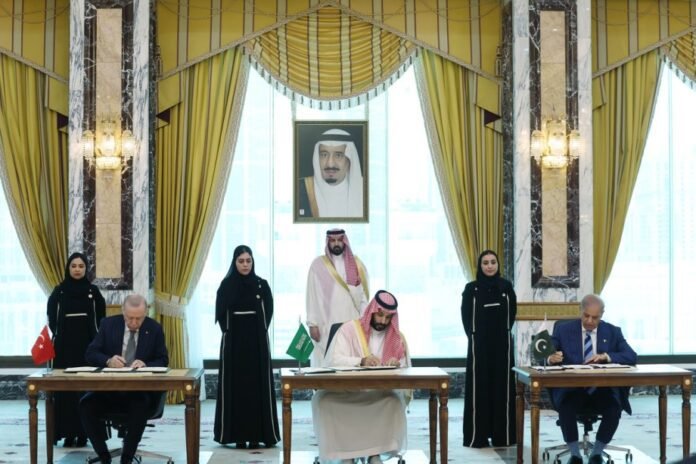
Regional countries on Friday welcomed the Mecca Joint Defence Agreement signed by Saudi Arabia, Turkiye and Pakistan, describing it as a step toward strengthening collective security, defense cooperation and regional stability, Anadolu reports.

Somalia described the agreement as a historic step toward strengthening collective security and defense cooperation.

In a statement, the Defense Ministry said the agreement establishes a strategic partnership capable of addressing shared security challenges while advancing long-term defense cooperation among the three countries.

The ministry said it was confident the pact would make a significant contribution to enhancing regional peace and stability and reinforce the principles of cooperation, solidarity and shared responsibility.

It added that the agreement would serve the interests of the peoples of the region while supporting international peace and security.

Bahrain called the development a strategic partnership that would strengthen deterrence and contribute to regional and international security and stability.

READ: ‘Attack on one is attack on all’: Saudi Arabia, Turkiye and Pakistan sign landmark Mecca defence pact

The Foreign Ministry highlighted the countries’ established defense capabilities, extensive military experience and longstanding roles in promoting regional security and stability.

It said the agreement represents a strategic partnership among equal partners, with each contributing its capabilities toward preserving regional and global security.

According to the ministry, the pact complements the Gulf Cooperation Council’s collective defense system, enhances its effectiveness and reinforces regional security through solidarity, integration and partnership among brotherly countries.

The ministry reiterated that Saudi Arabia’s security is an integral part of Bahrain’s own security, and affirmed support for efforts to safeguard regional stability, protect the sovereignty and territorial integrity of states and advance political solutions to regional issues.

The historic agreement was signed on Friday at a summit in the Muslim holy city of Mecca attended by Saudi Crown Prince Mohammed bin Salman, Turkish President Recep Tayyip Erdogan and Pakistani Prime Minister Shehbaz Sharif.

The agreement says that “any armed attack against any one of the three states shall be regarded as an attack against them all.”

READ: Iranian foreign minister calls on Muslim countries ‘to rely only on ourselves’

DOGE’s wild, unverifiable savings claims discredited in US government report

0
doge’s-wild,-unverifiable-savings-claims-discredited-in-us-government-report
DOGE’s wild, unverifiable savings claims discredited in US government report

It won’t come as a surprise that Trump’s Department of Government Efficiency (DOGE) didn’t save taxpayers nearly as much as it claimed. Analysis from outside the government showed savings claims were heavily inflated, and now the government’s own watchdog has said it wasn’t able to confirm savings claims made in DOGE’s so-called “Wall of Receipts.”

For example, DOGE reported savings of $49.2 billion from cutting grants, but almost none of it could be verified, the US Government Accountability Office (GAO) said in its report yesterday. The GAO is the auditing and investigating arm of Congress and issued the DOGE report in response to a June 2025 request from Sens. Gary Peters (D-Mich.) and Richard Blumenthal (D-Conn.).

“The Wall of Receipts did not provide sufficient information to verify the method DOGE used to calculate savings, or what the savings consisted of, for 13,553 of the 15,887 grants it reported as terminated. This corresponds to about 96 percent of the DOGE-reported grant savings,” the GAO report said.

Beyond grants, the GAO concluded that “DOGE did not use its stated methodology to calculate” most of the savings from contracts it reported as terminated, and that it exaggerated savings from terminated leases. “DOGE did not respond to our request for interviews or clarification,” the GAO said.

In response to the report, Peters said that “Elon Musk and the Trump administration claimed billions of dollars in savings it could not substantiate, took credit for work already underway, and refused to show its work, all while putting Americans’ sensitive data at risk and hollowing out critical agencies.”

DOGE claimed $215 billion in savings

The Musk-led DOGE tried to conduct much of its work in secrecy. Last year, Senate Democratic staff investigated DOGE activities at three agencies and found armed guards, locked doors, and windows covered with trash bags.

Overall, DOGE’s Wall of Receipts website claims it saved taxpayers $215 billion through “asset sales, contract/lease cancellations and renegotiations, fraud and improper payment deletion, grant cancellations, interest savings, programmatic changes, regulatory savings, and workforce reductions.” Even that figure was far short of Musk’s goal of $1 trillion.

Trump and Musk claimed that DOGE would cut government waste, but its whirlwind approach resulted in what one Brookings researcher called “cut[ting] muscle, not fat.” The researcher found “25,747 occasions where the Trump administration abruptly fired people and then hired them back.”

The GAO analysis examined a portion of the claimed savings, specifically $110.3 billion related to contracts, grants, and leases. Besides the $49.2 billion in claimed savings in grants, DOGE claimed $61 billion in savings from contracts and $113 million in savings from leases. DOGE reported making cuts affecting 15,887 grants, 13,440 contracts, and 264 leases.

DOGE ignored “complexities and nuances”

With contract cuts, GAO evaluated whether DOGE followed its own stated methodology for determining the amount of savings. It found that DOGE followed its stated methodology for 27.5 percent of reported savings and did not follow its stated methodology for 60.7 percent of savings. The GAO could not determine whether DOGE followed its stated methodology for the remaining 11.8 percent because of missing contract identifiers.

“Even in cases in which DOGE followed its stated methodology, it did not account for many complexities and nuances of federal contracting or sufficiently identify limitations,” the GAO said. “For example, the savings reported for terminated contracts do not account for subsequent obligations and deobligations that may be associated with termination settlement costs or contract closeout. As such, the amount of reported savings is likely misstated. Finally, whether reductions in contract value will result in savings will depend on circumstances that are not yet known.”

Although DOGE claimed $113 million in savings from leases, the GAO said the lease cuts listed on the Wall of Receipts came to only $53.5 million. “Because DOGE declined to meet with us, we could not obtain an explanation for the error,” the GAO said. Moreover, of “108 of the 264 leases identified for termination on the Wall of Receipts, about $15.3 million of the total $53.5 million in savings, were already in process for termination when DOGE was established,” the GAO said.

DOGE scaled back some of its claims in the year before GAO’s report. As of March 30, 2025, DOGE “reported 679 leases as terminated, totaling approximately $400 million in reported savings.” After that, “145 of the leases DOGE reported as terminated—accounting for about $346 million in reported savings—were removed from the Wall of Receipts because the leases were no longer being considered for termination,” the GAO report said.

The GAO recommended “that the Executive Office of the President, through the US DOGE Service, should ensure that known data quality issues and limitations are prominently displayed on the Wall of Receipts.”

DOGE ethics report lacking information

The GAO also issued a separate report this week on DOGE’s personnel and ethics activities. The GAO identified 206 DOGE personnel in the Executive Office of the President (EOP), many of whom also were detailed to other executive-branch agencies.

“EOP officials told GAO that DOGE personnel within EOP receive the same ethics and records management training as other EOP personnel,” the report said. “However, EOP did not respond to GAO’s requests for access to training records and financial disclosures for DOGE personnel. As a result, GAO could not determine all DOGE personnel who received training or completed financial disclosures with EOP.”

When contacted by Ars today, the White House press office said “the Trump Administration told GAO numerous times that all employees, whether in DOGE or not, are required to complete ethics training and follow financial disclosure requirements.” The White House did not provide us with any statement on the GAO report examining DOGE’s alleged savings.

Trump’s DOGE executive order in January 2025 established a temporary DOGE service and renamed the US Digital Service to the US DOGE Service. The temporary DOGE service had a mandate that expired on July 4, 2026, and said on that day that “the formal mission of DOGE has come to an end.”

But the US DOGE Service doesn’t have an expiration date, the GAO noted. “We agree that the USDS temporary organization terminated on July 4, 2026, pursuant to the terms of the EO [executive order] that created it. However, the EO did not terminate the broader USDS entity within EOP,” the GAO said.

EU migration chief urges stronger internal border management instead of dependence on neighbors

0
eu-migration-chief-urges-stronger-internal-border-management-instead-of-dependence-on-neighbors
EU migration chief urges stronger internal border management instead of dependence on neighbors


EU Migration Commissioner Magnus Brunner warned on Thursday the bloc is vulnerable to unauthorized migration if control of its external borders depends on the goodwill of neighboring countries.

Brunner’s remarks came at an extraordinary meeting of the European Parliament’s civil liberties committee, a week after a major migration surge from Morocco into the Spanish exclave of Ceuta, which has reignited debate over how the EU should secure its frontiers.

“What we have seen in Ceuta during the past few days was … a test of our resilience and also of the security of our external borders,” Brunner said.

“We must cooperate with our neighbors, of course. But as long as control depends on the goodwill of one neighboring state, we remain … vulnerable,” he added.

Brunner described last week’s events in Ceuta, when around 72,000 migrants forced their way into the Spanish exclave, as “solid proof that we need a strong and effective tool — and different tools — to combat smuggling.”

Ceuta Mayor-President Juan Jesús Vivas, who also attended the meeting, saidthat around 100 people died during the mass border crossing, and that between 3,000 and 5,000 remained in the exclave.

Brunner said the EU should use all available leverage to secure the cooperation of countries bordering the bloc.

“It’s about further strengthening the work with partners … [We need to] step up our migration diplomacy by reinforcing comprehensive partnerships to stem this illegal migration, secure effective returns and create the right opportunities for people at home,” he said.

Brunner said cooperation with non-EU countries was essential “because the goal there is to make sure such events never happen again.”

The conservative Austrian commissioner’s party colleague Integration Minister Claudia Bauer warned on Thursday in a written statement that “another attempted mass crossing” in Ceuta could happen on Aug. 15, quoting Spanish media.

“In light of reports of another attempted mass crossing, Spain must immediately and significantly reinforce border protection in its African enclaves and ensure that this time it will hold,” she said.

Via Politico

Nuclear age began 81 years ago with lies, could end the same way

0
nuclear-age-began-81-years-ago-with-lies,-could-end-the-same-way
Nuclear age began 81 years ago with lies, could end the same way

The atomic age began with a lie.

Eighty-one years ago this week, a single American airplane, flying almost unnoticed over a Japanese city, dropped a single bomb that destroyed the entire city. Three days later another American plane destroyed a second city.

The atomic bombs dropped on Hiroshima on August 6, 1945 and Nagasaki on August 9, 1945 killed 100,000 people outright. By the end of the year another 100,000 succumbed to radiation sickness, burns, and other injuries from the blasts. Over 90% were civilians.

The stated reason for killing all these people was a lie. The claim that we had to drop atomic bombs to avoid the horrific losses US troops would have been suffered in an invasion of the Japanese home islands was false – and American decision-makers knew it when they decided to drop the bombs.

In the face of these unspeakable horrors, the atomic death of 200,000 Japanese civilians stands out because they were the world’s first victims of nuclear warfare—and their unnecessary deaths, excused by a set of lies, ushered in an era of peril for all humanity.

Because the United States had broken Japanese military codes, American intelligence learned in July 1945 that the Japanese government had already contacted the Soviet Union, America’s World War II ally, to discuss surrender. The Japanese hoped, above all, to ensure that the Allies’ demand for unconditional surrender did not require the Japanese Emperor to abdicate – a condition that US readily agreed to in the end.

As Gar Alperovitz convincingly explains in his book, Atomic Diplomacy: Hiroshima and Potsdam, the destruction of the two Japanese cities had to do with emerging Cold War politics, not with avoiding an invasion of the Japanese islands.

Those who made the decision knew that Japan was seeking to end the war and believed that the entry of the Soviet Union into the war, after the Allies’ victory in Europe, would likely be enough to precipitate Japan’s capitulation.

A long-hidden, top-secret US intelligence study from 1946 confirmed that the atomic blasts were not what ended the war – it was Russia’s August 8, 1945 declaration of war against Japan and Soviet troop movements.

Because Russia was preoccupied with the life-and-death struggle against Nazi Germany, it had not participated in the war against Japan until then. But in July 1945, at a conference in occupied Potsdam, Germany, President Harry Truman secured Joseph Stalin’s promise to join the war against Imperial Japan.

“Fini Japs when that occurs,” Truman observed in his war-time, hand-written journal in July 1945. “We’ll end the war a year sooner now,” Truman wrote in a letter around the same time. “Think of all the kids who won’t be killed.”

US war leaders confirmed the atomic bombing was not needed. The Supreme Commander of Allied Forces General Dwight D. Eisenhower (later President Eisenhower) concluded that “Japan was already defeated and that dropping the bomb was completely unnecessary … no longer mandatory as a measure to save American lives.”

Fleet Admiral William Leahy, then Truman’s chief of staff, agreed: “The Japanese were already defeated and ready to surrender…. The use of this this barbarous weapon … was of no material assistance in our war against Japan.”

Truman did not hesitate to drop the bombs anyway. “The atom bomb was no ‘great decision,’” he said 15 years later.

The World War II era was an age of atrocity. The Second Sino-Japanese War – Japan’s war of conquest against China from 1937 to 1945 – caused an estimated 10-20 million deaths. Nazi Germany murdered 6 million European Jews. The Germans also murdered 2 million captured Russian soldiers through starvation. And there were the rape of Nanking, the destruction of Dresden, the 1943 famine of Bengal, and the firebombing of Tokyo and 60 other Japanese cities.

In the face of these unspeakable horrors, the atomic death of 200,000 Japanese civilians stands out because they were the world’s first victims of nuclear warfare – and their unnecessary deaths, excused by a set of lies, ushered in an era of peril for all humanity.

The lies and the dangers did not stop with the end of World War II. As we should have learned, nuclear weapons have a way of spawning lies.

In the wake of the 9-11 attacks, in 2003 the Bush regime constructed the fiction that Iraq had nuclear weapons, as an excuse for invading and occupying the oil-rich nation. But Iraq had neither nukes nor other weapons of mass destruction. The neoconservatives who promoted the invasion of Iraq (and urged President George W. Bush to proceed to invade Iran as well) had manipulated dubious intelligence to promote fears of an imaginary threat.

The price of those lies was high. In the end, the US occupation of Iraq cost the United States trillions of dollars and thousands of US service members’ lives – and caused hundreds of thousands of Iraqi civilian deaths.

This year President Donald Trump returned to the right-wing dream of overthrowing the Iranian government, again lying about nuclear weapons to support a completely unnecessary war. Trump and his aides claimed that Iran was on the verge of building a nuclear bomb and was developing long-range missiles that could soon strike the United States. US intelligence agencies confirmed that these claims were both lies.

The persistence of presidential lies about fictional nuclear threats should not obscure the all-too-real dangers of nuclear proliferation.

Citizens who are concerned about threats to our existence on this planet have rightly focused on climate change. But a world increasingly subjected to the stresses of climate change and its impacts – extreme temperatures, sea-level rise, mega storms, uncontrollable fires, crop destruction, drought, famine, refugee flows, and xenophobic politics – is a world in which desperate and megalomaniacal rulers may feel tempted to use thermonuclear weapons. And the nuclear age could end, as it began, with lies.

-Common Dreams

Mitchell Zimmerman is an attorney, longtime social activist, and author of the thriller Mississippi Reckoning (2019).

The ultimate eclipse chase: A Concorde raced against the Moon’s shadow

0
the-ultimate-eclipse-chase:-a-concorde-raced-against-the-moon’s-shadow
The ultimate eclipse chase: A Concorde raced against the Moon’s shadow

A walk down the tarmac at the National Air and Space Museum of France is guaranteed to thrill aviation enthusiasts. Several civilian and military aircraft of the past and the present are showcased in this museum, located at the Paris-Le Bourget airport. One of them is the legendary Concorde F-WTSS 001 prototype, the sight of which should give goosebumps to science enthusiasts as well.

That’s because right behind its long nose is a painted map that traces the path of a June 1973 total solar eclipse across Africa. It’s there on the Concorde 001 prototype because a group of eight scientists set a new world record of observing a total solar eclipse for 74 minutes by flying this aircraft at more than twice the speed of sound.

To put this figure into context, the maximum duration of totality on the ground is around 7.5 minutes when an eclipse is observed in the equatorial regions. For the upcoming solar eclipse of August 12, which can be seen from parts of Europe, the maximum duration of totality from the ground will be slightly more than two minutes.

Repurposing a prototype

One of the scientists, and the initiator of the record-creating project, was Pierre Léna. A year before June 30, 1973, Léna, who had carried out astronomical observations from high-altitude aircraft, came up with this idea.

Since the 1973 eclipse was going to be near the equator, the Moon’s shadow would move at a relatively slower speed, although still more than 2.2 times the speed of sound. There was only one big aircraft that came close to matching this speed: The Concorde.

Image of the side of an aircraft with a circular logo including the shape of Africa.

The Concorde Prototype 001 at the National Air and Space Museum of France in Le Bourget, with a map of Africa painted on it. The map depicts the aircraft’s path in the shadow of the total solar eclipse of June 30, 1973.

Image of the inside of a narrow aircraft, with no seating visible.

The interior of the prototype is now empty.

Image of a grey metal panel studded with dials and displays.

One of the instrument panels of the prototype.

Image of two aircraft, similar in design, but with one substantially larger than the other.

The prototype is on display next to the production vehicle.

“In 1970, the Concorde 001 prototype flew supersonic for the first time,” Léna told Ars. “The newspapers were full of these results. By 1972, I thought it was worth trying to approach André Turcat, the chief of test flights at Aerospatiale in Toulouse, and ask him about the possibility of using the 001 prototype to follow the June 1973 eclipse. He was very interested.”

With his plan accepted, Léna began organizing experiments for the historic flight. Flying at nearly 17 km above the Earth’s surface had many benefits. “Flying very high in the stratosphere had several advantages, including no humidity, which meant an excellent infrared transmission of the solar light.”

“I had planned an experiment to study the particles of dust in the corona in the infrared wavelengths. However, it would have been presumptuous to use this big aircraft only for a single experiment. So the first thing we did, after we got a feeling that the project would go ahead, was to propose to other scientific groups in France, the UK, and the United States a seat on this flight to carry their own observations,” he said.

Building a team

While Léna was from the Paris Observatory, the other scientists came from the French National Centre for Scientific Research; Queen Mary College in London; Kitt Peak Observatory in Arizona; Los Alamos National Laboratory; and the University of Aberdeen.

The main goal of this project was to use the long totality to study the solar corona at different wavelengths, as the whole corona is only visible during a total eclipse. According to Léna, the experiments included studying the dust in the corona (which was emitting infrared radiation), studying the oscillating hot gas in the corona, and studying the chromosphere.

To accommodate these experiments, the Concorde 001 prototype underwent significant modifications, notably the creation of four portholes in the ceiling, with one dedicated window for each experiment. Those portholes are unmissable even today. They can be seen while walking down the aisle of the aircraft.

Image of the ceiling of an aircraft with black inserts in it.

A view of the portholes on the ceiling of the Concorde prototype 001, used for the observations.

Image of a museum display, showing a scientific instrument behind glass.

One of the instruments that was on board the Concorde to study the June 30, 1973 total solar eclipse.

With the experiments and the team of scientists chosen, two rehearsal flights were conducted before the actual flight, which took off from Las Palmas in the Canary Islands for a rendezvous with the eclipse shadow over Mauritania.

“It had to be extremely precise. There were stringent conditions for the pilot and the crew. It [the rendezvous point] had to be within 1 nautical mile and within 15 seconds of time. They made it within one second. It was remarkable at that time, as it was done using only inertial navigation, as there was no GPS.”

In the eclipse

Léna distinctly remembers the experience of entering the shadow of the eclipse.

“During the eclipse, we were busy with our instruments, but a couple of minutes before the end, when we had done our measurements, I had the time to look through the window,” Léna said. “The sky was completely dark, and the curvature of the horizon noticeable. On the ground was a dark circle of 300 km radius in the Sahara Desert and on the horizon we could see the light because it was outside the eclipse. This was absolutely unique. Nobody had seen this before.”

With the shadow moving east at a slightly higher speed than the Concorde’s Mach 2.2, the scientists had 80 minutes of observation time in the totality before the aircraft fell behind the eclipse’s shadow. However, due to headwinds, that was reduced to 74 minutes, which was and still continues to be an astonishing achievement. “No one has achieved even half of it during the past 53 years,” Léna said.

Following this remarkable eclipse chase, the Concorde 001 landed in the Chadian capital of N’Djamena (then Fort-Lamy). “After we landed, a partial solar eclipse went on for an hour and a half or so. There were people (celebrating) on the streets with music as they were very happy to see us. It was a very special moment in my life,” Léna said.

0FansLike
0FollowersFollow
0FollowersFollow
0SubscribersSubscribe
- Advertisement -
Google search engine

Recent Posts