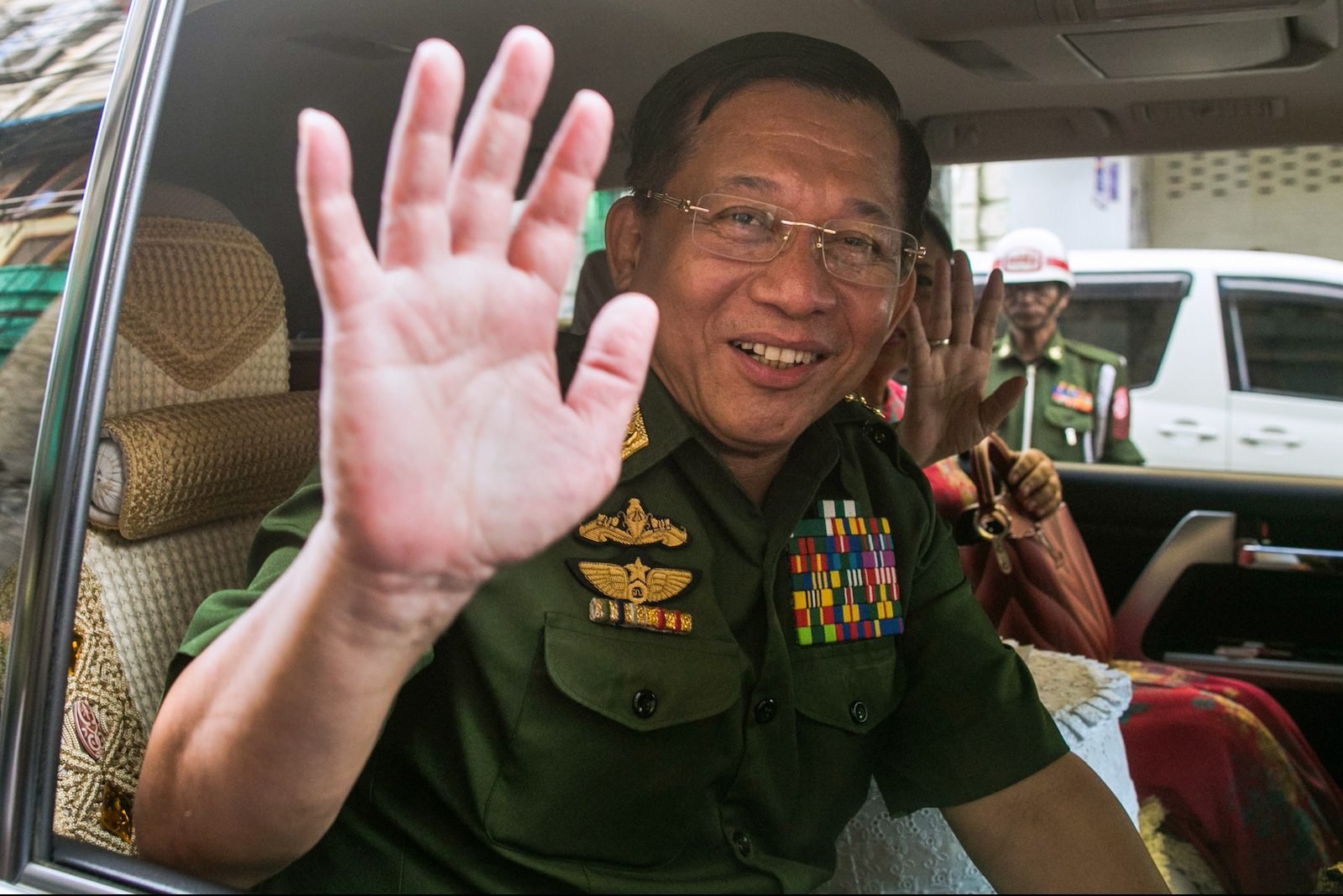
The multidimensional crisis that has gripped Myanmar since the military coup on February 1, 2021, has entered a new chapter — one increasingly complex and riddled with contradictions.
The move by military chief and coup maker Senior General Min Aung Hlaing to overthrow the civilian government of the National League for Democracy (NLD) did not merely halt the country’s democratic transition by force.
It triggered a total collapse of domestic stability, sparked a massive wave of civil disobedience, led to the rise of People’s Defense Force (PDF) militias, and escalated armed conflicts involving various ethnic armed organizations (EAOs).
Worse, the junta’s brutal response — marked by mass killings, arbitrary detentions, aerial bombardments of civilian populations and blockades on humanitarian aid — has mutated into a direct threat to Southeast Asia’s geopolitical stability.
For the Association of Southeast Asian Nations (ASEAN), the political tempest in Myanmar represents an existential test for the ASEAN Charter and the principle of regional sovereignty. From the outset, the regional bloc’s response has been crippled by deep internal fractures.
Member states further from the instability such as Indonesia, Malaysia, Singapore and the Philippines have repeatedly demanded an end to the violence and the restoration of democracy. Mainland states closer to the tumult such as Thailand, Laos, Cambodia and Vietnam, by contrast, have tended to shield themselves behind the bloc’s non-interference principle, viewing the crisis as a purely domestic affair.
Consequently, the collective effort manifested in the Five-Point Consensus (5PC) in April 2021 has proven toothless on the ground. Demands for a cessation of violence, inclusive dialogue, the appointment of a special envoy and the delivery of humanitarian aid through the AHA Centre have failed entirely.
This failure stems from a single, critical structural flaw: the complete absence of formal enforcement mechanisms and sanctions within the ASEAN Charter. The Myanmar military, or Tatmadaw, has shrewdly exploited this loophole to ignore its regional commitments while tightening its domestic grip.
Entering 2026, the Tatmadaw shifted its tactics to break the global diplomatic stalemate. Through a tightly controlled, artificial election held early in the year, the junta sidelined the opposition, dissolved direct military rule and declared a nominal civilian government, installing Min Aung Hlaing as president.
The maneuver was designed to manufacture cosmetic constitutional legitimacy, in hopes of coaxing ASEAN into restoring Myanmar’s full political participation. While most ASEAN members rejected this political theater for its lack of inclusivity, the bloc’s conflicting perspectives still leave the junta room to maneuver.
Two-pronged strategy
An informal foreign ministers’ meeting in Bangkok on July 12, 2026, offered the clearest reflection yet of ASEAN’s fragmented, multilayered diplomacy.
Initiated by the Philippines as 2026 ASEAN chair and facilitated by Thailand, the meeting brought regional diplomats face-to-face with the junta’s newly appointed foreign minister, U Tin Maung Swe, for the first time since 2021.
The approach was framed as offering an “olive branch” — flexible, unconditional face-to-face dialogue — while firmly maintaining “no political concessions” regarding the junta’s legitimacy. However, the outcomes from the Bangkok negotiating table only confirmed an acute asymmetry in commitment.
ASEAN stood firm in refusing to legitimize the January 2026 elections and continued to block Myanmar from high-level summits. On the other hand, the bloc’s primary demands — a halt to offensive military operations, inclusive dialogue with the National Unity Government (NUG) and physical access for the special envoy to meet with Aung San Suu Kyi — were flatly rejected by the Tatmadaw.
Instead, the Myanmar junta offered only minimal, technical concessions. It permitted the expansion of the AHA Centre’s humanitarian mission within strictly limited territories, offered vague promises regarding medical care and the potential transfer of Suu Kyi to house arrest, and opened the door to cooperation on cross-border cybercrime.
This pattern exposes a survival strategy that has remained consistent since 2021: engaging regionally on a tactical level to ease international pressure while systematically sabotaging the substance of peace on the ground. The Tatmadaw continues to exploit ASEAN’s weak internal coordination to secure bilateral deals that bolster its own position.
External actors, multidimensional costs
The Myanmar military’s stubborn defiance of regional diplomatic pressure is heavily backed by the geopolitical calculations of key external players. China, India and Russia have acted as the primary lifelines keeping the regime afloat amid global isolation.
China has deployed a highly pragmatic diplomacy aimed at securing its Belt and Road Initiative (BRI) investments, particularly the trans-Myanmar oil and gas pipelines and the Kyaukphyu deep-sea port in the Bay of Bengal. A high-profile visit by Chinese Foreign Minister Wang Yi to Naypyidaw in April 2026 underscored Beijing’s de facto recognition of the military-backed government.
Meanwhile, India has pursued a dual-track strategy to safeguard its northeastern border, protect the Kaladan multimodal transit project and secure access to critical minerals. Russia, on the other hand, has positioned itself as the primary supplier of heavy weaponry and military technology.
Moscow’s supply of fighter jets and attack helicopters has provided the Tatmadaw with the tools needed to sustain its offensive air campaigns while simultaneously offering a diplomatic shield at the UN Security Council.
Despite this external backing, ASEAN’s regional isolation has still inflicted severe, multidimensional damage on Naypyidaw. Economically, being frozen out of the ASEAN Economic Community (AEC) single market triggered a massive flight of foreign capital, particularly from Singapore and Thailand, contributing to an 18% GDP contraction at the start of the crisis and a chronic shortage of foreign exchange.
Geopolitically, the isolation perpetuates Myanmar’s pariah status on the global stage, trapping the country in a dangerous, asymmetric dependency on China and Russia. To mitigate these shocks, the junta has been forced to rely heavily on illicit and semi-legal border trade involving commodities such as jade, timber and rare earths.
Radical repositioning of regional centrality
The diplomatic experimentation in Bangkok opens a highly volatile and uncertain chapter for the future of Southeast Asia. Current analyses point to three potential scenarios.
The first, and most probable, is creeping normalization. In this outlook, ASEAN gradually succumbs to geopolitical pragmatism, driven by economic pressures and border security concerns felt by mainland neighboring states. The result would be de facto recognition of the nominal civilian government under Min Aung Hlaing, effectively pushing the pro-democracy movement off the formal stage.
The second scenario is ASEAN paralysis and internal fragmentation. The emergence of uncoordinated initiatives risks creating “parallel diplomacies,” in which Thailand operates via the “Bangkok Process” while Indonesia and Malaysia hold the line through the “Jakarta Club.”
This fractured voice would dissolve ASEAN centrality, leaving the bloc highly vulnerable to the junta’s divide-and-conquer tactics. The third and least likely scenario is a decentralized diplomatic breakthrough, in which ASEAN undergoes a paradigm shift, acknowledges that the Tatmadaw no longer controls the majority of Myanmar’s territory, and begins engaging in direct functional cooperation with non-state actors along the borders.
To avoid sinking into organizational paralysis, ASEAN must radically reinvent its tactical and strategic approaches. First, there must be absolute synchronization, unifying all informal and Track 1.5 diplomatic channels into a single command under an ASEAN Joint Contact Group.
Second, the bloc needs to institutionalize an “ASEAN Minus X” decision-making mechanism for humanitarian affairs, allowing cross-border aid delivery to be approved without requiring consensus, thereby bypassing junta representatives who frequently block aid.
Third, formal, territory-based engagement with non-state actors such as the SCEF, KIO, KNU and KNPP must be implemented immediately, acknowledging that de facto governance across large swaths of the borderlands is held by ethnic armed organizations rather than the military.
Fourth, the region must establish strict, time-bound benchmarks backed by progressive sanctions; if there is no significant reduction in airstrikes within the next six months, ASEAN should freeze Myanmar’s technocratic participation across the bloc’s sectoral bodies.
Finally, using the East Asia Summit forum, ASEAN must rally coordinated pressure on China and India, making clear that unconditional support for a fragile junta will only prolong the civil war and ultimately jeopardize their own long-term investments.
Without the political courage to execute this radical repositioning, ASEAN risks becoming a passive bystander to the total disintegration of one of its own members.
Ronny P Sasmita, PhD, is senior international affairs analyst at the Indonesian Strategic and Economic Action Institution, a Jakarta-based think tank.