Turkey, Saudi Arabia and Pakistan Sign Mutual Defense Pact in Mecca
Turkey, Saudi Arabia and Pakistan signed a mutual defense agreement in Mecca on Friday that treats an armed attack on any one of the three countries as an attack on all, Pakistan’s Foreign Ministry reported, as the countries seek to expand collective deterrence and defense cooperation.
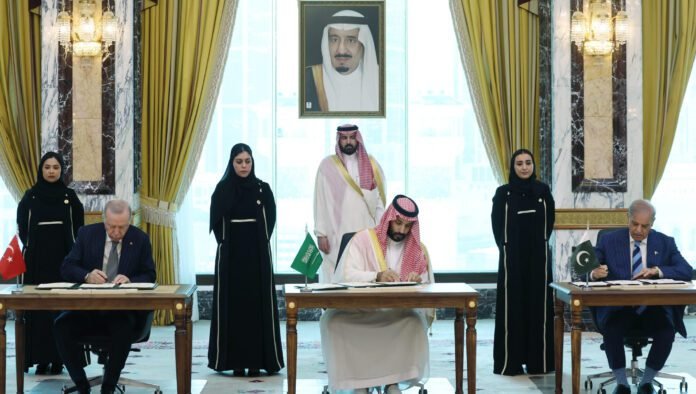
The agreement was signed during a closely watched summit attended by Saudi Crown Prince Mohammed bin Salman, Turkish President Recep Tayyip Erdogan and Pakistani Prime Minister Shehbaz Sharif.
Under the pact, the three countries committed to responding collectively if any member is attacked.
— Ministry of Foreign Affairs – Pakistan (@ForeignOfficePk) August 7, 2026
“The Agreement is intended to strengthen collective deterrence against any act of aggression, and stipulates that any armed attack against any one of the three States shall be regarded as an attack against them all. It further provides for the enhancement of all aspects of defence cooperation among the three States,” the agreement said.
The countries described the pact as reflecting “The three States’ shared commitment to further strengthening their collective security and to promoting peace, security, and stability in the region and beyond, in pursuit of a secure and prosperous future.”
A Turkish official told Reuters that the agreement was defensive and was not aimed at any particular country or other actor. The official said the arrangement was open to additional countries in the region and did replace existing bilateral or multilateral arrangements.
Discussions over the agreement had been underway before Friday’s summit, according to a source close to the Saudi government and military who spoke anonymously to Agence France-Presse.
“The agreement has been under discussion for a long time, but recent developments in the region accelerated the process,” the source said.
Saudi Arabia and Pakistan signed a joint defense pact last year, drawing considerable attention because Pakistan is the only Muslim country possessing nuclear weapons. In addition, in late July, Ankara also became one of 14 founding members of a Riyadh-led maritime defense coalition.
Portuguese man o’ war sightings prompt beach warnings across Spain
Spanish authorities have issued warnings after an increase in sightings of Portuguese man o’ war along parts of the country’s coastline, prompting temporary beach closures and renewed public health advice for swimmers.
The Portuguese man o’ war, often mistaken for a jellyfish, is a colonial marine organism whose tentacles can deliver painful stings and remain hazardous even after the animal has washed ashore.
Local officials have reported sightings in several coastal areas during the summer season. In some cases, beaches were temporarily closed as a precaution while lifeguards and emergency personnel monitored the affected waters.
Atención a las banderas de las playas: 🟩 Bandera verde: baño libre 🟨 Bandera amarilla: baño con precaución 🟥 Bandera roja: baño prohibido ⬜ Bandera blanca: presencia de medusas Consulta el protocolo ante las carabelas y recomendaciones -> https://t.co/rsfHgtsjSd#donostia… pic.twitter.com/w6s88zCp5M
Health authorities advised beachgoers not to touch the organisms, whether they are floating in the water or stranded on the sand. Contact with the tentacles can cause intense pain, redness, swelling and, in some cases, more serious reactions requiring medical attention.
If stung, experts recommend leaving the water immediately and seeking assistance from lifeguards or medical personnel. The affected area should be rinsed with seawater rather than fresh water, which can trigger additional venom release. Visible tentacle fragments should be removed carefully, preferably with tweezers or another object rather than bare hands.
Authorities also advised against rubbing the affected area and said medical care should be sought if symptoms become severe, spread beyond the sting site, or are accompanied by difficulty breathing, dizziness or other signs of a serious allergic reaction.
Marine specialists say Portuguese man o’ war sightings can increase during periods of favorable winds, currents and warm-water conditions that carry the organisms toward coastal areas. Officials are continuing to monitor conditions and update beach safety information as necessary.
Spain’s beach warning system relies heavily on local lifeguard services and municipal authorities, who can temporarily restrict access to affected areas when potentially dangerous marine life is detected.
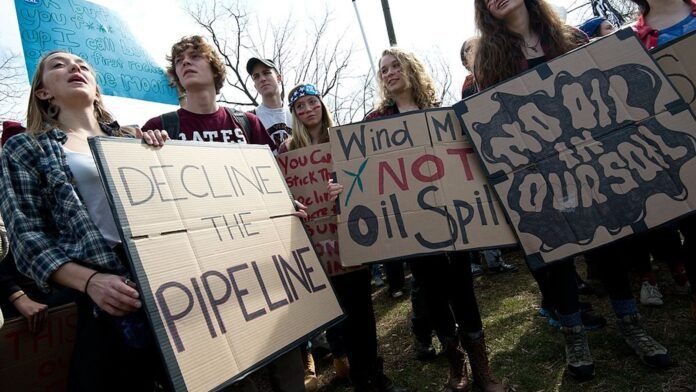
The Bridger Pipeline Expansion project has been moving through the permitting process with unusual speed. If built, the $2 billion, 650-mile pipeline will run through Montana and Wyoming and is one of three proposed pipeline legs connecting oil sands in Alberta, Canada to the trading hub in Cushing, Oklahoma.
The project appears to be a priority for the Trump administration. The Bureau of Land Management announced that the pipeline will receive an expedited environmental review, and in late April, the administration granted the pipeline developer a cross-border permit to pass into the U.S. Permitting documents show the company, Bridger Pipeline Expansion, LLC, a subsidiary of Wyoming-based True Companies, hopes to break ground as soon as July 2027, pending state and federal approval.
But the project has hit a stumbling block. On July 22, the Montana Department of Environmental Quality, or DEQ, withdrew a waiver it had previously granted the pipeline.
The waiver allowed the company to omit certain financial information and baseline environmental data from its state permit application with DEQ. Pipeline construction cannot begin without this permit and final federal approval.
At the core of the debate is Montana’s Major Facility Siting Act, a state law that outlines the process of evaluating the potential economic, community, and environmental impacts of large energy projects like pipelines or power plants. Earlier this year, Bridger requested a waiver to omit certain financial and economic information, as well as baseline environmental data from its application to DEQ. The law allows for “irrelevant information” to be omitted from the review process, and DEQ granted Bridger the waiver in February. The agency is now backtracking on that decision.
In June, the environmental law firm Earthjustice filed a complaint on behalf of two Montana residents against DEQ’s decision to grant the waiver. Lars Phillips, an attorney with Earthjustice said the information needed to be included in order to have a thorough review process.
“The law is clear, and DEQ was right to reverse course,” Phillips said. “But we are troubled by why DEQ decided to issue these waivers in the first place.”
Projects of this size and scale require both state and federal approval. Montana DEQ, along with the U.S. Bureau of Land Management, held a public comment period on the pipeline proposal in May. Phillips said without Earthjustice taking this action to discover what information was waived, members of the public would never have known they were commenting on an incomplete application.
Read Next
The proposed pipeline is expected to move roughly 500,000 barrels of crude tar sands oil per day, according to DEQ documents. But at full capacity, that number is projected to increase to moving 1.13 million barrels per day from Canada, through Montana and into Wyoming.
The project has been referred to by supporters as “Keystone Light,” referencing the Keystone XL Pipeline, which then-President Joe Biden canceled in 2021. Shannon James with environmental watchdog Montana Environmental Information Center said calling it “light” is a misnomer. “It’s Keystone XXL and a major climate threat that far too many people haven’t heard about yet,” she said.
James and other opponents have raised concerns over the potential environmental harms the pipeline’s proposed path would take, a route that would cross water 150 times.
“Pipelines leak,” James said. “It’s not a matter of if, but when. We should not be giving the green light to a company with a troubling track record in our state, especially before it has fully disclosed the impacts this project would have on Montana’s people, water, wildlife, and climate.”
In an email to Earthjustice shared with Montana Free Press, Jeremiah Langston, a lawyer for DEQ, said the agency is “requiring Bridger to produce the information in question” to move forward with the application. Permitting for the project cannot proceed until the application is complete, Langston said, and it’s up to Bridger to submit the additional information DEQ requires.
Phillips maintains it’s a positive sign to see DEQ addressing gaps in the application, but said he would have liked to see the agency more proactively inform the public.
“It is unfortunate that it took two Montanans standing up to big oil to force DEQ to require Bridger to comply with Montana law,” he said.
Editor’s note: Earthjustice is an advertiser with Grist. Advertisers have no role in Grist’s editorial decisions.
State Department Wants Palantir’s Advice on Free Speech and “Countering Digital Surveillance”
The Trump administration tapped a surveillance giant with a record of attacking the press to advise the State Department on free speech.
Among the partners for the State Department’s new “Freedom Tech Excellence Program” is Palantir, the AI and data integration firm started by right-wing powerbroker Peter Thiel. Under the program, company employees will go on temporary assignments to advise the government on “digital freedom and freedom of expression,” including counter-surveillance and dealing with First Amendment issues.
“FTEP brings private sector talent to the Department for limited-term assignments to advance diplomatic efforts on key issues including online freedom of expression, privacy-enhancing technologies, countering digital surveillance, and responsible AI governance,” according to the State Department’s website.
“Neither this State Department, nor the partners they have announced so far, are trustworthy leaders in what they identify as online freedom of expression.”
Palantir is best known for building large-scale data analysis platforms. In addition to corporate contracts, the company’s massive government tenders include database, surveillance, and tracking tools for police and federal authorities. Among its government clients are the military, the State Department itself, and U.S. Immigrations and Customs Enforcement. Palantir and its key personnel have also been involved in multiple lawsuits against journalistic outlets.
The firm’s history has raised criticisms of its role in the new State Department initiative, especially given the Trump administration own’s dubious track record on First Amendment issues.
“To some extent, this announcement and this program sound like doublespeak,” said Carrie DeCell, a senior staff attorney at the Knight First Amendment Institute. “Certainly neither this State Department, nor the partners they have announced so far, are trustworthy leaders in what they identify as online freedom of expression or countering digital surveillance.”
The new initiative is planned to run through the beginning of 2029, according to the State Department’s press office. While participants could be placed anywhere in the agency and may require security clearances, the Freedom Tech Excellent Program “is not geared towards bolstering the Department’s internal application or operational use of AI technologies,” the department said in a statement to The Intercept.
Anduril, a military tech firm with links to Palantir and Thiel, was also listed as a partner in the State Department initiative. Anduril’s executive chair Trae Stephens is a partner at Thiel’s Founders Fund, which has invested about $2.6 billion in Anduril. Besides a mutual appreciation of “The Lord of the Rings,” Thiel shares similar politics with Anduril co-founder Palmer Luckey and has backed Luckey’s new bank, Erebor.
Neither Anduril nor Palantir responded to requests for comment.
Palantir and the Feds
Palantir’s work has brought it notoriety across the globe, though at times defining what it does can be complex. It has repeatedly eschewed its label as a surveillance firm. Palantir CEO Alex Karp denied on a podcast last year that the company engages in unconstitutional surveillance work.
And, in an unsigned blog post last year, Palantir wrote, “Contrary to some media reports, we are not a surveillance company.”
Palantir, though, enabled U.S. mass surveillance by bolstering the National Security Agency’s global data collection efforts, according to documents provided to The Intercept by the whistleblower Edward Snowden. Palantir helped the NSA expand a program that became notorious for its ability to hoover up Americans’ communications along with those from abroad.
More recently, the firm has become a focal point for protests in the U.K. over its massive contract with the National Health Service and its ties to the Israeli military. Just this week, the NHS apologized after admitting it had falsely stated that Palantir did not have access to identifiable patient data.
Stateside, the company had a contract with New York City public hospitals that gave it access to patient information. The contract was allowed to expire after it came under scrutiny in an Intercept report. The Intercept also reported this year that Palantir has access to sensitive federal databases for its contract to aid in Internal Revenue Service investigations.
Palantir’s IRS work led to a letter last year from 10 members of Congress to Karp requesting information about the “mega-database” built off IRS data. In response, the firm again denied that it was engaging in widespread surveillance of Americans and that it was building any such database.
Palantir also has a 15-year relationship with ICE. The Intercept found that its contracts with the agency have aided immigration raids, including ones that led to family separations. And Palantir built bespoke software for ICE that helps track self-deportations and visa overstays.
In April, Reps. Dan Goldman and Nydia Velázquez, both Democrats from New York, sent a list of questions directed to ICE and its parent agency, the Department of Homeland Security, demanding information about how they were leveraging Palantir’s technology to create “a mass surveillance ecosystem.”
Attacks on Free Press
Along with eccentric far-right views and donations to MAGA Republicans, one of Thiel’s most well-known acts was his involvement in the lawsuit that drove the news outlet Gawker into bankruptcy.
Thiel had become upset with Gawker over the media company’s reporting about his personal life. He went on to spend $10 million secretly bankrolling lawsuits against the company, finally scoring with a major judgment in favor of the wrestler Hulk Hogan that caused Gawker to close and sell off its assets.
Journalism advocacy group Reporters Without Borders said that Thiel constituted a “serious threat” to the group’s principles of “freedom of press and independence of media,” particularly in light of the secrecy around his role in the case. His actions were, RSF said, “nothing different to governments using legal or economic leverage to shut down a media that happens to displease them.”
Palantir also recently filed a suit against Swiss online news magazine Republik for reporting on how Palantir repeatedly failed to land contracts with the Swiss government. Palantir claimed that Republik had an obligation to run a list of rebuttals from the firm.
A Swiss court, however, handed Palantir a defeat by siding with the outlet on all but one of the 23 charges and forcing Palantir to pay most of Republik’s legal fees. (In a since-deleted post on Medium responding to the Republik lawsuit, Palantir once again denied that it is a surveillance company.)
David Greene, senior counsel for anti-surveillance nonprofit Electronic Frontier Foundation, said that positioning Palantir as a bulwark for civil rights undermined the government’s own free speech initiative.
“There’s a big problem right now with the U.S. government and the people outside government who exercise power, in terms of trying to claim free speech as a value when they clearly don’t sincerely hold that value,” Greene said. “It really lowers the esteem of the U.S. in terms of having any moral authority on freedom of expression grounds.”
Europe’s wildfires have raised the danger posed by unexploded WWII bombs
When a wildfire broke out in the Müritz National Park of north-eastern Germany in July, it was no routine firefighting job. Bomb disposal teams had to work alongside firefighters because the forest floor is contaminated with cold war-era munitions. Crews could not approach parts of the blaze directly for fear of detonations.
Soon after, a wildfire tore through 42,000 hectares of the Gironde region in south-western France. As it burned through fields near the village of Le Porge, the fire exposed a forgotten cache of second world war-era shells. At least 75 were recovered from the scorched earth.
Several of the shells had detonated during the fire and one projectile punched through the wall of a house that had been evacuated. The local mayor, Martial Zaninetti, said the municipality had no record the munitions were there at all.
These events are symptoms of a clear problem: Europe is full of buried explosives left over from 20th century wars, and the continent’s wildfires are now big enough, hot enough and last long enough to reach them.
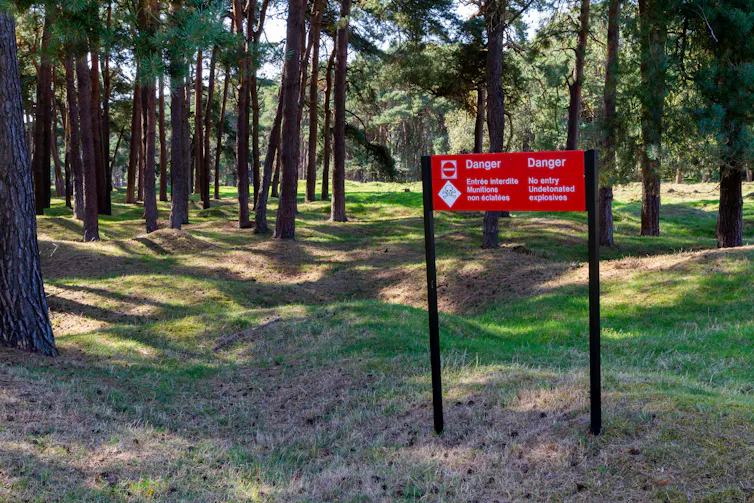
A sign in a forest near the northern French town of Vimy warning passers-by of unexploded bombs from the first world war.Adam Jan Figel / Shutterstock
While buried munitions are always dangerous, they are usually undisturbed enough not to go off. What changes during a wildfire is heat and pressure. Explosive fillings can ignite or detonate when heated past a critical threshold. Old ordnance is also often more unstable than it was when manufactured as decades of corrosion can make casings and fuses more sensitive.
A fire burning through leaf litter and topsoil for a few minutes generally is not hot enough to cause detonation. But a fire that burns for hours or days, or that sinks down into dry peat and smoulders underground for a prolonged period of time, can transfer enough sustained heat into the ground to trigger buried munitions directly.
This happened repeatedly in 2025 during the Langdale Moor fire in North Yorkshire, UK. Flames burrowing into deep peat set off more than 20 buried second world war shells over six weeks of burning.
Fires also expose ordnance that heat would not otherwise touch. Burning off vegetation and topsoil uncovers shells and mines buried further down, leaving them lying on the surface. This is how the Le Porge fire team ended up gathering 75 exposed shells from scorched fields that no one on the local council knew were there.
The underlying physics is not unique to wildfires. Six separate munitions sites exploded across Iraq during the summers of 2018 and 2019, when temperatures regularly climbed above 45°C. No fire was involved in this case – just prolonged, extreme ambient heat. A similar dynamic has been linked to a 2020 arms depot explosion in Jordan in 2020.
Europe’s buried munitions
Europe is contaminated with explosive remnants of two world wars and roughly four decades of cold war military activity. Many of these munitions sit precisely where wildfires now burn: in forests, moorland and heath that were requisitioned for military use and then largely left alone.
North-eastern Germany’s forests, including areas that are now nature reserves and Unesco world heritage sites, were Soviet and East German training grounds during the cold war. Germany’s ordnance-clearance service, the Munitionsbergungsdienst, works through this land area by area because the scale of contamination is too large to clear all at once.
Northern France and Belgium still produce a so-called annual “iron harvest” of first world war shells turned up by farmers every spring. Parts of the “Zone Rouge” near the French city of Verdun remain officially uninhabitable more than a century after the 1918 Armistice.
South-western France, including the Gironde forests that burned in 2026, also saw heavy fighting and stored ordnance during the second world war. And in the UK, moorland such as the North York Moors were used for tank training during the second world war, leaving buried ordnance in deep peat that is now increasingly prone to burning.
The nature of the fires that now burn in areas around this buried ordinance has changed. The devastating wildfires that have struck Spain and France in 2026 offer a striking illustration of Europe’s escalating wildfire crisis. Consecutive heatwaves, coupled with low rainfall and depleted soil moisture, created extreme fire weather conditions.
Climate change is a key factor driving the increase in fire weather in the region. Summer days featuring extreme fire-prone conditions across southern Europe doubled between 1981 and 2025, and climate change projections suggest this trajectory will continue. As temperature rise and rainfall patterns shift, the probability of extreme wildfires will continue to rise.
Climate is not the only factor behind Europe’s rising wildfire activity. While North America and Europe are seeing dramatic increases in fire frequency and intensity, global fire activity is declining. Changes in demographics and land management practices are changing the availability of fuel for fire.
In Africa, for instance, the fragmentation of grasslands and changing farming practices have contributed to a decline in wildfires. The opposite dynamic is at play in Europe. Rural abandonment in some parts of the continent has allowed vegetation to accumulate, creating the fuel loads that feed extreme wildfires.
The combination of drier ground, longer fire seasons and changing land use is turning Europe’s decades-old contamination problem into a live operational hazard.
New official 30th anniversary Quake mission pack adds new maps and mechanics
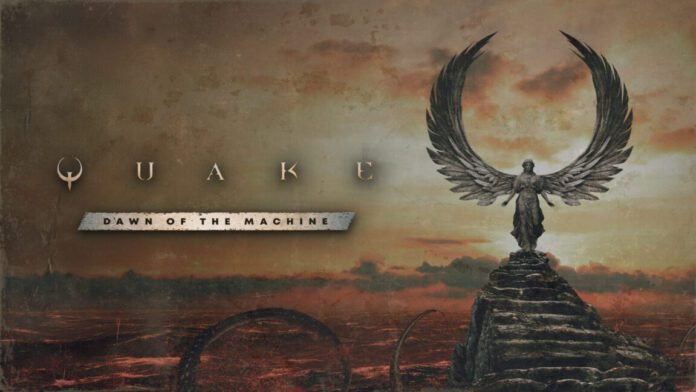
This year is the 30th anniversary of the launch of the original Quake by id Software, if you could believe it. To commemorate that, publisher Bethesda has released a new campaign chapter for the game, titled “Dawn of the Machine.”
This is part of a series of new campaign chapters, all developed by MachineGames “in collaboration with id Software.” MachineGames is best known for making the games in the relatively recent Wolfenstein reboot series, as well as Indiana Jones and the Great Circle. The Quake maps are made by a team dubbed “Quake Club,” which includes several MachineGames employees who work on Quake maps in their spare time.
The ambition and scope of some of these maps is beyond what was typical for Quake maps back in the late ’90s, thanks in part to the team’s use of Trenchbloom, a newer map editor that works well on modern systems and is easier to work with and more capable than what folks were using in those days.
There are 19 new levels, and they have several new gameplay gimmicks, like a time loop mechanic and a disorienting-but-cool teleportation system that makes it look like the levels are changing on the fly—kind of similar to the multi-time-period levels we saw in Titanfall 2 or Dishonored 2, though in these Quake maps the time shifts happen without player input. There’s also new music and a handful of new enemy and weapon variants.
This is the premise of the new campaign, as written on the blog post announcing the update:
As the battle-hardened Ranger, players survive a labyrinthine dimension where time folds back onto itself, creating a unique looping structure where each visit in the present reshapes the future.
Collect runes to unlock previously sealed paths brimming with new routes, encounters and secrets, plus persistent health and ammunition upgrades throughout add a new layer of progression to Quake’s classic gameplay.
The new maps have been added to the campaign list in the remastered version of Quake, and like that remaster, they’re available free to anyone who already owns Quake on Steam, as well as Quake on current and last-gen PlayStation, Xbox, and Nintendo consoles.
It has recently been reported that a significant number of people at original Quake developer id Software were laid off amid Microsoft’s major Xbox reorganization; however, most of that studio has been more focused on the recent Doom reboot series. MachineGames has been the primary force generating new Quake content, and that studio does not appear to have been as deeply affected by layoffs just yet—though more are expected throughout the Xbox organization in the coming months.
The grim context aside, it’s good to see some classic PC games still getting new maps all these years later. Like Age of Empires II, Quake has seen something of a resurgence thanks to its remaster and more official content over the past few years.
What Is the Trump Administration Doing With Foreign Aid Money?
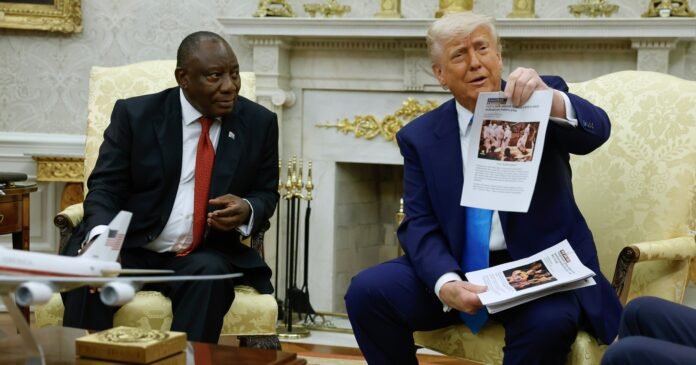
Since he returned to office, President Donald Trump’s administration has upended foreign aid. It’s labeled well-established, long-running programs as “not aligned with American interests” and slashed their budgets.
Still, the billions of taxpayer dollars Congress has allocated for foreign aid programs must be spent; lawmakers have insisted the government continue to fund humanitarian aid, global health and pro-democracy causes around the world. With most of the old programs now gone, however, we wanted to know: What is the Trump administration doing with that money now?
Recently, we published our investigation that found one answer to that question in a little-known bureau of the State Department that has dramatically transformed under Trump. For decades, the Bureau of Democracy, Human Rights and Labor, known as DRL, has supported human rights in some of the most oppressive countries in the world. Now, our reporting found, it’s planning to direct funds to controversial groups supporting right-wing causes in Europe and elsewhere.
Our full story lays out some of the groups the government has considered funding, which include a British free-speech organization that has fought against bans on “gay conversion therapy” and a British American think tank created this year to focus on “existential threats to Britain, to America, and to our shared Judeo-Christian civilisation.” (Administration officials dropped that grant after significant pushback from Congress.)
One proposed grant particularly caught our attention: Trump administration officials suggested funding research on crime against minority populations in South Africa.
It’s clear from sources we spoke with that the key targeted minority population in question is the white ethnic group known as Afrikaners. Afrikaners were responsible for creating the nation’s infamous and brutal racially segregated apartheid system. Previously, DRL staff had been told to begin the process of awarding funds to a group called Lex Libertas, which was founded by a controversial figure who has called for Afrikaner self-governance. The group is currently fundraising to place 3,000 white crosses on the National Mall in remembrance of attacks on South African farmers.
The proposed grant was later opened up to allow a broader set of invited groups to apply for $1 million of funding, though it is still intended for the same purpose, according to people with knowledge of the process. The State Department declined to say whether Lex Libertas will be among those invited to compete, citing ongoing deliberations, but said the Trump administration has serious concerns about the human rights situation in South Africa that need to be addressed. Lex Libertas did not respond to questions about the organization or the proposed grant.
Former diplomats who have worked extensively on human rights told us they were shocked that the victimization of white South Africans would be prioritized over the serious issues elsewhere in the region.
“It’s laughable to suggest that on the African continent, the prime issue of human rights concern is whites in South Africa,” one former agency official said when we asked him about the grant. South Africa is plagued by violence, but extensiveresearch has found that white South African farmers are not victims of crime at higher rates than other groups.
Read More
Experts also described the proposed grant to fund research into violence against Afrikaners as keeping with the Trump administration’s overall stance toward South Africa.
For decades, the U.S. relationship with the country has been symbolized by our massive support for HIV care, Mattie Webb, a professor at the Virginia Military Institute who studies South Africa and U.S. foreign policy, told us.
Since Trump returned to office, there’s been a stark shift as the administration has strengthened ties with borderline white nationalist groups that are considered fringe in South Africa.
“The U.S. is very clearly shifting its priorities away from aid that would benefit far more people in South Africa to this narrow focus on the white minority,” Webb said.
There have long been tensions between South Africa and the U.S., former diplomats told us, but the aid the U.S. provided saved lives and helped sustain a working relationship that is vital to U.S. national security and economic interests. Now, by seeking to fund a movement antagonistic to the South African government, the U.S. risks driving a wedge between the two nations.
Other grants also raised red flags for experts and lawmakers. Political appointees at the State Department are considering funding a British free-speech organization that has fought bans on discredited therapy practices that attempt to convert gay people to heterosexuality. That proposed $5 million grant would provide support for people facing “deplatforming” and advocate against “restrictive online safety and hate speech laws,” according to a document we reviewed. (The organization’s founder said it had “neither applied for nor been awarded a grant from the US State Department or any other branch of the US Government” but did not respond to our other questions.) And a call for proposals recently released by the bureau would fund research, conferences and cultural engagements in wealthy democracies to develop “civilizational self-confidence in Europe.”
Not all the proposed funding is directed to controversial groups, our reporting found. But even some of the grants slated to fund more traditional human rights projects skirt federal requirements for competitive bidding that are meant to deter waste, fraud and abuse. Instead, officials are trying to direct millions to handpicked organizations, according to sources and documents.
In response to questions about our reporting, the State Department stressed that the process of awarding grants is ongoing and that multiple offices provide input, writing that “programs are still in active deliberation and receipt of a grant is not guaranteed to any organization that does not meet all requirement and standards for federal grants.”
We are continuing to report on foreign aid and the Trump administration’s policies in South Africa. If you have tips or information we should know about either of these issues, please feel free to get in touch with us! Reach out via phone or Signal to Anna Maria Barry-Jester at 408-504-8131 or Sharon Lerner at 718-877-5236.
William Shatner may finally be ready to beam down from one of Hollywood’s longest-running feuds.
The 95-year-old Star Trek legend is reportedly considering making peace with former co-star George Takei, 89, as talk grows about the possibility of one last reunion for the surviving stars of the iconic sci-fi franchise.
Shatner, who famously played Capt. James T. Kirk, recently admitted he would be open to stepping into the role again.
“I still have the aggression and the instinct for battle,” he said while discussing the possibility of another Star Trek appearance.
Now, insiders say that unexpected admission has sparked fresh hope that Shatner could also put decades of bad blood with Takei behind him.
The two actors have been trading barbs for years, with their tense relationship stretching all the way back to their days working together on the original Star Trek series in the 1960s.
But with Shatner and Takei now the last surviving members of the show’s principal cast, friends reportedly believe time is running out for the pair to make peace — and potentially give fans one final moment together.
“It would be so wonderful for both of their legacies, and for the fans, if they could come together and make this happen,” an insider told RadarOnline.com.
According to the source, Shatner has historically been the bigger obstacle to a reconciliation.
“By all accounts, it’s really Bill standing in the way of this happening because he’s the one who has refused to make peace over and over,” the insider claimed.
But Shatner’s renewed interest in playing Kirk has apparently changed the mood.
“Now that he’s opening up to the idea of playing Captain Kirk again, there’s this new wave of hope that maybe he’ll climb off his high horse and finally bury the hatchet,” the source said.
Shatner has certainly shown he still has an appetite for adventure.
In 2021, at age 90, the television icon blasted into space aboard a Blue Origin suborbital flight, becoming the oldest person at the time to travel beyond Earth’s atmosphere.
Now friends are reportedly urging him to take another major leap — this time by ending his bitter rivalry with Takei.
“People keep telling Bill there’s just no point carrying this grudge around anymore,” the insider said.
And if another Star Trek reunion ever does happen, sources believe Takei would need to be involved.
“If he really wants to breathe new life into Star Trek, George has to be part of it because you simply can’t do a proper reunion without him,” the source continued.
For longtime fans who watched Kirk command the USS Enterprise while Takei played helmsman Hikaru Sulu, seeing the two men together again could provide an emotional final chapter to one of television’s most famous casts.
“They’re the last two standing,” the insider said, “and everyone thinks it would be such a crying shame if Bill’s stubbornness stopped one last magical moment from happening.”
Whether Shatner and Takei can actually put decades of insults, resentment and public sparring behind them remains to be seen.
But for the first time in years, insiders reportedly believe there may be a real chance for peace — and perhaps one final voyage together.
Israeli occupiers intensify attacks on Bedouin community near Ramallah
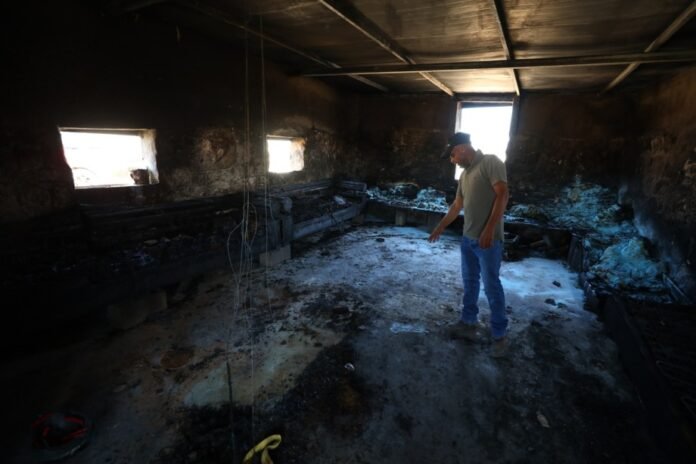
Israeli occupiers are intensifying attacks on a Palestinian Bedouin community east of Ramallah in the central occupied West Bank in an attempt to displace its residents, a rights group said Friday, Anadolu reports.
In a statement, the Al-Baidar Organization for the Defense of Bedouin Rights said occupiers attacked the Arab al-Kaabneh community east of the village of Taybeh on Friday, following similar attacks Wednesday evening.
“Occupiers, under Israeli army protection, stormed the community, forced their sheep among Palestinian homes and assaulted members of the Naif Kaabneh family,” the organization said.
“The repeated attacks fall within Israel’s maximum-pressure policy against Bedouin communities, aimed at forcibly displacing them,” it added.
READ: Armed Israeli settlers attack Armenian Church in occupied Jerusalem
During the first half of 2026, occupiers carried out 3,488 attacks across the West Bank, killing 17 Palestinians and fully or partially displacing 26 Bedouin and pastoral communities, according to the Palestinian Colonization and Wall Resistance Commission.
The attacks also resulted in the establishment of 42 new settlement outposts, most of them pastoral, the official commission said.
Since the start of Israel’s genocidal war on Gaza on Oct. 8, 2023, the Israeli army and occupiers have intensified attacks against Palestinians in the occupied West Bank.
The attacks have killed more than 1,182 Palestinians, injured around 13,000 and led to the arrest of nearly 25,000 others, in addition to causing widespread property damage, according to official Palestinian figures.
READ: Israeli occupiers burn 3 Palestinian vehicles, damage power grid in West Bank
Report: White House drafting executive order linking vaccines and autism
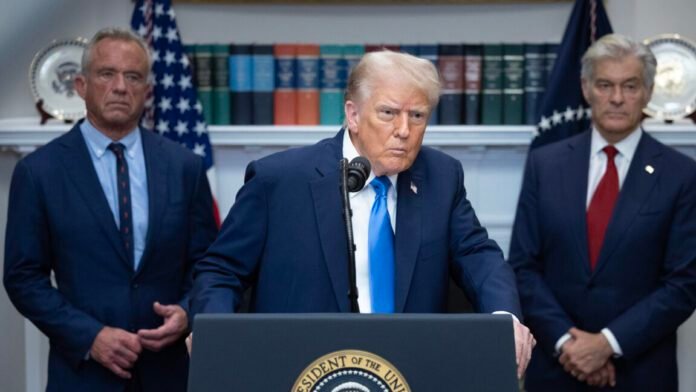
The White House is drafting an executive order on the disproven link between vaccines and autism, according to independent reports from The Washington Post and Bloomberg, which both cited unnamed sources with knowledge of the efforts.
Bloomberg reported that the executive order, which is still taking shape and is subject to change, could be issued as soon as next week. The Post said the order’s drafting so far is aimed at the childhood vaccine schedule, autism research, and parental choice for vaccinations.
Dozens of high-quality studies encompassing data from millions of children worldwide have already been carried out on the topic and have consistently found no link between childhood vaccines and autism. The claim of a link stems from an unethical, fraudulent study that was retracted years ago, and its author was stripped of his medical license.
Leading medical groups, scientists, and autism patient advocacy groups have strongly rejected any continued pursuit of the disproven link, seeing it as fearmongering and a waste of precious time and resources to find real causes and treatments. The majority of American voters also reject the claim, and promoting the false link has been deemed “politically risky” by analysts.
Still, for Trump, holding onto the debunked and dangerous claim appears to be a personal issue. Trump’s health secretary, Robert F. Kennedy Jr., is an ardent anti-vaccine activist who has long promoted the false link while generally disparaging life-saving immunizations. But even Kennedy has recently shifted from publicly discussing vaccines, given the political peril.
Recent reporting indicates that the White House’s continued effort to forge a false connection between vaccines and autism is coming from Trump directly. The octogenarian reportedly wants to be remembered as the president who cured autism and believes he can achieve that by scaling back vaccines, according to reporting by The Wall Street Journal.
Given the push, Trump has reportedly chastised Kennedy on multiple occasions for not doing more on the issue. Kennedy confirmed the Journal’s reporting in a combative August 2 CNN interview. (He otherwise made a barrage of false claims during the interview; a comprehensive fact check can be found here.)
As Trump and his administration continue to flout the science on vaccines, White House spokesman Kush Desai gave a statement to the Post claiming, once again, the administration would use “gold standard science” to ensure the US has the “best childhood vaccine schedule in the world.”
In a Cabinet meeting last week, Trump asked Kennedy about progress on autism research, to which Kennedy replied, “We will have an answer for you.”