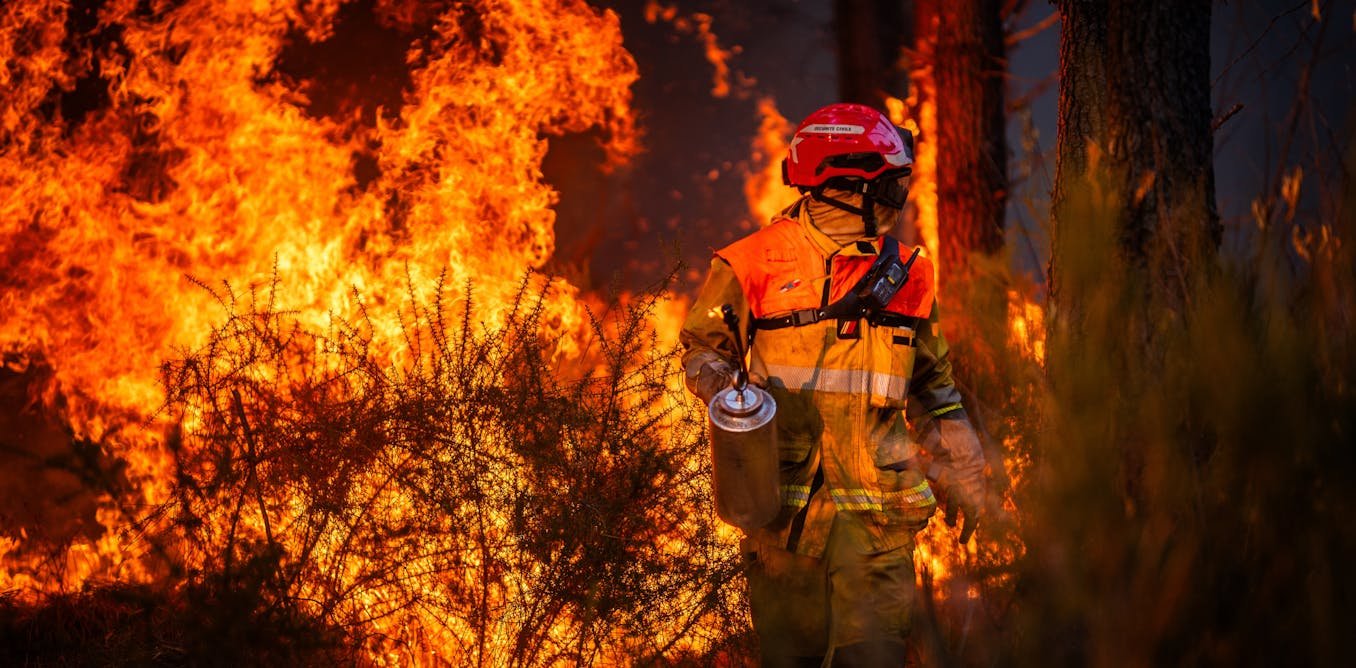
When a wildfire broke out in the Müritz National Park of north-eastern Germany in July, it was no routine firefighting job. Bomb disposal teams had to work alongside firefighters because the forest floor is contaminated with cold war-era munitions. Crews could not approach parts of the blaze directly for fear of detonations.
Soon after, a wildfire tore through 42,000 hectares of the Gironde region in south-western France. As it burned through fields near the village of Le Porge, the fire exposed a forgotten cache of second world war-era shells. At least 75 were recovered from the scorched earth.
Several of the shells had detonated during the fire and one projectile punched through the wall of a house that had been evacuated. The local mayor, Martial Zaninetti, said the municipality had no record the munitions were there at all.
These events are symptoms of a clear problem: Europe is full of buried explosives left over from 20th century wars, and the continent’s wildfires are now big enough, hot enough and last long enough to reach them.
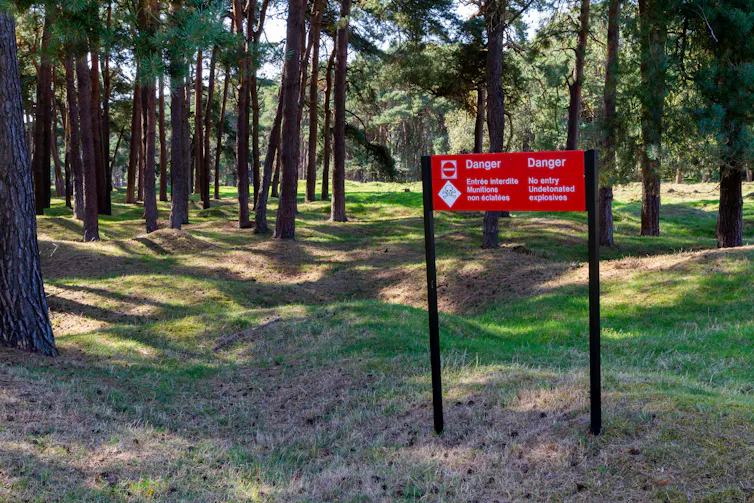
While buried munitions are always dangerous, they are usually undisturbed enough not to go off. What changes during a wildfire is heat and pressure. Explosive fillings can ignite or detonate when heated past a critical threshold. Old ordnance is also often more unstable than it was when manufactured as decades of corrosion can make casings and fuses more sensitive.
A fire burning through leaf litter and topsoil for a few minutes generally is not hot enough to cause detonation. But a fire that burns for hours or days, or that sinks down into dry peat and smoulders underground for a prolonged period of time, can transfer enough sustained heat into the ground to trigger buried munitions directly.
This happened repeatedly in 2025 during the Langdale Moor fire in North Yorkshire, UK. Flames burrowing into deep peat set off more than 20 buried second world war shells over six weeks of burning.
Fires also expose ordnance that heat would not otherwise touch. Burning off vegetation and topsoil uncovers shells and mines buried further down, leaving them lying on the surface. This is how the Le Porge fire team ended up gathering 75 exposed shells from scorched fields that no one on the local council knew were there.
The underlying physics is not unique to wildfires. Six separate munitions sites exploded across Iraq during the summers of 2018 and 2019, when temperatures regularly climbed above 45°C. No fire was involved in this case – just prolonged, extreme ambient heat. A similar dynamic has been linked to a 2020 arms depot explosion in Jordan in 2020.
Europe’s buried munitions
Europe is contaminated with explosive remnants of two world wars and roughly four decades of cold war military activity. Many of these munitions sit precisely where wildfires now burn: in forests, moorland and heath that were requisitioned for military use and then largely left alone.
North-eastern Germany’s forests, including areas that are now nature reserves and Unesco world heritage sites, were Soviet and East German training grounds during the cold war. Germany’s ordnance-clearance service, the Munitionsbergungsdienst, works through this land area by area because the scale of contamination is too large to clear all at once.
Northern France and Belgium still produce a so-called annual “iron harvest” of first world war shells turned up by farmers every spring. Parts of the “Zone Rouge” near the French city of Verdun remain officially uninhabitable more than a century after the 1918 Armistice.
South-western France, including the Gironde forests that burned in 2026, also saw heavy fighting and stored ordnance during the second world war. And in the UK, moorland such as the North York Moors were used for tank training during the second world war, leaving buried ordnance in deep peat that is now increasingly prone to burning.

The nature of the fires that now burn in areas around this buried ordinance has changed. The devastating wildfires that have struck Spain and France in 2026 offer a striking illustration of Europe’s escalating wildfire crisis. Consecutive heatwaves, coupled with low rainfall and depleted soil moisture, created extreme fire weather conditions.
Climate change is a key factor driving the increase in fire weather in the region. Summer days featuring extreme fire-prone conditions across southern Europe doubled between 1981 and 2025, and climate change projections suggest this trajectory will continue. As temperature rise and rainfall patterns shift, the probability of extreme wildfires will continue to rise.
Climate is not the only factor behind Europe’s rising wildfire activity. While North America and Europe are seeing dramatic increases in fire frequency and intensity, global fire activity is declining. Changes in demographics and land management practices are changing the availability of fuel for fire.
In Africa, for instance, the fragmentation of grasslands and changing farming practices have contributed to a decline in wildfires. The opposite dynamic is at play in Europe. Rural abandonment in some parts of the continent has allowed vegetation to accumulate, creating the fuel loads that feed extreme wildfires.
The combination of drier ground, longer fire seasons and changing land use is turning Europe’s decades-old contamination problem into a live operational hazard.