26.4 C
London
Saturday, August 1, 2026
Home Blog

Cori Bush Has No Regrets

0
cori-bush-has-no-regrets
Cori Bush Has No Regrets


The internet had a field day last summer when a picture surfaced of Sen. Josh Hawley, R-Mo., with his arm around a former Democratic member of Congress.

Hawley was at an event in St. Louis, Missouri, celebrating the inclusion of expanded funds for victims of nuclear radiation in President Donald Trump’s signature economic bill. In the photo, the far-right Republican smiled down on former Rep. Cori Bush, D-Mo., who had worked with him on the measure, as he embraced her.

Bush was no longer in Congress at the time. She was ousted from her St. Louis seat in a Democratic primary the summer before, after facing more than $18 million in spending from outside groups, including the super PAC for the American Israel Public Affairs Committee.

Bush’s AIPAC-backed replacement, Rep. Wesley Bell, stood in the background of the photo, off to the side.

“Cori, thank you,” Hawley said. “We would not be here without you and your work.”

It was a rare show of camaraderie between two officials who rarely saw eye to eye. Bush previously called for Hawley’s removal from office in 2021 and said he had blood on his hands after making a show of solidarity with rioters who attacked the Capitol on January 6.

“One thing that we both respect is fight,” Bush told The Intercept.

“The community came to me and said, ‘Cori, where is our fighter?’”

Though they might disagree on a swathe of other issues, they worked together to deliver the package because it was something they both believed in. Bush said the acknowledgment from Hawley was an honor, particularly because she was no longer in Congress when the bill was finalized. Zero Democrats in the House voted for the bill, though Bell said he supported the provision.

“He decided that he wouldn’t forget about me,” Bush said. “And he said that with the current congressman standing behind him. He didn’t acknowledge him.”

Asked recently about the event, Bell said: “I never take it offensively when Josh Hawley does not give me credit.” (Bell’s campaign did not respond to a request for comment.)

Beyond sparking internet memes speculating that there had been a romantic bent to their embrace, the event and the subsequent photo distilled the heart of Bush’s argument in her campaign to win back her seat on Tuesday in a rematch against Bell.

Bush told The Intercept this cycle is completely different from her last race.

“This cycle, the momentum met me,” she said. “The community asked me to run. The community came to me and said, ‘Cori, where is our fighter?’”

Two Paths From Ferguson

In many ways, the protracted fight between Bell and Bush started long before either of them ran for Congress.

It was the summer of 2014. Bush was working as a nurse and a pastor. Bell had just lost his first campaign for a seat on the St. Louis County Council.

Four days after Bell lost the race, a Ferguson police officer shot and killed 18-year-old Michael Brown Jr. Protests erupted that would rock the city and launch a nationwide movement against police brutality and overpolicing in Black communities.

Bush drove to Ferguson on the second night of demonstrations. She provided mental health support to people in the community. Her work in Ferguson and her ascendance in the Black Lives Matter movement would eventually lead her to run for federal office.

At the time, Bell was an assistant professor of criminal justice at St. Louis Community College, in addition to gigs as a municipal judge and a prosecutor. After he lost his 2014 race in St. Louis, Bell soon set to work on his next campaign for another council seat. This time, though, Bell ran in Ferguson in the city’s first election since Brown’s killing.

Ferguson was a majority-Black city with a largely white government, and Bell, the son of a police officer, was at the time one of four Black candidates running to reshape the city council. One supporter compared him to former President Barack Obama and speculated that he might eventually make it to Congress.

Bell would eventually do just that, though perhaps not in the way some of his supporters envisioned it. Bell moved from the Ferguson City Council to the office of the top prosecutor in St. Louis County, campaigning as a reformer and toppling the three-decade incumbent who’d failed to indict Brown’s killer. He transformed the prosecutor’s office, ending cash bail for misdemeanors and launching a unit dedicated to reviewing wrongful convictions and addressing police abuse.

Four years later, Bell launched a primary to unseat Bush. He initially ran for Senate in Missouri, but saw an opening to take on the incumbent after she introduced a resolution for a ceasefire in Israel’s assault on Gaza shortly after the October 7 attacks. Two weeks after the legislation was introduced, Bell dropped his Senate bid and announced his campaign against Bush.

It soon looked like Bell had made a sound political judgment. The pro-Israel lobby made Bush one of their top targets, with AIPAC pouring more than $8 million into the race, and Bell vanquished her in the primary.

Before resigning from office to enter Congress in 2025, one of his last acts as a prosecutor was slapping Ferguson protesters with felony charges.

Grassroots Energy

In a Democratic primary cycle that’s been largely defined by frustration with incumbents, Bell is aligned with two political forces that the party’s base increasingly views as enemies. He’s an incumbent with AIPAC on his side — though the group has invested just a fraction of its 2024 spending, with its super PAC United Democracy Project putting more than $3 million into the race this July.

One thing Bell does not have is Bush’s grassroots army. Though he’s far outraised Bush and has outside spending in his corner, Bush is buoyed by organizers with the St. Louis chapter of Democratic Socialists of America. The group, of which Bush is a member, has helped power insurgent candidates and topple incumbents from New York to Colorado this cycle. She also has endorsements from the progressive group Justice Democrats, Sen. Bernie Sanders, I-Vt., and Rep. Rashida Tlaib, D-Mich. (Bush told The Intercept she has not spoken to her former Squad colleague, Rep. Alexandria Ocasio-Cortez, D-N.Y.)

Facing that insurgency from below, Bell, who previously challenged Bush to televised debates, has not shown up to a series of candidate forums, frustrating Democratic organizers who say they rearranged schedules to accommodate him. One of the only polls in the race, released this spring, showed Bell just 4 percentage points ahead of Bush, with 17 percent undecided.

“A lot of people have buyer’s remorse.”

After being saturated with negative ads and mail from AIPAC and other groups that spent on the 2024 primary, St. Louis residents are slightly more prepared this time around, said organizers backing Bush’s campaign, including Jessica Montgomery, co-chair of the St. Louis DSA chapter. Montgomery said she joined DSA in 2021 because of her experience volunteering on Bush’s 2020 campaign, when she toppled a half-century political dynasty on her second attempt at the seat.

“A lot of people have buyer’s remorse,” Montgomery said. “Wesley Bell was selling himself to be a certain way, and now that he’s been in office, I don’t think he’s lived up to what he was selling people.”

Even with those factors on her side, Bush is still facing headwinds.

There’s the obvious problem: She lost her last primary.

She’s also facing a recently launched investigation by the Missouri attorney general, an unelected Republican official, over allegations that funds she raised for tornado relief were moved to a political committee. There’s been reporting on her using PACs not connected to her campaign to legally pay salaries to herself and her husband totaling $25,500. Her husband was the target of charges for pandemic loan fraud in a case that was dismissed earlier this year.

And she was the subject of an investigation launched by the Department of Justice in 2024 into using campaign funds to pay her now-husband for campaign security services, an issue the Office of Congressional Ethics had previously investigated and dismissed. (A conservative group had originally filed a complaint with the Federal Election Commission about the spending in 2023, claiming that Bush had used campaign funds for personal use.)

Bush has said all those claims, including her husband’s pandemic loan probe that started under former President Joe Biden, were politically motivated attempts to discredit her. The person who eventually signed her husband’s indictment was the former chair of the Missouri Republican Party, who at the time led the federal prosecutor’s office that brought the charge.

“What they’re talking about is less than what someone would be paid for a part-time job,” Bush said of the salaries she and her husband drew from PAC money. She added that the investigations into her husband were part of a broader effort to tear her down. (There has been no public update investigation by the Department of Justice investigation, which did not immediately respond to a request for comment.)

“The DOJ investigation against me did not go anywhere,” Bush told The Intercept. “There was someone that is no longer with the DOJ who we were told said, ‘Well, we just have to keep looking. Let’s look into her husband now,’ because the target was me.”

A Perfect Foil

In many ways, Bell is Bush’s perfect foil.

Asked if she looks back on her time in office and wishes she’d done anything different, Bush said, if anything, she would have done more.

“Before I felt like I was there flipping tables, sometimes. I was flipping them one by one,” she said. “This time, I’ll have to do two at a time.”

In contrast, Bell has largely kept his head down in Congress. He’s sponsored around 30 bills, including just one that passed the House in March that allowed the National Park Service to host private events at a national landmark in St. Louis.

At times, Bell has seemed to side with party centrists or, worse, Republicans. In June 2025, Bell voted with 74 other Democrats for a measure to express “gratitude” to ICE, explaining after Bush criticized him that the resolution included a condemnation of a thwarted terrorist attack in Colorado.

Montgomery, the St. Louis DSA co-chair, also pointed to a measure in Congress to back-burner an effort to impeach President Donald Trump; the majority of Democrats opposed the resolution, but Bell was one of 47 Democrats who voted present.

“There’s a lot of very progressive voters in St. Louis who don’t like the fact that he voted to thank ICE,” said Montgomery. “I think they want someone who will be more adversarial and will fight back against the Trump administration.”

Bree Bowen, president of the 6th Ward Democrats in St. Louis, helped to organize a recent forum where Bell canceled a planned appearance at the last minute that had more than 100 people in attendance, many who had come to see Bell speak. Bowen started working on Bush’s campaign shortly afterward.

After the group changed the date of the forum to accommodate Bell’s schedule, he canceled and sent a surrogate instead, Bowen said.

“The wards that were there have the highest turnout in the whole city,” Bowen said. “A lot of people that were there I think were very disappointed — not shocked, but disappointed that he wasn’t there because they came to see him.”

Today, there’s a higher level of literacy around the source of many of the most salient criticisms of Bush. She took heat for being one of six Democrats to vote against Biden’s infrastructure bill in 2021 over concerns that it didn’t include more spending for social services. And critics said Bush didn’t show up for work at a time when she said she had Covid.

Those attacks nevertheless stuck with many voters, said Keith Rose, another St. Louis DSA member who also helped on the 6th Ward candidate forum Bell skipped.

“Whenever you say ‘Cori Bush’ to so many of our voters, those are the first things that come to their mind,” said Rose, whose role as the Missouri organizer for Our Revolution, launched by supporters of Bernie Sanders after his 2016 presidential primary, is dedicated to supporting Bush’s campaign.

Still, Rose pointed out that Bush won reelection the next year by more than 40 percentage points the year after the Biden infrastructure bill vote. The difference two years later? Rose said it was AIPAC’s prodigious spending.

“These exact same humans” — those critical of Bush — “voted for her afterward because they hadn’t been told yet by AIPAC to care about that other vote,” Rose said. “They’ve really just defined the terms of the fight so effectively just through repetition and spending.”

Bush said she wouldn’t change the infrastructure vote, where she sided with the heads of Missouri unions in the effort to secure social welfare provisions along with the physical infrastructure funding.

“I put myself on the line with that,” she said. “But history recorded that, and now we can look back and say, maybe if we had those things right now, we wouldn’t be looking at a president who some people voted for because of the price of eggs.”
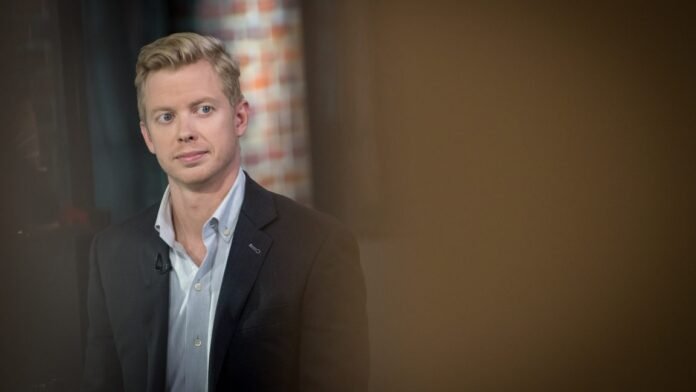

As Reddit stock falls, CEO questions value of Google’s AI Overviews

0
as-reddit-stock-falls,-ceo-questions-value-of-google’s-ai-overviews
As Reddit stock falls, CEO questions value of Google’s AI Overviews

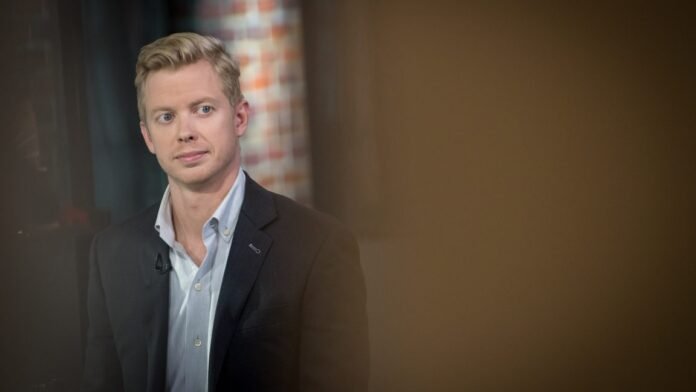
Like any company, Reddit reports quarterly earnings, and its CEO, Steve Huffman, addresses investors during those reports. It’s not always about just sharing numbers, though: This quarter, Huffman took the opportunity to voice concerns and criticisms about Google’s AI Overviews feature, which automatically summarizes search results on most user queries.

First, there was a letter to investors, wherein Huffman spun his narrative about Reddit’s value proposition and general strategic direction amid the proliferation of AI tools.

He wrote:

As the internet becomes flooded with synthetic content, people are craving real human perspective. We are the antidote to an automated web. AI compresses the internet into summaries. Reddit delivers the opposite: deep discussions, passionate debates, and lived experiences. People don’t want a summary of Reddit; they want Reddit.

The letter also said:

As AI makes information more abundant, the challenge is no longer finding content—it’s finding context, personal opinion, and first-hand accounts. Everything online feels flat, polished, generated, or sponsored, so consumers are overwhelmed and increasingly skeptical. We’ve never had more information, but we’ve never trusted it less.

And then, in comments around the earnings report, he added:

What we see is, 10 blue links has driven tremendous value and growth to the broader ecosystem… from where we sit, AI Overviews has yet to make a similar level of positive impact, and I think that’s consistent across the broader landscape, right? As businesses, publishers, retailers, we’re still looking for that win-win.

To add context to these statements, Reddit has long had a relatively lucrative ($60 million) licensing deal with Google, but Reddit is considering ending that deal, according to a Wall Street Journal report from earlier this month. The report also said that several prominent publishers are considering similarly cutting ties with Google, including The Economist, Reuters, Politico, and USA Today. (Reddit also has a deal with OpenAI.)

Last year, a study by Pew Research that looked at data from 900 US adults concluded that Google’s AI Overviews cut referrals to sites like those by almost half, compared to the “10 blue links” approach that Huffman referred to. It’s important to note, though, that Google has long diverged from just “10 blue links” in other ways even before AI Overviews entered the scene.

In light of the Pew Research study, Google told Ars, “This study uses a flawed methodology and skewed queryset that is not representative of Search traffic. We consistently direct billions of clicks to websites daily and have not observed significant drops in aggregate web traffic as is being suggested.”

A few days later, Google further countered in its own blog post, saying, “total organic click volume from Google Search to websites has been relatively stable year-over-year.” That contradicts what many publishers have been saying, though most publishers are of course wary of sharing too many proprietary numbers publicly.

Part of the problem is that both publishers and Reddit have historically depended on regular Google search traffic, but in most cases, the current status quo treats being surfaced as one of the so-called blue links and being part of AI Overviews as a package deal.

There have been several efforts to change that situation. Last year, we reported on Cloudflare’s attempt to update the default configuration for robots.txt in part to try to force Google to make changes. Google has also made changes to AI Overviews that it claims will lead to more prominent links out to other websites than before, but it still maintains that AI Overviews are here to stay and that they’re actually good for the user experience and the web in general.

The situation remains unresolved, and Reddit’s shares fell more than 20 percent after the earnings report, even though the company’s quarter trounced investors’ expectations on most of the basic financials. The reason? Search referrals were “choppy,” in Huffman’s words, and investors are thus concerned about the future of the site as AI tools continue to disrupt the traditional economics of the web.

Investors are concerned that Reddit can’t succeed without those Google referrals, and that concern can be extended to most other organizations in the business of producing content for the open web.

Advance Publications, which owns Ars Technica parent Condé Nast, is the largest shareholder in Reddit.

Podcast by Jasim Al-Azzawi with Richard Dalton: The Escalation Trap: How Long Can It Go On?

0
podcast-by-jasim-al-azzawi-with-richard-dalton:-the-escalation-trap:-how-long-can-it-go-on?
Podcast by Jasim Al-Azzawi with Richard Dalton: The Escalation Trap: How Long Can It Go On?

Middle East Monitor

Creating new perspectives since 2009

  • English Edition expand_more

    • English Edition
    • Portuguese Edition
  • Free Subscription

  • search

    Exact matches only

    Search in title

    Search in content

Middle East Monitor

  • Free Subscription

  • search

    Exact matches only

    Search in title

    Search in content

    • Loading…

  • Asia & Americas,
  • Iran,
  • Israel,
  • Middle East,
  • Podcast by Jasim Al-Azzawi,
  • US,
  • Videos & Photo Stories,

Podcast by Jasim Al-Azzawi with Sir Richard John Dalton, former British Ambassador to Iran

Podcast by Jasim Al-Azzawi with Sir Richard John Dalton, former British Ambassador to Iran

WATCH: Podcast by Jasim Al-Azzawi with former CIA analyst Ray McGovern & Larry Johnson 

0 Comments

Latest news

See all

  • Podcast by Jasim Al-Azzawi with Richard Dalton: The Escalation Trap: How Long Can It Go On?

    • Muhammad Hussein

  • The long shadow of 1973: Why “energy memory” is reshaping global diplomacy

    • Muhammad Hussein

  • Israeli airstrike destroys medical warehouses near hospital in central Gaza

    • Muhammad Hussein

  • US Embassy in Jordan urges citizens to consider leaving Middle East

    • Muhammad Hussein

  • Palestinian Resistance Literature Under Occupation: 1948 – 1968

    • Muhammad Hussein

  • Subscribe to our newsletter

Islam Race and Rebellion in the Americas: Transatlantic Echoes of the West African Jihads

Engaging the World: The Making of Hamas’s Foreign Policy

Related Posts

Trending

  • Today
  • This week
  • News Ceuta crisis sparks online speculation over Israel’s role in pressuring Spain
  • Article Malaysia’s Israel ban policy is not Washington’s to dictate
  • News Islamic Jihad says reported deal between Palestinian factions, Israel ‘inaccurate’
  • Article For the first time, money is not the issue
  • News UN chief urges Israel, Hamas to implement Trump-announced Gaza deal without delay
  • Article The Field Marshal’s expiring warranty
  • News Netanyahu flight to US again crosses ICC member states’ airspace
  • News Jordanian figures demand withdrawal of US forces and cancellation of military agreement
  • News Ceuta crisis sparks online speculation over Israel’s role in pressuring Spain
  • News US warplanes take off from Israel to attack Iran, Israeli defense minister says

Saudi Arabia Leads New Maritime Defense Coalition To Secure Red Sea Shipping 

0
saudi-arabia-leads-new-maritime-defense-coalition-to-secure-red-sea-shipping 
Saudi Arabia Leads New Maritime Defense Coalition To Secure Red Sea Shipping 


Saudi Arabia and 13 founding nations announced the creation of the Multinational Maritime Defense Coalition, a Saudi-led security initiative intended to protect commercial shipping, energy supply lines, and freedom of navigation in the Red Sea, Bab al-Mandeb Strait, and Gulf of Aden, following recent threats to maritime traffic. 

Representatives from 43 countries and the European Union attended an international meeting to discuss the proposed coalition. The Defense Ministry said Saudi Arabia will serve as the alliance’s founding and leading state while hosting its headquarters. 

The coalition’s founding members are Saudi Arabia, Kuwait, Bahrain, Qatar, Pakistan, Turkey, Egypt, Jordan, Yemen, Bangladesh, Nigeria, Sudan, Djibouti and Somalia. 

According to the ministry, the alliance is designed to strengthen maritime security, safeguard freedom of navigation, secure international trade routes and energy supply lines, and protect shared maritime interests in the Bab al-Mandeb Strait and the Gulf of Aden. 

This coalition will function as a defensive framework focused on protecting international shipping lanes, securing energy infrastructure and expanding cooperation on maritime security. 

Saudi officials said the coalition’s charter and operational framework are still being finalized. Additional countries will be able to join after completing their respective domestic procedures. 

The announcement comes as maritime security remains under pressure in the region. On July 20, Yemen’s Iran-backed Houthis declared a naval blockade against Saudi Arabia in the Red Sea and have since claimed a series of attacks targeting Saudi-linked shipping. 

Saudi Arabia has responded with airstrikes on what it described as Houthi military facilities in Yemen’s Hodeidah that it said were being used to threaten commercial shipping. 

The Saudi Defense Ministry said the coalition is intended to reinforce collective efforts to protect strategic maritime corridors linking the Indian Ocean and the Mediterranean while ensuring the continued movement of international commerce. 

This initiative is based on the principle of shared international responsibility for safeguarding maritime routes and deterring threats against commercial vessels operating in the region. 

The coalition is expected to be headquartered in Saudi Arabia, which will serve as its founding and leading member while coordinating with participating nations as additional countries complete the process of joining the organization. 


Reddit CEO on AI Overviews: “We’re still looking for that win-win”

0
reddit-ceo-on-ai-overviews:-“we’re-still-looking-for-that-win-win”
Reddit CEO on AI Overviews: “We’re still looking for that win-win”

Like any company, Reddit reports quarterly earnings, and its CEO, Steve Huffman, addresses investors during those reports. It’s not always about just sharing numbers, though: This quarter, Huffman took the opportunity to voice concerns and criticisms about Google’s AI Overviews feature, which automatically summarizes search results on most user queries.

First, there was a letter to investors, wherein Huffman spun his narrative about Reddit’s value proposition and general strategic direction amid the proliferation of AI tools.

He wrote:

As the internet becomes flooded with synthetic content, people are craving real human perspective. We are the antidote to an automated web. AI compresses the internet into summaries. Reddit delivers the opposite: deep discussions, passionate debates, and lived experiences. People don’t want a summary of Reddit; they want Reddit.

The letter also said:

As AI makes information more abundant, the challenge is no longer finding content—it’s finding context, personal opinion, and first-hand accounts. Everything online feels flat, polished, generated, or sponsored, so consumers are overwhelmed and increasingly skeptical. We’ve never had more information, but we’ve never trusted it less.

And then, in comments around the earnings report, he added:

What we see is, 10 blue links has driven tremendous value and growth to the broader ecosystem… from where we sit, AI Overviews has yet to make a similar level of positive impact, and I think that’s consistent across the broader landscape, right? As businesses, publishers, retailers, we’re still looking for that win-win.

To add context to these statements, Reddit has long had a relatively lucrative ($60 million) licensing deal with Google, but Reddit is considering ending that deal, according to a Wall Street Journal report from earlier this month. The report also said that several prominent publishers are considering similarly cutting ties with Google, including The Economist, Reuters, Politico, and USA Today. (Reddit also has a deal with OpenAI.)

Last year, a study by Pew Research that looked at data from 900 US adults concluded that Google’s AI Overviews cut referrals to sites like those by almost half, compared to the “10 blue links” approach that Huffman referred to. It’s important to note, though, that Google has long diverged from just “10 blue links” in other ways even before AI Overviews entered the scene.

In light of the Pew Research study, Google told Ars, “This study uses a flawed methodology and skewed queryset that is not representative of Search traffic. We consistently direct billions of clicks to websites daily and have not observed significant drops in aggregate web traffic as is being suggested.”

A few days later, Google further countered in its own blog post, saying, “total organic click volume from Google Search to websites has been relatively stable year-over-year.” That contradicts what many publishers have been saying, though most publishers are of course wary of sharing too many proprietary numbers publicly.

Part of the problem is that both publishers and Reddit have historically depended on regular Google search traffic, but in most cases, the current status quo treats being surfaced as one of the so-called blue links and being part of AI Overviews as a package deal.

There have been several efforts to change that situation. Last year, we reported on Cloudflare’s attempt to update the default configuration for robots.txt in part to try to force Google to make changes. Google has also made changes to AI Overviews that it claims will lead to more prominent links out to other websites than before, but it still maintains that AI Overviews are here to stay and that they’re actually good for the user experience and the web in general.

The situation remains unresolved, and Reddit’s shares fell more than 20 percent after the earnings report, even though the company’s quarter trounced investors’ expectations on most of the basic financials. The reason? Search referrals were “choppy,” in Huffman’s words, and investors are thus concerned about the future of the site as AI tools continue to disrupt the traditional economics of the web.

Investors are concerned that Reddit can’t succeed without those Google referrals, and that concern can be extended to most other organizations in the business of producing content for the open web.

Advance Publications, which owns Ars Technica parent Condé Nast, is the largest shareholder in Reddit.

Defcon’s new badge is a security key you can see inside

0
defcon’s-new-badge-is-a-security-key-you-can-see-inside
Defcon’s new badge is a security key you can see inside

It’s been a longtime feature of the annual Defcon hacker conference that attendees come away not only with knowledge of new software vulnerabilities and hacking techniques but also an elaborately designed conference badge—often electronic masterpieces embedded with intricate puzzles, complex crypto challenges, hidden Easter eggs, and even the mechanical gear trains of a watch.

Each year’s badge creator endeavors to top previous designs and blow the minds of hard-to-impress hackers. But this year’s badges take a different tack. Instead of the badge designs being the star, it’s what is inside the hardware that will really stand out.

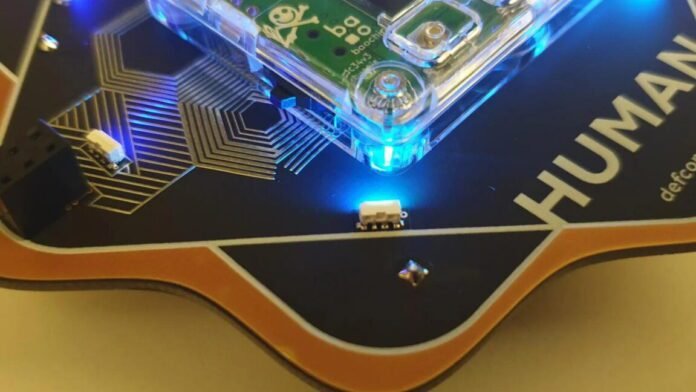
This year, Defcon asked legendary hardware hacker Andrew “bunnie” Huang to create the badges—revealed here for the first time—and they include an innovative open source chip that Huang designed and that aims to do no less than advance the state of security, transparency, and trustworthiness in computing.

But the chip isn’t just part of the badge. Its core module can be removed and used after the conference as a hardware security token, giving the badge a second life beyond Defcon.

The chip—called the Baochip-1x—is a “mostly” open source microcontroller that has been three years in the making and fulfills Huang’s years-long dream of making a chip whose security is verifiable. Huang has published the source code for the Baochip’s operating system, firmware, processor core, cryptographic engines, and input-output system, on GitHub, making these components available for inspection and use.

The chip is also packaged so that researchers can peer inside to check the silicon itself and compare what they see against the published design, rather than having to trust that the manufactured chip is what the designers intended.

Computer chips are traditionally black-box components with an opaque casing that obscures their circuitry. Even previous open source chips that made their specs and code available for users to examine were encased in impermeable plastic, creating a supply-chain problem. Users had to trust that nothing changed during the manufacturing stage of the chip, such as a backdoor component being added to it.

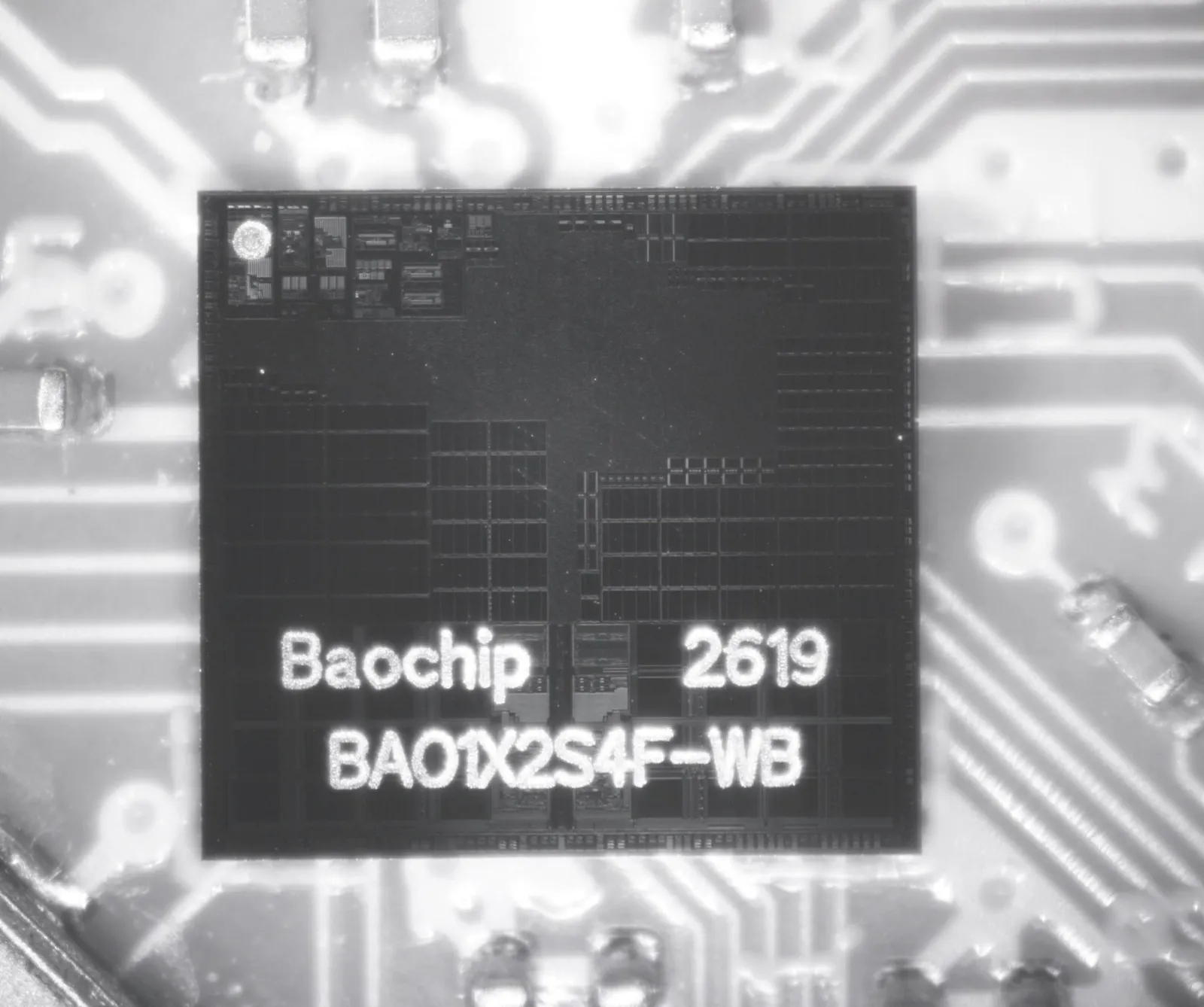
Unlike conventional chips encased in opaque plastic, the Baochip is packaged so that infrared light can be shone through the back of the silicon, allowing the chip’s internal structures to be visually inspected.

Infrared image of the Baochip-1x mounted on a circuit board.

Infrared image of the Baochip-1x mounted on a circuit board. Credit: Andrew “Bunnie” Huang

Huang plans to demonstrate the technique at the conference, allowing attendees to inspect the chip under an infrared light.

“I’ve been doing a bunch of stuff along the lines of trust and silicon and verification transparency” for years, Huang tells WIRED. “It’s all … this kind of story arc I’ve been on … to try and get a chip that we can trust down to the very core, down to the transistor … You can actually … see the RAM arrays … on the chip.”

Build-a-chip

Building a new chip is an expensive project that can cost millions of dollars for fabrication. But Huang got a big break three years ago when a company called Crossbar reached out to him. The company wanted to create a new open source and secure chip but didn’t know how to go about it. Huang agreed to assist on one condition: that they let him piggyback on their manufacturing run by placing his CPU on their chip wafer, allowing both designs to share the same manufacturing run rather than requiring Huang to fund a separate run.

“They look at it as, if they put me on the chip, they get two products for the price of one,” Huang says. This kind of piggybacking is not unusual, he adds, though it’s not something the industry likes to discuss publicly.

The result is a Crossbar chip that includes both Crossbar’s microprocessor and Huang’s. The Baochip is essentially the same chip but with the Crossbar microprocessor disabled, since Huang doesn’t have the rights to distribute it.

The Crossbar version of the chip uses a proprietary ARM core, whereas Huang’s version uses a RISC-V core whose implementation is open source. The RISC-V instruction set is also open and publicly documented. The two versions can use the same underlying infrastructure and peripherals while activating different CPU cores.

There are some closed-source elements on Huang’s chip. Some low-level physical-design and manufacturing elements, including those associated with TSMC’s 22-nanometer fabrication process, are proprietary. “But … if you look on the spectrum of how open you can get things, this is … very, very far beyond any [other] security-oriented chip,” Huang says.

Badge beginnings

Past Defcon badges have used commercial off-the-shelf chips rather than custom-designed open source silicon. The idea for using the Baochip was sparked by a meeting late last year when Huang spoke with Defcon founder Jeff Moss about his progress in developing his open source chip. He told Moss that he planned to release it this summer through his company, Baochip.

Moss realized the concept behind it matched perfectly with the conference theme this year—agency—which Defcon defines as the technologies we use and the choices we make that increase self-determination. And he and Huang realized it would be a great opportunity to help bootstrap the chip’s adoption. Until now, the Baochip has been distributed only in a small development release; the 27,000 Defcon badges represent its first major distribution.

Moss had one requirement for the badges. He wanted them to have a life beyond the conference and not be something that people would just throw in a drawer or a landfill after the event. He’s long been frustrated with the design and limitations of hardware security tokens and crypto wallets that, at the hardware level, can be cracked, so he thought Huang’s chip could be a more secure alternative to existing authentication tokens and wallets.

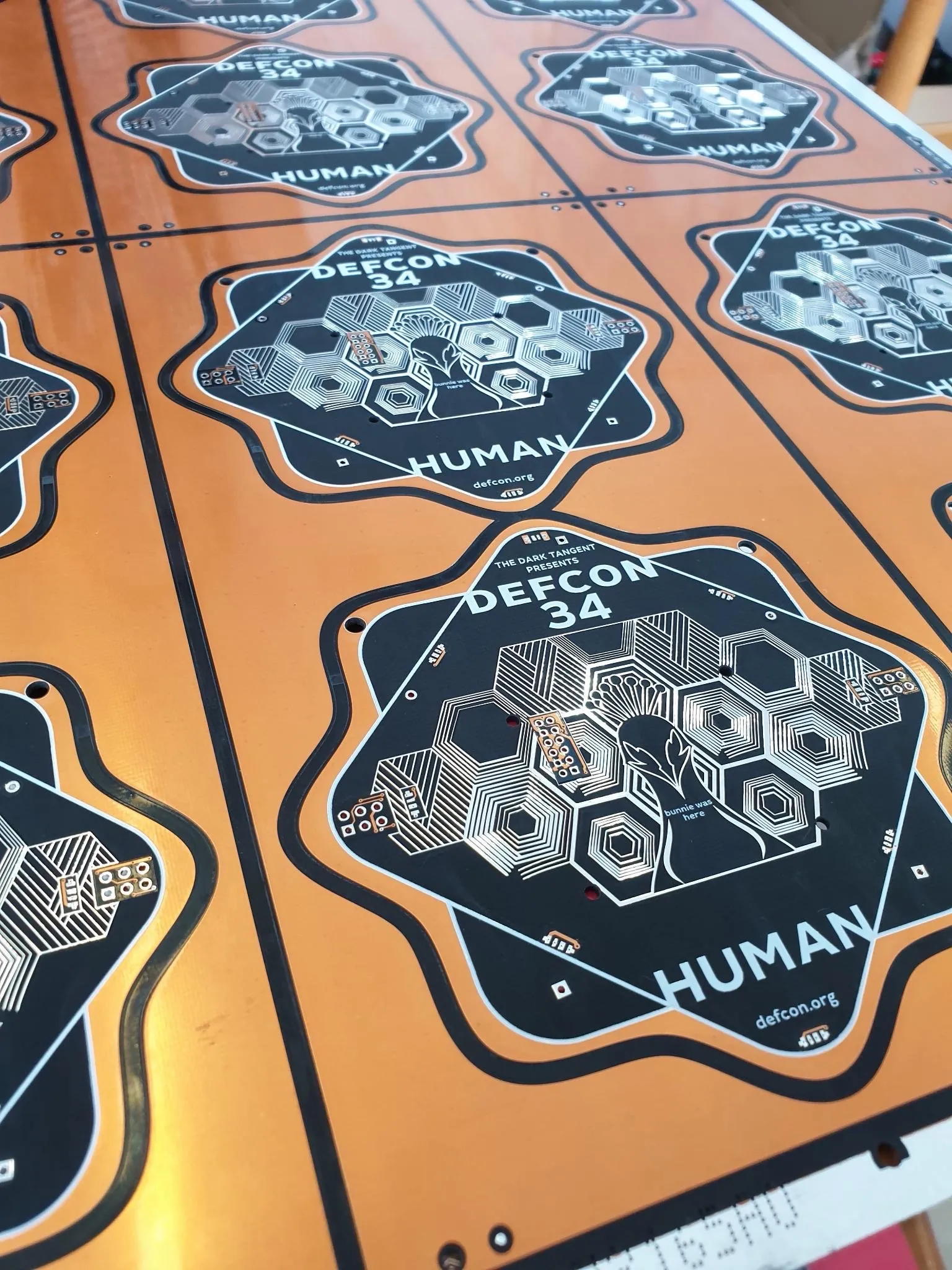
Badges are manufactured on panels nearly a meter on a side in the factory.

Badges are manufactured on panels nearly a meter on a side in the factory. Credit: Andrew “Bunnie” Huang

“I’ve always kind of dreamed of this idea where you can take your secrets, put them in hardware, and then if an attacker gets in, they can’t quite get your secrets,” Moss tells WIRED.

The badge’s detachable module can serve as a FIDO hardware security token. Its software supports time-based, one-time password systems and password management. Huang says it is “probably the world’s first open source security token that you can fully inspect all the way down to the bootloader [and] transistors.”

The removable module also includes a camera for scanning QR codes to register them to authentication systems. But in keeping with Defcon’s privacy practices and its ban on surreptitious photography at the conference, the camera is very low resolution and nearsighted, and the chip by default only utilizes the black and white data from the camera and doesn’t support photo storage.

“It’s … great at scanning QR codes and pretty much bad at everything else,” Huang says.

The badge doesn’t eschew conference life. Huang still included features designed to encourage attendees to interact. The badges, for example, have LED lights that flash in different color palettes and patterns depending on the type of badge—there are different ones for general attendees, speakers, and goons (the small army of volunteers who run the conference) as well as the special black Uber badges that go to contest winners and special VIPs, which give them free Defcon attendance for life. Each badge type starts with a specific color and flashing pattern, but users can add to their colors and build more complex flashing patterns when their badges communicate with other badges.

How secure is it?

The chip runs an operating system written in Rust and includes secure boot, a true random number generator, and hardware features intended to harden it against attacks. Huang believes it will be particularly resistant to remote, nonphysical attacks.

The chip also uses resistive RAM, or RRAM, a type of nonvolatile memory that Huang says is designed to make physical extraction of stored data more difficult than conventional flash memory. With flash memory, he says, “if you de-layer it down to the actual flash cells … you can just see the ones and zeros literally on these chips.”

Huang is cautious, however, about overhyping the chip’s security capabilities. He estimates that it could withstand attacks involving tens of thousands of dollars in resources, but says an adversary with millions of dollars and a sophisticated hardware-analysis lab could likely defeat it.

“I actually think it’s one of the most secure chips you can get out there, but I [also] think most chips have been oversold in terms of security,” he says.

Huang says he likes the fact that the chip will be stress-tested by Defcon attendees and knows they will likely hack them and expose flaws that will help him make them even more secure.

“I fully expect there will be zero-days [that people find in the code]. It’s actually … one of the features … of launching at Defcon,” he says of designing an open source chip capable of being examined.

Today the chip can function as a YubiKey-like security token; but in the future, he says, it could become an HSM or run other software such as Linux. The hardware uses a 350 MHz RISC-V processor with 2 megabytes of SRAM and 4 megabytes of RRAM, which he says puts it “on the edge of being able to run Linux,” and it has 4x 700MHz PicoRV32 cores for doing input-output. It already runs MicroPython and has C and Rust development kits.

Huang plans to expand the chip’s features himself, but he also expects DefCon participants to build on what he’s provided and make the chips their own.

This story originally appeared on wired.com.

Fake Priest Accused of Sham Weddings and Baptisms

0
fake-priest-accused-of-sham-weddings-and-baptisms
Fake Priest Accused of Sham Weddings and Baptisms


A man accused of posing as a Catholic priest has been unmasked after allegedly duping believers into fake weddings, baptisms, Masses and spiritual guidance along Mexico’s popular tourist coast.

The Diocese of La Paz in Baja California Sur issued a public warning this week about Gregorio Díaz Mora, saying he is not a priest, does not belong to the Catholic Church and has no authority to perform Catholic sacraments anywhere in the diocese.

“The Diocese of La Paz informs all the faithful and the general community that the person identified as Gregorio Díaz Mora is not a priest of the Catholic Church and does not belong to or exercise any ministry with authorization or recognition from this Diocese,” church officials said in a statement Tuesday.

According to the diocese, Díaz Mora has presented himself online as a “spiritual father” while using religious imagery and photos connected to the Sanctuary of Our Lady of Guadalupe in La Paz, a move church leaders warned could mislead Catholics into believing he was officially affiliated with the Church.

The diocese said the use of those images “can generate confusion among the faithful regarding their affiliation with the Catholic Church.”

Online, Díaz Mora appears in priestly vestments and posts videos that show him participating in Catholic-style rites, including what appear to be Masses and other ceremonies. He has promoted himself across several social media platforms, including Facebook, YouTube and TikTok, where one page reportedly has around 140,000 followers.

Church officials say he has also operated through pages that appear to resemble an official sanctuary presence while offering paid video-call consultations, spiritual services, “Catholic” weddings, baptisms and other rites.

But the diocese says none of it carries Catholic authority.

The warning has serious consequences for couples and families who may have paid Díaz Mora for ceremonies they believed were real. Under Catholic canon law, sacraments performed by someone who is not validly ordained are not recognized by the Church.

That means couples who thought they were married by Díaz Mora may need to have their marriages performed again by an actual priest if they want the Church to recognize the union. Families who believed their children were baptized may also need to contact a parish to determine what steps are required.

The Diocese of La Paz said the alert is the first official warning of its kind involving an alleged religious impostor in Baja California Sur.

Church leaders are now urging Catholics to verify anyone claiming to be a priest before handing over money, booking a ceremony or trusting them with major religious milestones.

The diocese said a simple call to a parish or diocesan office can confirm whether a priest is legitimate — and could save families from paying for fake ceremonies, invalid sacraments and the painful realization that one of the biggest days of their lives may never have counted in the eyes of the Church.

Google Earth risked ruin with retracted AI tool for making fake satellite pics

0
google-earth-risked-ruin-with-retracted-ai-tool-for-making-fake-satellite-pics
Google Earth risked ruin with retracted AI tool for making fake satellite pics

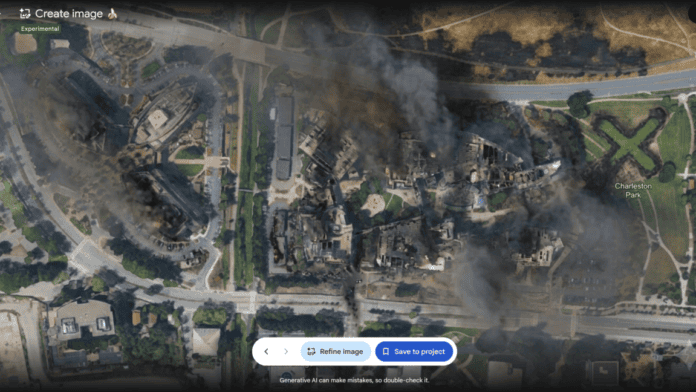
Google briefly allowed anyone to create AI-modified versions of satellite imagery available in Google Earth—before quickly reversing its decision as people shared examples of AI-generated pictures that illustrated the potential for misinformation and disinformation.

There is no shortage of generative AI tools that already allow people to create AI-modified images of real buildings and cities based on user prompts. But Google’s aborted attempt to incorporate its Nano Banana 2 AI image generator as a Google Earth feature made it even easier for anyone to create modified versions of authentic imagery depicting real locations—something that Google boasted about when initially promoting the new feature.

“For the first time, you can generate custom images using Google Earth’s satellite, aerial, and 3D imagery alongside Nano Banana, which creates concepts grounded in the real world,” wrote Bryan Horowitz, product manager for Google Earth, in a company blog post on July 30.

That possibility deeply alarmed researchers, who often use Google Earth to help verify images and videos of locations at a time when AI-generated misinformation and disinformation have become rampant online. They showed how the new feature could simplify the process of creating false scenarios overlaid on Google Earth’s photorealistic imagery.

“Google Earth, a tool often used as a source of satellite imagery to verify photos and videos, has added a feature that allows you to alter satellite imagery with AI, for reasons,” wrote Eliot Higgins, founder of the independent investigative organization Bellingcat, in a Bluesky post responding to the AI feature’s debut.

“No way this could be abused,” Higgins added sarcastically in a follow-up post that featured an AI-modified image made in Google Earth showing a giant golden statue of President Donald Trump looming over the White House.

Within a day, Google announced on the social media platform X that it was rolling back the feature. Shortly afterward, Ars checked and found that the feature was inaccessible to Google Earth users.

Before removing the AI feature, Google had touted its potential to allow Google Earth users to depict completed real estate projects or enable teachers and students to transform the modern-day ruins of Pompeii into a “hyper-realistic view” of what the town looked like in 78 CE under the Roman Empire. But independent researchers immediately gravitated toward the potential for misuse.

“Tonight I typed just one sentence into Google Earth and put refugees near the Mexican border,” wrote Henk van Ess, an independent investigator, in an extensive blog post detailing his concerns on July 30. “Then I planted a nuclear plant in Iran. Then I put a fatal crash on a street in Amsterdam. Google’s own satellite imagery underneath all three. What on earth is Google doing?”

Checking for misinformation

Ess pointed to a previous example of AI-generated misinformation gone viral that used a Google Earth satellite photo of the US Navy’s Fifth Fleet headquarters in Manama, Bahrain. A forger had prompted Google’s Gemini AI assistant to transform a screenshot of that Google Earth image into a false image depicting the aftermath of an Iranian drone strike on the US military base.

The same process that might have taken about six steps could be done “in seconds” with the AI tool built into Google Earth, Ess said.

Before eventually removing the Google Earth feature, Google initially responded to Ess by highlighting its SynthID system that automatically embeds digital watermarks in images generated by Google’s AI tools.

“We take misinformation seriously—every image created with Nano Banana in Google Earth includes the SynthID digital watermark, so if someone is unsure about an image, they can ask the Gemini app or use Lens in Search to see if the image was AI-generated,” according to Google’s post on X on July 30. “In addition, we prevent image creation on harmful topics and are continually updating our protections.”

Previous Ars testing of Google’s SynthID system has shown that Google’s digital watermark can persist despite substantial image edits and data loss. However, Ars also encountered the issue of SynthID limiting image checks to about 10 per day.

When Ars prompted Google’s Gemini app to run a SynthID check on several AI-modified images generated within Google Earth—before Google removed the Google Earth feature—Gemini responded that it had “detected digital watermarking indicating that part or all of this image was generated or edited using Google AI tools.”

But Ess questioned why Google’s policy on preventing the creation of AI-generated images on harmful topics had not stopped him from depicting scenes such as a hospital with a bomb crater in Gaza. He also expressed skepticism about primarily relying on Google’s SynthID watermarking system and Google’s AI tools for verifying whether an image is AI-generated.

“Fakes do not travel as clean files with their credentials intact,” Ess wrote. “They travel as screen recordings, re-encodes, screenshots of screenshots, filmed off somebody’s phone in a hurry.”

Indeed, Google’s SynthID was unable to provide any image verification when Ars used a smartphone camera to take a photo of an AI-altered image made using the Google Earth feature.

Undermining trust

By introducing an AI image generator as a Google Earth feature, Google risked undermining public trust in Google Earth as a reliable reference for providing authentic imagery of the real world, Ess said. It could have also handed an additional excuse to government officials or anyone who wants to deny genuine satellite photos by claiming they were modified or generated entirely by AI tools.

Giving anyone access to an easy tool to create AI-modified satellite imagery could have also made it even harder for journalists and researchers checking misinformation and disinformation. Ess recommended using multiple sources to verify satellite imagery and relying on constantly updated satellite imagery sources such as Europe’s Copernicus Sentinel-2.

Google may have alleviated immediate concerns by deciding to quickly remove the AI tool within Google Earth—but its statement suggested that the company could eventually bring the feature back in the future.

“We’ve seen geospatial professionals using this feature for a range of useful purposes, however we’ve also seen people sharing screenshots of generated imagery that appear to violate our policies,” according to the Google statement. “So we’re rolling back this feature in Google Earth while we work on implementing stronger guardrails.”

Morocco Border Breach Leaves 18 Dead as 49,000 Enter Spanish Enclave 

0
morocco-border-breach-leaves-18-dead-as-49,000-enter-spanish-enclave 
Morocco Border Breach Leaves 18 Dead as 49,000 Enter Spanish Enclave 


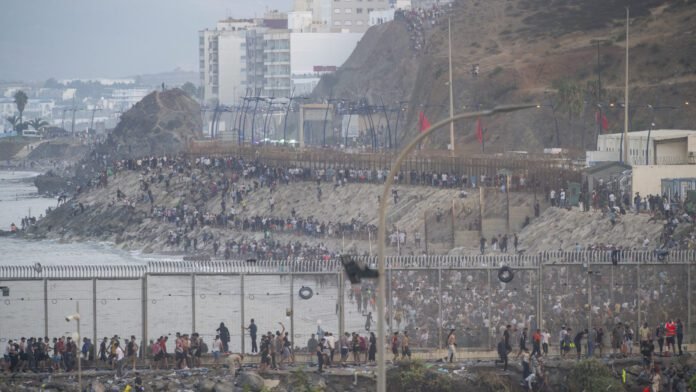
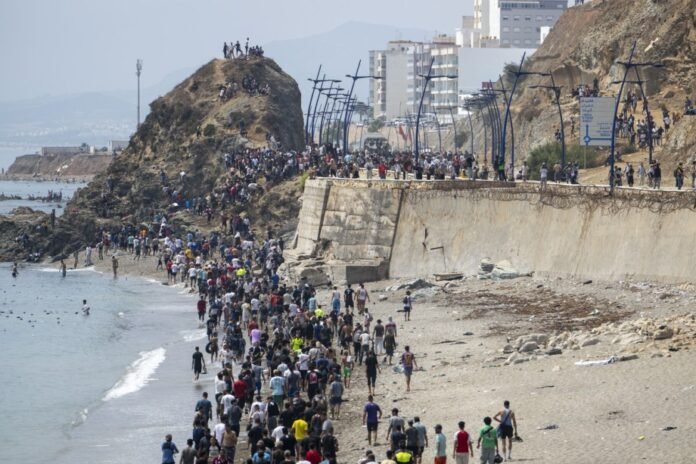
Spain deployed the military to its North African enclave of Ceuta after an estimated 49,000 migrants crossed from Morocco within 24 hours, leaving at least 18 people dead and touching off a diplomatic dispute within the European Union. 

The fatalities occurred at the Tarajal beach breakwater, where some migrants drowned and others were killed in a stampede. Local authorities said the sudden influx created a severe humanitarian situation, with migrants sleeping on pavements as officials worked to restore order. 

Spanish Prime Minister Pedro Sánchez is expected to visit Ceuta on Friday morning with Interior Minister Fernando Grande-Marlaska as the government responds to the crisis. 

Video from Thursday showed large groups of people, primarily Moroccans, making their way across the breakwaters and into Ceuta. Most appeared to be young men, although families, including women and small children, were also among those crossing. 

Late Thursday into Friday, an NBC photographer saw crowds gathered on the Moroccan side of the border attempting to enter the enclave. The photographer also observed people leaving Ceuta on foot and returning to Morocco. 

Spain’s state broadcaster RTVE aired footage of burned vehicles on the Moroccan side of the border following reported clashes. 

The mass crossing escalated political tensions in Europe after Italy threatened to suspend Spain from the Schengen Area over the breach, prompting a sharp diplomatic clash between the two countries. 

The Spanish army was deployed to help restore order as authorities dealt with the aftermath of the crossing. 

Moroccan authorities have not publicly commented on the incident, and Morocco’s Interior Ministry did not respond to requests for comment. 

Spain says over 48,300 migrants have returned to Morocco from Ceuta

0
spain-says-over-48,300-migrants-have-returned-to-morocco-from-ceuta
Spain says over 48,300 migrants have returned to Morocco from Ceuta

More than 48,300 of the approximately 50,000 migrants who entered the Spanish enclave of Ceuta since early Thursday have returned to Morocco by Friday afternoon, Spain’s Interior Ministry said, according to EFE news agency.

EFE reported that the figures, compiled as of 3.30 pm local time (1330GMT), followed an earlier ministry statement that returns from Ceuta to Morocco were taking place at a rate of about 150 people per minute.

Despite the large number of departures, thousands of migrants remained in different neighborhoods of Ceuta with no clear destination, according to the report.

READ: Ceuta crisis sparks online speculation over Israel’s role in pressuring Spain

EFE said hundreds of migrants were heading toward the border Friday afternoon to return to Morocco, citing a repatriation agreement between Spain and Morocco as well as the lack of open shops, supermarkets and restaurants in Ceuta to meet basic needs.

Spain’s Civil Guard and the Army’s Regulares Group No. 54 were deployed along Tarajal beach area to prevent further arrivals by sea.

According to EFE, security forces turned back a group of about 40 people who reached the shore by swimming, directing them to leave Ceuta and return to Morocco.

The news agency added that commercial activity in Ceuta remained at a standstill, with businesses closed amid security concerns following the mass arrivals.

According to Spanish authorities, at least 57 people have died in the migration crisis.

READ: Nearly 49,000 migrants from Morocco recently entered Spanish enclave Ceuta, estimates show

0FansLike
0FollowersFollow
0FollowersFollow
0SubscribersSubscribe
- Advertisement -
Google search engine

Recent Posts